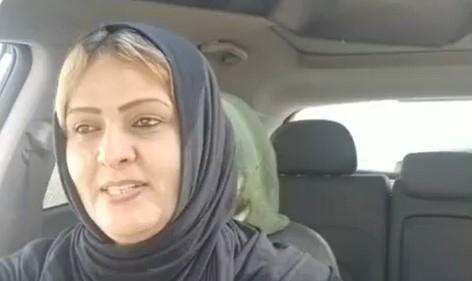
International media (here CNN) reported on 11 November 2020 on the killing of prominent Libyan lawyer and women’s rights activist Hanan al-Barassi, who was gunned down by armed men Tuesday in the eastern city of Benghazi. Her killing in Benghazi, which falls under the control of the Libyan National Army (LNA), came just a day after she shared comments on social media criticizing the son of renegade military general and LNA leader Khalifa Haftar. “The assassination of human rights defenders and opinion-holders and the silencing of voices is a heinous crime and a disgraceful form of tyranny and a desperate attempt to destroy hope for the establishment of a civil and democratic state,” Libya’s Interior Minister, Fathi Bashagha, tweeted Tuesday.
According to the United Nations Support Mission in Libya (UNSMIL), al-Barassi — whom the mission describes as a “vocal critic of corruption, abuse of power and human rights violations” — was shot “in broad daylight” by unidentified armed men. “Her tragic death illustrates the threats faced by Libyan women as they dare to speak out,” UNSMIL added. In videos posted publicly on her Facebook page, al-Barassi expressed criticism of figures loyal to the LNA. In a livestream shared on Monday, just a day before her killing, al-Barassi said she would not be silenced by threats. “I won’t surrender, only with bullets will I ever surrender — if I die, so be it. Only in death will I be silenced. Tomorrow I will have several surprises [to share], several surprises,” she told viewers. The LNA has not yet responded to a CNN request for comment on al-Barassi’s death.
Elham Saudi, the director of Lawyers for Justice in Libya, an organization which seeks to defend and promote human rights in the conflict-ridden country, called the attack an “appalling and painful reminder of the reality on the ground” for women in Libya. “With no accountability, violators will continue to get away with literal murder in broad daylight,” she added.Al-Barassi’s killing follows a series of attacks against those critical of forces aligned to the LNA.
“The killing of an outspoken lawyer in broad daylight in Benghazi will send chills through activists across the region,” said Hanan Salah, senior Libya researcher at Human Rights Watch. “This brutal killing smacks of a cold-blooded execution. The only way to end this cycle of violence is if authorities hold criminals to account for these terrible acts.”
On 10 November 2020 Scholars at Risk (SAR) announced that Dr. Rahile Dawut is the recipient of its Courage to Think Award for 2020. Dr. Dawut is being recognized for her own work, as well as that of all the scholars and students of the Xinjiang Uyghur Autonomous Region, who together struggle for academic freedom and freedom of opinion, expression, belief, association, and movement.
Dr. Dawut is an Associate Professor in the Human Science Institute of Xinjiang University and founder of the Minorities Folklore Research Center in Xinjiang University. In December 2017, Dr. Dawut told a relative of her plans to travel from Urumqi to Beijing. Shortly thereafter, her family and friends lost contact with her. Professor Dawut’s disappearance was made public in August 2018. It is suspected that she is held by state authorities at an undisclosed location.
“My mother is a scholar, not a criminal,” said Akeda Pulati. “She studies the folklore and cultural traditions of minority populations. That is not a threat to the government, other institutions, or the people of China.”
“The imprisonment of Dr. Dawut, an internationally recognized scholar of Uyghur culture, reveals the Chinese government’s blatant repression of voices and ideas it finds displeasing,” said Rob Quinn, executive director of SAR. “This constricts academic activity and public expression, threatening minority traditions, histories, and languages. The disappearance of Dr. Dawut, along with many thousands of others, is an atrocity we should all strive to end.”
‘In the face of proliferating environmental conflicts and persistent intimidation, harassment and detention of environmental human rights defenders, the Escazú Agreement offers hope to the countless individuals and communities in the region that suffer from pollution and the negative impacts of extractive industries,’ said the UN Special Rapporteur on toxics and human rights, Marcos Orellana.
The Escazú Agreement includes strong protections for indigenous peoples and environmental human rights defenders, at a time when they are subject to unprecedented levels of violence.
The experts expressed hope that the treaty could serve as a model for other regions to improve cooperation and mobilise efforts for better governance of natural resources and environmental protection through transparency, accountability and community engagement. By ensuring people’s rights to information, participation, and access to justice, the Agreement affirms a strong rights-based approach to environmental governance.
The experts also voiced concern over disinformation campaigns that have obfuscated public debate in certain countries of the region.
‘We urge those countries who have yet to ratify or adhere, to join regional efforts and demonstrate best practice for a more just and sustainable region,’ the experts said.
The Escazú Agreement will enter into force 90 days following the 11th ratification. The experts commended the 11 countries that ratified the agreement: Antigua and Barbuda, Argentina, Bolivia, Ecuador, Guyana, Nicaragua, Mexico, Panama, Saint Vincent and the Grenadines, Saint Kitts & Nevis, and Uruguay.
‘The remaining nations in the Latin America and Caribbean region should move quickly towards ratifying the Escazú Agreement in order to maximise the treaty’s effectiveness in protecting human rights in the face of today’s interconnected climate, biodiversity, and pollution crises,’ the experts said.
Bulatlat of 10 November 2020 reports that Neri Colmenares, one of the country’s most prominent public interest lawyers, has won the human rights award of the International Bar Association (IBA) for his “extensive contribution to human rights, and his continuing determination and advocacy, in the face of great adversity.”
Himself a victim of unrelenting red-baiting by military, police and government officials for his human rights advocacy and activism, Colmenares is a former three-term member of the Philippine House of Representatives and is currently the national chairperson of the National Union of People’s Lawyers (NUPL). He is also a leader of the Concerned Lawyers for Civil Liberties and adviser for advocacy of the Integrated Bar of the Philippines.
Colmenares’ human rights advocacy began when he became the Western Visayas regional chairperson of the Student Catholic Action of the Philippines during martial law in the 1970s. While campaigning for the return of student councils in schools ordered closed by then President Ferdinand Marcos, Colmenares was arrested and tortured by the military.
He spent four years in jail as one of martial law’s youngest political prisoners at 18. After his release from prison, Colmenares earned his BA Economics degree from San Beda University (SBU), his law degree from the University of the Philippines and his Master of Laws degree from the University of Melbourne in Australia on scholarship.
As a human rights lawyer, Colmenares has argued a number of cases before the Supreme Court and championed causes in the legislature in support of marginalized sectors, including the following:
* The Party List Election Case in 2000, which led to the High Court ordering that 20 per cent of the seats in Congress be reserved for the marginalized and underrepresented poorer .
* The Pork Barrel Case during the Gloria Macapagal-Arroyo administration that led the Supreme Court to declare the Congressional practice as unconstitutional.
* In 2017 Mr Colmenares, alongside fellow human rights lawyers, constitutionalists and several law students, established Manlaban sa EJK that campaigns against the continuing extra judicial killings under President Rodrigo Duterte.
* Colmenares is also acting as co-counsel in a complaint against President Duterte for crimes against humanity, filed to the International Criminal Court (ICC) by families of extrajudicial killing victims.
* Colmenares is a counsel-complainant in one of the 37 petitions questioning the constitutionality of the Anti-Terrorism Act of 2020
As a parliamentarian, Colmenares advocated for the democratic rights of those with disabilities and the elderly, such as special election precincts to assist them in voting, as well as introducing the Early Voting Law for media personnel who would be covering the election on the day.
He also authored the law mandating the Philippine government to issue early warning to citizens during disasters and calamities as well as an increase of benefits given to social security system pensioners, among many other pieces of legislation.
In 2005, Colmenares helped organize the Counsels for the Defense against Attacks on Lawyers, a group of lawyers and law students advocating against the unlawful killings and arrests of their colleagues under then President Arroyo.
Colmenares (second from left) denouncing extra-judicial killings. (Photo from Neri Colmenares’s Facebook account)
In bestowing him the award, IBA Human Rights Law Committee co-chairperson Federica D’Alessandra said Colmenares has drawn on every tool in the legal toolbox, from legislation, to litigation, to advocacy in order to advance human rights and the rule of law for the protection of the Filipino people.
“With this award the IBA recognizes [Colmenares’] incredible accomplishments, and celebrates his great resolve as he continues to fight for media freedom, and stand against extrajudicial killings, forced disappearances and unlawful detention in the Philippines,” D’Alessandra said.
“It could not have come at a better time than now that human rights lawyers and defenders in the Philippines are under attack especially in the form of vicious vilification commonly referred to as red-tagging,” the NUPL said.
Colmenares said the award is both an honor and an inspiration to human rights lawyers like them to continue their work with the people despite the threats and difficulties. He said awards from established international institutions like the IBA serves as a mantle of protection to threatened lawyers worldwide.
“Fifty (50) lawyers and judges have been killed in the Philippines since 2016 and this award will also provide a mantle of protection for human rights lawyers like me,” Colmenares said.
International Human Rights Day 2020 is coming up and here is an early save the date for the Humanists International.
Since 2012 Humanists International has published the Freedom of Thought Report to monitor the rights and treatment of humanists, atheists and non-religious people in every country in the world. This year, the thematic focus of the Report is COVID-19, and its impact on the non-religious people globally. In particular we have seen the establishment of restrictions on:
– Women’s rights – Media freedom, protest and access to information – Individuals at risk
Here is the list of the event speakers:- Andrew Copson President of Humanists International
– Dr Ahmed Shaheed UN Special Rapporteur on Freedom of Religion or Belief
– Emma Wadsworth-Jones Humanists International’s Casework & Campaigns Manager
– Mohamed Cheikh Ould Mkhaitir Mauritanian blogger and anti-slavery activist
– Debbie Goddard, Vice-President of American Atheists
– Rev. Fred Davie, Commissioner of The United States Commission on International Religious Freedom
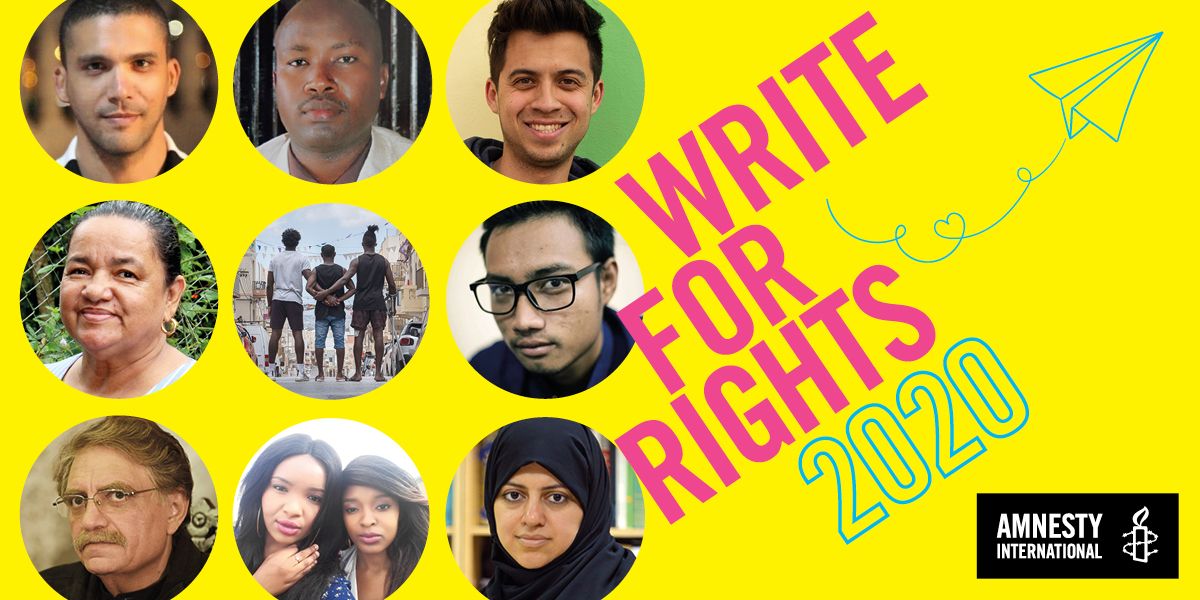
On 2 November 2020 Amnesty International has launched its flagship annual letter-writing campaign, Write for Rights, to help change the lives of people around the world who have been attacked, jailed, harassed or disappeared for standing up for their rights.
During Write for Rights – which takes place between November and December each year – people around the world will send millions of cards, emails and tweets of solidarity to individuals or groups of people whose freedoms are being denied, or write letters putting pressure on those in power to stop the abuses being committed against them.
This year, the campaign will support ten individuals who are suffering abuses, including:
Chilean Gustavo Gatica, a 22-year-old psychology student who was protesting against rising prices and inequality when he was struck in both eyes and blinded by police firing rubber and metal ammunition;
A group of Turkish university students known as the ‘METU Pride Defenders’, who are facing trail and a prison sentence for organising a peaceful sit in to protest the cancellation of their annual LGBTI+ pride march on campus.
Write for Rights goes back to the very roots of Amnesty International, which was founded in 1961, with Amnesty’s early campaigners writing letters of support to those affected by human rights abuses, as well as letters of concern to governments around the world.
He is currently a UN fellow at OHCHR, and the former recipient of the ISHR Human Rights Defenders Fellowship. He is involved in social work, advocacy, and is authoring in collaboration with other refugees offshore and inshore ( They Can’t Take The Sky):
I’m tired of hearing celebrities saying they are “voices of the voiceless.” Unfortunately, I hear it often from celebrities with our pictures and stories, rather than from refugees themselves.
The so-called “voiceless” are individuals living in poverty and conflict zones, and were forced to leave their countries while they were muffled, hushed, pushed down and left out. But they are not voiceless. They do not need your voices but they do need you to put them behind the microphone, make room at the table, and give them a chance to speak up. If we want to find lasting and sustainable solutions for the refugee and migrant crisis, then stop speaking for the so-called voiceless, and start working alongside them to make sure their powerful voices are heard.
Media, the arts and celebrities often say they strive to “give voice to the voiceless”. While this can empower, it can also be a potentially harmful tool for them too. It makes me feel like an object, it discourages me from speaking for myself and most importantly, it is dehumanising because someone else is speaking on my behalf. Being a refugee means more than being an alien, no right, no voice; this can sound trite, clichéd, even patronising. Speaking on our behalf can take the real voices of the concerned people away and replace them with a slogan, “Voice of the Voiceless”. Are they really voiceless? If so, then who took their voices?
What refugees urgently need, besides food and water, medical care, and a roof over their heads, is hope! And prospects of a homeland, friends, and a sense of security. Unfortunately, reality presents a completely different picture to many of them. Here is a call for reflection.
Protests and public ceremonies at least remind us of the problem, even if they do not solve them. Anyone who has never been part of a refugee trek has little idea of everything that happens along the way. These people have just turned their backs on violence, persecution, and human rights violations only to walk into hopelessness, hunger, and cold! It is a vicious cycle of evil that has been set in motion. People with a permanent home and a roof over their heads can barely imagine this. There are millions of fates and stories that tell of violence, human abysses, but some also of hope and courage.
Why is it easy to listen to someone who speaks out on behalf of victims but not to the victims directly? Is it also time to question this invisibility? The fact is that no-one is listening and no-one is offering them a platform to express their concerns on their own, so it doubles their suffering. We hide them in detention centres or camps, away from us, making it harder for them to connect with reality. But it also prevents the truth from coming out as it is, and that’s part of the complexity. The majority of these refugees are coming from countries that are torn apart by wars, extreme poverty, lack of freedom of speech, human rights abuses etc.
The media are not interested in listening to the people concerned. Instead they listen to the rich and famous, and this makes them complicit. It is on journalists and the media’s shoulders to seek out the stories of those who would be left out of the public record, like refugees, asylum seekers and migrants. If we aim “to give voice to the voiceless,” it requires more than asking for sound-bite quotes, taking pictures in refugee camps or using them to sell newspapers. No, it is bigger than that, it means listening to their stories, offering them a safe platform to speak for themselves rather than to speak on their behalf, no-one was born without a voice.
No media so far asks the refugees about the impact of the US election or the EU migration policy, why? Because we don’t have a voice and our point of view is not considered as valuable. The Trump administration, but also the Democratic party, have largely dismantled the US asylum seekers and refugees resettlement programme. It became a model for the EU member States and Australia, and even questioned the refugees convention of 1951.
The actions of the US government over the last four years shaped the dichotomy of “Us-vs-Them”. It has also created social and economical inequality among the refugee communities: some were seen as vulnerable and others not, and this in turn has increased tensions within refugee communities. As an example, in 2017 when the US government made a deal with the Australians to take refugees from offshore detention centres on Manus Island and Nauru several countries were banned and it created big tensions between the refugees. These actions show a lack of compassion for the victims of armed violence and persecution and abdicates US leadership and support for countries struggling to cope with refugee crises. The Trump administration turned a cold shoulder to countries on the frontlines of conflict, many of which are close US allies and bear the burden of caring for and protecting the overwhelming majority of the world’s refugees. Even at its most robust, US refugee resettlement only directly benefits a small fraction of the world’s 26 million refugees. But when used strategically, and in combination with humanitarian assistance and technical support, it can have enormous benefits beyond helping the relatively few people rescued.
The US refugee resettlement program has traditionally aimed to identify the most vulnerable refugees, often those who are not only persecuted in their home country but also unwelcome in the country of first arrival, such as members of religious minorities or LGBT. The American refugee policies have inspired many countries such as Australia, Europe, the UK, and especially after the domination of the right-wing in Europe. In Australia, refugees are forcibly sent to remote islands and detained for almost seven years, in Europe especially Greece became the EU warehouse for asylum seekers and migrants, and some were forcibly pushed back by some EU member States to Libya or left to drown off the coast of Libya.
Europe’s humanity is lost at sea when it comes to refugees and no-one knows when or how will the EU get it back.
Jackie Abramian, contributor of ForbesWomen of 5 November 2020, gives a voice to Chilean-American poet, novelist, and human rights activist Marjorie Agosin. The piece is too rich to summarize, so here it is in full:
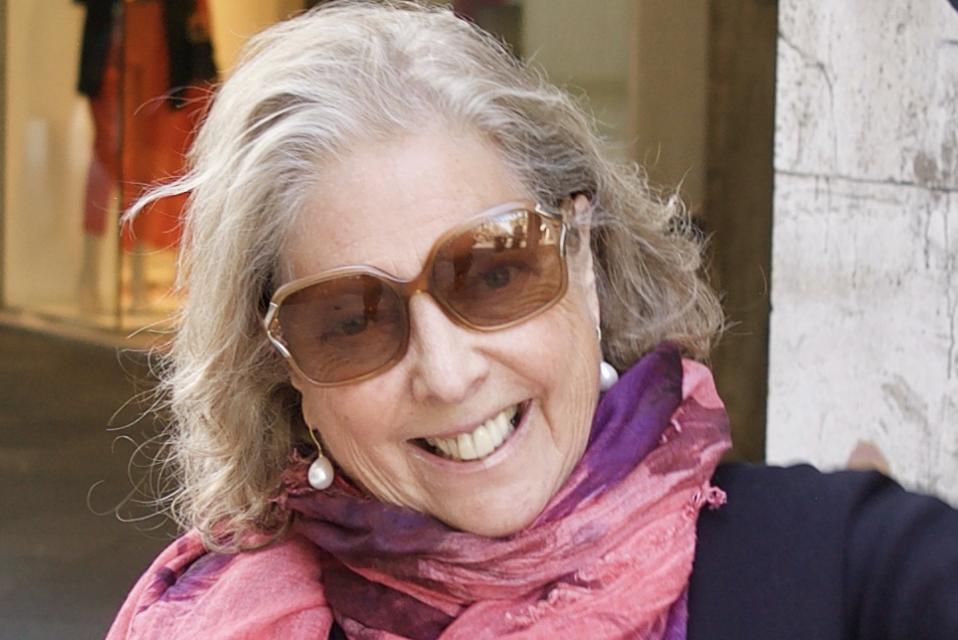
Chilean American Poet, Marjorie Agosin. John Wiggins
Like a beam of light piercing through the darkest tunnels of human destitute, Chilean-American poet, novelist, and human rights activist, Marjorie Agosin unveils the misery of the marginalized, weaving Latin America’s brutal history with her own Jewish traditions of survival and endurance. Memory and remembrance surface and resurface as a constant in Agosin’s writing. She flirts with her ancestral ghosts to unveil universal pain, desperation of loss and exile, and a yearning to belong.
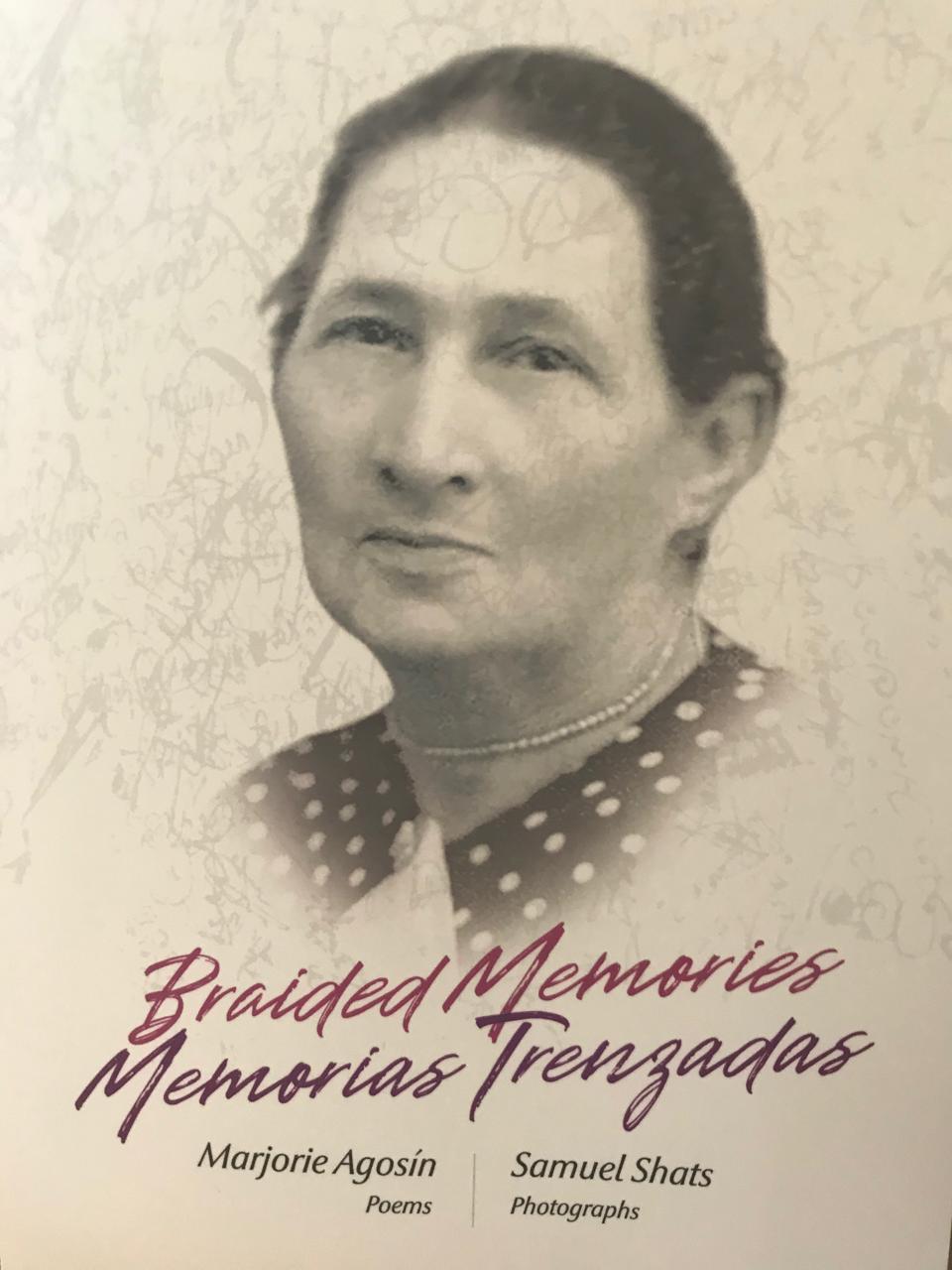
In Braided Memories (Solis Press, 2020), Marjorie Agosin awakens her great-grandmother, Helena … [+] Marjorie Agosin
Her most recent poetry collection, Braided Memories (Solis Press, 2020), with photographer Samuel Shats, awakens her great-grandmother, Helena Broder’s memory, and escape from Vienna for Chile after the 1938 “Night of Broken Glass.” Agosin journeys to Prague and Vienna to shed light on her ancestors–finding their Stolperstein–stumbling stones of brass plate inscriptions of Holocaust victims’ name and life dates, set before their homes. Her great grand cousins’ spirits fly over Vienna “like a Chagall dream.” In Helena’s imprisoned “silent gaze” she imagines her train ride from Vienna with strangers “familiar in the knowledge of certain escape.” We learn how Helena taught Agosin to “leave glasses of wine before the vacant places” of the dead, how she “acquired the blessing of forgetfulness” and left to “roam on the other side of imaginary spaces.” Agosin, grateful for the remembering gift, becomes Helena’s “tranquil memory.
“The hand that writes knows before the actual writing foreshadows. I hear a voice, a spirit that comes to me—call it intuition or God. You either suppress it or follow it for the magic of discovery,” speaking in her gentle Chilean accent, Agosin is alone with her creative thoughts in spaces that make poetry happen. “Poetry is the soul of life, the language of sentiments. Poetry is not in a hurry—the world is in a hurry and that’s why we fail to see the most important problems of our civilization.”
As a human rights activist, Agosin’s 84 works of poetry, fiction, and literary criticisms have earned her the Pura Belpré Award, Letras de Oro Prize, Latino Literature Prize, Jeannette Rankin Award in Human Rights, U.N. Leadership Award for Human Rights, the Gabriela Mistral Medal for Lifetime Achievement from the Chilean government, and the Fritz Redlich Human Rights Award by the Harvard Program on Refuge and Trauma. She holds a BA from the University of Georgia, an MA and a Ph.D. from Indiana University–and has been a Professor in Latin American studies and Spanish at Wellesley College for over 30 years.
Born in the U.S., Agosin spent her childhood in Chile before the rumbles of a U.S.-backed coup sent her family fleeing the país de poetas (land of poets) to settle in the U.S. The coup overthrew the democratically elected socialist leader, Salvador Allende and on September 11, 1973 brought Augusto Pinochet to power. During the 17-year rule, Pinochet imprisoned, tortured and killed some 130,000 Chileans–and thousands “disappeared.”
Tapestries of Hope, Threads of Love (U. of New Mexico Press, 1996) is Agosin’s landmark work with a … [+] Marjorie Agosin
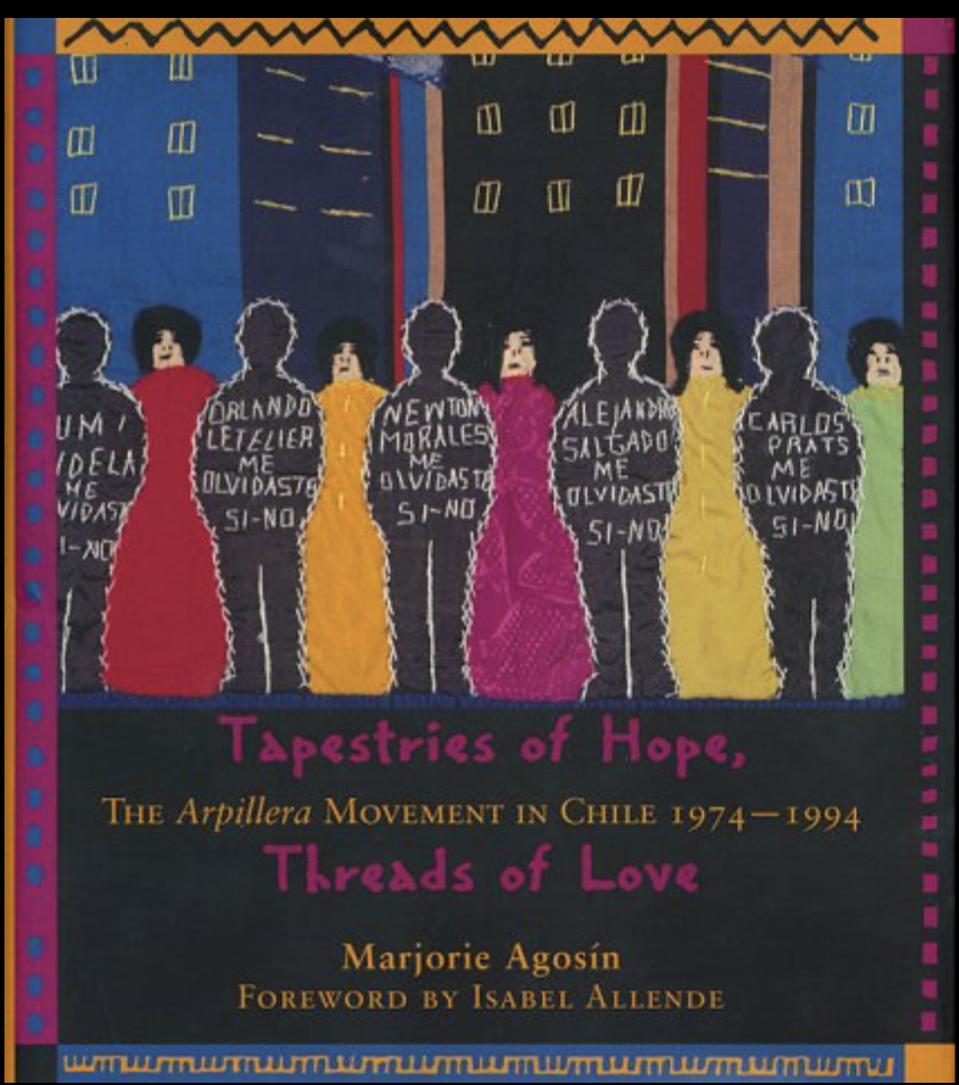
Tapestries of Hope, Threads of Love (U. of New Mexico Press, 1996) is Agosin’s landmark work with a foreword by Isabel Allende. It spans 30-years of interviews with members of Latin America’s most influential women’s resistance the Arpilleras (burlapin Spanish) movement. The tapestries of embroidered cloth scraps made by impoverished women memorialize the “disappeared” loved ones under Pinochet’s rule. Agosin worked with the initial group of 12 women and brought their stories to the world. They were part of the anti-Pinochet art workshops, funded by Vicarâia de Solidaridad human rights organization of the Chilean Catholic Church. The embroideries, smuggled and sold abroad, provided income for the destitute women. {see also: https://humanrightsdefenders.blog/2020/02/22/arpilleras-making-a-come-back-as-blankets-that-protect/]
“As a woman and a mother, this is the most important work I’ve done–it changed my life,” Agosin was 24 when she first saw an Arpillera shown by the Chilean National Literature Prize-winning writer, Antonio Skármeta–whose book Ardiente paciencia inspired Academy Award-winning movie on Neruda, “IL Postino”.
Arpillera, means burlap in Spanish, a patchwork picture made by the women, became popular in Chile … [+] Marjorie Agosin
Like poetry, women’s distinct resistance movement reaches the core of what it means to be human, Agosin believes. The tapestries reveal an innate grief, immortalize memory, unfulfilled yearning to reunite with loved ones, and the trauma of lifelong scars.
In her most favorite poem The Most Unbelievable Part, Agosin explores how power corrupts and turns ordinary people into torturers. How in 1973 Pinochet designated La Esmeralda, the 1400 feet-long Chilean navy training vessel, into a detention and torture center for the “disappeared.”..
“Poetry is the intimacy of memory–it transcends history. The poem wrote the story of the tortures on La Esmeralda, not the other way around,” explains Agosin. “Torture is a metaphor for how power works—how a woman of privilege treats her maid.”
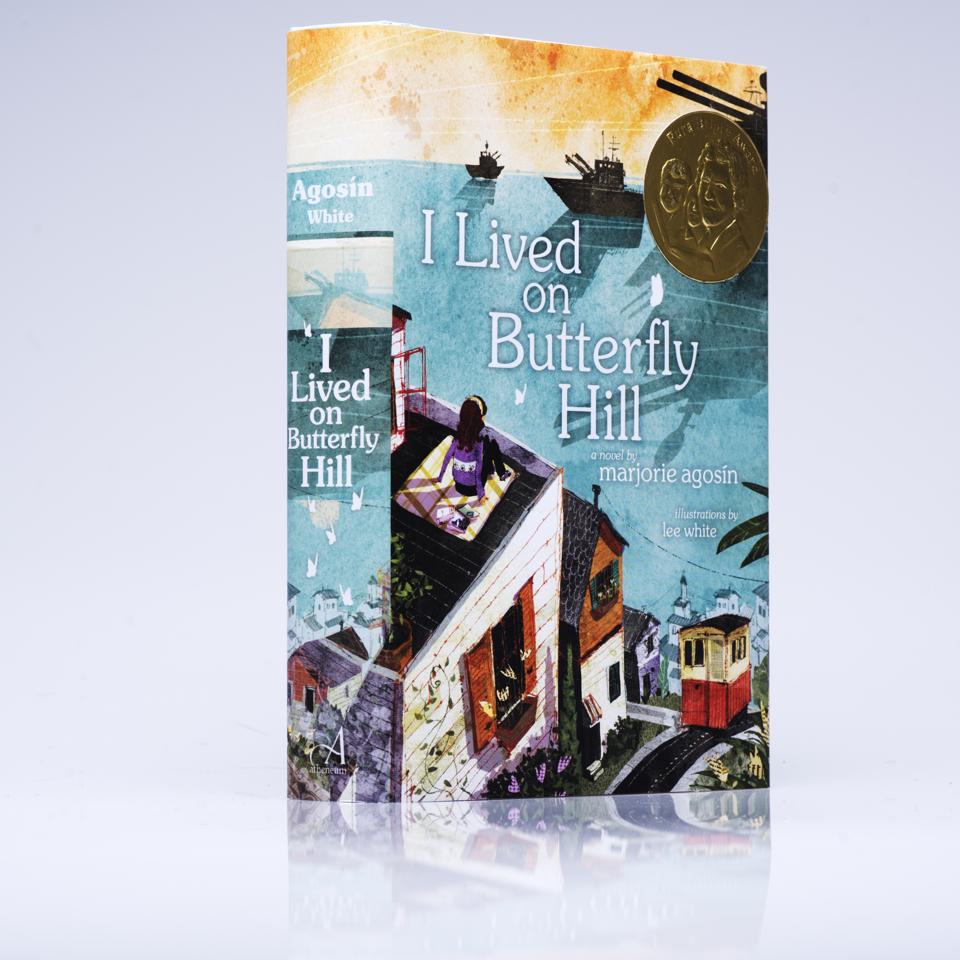
Considering Chile her home that gave her “a beautiful language” (she still writes in Spanish), and refuge to her family when they came on ships from war-torn Europe, Agosin’s exilic yearning of the familiar stranger expresses the constant pangs of un-belonging. In her Pura Belpré Award–winning young adult novel, I Lived on Butterfly Hill (Atheneum Books 2014)
WASHINGTON DC – JUNE 01: I Lived on Butterfly Hill by author Marjorie Agosin is one of the Kids … [+] The Washington Post via Getty Images
and its sequel, The Maps of Memory: Return to Butterfly Hill (Atheneum Books2020), Agosin recreates her happy childhood in Chile through the 11-year-old Celeste Marconi’s life. Her peaceful life, extended family, deep ties with the sea and the pelicans of the hill-town of Valparaiso unravel with the political shift to dictatorship. Celeste goes into exile to Maine and returns years later to find her country scarred by the brutality of dictatorship, and is determined to find her displaced classmates, re-build and heal her town and country. Like Celeste, Agosin is not totally at home in Chile.
“I’m home in books, poems, writings, friendships, history, travels–in places where Jews lived, and among trees and nature–human beings are not exiled from the beauty of the world,” Agosin immerses herself in her seacoast Maine home–which reminds her of Chile– surrounded by her garden dotted with quaint alcoves that invite the visitor to stop, rest, and embrace nature. “I’m at home in sacred places, from mosques to churches to synagogues.”
In A Cross and a Star: Memoirs of a Jewish Girl in Chile (Feminist Press, 1997)and Always from Somewhere Else: A Memoir of My Chilean Jewish Father (Feminist Press, 2000)–Agosin meets her parents at history’s crossroads. Her father, as an infant with chickenpox, was hidden, crossed the ocean and was named Moisés. He became a medical doctor in Chile and later emigrated to the U.S., becoming a foreigner once again. Her blond, blue-eyed mother could only attend an impoverished rural school–not a Catholic school because she wasn’t baptized, nor the German school run by the Nazis.
“My mother’s story explains what’s it like to be a minority in south of Chile when the Nazi’s arrived–how Chile denied and marginalized its minorities and its indigenous people,” Agosin wonders why vast majority of Chile’s Jewish community stood in silence against Pinochet’s atrocities as she explores human rights abuses from Latin America to the unfair partition of Israel which offered a refuge for the Jewish people displaced by the Holocaust–and in process displaced the Palestinians.
“Unfortunately Israel continues to suppress the Palestinian people that deserve the right of self-determination. To continue with the occupation of their lands violates the spirit of Israel as a vibrant democracy. Only a two state solution will allow Israelis and Palestinians to live in peace and with the dignity each one deserves,” Agosin states.
Agosin is inspired by her “amazing group of politically engaged” students at Wellesley College whose worldview, commitment to academic learning, open expression, and internships across the world to engage with the vulnerable reflects in their “gratitude for the possibility of learning as they face economic and emotional challenges amidst a pandemic.” Her immense empathy and loyalty to amplify all injustices reveals an undeniable allegiance to the spiritual and universal values of preserving memory.
“Memory is the active cause. Memory will not remember itself, like the Stolperstein tiles. Memory is a process, a constant commitment; without it we won’t remember the future. Memory is the future of the past,” Agosin confirms.
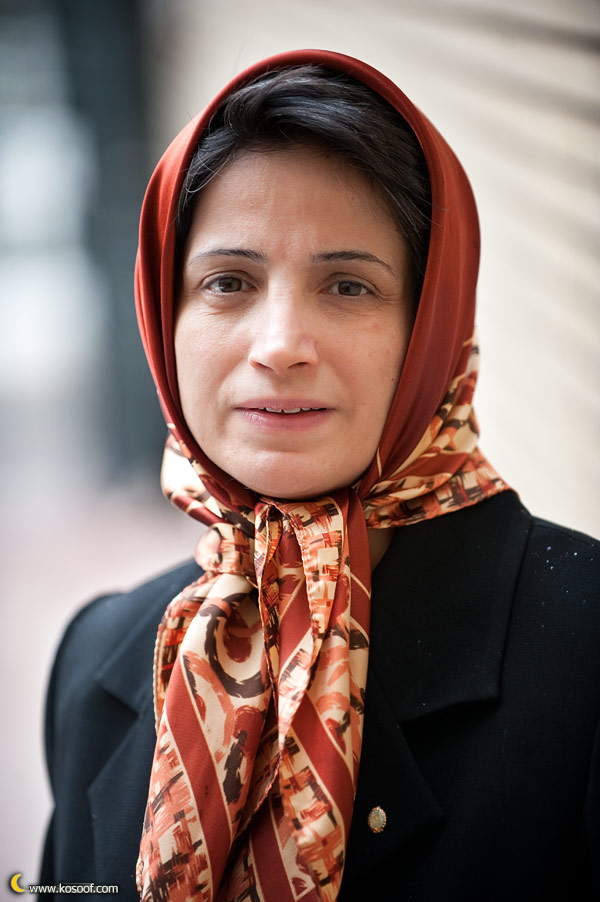
Many media outlets (here the Guardian) reported on Saturday 7 November 2020 that Iran has temporarily released Nasrin Sotoudeh, a prominent human rights lawyer who was jailed two years ago on spying and propaganda charges. Sotoudeh’s release followed warnings last month by human rights groups that her health had severely deteriorated after she staged a six-week hunger strike to demand the release of political prisoners and rights activists.
“Nasrin Sotoudeh … went on furlough with the agreement of the assistant superintendent of the women’s prison,” the judiciary’s Mizan news agency said, without giving further details.
Sotoudeh, 57, who has represented opposition activists including women prosecuted for removing their headscarf, was arrested in 2018 and charged with spying, spreading propaganda and insulting Iran’s supreme leader.
Sotoudeh has been recognised widely with seven major human rights awards.
This international advocacy campaign highlights days like the International Day for the Elimination of Gender-Based Violence (November 25); the International Day of Women Human Rights Defenders (November 29); the National Day of Remembrance and Action on Violence against Women (December 6); and International Human Rights Day (December 10).
As the world retreated inside homes due to the lockdown measures introduced to curb the COVID-19 pandemic, reports showed an alarming increase in the already existing pandemic of violence against women.
You can make a difference during the ongoing COVID-19 pandemic and protracted state of crisis it has generated across the world. You can support women and girl survivors of violence to stay safe and free of violence. Take action during this year’s 16 Days of Activism to End Gender-Based Violence. For more information about “Orange the World: Fund, Respond, Prevent, Collect!” and action ideas, see this year’s concept note.
This year, organizations are joining forces to gather positive words and messages of strength, hope and resiliency. Until 18 November, organizers are asking their partners, clients and the general public to submit positive written messages. These words will be used to design a piece of artwork, which will be unveiled on 10 December on social media.




.jpg?h=171&w=400&la=en&vs=121&hash=FE774AAA699F2D337C07BEC184919553D64ABD40)
 Hans Thoolen on Human Rights Defenders and their awards