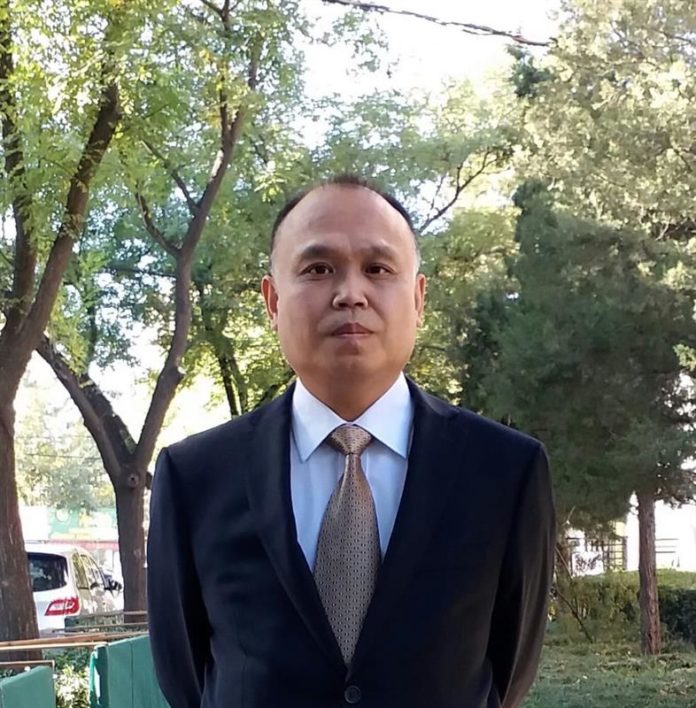
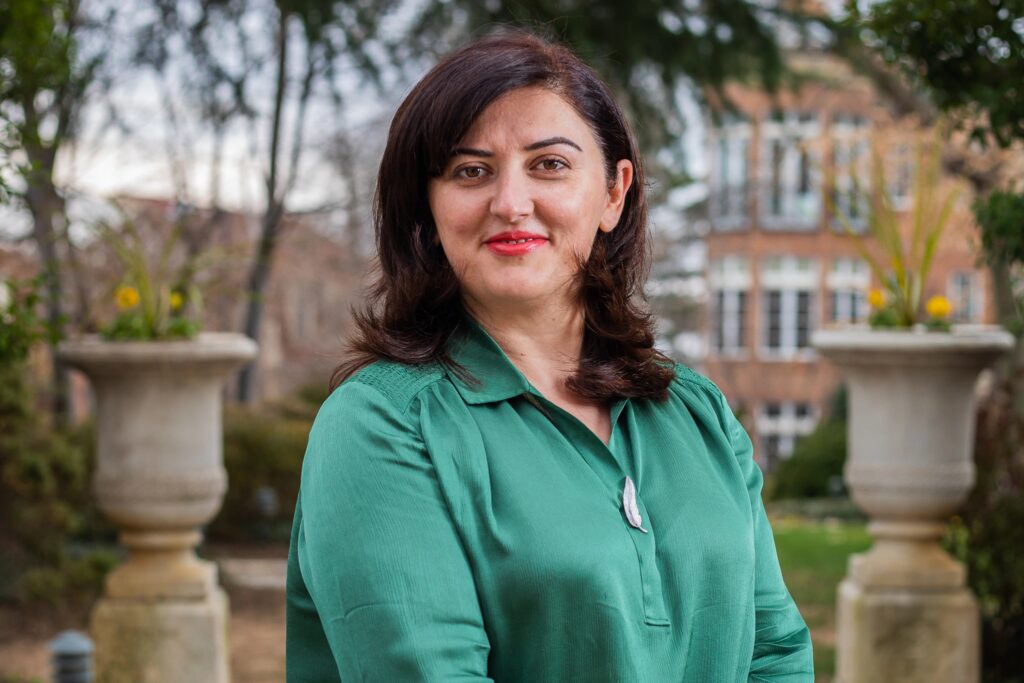
Yu was just another corporate lawyer in a fast-rising Chinese economy. But when he decided to take on human rights cases and ask for constitutional reform in his country, he drew the ire of one of the most powerful regimes in the world. Yu has been detained, harassed, and convicted in secret. While in custody, he has been tortured and denied medical care and family visits. His wife, Xu Yan, who Yu has not seen in person for 3 years, herself has become an icon. She has taken up the mantel of human rights defense and is currently studying law. Yu’s fight for due process has completely upended his life. [https://humanrightsdefenders.blog/2021/01/21/mea-nominee-yu-wensheng-in-poor-health-after-years-in-prison/]
With cartoons by Patrick Chappatte, music by Gaspard Sommer and choreography by the Ballet Junior of Genève. An evening hosted by the journalist Catherine Sommer – in French and English – and broadcast on https://www.martinennalsaward.org/
On 4 February 2021 the Business and Human Rights Resource Centre published an opinion piece by Mary Lawlor, the UN Special Rapporteur on Human rights Defenders:
Human rights defenders (HRDs) all over the world face continuous harassment, threats and intimidation, with some even getting killed in response to their work protecting and defending human rights. Since the start of the COVID-19 pandemic, attacks against HRDs have continued with many facing greater risks as some governments misuse the situation to further curtail civil rights, deny participation in public decision-making, and deploy state forces to repress legitimate, peaceful protests and obstruct access to justice.
Many of these attacks are related to business activities. In 2019, the United Nations High Commissioner for Human Rights (OHCHR) documented the killing of 357 HRDs, half of whom worked on land rights, protection of the environment, minority rights and indigenous people rights. These violations are often carried out in the context of extractive industries, energy production, agro-industrial development and other business activities. When human rights are under threat from business activities, HRDs stand up and put themselves at risk to protect these rights and their communities. For an overview of all such HRDs, see: https://www.trueheroesfilms.org/thedigest
A landmark example is that of HRD Mungunkhun Dulmaa in Mongolia. In 2017, the Mongolian Government entered into a mining agreement with Steppe Gold, a Canadian gold mining company. The local community complained about the environmental impact of the agreement, the associated gold mine, and allocation of land to step-mines – lands which had been used by the community for generations. In 2018, members of the affected community staged a protest and were attacked by private security guards, hired by the company. When Ms. Dulmaa tried to video-record the assault as evidence she was detained, beaten and sexually harassed, and the video was deleted from her phone. A year later, when she attempted to report the incident to local police, Ms. Dulmaa received death threats via text, warning her to stop her work. Here, the lack of engagement by companies with potentially affected communities is blatant. In 2020, my predecessor and the UN Working Group on business and human rights sent a communication regarding Ms. Dulmaa’s case to both the Mongolian Government and the company, but neither responded. This signals a real lack of accountability. If we really want to ‘build back better’ and achieve a just recovery,human rights and HRDs need to become a priority for both states and business.
Five steps companies should take to address risks to HRDs in the context of just recovery:
Implement the UN Guiding Principles on Business and Human Rights (UNGPs) through adequate engagement with rightsholders. A recent report from Trinity College, Dublin on 50 large companies and 10 states showed that companies either don’t know or don’t care about the UNGPs. A key part of the implementation of UNGPs is engagement with potentially affected rightsholders and their representatives, including independent trade unions and other civil society organisations. So far, this is not happening: for example, in the Know the Chain benchmark, all companies scored zero on their efforts to support freedom of association. This must change if we want to ‘build back better’: from the earliest possible stage of each project and throughout their supply chains, companies need to engage with potentially affected communities, workers and HRDs representing and supporting them. This needs to include critical voices and companies must give due consideration to the possible objections of HRDs, even if these may render their work and projects more costly, less profitable or even less viable.
Free, prior and informed consent (FPIC) from affected communities, especially indigenous ones, is non-negotiable. It is an essential part of the effective due diligence called for in the UNGPs and a platform to prevent conflict. HRDs, typically leaders in their communities, can help business develop the kind of precise, contextualised understanding of local situations they need if they intend to prevent and address the potential threats to human rights arising from their activities. In assessing risk, both companies and investors, and the social auditors they hire to help them do so, should give adequate weight to independent civil society and community-level information and evidence. This is fundamental when considering actions for just recovery.
This engagement with HRDs and rightsholders must continue for the duration of any business project, because opinions can change over time. Therefore, companies need to constantly keep their door open to HRDs and their input.
Companies should create publicHRDs policies and processes. Business needs to commit to the recognition of communities, HRDs and trade unions as partners by systematically including them in human rights policies and due diligence. They need to commit to a zero-tolerance approach to violence in their supply chains, and enforceable agreements with unions, and consistently prevent, monitor and address risks HRDs face in them.
Companies should also stand with HRDs when they are attacked and release public statements denouncing threats and attacks. Such steps should be taken in consultation with HRDs themselves to increase effective actions that prevent harm and most importantly build trust with HRDs and local communities.
It must be acknowledged some private businesses are already taking positive steps when it comes to protecting HRDs, but most of them do not. This is extremely disappointing and indicates a very strong need for mandatory human rights and environmental due diligence (HREDD). As the UN Special Rapporteur on the situation of HRDs, I strongly support the growing momentum worldwide for mandatory HREDD, and advocate for an early inclusion of rightsholders and HRDs in the legislative process. These laws need to ensure access to justice and the right to an effective remedy, include a business duty to conduct effective, meaningful and informed consultations, and introduce robust safeguards for HRDs and whistle-blowers. An uncritical return to business-as-usual in the post-pandemic period would only perpetuate the deep inequalities between companies, workers and local communities, whereas we have a precious opportunity to reimagine and rebuild an economy that serves and respects the rights of all its participants.
The Guardian of 10 February 2021 reports that a Chinese publisher who spoke out in support of a dissident academic has been jailed for three years in Beijing after she pleaded guilty to illegal business operations.
Geng Xiaonan, 46, and her husband Qin Zhen, were arrested in September on suspicion of publishing thousands of illegal titles. According to reports, Geng told the court she was guilty of the charges against her, that she was the primary decision maker, and asked it to show leniency to her husband and staff who were just following instructions. She also asked for leniency for herself, because she was sole carer to her ailing father. Qin was given a suspended sentence of two-and-a-half years.
The court proceedings were streamed live and reportedly viewed more than 80,000 times before the recording was taken offline, according to local media. The South China Morning Post said several dissidents and supporters had been prevented from attending the hearing.
Chinese Human Rights Defenders said Geng had also tried to raise awareness about the disappearance of citizen journalist, Chen Qiushi, and said it was another example of the Chinese government criminalising dissent. Her jailing is the latest in a string of crackdowns on prominent people who have criticised the party, including academic Xu Zhiyong, and businessman Ren Zhiqiang.
On 9 February 2021 Hamida Giyasbayli of OC Media reports thatAzerbaijani human rights lawyer Shahla Humbatova has vowed to fight disbarment procedures against her despite what she says is a campaign of ‘harassment and threats’ from the Bar Association.
The Azerbaijani Bar Association has accused Humbatova of submitting a fake document as evidence during a civil case she was litigating, a criminal offence. They have also accused her of owing ₼460 ($270) in membership fees. The association has taken her to court in an attempt to disbar her, which would strip her of the right to practice law.
Speaking with OC Media, Humbatova said the allegation she submitted fake documents was baseless, and that her defence had submitted evidence proving this.
She confirmed that she had owed eight months of membership fees, but insisted the association did not make any effort to notify her of this. ‘I learned about this from the media the day after the Board’s decision [to take me to court]’, she said. She immediately made the payment, so when the Bar went to court with her disbarment request, there was no longer any debt. Emin Abbasov, a legal practitioner who also works on human rights cases, criticised the proceedings against Humbatova for being conducted behind closed doors and without any records. Abbasov, along with four others, is himself appealing to the European Court of Human Rights after being denied certification by the Bar Association.
Humbatova told OC Media that the move to disbar her was a continuation of the policy of dismantling human rights defenders in the country. ‘It is lawyers and human rights activists who are fighting against politically motivated arrests, torture, repression of dissidents and those who simply demand their rights, and informing the public and international organisations. Therefore, they are being neutralised’, she stated.
In December 2019, 42 member organisations of the Human Rights House, a global rights group, called on the Azerbaijani Bar Association to ‘halt reprisals against a number of human rights lawyers, including Shahla Humbatova and Elchin Sadigov’. Sadigov is Humbatova’s current lawyer.
Saudi activist Loujain al-Hathloul had been sentenced to almost six years in jail (AFP/File photo) By Ali Harb in Washington
After more than 1,000 days in detention where she endured torture and hunger strikes, Saudi women’s rights activist Loujain al-Hathloul is expected to be released on Thursday, her sister revealed in a tweet on Monday.
Her early release would come weeks into the administration of US President Joe Biden, who has vowed to “reassess” relations with Riyadh and prioritise human rights in its dealings with the kingdom. In a phone call with Saudi Foreign Minister Faisal bin Farhan last week, US Secretary of State Tony Blinken stressed “several key priorities of the new administration including elevating human rights issues and ending the war in Yemen”, according to a statement by the State Department.
This African American musician was also a civil rights activist. With her unique voice and powerful music, she would often talk about the injustice and discrimination that black people had to face in the United States. And more often than not, radio stations, at the time, would simply refuse to have her on or play her songs.
Another musician, Belafonte had his boyish charm and powerful voice do the work for him. But he was also a civil rights activist and a friend of Martin Luther King Jr. Due to this, the white American media ostracised him, labelled him a communist during the age of the McCarthism Witch Hunt. See also: https://www.trueheroesfilms.org/thedigest/laureates/2083D5D5-2B65-456E-8BB0-9CEFEE7B3EC0
The former NFL quarterback is famous for taking a knee during the national anthem to protest against police brutality and the judicial murders of people of colour. As a result of this, not only was he demonised by ‘patriots’, who believed that he had insulted the American troops, but Kaepernick also lost his spot in the team and has been a free agent ever since. See also: https://www.trueheroesfilms.org/thedigest/laureates/c871b795-61a3-40e8-8635-37aeb02bc205
During his years as a cricket administrator, Sir Don Bradman met with South African President, John Vorster during the height of apartheid. Vorster was of the opinion that black people or people of colour were inferior and thus would be a curse on the game of cricket. Bradman then reportedly asked him if he knew who Sir Gary Sobers was. He came back to Australia and said ‘We will not play them until they choose a team on a non-racist basis’. Following this he cancelled Australia’s tour of South Africa.
The greatest boxer of all time was also one of the fiercest defenders of human rights on the planet. When his name was drafted during the illegal war in Vietnam, Ali promptly refused to go. This not only cost him heavyweight title belt but the man also had to spend his prime years in jail. He had very famously said: My conscience won’t let me go shoot my brother, or some darker people, or some poor hungry people in the mud for big powerful America… And shoot them for what? They never called me n*****, they never lynched me, they didn’t put no dogs on me, they didn’t rob me of my nationality, rape and kill my mother and father…Shoot them for what? How can I shoot them poor people? Just take me to jail. See also: https://www.trueheroesfilms.org/thedigest/laureates/76C5F0C9-D414-3DC0-BB0C-AFBD1EEDBD6A
During the medal ceremony in the 1968 Olympics in Mexico, two African American athletes, Tommie Smith and John Carlos, each raised a black-gloved fist during the national anthem. They were also wearing black socks at the time to raise awareness about black poverty. The duo also had other symbols on them protesting the lynchings and murders of black people in America.
Following the murder of the communist playwright and director Safdar Hashmi, actor Shabana Azmi started protesting against the INC government. Addressing the crowd at the 12th International Film Festival of India in 1989, Azmi said: We filmmakers and film lovers wish to register out protest against the system that, on one hand, claims to promote creativity and on the other connive in the murder of a cultural activist.
8. John Boyega
Following the brutal murder of George Floyd at the hands of police officers, many celebrities stage rose in support of protests against police brutality. One of these celebrities was Star Wars actor John Boyega. Boyega, who was once advertised as a key selling point in the Star Wars franchise, had been gradually losing screen time as the series progressed. Many believed internalised racism was a cause of it. The actor was on the streets on the day of the protests and addressed the crowd: We have always been important. We have always meant something. We have always succeeded regardless. And now is the time. I ain’t waiting…We are a physical representation of our support for George Floyd. We are a physical representation of our support for Sandra Bland. We are a physical representation of our support for Trayvon Martin. We are a physical representation of our support for Stephen Lawrence… I don’t know if I’m going to have a career after this, but fuck that.
Franklin was known as the Queen of Soul. In fact, when she passed away, people referred to her as the best America ever had. However, when she was alive, she was a huge supporter of Angela Davis. Davis was and still is quite vocal about black rights, human rights, which at that time was frowned upon in the USA. So Franklin’s white audience wasn’t too please about her association with someone like Davis.
Newman was a famous Hollywood actor and director with awards like the Oscars and BAFTAs associated with his name. He was also one of the more consistent activists during the civil rights movement in the USA. He even marched with Martin Luther King in 1963, along with his colleagues that involved celebrities of the stature of Marlon Brando and Bob Dylan.
Speculating about the Nobel Peace Prize is a sport that keeps some media busy most of the year.
Although thousands of people, from members of parliaments worldwide to former winners, are eligible to propose candidates (see list in link), it is the group of Norwegian parliamentarians that has nominated the eventual laureate every year since 2014 (with the exception of 2019), according to Henrik Urdal, Director of the Peace Research Institute Oslo. And for this year Russian dissident Alexei Navalny, the World Health Organization and climate campaigner Greta Thunberg are among those nominated by backed by Norwegian lawmakers.
The Norwegian Nobel Committee, which decides who wins the award, does not comment on nominations, keeping secret for 50 years the names of nominators and unsuccessful nominees. But the nominators themselves can choose to reveal their choice and often do.
On 31 January 2021 Gwladys Fouche and Nora Buli started off the guessing season by reporting that, according to a Reuters survey of Norwegian lawmakers, nominees include Thunberg, Navalny, the WHO and its COVAX programme to secure fair access to COVID-19 vaccines for poor countries.
Other names are Belarusian activists Sviatlana Tsikhanouskaya, Maria Kolesnikova and Veronika Tsepkalo for their “fight for a fair election and inspiration for peaceful resistance”, one nominator, Geir Sigbjoern Toskedal, said. Another, Jette Christensen, also named the Hungarian Helsinki Committee, a human rights group, and IUSTITIA, a group of Polish judges defending civil rights. “My nomination this year is … for the fight to preserve democracy as a form of government in Europe,” Christensen said.
Freedom of information is a recurring theme with nominees including the U.S.-based Committee to Protect Journalists; former Charlie Hebdo journalist Zineb el Rhazoui; news website Hong Kong Free Press, the U.S.-based International Fact-Checking Network and Paris-based Reporters without Borders (RSF). Also mentioned are: the Black Lives Matter movement and Stacey Abrams, the former Georgia gubernatorial candidate who has become a leading voting rights advocate.
Other nominees include former U.S. President Donald Trump (by Jaak Madison, a member of the right-wing populist EKRE party) as well as Kushner and Berkowitz for negotiating deals between Israel and the United Arab Emirates, Bahrain, Sudan and Morocco), .
Also on the list are NATO and again the U.N. refugee agency (UNHCR) as well as Aminatou Haidar, for her peaceful campaigning towards an independent Western Sahara, the International Space Station and the International Scout Movement.
With the launching of the new Digest of human rights laureates by True Heroes Films (THF) today, 2 February 2021, I have decided to centre my blog more on human rights awards and laureates. It will give the blog more focus and this will also help the Digest to stay up to date. After many years of work, True Heroes Films (THF) has made public its gateway to human rights awards and their laureates at www.trueheroesfilms.org/thedigest. The Digest is a new free online tool that gives everybody access to information on human rights awards, including the list of people who received such awards. Over the last 20 years, the human rights movement has discovered the value of awards. The Digest tells that story and makes human rights defenders more visible as an encouragement and role model for others.
Here some specialised user comments: The Digest “will help us demonstrate to the world how many human rights defenders there are in the world and the different human rights they defend and fight for” stated Guadalupe Marengo, Head of Global Human Rights Defenders Programme at Amnesty International.
“It is a useful resource that places individuals, the laureates, at the heart of the search process,” commented Eleanor Davies of the Centre of Applied Human Rights at York University.
“With a simple and straightforward way to find what you are looking for, it helps initiate partnerships,” says Friedhelm Weinberg, Executive Director of HURIDOCS, an organisation specialised in information technology.
For human rights defenders, the Digest allows finding awards and people concerned with similar causes worldwide. Award givers can quickly check their candidates. For media, the Digest means instant access to information on human rights defenders or an award announcement to complete their story.
The Digest was created during 8 years with support from the City of Geneva, Brot für die Welt and the Permanent Mission of the Netherlands to the United Nations Office.
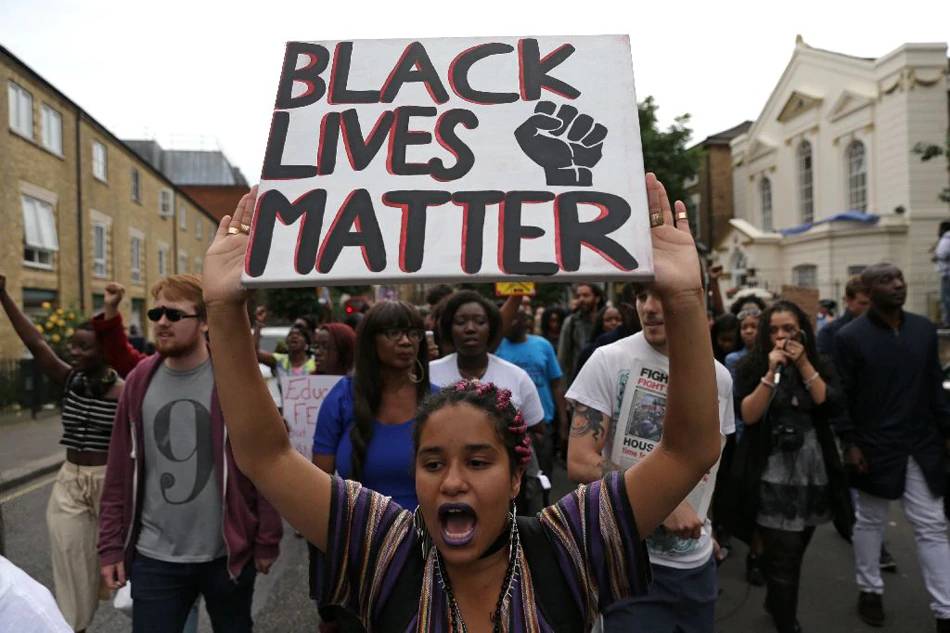
A woman holds up a placard with the slogan “Black Lives Matter” as people march in Brixton, south London to protest against police brutality in the US after two recent incidents where black men have been shot and killed by police officers. Daniel Leal-Olivas, AFP
AFP reported on 30 January that the international civil rights movement Black Lives Matter Global Network Foundation on Friday won Sweden’s Olof Palme human rights prize for 2020.
The foundation was honored for its work promoting “peaceful civil disobedience against police brutality and racial violence all over the world,” prize organizers said in a statement.
The Black Lives Matter movement, founded in 2013 in the United States, has “in a unique way exposed the hardship, pain, and wrath of the African-American minority at not being valued equal to people of a different color,” the statement said.
The movement had its major international breakthrough in the summer of 2020 following several cases of extreme brutality in the US, including the deaths of George Floyd and Breonna Taylor. Prize organizers noted that an estimated 20 million people have taken part in Black Lives Matter protests in the US alone, and millions more around the world.
“This illustrates that racism and racist violence is not just a problem in American society, but a global problem.”