Hans Thoolen on Human Rights Defenders and their awards

share information on human rights defenders, with special focus on human rights awards and laureates


Posts Tagged ‘women human rights defenders’

« Older posts
Newer posts »

Afghanistan: human rights defenders targeted but fearless

November 26, 2019
On 25 November 2019 Amnesty International said that Afghanistan’s top intelligence agency must immediately release two human rights defenders it detained after they exposed alleged sexual abuse against children. Musa Mahmudi and Ehsanullah Hamidi, both well-known human rights defenders from Logar province, were arbitrarily detained by the National Directorate of Security (NDS) on 21 November 2019 when they were on their way to meet with the European Union ambassador in Kabul.

The two human rights defenders began receiving threats, including from local officials in Logar, on Facebook after they gave interviews to The Guardian and Afghanistan’s TOLO News about the existence of a paedophile ring in the area. The human rights defenders uncovered more than 100 videos of the alleged abuse. Some of the victims of abuse have been murdered, according to The Guardian. “This is the latest case where human rights defenders have been targeted by the authorities for carrying out their important work. Faced with threats from both the state and non-state actors, they are operating in some of the most hazardous conditions anywhere in the world. There is impunity for attacks on these brave defenders, who have little to no protection.”

One day before he disappeared, Musa Mahmudi told a fellow Afghan human rights defender that he feared for his safety and that the NDS was planning to arrest him. He added that he was worried that he was under surveillance. Musa Mahmudi said that he had also received death threats, accusing him of “dishonouring the people of Logar.” In August 2019, Amnesty International published a briefing entitled, “Defenceless Defenders: Attacks on Afghanistan’s Human Rights Community,” where the organization detailed how the Afghan government has persistently failed to investigate attacks on human rights defenders – sometimes accusing them of ‘fabricating’ their claims, declining to offer them protection; telling them to arm themselves instead. [on 26 november: https://www.rferl.org/a/afghan-president-orders-probe-into-alleged-pedophile-ring/30293787.html] and then; https://www.rferl.org/a/afghanistan-releases-activists-who-exposed-alleged-pedophile-ring/30294906.html

The same day AI continued with its series of 16 omen human rights defenders from Afghanistan in the context of the “16 Days of Activism against Gender-Based Violence” campaign [see: https://humanrightsdefenders.blog/2019/11/19/16-days-of-activism-against-gender-based-violence-start-on-25-november-2019/]. Untill December 10, their stories will be published one a day.

Day two: Maria Raheen

I am the director of the Journalism and Mass Communication Unit at Balkh University. I also head a non-governmental organization that works on human rights. For 20 years, as a women’s rights activist, I have pushed to address issues that prevent women from accessing their rights, not only in Balkh but also in other neighbouring provinces such as Samangan, Jowzjan, and Faryab.

One of my achievements is the establishment of the first private university in Balkh – Taj Higher Education Institute, which offers medicine, economy and law. Similar to Kabul, Herat and Kandahar, Balkh has some developments and achievements in terms of women’s rights. However, the province is still well known for the presence of armed groups, the local mafia and warlords, who have no respect for human rights. Due to existing challenges and the weak rule of law, self-censorship is embedded in the day-to-day lives of people in Balkh.

I am no stranger to tolerating injustices, especially when it is a matter of saving my life and my family’s lives. It gets challenging especially when it involves former war commanders who are now elected representatives of the area and, who would not hesitate to exert their power to commit crimes.

I hope in future like-minded women will join hands for the women’s revolution in Afghanistan, to reclaim the rights that we are entitled to.

Day one: Khawar Amiri

I am the Head of the Literacy Department of the Directorate of Education in Khost Province and have worked for many years as a mediator for women’s issues. As most women of Khost Province are illiterate, and some districts are yet to establish schools for girls, through the Literacy Department, I have conducted courses for women and girls above the age of 14 to enable their basic reading and writing skills. As a well-known human rights defender, I have worked in solving many of women’s issues through the Committee on Elimination of Violence against Women and tribal Jirgas (councils), with help of the police.

Women in Khost are exposed to discrimination and violence. Girls’ education is till grade six, after which they are sent off to marriage or asked to stay home. Forced marriages, being sold off, physical violence, lack of access to inheritance rights are some of the issues women face on daily basis.  Women don’t work in government posts in Khost, as most of the positions are held by men. Women are discouraged from applying for government positions as their posts are given to men and justified with unlawful reasons for not being appointed.

I have intervened in many cases of women being abused, sometimes solving the case with the help of local elders and at times through direct mediation. One of my biggest successes is organizing a Master’s Degree programme for women in Khost to study in India, funded by the US Embassy. Despite being threatened and attacked, I am continuing my activism.

I hope women are independent, have security, and have equal opportunities for studies, get to live a life free from violence. 

You can send a solidarity message to all of the 16 WHRDs in Afghanistan, or any one of them, and let them know that they are not alone. Please email your thoughts in a personal message to AfghanDefenders@amnesty.org and AI will share them with the activists.

https://www.amnesty.org/en/latest/news/2019/11/afghanistan-release-hrds-now/

https://www.amnesty.org/en/latest/news/2019/11/16-days-of-activism-afghanistan-whrds/

Posted in AI, Amnesty international, EU, Human Rights Defenders | 2 Comments »
Tags: 16 Days Campaign Against Gender Based Violence, Afghanistan, Amnesty International, arbitrary arrest, attacks, Ehsanullah Hamidi, EU, international campaign, Maria Raheen, Musa Mahmudi, sexual abuse against children, threats, women human rights defenders

BREAKING NEWS: MEA has 3 women HRDs as finalists for 2020

November 26, 2019


Late on Monday 25 November 2019 the Martin Ennals Award for Human Rights Defenders announced that its has three exceptional women as the finalists for the 2020 award, a demonstration of the leading position now occupied by women in the defence of human rights. In Yemen, Huda Al-Sarari has exposed and challenged the existence of secret prisons and many cases of torture. In Mexico, Norma Ledezma is fighting against femicides and disappearances. In South Africa, Sizani Ngubane is fighting for access for women to education and to land.

In 2020, for the first time the Jury nominated three women who defend the fundamental rights of their communities in sensitive contexts. ‘The Martin Ennals Foundation is proud to recognise the courageous work of three women. For the 2020 edition, our Jury’s choice reflects the ever-greater global impetus of individuals – whatever their gender – who are committed to respect for human rights and women’s rights in particular’, says Isabel de Sola, Director of the Martin Ennals Foundation.  [see also: https://humanrightsdefenders.blog/2019/11/19/16-days-of-activism-against-gender-based-violence-start-on-25-november-2019/]

The 2020 Finalists are:

  • In Yemen, where the conflict has been ongoing since 2005, Huda Al-Sarari, a Yemeni lawyer, unveiled the existence of several secret detention centres where the worst violations of human rights were committed: torture, disappearances or even extrajudicial executions.
  • In South Africa, women face discrimination, the worst expression of which is widespread gender violence. In rural communities, they frequently have their land expropriated and are deprived of access to education and justice. Sizani Ngubane founded an organisation of more than 50,000 women from rural areas in her country and has fought successfully for over 40 years for the recognition of their rights.
  • In Mexico, the civil population is paying a high price for the weakness of the rule of law which is underpins widespread violence and impunity. Women are the primary victims, with more than 3,500 femicides committed each year. Norma Ledezma, who is the mother of one of the victims, puts all her energy into supporting families seeking access to justice in the state of Chihuahua.

Huda Al-Sarari is a Yemeni lawyer and human rights activist. She graduated in Sharia and Law from Aden University in 2011 and holds a masters in Women’s Studies and Development from the Women’s Centre at Aden University. She has been working for more than a decade with numerous local Yemeni human rights organisations such as the Yemeni Women’s Union, the Adalah Centre for Rights and Freedoms and the National Committee to Investigate Allegations of Human Rights Violations. Over the last years, she investigated, exposed and challenged the network of secret prisons run by foreign governments in Yemen since 2015, where thousands of men and boys suffered arbitrary detention and torture. Huda Al-Sarari collected evidence on more than 250 cases of abuse taking place within the prisons and succeeded in convincing international organisations such as Amnesty International and Human Rights Watch to take up the cause. Despite the threats, defamation campaigns and sacrifices she and her family endured, she continues to stand alongside the families of those who have disappeared and pursue justice. In October 2019, she was honoured as a co-finalist by the Aurora Prize.

‘Huda Al Sarari has chosen not to leave Yemen. That is a decision which shows a rare courage, all the more so as she is working in a high-risk context and a source of danger for herself’ declared Alice Mogwe of the FIDH

Norma Librada Ledezma began her career as a human rights defender the day her daughter, Paloma, disappeared on her way home from school in Chihuahua, Mexico. Since that moment, Norma has dedicated herself to seeking justice for the families and victims of femicide, disappearance and human trafficking in Mexico. She is one of the founders and Director of Justicia Para Nuestras Hijas, a local organisation that offers legal counsel and support to ongoing cases. She is a member of the Board of the Centre for Justice for Women of Chihuahua, the Consultative Assembly of the Executive Committee for Victim’s Redress, and Deputy Coordinator of the Committee for Prevention and Redress of Domestic and Gender-based Violence. Norma has supported over 200 investigations into cases of femicide and disappearances, on behalf of both male and female victims. As a party in the case over her daughter’s murder, which was brought before the Interamerican Commission on Human Rights, Norma is responsible for the creation of a Special Prosecutor for Women Victims of Violence in her native state of Chihuahua. In spite of having received numerous death threats, she continues with her human rights work.

‘Norma Ledezma has received numerous death threats, but she is not daunted and continues her work seeking not only to obtain justice for the murder of her daughter, but for all the young women who have been murdered,’ noted Andrew Anderson of Frontline Defenders.

Sizani Ngubane is a South African activist who has dedicated her life to promoting gender equality, fighting for women’s and indigenous people’s rights. After her initial career as an activist with the ANC, she became Provincial Coordinator of the SA Women’s National Coalition in 1991 and contributed to the development of the Women’s Charter for Effective Equality in South Africa. That contribution was instrumental in building the section on rural and indigenous women of the Bill of Rights within the South African Constitution. In 1998, Sizani founded the Rural Women’s Movement (RWM), a unique organisation striving against gender-based violence and for women’s access to land, education, land rights, property and inheritance rights in courts operating under customary law. Recently, she is focused on fighting against traditional courts legislation, such as the Ingonyama Trust, which could lead to the misappropriation of many families’ land in KwaZulu-Natal Province.

‘Sizani Ngubane’s work has greatly advanced the rights of women and girls in South Africa over more than 40 years,’ underlined Guadalupe Marengo of Amnesty International.

The jury of the MEA  is made up of ten of the world’s leading human rights organisations. They are: Amnesty International,  Bread for the World, the International Commission of Jurists, the FIDH, Front Line Defenders, Human Rights First, Human Rights Watch, HURIDOCS, the World Organisation against Torture and the International Service for Human Rights. In order to reflect the cultural and geographic diversity of the human rights movement, a global network of regional human rights organisations consults with the selection process.

The 2020 Martin Ennals Award for Human Rights Defenders will be presented to one of them on 19 February during a ceremony hosted by the City of Geneva in the Salle Communale de Plainpalais (Geneva), in the presence of the three finalists. The event, organised by the City of Geneva, is open to the public. In order to make it possible for an international audience to participate, the event is also livestreamed. All the details on the evening’s event is available here: www.martinennalsaward.org

For more information on this and other awards, see: http://www.trueheroesfilms.org/thedigest/awards/martin-ennals-award-for-human-rights-defenders

For media inquiries contact: Chloé Bitton, Communications Manager, Martin Ennals Foundation media@martinennalsaward.org Mobile: +41.78.734.68.79

Twitter : @martinennals

Facebook : facebook.com/martinennals
Youtube : youtube.com/martinennalsaward

LinkedIn : https://www.linkedin.com/company/martin-ennals-foundation/


Posted in awards, Human Rights Defenders, MEA | 6 Comments »
Tags: Chloé Bitton, City of Geneva, digest, Huda Al-Sarari, human rights award, Human Rights Defenders, Isabel de Sola, Martin Ennals Award for Human Rights Defenders, MEA finalists 2020, Mexico, Norma Ledezma, Sizani Ngubane, South Africa, women human rights defenders, Yemen

UNiTE Campaign: I am a human rights defender: this is my story

November 23, 2019

The 16 Days of Activism [see: https://humanrightsdefenders.blog/2019/11/19/16-days-of-activism-against-gender-based-violence-start-on-25-november-2019/] generate many different actions. Here an example from Canada:
a Panel with the following Speakers :

  • Tata DIKO | Founder, Lady in Action (LIA)
  • Nandar | Founder, Purple Feminist Group
  • Carine SACERDOCE | Co-Founder, Club de défenseurs des droits de la fille
  • Areeg ABASS | National Officer on Sexual and Reproductive Health, Sudan

Event - I Am a Human Rights Defender


Posted in human rights | Leave a Comment »
Tags: 16 Days Campaign Against Gender Based Violence, Areeg ABASS, Canada, human rights of women, Ottawa, panel, Tata DIKO, UNiTE campaign, women human rights defenders

16 Days of Activism against Gender-Based Violence start on 25 November 2019

November 19, 2019

The 16 Days of Activism against Gender-Based Violence is an annual international campaign that kicks off on 25 November, the International Day for the Elimination of Violence against Women, and runs until 10 December, Human Rights Day. It was started by activists at the inaugural Women’s Global Leadership Institute in 1991 and continues to be coordinated each year by the Center for Women’s Global Leadership. It is used as an organizing strategy by individuals and organizations around the world to call for the prevention and elimination of violence against women and girls.

In support of this civil society initiative, the UNiTE campaign [United Nations Secretary-General’s UNiTE by 2030 to End Violence against Women campaign] calls for global actions to increase awareness, galvanize advocacy efforts, and share knowledge and innovations.

2019

16 Days of Activism against Gender-Based Violence 2019 - Generation Equality stands against rape

In 2019, the UNiTE campaign will mark the 16 Days of Activism against Gender-Based Violence, from 25 November to 10 December, under the theme, “Orange the World: Generation Equality Stands against Rape!”

While the names, times and contexts may differ, women and girls universally experience rape, sexual violence, and abuse, in times of peace or war. Rape is rooted in a complex set of patriarchal beliefs, power, and control that continue to create a social environment in which sexual violence is pervasive and normalized. Exact numbers of rape and sexual assaults are notoriously difficult to confirm due to frequent latitude and impunity for perpetrators, stigma towards survivors, and their subsequent silence. In recent years, the voices of survivors and activists, through campaigns such as #MeToo, #TimesUp, #Niunamenos, #NotOneMore, #BalanceTonPorc, and others, have put the spotlight on the issue of sexual violence and have reached a crescendo that cannot be silenced or ignored anymore.

As an example see my anthology of 2017: https://humanrightsdefenders.blog/2017/12/07/women-human-rights-defenders-day-2017-an-anthology/

That is why, under the umbrella of UN Women’s Generation Equality campaign that marks the 25th anniversary of the Beijing Declaration and Platform for Action, the UNiTE Campaign is calling on people from all walks of life to learn more and take a stand against the pervasive rape culture that surrounds us. You can share your photos, messages and videos showing how you are participating in the campaign on Facebook, Instagram, and Twitter using #OrangeTheWorld and #GenerationEquality. You can also join the conversation on social media by sharing the campaign materials that you can download here.

For more information about “Orange the World: Generation Equality Stands against Rape” and action ideas, see this year’s concept note.

Subscribe to the mailing list for updates.

https://www.unwomen.org/en/what-we-do/ending-violence-against-women/take-action/16-days-of-activism

Posted in Human Rights Defenders, UN | 5 Comments »
Tags: 16 Days Campaign Against Gender Based Violence, human rights of women, international campaign, International Day for the Elimination of Violence against Women, rape, UNiTE campaign, Violence against women, women human rights defenders

Six HRDs from Latin America on PBI’s European tour

November 18, 2019
Whilst the European Union continues to express concern for the increased impact of climate change on the planet, those defending their territories and the environment continue to be attacked for their activism across the world. This alarming trend is present in Latin America where the women defenders of land, territory and the environment are particularly vulnerable. [see e.g. https://humanrightsdefenders.blog/2019/08/06/environmental-human-rights-defenders-more-deadly-than-being-a-soldier-in-a-war-zone/] With this in mind, PBI will be accompanying five women and one man from Mexico, Guatemala, Honduras and Colombia to different parts of Europe in order to exchange experiences and perspectives about protection and self-protection from a holistic perspective. These defenders will share information about their own situation of risk, as well as the cases they are working on.

Sandra.png

Telma.png

Nora.png

Olga.png

Emily.png

Franklin.png

https://www.peacebrigades.org/en/news/women-human-rights-defenders-latin-america-come-europe

Posted in Human Rights Defenders | 1 Comment »
Tags: accompaniement, Emilie Dewolf, environmental defenders, Europe, Franklin Alvarez, Indigenous rights, Latin America, Nora Ramirez, Olga Aroujo, PBI, Sandra Camuec, Telma Perez, women human rights defenders

Lina al-Hathloul speaks out for her sister Loujain imprisoned in Saudi Arabia

October 7, 2019

MSMAGAZINE of 27 September 2019 published a long interview with Lina al-Hathloul, the younger sister of Loujain al-Hathloul. It ws done by Uma Mishra-Newbery, the Executive Director of Women’s March Global.

Over the past week, Women’s March Global has been working with the other members of the Free Saudi Women Coalition to continue fighting for the immediate and unconditional release of Saudi activists. As part of its advocacy efforts, the Coalition invited Lina al-Hathloul—the younger sister of Loujain al-Hathloul, who is currently imprisoned in Saudi Arabia—to attend the 42nd Session of the Human Rights Council in Geneva.

[ see also: https://humanrightsdefenders.blog/2019/09/25/saudi-arabia-in-the-spotlight-at-the-42nd-sesstion-of-the-council-hits-back-wildly/]

I spent nearly three days with Lina, each day more intense and rigorous than the last. What I witnessed was nothing short of extraordinary. Lina is only 24 years old, and yet her determination and commitment to fight for her sister’s freedom is relentless. During her stay, I had the opportunity to sit down with Lina for a conversation about the convening and her new life as an activist.

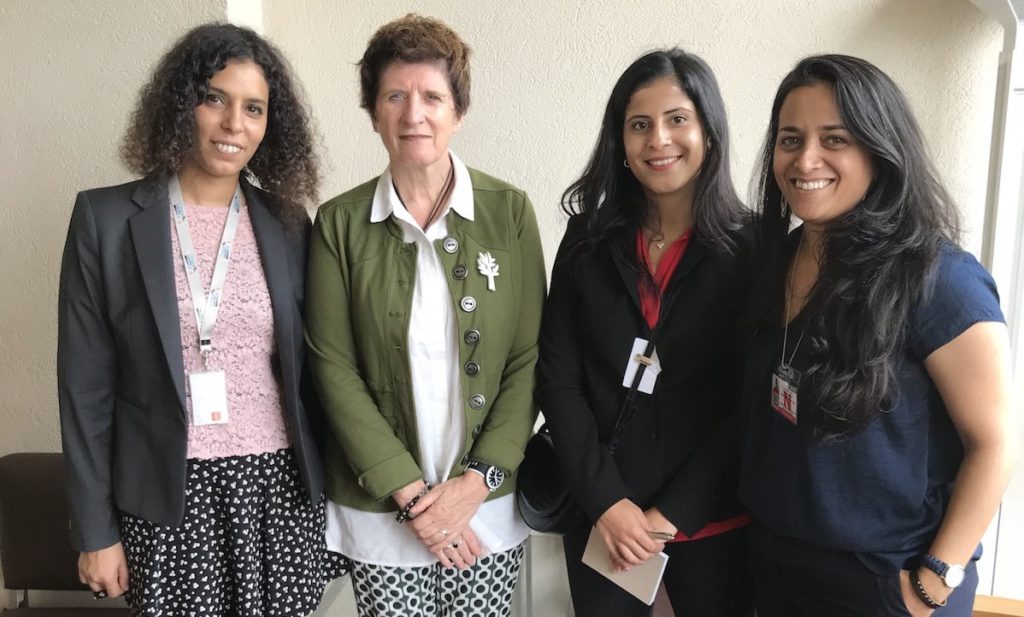
Left to right: Salma El Hosseiny (ISHR), Kate Gilmore (Deputy High Commissioner for Human Rights), Lina al-Hathloul, Uma Mishra-Newbery (Women’s March Global).

Lina, it’s been a busy two and a half days in Geneva at the UN, and you’ve done a tremendous amount. How do you feel?

I feel good, but the thing is I never know if what I’m doing is the right thing. So it’s a mixture of good feelings and bad feelings and stress. We will see what happens and I hope it’s the right thing I’ve done. I don’t know if what I am doing will make a difference—all I have is hope that it will.

You said yesterday that you have no choice but to do what you’re doing right now, whereas the rest of us, who are activists in the movement space, we have a choice in how, when, where we show up. 

Yeah. It’s a very personal issue for me. Because of this I think my heart is always more involved in what I’m doing—compared to other activists—because it’s directly linked to my family. There is a lot of pressure because my family is still in Saudi Arabia while I’m trying to save my sister, but maybe [what I am doing] would harm the rest of my family.

When our family didn’t do anything and we remained silent [when Loujain was first imprisoned], nothing changed and things got worse. So now I have no choice but to speak up. We have seen that when we have spoken up, the torture stopped. So being public is needed, and I need to continue.

You are 24 years old and the resilience that you have, it’s humbling for me to witness. At what age did Loujain start speaking out?

I think Loujian was my age actually, or maybe a year younger. When she started she was in Canada during her studies and she started with the videos. Then she went back to Saudi Arabia and continued, and then started working in the UAE [United Arab Emirates] and never stopped. Even her first imprisonment, she was 24 years old. It was in 2014. I’m speaking out when I’m 24 years old, but she was imprisoned when she was 24 years old. My journey is nothing compared to what she has been through.

I know that doing everything that you’re doing takes a toll mentally and physically. But for you, do you see forward movement? Do you see progress in this?

Yes, I think I do see progress in the sense that her treatment is much better. They allow more visits for my parents. I do see progress because every time… I mean, when we speak up, I see that they don’t mistreat her as much as before and that they truly stick with their engagement [setting up] the visits and calls. When there are no voices anymore for her, the treatment goes down. I clearly see that when we speak up, things go better.

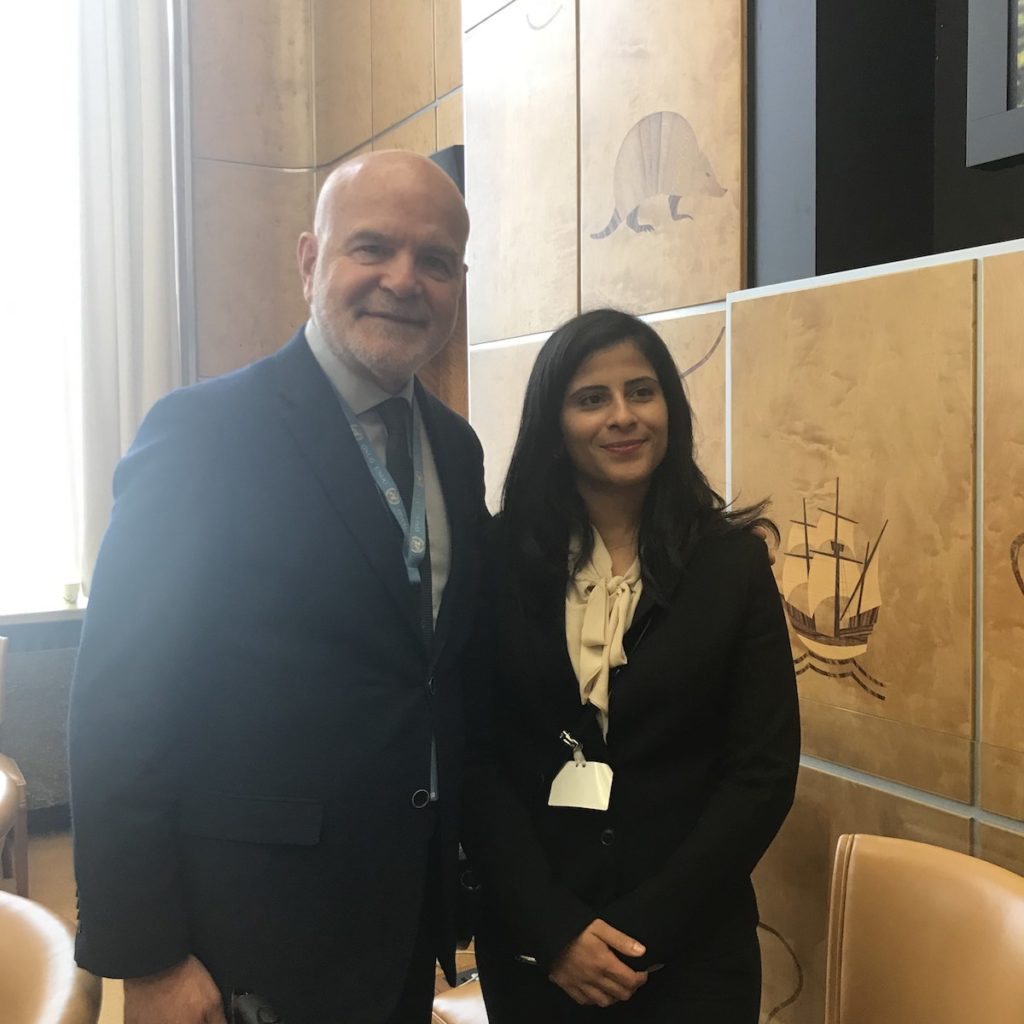
Lina al-Hathloul with Michel Forst, UN Special Rapporteur on the Situation of Human Rights Defenders. 

What do you want the other 24 year olds of the world to know? You’re fighting for your sister, but this is not just about Loujain. This is also about the other women, human rights defenders, that are in prison right now. What would you say to some 24 year old that says, “I’m not affected by this issue?”

I think I understand them, because before Loujain, I thought that all the problems were really far from me—but now that my sister is in prison, I understand that injustice is everywhere.

I think people don’t really realize the power we have with our voices. Speaking up once makes maybe three or four of your friends speak up afterwards and it’s a domino [effect] that really goes fast. If they just make the effort to be in solidarity with this woman once or twice, I really think things could change really fast. I think they have to take the time to read about it and be brave and just speak up.

I can promise things will change for the better if they act

https://msmagazine.com/2019/09/27/lina-al-hathloul-speaks-out-for-her-sisters-freedom/
https://www.middleeasteye.net/news/top-un-officials-call-release-saudi-women-rights-activist

Posted in human rights | 2 Comments »
Tags: 42nd session of the UN Human Rights Council, interview, Lina Al-Hathloul, Loujain al-Hathloul, Saudi Arabia, Uma Mishra-Newbery, women human rights defenders, Women’s March Global

South Africa needs its women human rights defenders

August 23, 2019
Call to action: Former judge Yvonne Mokgoro says society must prioritise women’s rights. (Muntu Vilakazi/City Press/Gallo Images)

Inspired by a lecture on 14 August by former judge Yvonne Mokgoro about the dire social and economic condition of women in South Africa at a women’s month event hosted by the International Commission of Jurists and the Centre for Applied Legal Studies, On 23 August 2019, three women human rights defenders in South Africa (Mateenah Hunter, a human-rights lawyer, and Shaazia Ebrahim and Tim Fish Hodgson who work for the Africa team of the International Commission of Jurists in Johannesburg) published a piece on the plight of women in South africa:

Mokgoro, South Africa’s first black female judge and a retired justice of the Constitutional Court, emphasised in her keynote address that poor, black women particularly continued to disproportionately bear the brunt of the most severe forms of poverty and inequality in South Africa. Poor black women face difficulties accessing a number of constitutionally recognised rights, including education, healthcare, land and housing. This, despite far-reaching constitutional protections of women’s rights and socioeconomic rights in South Africa’s Constitution…

Mokgoro’s moving and passionate address created an open environment in which women human-rights defenders and public-interest lawyers voiced their experiences of gendered socioeconomic rights violations in South Africa.
Mokgoro articulated the deep frustration of South African women with the government and broader society’s failure to act to curb and prevent the social, cultural and economic violence suffered by the women of South Africa. “Women constitute most of society. Why can’t we make women’s rights at the forefront? We must structure the rules to meet the needs of women,” Mokgoro said. She was moved to tears as she spoke.

Tumelo Matlwa and Amelia Rawháni-Mosalakae, lawyers at the Centre for Applied Legal Studies, spoke to the all-too-common difficulties faced by women in South Africa who are married in community of property and who — because of an under-protective legal system and the disinterest of banks in their welfare — unwillingly take on their husbands’ debts. Poverty, they concluded, “is a form of economic violence that has a disproportionate effect on women”.

Fatima Shabodien, feminist activist and strategy director at the Raith Foundation, spoke directly to the sexual harassment crisis in the nongovernmental organisation (NGO) sector in South Africa, which has received extensive media coverage, and about the responses of a number of organisations to allegations of sexual harassment. …She urged human rights defenders, public interest lawyers, boards of NGOs and donors to demand that allegations of sexual harassment are dealt with expeditiously and effectively and that there are real and lasting consequences for perpetrators.

This was brought into sharp relief by Nonhle Mbuthuma, a community land rights activist and member of the Amadiba Crisis Committee. It is primarily women, Mbuthuma indicated, who are risking their lives and wellbeing by signing affidavits to go to court to fight against the use of their land for mining in the name of economic development. [see also: https://humanrightsdefenders.blog/2018/11/25/the-human-rights-defenders-in-ais-2018-write-for-rights-campaign/]

…

Mokgoro’s intervention was aimed at encouraging lawyers, judges and government officials to reverse this practice that often renders women invisible, thus limiting the transformative potential of the Constitution in their lives. Mokgoro called for an “engendering” of socioeconomic rights towards the social and economic liberation of women from the feminisation of poverty, citing Professor Sandra Fredman.

As young human-rights defenders, we are inspired by Mokgoro’s life, love, learning and labour through which she continues to contribute to the creation of a nonsexist society in which the oppressive effects of patriarchy are eliminated. We take this opportunity, in “Women’s Month”, to remember all those women, who, like Mokgoro, have struggled against the odds to bring us to this point.

  • The many women who risked their lives fighting apartheid and colonialism, including the thousands of women who marched to the Union Buildings in 1956, demanding that the apartheid government withdraw pass laws.
  • The women who fought to secure a seat at the table during our constitutional negotiations despite their initial marginalisation and ensured that women’s rights are now afforded significant constitutional protection;
  • The women who continue to campaign tirelessly for women’s reproductive rights and against gender-based violence.
  • The women public interest lawyers who bring women’s socioeconomic rights cases to our courts.
  • The women in grassroots social movements around the country who continue to claim their constitutional rights and insist that they are written into the story of our constitutional rights jurisprudence.
  • The women in homes around the country giving their love and labour on a daily basis to ensure that care work that is so crucial to our families and communities is undertaken.
  • The women in townships, urban centres and rural areas around the country who work as domestic workers, community health workers, informal traders and farm workers and many other precarious jobs; who sacrifice spending time with their own families to provide them with the basic necessities of life in the absence of sufficient support from the state.
  • The women of Marikana, who are still fighting for simple justice for their murdered husbands and partners and their decimated families, seven years after the Marikana massacre.

………

As Toni Morrison said: “If there’s a [story] that you want to read, but it hasn’t been written yet, then you must write it.” Mokgoro has reminded us that the story of the constitutional realisation of women’s socioeconomic rights has yet to be fully written. And she has inspired us to continue — alongside the many women activists currently doing so —to write it.

https://mg.co.za/article/2019-08-23-00-sas-women-are-fighting-for-social-justice-remarkable-women

Posted in Human Rights Defenders | Leave a Comment »
Tags: Amelia Rawháni-Mosalakae, Centre for Applied Legal Studies, human rights of women, International Commission of Jurists, Mateenah Hunter, Nonhle Mbuthuma, Shaazia Ebrahim, South Africa, Tim Fish Hodgson, Tumelo Matlwa, women human rights defenders, Yvonne Mokgoro

New documentary series highlights the struggle of women human rights in Vietnam

August 7, 2019

Screenshot from video ‘Full interview Doan Trang’ uploaded on 10 May 2019 by the 88 Project on Youtube.

A new series of video interviews highlights the perspectives and struggles of human rights women in Vietnam. On 1 July 2019 Don Le posted this in Global Voives:

The 88 Project, an organisation supporting freedom of expression in Vietnam, released the first video of an ongoing interview series with female activists in Vietnam. In the first interview with Pham Doan Trang, a dissident journalist and political activist, she discusses the challenges women face as bloggers and human rights activists: “In general, Vietnamese women are not respected. Not only in democracy activism but in all fields. In democracy activism, female activists are disadvantaged because they get attacked no less than male activists. They get beaten and assaulted. The work they do is no less than their male counterparts. But what they often get from other people is pity. I think it is not respect.” See also: https://humanrightsdefenders.blog/2017/11/18/overview-of-recent-campaigning-for-human-rights-defenders-in-vietnam/

Other women including social activist and blogger Tran Thi Nga, who is currently serving a nine-year prison sentence, have also been seriously injured following physical attacks, often conducted by hired men. Tran Thi Nga’s attack was documented and posted on Youtube with recordings of her being wheeled into a hospital accompanied by her two young children. According to family reports, Tran Thi Nga has been subjected to both physical and psychological harassment after her arrest, receiving death threats and beatings from a cellmate.

According to the 88 Project database, there are currently more than 200 prisoners of conscience in Vietnam with over 30 identifying as female. Bloggers and journalists are frequently arrested and charged for “activities attempting to overthrow the state” or “conducting propaganda against the state”. According to Amnesty International, the Vietnamese government has been conducting a growing crackdown on freedom of expression and peaceful activism over the past few years.

Nguyen Dang Minh Man, a photojournalist and the woman who has served the longest time in prison so far, is expected to be released at the beginning of August.

New documentary series highlights the struggles of women activists in Vietnam

Posted in films, human rights, Human Rights Defenders | Leave a Comment »
Tags: 88 Project, bloggers, citizen journalists, freedom of expression, Global Voices, Nguyen Dang Minh Man, Pham Doan Trang, threats, Tran Thi Nga, video clips, Vietnam, women human rights defenders, You Tube

Angelina Jolie extolls women human rights defenders in new essay

August 6, 2019

On 5 August 2019, Annie Martin wrote that “Angelina Jolie sends love to ‘wicked women‘ (women breaking rules and pushing boundaries) in new essay”

Angelina Jolie reflected on women’s rights and societal expectations in the September issue of Elle. File Photo by John Angelillo/UPI | License Photo
The 44-year-old actress reflected on women’s rights and societal expectations in an essay for the September issue of Elle published Monday. Jolie began by asking the question, “What is it about the power of a woman free in mind and body that has been perceived as so dangerous throughout history.” She recounted how accusations of witchcraft have ben used “to control and silence women” in many societies throughout the centuries….”Since time immemorial, women who rebel against what is considered normal by society — even unintentionally — have been labeled as unnatural, weird, wicked, and dangerous. What is surprising is the extent to which this kind of myth and prejudice has persisted throughout the centuries and still colors the world we live in”Jolie discussed how modern women across the globe are considered “wicked” for such behaviors as dancing or singing in public, running for political office, or fighting for human rights. These women are sometimes met with violence, imprisonment or social ostracism. “Female human rights defenders across the world are incarcerated for their political views or for defending themselves or others, with courage I can hardly imagine. For all our modern advances, the independence and creative energy of women is still frequently seen as a dangerous force to be controlled, often in the name of religion, tradition, or culture,” Jolie wrote.

“Looked at in this light, ‘wicked women’ are just women who are tired of injustice and abuse,” she said. “Women who refuse to follow rules and codes they don’t believe are best for themselves or their families. Women who won’t give up on their voice and rights, even at the risk of death or imprisonment or rejection by their families and communities.” “If that is wickedness, then the world needs more wicked women,” the star declared.

For more on Angelina Jolie and her human rights work, see: https://humanrightsdefenders.blog/tag/angelina-jolie/

https://www.upi.com/Entertainment_News/2019/08/05/Angelina-Jolie-sends-love-to-wicked-women-in-new-essay/1591565015424/

Posted in films, Human Rights Defenders | Leave a Comment »
Tags: Angelina Jolie, Annie Martin, celebrities, Elle (magazine), rights of women, star power, women human rights defenders

Guide to Human Rights Defenders issues at the 41st Human Rights Council starting on 24 June

June 14, 2019

Thanks to the – as always very complete and timely – “Alert to the Human Rights Council’s 41st session” (from 24 June to 12 July 2019) issued by the International Service for Human Rights. I am able to give a short guide to the main items that relate to human rights defenders. To Read the full Alert to the session online click here and stay up-to-date with @ISHRglobal and #HRC41 on Twitter.

Thematic areas of interest:

Sexual orientation and gender identity: The interactive dialogue with the Independent Expert on protection against violence and discrimination on the basis of sexual orientation and gender identity (SOGI) will be held on Monday 24 June at 11:00. The Council will consider the new thematic report of the mandate holder as well as the report of the country visits he made to Georgia and Mozambique. The Council will also consider the renewal of the mandate.

Business and human rights: The Council will hold an interactive dialogue with and consider several reports of the Working Group on the issue of human rights and transnational corporations and other business enterprises on 26 June. The Working Group will present a report on the gender dimensions of the Guiding Principles on Business and Human Rights and the reports of country visits to Thailand and Kenya. The Working Group’s report on the gender dimensions of the Guiding Principles integrates clear recognition that women human rights defenders play a vital role in challenging business-related human rights abuses as well as in promoting and protecting human rights in relation to business activity, including the right to an effective remedy. As a result of this work, women human rights defenders often face gender-specific risks including sexual violence, misogynist public shaming and online harassment. Among its recommendations, the Working Group calls on business enterprises to ensure the meaningful participation of women’s organisations, women human rights defenders and gender experts in all stages of human rights due diligence.

Women human rights defenders and women’s rights: The annual full day discussion on the human rights of women will take place on 27 and  28 June. The discussions will focus this year on violence against women in the world of work, the rights of older women and their economic empowerment. A panel focused on women’s rights and climate change will also be organised, focusing on climate action, best practices and lessons learned. States should place due consideration on the role of women human rights defenders and social movements in this regard, in line with the Human Rights Council resolution focused on environmental human rights defenders adopted in March 2019…
The Council will also hold an interactive dialogue with the Working Group on the issue of discrimination against women in law and in practice which focuses on women deprived of liberty (including women human rights defenders in detention, facing travel bans, among other situations), and will consider their reports including a report on the country visits to Honduras and Poland. The Council will hold an interactive dialogue with the Special Rapporteur on violence against women, its causes and consequences on 27 June and will consider her report including the report of her visits to Canada and Nepal.

Reprisals:  In spite of a number of measures, reprisals not only continue, but grow. Item 5 of the Human Rights Council’s agenda provides a key opportunity for States to raise concerns about reprisals, including specific cases, and for relevant governments to provide updates on cases to the Council on any investigation or action taken toward accountability. During the organisational meeting held on 7 June, the President of the Council stressed the importance of ensuring the safety of those participating in the Council’s work, and the obligation of States to prevent intimidation or reprisals. In line with previous calls, ISHR expects the President of the Human Rights Council to publicly identify and denounce specific instances of reprisals by issuing formal statements, conducting press-briefings, corresponding directly with the State concerned, publicly releasing such correspondence, and insisting on undertakings from the State concerned to investigate, hold the perpetrators accountable and report back to the Council on action taken. [see also: https://humanrightsdefenders.blog/2019/05/13/ishr-on-reprisals-un-and-states-must-do-more-to-address-reprisals/]

Other key thematic reports: The Council will hold dedicated debates and consider reports of several mandates relating to civil, political, economic, social and cultural rights, and the role of human rights defenders in that work area, in some instances involving the renewal of the mandate:

  • The Special Rapporteur on independence of judges and lawyers and on the right to health (including country visits report to Canada and Kyrgyzstan) on 24 June
  • The Special Rapporteur on the rights to freedom of peaceful assembly and association (mandate renewal, reports include country visits to Tunisia and Armenia) on 25 June
  • The Special Rapporteur on extrajudicial, summary or arbitrary executions and right to education on 26 June
  • The Special Rapporteur on freedom of opinion and expression (including thematic report on surveillance companies and country visit report to Ecuador) on 25 June
  • The Special Rapporteur on extreme poverty and human rights (including country visits reports to the UK and Laos) on 28 June

In addition, the Council will hold dedicated debates on rights of specific groups including with:

  • The Special Rapporteur on the human rights of migrants (and country visit report to Niger) on 24 June
  • The Special Rapporteur on the human rights of internally displaced persons on 28 June (mandate renewal)
  • The Special Rapporteur on trafficking in persons (and country visit to Nigeria) on 27 June
  • The Special Rapporteur on the elimination of discrimination against persons affected by leprosy and their family members on 24 June

Country-specific developments:

China: For more than a year, the international community has had access to credible reports and first-hand testimony of the harassment, surveillance, and mass detention of more than one million Uyghurs and other Turkic Muslims in Xinjiang. Despite the consistent work of the UN human rights mechanisms to review China, ask questions, and make recommendations, there has been no serious or effective response. The Council should take urgent action to seek access, monitoring and reporting of the situation to inform future actions. ..ISHR urges States to act collectively to advance a resolution calling for China to allow access to the region to independent human rights experts and to end country-wide the arbitrary detention of individuals based on their religious beliefs or political opinions.

Sudan: In response to the gross and systematic human rights violations occurring in Sudan, ISHR andother NGOs have urged Council Member States to urgently hold a Special Session on the human rights situation in Sudan. The Council should urgently establish an international fact-finding mission to document violations, identify perpetrators and push for accountability, in line with calls made by a group of Special Procedures including the Independent Expert on Sudan. Since 3 June, Rapid Security Forces, riot police and national security officers violently dispersed peaceful protesters in Khartoum as well as in different cities across Sudan. The MENA Women Human Rights Defenders’ Coalition reported that at least 113 people have died including women human rights defenders. Civil society documented cases of rape, attacks on hospitals, with hundreds injured and missing.  The Transitional Military Council is enforcing a ban on communication causing an internet black out. The High Commissioner has deplored the killings and proposed ‘the rapid deployment of a UN human rights monitoring team’ to Sudan.

Saudi Arabia: The June session provides an important opportunity for the Council to follow up on the joint statement delivered on behalf of 36 States [see: https://humanrightsdefenders.blog/2019/03/08/saudi-arabia-for-first-time-openly-criticized-in-un-human-rights-council/] .. Seven women’s rights activists have been provisionally released, but they are still facing trial, and other women human rights defenders are still in detention, with the human rights situation on the ground deteriorating markedly on other fronts, including through increased use of the death penalty and the authorities’ continuing crackdown on freedom of expression.  [see also: https://humanrightsdefenders.blog/2019/03/28/3-saudi-women-human-rights-defenders-released-but-for-how-long-and-what-about-the-others/]
The Special Rapporteur on extrajudicial, summary or arbitrary executions will present her findings of the investigation into the killing of Khashoggi. [see: https://humanrightsdefenders.blog/2019/01/26/other-members-of-the-uns-khashoggi-investigation-team-named/%5D…..ISHR calls on States to advance a Human Rights Council resolution establishing a monitoring mechanism over the human rights violations in the country and calling explicitly for the immediate and unconditional release of all human rights defenders including the detained women human rights defenders and to drop all charges against them, including those provisionally released. ISHR considers the March joint statement as a first step towards more sustained and dedicated review by the Council in its efforts to hold its members accountable.

The Philippines: The Philippines is one of the most dangerous countries for human rights defenders. Several NGOs callied on the Council to advance accountability for human rights violations by adopting a resolution establishing an independent international investigation into extrajudicial killings and this call was strongly endorsed by a group of independent UN experts who condemned a ‘sharp deterioration in the situation of human rights across the country, including sustained attacks on people and institutions defending human rights.’ [see also: https://humanrightsdefenders.blog/2019/06/07/philippines-labour-rights-defender-dennis-sequena-shot-dead-while-meeting-with-workers/]

Egypt: Despite the Egyptian government’s assurances to the African Commission civil society faced restrictions, reprisals and intimidation for engaging or seeking to engage with the Commission. These restrictions and reprisals happened in a context where the Government of Egypt crushes dissent, discourages public participation in public affairs and punishes people who dare to claim basic human rights. Individuals and communities who engaged with the Special Rapporteur on the right to housing during her visit in September 2018 faced systematic reprisals. All other scheduled visits by the Special Procedures have been postponed as a result. [see: https://humanrightsdefenders.blog/2018/12/07/egypt-denounced-for-reprisals-against-human-rights-defenders-who-talked-to-visiting-un-delegation/ and https://humanrightsdefenders.blog/2019/05/12/reprisal-against-egyptian-human-rights-defender-mohamed-soltan/]. ISHR calls on States to condemn the acts of intimidation and reprisals for civil society engaging with the African Commission and with the Special Procedures, and recall Egypt’s obligations to prevent acts of intimidation and reprisals, investigate the allegations and provide victims with effective remedy.

Burundi: The Commission of Inquiry on Burundi will present its oral briefing on 2 July. The closing of the office of the High Commissioner for Human Rights is regrettable and worrying. In addition, ISHR remains seriously concerned over the breaches to due process observed in all of human rights defender Germain Rukuki’s legal proceedings since his arrest without warrant on 13 July 2017. [See: https://humanrightsdefenders.blog/2019/03/29/ngo-statement-condemns-new-irregularities-in-the-case-of-germain-rukuki-burundi/]. For more information on the situation of human rights defenders in Burundi, check ISHR Briefing Paper for the UPR here.

Other country situations: The High Commissioner will present her oral update to the Council on 24 June. The Council will hear reports on and is expected to consider resolutions addressing a range of country situations, in some instances involving the renewal of the relevant expert mandates. These include:

  • Interactive dialogue with the Special Rapporteur on the human rights situation in Belarus (mandate renewal) on 1 July
  • Interactive dialogue with the Special Rapporteur on the human rights situation in Eritrea (mandate renewal) on 2 July
  • Interactive dialogue with the Commission of Inquiry on Syria, the Commission of Inquiry on Burundi and the Special Rapporteur on Myanmar on 2 July
  • Enhanced interactive dialogue with the government of Sudan and OHCHR on 9 July
  • Enhanced interactive dialogue on the situation in the Democratic Republic of Congo and interactive dialogue with the team of experts on the situation in the Kasai region on 9 July
  • Interactive dialogue with the High Commissioner on the situation in Ukraine on 10 July
  • Interactive dialogue with the Independent Expert on the Central African Republic on 10 July
  • Enhanced interactive dialogue on the report of the High Commissioner on Venezuela on 10 July
  • Interactive dialogue with the High Commissioner on the situation of Rohingya Muslims and other minorities in Myanmar on 10 July
  • First oral update and enhanced interactive dialogue on the report of the High Commissioner on Nicaragua on 11 July
  • Oral update by the High Commissioner on cooperation with Georgia on 11 July

Adoption of Universal Periodic Review (UPR) reports: During this session, the Council will adopt the UPR working group reports on New Zealand, Afghanistan, Chile, Viet Nam, Uruguay, Yemen, Vanuatu, North Macedonia, Comoros, Slovakia, Eritrea, Cyprus, Dominican Republic and Cambodia.

Resolutions to be presented to the Council’s 41st session: At the organisational meeting resolutions were announced (States sponsoring the resolution in brackets); it is possible that more resolutions could be presented at this session. These include:

  • The human rights situation in Belarus (European Union)
  • Human rights of internally displaced persons (Austria, Honduras, Uganda)
  • Human rights and climate change (Bangladesh, Philippines, Viet Nam)
  • Human rights, sexual orientation and gender identity (Argentina, Brazil, Chile, Colombia, Costa Rica, Mexico, Uruguay).
  • Elimination of discrimination against women and girls (Colombia, Mexico)
  • Rights to freedom of peaceful assembly and of association (Czech Republic, Indonesia, Lithuania, Maldives, Mexico)
  • New and emerging and digital technologies and human rights (Republic of Korea, Austria, Brazil, Denmark, Morocco, Singapore)
  • Accelerating efforts to eliminate all forms of violence against women(Canada)
  • The human rights situation in Syria (France, Germany, Italy, Jordan, Kuwait, Morocco, Netherlands, Qatar, Turkey, United Kingdom of Great Britain and Northern Ireland)

There wil be again many side events at the Council, on which I will report separately.

Read here the three year programme of work of the Council with supplementary information.
Read here ISHR’s recommendations on the the key issues that are or should be on the agenda of the UN Human Rights Council in 2019.

Posted in human rights, Human Rights Council, Human Rights Defenders, ISHR | 5 Comments »
Tags: 41st Human Rights Council, Burundi, China, Egypt, Human Rights Defenders, ISHR, Philippines, reprisals, Saudi Arabia, Sudan, UN Human Rights Council, UN Special Rapporteurs, UPR, women human rights defenders

« Older posts
Newer posts »
  • Enter your email address to subscribe to this blog and receive notifications of new posts by email.

    Join 2,331 other subscribers
  • Recent Posts

    • The 7th Human Rights summit of Southern Defenders took place in November in Johannesburg – reports Puleng Motaug
    • Dejusticia 2025 fellowships for defenders from the Global South
    • EUROPEAN MASTER’S DEGREE IN HUMAN RIGHTS & DEMOCRATISATION (EMA)
    • 10 December 2024: webinar on the critical role of documentation and technology in protecting defenders
    • The North-South Centre celebrates young people’s contributions to Human Rights
    • Canadian Minister Joly announces funding for child human rights defenders and independent media
    • Call for Nominations Martin Ennals Award 2025
    • Syrian human rights defender Mazen al-Hamada found dead in Sednaya prison
Blog at WordPress.com.
Entries and comments feeds.Valid XHTML and CSS.
  • Subscribe Subscribed
    • Hans Thoolen on Human Rights Defenders and their awards
    • Join 439 other subscribers
    • Already have a WordPress.com account? Log in now.
  • Privacy
    • Hans Thoolen on Human Rights Defenders and their awards
    • Customize
    • Subscribe Subscribed
    • Sign up
    • Log in
    • Report this content
    • View site in Reader
    • Manage subscriptions
    • Collapse this bar
 

Loading Comments...