Posts Tagged ‘women human rights defenders’

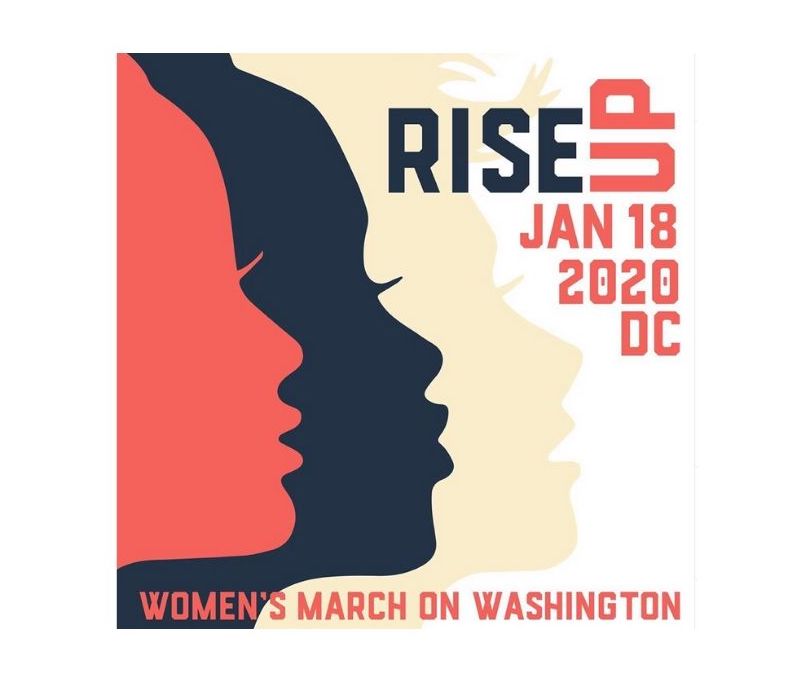
4th Annual Global Women’s March is on 18 January 2020

January 1, 2020
2020 women's march BELatina

On January 21st of 2017, millions of women and allies around the world took to the streets to make themselves seen and heard, demonstrating to advance women’s human rights. Now, nearly three years later, the Women’s March movement has announced that on 18 January, 2020, feminists and women’s human rights defenders will march yet again in the 4th Annual Global Women’s March.

Common Dreams also reported that women and men alike marched in France, Spain, Uganda, and other countries in November 2019 to demand that their elected officials work to end violence against women. In Spain, tens of thousands of people marched to recognize the day. But as the New York Times reported, the country’s far-right Vox Party—which, though still a minority party, doubled its representation in Parliament in recent elections—used the opportunity to affirm its opposition to a law aimed at protecting women from gender-based violence. Women gathered at City Hall in Madrid shouted, “This is shameful!” as Vox secretary-general Javier Ortega Smith spoke out against the law and called for national attention to men who are killed by their partners.

Women during a protest on the commemoration of the International Day for the Elimination of Violence Against Women, in Nantes, France, on November 25, 2019. (Photo: Estelle Ruiz/NurPhoto via Getty Images)

As part of the global effort, the International Labor Organization (ILO) called for ratification of its new Convention, adopted in June, to recognize the right of all people to be free from harassment and violence in their workplaces. “This commitment now needs to be turned into concrete, practical action,” the ILO wrote. “Violence and harassment in the world of work has enormous human, social and economic costs. Violence and harassment constitutes one of the greatest threats to decent work. No more excuses. Let’s work together and make the promise of Convention No. 190 a reality for all.”

It’s Official! The 4th Annual Global Women’s March is in January of 2020

New Amnesty report: Governments failing women human rights defenders

December 1, 2019
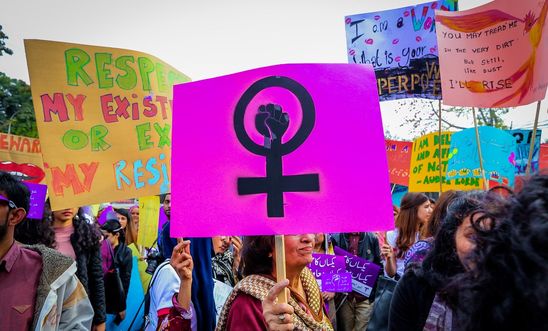
Women in Lahore, Pakistan, march to mark International Women's Day 2019
Women in Lahore, Pakistan, march to mark International Women’s Day 2019 © Ema Anis for Amnesty International

Governments around the world are failing to protect women human rights defenders from increasing attacks, Amnesty International said on 29 November 2019, International Women Human Rights Defenders Day. In a new report –Challenging power, fighting discrimination” – based on interviews with 23 activists across 21 countries, Amnesty highlights how women human rights defenders continue to be assaulted, threatened, intimidated, criminalised and even killed for their campaigning.

Kumi Naidoo, Amnesty International’s Secretary General, said: “Women human rights defenders are attacked because of who they are and what they do. The risks are even greater for those facing intersecting forms of discrimination: if you are a woman and from a racial minority, indigenous, poor, lesbian, bisexual, trans, or a sex worker, you have to fight so much harder to have your voice heard by those in power…All over the world, women human rights defenders are speaking out against injustice, abuse and discrimination, often because they have experienced it first-hand…..They are central to human progress: they fight for human rights and against patriarchy and racism, while pushing for ground-breaking reforms on so many fronts. Governments must live up to their commitment to ensure these activists can operate freely and safely.

In recent years, campaigners working on the rights of women, LGBTI people and other marginalised groups have come under growing pressure from politicians, religious leaders and violent groups. Women campaigning on these issues tend to be the first to be targeted in increasingly frequent backlashes against a more inclusive, fairer world.

Sexual violence

The report highlights several cases in which violence, including sexual violence as a form of torture, was used against women human rights defenders to silence them. In Bahrain, Ebtisam El-Saegh, an activist with the human rights organisation SALAM for Democracy and Human Rights, was sexually assaulted, badly beaten, kicked in the stomach and kept standing for most of the seven hours she was being interrogated while in detention in 2017. El-Saegh told Amnesty: “I was threatened that they would harm my family and that they would bring my husband and torture and electrocute him. The men told me ‘no one can protect you’.”

In Egypt, Malak al-Kashef, a 19-year-old transgender woman human rights defender was arrested in March this year following her involvement in peaceful protests in Cairo. She faced trumped-up charges of ‘aiding a terrorist organisation’ and ‘misusing social media to commit a crime punishable by law.’ While in detention, she was subjected to a forced anal examination and other forms of sexual assault. Even though she was undergoing gender affirming treatment, Malak was placed in an all-male detention facility which put her at increased risk of sexual violence. She was eventually released in July this year.

Smear campaigns

Women activists are often subjected to smear campaigns which vilify their “deviant behaviour” and are designed to fuel hostility against them. After rescuing migrants from the central Mediterranean Sea in June 2019, Carola Rackete, the Italian captain of the rescue boat Sea-Watch 3, was repeatedly insulted by the Italian Minister of Interior who called her a pirate and a criminal. His slurs were followed by vicious verbal attacks by others who incited sexual violence against her while also targeting her gender and appearance.

In Mauritania, Mekfoula Brahim, a woman human rights defender who has campaigned for an end to female genital mutilation, was branded an apostate in 2016 Facebook posts after defending a blogger sentenced to death for criticising those who use religion to discriminate against minorities. The slur exposed her to the risk of being prosecuted and sentenced to death.

Click to access ACT3011392019ENGLISH.PDF

https://www.amnesty.org.uk/press-releases/governments-failing-protect-women-activists-increasing-attacks-new-report

http://www.voxy.co.nz/politics/5/353494

Afghanistan: human rights defenders targeted but fearless

November 26, 2019
Afghanistan’s top intelligence agency must immediately release two human rights defenders it detained after they exposed alleged sexual abuse against children. Musa Mahmudi and Ehsanullah Hamidi, both well-known human rights defenders from Logar province, were arbitrarily detained by the National Directorate of Security (NDS) on 21 November 2019 when they were on their way to meet with the European Union ambassador in Kabul.

The two human rights defenders began receiving threats, including from local officials in Logar, on Facebook after they gave interviews to The Guardian and Afghanistan’s TOLO News about the existence of a paedophile ring in the area. The human rights defenders uncovered more than 100 videos of the alleged abuse. Some of the victims of abuse have been murdered, according to The Guardian. “This is the latest case where human rights defenders have been targeted by the authorities for carrying out their important work. Faced with threats from both the state and non-state actors, they are operating in some of the most hazardous conditions anywhere in the world. There is impunity for attacks on these brave defenders, who have little to no protection.”

One day before he disappeared, Musa Mahmudi told a fellow Afghan human rights defender that he feared for his safety and that the NDS was planning to arrest him. He added that he was worried that he was under surveillance. Musa Mahmudi said that he had also received death threats, accusing him of “dishonouring the people of Logar.” In August 2019, Amnesty International published a briefing entitled, Defenceless Defenders: Attacks on Afghanistan’s Human Rights Community,” where the organization detailed how the Afghan government has persistently failed to investigate attacks on human rights defenders – sometimes accusing them of ‘fabricating’ their claims, declining to offer them protection; telling them to arm themselves instead. [on 26 november: https://www.rferl.org/a/afghan-president-orders-probe-into-alleged-pedophile-ring/30293787.html] and then; https://www.rferl.org/a/afghanistan-releases-activists-who-exposed-alleged-pedophile-ring/30294906.html

The same day AI continued with its series of 16 omen human rights defenders from Afghanistan16 Days of Activism against Gender-Based Violence” campaign [see: https://humanrightsdefenders.blog/2019/11/19/16-days-of-activism-against-gender-based-violence-start-on-25-november-2019/]. Untill December 10, their stories will be published one a day.

Day two: Maria Raheen

I am the director of the Journalism and Mass Communication Unit at Balkh University. I also head a non-governmental organization that works on human rights. For 20 years, as a women’s rights activist, I have pushed to address issues that prevent women from accessing their rights, not only in Balkh but also in other neighbouring provinces such as Samangan, Jowzjan, and Faryab.

One of my achievements is the establishment of the first private university in Balkh – Taj Higher Education Institute, which offers medicine, economy and law. Similar to Kabul, Herat and Kandahar, Balkh has some developments and achievements in terms of women’s rights. However, the province is still well known for the presence of armed groups, the local mafia and warlords, who have no respect for human rights. Due to existing challenges and the weak rule of law, self-censorship is embedded in the day-to-day lives of people in Balkh.

I am no stranger to tolerating injustices, especially when it is a matter of saving my life and my family’s lives. It gets challenging especially when it involves former war commanders who are now elected representatives of the area and, who would not hesitate to exert their power to commit crimes.

I hope in future like-minded women will join hands for the women’s revolution in Afghanistan, to reclaim the rights that we are entitled to.

Day one: Khawar Amiri

I am the Head of the Literacy Department of the Directorate of Education in Khost Province and have worked for many years as a mediator for women’s issues. As most women of Khost Province are illiterate, and some districts are yet to establish schools for girls, through the Literacy Department, I have conducted courses for women and girls above the age of 14 to enable their basic reading and writing skills. As a well-known human rights defender, I have worked in solving many of women’s issues through the Committee on Elimination of Violence against Women and tribal Jirgas (councils), with help of the police.

Women in Khost are exposed to discrimination and violence. Girls’ education is till grade six, after which they are sent off to marriage or asked to stay home. Forced marriages, being sold off, physical violence, lack of access to inheritance rights are some of the issues women face on daily basis.  Women don’t work in government posts in Khost, as most of the positions are held by men. Women are discouraged from applying for government positions as their posts are given to men and justified with unlawful reasons for not being appointed.

I have intervened in many cases of women being abused, sometimes solving the case with the help of local elders and at times through direct mediation. One of my biggest successes is organizing a Master’s Degree programme for women in Khost to study in India, funded by the US Embassy. Despite being threatened and attacked, I am continuing my activism.

I hope women are independent, have security, and have equal opportunities for studies, get to live a life free from violence. 

You can send a solidarity message to all of the 16 WHRDs in Afghanistan, or any one of them, and let them know that they are not alone. Please email your thoughts in a personal message to AfghanDefenders@amnesty.org and AI will share them with the activists.

https://www.amnesty.org/en/latest/news/2019/11/afghanistan-release-hrds-now/

https://www.amnesty.org/en/latest/news/2019/11/16-days-of-activism-afghanistan-whrds/

BREAKING NEWS: MEA has 3 women HRDs as finalists for 2020

November 26, 2019


Late on Monday 25 November 2019 the Martin Ennals Award for Human Rights Defenders announced that its has three exceptional women as the finalists for the 2020 award, a demonstration of the leading position now occupied by women in the defence of human rights. In Yemen, Huda Al-Sarari has exposed and challenged the existence of secret prisons and many cases of torture. In Mexico, Norma Ledezma is fighting against femicides and disappearances. In South Africa, Sizani Ngubane is fighting for access for women to education and to land.

In 2020, for the first time the Jury nominated three women who defend the fundamental rights of their communities in sensitive contexts. ‘The Martin Ennals Foundation is proud to recognise the courageous work of three women. For the 2020 edition, our Jury’s choice reflects the ever-greater global impetus of individuals – whatever their gender – who are committed to respect for human rights and women’s rights in particular’, says Isabel de Sola, Director of the Martin Ennals Foundation.  [see also: https://humanrightsdefenders.blog/2019/11/19/16-days-of-activism-against-gender-based-violence-start-on-25-november-2019/]

The 2020 Finalists are:

  • In Yemen, where the conflict has been ongoing since 2005, Huda Al-Sarari, a Yemeni lawyer, unveiled the existence of several secret detention centres where the worst violations of human rights were committed: torture, disappearances or even extrajudicial executions.
  • In South Africa, women face discrimination, the worst expression of which is widespread gender violence. In rural communities, they frequently have their land expropriated and are deprived of access to education and justice. Sizani Ngubane founded an organisation of more than 50,000 women from rural areas in her country and has fought successfully for over 40 years for the recognition of their rights.
  • In Mexico, the civil population is paying a high price for the weakness of the rule of law which is underpins widespread violence and impunity. Women are the primary victims, with more than 3,500 femicides committed each year. Norma Ledezma, who is the mother of one of the victims, puts all her energy into supporting families seeking access to justice in the state of Chihuahua.

Huda Al-Sarari is a Yemeni lawyer and human rights activist. She graduated in Sharia and Law from Aden University in 2011 and holds a masters in Women’s Studies and Development from the Women’s Centre at Aden University. She has been working for more than a decade with numerous local Yemeni human rights organisations such as the Yemeni Women’s Union, the Adalah Centre for Rights and Freedoms and the National Committee to Investigate Allegations of Human Rights Violations. Over the last years, she investigated, exposed and challenged the network of secret prisons run by foreign governments in Yemen since 2015, where thousands of men and boys suffered arbitrary detention and torture. Huda Al-Sarari collected evidence on more than 250 cases of abuse taking place within the prisons and succeeded in convincing international organisations such as Amnesty International and Human Rights Watch to take up the cause. Despite the threats, defamation campaigns and sacrifices she and her family endured, she continues to stand alongside the families of those who have disappeared and pursue justice. In October 2019, she was honoured as a co-finalist by the Aurora Prize.

Huda Al Sarari has chosen not to leave Yemen. That is a decision which shows a rare courage, all the more so as she is working in a high-risk context and a source of danger for herself’ declared Alice Mogwe of the FIDH

Norma Librada Ledezma began her career as a human rights defender the day her daughter, Paloma, disappeared on her way home from school in Chihuahua, Mexico. Since that moment, Norma has dedicated herself to seeking justice for the families and victims of femicide, disappearance and human trafficking in Mexico. She is one of the founders and Director of Justicia Para Nuestras Hijas, a local organisation that offers legal counsel and support to ongoing cases. She is a member of the Board of the Centre for Justice for Women of Chihuahua, the Consultative Assembly of the Executive Committee for Victim’s Redress, and Deputy Coordinator of the Committee for Prevention and Redress of Domestic and Gender-based Violence. Norma has supported over 200 investigations into cases of femicide and disappearances, on behalf of both male and female victims. As a party in the case over her daughter’s murder, which was brought before the Interamerican Commission on Human Rights, Norma is responsible for the creation of a Special Prosecutor for Women Victims of Violence in her native state of Chihuahua. In spite of having received numerous death threats, she continues with her human rights work.

Norma Ledezma has received numerous death threats, but she is not daunted and continues her work seeking not only to obtain justice for the murder of her daughter, but for all the young women who have been murdered,’ noted Andrew Anderson of Frontline Defenders.

Sizani Ngubane is a South African activist who has dedicated her life to promoting gender equality, fighting for women’s and indigenous people’s rights. After her initial career as an activist with the ANC, she became Provincial Coordinator of the SA Women’s National Coalition in 1991 and contributed to the development of the Women’s Charter for Effective Equality in South Africa. That contribution was instrumental in building the section on rural and indigenous women of the Bill of Rights within the South African Constitution. In 1998, Sizani founded the Rural Women’s Movement (RWM), a unique organisation striving against gender-based violence and for women’s access to land, education, land rights, property and inheritance rights in courts operating under customary law. Recently, she is focused on fighting against traditional courts legislation, such as the Ingonyama Trust, which could lead to the misappropriation of many families’ land in KwaZulu-Natal Province.

Sizani Ngubane’s work has greatly advanced the rights of women and girls in South Africa over more than 40 years,’ underlined Guadalupe Marengo of Amnesty International.

The jury of the MEA  is made up of ten of the world’s leading human rights organisations. They are: Amnesty International,  Bread for the World, the International Commission of Jurists, the FIDH, Front Line Defenders, Human Rights First, Human Rights Watch, HURIDOCS, the World Organisation against Torture and the International Service for Human Rights. In order to reflect the cultural and geographic diversity of the human rights movement, a global network of regional human rights organisations consults with the selection process.

The 2020 Martin Ennals Award for Human Rights Defenders will be presented to one of them on 19 February during a ceremony hosted by the City of Geneva in the Salle Communale de Plainpalais (Geneva), in the presence of the three finalists. The event, organised by the City of Geneva, is open to the public. In order to make it possible for an international audience to participate, the event is also livestreamed. All the details on the evening’s event is available here: www.martinennalsaward.org

For more information on this and other awards, see: http://www.trueheroesfilms.org/thedigest/awards/martin-ennals-award-for-human-rights-defenders

For media inquiries contact: Chloé Bitton, Communications Manager, Martin Ennals Foundation media@martinennalsaward.org Mobile: +41.78.734.68.79

Twitter : @martinennals

Facebook : facebook.com/martinennals
Youtube : youtube.com/martinennalsaward

LinkedIn : https://www.linkedin.com/company/martin-ennals-foundation/


UNiTE Campaign: I am a human rights defender: this is my story

November 23, 2019

The 16 Days of Activism [see: https://humanrightsdefenders.blog/2019/11/19/16-days-of-activism-against-gender-based-violence-start-on-25-november-2019/] generate many different actions. Here an example from Canada:
a Panel with the following Speakers :

  • Tata DIKO | Founder, Lady in Action (LIA)
  • Nandar | Founder, Purple Feminist Group
  • Carine SACERDOCE | Co-Founder, Club de défenseurs des droits de la fille
  • Areeg ABASS | National Officer on Sexual and Reproductive Health, Sudan

Event - I Am a Human Rights Defender


16 Days of Activism against Gender-Based Violence start on 25 November 2019

November 19, 2019

The 16 Days of Activism against Gender-Based Violence is an annual international campaign that kicks off on 25 November, the International Day for the Elimination of Violence against Women, and runs until 10 December, Human Rights Day. It was started by activists at the inaugural Women’s Global Leadership Institute in 1991 and continues to be coordinated each year by the Center for Women’s Global Leadership. It is used as an organizing strategy by individuals and organizations around the world to call for the prevention and elimination of violence against women and girls.

In support of this civil society initiative, the UNiTE campaign [United Nations Secretary-General’s UNiTE by 2030 to End Violence against Women campaign] calls for global actions to increase awareness, galvanize advocacy efforts, and share knowledge and innovations.

2019

16 Days of Activism against Gender-Based Violence 2019 - Generation Equality stands against rape

In 2019, the UNiTE campaign will mark the 16 Days of Activism against Gender-Based Violence, from 25 November to 10 December, under the theme, “Orange the World: Generation Equality Stands against Rape!”

While the names, times and contexts may differ, women and girls universally experience rape, sexual violence, and abuse, in times of peace or war. Rape is rooted in a complex set of patriarchal beliefs, power, and control that continue to create a social environment in which sexual violence is pervasive and normalized. Exact numbers of rape and sexual assaults are notoriously difficult to confirm due to frequent latitude and impunity for perpetrators, stigma towards survivors, and their subsequent silence. In recent years, the voices of survivors and activists, through campaigns such as #MeToo, #TimesUp, #Niunamenos, #NotOneMore, #BalanceTonPorc, and others, have put the spotlight on the issue of sexual violence and have reached a crescendo that cannot be silenced or ignored anymore.

As an example see my anthology of 2017: https://humanrightsdefenders.blog/2017/12/07/women-human-rights-defenders-day-2017-an-anthology/

That is why, under the umbrella of UN Women’s Generation Equality campaign that marks the 25th anniversary of the Beijing Declaration and Platform for Action, the UNiTE Campaign is calling on people from all walks of life to learn more and take a stand against the pervasive rape culture that surrounds us. You can share your photos, messages and videos showing how you are participating in the campaign on Facebook, Instagram, and Twitter using #OrangeTheWorld and #GenerationEquality. You can also join the conversation on social media by sharing the campaign materials that you can download here.

For more information about “Orange the World: Generation Equality Stands against Rape” and action ideas, see this year’s concept note.

Subscribe to the mailing list for updates.

https://www.unwomen.org/en/what-we-do/ending-violence-against-women/take-action/16-days-of-activism

Six HRDs from Latin America on PBI’s European tour

November 18, 2019
Whilst the European Union continues to express concern for the increased impact of climate change on the planet, those defending their territories and the environment continue to be attacked for their activism across the world. This alarming trend is present in Latin America where the women defenders of land, territory and the environment are particularly vulnerable. [see e.g. https://humanrightsdefenders.blog/2019/08/06/environmental-human-rights-defenders-more-deadly-than-being-a-soldier-in-a-war-zone/] With this in mind, PBI will be accompanying five women and one man from Mexico, Guatemala, Honduras and Colombia to different parts of Europe in order to exchange experiences and perspectives about protection and self-protection from a holistic perspective. These defenders will share information about their own situation of risk, as well as the cases they are working on.

Lina al-Hathloul speaks out for her sister Loujain imprisoned in Saudi Arabia

October 7, 2019

MSMAGAZINE of 27 September 2019 published a long interview with Lina al-Hathloul, the younger sister of Loujain al-Hathloul. It ws done by Uma Mishra-Newbery, the Executive Director of Women’s March Global.

Over the past week, Women’s March Global has been working with the other members of the Free Saudi Women Coalition to continue fighting for the immediate and unconditional release of Saudi activists. As part of its advocacy efforts, the Coalition invited Lina al-Hathloul—the younger sister of Loujain al-Hathloul, who is currently imprisoned in Saudi Arabia—to attend the 42nd Session of the Human Rights Council in Geneva.

[ see also: https://humanrightsdefenders.blog/2019/09/25/saudi-arabia-in-the-spotlight-at-the-42nd-sesstion-of-the-council-hits-back-wildly/]

I spent nearly three days with Lina, each day more intense and rigorous than the last. What I witnessed was nothing short of extraordinary. Lina is only 24 years old, and yet her determination and commitment to fight for her sister’s freedom is relentless. During her stay, I had the opportunity to sit down with Lina for a conversation about the convening and her new life as an activist.

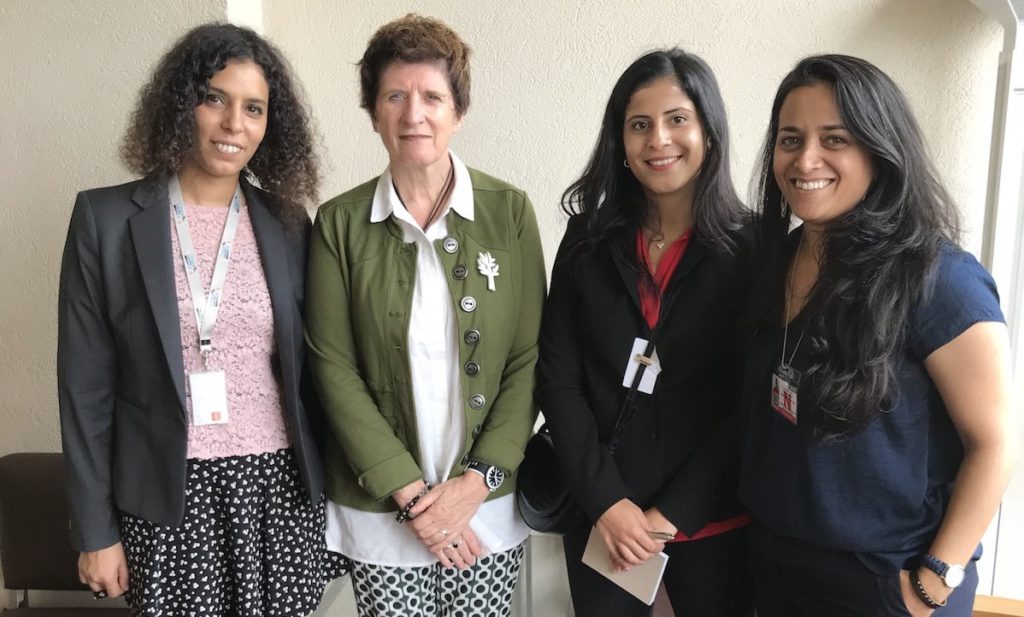
Left to right: Salma El Hosseiny (ISHR), Kate Gilmore (Deputy High Commissioner for Human Rights), Lina al-Hathloul, Uma Mishra-Newbery (Women’s March Global).

Lina, it’s been a busy two and a half days in Geneva at the UN, and you’ve done a tremendous amount. How do you feel?

I feel good, but the thing is I never know if what I’m doing is the right thing. So it’s a mixture of good feelings and bad feelings and stress. We will see what happens and I hope it’s the right thing I’ve done. I don’t know if what I am doing will make a difference—all I have is hope that it will.

You said yesterday that you have no choice but to do what you’re doing right now, whereas the rest of us, who are activists in the movement space, we have a choice in how, when, where we show up. 

Yeah. It’s a very personal issue for me. Because of this I think my heart is always more involved in what I’m doing—compared to other activists—because it’s directly linked to my family. There is a lot of pressure because my family is still in Saudi Arabia while I’m trying to save my sister, but maybe [what I am doing] would harm the rest of my family.

When our family didn’t do anything and we remained silent [when Loujain was first imprisoned], nothing changed and things got worse. So now I have no choice but to speak up. We have seen that when we have spoken up, the torture stopped. So being public is needed, and I need to continue.

You are 24 years old and the resilience that you have, it’s humbling for me to witness. At what age did Loujain start speaking out?

I think Loujian was my age actually, or maybe a year younger. When she started she was in Canada during her studies and she started with the videos. Then she went back to Saudi Arabia and continued, and then started working in the UAE [United Arab Emirates] and never stopped. Even her first imprisonment, she was 24 years old. It was in 2014. I’m speaking out when I’m 24 years old, but she was imprisoned when she was 24 years old. My journey is nothing compared to what she has been through.

I know that doing everything that you’re doing takes a toll mentally and physically. But for you, do you see forward movement? Do you see progress in this?

Yes, I think I do see progress in the sense that her treatment is much better. They allow more visits for my parents. I do see progress because every time… I mean, when we speak up, I see that they don’t mistreat her as much as before and that they truly stick with their engagement [setting up] the visits and calls. When there are no voices anymore for her, the treatment goes down. I clearly see that when we speak up, things go better.

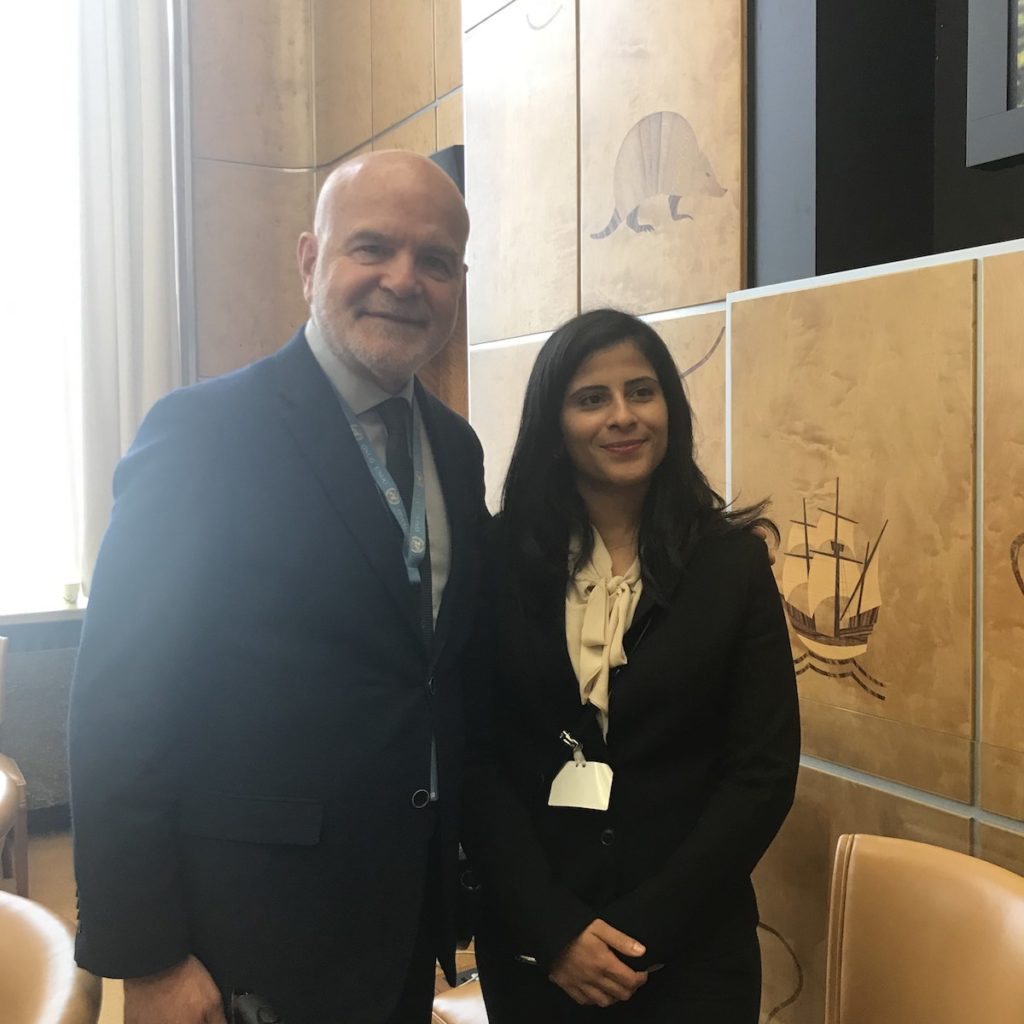
Lina al-Hathloul with Michel Forst, UN Special Rapporteur on the Situation of Human Rights Defenders. 

What do you want the other 24 year olds of the world to know? You’re fighting for your sister, but this is not just about Loujain. This is also about the other women, human rights defenders, that are in prison right now. What would you say to some 24 year old that says, “I’m not affected by this issue?”

I think I understand them, because before Loujain, I thought that all the problems were really far from me—but now that my sister is in prison, I understand that injustice is everywhere.

I think people don’t really realize the power we have with our voices. Speaking up once makes maybe three or four of your friends speak up afterwards and it’s a domino [effect] that really goes fast. If they just make the effort to be in solidarity with this woman once or twice, I really think things could change really fast. I think they have to take the time to read about it and be brave and just speak up.

I can promise things will change for the better if they act

South Africa needs its women human rights defenders

August 23, 2019
Call to action: Former judge Yvonne Mokgoro says society must prioritise women’s rights. (Muntu Vilakazi/City Press/Gallo Images)

Inspired by a lecture on 14 August by former judge Yvonne Mokgoro about the dire social and economic condition of women in South Africa at a women’s month event hosted by the International Commission of Jurists and the Centre for Applied Legal Studies, On 23 August 2019, three women human rights defenders in South Africa (Mateenah Hunter, a human-rights lawyer, and Shaazia Ebrahim and Tim Fish Hodgson who work for the Africa team of the International Commission of Jurists in Johannesburg) published a piece on the plight of women in South africa:

Mokgoro, South Africa’s first black female judge and a retired justice of the Constitutional Court, emphasised in her keynote address that poor, black women particularly continued to disproportionately bear the brunt of the most severe forms of poverty and inequality in South Africa. Poor black women face difficulties accessing a number of constitutionally recognised rights, including education, healthcare, land and housing. This, despite far-reaching constitutional protections of women’s rights and socioeconomic rights in South Africa’s Constitution…

Mokgoro’s moving and passionate address created an open environment in which women human-rights defenders and public-interest lawyers voiced their experiences of gendered socioeconomic rights violations in South Africa.
Mokgoro articulated the deep frustration of South African women with the government and broader society’s failure to act to curb and prevent the social, cultural and economic violence suffered by the women of South Africa. “Women constitute most of society. Why can’t we make women’s rights at the forefront? We must structure the rules to meet the needs of women,” Mokgoro said. She was moved to tears as she spoke.

Tumelo Matlwa and Amelia Rawháni-Mosalakae, lawyers at the Centre for Applied Legal Studies, spoke to the all-too-common difficulties faced by women in South Africa who are married in community of property and who — because of an under-protective legal system and the disinterest of banks in their welfare — unwillingly take on their husbands’ debts. Poverty, they concluded, “is a form of economic violence that has a disproportionate effect on women”.

Fatima Shabodien, feminist activist and strategy director at the Raith Foundation, spoke directly to the sexual harassment crisis in the nongovernmental organisation (NGO) sector in South Africa, which has received extensive media coverage, and about the responses of a number of organisations to allegations of sexual harassment. …She urged human rights defenders, public interest lawyers, boards of NGOs and donors to demand that allegations of sexual harassment are dealt with expeditiously and effectively and that there are real and lasting consequences for perpetrators.

This was brought into sharp relief by Nonhle Mbuthuma, a community land rights activist and member of the Amadiba Crisis Committee. It is primarily women, Mbuthuma indicated, who are risking their lives and wellbeing by signing affidavits to go to court to fight against the use of their land for mining in the name of economic development. [see also: https://humanrightsdefenders.blog/2018/11/25/the-human-rights-defenders-in-ais-2018-write-for-rights-campaign/]

Mokgoro’s intervention was aimed at encouraging lawyers, judges and government officials to reverse this practice that often renders women invisible, thus limiting the transformative potential of the Constitution in their lives. Mokgoro called for an “engendering” of socioeconomic rights towards the social and economic liberation of women from the feminisation of poverty, citing Professor Sandra Fredman.

As young human-rights defenders, we are inspired by Mokgoro’s life, love, learning and labour through which she continues to contribute to the creation of a nonsexist society in which the oppressive effects of patriarchy are eliminated. We take this opportunity, in “Women’s Month”, to remember all those women, who, like Mokgoro, have struggled against the odds to bring us to this point.

  • The many women who risked their lives fighting apartheid and colonialism, including the thousands of women who marched to the Union Buildings in 1956, demanding that the apartheid government withdraw pass laws.
  • The women who fought to secure a seat at the table during our constitutional negotiations despite their initial marginalisation and ensured that women’s rights are now afforded significant constitutional protection;
  • The women who continue to campaign tirelessly for women’s reproductive rights and against gender-based violence.
  • The women public interest lawyers who bring women’s socioeconomic rights cases to our courts.
  • The women in grassroots social movements around the country who continue to claim their constitutional rights and insist that they are written into the story of our constitutional rights jurisprudence.
  • The women in homes around the country giving their love and labour on a daily basis to ensure that care work that is so crucial to our families and communities is undertaken.
  • The women in townships, urban centres and rural areas around the country who work as domestic workers, community health workers, informal traders and farm workers and many other precarious jobs; who sacrifice spending time with their own families to provide them with the basic necessities of life in the absence of sufficient support from the state.
  • The women of Marikana, who are still fighting for simple justice for their murdered husbands and partners and their decimated families, seven years after the Marikana massacre.

………

As Toni Morrison said: “If there’s a [story] that you want to read, but it hasn’t been written yet, then you must write it.” Mokgoro has reminded us that the story of the constitutional realisation of women’s socioeconomic rights has yet to be fully written. And she has inspired us to continue — alongside the many women activists currently doing so —to write it.

https://mg.co.za/article/2019-08-23-00-sas-women-are-fighting-for-social-justice-remarkable-women

New documentary series highlights the struggle of women human rights in Vietnam

August 7, 2019

A new series of video interviews highlights the perspectives and struggles of human rights women in Vietnam.

The 88 Project, an organisation supporting freedom of expression in Vietnam, released the first video of an ongoing interview series with female activists in Vietnam. In the first interview with Pham Doan Trang, a dissident journalist and political activist, she discusses the challenges women face as bloggers and human rights activists: “In general, Vietnamese women are not respected. Not only in democracy activism but in all fields. In democracy activism, female activists are disadvantaged because they get attacked no less than male activists. They get beaten and assaulted. The work they do is no less than their male counterparts. But what they often get from other people is pity. I think it is not respect.” See also: https://humanrightsdefenders.blog/2017/11/18/overview-of-recent-campaigning-for-human-rights-defenders-in-vietnam/

Other women including social activist and blogger Tran Thi Nga, who is currently serving a nine-year prison sentence, have also been seriously injured following physical attacks, often conducted by hired men. Tran Thi Nga’s attack was documented and posted on Youtube with recordings of her being wheeled into a hospital accompanied by her two young children. According to family reports, Tran Thi Nga has been subjected to both physical and psychological harassment after her arrest, receiving death threats and beatings from a cellmate.

According to the 88 Project database, there are currently more than 200 prisoners of conscience in Vietnam with over 30 identifying as female. Bloggers and journalists are frequently arrested and charged for “activities attempting to overthrow the state” or “conducting propaganda against the state”. According to Amnesty International, the Vietnamese government has been conducting a growing crackdown on freedom of expression and peaceful activism over the past few years.

Nguyen Dang Minh Man, a photojournalist and the woman who has served the longest time in prison so far, is expected to be released at the beginning of August.