Posts Tagged ‘UNICEF’

Oldest children NGO in Iran shut down and its founder Hossein Mirbahari arrested

November 8, 2025

On 3 November 2025, the Centre for Human Rights in Iran reported that the arbitrary arrest of child rights defender Hossein Mirbahari and the forcible closure of the Society for the Protection of Child Laborers and Street Children—one of the country’s oldest and most respected NGOs supporting vulnerable children.

Mirbahari, a founding member of the organization, was arrested by security forces at his sister’s home in Tehran on October 15, 2025, and detained without charge. His whereabouts remain unknown, as does the status of his case, and he is being denied access to his family and lawyer. There are serious concerns about his state of health. Security agents also sealed the organization’s office and confiscated equipment and communication devices, effectively halting its operations.

“Mirbahari’s unlawful arrest and the closing of the organization mirror the Islamic Republic’s dismantling of other NGOs, and reflect its intensifying drive to wipe out independent civil society organizations,” said Hadi Ghaemi, executive director of the Center for Human Rights in Iran (CHRI).

In a pattern of increasing judicial harassment, Mirbahari was previously arbitrarily arrested on June 20, 2025, and released after 30 days in solitary confinement upon posting bail, again without lawful cause or disclosed charge.

This latest act of repression comes amid an escalating campaign by Iranian authorities to criminalize humanitarian work and silence independent voices advocating for social justice and the rights of children, women, and marginalized groups.

A knowledgeable source told CHRI that Mirbahari’s physical condition is fragile, following chemotherapy, and his whereabouts and charges against him remain unknown. His family and lawyer have had no contact with him since his arrest.

Two Decades of Children’s Rights Advocacy

Since its founding in 2002, the Society for the Protection of Child Laborers and Street Children has been a lifeline for working and street children across Iran, advocating for the eradication of child labor and all forms of exploitation, and promoting equal rights and humane living conditions for every child, regardless of gender, ethnicity, or religion.

Its activities included providing educational programs, health services, psychological support, and advocacy for social protections such as child and family insurance coverage. The organization also sought to raise public awareness about the plight of working children in Iran and to encourage community participation in child protection.

Operating through eight specialized units —public relations, health, arts, library, education, social work, finance, and research— the society was one of the few NGOs in Iran maintaining a consistent focus on children’s welfare amid tightening restrictions on civil society….

Reza Shafakhah, a prominent human rights lawyer, in an interview with Shargh newspaper on October 13, 2024, said: 

“It is not possible for you to open a curtain and look out the window in the farthest reaches of Iran and not see a child going through a trash can. The fact that nearly 120,000 street children are active in Iran is a form of child abuse.”

Investigative journalism in Arab states: the threats to journalists

February 12, 2024

The Gulf Centre for Human Rights (GCHR) is working with journalists in the Middle East and Northern Africa to investigate various violations affecting the safety of journalists and their ability to do their work.

Investigative journalism: Unveiling the threats to journalists in Arab States

Shutterstock

I find myself wishing there was more protection [for investigative journalists], a sense of safety and even simply just hope. I watch in awe as they investigate crimes that they unfortunately know they could well be victims of in the future, or in some cases already have been.“ Zaynab Al-Khawaja, GCHR’s Journalists Protection Coordinator, working with journalists conducting the investigations

Supported by the Global Media Defence Fund, GCHR’s project Investigating impunity for crimes against journalists in the Arab States, while providing protection has identified a range of threats journalists face, such as arbitrary detentions and gendered threats.

With a strong gender focus, the GCHR ensures that the majority of the investigations are carried out by women, empowering them and shedding light on cases involving women.

One investigation highlights the story of an anonymous woman journalist who quit her job and relocated due to sexual harassment. She writes:

A large proportion of society is aware of widespread harassment in the streets, resulting from an exacerbated hypermasculinity. However, statements by several Iraqi women journalists confirm that this phenomenon did not spare women in press and media outlets, forcing a considerable number of them to quit journalism for good.

The investigation also reported that 41% of women journalists in Iraq have been victims of harassment, forcing 15% to leave their jobs and 5% to quit their profession for good.

This data aligns with UNESCO’s Chilling report, revealing increasing offline and online attacks against women journalists, including stigmatization, sexist hate speech, trolling, physical assault, rape and murder.

Another investigation looked into the imprisonment and silencing of journalists, some facing fabricated allegations of sexual harassment. GCHR collaborates with the NGO Vigilance and 40 partners on a joint appeal to end the persecution and detention of journalists and human rights defenders exercising their right to freedom of expression. GCHR also supported a journalist in the Middle East investigating the case of a disappeared journalist in Syria. 

Since 2022, GCHR and UNESCO have joined forces to support investigative journalism, reducing impunity for crimes against journalists and enhancing their safety through the Global Media Defence Fund. Established in 2019, this fund has supported over 120 projects globally, directly benefiting over 5,000 journalists, 1,200 lawyers and 200 non-governmental organizations.

In 2022, UNESCO published recommendations on addressing violence against women journalists, based on The Chilling, a global research project by UNESCO and the International Center for Journalists (ICFJ). All reports related to this project are available here on UNESCO’s website.

see also: https://humanrightsdefenders.blog/tag/journalist/

https://www.unesco.org/en/articles/investigative-journalism-unveiling-threats-journalists-arab-states

Update on the impact of US cuts to the UN budget

February 21, 2019
Here is what you need to know about how the budget deal between President Trump and Congress will impact the United Nations.

UN Peacekeeping is underfunded.

The budget deal includes$1.551 billion for the “Contributions to International Peacekeeping Activities” account. This is the budget line that funds most of America’s contributions to United Nations peacekeeping operations, including key missions in Mali, the Democratic Republic of Congo, Lebanon and more.  The $1.551 billion appropriated by Congress falls short of this rate by nearly 3%. At issue is an arbitrary “cap” of 25% that Congress imposes on US dues to UN peacekeeping, despite the fact that at the UN, the US had agreed to pay 27.9%. The gap between what is assessed and what is paid by the United States results in an underfunding of UN peacekeeping operations and the accumulation of arrears by the United States, now to the tune of $750 million.

This underfunding of UN peacekeeping is contributing to a major cash crisis for UN Peacekeeping operations. Last month, the UN Secretary General sent a letter to every UN ambassador, warning them that a $2 billion shortfall means the UN only has a few months of cash on hand to sustain its peacekeeping operations.  This budget passed by congress only adds to the these uncertainties facing UN Peacekeeping.

The UN regular budget is properly funded

The “Contributions to International Organizations” account funds the regular budget of the United Nations and also the core budgets of some UN agencies, like the International Atomic Energy Agency and the World Health Organization. The Congressional deal includes over $1.3 billion for this account, which represents a funding level commensurate with the rates the United States is assessed as a dues paying member of the UN. In other words, it is the proper funding level.

The caveat here is that the Trump administration may still try to withhold, or slow walk, the disbursement of these funds in an attempt to punish the Office of the High Commissioner for Human Rights. Last year, the White House sought to withhold $27 million in payments to the UN, which it calculated was roughly the amount that the UN would spend to fund the Office of the High Commissioner for Human Rights and also the UN Human Rights Council. ..

The Budget Deal Thwarts the Trump Administration’s Attempt to Kill UNICEF

In its budget request last year, the White House sought to completely eliminate an account known as “International Organizations and Programs.”  (UNICEF is also funded through this account)…

Congress did not agree to these gratuitous cuts, and maintained a funding level for this account consistent with previous budgets, to the tune of $340 million. The budget also includes consistent funding levels for global health programs like the Global Alliance for Vaccines and Immunizations and the Global Fund to Fight AIDS, Tuberculosis and Malaria. Additionally, the budget includes consistent levels of funding for refugee related programs, including the UN Refugee Agency and the UN Relief and Works Agency, which supports Palestinian refugees. (Alas, it is likely that the administration will nonetheless withhold the disbursement for UNRWA for political reasons.)

In sum, with the exception of UN Peacekeeping, American commitments to the United Nations remained consistent with America’s traditional role as the indispensable member state of the UN.

For more detailed analysis (and the original data upon which this post was written) see this memo from the Better World Campaign.

see also: https://humanrightsdefenders.blog/2018/03/01/without-more-extra-budgetary-funding-human-rights-work-in-the-un-is-in-trouble/

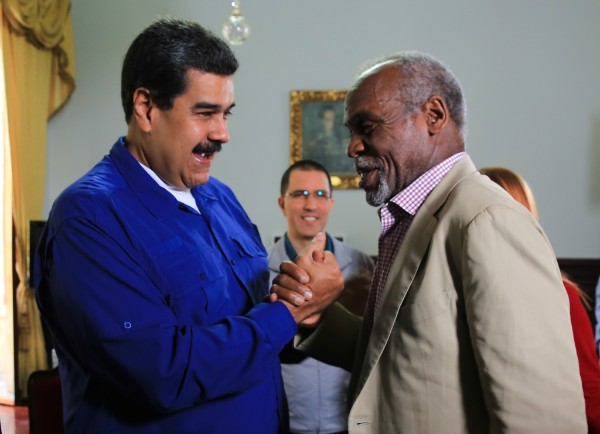
Danny Glover uses his image to brush up venal Venezuela

March 30, 2018

The way celebrities involve themselves in human rights (positively or negatively) has been a topic in this blog several times [see e.g. https://humanrightsdefenders.blog/2014/02/28/and-the-nominees-are-oscars-for-human-rights/ and recently https://humanrightsdefenders.blog/2017/11/10/helen-hunt-joins-list-of-celebrities-that-show-insensitivity-on-human-rights/]. Venezuela has played the game getting star power on its side, but the president of the New York based Human Rights Foundation, Thor Halvorssen, is quite right that when it concerns a UNICEF goodwill ambassador matters become more serious: “…the moment Danny Glover travels to Venezuela using the seal of the United Nations’ highest office that deals with children, then Glover’s statements deserve higher scrutiny,” Thus HRF’s demand that UNICEF should strip Danny Glover from its honorary Ambassadorship.


This Saturday in Caracas, Glover praised Maduro’s government for “advancing humanity through education, health, and other aspects that honor humankind.” Meanwhile, the dictatorship’s economic policies have brought over 30 million Venezuelans into the worst humanitarian crisis in the 200-year history of the country. In 2017, Venezuelans lost 24 pounds in average due to hunger and undernourishment and, according to NGO Caritas, 33% of Venezuela’s 10 million child population has stunted growth.
 
[HRF adds: “Danny Glover has behaved unspeakably in his support for the Venezuelan regime and his motivation is unbridled greed. Eleven years ago, Glover received close to 20 million dollars from the Venezuelan regime to produce a film that was never made, and the funds have yet to be returned to the Venezuelan people. The payment was a crude payoff, masked as a production budget, in order to ensure that Glover was a permanent public relations agent for the Venezuelan government. In doing so, Glover violated American laws regarding registration as a foreign agent. But most of all, he lost all credibility as a spokesperson for human rights,”]

(Early this year, the International Criminal Court in The Hague (ICC), Netherlands, opened an investigation against the Venezuelan regime for crimes against humanity, while the Organization of American States (OAS) has created a commission to investigate gross human rights violations committed by the regime and refer their results to the ICC.)

https://mailchi.mp/e97c4e3f959c/hrf-to-un-fire-danny-glover-from-unicef-ambassadorship?e=f80cec329e

UNICEF: the top ten cartoons for children’s rights

November 23, 2012

UNICEF has just released the ‘Top 10 Cartoons for Children’s Rights’, as selected by polling broadcasters and communicators, to commemorate the 15th anniversary of the Convention on the Rights of the Child. Cartoons for Children’s Rights is a UNICEF broadcast initiative that aims to inform people around the world about children’s rights. So far, the effort has forged partnerships with many well-known animation studios that have developed more than 80 half-minute public service announcements (PSAs). Each PSA illustrates a right described in the global rights treaty, such as ‘Freedom from Child Labour’ or ‘Protection from Neglect’. All the spots are non-verbal, in order to get the rights message across to everyone, regardless of language.