Posts Tagged ‘UNDP’

UNDP sees national human rights institutions (NHRIs) as vital defenders

July 6, 2025
Group of diverse professionals posing together at a conference table in a meeting room.
Annual meeting of the Tripartite Partnership to Support National Human Rights Institutions UNDP

In the face of democratic backsliding, shrinking civic space and complex global crises, national human rights institutions (NHRIs) stand as vital defenders on the frontlines of human rights protection. On 18-19 June, UNDP, UN Human Rights Office (OHCHR), the Global Alliance of National Human Rights Institutions (GANHRI), NHRIs and their regional and global networks, as well as international partners convened to reflect on challenges NHRIs encounter in their daily work and to chart a strategic path forward.

“National human rights institutions are a cornerstone of any democratic system. When properly supported, they help prevent violations, close accountability gaps, and bring the voices of the most marginalized to the forefront,” said Dr. Ammar Dwaik, Director General, Independent Commission for Human Rights in Palestine.

The Tri-Partite Partnership (TPP) to Support NHRIs, a strategic collaboration between UNDP, OHCHR and GANHRI, has played a catalytic role in strengthening NHRIs in 15 countries. Through this partnership, NHRIs have enhanced their capacity, increased visibility and improved outreach to deliver services to marginalized or remote communities, as well as to support people amidst conflict, hostilities or post-crises. Compelling stories of institutional transformation were shared from the State of Palestine, Timor-Leste and Ukraine. 

The TPP has also empowered NHRIs to respond more effectively to urgent challenges, including the impacts of climate change and the digital divide. Innovative practices encompass the use of a real-time Human Rights Dashboard in Nigeria and the development of a digital platform to enhance public engagement in Costa Rica. “We have seen how investments in digital systems are improving institutional quality and deepening human rights impact,” said Turhan Saleh, Deputy Director, UNDP Crisis Bureau.

Discussions on environmental rights and climate justice highlighted experiences from Ecuador, Georgia and North Macedonia, demonstrating how NHRIs supported environmental defenders and helped integrate human rights into national climate responses. 

“We see a direct link between access to environmental justice and the protection of communities’ rights – especially those on the frontlines of climate impacts. Our role has been to amplify these voices and ensure that environmental policy is grounded in human rights,” said Tamar Gvaramadze, First Deputy Public Defender of Georgia.

The TPP Annual Meeting re-affirmed the UN system’s continued commitment to empowering NHRIs as independent, effective, and resilient institutions – essential for upholding human rights, democracy, peace, and sustainable development worldwide. 

see also: https://humanrightsdefenders.blog/2025/03/21/global-alliance-of-national-human-rights-institutions-annual-meeting-2025/

https://www.undp.org/press-releases/catalysts-change-rising-impact-national-human-rights-institutions

10 December 2024: Human Rights Day

December 10, 2024

Here a few highlights for this year from UN and NGOs sources:

While commemorating the 76th anniversary of the Universal Declaration of Human Rights, the United Nations Secretary-General Antonio Guterres said that “human rights are under assault”. “Whether economic, social, civic, cultural or political, when one right is undermined, all rights are undermined,” Guterres said in a post on X. “Let’s protect, defend and uphold all human rights for all people,” he added. In a video message, The UN secretary-general said “we must stand up for all rights — always.

Achim Steiner UNDP Administrator added his voice:

..As we mark Human Rights Day 2024, we are reminded that human rights are not abstract ideals. They are vital tools for addressing these pressing challenges and advancing dignity and justice for all. 

… the United Nations Development Programme (UNDP) works to support human rights solutions that strengthen accountability, protect communities and foster peace, recovery, and stability. This includes partnering with National Human Rights Institutions, which often represent the frontline defenders of human rights. … Local initiatives also remain key. That includes women in Somalia who are being supported to lead peace efforts including assisting those facing violence, discrimination, and injustice. “I have resolved numerous local disputes…I feel motivated when I see I have been able to change people’s lives positively,” says Fatuma who led a local Peace Working Group.

As the accelerating climate emergency threatens the ability of current and future generations to enjoy their right to a clean, healthy, and sustainable environment, UNDP is focusing on access to justice, working with the United Nations Environment Programme (UNEP) and OHCHR to help communities claim their rights. …The private sector also has a pivotal role to play. UNDP supports the implementation of the UN Guiding Principles on Business and Human Rights including to advance sustainable practices that protect the environment. Indeed, technology offers both risks and opportunities to advance human rights. The Global Digital Compact aims to create an inclusive, open, safe, and secure digital space that respects, protects and promotes human rights. Tech-enabled UNDP tools like iVerify and eMonitor+ deployed in over 25 countries to monitor and address false narratives and hate speech show the potential. It is now crucial to adopt a rights-based approach to technologies like A.I., addressing ethical challenges, protecting data, and tackling biases to mitigate risks today and unlock immense benefits for the generations to come. [https://humanrightsdefenders.blog/2024/09/27/united-nations-adopts-ground-breaking-pact-for-the-future-to-transform-global-governance/]

——

The NGO Index on Censorship spotlights four people standing up for human rights around the world:

Despite the declaration, all around the world human rights are being challenged, degraded and attacked. That is why this year, on Human Rights Day, we pay tribute to five human rights defenders who have worked tirelessly to defend people’s rights and have been persecuted as a result. 

Jemimah Steinfeld, CEO at Index on Censorship said:  “In this increasingly polarised and authoritarian world these people stand out as beacons of hope and light. It’s depressing to think that over 75 years since the Declaration, we still need a day like this but that should not detract from the bravery and fortitude of these people. May their example show us all how we can all better fight injustice.” 

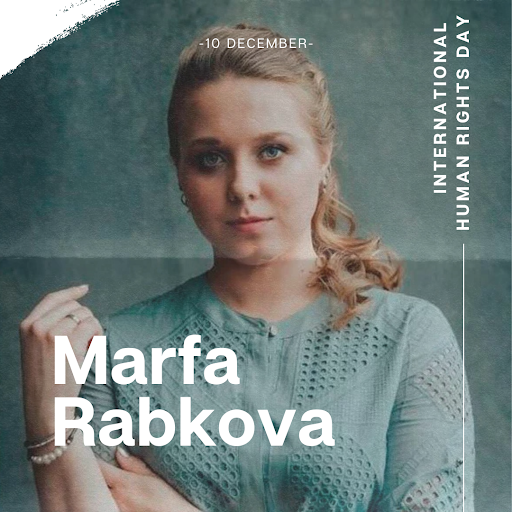
Marfa Rabkova (Belarus) Marfa Rabkova is a human rights defender who has been behind bars since 17 September 2020. She has long been targeted by the Belarusian authorities as a result of her civic activism. Marfa became head of the volunteer service at the Human Rights Centre Viasna in 2019. During the 2020 presidential election, she joined the “Human Rights Defenders for Free Elections” campaign, which registered over 1,500 election observers. When peaceful protests began to take place after the election, she helped document evidence of torture and violence against demonstrators.  Marfa was indicted on a long list of charges, including inciting social hostility to the government and leading a criminal organisation. She was sentenced to 14 years and 9 months in prison in September 2022, after nearly two years of pre-trial detention. Index on Censorship calls for her immediate and unconditional release.  See also:
https://humanrightsdefenders.blog/2021/03/22/belarus-end-reprisals-against-human-rights-defenders/

https://www.indexoncensorship.org/2024/12/human-rights-day-2024-a-tribute-to-human-rights-defenders/

https://www.undp.org/speeches/administrators-statement-human-rights-day-10-december-2024

https://www.coe.int/sl/web/commissioner/-/on-human-rights-day-the-commissioner-calls-for-action-to-realise-the-universal-declaration-s-vision

https://www.ohchr.org/en/stories/2024/12/celebrating-human-rights-day-around-world

UNDP report says Thai human rights defenders are targeted by businesses

February 23, 2024

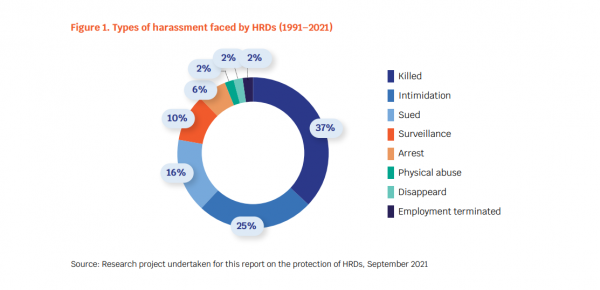
A new UN report claims that, between 2001 and 2021, 30% of outspoken Thai activists experienced violence resulting in a loss of life, by the businesses against which they had campaigned. Released by the United Nations Development Programme (UNDP), on 11 February 2024, the report says that businesses have used legal action, intimidation and violence to silence human rights defenders.

The categories of abuse faced by human rights defenders, per the report.

Activists, affected villagers and attorneys are among the groups considered to be human rights defenders in the report. Over the last 25 years, businesses filed 109 lawsuits against human rights defenders. 68.9% of these were by those with stakes in the mining, livestock and energy industries.

One anonymous interviewee said the lawsuits are used as strategic roadblocks and that they found themselves “going to court approximately once a month, incurring expenses and losing time.” Outside of the judicial system, human rights defenders were reportedly spied upon, or threatened with violence and job loss.

“After making a turn in my car, someone fired shots at me,” claims another anonymous interviewee, adding “I was in the orchard, a single home in the orchard. It was dark. Five shots were fired. I did not report the case, thinking it was an act of intimidation.”

4% of human rights defenders have died or been forcibly disappeared in the 25 years covered by the report, published on February 12th, the International Day for the Prevention of Violent Extremism.

In 2015, Thailand pledged to work towards the fulfilment of the UN’s 17 Sustainable Development Goals (SDGs), alongside other members of the organisation. SDG 16, one of the goals, asks countries to “uphold peace, justice and strong institutions,” and another, SDG 10, aims for “reduced inequalities”.

The report recommends that government and relevant agencies recognize the status and importance of human rights defenders and develop measures that protect them from violence and harassment.

https://www.undp.org/thailand/blog/human-rights-defenders-reports

https://www.thaipbsworld.com/undp-report-says-human-rights-defenders-are-targeted-by-businesses-30-are-victims-of-violence-resulting-in-loss-of-life

UDHR@75: how UNDP sees itself ensuring rights for all

December 11, 2023
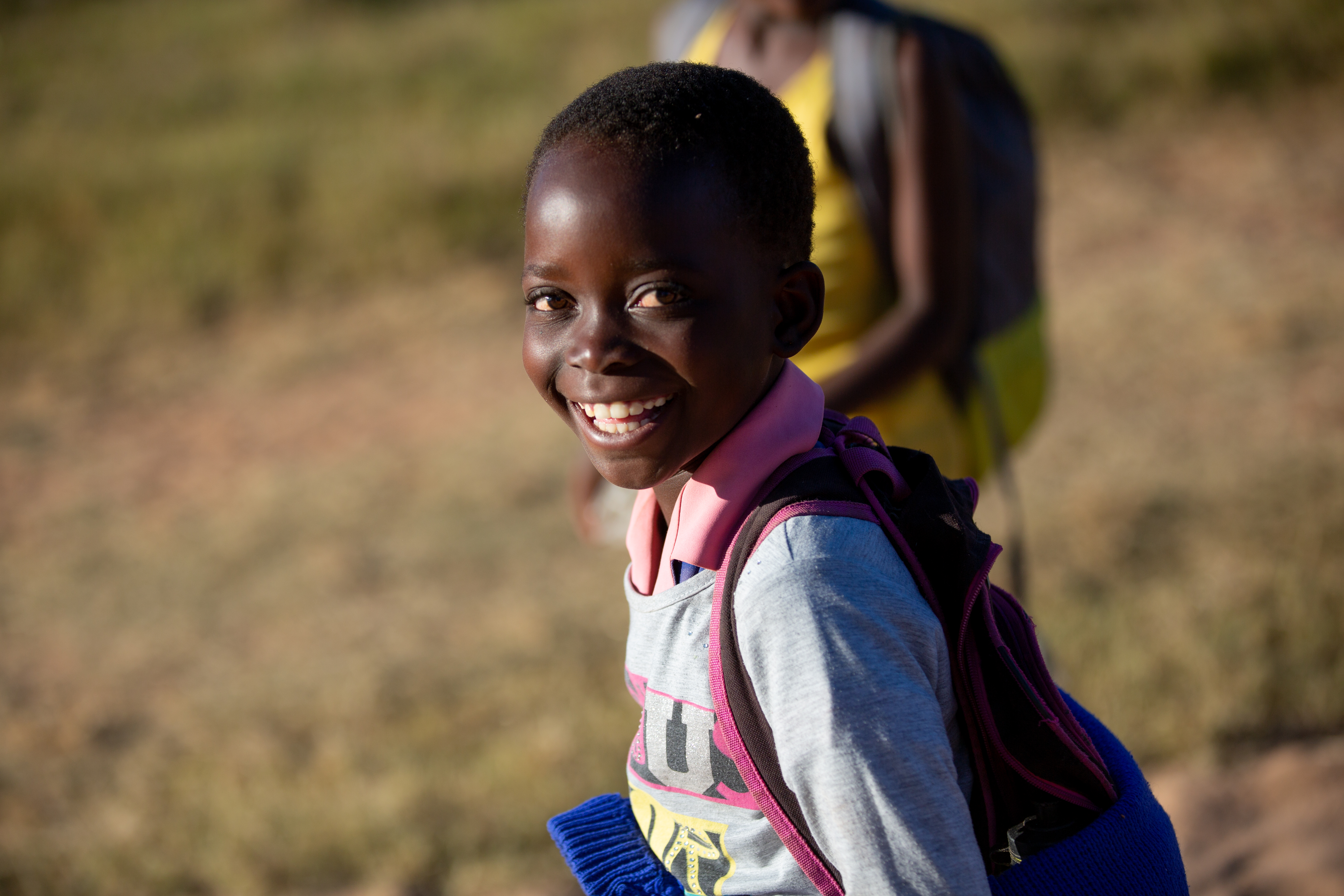
Children smiling
Photo: UNDP Zimbabwe

On 8 December, 2023 the United Nations lead agency on international development, UNDP, posted its commitment to human rights:

..Protecting our rights to do so was enshrined in the Universal Declaration of Human Rights 75 years ago, and it has been our North Star for human rights ever since.  The past three years have been defined by crises on a global scale. Conflict is at its highest since the Second World War. From Gaza to Ukraine, Sudan and Myanmar, people’s right to live without fear is being undermined. Climate change, brought about by humanity’s own actions, is stripping away the right of our children to a healthy and prosperous future. The COVID-19 pandemic brought to stark light the value of the right to health for all.  

Three-quarters of a century on, we are at an important inflection point, where we must recalibrate and reconnect with the principles of the Universal Declaration of Human Rights if we want to shape a future that lives up to its vision.  Doing so will not be easy. It will require action across many different spheres of life. Recognizing this, UNDP is prioritizing seven key areas where it is working to strengthen human rights. 

Dignity and equality of rights is needed for all people and the rights of people living in crisis and conflict must be assured 

If we don’t invest in human rights, we won’t achieve the Sustainable Development Goals 

Ninety percent of Sustainable Development Goals (SDGs) targets align with the obligations outlined in international human rights frameworks.  However, halfway to the 2030 deadline, development progress and the realization of Agenda 2030 is under threat due to the combined impacts of climate change, conflict, overlapping energy, food and economic shocks, and lingering COVID-19 effects. Human rights can be part of proactive solutions helping to address contemporary development challenges and pushing progress towards Agenda 2030.  By adopting a human rights-based approach, UNDP is working to ensure that no one is left behind as we strive for sustainable development. For example, UNDP has worked to promote synergies between human rights and SDG systems in eight countries, including Sierra Leone, Uruguay and Pakistan, boosting both the efficiency and effectiveness of national efforts to advance human rights and sustainable development. 

Human rights defenders must be able to speak out without fear 

Human rights defenders face alarming threats, including intimidation and reprisals, in the pursuit of a goal that should be a shared aspiration for all – the creation of fair and peaceful societies.  In 2022, there was a 40 percent increase in the killings of human rights defenders, journalists, and trade unionists compared to 2021.  UNDP works with civil society, human rights defenders and national human rights institutions around the world to ensure those that want to speak out have the freedom to do so. In Thailand, UNDP conducted a study looking into the protection of human rights defenders at the request of the Ministry of Justice.  

Young people must be included in efforts to protect the rights of future generations 

There are 1.2 billion young people in the world today, and UNDP recognizes the important role they play as positive agents of change. 

Private sector has an important role to play 

Business can be a powerful driver of sustainable development, offering access to social and economic opportunities and a pathway to prosperity for many.  

Human rights and the environment are interconnected 

In the next 25 years, building resilience to biodiversity loss and climate change will be key to the realization of all human rights – including the right to a clean, healthy and sustainable environment.  

Digital technology must unite, not divide 

Technology can be a great enabler of equality and development by improving connectivity, financial inclusion, and public services, positively impacting the realization of human rights.  But it can also have a dangerous downside, exacerbating existing inequalities and vulnerabilities. While over 80 percent of developed countries have access to the internet, only 36 percent of individuals in least-developed countries are online.  UNDP puts human rights at the centre of its Digital Strategy, and supports countries to harness digital technology as a means to advocate for, protect, access, report on, and exercise human rights…

https://www.undp.org/stories/ensuring-rights-all-rapidly-changing-world

UNDP launches a Global Initiative on Business and Human Rights

July 8, 2020

With thanks to Reliefweb for posting on 7 July 2020 here UNDP’s launch of a project to implement the human rights and bussines agenda.

Excerpts from the speech by Mourad Wahba (Assistant Administrator of UNDP and Director of the UNDP Regional Bureau for Arab States):

UNDP has been working on advancing the business and human rights agenda since 2016 when we started a regional programme in Asia, built around the participation and partnership of governments, businesses, Civil Society organisations, National Human Rights Institutions, trade unions and other stakeholders. Our work has been strongly aligned with the UN Working Group on Business and Human Rights, the Office of the High Commissioner on Human Rights, ILO and the OECD.

Our collaboration will now grow. Last week, UNDP launched a Global Initiative on Business and Human Rights building on our achievements in Asia, which will incrementally expand to the rest of the world.

The Global Initiative will have four main fronts:

  1. Supporting governments in developing and implementing National Action Plans;
  2. Strengthening access to justice for victims of business-related human rights abuses;
  3. Advising corporations on how to address human rights risks; and
  4. Enabling peer-learning for government officials, businesses, civil society and national human rights institutions.

We are honoured to partner with the Working Group and OHCHR, to chart the lessons learned since the adoption of the Guiding Principles and accelerate their implementation. Over the coming 12 months we will be hosting regional consultations, which will guide the development of a joint Roadmap for the Next Decade of Business and Human Rights.

Our network of five regional offices and 170 country offices will be leveraged to ensure all relevant stakeholders, including representatives of vulnerable and marginalised groups, are consulted on the way forward.

UNDP believes that the elaboration of this Roadmap should be guided by the goals set in the 2030 Agenda and the Secretary General’s Call to Action for Human Rights….

See also: https://humanrightsdefenders.blog/2020/01/28/ngos-demand-that-rules-against-strategic-lawsuits-against-public-participation-slapp-are-upgraded/

https://reliefweb.int/report/world/project-launch-business-and-human-rights-towards-decade-global-implementation

Ranking of countries on Human Rights: Global Network For Right and Development has a go at it

October 19, 2013

PLEASE NOTE THAT  the website is now suspended!!

Rankings of countries are popular at least with the media and public. That is also true for human rights. There is already the annual Freedom House survey as well as the UNDP development-oriented one.  Now, on 17 October, the Global Network for Rights and Development [GNRD] – created in 2008 and based in Stavanger, Norway – has published a new one, that tries to combine all social and economic indicators. It calls itself without much modesty “the Most Trustful and Complete International Human Rights Rank Indicator“, reflecting Live Data on the respect for human rights in 216 countries. The website states that it acts “in cooperation with various international organizations, governments and other NGOs to make the outcomes full and veritable. More than two thousand individuals all over the world are collecting and entering information constantly. The countries’ human rights rank indicator depends on a complex calculation of the respect for 21 interconnected human rights, including the evaluation of respect for human rights abroad, and the rights’ values. The new Indicator’s website offers to any person from any corner of the world an advantage to influence on the countries’ rank and significantly contribute to the protection of the human rights by registering a violation case in the online system….. Thus, we introduced today a real, free of bias, unique in its implementation International Human Rights Rank Indicator ihrri.com.

The problem is that verification of these claims is not possible without knowing more of the methodology, the data used and especially the ‘authorised organisations’ that are NOT listed. Theoretically the listing is an interesting notion but there must be a reason that most serious human rights NGOs have not done.

In the meantime governmental Gulfnews has already picked up on it: http://gulfnews.com/news/gulf/uae/society/uae-top-for-human-rights-in-arab-countries-1.1244390

via http://www.gnrd.net/vnews.php?id=297

Two Somali Human Rights lawyers killed: in the wrong place at the wrong time

April 16, 2013

On 14 April 2013, two prominent human rights lawyers, Mohamed Mahmoud Afrah and Abdikarin Hussein Gorod, were killed when they were in the wrong place at the wrong time: Al-Shabaab adherents in army uniform stormed Somalia’s main court complex in Mogadishu. They were among the approximately thirty people killed in the suicide attack.

Both Mohamed Mahmoud Afrah and Abdikarin Hussein Gorod have worked for a Legal Aid programme funded by the UN Development Programme in Mogadishu and had previously assisted internally displaced persons and other vulnerable individuals. They had recently defended Abdiasis Abdinur Ibrahim, also known as Koronto, a journalist who was jailed for interviewing an internally displaced woman who said she had been raped by state security forces in Mogadishu. A case referred to in this blog and by Front Line Defenders http://www.frontlinedefenders.org/node/21570