Posts Tagged ‘UN High Commissioner for Human Rights Volker Turk’

Global Alliance of National Human Rights Institutions – annual meeting 2025

March 21, 2025

Οn 12 March 2025 the United Nations High Commissioner for Human Rights Volker Türk addressed the Annual Meeting of the Global Alliance of National Human Rights Institutions

…Our partnership is especially crucial today, when the international system and the global consensus on human rights are under tremendous pressure. Across all regions, we see attempts to ignore, undermine and redefine human rights, to pit one right against another.

Women’s rights are one such example. 

The history of women’s rights has always been one of ebbs and flows. There have been incredibly important advances – universal suffrage, the right to work, property, inheritance, and economic rights – followed by setbacks. 

It has never been a straight path, but there has been progress overall. And the setbacks are temporary, because you cannot turn back the clock on gender equality and on the rights of women and girls. Even if there are those who loudly will try do so, you cannot. 

What is clear is that we cannot take anything for granted and must never be complacent.

Today, among other examples, the challenges include online and offline violence against women and girls, arbitrary limits to sexual and reproductive health and rights, resurgent toxic ideas about masculinity, especially among young men. 

Then there are the extreme cases of oppression and persecution of women such as in Afghanistan and parts of Yemen. 

Amidst all of this, against tremendous odds, and at great personal cost, women human rights defenders have remained steadfast in pushing for gender equality for women everywhere. 

More broadly, despite progress over decades, women still go unrecognized and ignored in many areas of life. 

In a world largely built by men, for men, the gender data gap persists. We need to address the invisibility of women on the data front. For example, women are still largely overlooked when it comes to science, healthcare, and the development of new technologies. According to Harvard University, 70 percent of the people impacted by chronic pain are women. And yet, 80 percent of pain studies are conducted on male mice, or on men.

For women with disabilities, women of African descent, indigenous women and other minorities, the disparities are even greater. For example, there is a 2:1 gender gap in internet access in favour of men with disabilities compared to women with disabilities.

Nearly 60 percent of women’s employment globally is in the informal economy, but the value of that work is often excluded from economic indicators. Women’s productivity and contributions are not captured or valued. And the COVID-19 pandemic made it clear that economies depend on women’s unpaid care work. 

There is a high risk that women will continue to be invisible as an overwhelmingly male generation of engineers develop AI systems and other new technologies.

Women and girls face entrenched discrimination, perpetuated by harmful power dynamics that subjugate and oppress half the world’s population.

Unless we dismantle structural inequalities piece by piece; and until we have full gender parity and equality, women’s rights will be vulnerable to fierce pushback and even manipulation.

The primary duty to promote and protect the rights of women and girls rests with States, in line with international human rights law.

But everyone in society – companies, including social media companies, civil society organisations, and national human rights institutions – has a role to play, and a stake in this issue. 

So much of the progress on women’s rights has been due to mobilisation at the national level. You are the best examples of that.

For example, painstaking advocacy by women human rights defenders led to the adoption of laws and policies on violence against women in a number of countries.

The private sector is working in collaboration with Governments to help to close the gender pay gap in a number of other countries.

These examples of success can inspire communities in other regions, inform international standards and improve the situation for women everywhere. 

As national human rights institutions, your role in promoting and protecting human rights is key. You are uniquely placed as advocates of international law and experts on the national context. 

Human rights are about facts. That is why our work to monitor and report on gender equality at the national level is crucial for legal and policy reform. You can also come up with creative new ideas on how to make women visible in data. 

Human rights are about the law. The right of women, in all their diversity, to have an equal say in all decisions that shape their societies, economies, and futures, is non-negotiable. Your advocacy for full gender parity across all policy areas, from economics to climate, from the design and roll-out of digital technologies to peace negotiations, can help make that law a lived reality on the ground. There are myriad examples within your own work of how to do that.

Within your institutions, you can lead by example by setting a high standard of gender parity and ensuring gender equality in staffing at all levels.

And human rights are about compassion – the glue that unites us in our common humanity. With our societies so divided, we need urgently open spaces for dialogue and joint action by different constituencies who may not always agree: Governments, companies, civil society, religious and faith leaders.  You are uniquely placed to build that space and bring various communities together in a public space for open debate and dialogue.

—-

The UNDP Administrator Achim Steiner participated via videolink.

https://www.ohchr.org/en/statements-and-speeches/2025/03/hc-turk-addresses-global-alliance-national-human-rights

https://www.undp.org/speeches/statement-high-level-opening-ganhri-annual-conference-2025

First assessment of Human Rights under the Trump Administration by HRW

March 5, 2025

Amy Braunschweiger speaks with Human Rights Watch’s US Program Director Tanya Greene, who leads research within the United States, as well as Washington Director Sarah Yager, who advocates with the US government on global issues, about the slew of executive orders President Trump has issued, the damage to human rights his administration’s policies have already done, and where we go from here.The text – reproduced in full below, was published on 3 March 2025.

See also: https://youtu.be/N_hCOCVuJsA?si=t2lUEb3Fw8XWH7Vo where UN human rights chief Volker Türk has voiced deep concerns for hostilities happening across the globe, including a “fundamental shift in direction” of the US. He expressed concern over a peace deal in the Russia-Ukraine war that did not involve Kyiv.

President Trump has been governing by executive orders. Could you give us some quick background on executive orders and what they do?

TG: An executive order is a presidential directive regarding federal government operations and policies. Their reach and power can be extraordinary, including because they often impact federally funded non-governmental entities, like universities and housing providers. Executive orders should be based on existing law, and are often operationalized through agency action, such as the departments of labor, homeland security, or education.

Many of Trump’s executive orders are facing court challenges arguing that they are unconstitutional or otherwise illegal. For example, his executive order denying citizenship to children of undocumented people born in the United States has been stayed by the courts pending a legal challenge. It is widely seen as a clear violation of the 14th amendment to the Constitution.

Although the implementation of executive orders is not always automatic, widespread responses have been preemptive, anticipatory, and fearful, which is likely what Trump intended in this blitz of actions.

SY: These executive orders show how split the United States is. In 2016, Trump’s executive orders reversed former President Barack Obama’s. Then Joe Biden reversed Trump’s orders. And today, Trump reverses Biden’s. But this isn’t typical. It shows the divisive nature of US politics.

It’s also not typical that so many of these current orders are harmful to human rights.

Many of Trump’s executive orders harm human rights, both in the United States and around the world. Meanwhile, billionaire Elon Musk’s “Department of Government Efficiency,” or DOGE, is laying off masses of federal employees at various agencies. What are we most concerned about inside the US?

TG:  Whatever its supposed intentions, DOGE is slashing and burning to the point that a growing number of federal agencies are crippled by lack of resources, staff, and competent leadership. DOGE is also taking down websites and data that we rely on, both as human rights defenders and as the general public seeks information. For instance, hospitals across the country can no longer obtain important public health data from the Centers for Disease Control and Prevention.

Human Rights Watch is investigating the treatment of immigrant children, racial justice impacts, environmental concerns, healthcare access, rights of lesbian, gay, bi-sexual, and transgender people, and reproductive freedoms. You have a president that says diversity, equity and inclusion (DEI) is “dangerous, demeaning and immoral” but offers no ways to fight racial injustice, and yet one of his executive orders allows for resettling certain supposedly-persecuted white South Africans in the US, just after an earlier order closed the refugee admissions door on all other refugees worldwide.

Immigration enforcement raids and other enforcement activities in the last month have targeted all immigrant communities, disproportionately those of color. Enforcement has targeted immigrants regardless of how long they have been in the United States and without considering their contributions to their communities, as well as people in the process of an immigration proceeding, where a judge decides if they can stay in the US.  As a result, there are communities in which many people are terrified and some avoid going to church or the hospital, and many children don’t go to school.

There is also an order now in place defunding reproductive justice and abortion access both in the US and around the world.

The stock value of GEO Group, a company the US government has long contracted with to run private immigration detention facilities, went up immediately after Trump’s election, presumably in anticipation of ramped-up immigration detention in private facilities. Human Rights Watch has long called for investment in community-based public safety solutions rather than more prisons.

What are we worried about in terms of US foreign policy?

SY: The foreign aid freeze and termination of thousands of State Department grants is a key focus for us right now, though of course there are new concerns that rise up every day. The aid being stopped has had awful consequences around the world. People will die needlessly because of this one policy decision.

There is also an impact on civil and political rights abroad. Russian independent media outlets, which have been doing an amazing job exposing the Kremlin’s repression and debunking the official propaganda, received significant US-funding. Terminating aid will severely undercut that work. The same thing with Belarusian independent media.

Many human rights defenders targeted by their governments lived in US-funded safe houses, which are now closed.

Small human rights groups, some the only ones in their country, are on the verge of closing. We’re going to see the ripple effects and deaths in populations unable to stand up for their freedoms without this funding and the political support the United States gave.

Aside from the aid freeze, Trump and Secretary of Defense Pete Hegseth fired the military’s top lawyers. Military lawyers are supposed to ensure US military operations abide by international law, the laws of war.  This could mean far more harm to civilians, who are supposed to be protected, when the US military is in an armed conflict. In fact, Trump also just lifted limits on US commanders authorizing airstrikes and special operations raids outside of war zones, which rolls back 20 years of work to ensure only combatants are targeted and only in recognized armed conflicts.

These kinds of actions will have long-term ramifications on how people around the world view the United States.

When there’s so much happening in a short period of time, how does Human Rights Watch approach its work?

TG: We remember our priorities and how we can make a difference. There’s a lot of noise and distraction so we have to be thoughtful about putting limited resources into efforts that have impact. Our research on immigration raids or deportation flights might be used in partner litigation; our interviews with witnesses to abuses help support policymakers advocating in support of human rights.

As an organization with colleagues who deal with repressive states and authoritarian regimes globally, those of us working in the US are informed of effective strategies and lessons learned as we encounter them here. And we can share this information with partners on the ground and policymakers, too.

SY: We were not caught off guard by this. We were able to plan. I do think the speed, the apparent vindictiveness, and the level of chaos of Trump’s first month in office shocked many people. But we planned for this. We had a strategy that we are now implementing. We are going to engage with every policymaker that we can. We know for a fact many on both sides of the aisle don’t agree with what is happening. We are going to document the Trump administration’s impact on human rights around the world, and we’re going to try and block or end those policies. We are working together with our partners, some of whom focus on strategic litigation – litigation designed to advance respect for and protection of rights.

How is Human Rights Watch responding to this? What is our work inside the US focusing on?

TG: All the areas of work I mentioned are under attack by the new administration.

The immigration space is fraught with misinformation that stokes fears and prejudices, but we counter that with fact-finding and with the stories of the real people who are harmed by dehumanizing rhetoric and policies.  We will build on our track record of careful research on problematic immigration policies from previous administrations, including the first Trump administration, exposing harmful policies such as inhuman and degrading immigration detention and the separation of migrant children from their parents. We are continuing this work, documenting what’s happening to people and using it to advocate for change.

We’ve seen US Immigration and Customs Enforcement (ICE) deporting Iranian families with children to Panama with an agreement that the US will pay for Panama to deport them to Iran. A country cannot lawfully send Iranian asylum seekers to Panama without hearing their claims and just be done with it – sending them back to a country to face persecution violates international refugee law. The administration is also preparing to deport unaccompanied immigrant children – not just cruel and terrifyingly dangerous, but a human rights violation.

In the democracy space, some US voters seem ready to trade freedoms away for supposed gains that are ultimately long-term losses, like increased surveillance, that will embolden and enable bad actors in government.

In the racial equality space, we’ve been working on education, and that is a battle zone. We are doing research to expose state-level policies that censor and distort school curricula in ways that are inconsistent with human rights norms—measures that target the histories and experiences of Black, Indigenous and LGBT people in particular. If those efforts succeed they will be exported to other states.

How is our work responding to changes in the foreign policy space?

SY: The Trump executive order putting in place a sanctions program targeting the International Criminal Court has already done damage. We are working to convince the Senate not to legislate more sanctions, and to make sure other governments step up to defend the court from US pressure.

We continue to focus on some of the conflicts where we think the Trump administration could play a valuable role. When it comes to Sudan, where the US government itself said a genocide took place, the US could pressure allies like the United Arab Emirates to stop supplying weapons to the Rapid Support Forces, one of the abusive warring parties there.

President Trump says he wants to be a peacemaker. There are ways he could do that, but so far we are seeing very worrying foreign policy proposals. For example, Ukraine’s future is being discussed by the United States and Russia without Ukraine, and in Gaza, Trump has proposed permanently and forcibly displacing the Palestinian population, which would amount to crimes against humanity and ethnic cleansing.

Some people would say there is no way to engage with this administration on human rights.

SY: Engaging is certainly more challenging. But we don’t want to just walk away from our advocacy with US officials. Then you give up the power of the human rights movement, and any opportunity to change the minds of policymakers. There are still people in this administration who care about human rights. They may talk about it differently, they may be focused on particular places or issues. We’ll start there and make our case for the US role in lessening suffering and protecting rights around the world, not only because it’s good but because it’s smart and it’s in the US interest.

And there’s Congress, which needs to step up as a check on the power of the White House. We will continue to work with House representatives and Senators on both sides of the aisle.

TG:  The fear that the administration is cultivating among the public is dangerous, and information is so critical in response. That’s why we respond with research, arming people with facts. We know there are members of congress and state leadership like governors that support human rights. They are also empowered by our work.

What can people in the US do in this situation?

SY: If we want to see rights on the agenda, we need to see people in the United States reaching out to their representatives in Congress. They were elected to bring to Washington the needs and desires of their people.

Also, if you see a person acting with courage in these difficult times, thank them. We’re going so fast, and we push and yell and scream, and then when a policymaker, a celebrity, or the head of a local food bank steps out and does the right thing, we move on. Stop for a minute and recognize the people doing the right thing. Make the space for them to keep doing that important work of holding the line.

TG: Also, you too can be that person. Share the information. Have the conversations with your friends and family, provide what you know, encourage exchange of real information. It’s about building community. One of the strongest weapons we have is our unity, and we can each do something to build that.

Religious communities and school groups and community centers, there are many places we can plug in to make a difference. Support your local homeless shelter or food pantry. Sponsor or reach out to refugees and immigrants living in your localities. I think the big risk is feeling powerless and unplugging. I know the temptation is great. We each don’t have to do everything. But if we all do something, that’s more than nothing. And don’t be afraid to hear “no” or lose on your first try. No is the first step to yes.

And remember that there have been people in this country who have been targeted for abuse and destruction by the government their entire time in this country. Us as Black people, Indigenous people. And we’ve not only survived but thrived, and there are lessons to be learned from those struggles. And for the rest of the US population, we are a nation of mostly immigrants who came here to escape ills like human rights abuses or poverty. So gain strength from that.

We’re doing this work for the next generation as well as the present. Not only are we trying to protect rights for them, we are also modeling what to do when you have problems and face difficulties.

https://www.hrw.org/news/2025/03/03/interview-snapshot-rights-under-trump-administration
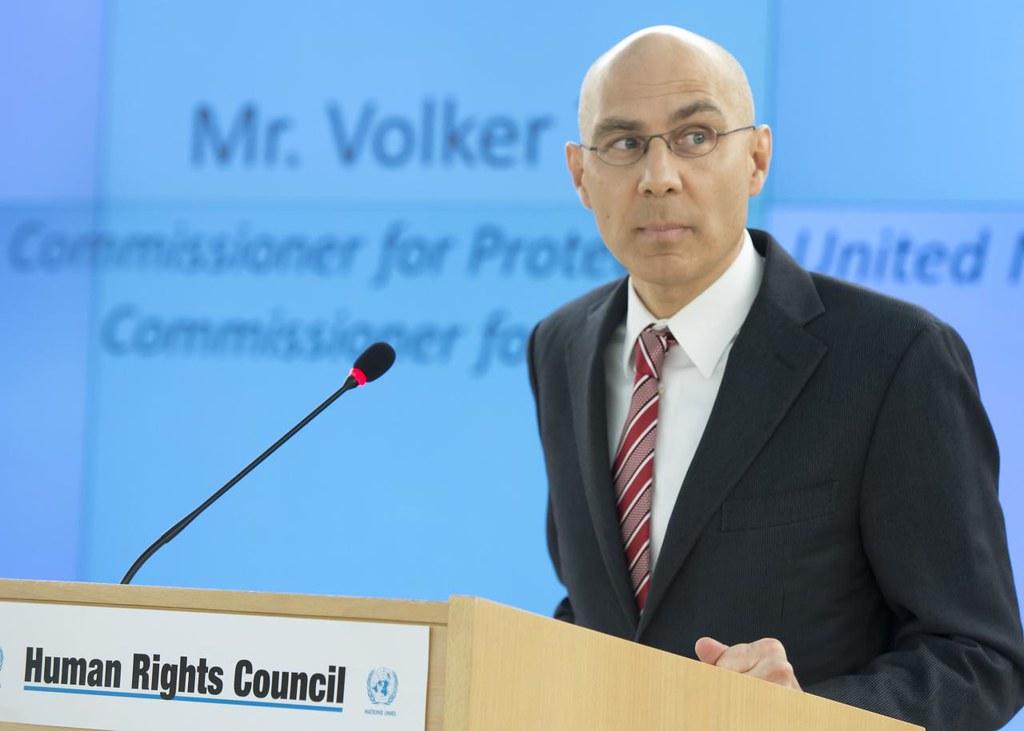
New High Commissioner for Human Rights Volker Turk – the man for an impossible job?

September 15, 2022

On 23 June 2022 Marc Limon, Executive Director of the Universal Rights Group posted a Blog: “Time to ask again: is being the UN High Commissioner for Human Rights an impossible job?”

In February 2018, he published a blog on the early departure of the previous High Commissioner for Human Rights, Zeid Ra’ad Al Hussein. The blog responded to David Petrasek’s article in OpenGlobaRights, entitled ‘Another one bites the dust’ (8 February 2018).

Limon argues that the High Commissioner position is, in fact, several jobs rolled into one. The mandate of the High Commissioner and his/her Office comprises inter alia:

  • Monitoring and speaking out about human rights violations around the world – ‘preventing the continuation of human rights violations throughout the world,’ (OP4f of GA resolution 48/141 of 7 January 1994).
  • Acting as the Secretariat to the ‘competent bodies of the United Nations system in the field of human rights and [making] recommendations to them,’ (OP4b of GA res. 48/141).
  • Providing capacity building, advisory services and technical assistance, at the request of the State concerned, ‘with a view to supporting actions and programs in the field of human rights,’ (OP4d, GA res. 48/141).
  • Engaging in human rights diplomacy (‘dialogue’) with governments and ‘enhanc[ing] international cooperation,’ in order to promote the implementation of international human rights obligations and commitments, and respect for human rights, (OP4g, OP5h, GA res. 48/141).
  • Coordinating human rights mainstreaming across the UN system, (OP4i, GA res. 48/141).
  • Making recommendations and driving efforts to ‘rationalize, adapt, strengthen and streamline the United Nations machinery in the field of human rights with a view to improving its efficiency and effectiveness,’ (OP4j, GA res. 48/141).

It is clear that, when held in the hands of a single human being, these different parts of the High Commissioner’s overall mandate operate in tension and are, perhaps, even mutually incompatible…

Is it possible for one person to wear all these hats at the same time? Can a single person publicly criticise States in one breath, then in the next reach out to them to forge agreement on reform of the UN human rights system or to provide human rights technical assistance?

Petrasek has made no secret of his belief (apparently shared by the UN Secretary-General, Antonio Guterres) that Zeid over-prioritised human rights monitoring and public advocacy, to the detriment of almost all other parts of his mandate. Yet for many other civil society representatives in Geneva and for many Western diplomats, this singlemindedness (together with Zeid’s natural eloquence) made the former High Commissioner something of a cult hero and the perfect High Commissioner,

Fast forward four and a half years and Zeid replacement as High Commissioner, the former President of Chile Michelle Bachelet, has also fallen on her sword – yet for precisely the opposite reasons as Zeid.

Bachelet was handpicked by Guterres to mark a clear break from Zeid by pursuing a more holistic and balanced approach to the role and mandate of the High Commissioner. In addition to public advocacy Bachelet tried to emphasise human rights diplomacy, international cooperation, support for the international human rights machinery, a focus on emerging thematic human rights concerns (e.g., climate change, the right to a healthy environment, prevention, digital technology), and the on-the-ground delivery of technical assistance and capacity-building support.

See: https://humanrightsdefenders.blog/2022/06/09/disappointment-with-un-high-commissioners-visit-to-xinjiang-boils-over/ and

In truth, the world needs a High Commissioner Zeid and a High Commissioner Bachelet. The question is: is that possible? Maybe other solutions might be considered? Might, perhaps, the High Commissioner focus on public advocacy, and the Deputy High Commissioner on the more cooperation-orientated aspects of the mandate? Maybe different Deputies could be appointed for each of the main ‘baskets’ of the High Commissioner’s overall mandate? Or maybe the parts of the mandate related to the human rights machinery could be ‘spun off’ – for example, into a new position of secretary-general of the Human Rights Council and its mechanisms, and of the Treaty Bodies?

These are difficult and sensitive questions, and yet it is surely important that they be asked and considered now rather than later. Perhaps today, as the Secretary-General ponders the appointment of the next High Commissioner, is an opportune moment to do so?

On September 7, 2022, the UN announced Secretary-General António Guterres’ decision to appoint Volker Türk, an Austrian national, to replace Michelle Bachelet.

Reactions were swift, most of them expressing the need for action, e.g. “The new UN high commissioner for human rights should neither seek nor expect a honeymoon period from UN member states,” said Tirana Hassan, interim executive director of Human Rights Watch on 8 September “What’s needed by the millions of people around the world whose rights are being violated every day is an advocate in their corner who will take on abusive governments large and small without fear and without hesitation.”

Yoni Ish-Hurwitz, Executive Director of Human Rights Likeminded Office was invited by the Universal Human Rights Group on 12 September, 2022, to contribute a Blog `’Who is Volker Türk?’:

Opinions have already begun forming about Volker Türk in the short time since the announcement of his appointment last week as the new UN High Commissioner for Human Rights. However, in the absence of a public competition, there was little opportunity to learn about Türk. He is also not well-known outside of the UN (and had few followers on twitter until last week). Therefore, in the absence of personal familiarity, it may be useful to focus on his biography, body of work and statements. This would lead to a better understanding of why he was selected for this role. [DISCLAIMER; I happen to know him personally from my days in UNHCR. He has always struck me as an honest and dedicated person with a pronounced interest in the human rights side of refugee work.]

Central to Türk’s biography is his long professional relationship with the Secretary-General Antonio Guterres. They worked together at UNHCR when Guterres led the agency as High Commissioner for Refugees. When Guterres became UN Secretary-General, Türk joined him in New York, to serve as Assistant Secretary-General for Strategic Coordination in the Executive Office. Guterres promoted him in January, to the rank of Under-Secretary-General for Policy, also in the Executive Office, perhaps setting him up to take the role of the High Commissioner for Human Rights.

Having a close confidant as the High Commissioner may be especially important for the Secretary-General at present, considering the significant current political challenges he faces. This is especially the case in the aftermath of the release of the long-awaited report on Xinjiang by the former High Commissioner, Michelle Bachelet. She spared Türk the need to continue holding this hot potato. However, China won’t let Türk off the hook, and will likely exert pressure on him, as it has done with Bachelet, to carefully weigh his words and the way he manages his Office’s work on China. In the meantime, Chen Xu, the Permanent Representative of China in Geneva, announced that ‘the Office closed the door of cooperation by releasing the so-called assessment.’ This means that this is one political crisis that will not end with Bachelet’s departure.

One key question is whether the new High Commissioner will prioritise engagement over speaking truth to power. Bachelet was criticised of doing just that following her recent statements on China, until she released her report at the 11th hour on the job. .. On the face of it, it may appear that Guterres selected a diplomat, rather than an advocate. Türk is a UN career officer through and through, and as such he is in a better position to offer ‘good offices,’ as the UN does, compared to any former Head of State that could have taken the High Commissioner’s post. Among his predecessors were two presidents, two supreme court judges, one foreign minister and one permanent representative to the UN headquarters. However, every day before walking into his new office, the face that Türk will see first is that of his predecessor Sérgio Vieira de Mello, who also spent most of his career in UNHCR. He was commemorated in a bust at the entrance to Palais Wilson, four years after his death in a bombing at UN headquarters in Iraq.

Türk worked in the UN refugee agency for over 30 years, including in the field. Coming from within the UN system is an asset for navigating organisational politics, fostering collaboration with other parts of the UN, enhancing the contribution of OHCHR to all relevant UN fora, and understanding how to engage with Member States to address the situation of the most vulnerable people. His intimate understanding of the UN system is manifested in two major initiatives he stewarded – the Secretary-General’s flagship report, Our Common Agenda, as well as the Secretary-General’s Call to Action for Human Rights. This may not be the place to analyse their successes or shortcomings, but it can be said that they were both well-received. Our Common Agenda offered a vision for mobilising the UN to address global challenges. OHCHR needs a manager with this kind of foresight to grasp the organisation’s structure, programmes and needs. The second initiative, the Call to Action for Human Rights, identified areas for action to advance human rights. As High Commissioner, perhaps Türk will be in a better position to support the implementation of the Call to Action.

This work demonstrates deep engagement on human rights. His legal background, holding a doctorate in international law, will support his role as an advocate. He can substantively articulate concerns and uphold norms based in international human rights law, humanitarian law and refugee law. He certainly appears as an advocate on twitter (@volker_turk). His tweets show his compassion, as he mostly addresses human rights concerns, with people at the centre.

Civil society was concerned about the selection process. Phil Lynch, Executive Director of the International Service for Human Rights (ISHR), said: ‘The lack of transparency and meaningful consultation with independent civil society in the selection process meant that the Secretary-General missed a key opportunity to build the legitimacy and authority of the next High Commissioner.’ The appointment of the Secretary-General’s confidant may have reaffirmed worries that the High Commissioner would prioritise diplomacy and engagement over advocacy for human rights. However, Türk appears to have the appropriate biography and a heart in the right place to fulfil both of the High Commissioner’s roles as an advocate and a diplomat. Hopefully he will be attentive to civil society and rights-holders, in line with his advice during his time as Assistant High Commissioner for Protection at UNHCR: ‘Listen to what refugees are telling us.’

After being appointed at the last minute as the next UN high commissioner for human rights, Volker Turk is not expected to be at the 51st session of the UN Human Rights Council, held from 12 September to 7 October. When he does, Turk will have to grapple among other challenges with his predecessor’s report on Xinjiang, but for the moment deputy high commissioner Nada Al Nashif is in charge of the UN rights office and will have to answer any questions about China that might come up during the first days of debate..

https://www.universal-rights.org/uncategorized/time-to-ask-again-is-being-the-un-high-commissioner-for-human-rights-an-impossible-job/

https://www.hrw.org/news/2022/09/08/un-new-rights-chief-should-speak-out-all-victims