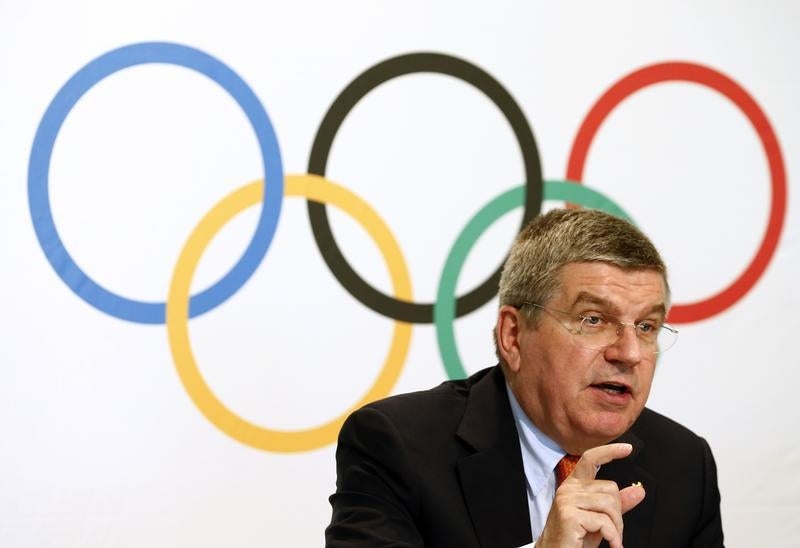
IOC President Thomas Bach said Saturday 2 December 2018 at meetings in Tokyo that “human rights standards” will be included in Olympic host-city contracts, beginning with the 2024 Games in Paris. “Promoting humanistic values in sport has been a core feature of the IOC since its beginning” and “Our mission, to put sport at the service of humanity, goes hand in hand with human rights, which is part of our DNA” But his answers re the Bejing Winter Olympics in 2022 fell short of this lofty language: Bach was asked if the committee would look at human rights in China, where hundreds of thousands of Muslims in western China are being held in interment camps. He said the IOC would not question China because it “has not the mandate nor the authority to solve the human rights problems” that are clearly “political issues. Bach suggested the committee would focus on issues like the rights of transgender athletes. “We should concentrate on what we can really achieve and what we can really do” .
The report covered the period from October 2017 to September 2018, and while it highlights progress it also shows soccer’s governing body still has a lot of work to do. The advisory board only began its work in March 2017, and described human rights as “still in the relatively early stages of being embedded in FIFA’s culture,” acknowledging that past decisions and contracts make it hard to deal with human rights issues. That can be seen by the large number of recommendations involving the Russia 2018 World Cup and the Qatar 2022 World Cup.
Of the advisory board’s six recommendations for Qatar 2022, FIFA still has work to do in two areas: using its leverage to try and improve the ‘kafala’ labor system so that it is more in line with workers’ rights, and encouraging companies linked to World Cup-related employment to do more to meet international human rights standards. The focus on World cups misses out on the same issues at the Club World Cup which takes place in the UAE in December 2018.
The human rights advisory board’s existence appears in some respects to be a reaction to the criticism FIFA received over the decision to award Qatar the right to host the 2022 World Cup, but the World Cup is far bigger than just the stadiums, and ..FIFA’s narrow focus on stadium workers means it misses the chance to create a long-term positive World Cup legacy in regards to human rights.
The report highlighted that FIFA “needs to invest in a sustainable approach” to human rights rather than just provide superficial fixes. Improvements that are made when issues are in the spotlight are often fluid and can be rolled back once the world’s attention swings to another issue.
One issue that the advisory board brought up, and which will be addressed in more detail in the next report, is how women in Iran have been banned from attending men’s soccer matches.
Steve Price on whose article in Forbes this piece is largely based concludes: “The use of soccer as soft power means that FIFA has human rights responsibilities, whether the organisation likes it or not. That FIFA is beginning to acknowledge these responsibilities is a good thing, but FIFA needs to be in it for the long haul, not just as a reaction to the backlash over Qatar 2022. Towards the end of the report, there is a sentence that reads “FIFA has decided to renew the mandate of the Human Rights Advisory Board for another two years until the end of 2020.” For FIFA to really tackle human rights issues, it will need to commit to them for longer than that.”
Now Novak Djokovic and Rafael Nadal have been urged to use an upcoming exhibition match in Saudi Arabia as an opportunity to lend their support to human rights causes. The world’s top-two ranked players will square off against one another at Jeddah’s King Abdullah Sports City on 22 December 2018.
While the world is asking itself literally whether Saudi Arabia will get away with the murder of dissident journalist.Jamal Khashoggi, the two tennis players have both said they’re looking forward to visiting the country for the first time – with both men set to pocket more than $1-million for the match.
Amnesty International says the pair’s visit provides a perfect opportunity for the global stars to lend their support to an important cause. “It’s not for us to say which countries should and shouldn’t be hosting sporting competitions, but it’s also clear that countries like Saudi Arabia are well aware of the potential for sport to subtly ‘rebrand’ a country,” Allan Hogarth of Amnesty International told the Times. “Tweeting support for Saudi Arabia’s brave human rights defenders would be a start.”
On it is not just Khashoggi. For the second time since July, UN human rights experts are calling on Saudi Arabia to “immediately and unconditionally” release all women human rights defenders, including six imprisoned on charges relating to their peaceful defence of human rights. The detained have been charged for being involved in pro-democracy demonstrations, and previously campaigning for the right of women to vote and drive. In late June 2018, a long-standing ban on women driving in Saudi Arabia, was lifted by royal decree, UN Newsreports.
In a statement on October 12, the group of nine independent experts has condemned the actions of the Saudi authorities in continuing to detain the women rights defenders, “in the strongest possible terms,” calling for their “immediate and unconditional” release.
A group of those indicted – Samar Badawi, Nassima Al-Sadah, Nouf Abdulaziz, Mayya Al-Zahrani, and Hatoon Al-Fassi – are being held in detention, without any channels of communication. The five were particularly active in demonstrations for women’s rights. The group of women also include Israa Al-Ghomghan, who faces possible execution despite being denied representation during her trial, and is being tried in Riyadh’s Specialized Criminal Court, an entity set up for terrorism-related cases.
I have written above football clubs (such as Real Madrid) having Emirates as a sponsor [see: https://humanrightsdefenders.blog/tag/fly-emirates/], but this time the club has done something admirable: Saturday 29 September it has honored Palestinian Ahed Tamimi, who was imprisoned for eight months this year for slapping an Israeli soldier after her cousin was shot in the head, was honored Saturday by the Real Madrid football team in Spain.
In December 2017, a video was released of Ahed slapping a soldier in the front yard of her house just hours after her cousin had been shot in the head and put in critical condition by Israeli soldiers who fired at him during a non-violent demonstration. The next day, Ahed and her mother were pulled from their beds in the middle of the night by Israeli soldiers, separated, and imprisoned. Ahed was imprisoned for eight months, and released in July 2018.
17-year old Ahed was greeted by former striker Emilio Butragueno, who presented the teenager with a personalised football jersey. The jersey had ‘Ahed’ printed across the back, and the number 9, which is commonly assigned to strikers who take the front lines of the field and score most of the goals.
(In 2012, her father Bassem Tamimi, was declared a prisoner of conscience by Amnesty International)
In response to the honor by Real Madrid, Emmanuel Nahshon, the Israeli foreign minister spokesman, tweeted in Spanish, “A shame! Real Madrid receives a terrorist who incites hatred and violence. What has that to do with the values of the football?!?!”
On 25 June 2018 a new Center for Sport and Human Rights was established to curb human rights abuses tied to sports and assist victims. The Geneva-based center will also address abuses linked to mega-sporting events such as the Olympics and the World Cup, under way now in Russia [see also: https://humanrightsdefenders.blog/2018/06/07/the-bravest-world-cup-team-in-russia-fifa-human-rights-defenders/]. The center was established under the auspices of the Institute for Human Rights and Business (IHRB), and is chaired by Mary Robinson, the former president of Ireland and former United Nations high commissioner for human rights.
“Major sporting events have been marred by jailing and harassment of journalists, abuses of workers’ rights, environmental destruction, and abusive sweeps of poor neighborhoods,” said Minky Worden, director of global initiatives at Human Rights Watch. “Sports fans don’t want to sit in a stadium built by exploited, cheated, and abused workers – or worse, a facility that cost lives to construct.”
The Centre for Sport and Human Rights will seek to provide resources for learning and remediation, working to limit and ultimately eradicate the serious human rights violations that often accompany world sporting events. It will seek to increase the accountability of those involved, provide a space for victims to share their stories and seek justice, and help prevent future human rights abuses tied to sports.
The platform is an unprecedented coalition of intergovernmental organizations, governments, sports bodies, athletes, local organizing committees, sponsors, broadcasters, nongovernmental organizations, trade unions, employers, and national human rights institutions that have come together to show that sport has the power to create positive change.
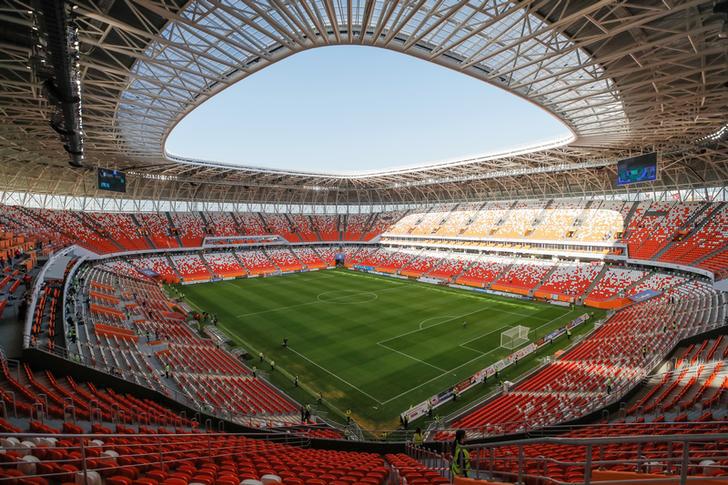
The next World Cup will be hosted by Qatar in 2022. Since December 2010, when Qatar won its bid from FIFA to host the 2022 World Cup, the country has embarked on a massive building spree – restoring or building eight stadiums, hotels, transportation, and other infrastructure. Qatari authorities have said they are spending US$500 million per week on World Cup-related infrastructure projects. It is important for Qatar to respect workers’ rights and to provide remedies for any abuses, Human Rights Watch said. The situation is particularly urgent for workers building the stadiums and other facilities, given the country’s intense heat and humidity. [see also:https://www.ohchr.org/EN/NewsEvents/Pages/DisplayNews.aspx?NewsID=23147&LangID=E]
The Center includes sports organizations like FIFA (The International Federation of Football Association), the International Olympic Committee, UEFA (The Union of European Football Associations), the Commonwealth Games Federation, and other sport institutions seeking to better manage the human rights risks associated with their competitions. It will also include non-governmental watchdogs like Human Rights Watch, Amnesty International, Transparency International, global trade unions, and the UN Office of the High Commissioner for Human Rights.
“Sport has the potential to inspire and celebrate human achievement. So there is no reason one worker should die or one journalist should be jailed to deliver a major sporting event,” Worden of HRW said. “We expect the center to move the ball forward to protect the rights of workers, journalists, athletes, environmentalists, and fans.”
Joe Odell (press officer for the International Campaign for Freedom in the UAE) wrote on Wednesday 6 June 2018 a long piece in the Middle East Eye about the “UAE‘s shameful imprisonment of Ahmed Mansoor“. As the last dissident voice in the Emirates is silenced, it remains to be seen who is left to speak out about injustice in the UAE, he states rightly. As I have posted regularly on him (see e.g. https://humanrightsdefenders.blog/2018/04/13/update-on-mansoor-in-uae-after-one-year-detention-appears-in-court/), will only refer to a few highlights in Odell’s article:
“Last week Abu Dhabi’s Supreme Court sentenced the awarded-winning Emirati human rights activist Ahmed Mansoor to 10 years in prison after finding him guilty of using his social media account to “defame the nation” by spreading “rumours and lies about the UAE” and promoting “sectarian feelings and hatred” among its citizens. It is a ruthless ruling for one of the region’s most prominent rights campaigners, who in 2015 won the prestigious Martin Ennals Award for Human Rights Defenders after his tireless struggle for basic political and civil rights in the UAE.……
It was almost as if the UAE wanted to get this news out in a way that created as little fanfare as possible. Many hours were to pass before the UAE state-owned publication the National confirmed that this was indeed Ahmed Mansoor; international media promptly picked up the story within minutes – no doubt to the ire of the UAE government. Emirati authorities, however, are yet to give an official comment on the court decision. More pertinently, Mansoor’s exact whereabouts remains unknown, leaving the 48-year-old father of four at grave risk of torture and other forms of ill-treatment.
…..Perhaps, in his heart, Ahmed knew this day would come. But he always refused to place himself above the struggle, telling journalist Bill Law prior to his arrest: “The only way to counter repression is by revealing it. And, yes, there is always that possibility that I will go back to jail. But if activists do not talk, who will?”
This knock-on effect has already begun. In the UK, pressure is now mounting on Manchester mayor Andy Burnham to issue a statement on Ahmed’s case after a coalition of 34 NGOs, including Amnesty International and the European Centre for Democracy and Human Rights, demanded intervention. This is a sensitive and fought over issue in a city whose council have burgeoning commercial links with the UAE, and whose football club is owned outright by the Emirates’ deputy prime minister, Sheikh Mansoor bin Zayed al-Nahyan. [see below]
…….Meanwhile, in north London, Arsenal supporters are now questioning their club’s links with the UAE, which began with their move to the Emirates Stadium more than 10 years ago. In response to Ahmed’s sentence, leading Arsenal fan website the Daily Cannon published an editorial calling for a review of the club’s sponsorship deal with Emirates Airline. Perhaps for the first time the UAE’s soft-power project in the UK now lies on contested ground, not only from regional foes, but increasingly from ordinary people across Britain….[ see also my: https://humanrightsdefenders.blog/2015/09/15/fly-emirates-if-the-emirs-let-you/]
And indeed on Friday 3 June 2018, campaigners in Manchester, UK, held a “street renaming” ceremony for Ahmed Mansoor and to highlight the city’s close links with the UAE government. Activists raised a banner saying “Ahmed Mansoor Street” in Manchester, to pressure the city’s council to bring up the case of the blogger who was sentenced to a decade in jail by UAE authorities this week.
The protest took place on Thomas Street, in the city’s fashionable Northern Quarter district. Supporters of Mansoor in the UK have asked Manchester Mayor Andy Burnham to help secure the release of the free-speech activist. The campaigners believe one way that could help is for Burnham to name a street after the 2015 Martin Ennals Award for Human Rights Defenders laureate.
“As the first directly-elected Mayor of Greater Manchester you are in a unique position to show leadership on this issue,” a letter by Mansoor’s supporters to Burnham stated. “Your public support for a street named after Ahmed Mansoor – and calling for his immediate and unconditional release – would demonstrate your commitment to this heritage and these ideals.”
Manchester has deep ties with the Gulf state, including companies and investment groups tied to Abu Dhabi Crown Prince Mohammed bin Zayed al-Nahyan, the de-facto ruler of the UAE. The football club, Manchester City, is also owned by leading Emirati royal Sheikh Mansour bin Zayed al-Nahyan.
On 7 June 2018, one week before the opening of the FIFA World Cup in Russia, Amnesty Internationalcomes with a marvelous contribution: a team of 11 Russian human rights champions who routinely put their lives on the line to defend human rights in Russia. A new campaign, Team Brave, will profile a human rights defender from each of the 11 regions hosting World Cup matches to raise awareness of their important work, and you can send messages of solidarity to show these brave individuals that they are not alone.
“As World Cup excitement builds, we want to highlight the work of the inspiring men and women who risk their lives and freedom to fight for human rights in Russia. The lineup of Team Brave includes activists who have fought to end torture in police stations, protect the environment, defend LGBTI rights and sex workers’ rights, and support victims of domestic violence – they are the real champions in Russia,” said Inga Kelekhsaeva, Russia Campaigner at Amnesty International.
The lineup of Team Brave includes activists who have fought to end torture in police stations, protect the environment, defend LGBTI rights and sex workers’ rights, and support victims of domestic violence – they are the real champions in Russia:
Grozny: Oyub Titiev, the head of the NGO Memorial’s office in Chechnya imprisoned under bogus charges since January 2018
Sochi: Andrei Rudomakha, an environmental human rights defender who was brutally attacked in 2017
St Petersburg: Irina Maslova, who founded a movement to defend the rights of sex workers.
Volgograd: Igor Nagavkin, who worked on fighting torture and corruption in the Volgograd region until he was arbitrarily detained in October 2016.
Rostov-on-Don: Valentina Cherevatenko, a women’s rights activist
Kaliningrad: Igor Rudnikov, an independent journalist investigating cases of corruption until his arbitrary detention in 2017.
Samara: Oksana Berezovskaya, who runs an LGBTI rights organization
Nizhny Novgorod:Igor Kalyapin, who founded the Committee Against Torture
Kazan: Yulia Fayzrakhmanova, an environmental human rights defender
Yekaterinburg: Aleksei Sokolov, who fights torture and other abuses in the prison system
Saransk: Vasiliy Guslyannikov, the founder of the NGO Mordovian Republic Human Rights Centre
Many of these human rights defenders have faced harassment, intimidation, physical attacks, smear and in some cases have been arbitrarily detained simply for carrying out their vital work.
As part of the Team Brave campaign, Amnesty International is asking supporters to take action for three of the human rights defenders featured, who remain in prison to date or whose assailants remain at large.
Oyub Titiev has been detained for almost six months on fabricated charges because of his human rights work. Environmental human rights defender Andrei Rudomakhawas brutally assaulted in 2017 by unknown assailants for documenting illegal construction work on the Black Sea coast, and his attackers still walk free. Igor Nagavkin has spent more than a year and a half in pre-trial detention on trumped-up charges for his work defending prisoners’ rights and combatting torture and corruption.
“The Russian authorities cannot continue to intimidate and harass every critic into silence. With the eyes of the world on Russia, they must decide what they want the legacy of this World Cup to be. There can be no winners in Russia until human rights defenders are recognized, protected and free to do their important work unobstructed and without fear of reprisals.”
[On 29 May, FIFA took the important step of launching a complaints mechanism for human rights defenders and media representatives to report rights violations and committed to supporting human rights defenders and freedom of the press in relation to FIFA’s activities. With the 2018 World Cup taking place amidst a crackdown on human rights by the Russian authorities, FIFA commitments and mechanisms will be put to the test. Amnesty International has urged the Football’s governing body to be ready to confront the Russian authorities and use all of its leverage to effectively protect human rights defenders and stop the 2018 World Cup providing the backdrop for a renewed wave of oppression.] See also: https://humanrightsdefenders.blog/2018/05/24/fifa-expresses-concern-about-chechen-human-rights-defender-but-to-whom/
In less than a month, millions of people will turn their eyes upon Russia as the 2018 Football World Cup kicks off. On 23 May 2018, the NGO Civil Rights Defenders published FIFA’s reply to an open letter it and and 13 other international and Russian human rights groups sent to FIFA, urging the association to start engaging with the Russian authorities on the human rights crisis in Chechnya, especially the case of Oyub Titiev [see also: https://humanrightsdefenders.blog/2018/01/15/chechen-human-rights-defender-oyub-titiev-arrested-on-trumped-up-charges/].
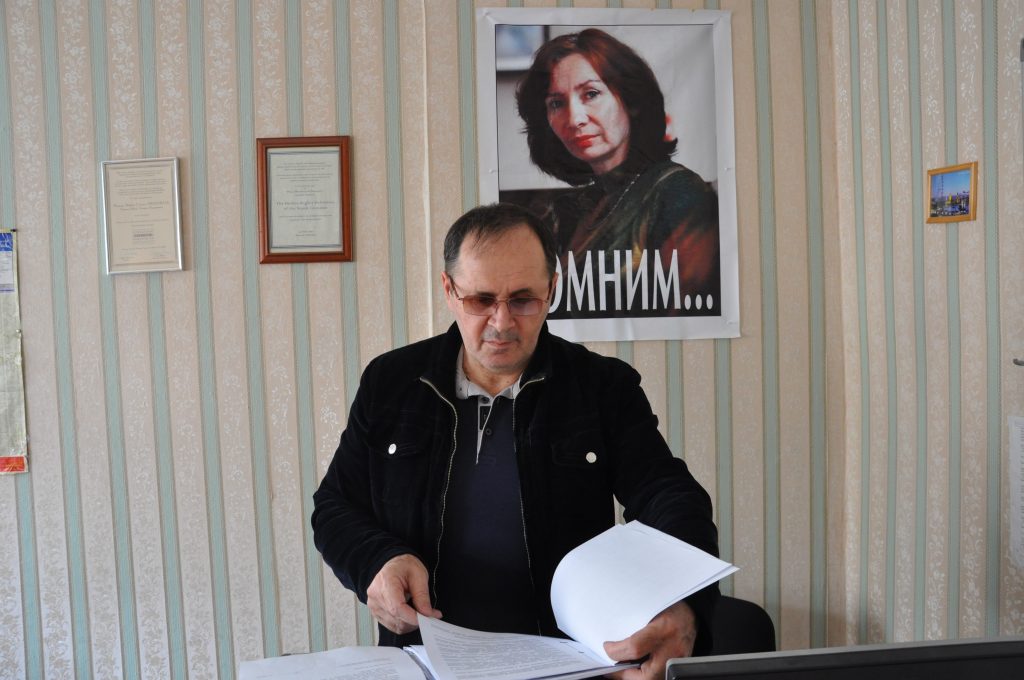
Oyub Titiev in Memorial’s local office in Grozny, Chechnya. In the background a portrait of his murdered colleague, Natalia Estemirova.
[In January 2018, Chechen authorities started a campaign against the leading Russian human rights organisation Memorial, by jailing prominent human rights defender and head of Memorial’s local office, Oyub Titiev, on fabricated charges. In February, it was announced that the capital of Chechnya, Grozny, was confirmed by FIFA as the team base for Egypt.]
“Such engagement is consistent with FIFA’s responsibility to respect human rights under the UN Guiding Principles on Business and Human Rights,” the letter addressed to Mr. Infantino, President of FIFA, read. “It is also consistent with the commitment in article 3 of FIFA’s statutes to promote the protection of international human rights, and would demonstrate determination to implement its new Human Rights Policy”. [see also: https://humanrightsdefenders.blog/2017/02/02/fifa-governance-committee-starts-dealing-with-a-human-rights-policy/]
FIFA has now replied (follow link for full text) to the letter, thanking the rights groups for raising concern about the detention of Oyub Titiev: “… FIFA values the important work done by human rights defenders such as Mr. Titiev and yourselves and is, in accordance with paragraph 11 of its human rights policy, committed to respect and help protect the rights of everyone who is working to advance human rights in relation to FIFA’s activities.”
This is quite a change from the traditional view that politics and sport have nothing to do with each other, but it does not say WHAT and with WHOM in Russia FIFA has taken up the case. That will probably remain confidential.
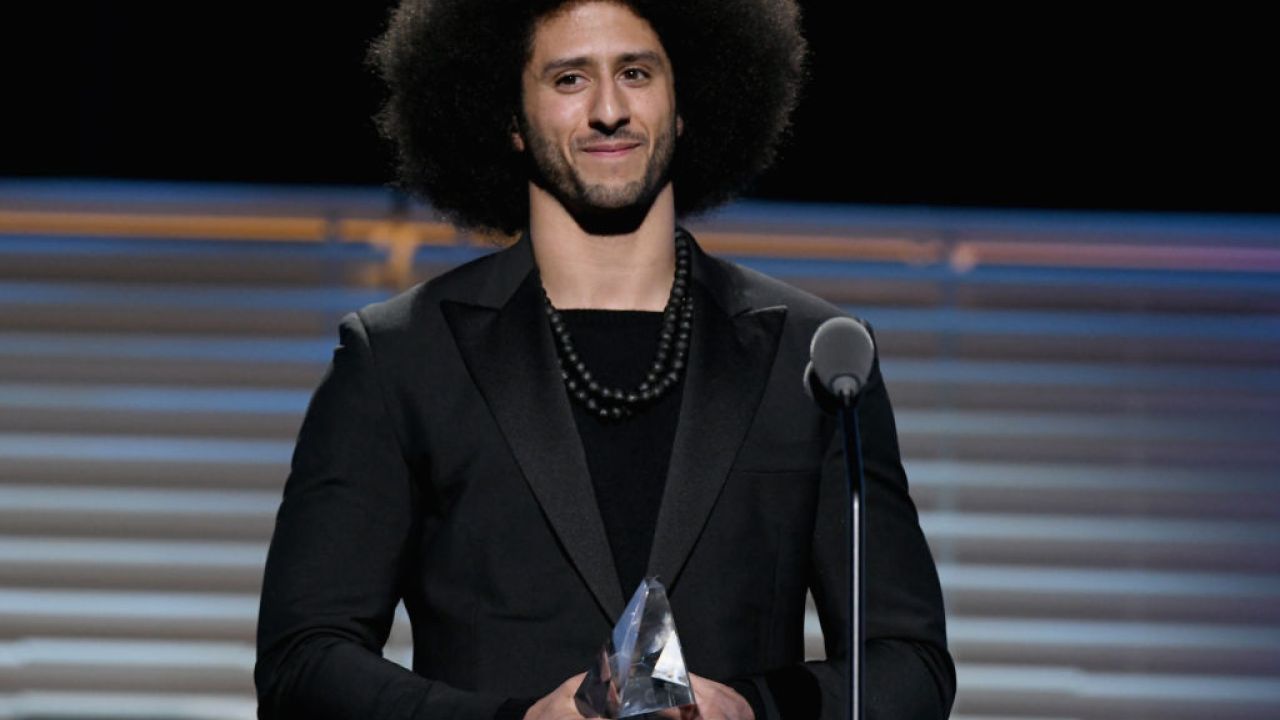
SPORTS ILLUSTRATED 2017 Sportsperson of the Year Show on December 5, 2017 at Barclays Center in New York City.
USA athlete and activist Colin Kaepernick has been honoured with Amnesty International’s Ambassador of Conscience Award for 2018. The award was officially presented at a ceremony in Amsterdam, Netherlands, on 21 April 2018, to coincide with the 50th anniversary of AI Netherlands.
“The Ambassador of Conscience award celebrates the spirit of activism and exceptional courage, as embodied by Colin Kaepernick. He is an athlete who is now widely recognised for his activism because of his refusal to ignore or accept racial discrimination,” said Salil Shetty, Secretary General of Amnesty International. [for more on this and other human rights awards see: http://trueheroesfilms.org/thedigest/awards/ambassador-of-conscience-award]
[During the 2016 pre-season of the American National Football League, Colin Kaepernick knelt during the US national anthem, as a respectful way of calling for the country to protect and uphold the rights of all its people. The bold move was a response to the disproportionate numbers of black people being killed by police. It sparked a movement that follows a long tradition of non-violent protests that have made history. While the polarised response to the “take-a-knee” protest has ignited a debate about the right to protest and free speech, Colin Kaepernick has remained focused on highlighting the injustices that moved him to act. His charity, the Colin Kaepernick Foundation, works to fight oppression around the world through education and social activism, including through free “Know Your Rights” camps which educate and empower young people.]
“I would like to thank Amnesty International for the Ambassador of Conscience Award. But in truth, this is an award that I share with all of the countless people throughout the world combating the human rights violations of police officers, and their uses of oppressive and excessive force. …said Colin Kaepernick. “While taking a knee is a physical display that challenges the merits of who is excluded from the notion of freedom, liberty, and justice for all, the protest is also rooted in a convergence of my moralistic beliefs, and my love for the people.“
See also: https://humanrightsdefenders.blog/2016/05/07/ais-ambassador-of-conscience-award-2016-shared-by-angelique-kidjo-and-african-youth-groups/
For the first time, the IOC has included explicit reference to the United Nations Guiding Principles on Business and Human Rights (UNGP), which outline the human rights responsibilities of businesses, as well as references to anti-corruption standards. The Guiding Principles explain how commercial enterprises should assess human rights risks, take effective steps to avoid human rights problems, and ensure a remedy for abuses that occur in spite of those efforts.
“This is an important step by the IOC for the future,” said Sharan Burrow, International Trade Union Confederation general secretary. “Implementing the UN Guiding Principles across all major global sporting events could help break the cycle of human rights abuses, and this example from the IOC should be applied to all such events, starting now.”
The SRA’s mission is to ensure that sports bodies and mega-sporting events respect human rights, the environment, and anti-corruption requirements at all stages of the process. “Time after time, Olympic hosts have gotten away with abusing workers building stadiums, and with crushing critics and media who try to report about abuses,” said Minky Worden, director of global initiatives at Human Rights Watch. “The right to host the Olympics needs to come with the responsibility not to abuse basic human rights.”
The revised contract requires host cities to “protect and respect human rights and ensure any violation of human rights is remedied in a manner consistent with international agreements, laws and regulations applicable in the Host Country and in a manner consistent with all internationally-recognized human rights standards and principles, including the United Nations Guiding Principles on Business and Human Rights, applicable in the Host Country.”
“If implemented, the revised Host City Contract will help ensure that Olympic hosts respect ‘human dignity’ as required by the Olympic Charter,” said Brendan Schwab, head of UNI World Athletes. “This should have a ripple effect across all mega-sporting events such as the World Cup, and wherever abuses tied to sport still occur.”
[Key provisions of the revised Olympic Host City Contract include:
13. Respect of the Olympic Charter and promotion of Olympism
13.1. The Host City, the Host NOC and the OCOG undertake to abide by the provisions of the Olympic Charter and the IOC Code of Ethics and agree to conduct their activities related to the organisation of the Games in a manner which promotes and enhances the fundamental principles and values of Olympism, as well as the development of the Olympic Movement.
13.2. Pursuant to their obligations under §13.1, the Host City, the Host NOC and the OCOG shall, in their activities related to the organisation of the Games:
a. prohibit any form of discrimination with regard to a country or a person on grounds of race, colour, sex, sexual orientation, language, religion, political or other opinion, national or social origin, property, birth or other status;
b. protect and respect human rights and ensure any violation of human rights is remedied in a manner consistent with international agreements, laws and regulations applicable in the Host Country and in a manner consistent with all internationally-recognised human rights standards and principles, including the United Nations Guiding Principles on Business and Human Rights, applicable in the Host Country; and
c. refrain from any act involving fraud or corruption, in a manner consistent with any international agreements, laws and regulations applicable in the Host Country and all internationally-recognised anti-corruption standards applicable in the Host Country, including by establishing and maintaining effective reporting and compliance.
13.3. The IOC, through its Coordination Commission referred to in §27, shall establish a reporting mechanism to address the obligations referred to in §13.1 and §13.2 in connection with the activities of the Host City, the Host NOC and the OCOG related to the organisation of the Games.
15. Sustainability and Olympic legacy
15.1. The Host City, the Host NOC and the OCOG undertake to carry out all activities foreseen under the HCC in a manner which embraces sustainable development and contributes to the United Nations’ Sustainable Development Goals.]




 Hans Thoolen on Human Rights Defenders and their awards