Posts Tagged ‘prosecutors office’

Exile is ‘a little bit less than death’ for Virginia Laparra forced to flee Guatemala

March 12, 2025

On 5 March 2025 Haroon Siddique in the Guardian wrote about Virginia Laparra, a Guatemalan anti-corruption prosecutor, who spent two years in prison after reporting her suspicion that a judge leaked sealed details of a case. She was forced into exile after being pursued by the country’s conservative elite.

In January last year, she was released under house arrest but in July was jailed for five years for another charge relating to her work. [see: https://humanrightsdefenders.blog/2024/01/04/virginia-laparra-former-impunity-prosecutor-in-guatemala-released/]

Facing the prospect of going back to prison and further charges, Laparra left her two daughters behind to seek asylum across the border in Mexico.

In an interview with the Guardian in London after receiving the Alliance for Lawyers at Risk’s Sir Henry Brooke award honouring human rights defenders, Laparra said: “Nobody goes into exile voluntarily. Exile is the only thing left when nothing else has worked, it’s the only thing you’ve got left to defend your life and your freedom.
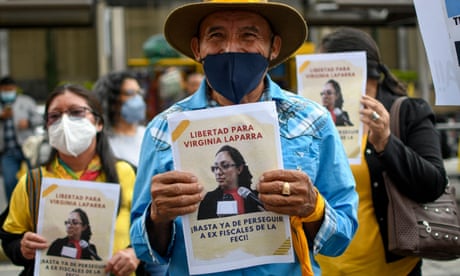
Protesters in Guatemala City demand the release of  Virginia Laparra. ‘This is a political dispute, not a legal one,’ said a member of her defence team.

Exile is just little bit different, a little bit less than death. [Your persecutors] take everything from you, take away your family, your children, your parents, your house, your way of life, your friends.’

Laparra headed a special prosecutor’s office working alongside the International Commission Against Impunity in Guatemala (Cicig), a UN anti-corruption mission that was controversially expelled in September 2019 by the then president, Jimmy Morales. Widespread reprisals followed against those who had worked with Cicig.

When Laparra was taken taken into preventive detention, she said it was as “if I were the worst drugs trafficker in Guatemala. When we drove out of the underground parking in my building there were soldiers, the police, hooded, with heavy weapons on both sides of the street. It was like in a film.”

She spent her first five months in solitary confinement in a windowless 2.5 sq meter cell in a high security jail in Guatemala City, 200 miles away from her Quetzaltenango home, and allowed out for only one hour a day.

She also endured bleeding to the womb in prison but waited months for treatment. Laparra eventually had a hysterectomy and four subsequent operations, during which she said police surrounded “the hospital, the gynaecology area, the operation room, and I had on each side of my bed a member of the police”.

She was later transferred to Matamoros prison, another notorious facility where drug traffickers and gang leaders are held, after she angered the authorities by speaking to a journalist. “My idea was that at least if I’m going to die [in jail], let’s make sure the world knows what happened,” said Laparra.

She considered pleading guilty in the hope that she might be released as both her sentences were commutable, which in Guatemala usually means no jail time is served, but her daughters told her: “Don’t do that, you’ve been here too long to give up now.”

When things reached their lowest ebb, Laparra said she decided to kill herself before remembering the promise she made to her daughters each time they visited – that she would be there the next time they came.

After her release on house arrest last year, she received an award from Guatemala’s current progressive president, Bernardo Arévalo, a surprise victor in the 2023 election. But Laparra believes the award only inflamed the pursuit of her by the public prosecutor’s office led by the attorney general, María Consuelo Porras, who had also tried to stop Arévalo from taking office.

Porras, who has pursued many other anti-corruption prosecutors and judges, also forced into exile her predecessor as attorney general and has been sanctioned by the US for corruption and the Council of the European Union for undermining democracy.

The Fund for Global Human Rights, which nominated Laparra for the Sir Henry Brooke award, and Amnesty International, which named her as a prisoner of conscience in 2022, said they were “deeply concerned about the systematic pattern of criminalisation imposed by the Guatemalan judiciary and the public prosecutor’s office against former judges, prosecutors, human rights defenders and journalists who have worked tirelessly for years to fight impunity and corruption in the country”.

Laparra says she feels proud to have received the award but adds that her persecutors reacted to the news with anger online. “I thought that it wasn’t possible to keep hate burning for so long,” she said. “Surely, two years in prison would have been enough for them, I thought, but it wasn’t.”

https://www.theguardian.com/world/2025/mar/05/virginia-laparra-lawyer-guatemala

Virginia Laparra, former impunity prosecutor in Guatemala, released

January 4, 2024

Following the decision of a judge in Guatemala City to authorize the immediate release of Virginia Laparra, former prosecutor of the Special Prosecutor’s Office against Impunity (FECI) on Tuesday, 3 January, Ana Piquer, Americas director at Amnesty International, said: 

Virginia Laparra should never have spent a day in jail. It’s great news that she can be reunited with her loved ones after nearly two years as a prisoner of conscience. Her release is a first step towards ending the terrible human rights violations she has faced in retaliation for her outstanding work as an anti-corruption prosecutor.” 

“We lament, however, that Virginia Laparra remains convicted of a crime she did not commit and faces another unfounded trial, due to the regrettable use of criminalization against dozens of people who, like her, have led the fight against impunity. Amnesty International reiterates its call for the Guatemalan authorities to put an immediate end to the misuse of the criminal justice system to harass, intimidate and punish judges, prosecutors, human rights defenders and journalists”.

On 28 November 2022, Amnesty International named the former prosecutor as a prisoner of conscience, having found that her detention was solely due to her human rights work as head of FECI in Quetzaltenango, and requested her immediate and unconditional release. In May 2023, the United Nations Working Group on Arbitrary Detention declared that the detention of the former anti-corruption prosecutor was arbitrary and requested her immediate release. At the same time, the international mobilization of thousands of human rights activists on the case has not ceased. 

“Amnesty International underscores the importance of international pressure in cases such as those of Virginia Laparra. Our movement in the Americas and around the world has not rested in demanding the release of the former prosecutor,” said Ana Piquer.

The unfounded criminal prosecution against Virginia Laparra took place in a context of attacks against dozens of people for their role in the investigation of high-profile cases of large-scale corruption and human rights violations. In 2022, there were 3,754 attacks against human rights defenders and at least 73 judicial workers, journalists and activists had to go into exile, according to data from Guatemala’s Human Rights Defenders Protection Unit (UDEFEGUA).

see also: https://humanrightsdefenders.blog/2023/05/10/guatemalan-lawyer-claudia-gonzalez-orellana-laureate-lawyers-for-lawyers-award-2023-ceremony-on-line-11-may/

https://www.amnesty.org/en/latest/news/

Cambodian MEA Laureate 2012 Luon Sovath charged with incitement

November 5, 2014
 
cambodia-luon-sovath-award-oct-2012.jpg

(Luon Sovath after receiving the Martin Ennals Award for Human Rights Defenders in Geneva on 2 October 2012; left myself.  AFP)
 On 4 November Radio Free Asia (RFA) reports that two outspoken critics of Cambodia’s Prime Minister Hun Sen are called to court this month on vague charges of “incitement to commit a crime,” but the defendants say they have done nothing illegal. It concerns the human rights defender and monk Luon Sovath (MEA Laureate 2012) and dissident Sourn Serey Ratha (based in the USA). They received summons dated 22 October (!) signed by Phnom Penh Municipal Court deputy prosecutor Meas Chanpeseth accusing then of “incitement to commit crimes in Phnom Penh, Cambodia and abroad” in 2011, under Penal Code article 495, but the summonses, which ordered the two men to appear in court together in the capital on 25 November, do not specify what crimes they had incited or how their cases were linked.

[Under the Penal Code, incitement is vaguely defined in article 495 as directly provoking the commission of a crime or an act that creates “serious turmoil in society” through public speech, writings or drawings, or audio-visual telecommunication. Luon Sovath faces up to five years in prison if convicted, while Sourn Serey Ratha faces a total maximum punishment of 15 years.]

Read the rest of this entry »

the Crimea and Foreign Agents: a T-shirt tells it all

April 1, 2014

As a result of the annexation of the Crimea, the Russian Procurator-General has found himself in a legal conundrum. The local NGO “Crimea Human Rights Centre” [CHRC] had for years militated in favour of the rights of the Russian speaking majority and insisted on the right to self-determination already in 2005 as the only way to secure their rights.

As the NGO receives funding from abroad (mostly from the Russian government but also from a rich businessman in Abkhazia), it had been forced on 2 February 2014 to register under the new Ukrainian “Foreign Agents law” [see my earlier post: https://thoolen.wordpress.com/2014/01/21/ukraine-follows-russias-example-again-human-rights-defenders-labeled-as-foreign-agents/].

As a result, the members of the CHRC had even been forced to wear T-shirts with the text: “Foreign Agent”. With the integration of the Crimea, several staff members had stopped wearing the hated T-shirts but a certain, Aleksey Baburinko, one of the few Ukrainian human rights defenders left in the Crimea, lodged a complaint saying the CHRC still fell under the law on Foreign Agents, “either the Ukrainian or the Russian version”.

Today, 1 April 2014, the local Prosecutor’s office in Sebastopol issued a statement that wearing the T-shirts was no longer necessary but that the issue of registration would be referred to the new Russian Minister for Crimean Affairs, Oleg Savelyev, who has just been appointed.

Via http://en.itar-tass.com/russia/1april2014

Civil proceedings against ‘Memorial’ under Russia’s Foreign Agents Law continue

November 17, 2013

On 11 November the Prosecutor’s Office brought a civil lawsuit against Memorial before the Leninsky District Court of St Petersburg after administrative charges against the same organisation ‘ for failing to register as a ‘foreign agent were dismissed by the same court. The Prosecutor’s Office initiated the civil suit on the basis that its failure to register as a ‘foreign agent’ would violate the interests ‘of an undefined group of persons’. Frontline Defenders follows this and other cases in which the ‘foreign agent’ harassment of NGOs in Russia continues. The details of the case are illuminating, including the involvement of a preposterous ‘expert“: Read the rest of this entry »

PBI demand guarantees of security for human rights defenders in Mexico

April 12, 2013

During the night of April 3rd, the offices of the Mexican Committee for the Integral Defense of Human Rights Gobixha (Código DH) were forcibly entered. Personnel noticed the entry when they arrived at the office at 8:20am and found the door unlocked and the padlock partially open. They found the computer was turned on and that someone had gone through the records kept at the desk, taking several of them. It is also probable that they went through digital documents found on the computer. These events were denounced before SEGOB, the Special Prosecutors Office for Crimes of Social Significance of the Attorney Generals Office and the Federal Police. In Oaxaca in recent months a climate of intimidation and harassment of community defenders, to whom Peace Brigades International (PBI) provide accompaniment, has been generated. Some of these defenders have also recently been detained. PBI demand that the state and federal government of Mexico secure conditions for the work of human rights defenders!

via Codigo-DH: We demand guarantees of security for human rights defenders: PBI.