Two journalists, one imprisoned in Belarus and the other in Georgia, have won the European Union’s top human rights honor, the Sakharov Prize, European Parliament President Roberta Metsola announced on Wednesday 22 October 2025.
Andrzej Poczobut is a correspondent for the influential Polish newspaper Gazeta Wyborcza. He was convicted of “harming Belarus’ national security” and sentenced to eight years, which he is serving in the Novopolotsk penal colony.
Mzia Amaghlobeli, a prominent journalist who founded two of Georgia’s independent media outlets, was in August convicted of slapping a police chief during an anti-government protest. She was sentenced to two years in prison in a case that was condemned by rights groups as an attempt to curb media freedom.
“Both are journalists currently in prison on trumped up charges simply for doing their work and for speaking out against injustice. Their courage has made them symbols of the struggle for freedom and democracy,” Metsola said at the parliament in Strasbourg, France.
The award ceremony took place on at the Palace Cultural Center in St. Gallen.
Paula Weremiuk from Narewka on the Polish-Belarusian border works as a teacher during the day and as a refugee aid worker in the Bialowieza forest at night. According to the Paul Grüninger Foundation, a refugee drama of enormous proportions has been taking place there since 2021.
Paula Weremiuk searches for people in need in the inaccessible areas of Bialowieza, providing them with clothing, food, sleeping bags and the most basic necessities, writes the Paul Grüninger Foundation. The Belarusian dictator Alexander Lukashenka is forcing thousands of refugees from the Middle East and Africa across the border to Poland, where they are met with strong political rejection.
At the border, in the primeval forest of Bialowieza, there is often brutal violence, abuse, rape and repeated deaths. The refugees, including women and small children, are helplessly abandoned to their fate in the inaccessible terrain and are chased back and forth across the border by the authorities. Refugee helpers are being harassed and criminalized, the press release continues.
Ayşe Gökkan’s award was accepted by her lawyer, Berfin Gökkan. The lawyer read out a letter from Ayşe Gökkan written in Kurdish: “I greet you with the warmth of the sun and the enthusiasm of Jin-Jiyan-Azadî. As a member of the Movement of Free Women, I accept this award on behalf of thousands of struggling Kurdish women. There are many fighting women in prison in Turkey.”
The foundation justified the awarding of the recognition prize of 10,000 francs to the Kurdish feminist and human rights defender Ayşe Gökkan for her civil society commitment and her criminalization:
“Ayşe Gökkan has particularly distinguished herself as a journalist and as an activist for women’s rights. For almost forty years, she has been writing newspaper columns against racial and gender discrimination, speaking at national and international podiums and seminars, leading workshops on the topic of gender inequality and taking part in peaceful demonstrations in this context.
From 2009 to 2014, Ayşe Gökkan was mayor of the Kurdish city of Nusaybin, which lies on the border between Turkey and Syria. When Turkey began to build a wall against refugees between Nusaybin and the neighbouring Syrian town of Qamishlo, the mayor protested against this “wall of shame” with, among other things, a sit-in strike.
Because of her civil society commitment, Ayşe Gökkan has been arrested in Turkey more than eighty times, subjected to more than two hundred investigations and, in 2021, sentenced to more than 26 in a grotesque court case based on the statements of a single “secret witness” for membership in a “terrorist organization”.
She is a victim of the criminalization of the political opposition in Turkey. Ayşe Gökkan is in prison, her sentence has not yet been confirmed by the Turkish Court of Cassation, and proceedings are also pending before the European Court of Human Rights.”
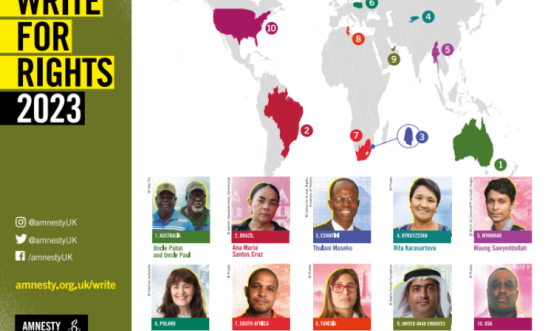
Amnesty International launched its flagship Write for Rights campaign to help people facing human rights abuses around the world. Millions of letters and emails will be sent to support these individuals and urge authorities to end injustices. ‘While sending a letter may seem like a small gesture for any single one of us, the collective action of many of us has the potential to transform lives’ said Sacha Deshmukh, Chief Executive of Amnesty International UK.
Taking place across November and December, Write for Rights will see people around the world send millions of cards, emails and social media posts of solidarity to individuals whose fundamental rights are being threatened or denied, while urging those in power to put a halt to the abuses.
This year, the global Write for Rights campaign will focus on 10 cases of individuals and communities from across the world who are facing human rights violations, including:
Rocky Myers, a Black man, has been on death row in Alabama, USA, since 1994. A nearly all-white jury convicted and sentenced him to life without the possibility of parole for the murder of his white neighbour. The trial judge overrode their decision and imposed a death sentence – a practice now outlawed in Alabama. No evidence linked Rocky to the murder, except for a VCR stolen from the victim, which he maintains he had found abandoned in the street. In 2018, Rocky and others on death row were given 30 days to choose if they wanted to die by nitrogen gas asphyxiation or by amended lethal injection protocols. Rocky chose the former, and his execution could be reset as soon as the new protocol for execution by nitrogen gas asphyxiation is finalised and ready to be implemented, which is expected by the end of this year.
Rita Karasartova, a Kyrgyzstan-based human rights defender who works for the Institute of Civic Analysis – a human rights organisation and think-tank. Rita was arrested in October 2022 for joining group of activists who objected to a border demarcation agreement with Uzbekistan. After the group called for a public assembly and formed a committee to oppose the agreement, Rita and others were charged with attempting to violently overthrow the government, which carries a maximum sentence of 15 years imprisonment. Rita is now under house arrest and a strict curfew.
Ahmed Mansoor is a human rights defender and previously won the prestigious Martin Ennals Award for Human Rights Defenders in 2015. Ahmed has documented human rights abuses in the UAE since 2006, until he was arrested in early 2011 and March 2017, he was given a 10-year prison sentence. He has been held in solitary confinement since the beginning of his detention, and continues to be denied a mattress, access to books, and to be permitted to go out in a yard. See: https://humanrightsdefenders.blog/tag/ahmed-mansoor/ and https://www.trueheroesfilms.org/thedigest/laureates/074ACCD4-A327-4A21-B056-440C4C378A1A]
Justyna Wydrzyńska is a reproductive rights defender in Poland and is one of the co-founders of the Abortion Dream Team, an activist collective campaigning against abortion stigma and offering advice on accessing safe abortion in Poland, where abortion laws are among the most restrictive in Europe. In March 2023 Justyna was convicted to 8 months’ community service for helping a pregnant woman to access abortion pills in Poland, setting a dangerous precedent in a country where abortion is almost completely banned.
Amnesty International’s Write for Rights campaign dates back to the origins of Amnesty International in 1961. In the organisation’s early days, Amnesty campaigners wrote letters of support to individuals facing human rights violations. Now, Write for Rights is Amnesty’s flagship campaign, running every year to raise awareness about individuals whose rights are being seriously threatened.
Last year’s Write for Rights saw:
Over 5.3 million actions worldwide – of which at least 234,801 letters and cards were solidarity actions.
Letters were sent from around the world, from Zimbabwe to Hong Kong.
Amnesty’s International Secretariat digitally collected almost double the number of digital actions from 2021.
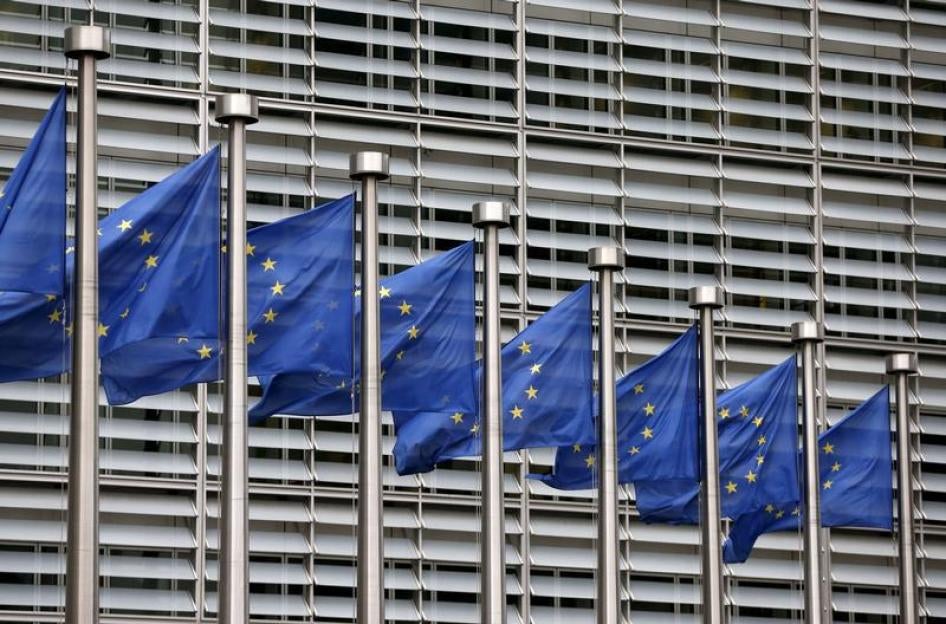
On 26 June 2023 HRW called on Spain use its six-month tenure as EU Presidency to translate into concrete and bold actions commitment to protect fundamental rights and the rule of law.
Spain holds the presidency as the world marks the 75th anniversary of the Universal Declaration of Human Rights (UDHR) on 10 December 2023. In anticipation of this pivotal moment Spain should make every effort to uphold the rights and values enshrined in this historic document.
HRW calls upon the Spanish government to consider the following priority issues and recommendations:
Fundamental Rights and Rule of Law in EU member states
Two EU member states – Hungary and Poland – currently face scrutiny under Article 7 of the Treaty on European Union (TEU)…
The freezing of EU recovery and cohesion funds under the conditionality mechanism represents a welcome step but it is insufficient to address the gravity of the erosion of rule of law and human rights. While Hungary and Poland have adopted some limited measures in response to requirements under the mechanism, these have failed to address fundamental and long-standing concerns. ….We urge the Council to hold the Polish and Hungarian governments to account by using the powers conferred to it under the Treaties and to fulfil the strong mandate to act given to it by the European Commission and Parliament. The urgency of Spain’s leadership and responsibility cannot be overstated as it is one of only two remaining presidencies before Hungary and Poland in turn assume leadership of the Council. It is highly likely that during that time progress on rule of law will at best stall, and at worst Article 7 scrutiny will come to an end altogether…
Rights-Respecting and Principled EU Migration Policy
Spain’s EU Council presidency comes at a critical time for the EU’s migration policy after the Council agreed on 8 June on a negotiating position on an EU-wide reform of its asylum and migration system. Given its mandate to lead on behalf of member states the negotiations with the European Parliament on a final agreement, Spain has an opportunity to broaden the scope for a rights-respecting approach.
We call on your government to:
Support the establishment of proactive, state-led SAR operations in the Mediterranean Sea that could involve expanding the mandates and capacity of existing initiatives like EUNAVFOR MED and Frontex, funding professional rescue NGOs and ensuring predictable disembarkation.
Promote a discussion on the critical role of NGOs to ensure that they are fully able to carry out their lifesaving SAR activities, instead of facing obstruction and criminal and administrative penalties; and provide platforms for discussion of cooperation between member state rescue coordination centers and NGOs.
Advocate for independent and effective border monitoring mechanisms to document human rights violations at EU external borders, such as unlawful pushbacks, to ensure accountability for those responsible for human rights abuses and access to justice for victims.
Ensure that migration cooperation with third countries, and all provision of financial, technical, and material assistance, are contingent on clear and verifiable human rights commitments.
Enable a constructive trialogue on the asylum procedures regulation and the asylum and migration management regulation with a view to limiting the use of accelerated border procedures, the detention of asylum seekers including families with children, and discretionary use of the “safe third country” concept.
Promote a discussion on establishing more safe and legal pathways for migration as called for by EU Justice and Home Affairs Commissioner Johansson.[8]
Human Rights as a Pillar of EU’s Foreign Policy
The EU is equipped with solid instruments to ensure that human rights protection remains at the centre of its external action. The EU has shown resolve in its response to Russia’s invasion of Ukraine and has led at the United Nations to address key human rights crises.
..
During its Presidency, we call on your government to:
Continue to combat impunity for crimes committed in Ukraine, including by providing adequate resources to the International Criminal Court’s (ICC) regular budget, advocating and supporting the implementation of ICC arrest warrants, pressing Ukraine to ratify the Rome Statute and supporting independent investigations and prosecutions under universal jurisdiction.
Continue to support Human Rights Defenders (HRDs) at risk and share your experience with other EU member states. Encourage other EU member states to learn from and replicate Spain’s forward-leaning approach with the Program for Support and Protection of Human Rights Defenders at Risk that provides dedicated one-year residential visas for HRDs. Advocate with EU member states to use their discretion and facilitate access by HRDs to multi-year multi-entry Schengen visas in line with EU guidelines.
…
Recalibrate EU’s engagement with China to address the government of China’s human rights record through measurable deliverables; counter the government of China’s flawed narratives on its own human rights record; reject efforts to undermine international human rights institutions; lead the creation of a UN investigative and monitoring mechanism for crimes against humanity committed in Xinjiang; sanction or hold accountable those responsible for such crimes; and make plans to reduce dependency on a government that assaults human rights both domestically and in its foreign policy.
Human Rights First announced that it will present Grupa Granica with the William D. Zabel Human Rights Award 2022 in recognition of its commitment to human rights at the Poland-Belarus border.
“Grupa Granica are front-line human rights defenders working at a flashpoint for human rights and freedom of migration,” said Michael Breen, president and CEO of Human Rights First. “We hope that Human Rights First’s presentation of the William D. Zabel Award provides additional recognition to the importance of their work and helps to stem this humanitarian and geopolitical crisis.”
Formed in 2021 in response to the humanitarian crisis at the Polish-Belarusian border, Grupa Granica is an informal network of Polish NGOs, activists, and inhabitants of the border region that provides humanitarian, medical, and legal aid to migrants stranded in the forests there. They monitor the situation on the ground, provide assistance to people searching for missing family members, document human rights violations and educate Polish society on the situation at the border.
“Our network was formed in August last year in response to the humanitarian crisis at the Polish-Belarusian border. It consists of local inhabitants, activists, NGO staff, doctors, lawyers, interpreters, psychologists, public figures and many others working hand in hand to save the lives of migrants stranded at the border,” says Marta Górczyńska of Grupa Granica. “This prestigious award sends a clear message to the public that despite the recent attempts by the Polish authorities, providing humanitarian aid and defending human rights must never be criminalized. We hope it will also make it more difficult for the international community to turn a blind eye to the violations at the border.”
The 2022 award will be officially presented to Grupa Granica on June 8.
Poland must investigate all allegations of harassment of human rights defenders, including media workers and interpreters, at the border with Belarus, and grant access to journalists and humanitarian workers to the border area ensuring that they can work freely and safely, UN human rights experts* said on 16 February 2022.
“I am receiving several reports of harassments from human rights defenders who assist migrants and document human rights violations against them at the Polish-Belarusian border, and I am deeply concerned at this practice,” said Mary Lawlor, the Special Rapporteur on the situation of human rights defenders.
Jakub Sypiański, a volunteer interpreter assisting migrants and asylum-seekers, was reportedly stopped by armed soldiers when driving home in November 2021. The soldiers, who were in an unmarked vehicle, did not identify themselves nor explain their actions. They forced open the car door, took the keys out of the ignition and tried pulling him out by his legs.
“Most of the migrants at the border do not speak Polish,” said Mary Lawlor. “Interpreters play a vital role in ensuring their human rights are protected both at the border and in immigration detention centres.”
At around the same time, armed soldiers reportedly harassed journalists covering the arrival of migrants and asylum seekers. Soldiers who did not identify themselves stopped, searched and handcuffed photojournalists Maciej Moskwa and Maciej Nabrdalik outside a military camp. The soldiers searched their equipment, scrutinising their photos, and documented their phone messages and incoming calls.
Journalists Olivia Kortas and Christoph Kürbel, along with two local Polish residents, were allegedly harassed by soldiers while filming a documentary about the human rights situation of migrants at the border.
“Reports that these journalists are being persecuted for documenting such human rights violations are appalling,” said Irene Khan, the Special Rapporteur on the right to freedom of opinion and expression. “Their work is crucial for everyone’s access to information about the situation unfolding at the border. If they are not allowed to do their job, there are very serious consequences for the human rights of migrants”.
“Interpreters and journalists, along with medics, lawyers and others who peacefully work for the protection of human rights or who provide humanitarian aid, are human rights defenders, according to the UN Declaration on Human Rights Defenders. Poland should bear this in mind and ensure that they are able to carry out their legitimate work in a safe and enabling environment and with full access to the border area,” said Lawlor.
The experts are in contact with the Polish authorities on the matter.
The experts’ call was endorsed by: Mr. Felipe González Morales, Special Rapporteur on the human rights of migrants, and Ms. Elina Steinerte (Chair-Rapporteur), Ms. Miriam Estrada-Castillo (Vice-Chair), Ms. Leigh Toomey, Mr. Mumba Malila, and Ms. Priya Gopalan, Working Group on arbitrary detention.
The decision on February 16, 2022 by the Court of Justice of the European Union to allow EU institutions to tie funding to EU states to respect for the rule of law clears the way for strong action by the European Commission, Human Rights Watch said. The EU Court’s ruling dismissed the actions brought by Hungary and Poland against the new conditionality mechanism.
“The EU Court has sent a clear signal that EU funds should be used in ways that uphold rather than undermine Europe’s democratic values,” said Philippe Dam, Europe and Central Asia Advocacy Director at Human Rights Watch. “The EU Commission should now act swiftly and demonstrate that defending the rule of law is at the top of its agenda.”
In December 2020 the EU adopted a regulation creating a new conditionality mechanism to protect the EU budget from rule of law breaches by an EU member state. A last-minute deal among EU member states obliged the Commission to wait for a ruling by the EU Court of Justice before finalizing the guidelines for applying the conditionality mechanism. Hungary and Poland brought legal action before the EU Court seeking to annul the rule of law conditionality mechanism in March 2021, initiating that process…
The court’s ruling confirms that “compliance by the Member States with the common values on which the European Union is founded (…) such as the rule of law and solidarity, justifies the mutual trust between those States.” The Court added that the EU “must be able to defend those values.”
The European Commission should demonstrate its stated commitment to protect the rule of law and democratic values in the EU by swiftly initiating procedures provided by the regulation, Human Rights Watch said. It should seek to suspend, reduce, or prevent new agreements to provide EU funds to a member state if it finds that the state has failed to respect the rule of law.
In applying the conditionality mechanism, the European Commission should ensure that a broad range of breaches to EU’s democratic values could lead it to recommend cutting funds to EU member states. These should include attacks on the independence of the judiciary, as well as state interference with media and civil society. The Commission should also seek to ensure that EU funding cannot be used to promote intolerance or discriminatory policies, including against women and lesbian, gay, bisexual, and transgender (LGBT) people and other minorities.
The Commission should also ensure that carrying out this procedure does not punish EU citizens for the actions of their governments, including by negatively affecting their economic and social rights. The Commission should conduct human rights impact assessments to determine the risk that people’s rights would be harmed by any decision and should divert rather than cut funding as required, to ensure that beneficiaries’ rights are not affected.
Hungary and Poland, the two EU countries that initiated legal action against the regulation, are already facing scrutiny for their poor rule of law records under the Article 7 procedure – the EU treaty provision dealing with governments that flout EU values, which can ultimately lead to the suspension of their voting rights in the Council. Hungary is among the largest recipients of EU funding per capita, and Poland is the largest overall net recipient.
Poland’s government has eroded judicial independence and ignored recent EU Court of Justice decisions. It also used its politically compromised constitutional tribunal to undermine women’s rights and the binding nature of EU law. LGBT and women’s rights activists face threats and harassment. In Hungary, restrictive laws target civil society groups, and the government or its supporters control most media outlets. A June 2021 law banned discussion on gender identity and sexual orientation, putting health providers, educators, artists, and broadcasters at risk of sanctions.
EU member states also have a serious responsibility to ensure that all member states respect EU’s democratic values and the rule of law. On February 22 they will hold a hearing on the situation of the rule of law in Poland under the Article 7 procedure. But since Article 7 was triggered in 2017 on Poland and in 2018 on Hungary, other EU member states have failed to take further action to hold those two governments to account.
..Proceedings under Article 7 should remain the cornerstone of the action against the erosion of EU values in countries like Hungary and Poland. The EU is equipped with the tools needed to stand up against member states that disregard the EU’s own democratic values, Human Rights Watch said. What has been missing is political will by the EU Commission and by leading EU member states to take decisive action and to hold states responsible for abuses to account.
“The EU Court ruling underscores that EU institutions can fight back against the erosion of the rule of law within the bloc, but much depends on the European Commission quickly building on this momentum,” Dam said. “Tying EU money to EU values and strengthening scrutiny of rule of law abuses should go hand in hand to demonstrate that EU membership and respect for the rule of law are inseparable.”
Mirage news of 8 June 8, 2021 tells the sad story of Artur Ligęska, a 40-year-old Polish citizen who has spoken out widely about torture and ill-treatment in Emirati prisons. He was found dead in his apartment in Amsterdam, the Netherlands on May 26, 2021. The Gulf Centre for Human Rights and Human Rights Watch are deeply saddened by the news of his death and extend their sincere condolences to his friends and family.
Following his release from al-Sadr prison in May 2019, Artur dedicated himself to seeking justice for the abuse he and other prisoners suffered in prison, especially Ahmed Mansoor, an award-winning human rights defender who is on the advisory boards of GCHR and Human Rights Watch. [see: https://www.trueheroesfilms.org/thedigest/laureates/074ACCD4-A327-4A21-B056-440C4C378A1A]Artur was a uniquely valuable source of information on prison conditions in the United Arab Emirates (UAE).
He was an activist, author, and fitness expert and had recently celebrated the second anniversary of his acquittal on May 9. He had been sentenced to life in prison in the UAE following a deeply flawed trial on drug charges despite the absence of any evidence of drugs in his possession.
In a voice message to a friend at GCHR on May 9, Artur said, “My main wish for this new-life birthday is freedom for Ahmed Mansoor. I really do hope that this year will be special for him. I was thinking all day about him. I remember our last talk, and I was thinking about his wife and kids. …In the last days, Ahmed told me ‘Don’t forget about me.’”
Artur said he was planning to organize a protest in The Hague soon to call for Ahmed’s release. Artur’s many actions to help Ahmed included advocacy with Polish and EU officials, providing human rights groups with information, taking part in human rights events, documentary films and TV appearances, and writing about Ahmed in his two books.
Artur first phoned GCHR staff in April 2019 to tell them that Ahmed was on a hunger strike and told them that he was worried that Ahmed might die because his health had deteriorated greatly. He told GCHR that Ahmed was being held in “terrible conditions” in a cell with no bed, no water, and no access to a shower. Ahmed today remains in a 2-by-2 meter isolation cell with no bed or mattress, serving a 10-year prison sentence for his human rights activities.
Despite suffering serious trauma after suffering abuse as a prisoner in the UAE, Artur again phoned GCHR to share the good news that human rights groups’ advocacy had been successful. Ahmed had ended his hunger strike after being allowed to phone his ill mother and to go outside to see the sun for the first time in two years. Artur sacrificed phone calls to his own family to make calls on behalf of Ahmed, referring to him as a brother.
Following his release, Artur was able to provide GCHR with more details about what he called the “medieval prison conditions” in al-Sadr prison, including periods when there was no running water despite extreme heat.
Artur told GCHR that after he left the UAE, he had undergone surgery and therapy to treat the damage done by the rape and psychological torture that he said he was subjected to but he was recovering well and taking classes to become a journalist and human rights professional.
On April 13, 17 European Parliament members wrote to the EU’s High Representative Josep Borrell to express their “deepest concern over the ongoing human rights violations in the United Arab Emirates, particularly with regards to the systematic crackdown on freedom of speech and expression and the subsequent retaliation received during detention.” The letter mentions Ahmed, and also refers to Artur, noting, “The use of torture has not been limited to Emirati nationals, as there have also been instances of EU citizens that have reported facing brutal torture at the hands of prison authorities.”
On October 22, 2020, Amnesty Westminster Bayswater and GCHR held an online event, The Prisoner and the Pen, featuring the writing, songs and poetry of prisoners who are human rights defenders and the work of writers and artists from the Middle East and North Africa region. The event, held on Ahmed ‘s birthday, included his poems. Artur read from his memoir, “The Sheikh’s Different Love,” published in 2019 in Polish. He has also written a second bestselling book in Poland, “Prison Diary.” His story is documented in a film by Hossam Meneai, Isolation Cell 32, which debuted at the Polish Film Festival in America in November. Artur also appears in an upcoming documentary about Ahmed Mansoor made by Manu Luksch.
Artur’s untimely and unexpected death comes as a great shock to those who knew him. The Dutch police are investigating the circumstances of his death.
Hussein al-Qaidi, director of the Office of Rescuing Kidnapped Yezidis for the Kurdistan Regional Government (KRG), has been named the recipient of the Sergio Vieira De Mello Prize, which is awarded yearly in Poland (!) to individuals and organizations which promote human rights and dialogue.
Qaidi is a Yezidi, born in the Duhok province of Iraqi Kurdistan. In 2014, after ISIS overran the Yezidis’ homeland, he organized campaigns to find missing people, free them, and help then return to a normal life.
The KRG supported Qaida’s efforts and already in August 2014, he was named to lead a new unit: the Office of Rescuing Kidnapped Yezidis. It is based in Duhok, and Qaida remains its head.
Last November, Qaida received the prestigious Mother Teresa Memorial Award for rescuing thousands of Yezidi women from the clutches of the ISIS terrorists.
Raoof hopes that the award will put Yezidis in the spotlight again in Poland, since previous awards were widely reported in the Polish media.
“I believe that it will once again make Polish people aware of the difficult fate of Yezidis and also show that there are still many people and organizations helping Yezidi people with great courage and commitment, ”he continued.
Unfounded charges of “offending religious beliefs” are being brought against three women human rights defenders in Poland for simply exercising their right to freedom of expression, a coalition of six nongovernmental groups said. The first hearing in their case is scheduled for November 4, 2020, in the town of Plock.
The Prosecutor General should drop the charges – and ensure that the three women can carry out their human rights work without harassment and reprisals by the authorities. The Polish authorities should amend their legislation in line with international and regional human rights standards and abstain from using it against activists to unduly curtail their right to freedom of expression.
The three human rights defenders, Elżbieta, Anna and Joanna – whose surnames are not being used to protect their privacy – are facing trial for “offending religious beliefs” under Article 196 of the Criminal Code (C.C.) in relation to the use of posters depicting the Virgin Mary with a rainbow halo symbolic of the LGBTI flag around her head and shoulders. The authorities are alleging that the three activists pasted the posters on 29 April 2019 in public places such as on portable toilets, dustbins, transformers, road signs, building walls in public areas in the city of Plock and have “publicly insulted an object of religious worship in the form of this image which offended the religious feelings of others”. They now face up to two years in prison if found guilty for their peaceful activism.
The authorities arrested and detained Elżbieta in 2019 after she took a trip abroad with Amnesty International. The authorities opened an initial investigation against her in May 2019 and in July 2020, they officially charged the three activists.
Having, creating or distributing posters such as the ones depicting the Virgin Mary with a rainbow halo should not be a criminal offence and is protected under the right to freedom of expression.
In its current formulation, Article 196 of the Criminal Code imposes undue restrictions on the right to freedom of expression by providing overly broad discretion to the authorities to prosecute and criminalise individuals for expression that must be protected. This is incompatible with Poland’s international and regional human rights obligations.
Poland is bound by the International Covenant on Civil and Political Rights (ICCPR), the European Convention on Human Rights as well as the Charter of Fundamental Rights of the EU to respect, protect and fulfil the right to freedom of expression.
Furthermore, in 2013, the Special Rapporteur in the field of cultural rights noted that “Restrictions on artistic freedoms based on insulting religious feelings… are incompatible with [ICCPR]”. In 2019, this was again highlighted by the Special Rapporteur on freedom of opinion and expression who stressed that criminalising expression that insults religious feeling limits “debate over religious ideas and… such laws [enable] governments to show preference for the ideas of one religion over those of other religions, beliefs or non-belief systems”. Freemuse is particularly concerned about the policing of artistic and creative content by the authorities in Poland and regard it as an unlawful attack on freedom of artistic expression.
Amnesty International has previously called on the Polish authorities to repeal or amend legal provisions, such as Article 196 of the Criminal Code, that criminalises statements protected by the right to freedom of expression, for example in the report ‘Targeted by hate, Forgotten by Law: Lack of a coherent response to hate crimes in Poland’. Many other national and international human rights organisations have criticised provisions of the Polish Criminal Code, including Article 196, as problematic because they constitute restrictions on the right to freedom of expression not permissible under international human rights law.
International human rights law permits states to impose certain restrictions on the exercise of the right to freedom of expression only if such restrictions are provided by law and are demonstrably necessary and proportionate for the protection of certain specified public interests (national security, public order, protection of health or morals) or for the protection of the rights of others (including the right to protection against discrimination). When restricting the right to freedom of expression to protect public order or morals, the Human Rights Committee, which interprets the ICCPR, observed that states must not base their restrictions on principles deriving “exclusively from a single tradition” e.g. Christianity. States may impose certain restrictions on certain forms of expression if they can demonstrate that such restrictions are necessary and proportionate to the specified purpose (that is, the measure is designed to be effective in achieving its goal, lesser measures do not suffice and without putting in jeopardy the right itself). The current formulation of Article 196 of the C.C. does not appear to pass the test of proportionality and necessity. ..
The organisations recall that everyone has a right to express themselves safely and without fear of reprisals, and that the right to freedom of expression is protected, even if some people might find the expression to be deeply offensive (Human Rights Committee, General Comment 34 on Freedom of Expression, para. 11). In the words of the European Court of Human Rights the right to freedom of expression “is applicable not only to information or ideas that are favourably received or regarded as inoffensive or as a matter of indifference but also to those that offend, shock or disturb the state or any sector of the population”.
Elżbieta, Anna and Joanna now face up to two years in prison if found guilty under the unfounded charges brought against them. The case against them is not unique but an example of the repeated harassment activists and human rights defenders face simply for carrying out peaceful activism in Poland, which Polish and international human rights organisations have documented and denounced at length in the last several years.
Elżbieta, Anna and Joanna stood against hate and discrimination and for years they have been fighting for a just and equal Poland. They deserve to be praised and not taken to court for their activism.
At the time of her arrest in May 2019, she had just returned from a trip to Belgium and the Netherlands with Amnesty International, where she participated in several events and advocacy meetings with activists and supporters to raise awareness about the situations of peaceful protesters and the crackdown they are facing in Poland.



 Hans Thoolen on Human Rights Defenders and their awards