
Joseph DeCaro of Worthy Christian News reports on 19 August 2013 how human rights defenders could play a role in preventing the escalation of religious conflict in Pakistan: Read the rest of this entry »
share information on human rights defenders, with special focus on human rights awards and laureates

In its concluding observations, the United Nations Committee on the Convention on Elimination of All Forms of Discrimination against Women (CEDAW) has asked Pakistan to improve in key areas of education, legislation, employment and public and political participation of women. The observation were shared and discussed at a consultation organised by Aurat Foundation. Human Rights activist Tahira Abdullah highlighted the challenges and constraints in the way of implementation of CEDAW and Naheed Aziz discussed role of civil society in application of CEDAW. ……. In its other recommendation regarding education, the committee has asked the government to prevent the occurrence of attacks and threats against educational institutions which undermine women and girls’ fundamental rights. The committee-members have urged Pakistani government to prevent, investigate, and punish gender-based violence by non-state actors in conflict affected areas and have suggested the government to conduct an assessment of the impact of the conflict situation on women and girls and strictly enact legislation regulating the trade, sale and possession of small arms. The Committee has asked the government to ensure the safety and protection of women human rights defenders and mobilize adequate resources to address the specific risks and security needs of women’s rights defenders.
via CEDAW calls for improvement in key areas of education, legislation, employment – thenews.com.pk.

(Magamed Abubakarov)
Magamed Abubakarov, a Russian human rights lawyer specialized in terrorist cases in the North-Caucasus, will receive the Lawyers for Lawyers Award 2013. Magamed Abubakarov will accept the award on 31 May at the end of a seminar called ‘Lawyers controlled, independence at stake?’ in Amsterdam. Read the rest of this entry »
For many years Dublin-based Front Line Defenders has continued a practice of issuing official-looking cards to whom they judge to be genuine human rights defenders. It is interesting to note that the news service Authint has picked up on this and issued a statement on 2 April 2013 saying: Defenders has issued an identity card to local human rights activist Abdul Qadeer Dar [in Kashmir]. Dar is an Executive Director of Voice of Victims and Chairman Peoples Rights Movement.” “The card is for those human rights defenders who have worked very closely with or have attended one of the Dublin Platforms or trainings”, Front Line told KNS. The “Card doesn’t empower the holder to represent Front Line defenders as it is not a membership organization. The card is intended to demonstrate that its holder is human rights defender with whom front Line Defenders has worked”.
Ms. Perveen Rehman (56), worked for the betterment of the poor and neglected

A statement of 14 March 2013 by the Asian Human Rights Commission (AHRC) starts dramatically with this “When a small lady weighing hardly 60 kilograms working for the betterment of poor slum-dwellers, and amongst the under-privileged in poorer residential areas, is viewed as a dire threat to the Taliban and the local administration, the sanity of these institutions, and those that man them, is called into question. However, with yesterday’s murder of Ms. Perveen Rehman, an even more fundamental question confronts us: the raison d’être of the Pakistani state itself.”
Ms. Perveen Rehman, an architect by profession, was targeted and murdered in broad daylight yesterday, March 13th. Fifty-six years of age, having worked for the poor and underprivileged for 25 of them, Ms. Rehman was murdered close to her office as she arrived in a car. Armed men riding two motorcycles approached and opened fire on her. She was struck twice in the face and once in the neck. She was rushed to the Abbasi Shaheed Hospital where she succumbed to her wounds. It is believed that she was assassinated by Deobandi militants of Ahle Sunnat Wal Jamat (ASWJ). These are said to be the same militants responsible for the deaths of the four anti-polio workers and the attack on Malala Yusufzai.
The statement then continues to describe Ms. Rehman as a tireless social activist, working for people living in slum areas. She had, however, been receiving death threats for some time. Read the rest of this entry »
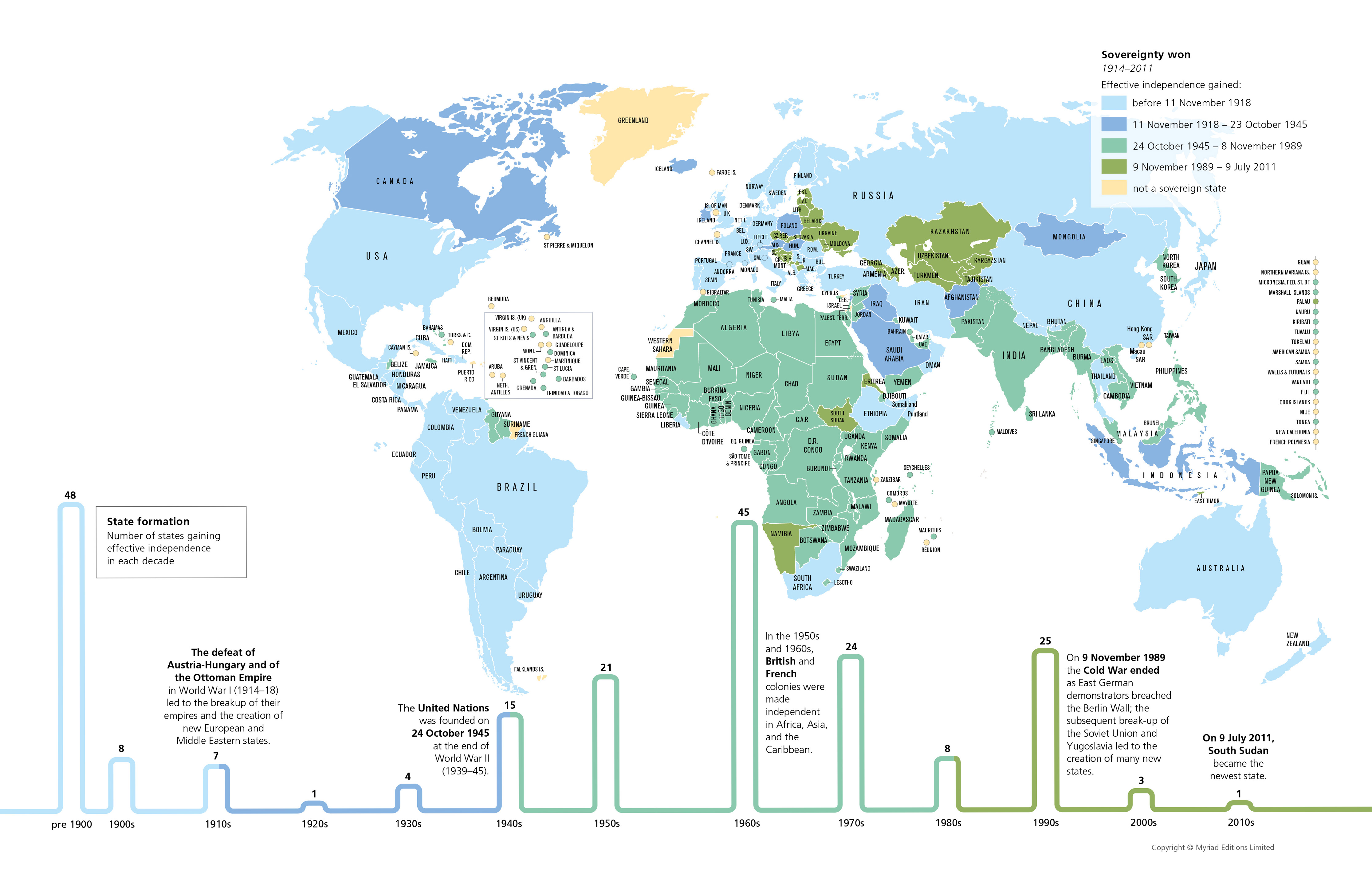
First he points out that most states are relatively new. By 1900 there were just 48 states in our modern sense of the term. In the years either side of World War I, with the break-up of the Ottoman and Habsburg Empires, there was considerable state-making. Even so, the UN was founded by just 51 states. Today, 193 states make up the UN, the newest being South Sudan in July 2011.

Mr Malik’s was probably a sectarian killing as he was from the Shia sect, the second largest sect of Islam which is under attack by the Taliban and other fundamentalist Sunnis who had declared them as Kafir (infidel) and liable to be killed. In the recent days four prominent Shia were assassinated by unknown persons in Peshawar.
The legal fraternity of the whole country organised a two-day boycott of courts in protest of killings. The lawyers see in the killings of their colleagues the total failure of the government to for maintaining the rule of law in the country.
In the last week four workers of one NGO, HANDS, working to provide health facilities and food rations to poor fisherfolk, were abducted by unknown persons but the government has failed to recover them. Persons who work in favour of human rights, which is deemed contrary to the interests of radical Islamist groups face considerable threat, as may be noted in the killings in 2011 of the Governor of Punjab, Salman Taseer, and the Federal Minister of Minority Affairs, Shabaz Bhatti, who were targeted for their efforts to protect minorities, and their opposition to Pakistan’s draconian blasphemy laws.
So far 87 journalists had been killed in Pakistan since 2000. In the year 2012, eight journalists were killed while performing their official duty.
The irresponsible attitude of the government towards the security and protection of the human rights defenders and the appeasement policy towards the Muslim fundamentalists groups can be judged by the government’s refusal to allow the UN Special Rapporteur on human rights defenders to visit the country. The government, after ratifying the UN ICCPR has accepted a recommendation to do so.
source: http://www.humanrights.asia/news/ahrc-news/AHRC-STM-039-2013
In a long but interesting blog post in the Huffington News of 4 February 2013 Malik Siraj Akbar, takes issue with Pakistan’s reaction to criticism on it human rights record by organisations such as Amnesty International (AI) and Human Rights Watch (HRW). “A pack of lies” is Pakistan army’s favorite defensive phrase whenever it is blamed for committing human rights abuses or covertly sponsoring Islamic extremist organizations. On December 13, 2012, the Pakistan army described an Amnesty International report, The Hands of Cruelty, as “a pack of lies”. On February 2nd, the Pakistan army once again used its favorite ‘a pack of lies” phrase to reject the Human Right Watch World Report 2013. The army says the report is “propaganda driven and totally biased” which is “yet another attempt to malign Pakistan and its institutions through fabricated and unverified reports, completely favouring an anti-Pakistan agenda.”
The author then goes on to explain the powerful position of the army and why it reacts so vehemently. The part that is of special interest for the protection of human rights defenders follows:
 “ThePakistan military does not solely suffice with rebuttals. It oftentimes turns unimaginably nasty against those who question its authority. In this case, the H.R.W.’s Pakistan Director Ali Dayan Hasan, a widely respected human rights defender, has become the focus of a malicious and misleading campaign in the national media. The military has unleashed a media trial of Mr. Hasan with the help of Pakistan’s largest media group, the Jang, questioning his integrity and even patriotism to the extent that it now raises genuine concerns about his personal safety and that of his family.
The News International, an English language newspaper published by the Jang media group, has become a tool in the hands of the military in the extremely dangerous campaign against Mr. Hasan. Last year, the newspaper bullied the human rights activist so much that it even published his U.S., Pakistan and London U.K. telephone numbers. This was a clear violation of journalistic standards but the newspaper apparently did so in order to encourage Islamic fundamentalists to directly threaten him on the phone numbers printed in the newspaper.
Ahmed Noorani, a young, angry and highly opinionated journalist, has been bullying Mr. Hasan and his organization for more than one year in his dispatches which, whenever attacking the H.R.W., hardly undergo the routine process of fact-checking, language correction and copy editing which is essential to sift opinion from reporting.
On February 24, 2014, the Citizens for Free and Responsible Media, a group of professional Pakistani journalists, sent a letter to the publisher and top editors of the News International, to express “our dismay at the unethical and false reporting in your paper … that is not only inaccurate and based on lies, but also endangers the life and safety of a Pakistani citizen.” One year later, the newspaper still continues to publish unsubstantiated personal attacks against Mr. Hasan which seem to be caused by the reporter’s personal dislike for the H.R.W.’s Pakistan head.
The Pakistani military and sections of the media must stop harassing Mr. Hasan. Such childish and unprofessional behavior does not help Pakistan’s democracy. Reports issued by H.R.W. and other international think-tanks and human rights groups are professional analyses of different countries. It is absolutely irresponsible and unethical to respond to such criticism with personal attacks on individual professionals affiliated with these organizations. It amounts to shooting the messenger. In a countries like Pakistan Mr. Hasan is a rare breed of bravery and hope for millions of citizens who want their rights to be respected and protected by their government. Human rights activists and journalists in Pakistan risk their lives on a daily basis to speak up for the citizens’ democratic rights and Pakistan’s largest media outlet should appreciate courageous Pakistan rights activists, such as Mr. Hasan, instead of endangering their lives.”
Under the title “Urgent Appeals, theory and practice“, the NGO ‘Asian Human Rights Commission‘ reflects on the need and increasing practicality (especially thanks to IT) of conducting urgent appeals. The AHRC Urgent Appeals system was created to give a voice to those affected by human rights violations and it now concludes that “Patterns start to emerge as violations are documented across the continent, allowing us to take a more authoritative, systemic response, and to pinpoint the systems within each country that are breaking down. This way we are able to discover and explain why and how violations take place, and how they can most effectively be addressed. On this path, larger audiences have opened up to us and become involved: international NGOs and think tanks, national human rights commissions and United Nations bodies. The program and its coordinators have become a well-used tool for the international media and for human rights education programs. All this helps pave the way for radical reforms to improve, protect and to promote human rights in the region”.
for the full text of the reflection go to: http://www.humanrights.asia/news/urgent-appeals
To illustrate the point the AHRC comes at the same time with a call for action against what it calls a “witch hunt” by the Indian authorities against human rights defender Madhuri Krishnaswami of the Jagrat Dalit Adivasi Sangthan. In the most recent attack, the District Magistrate has written a letter to the Divisional Commissioner that found its way to Chief Secretary accusing the organisation to have links with Maoists and have demanded an inquiry into the issue. The attack is not a stray one but comes high on heels of an externment notice served on her by the same district administration in May, 2012 and subsequent attack on a JADS rally by the local goon with the administration looking away. Interestingly, the charge has been refuted by the police with the Inspector General of Police, categorically denying the presence of any Maoists activities in the reason.[The administration, evidently, is working on the behest of deeply entrenched vested interests whose corruption Madhuri and the organisation have continuously been exposing. The current attack, too, is an attempt to divert attention from the massive scam in the implementation of the Mahatma Gandhi National Rural Employment Guarantee Act in the area tipped to be worth more than 150 crore INR.]
At the same time the AHCR expresses great concern over the abduction of 4 human rights defenders in Pakistan by (probably) members of an outlawed religious organization. The unknown armed persons abducted six workers of a NGO including, two lady workers. However, after some time they threw the two women out of the vehicle. It is feared that the abducted workers would be assassinated as has happened in the past. Many health workers and human rights defenders have been killed after their abduction by such ‘religious groups’. The NGO, ‘HAND’, works under the UN programme. The abducted persons and female workers who were working in the Noor Mohammad Village Goth, Mauripur, Karachi, where they have been distributing medicines and rations to the residents for some time. The male abductees were Engineer Amjad Ali Siyal, Mohammad Ashfaq, dispenser, Khurram Ahmad Abbas, dispenser and driver Humayun Ahmad, driver. The released women, Miss. Shakila and Miss. Rashida told police that the kidnappers had taken the four abducted workers in a car towards Balochistan. The police claim that they were abducted by one of the banned Muslim extremist groups who are opposed to the polio vaccination programme and this incident due to the campaign against NGO volunteers. It is believed that the abductors are convinced that they are working for the interests of America or the West.
for more information, see: http://www.humanrights.asia/news/ahrc-news/AHRC-STM-033-2013
 Hans Thoolen on Human Rights Defenders and their awards