On 13 October 2025, Nina Lakhani, climate justice reporter the Guardian, published this interview with Mary Lawlor, UN special rapporteur for human rights defenders, who presented her final annual thematic report during an interactive dialogue at the 80th session of the United Nations General Assembly’s Third Committee. The Special Rapporteur’s report focused on the contributions of human rights defenders addressing climate change and working to realise a just transition from fossil fuels, and the risks they face in carrying out this work.
Mary Lawlor, the UN special rapporteur for human rights defenders since 2020, has documented hundreds of cases where states have sought to smear and silence climate defenders engaged in peaceful protest, non-violent civil disobedience and litigation.
“Attacks against climate defenders have surged over the course of the mandate, and we now see outright repression against people who are organizing for climate action. It’s some of the states that have claimed to be the strongest supporters of human rights defenders including the UK, Germany, France and the US, that are most often repressing climate activists and where the right to protest is being denigrated and delegitimized.
“These big countries spew out the rhetoric about 1.5C, but they don’t mean it. They are playing the game to suit themselves. It’s business as usual,” Lawlor said in an interview with the Guardian.
It documents state repression including police violence and surveillance, civil litigation deployed to deliberately wear down and silence climate defenders known as Slapp (strategic lawsuits against public participation), as well as bogus criminal charges ranging from sedition, criminal defamation, terrorism and conspiracy to trespass, to public disorder and to disobedience.
One trend documented by Lawlor is the conflation of non-violent climate action with terrorism. In 2022, the French minister of interior at the time, and current minister of justice, accused the national environmental movement Les Soulèvements de la Terre of “ecoterrorism”. The government sought to close down the group, but the country’s highest administrative court eventually overturned the effort.
Lawlor is adamant that climate activists are human rights defenders. They use non-violent protest, disruptive civil disobedience and litigation to stop fossil fuel projects and pressure elected officials to take meaningful action precisely because they are trying to protect the right to food, clean water, health, life and a healthy environment.
But it’s not just fossil fuels. Human rights are now being targeted in the rush for critical minerals and new sources of non-fossil energy. The same repressive playbook is being used by governments and private companies involved in land grabs, pollution and Indigenous rights violations in pursuit of a green transition.
“Governments are repressing human rights defenders and the current trajectory is incompatible with the realization of human rights for all. It’s just a road to destruction … I think states are behaving in a criminal fashion,” Lawlor said.
“No system, no power, no government, no big company seeking profit should trump the rights of billions of people in the world. And that’s what’s happening. It’s the rich, the powerful that are creating such a disaster for humanity.”
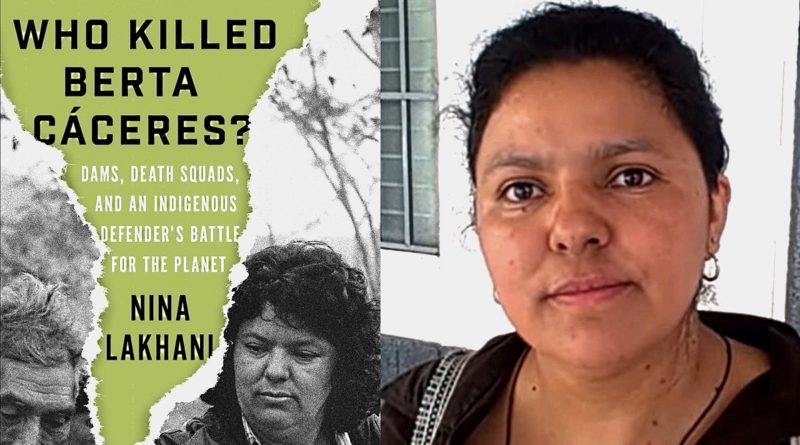
“They build dams and kill people.” These words, spoken by a witness when the murderers of environmental defender Berta Cáceres were brought to trial in Honduras, describe Desarrollos Energéticos SA (DESA), the company whose dam project Berta opposed. DESA was created in May 2009 solely to build the Agua Zarca hydroelectric scheme, using the waters of the Gualcarque River, regarded as sacred by the Lenca communities who live on its banks. As Nina Lakhani makes clear in her book Who Killed Berta Cáceres?, DESA was one of many companies to benefit from the 2009 coup d’état in Honduras, when the left-leaning President Manuel Zelaya was deposed and replaced by a sequence of corrupt administrations. The president of DESA and its head of security were both US-trained former Honduran military officers, schooled in counterinsurgency. By 2010, despite having no track record of building dams, DESA had already obtained the permits it needed to produce and sell electricity, and by 2011, with no local consultation, it had received its environmental licence.
..Lakhani quotes a high-ranking judge she spoke to, sacked for denouncing the 2009 coup, as saying that Zelaya was deposed precisely because he stood in the way of this economic model and the roll-out of extractive industries that it required. The coup “unleashed a tsunami of environmentally destructive ‘development’ projects as the new regime set about seizing resource-rich territories.” After the post-coup elections, the then president Porfirio Lobo declared Honduras open for business, …….
Lakhani’s book gives us an insight into the personal history that brought Berta Cáceres to this point. She came from a family of political activists. As a teenager she read books on Marxism and the Cuban revolution. But Honduras is unlike its three neighbouring countries where there were strong revolutionary movements in the 1970s and 1980s. The US had already been granted free rein in Honduras in exchange for “dollars, training in torture-based interrogation methods, and silence.”… At the age of only 18, looking for political inspiration and action, Berta left Honduras and went with her future husband Salvador Zúñiga to neighbouring El Salvador. She joined the FMLN guerrilla movement and spent months fighting against the US-supported right-wing government. Zúñiga describes her as having been “strong and fearless” even when the unit they were in came under attack. But in an important sense, her strong political convictions were tempered by the fighting: she resolved that “whatever we did in Honduras, it would be without guns.”
Inspired also by the Zapatista struggle in Mexico and by Guatemala’s feminist leader Rigoberta Menchú, Berta and Salvador created COPINH in 1993 to demand indigenous rights for the Lenca people, organising their first march on the capital Tegucigalpa in 1994. From this point Berta began to learn of the experiences of Honduras’s other indigenous groups, especially the Garífuna on its northern coast, and saw how they fitted within a pattern repeated across Latin America….
In Río Blanco, where the Lenca community voted 401 to 7 against the dam, COPINH’s struggle continued. By 2013, the community seemed close to winning, at the cost of activists being killed or injured by soldiers guarding the construction. They had blocked the access road to the site for a whole year and the Chinese engineering firm had given up its contract. The World Bank allegedly pulled its funding, although Lakhani shows that its money later went back into the project via a bank owned by the Atala Faraj family. In April 2015 Berta was awarded the Goldman Prize for her “grassroots campaign that successfully pressured the world’s largest dam builder to pull out of the Agua Zarca Dam.”
…….
The horrific events on the night of Wednesday March 2 are retold by Nina Lakhani. Armed men burst through the back door of Berta’s house and shot her. They also injured Gustavo Castro, who was visiting Berta; he waited until the men had left, found her, and she died in his arms. ,,,By the first anniversary of Berta’s death the stuttering investigation had led to eight arrests, but the people who ordered the murder were still enjoying impunity. Some of the accused were connected to the military, which was not surprising since Lakhani later revealed in a report for The Guardian that she had uncovered a military hit list with Berta’s name on it. In the book she reports that the ex-soldier who told her about it is still in hiding: he had seen not only the list but also one of the secret torture centers maintained by the military.
Nina Lakhani is a brave reporter. She had to be. Since the coup in Honduras, 83 journalists have been killed; 21 were thrown in prison during the period when Lakhani was writing her book. She poses the question “would we ever know who killed Berta Cáceres?” and sets out to answer it. Despite her diligent and often risky investigation, she can only give a partial answer. Those arrested and since convicted almost certainly include the hitmen who carried out the murder, but it is far from the clear that the intellectual authors of the crime have been caught. In 2017 Lakhani interviewed or attempted to interview all eight of those imprisoned and awaiting trial, casting a sometimes-sympathetic light on their likely involvement and why they took part.
….
In September 2018, the murder case finally went to trial, and Lakhani is at court to hear it, but the hearing is suspended. On the same day she starts to receive threats, reported in London’s Press Gazette and duly receiving international attention. Not surprisingly she sees this as an attempt to intimidate her into not covering the trial. Nevertheless, when it reopens on October 25, she is there. The trial reveals a weird mix of diligent police work and careful forensic evidence, together with the investigation’s obvious gaps. Not the least of these was the absence of Gustavo Castro, the only witness, whose return to Honduras was obstructed by the attorney general’s office. Castillo, though by then charged with masterminding the murder, was not part of the trial. Most of the evidence was not made public or even revealed to the accused. The Cáceres family’s lawyers were denied a part in the trial.
“The who did what, why and how was missing,” says Lakhani, “until we got the phone evidence which was the game changer.” The phone evidence benefitted from an expert witness who explained in detail how it implicated the accused. She revealed that an earlier plan to carry out the murder in February was postponed. She showed the positions of the accused on the night in the following month when Berta was killed. She also made clear that members of the Atala family were involved.
When the verdict was delivered on November 29 2018, seven of the eight accused were found guilty, but it wasn’t until December 2019 that they were given long sentences. That’s where Nina Lakhani’s story ends. By then Honduras had endured a fraudulent election, its president’s brother had been found guilty of drug running in the US, and tens of thousands of Hondurans were heading north in migrant caravans. David Castillo hasn’t yet been brought to trial, and last year was accused by the School of Americas Watch of involvement in a wider range of crimes. … Daniel Atala Midence, accused by COPINH of being a key intellectual author of the crime as DESA’s chief financial officer, has never been indicted.
...And a full answer to the question “Who Killed Berta Cáceres?” is still awaited.

 Hans Thoolen on Human Rights Defenders and their awards