On 26 October 2026, Amnesty Inrernational carried the story of Usman Hamid, the Executive Director of Amnesty International Indonesia, who has spent decades as a human rights defender in spite of ampaigns of harassment and intimidation with a new dimension in the digital age:
My journey into human rights activism was forged in the blood that stained the pavement of Trisakti University. In my teenage years, my mother got me involved in organizing assistance for people living in poverty. I began to witness the stark socio-economic disparities that existed under former president Suharto, amid widespread corruption and state repression. By May 1998, public frustration had reached boiling point, sparking student protests across Indonesia. What began as a growing unease with social injustice drew me into the movement. But it was the killing of four of my classmates at Trisakti on 12 May 1998 that transformed my concerns into a lifelong commitment to human rights activism.
Shortly after the brutal protest crackdown, I was appointed as student representative to a military police investigation team to search for the truth about what happened. It was through this work that I met the human rights activist Munir Said Thalib, who later became my mentor. After my graduation, Munir persuaded me to join the Commission for Missing Persons and Victims of Violence (KontraS).
Due to my work at KontraS, I faced a relentless campaign to destroy my credibility. In 1999, pamphlets were circulated in communal spaces, falsely accusing me of being a “communist” or a “Jewish secret agent”. Conservative-linked publications, including Majalah Garda, spread rumors about me, publishing photographs of me and suggesting that I was not a “pure” student activist. Before long, both Munir and I started receiving death threats because we exposed human rights violations that implicated key army figures.
In 2001, I was appointed to the inquiry commission at the National Human Rights Commission (Komnas HAM) to continue investigating the deaths of protesters between 1998-1999 involving powerful army generals. Soon after, my mother began receiving mysterious phone calls accusing me of being an anti-Muslim activist, and two army officers paid an uninvited visit to our home to offer us money in exchange for me to stop my activism.
My activism became increasingly dangerous. In March 2002, a violent mob attacked the KontraS office. They were looking for me and Munir. That was when Munir gave me a bulletproof vest to protect myself and helped me to temporarily relocate to the Netherlands.
Tragically, not long after that, Munir was murdered by arsenic poisoning on his flight to Amsterdam in September 2004. Intimidation continued because of my key role in the fact-finding team investigating Munir’s murder. Two high-level intelligence officials suspected of being involved in the murder filed criminal defamation lawsuits against me in 2005 and 2008. When I joined Amnesty International in 2016, I realized that the state apparatus aimed at intimidating human rights activists was still very much alive, and had evolved significantly.
Under President Prabowo Subianto’s administration, the old authoritarian tactics have returned with a digital vengeance. In early 2025, after Amnesty International Secretary General Agnès Callamard raised concerns around the entrenchment of authoritarian practices in Indonesia during a media interview, I received a phone call from a high-ranking politician. He sent me disappearing voice notes, calling me a “foreign lackey”. Weeks later, on 15 March, activists from KontraS staged a protest that disrupted lawmakers’ closed-door meeting on revisions to the military law that would allow soldiers to hold civilian positions.
Shortly after this protest, I received a phone call from the same politician. He yelled, “Where are you, foreign lackey? I’m going to kill you now.” He accused me of masterminding the KontraS protest. Days later, amid nationwide demonstrations against the military law revision, the same politician also called to accuse me of being behind these protests. My wife and I had to go to a quiet corner of our house to listen to his disappearing voice notes so our children wouldn’t hear.
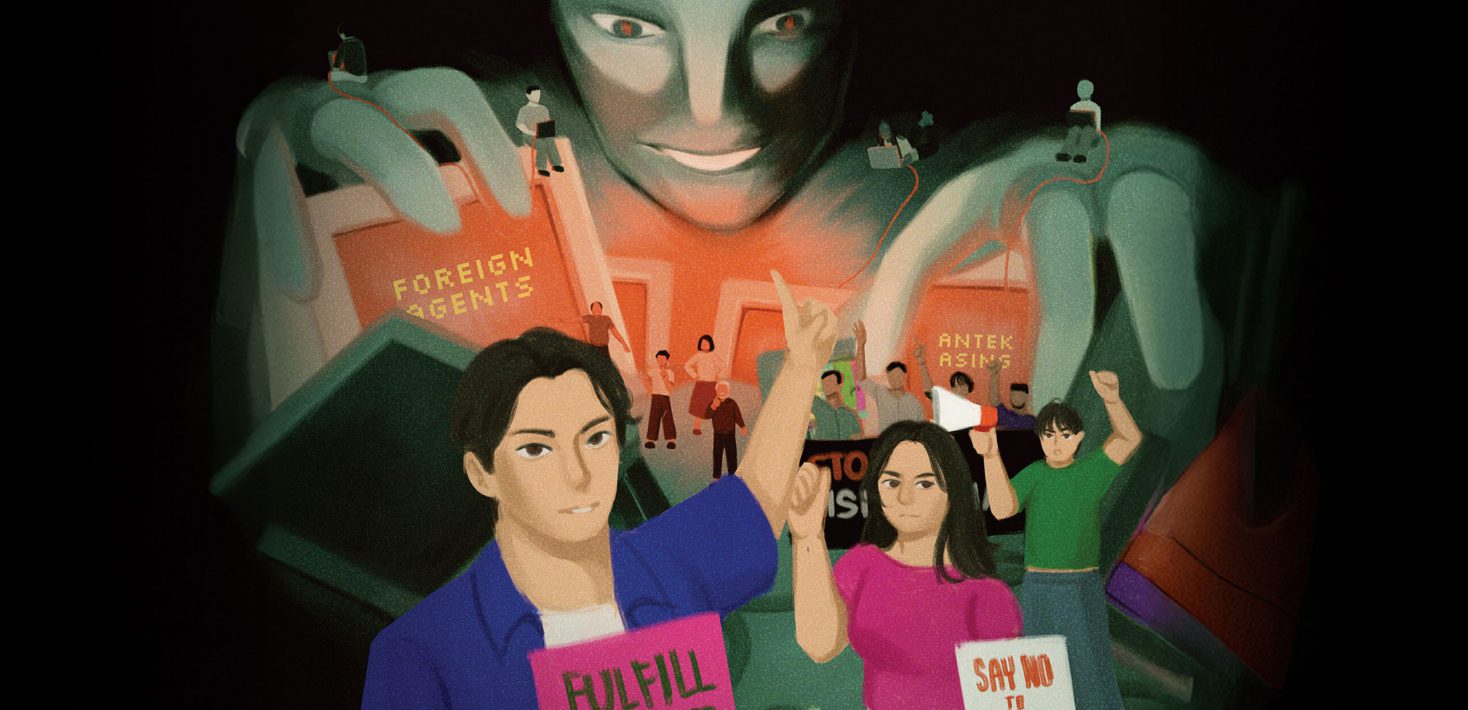
These threats came to me at the same time as a coordinated disinformation campaign by the military against me. On 23 March 2025, Instagram accounts linked to four military units posted a video spreading false accusations that human rights defenders and journalists are “foreign agents” working to undermine Indonesia’s sovereignty. The video named a few individuals, including myself, as these foreign agents.
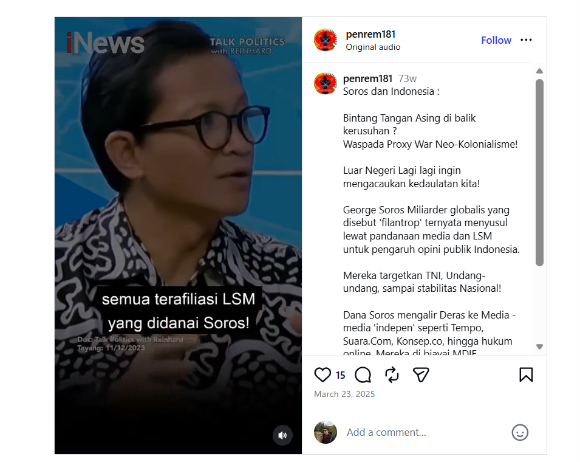
Example of such a post by an account that presented itself as belonging to the Sub-Regional Military Command No. 181 Praja Vira. The video is still publicly accessible via this link.
These stigmatizing narratives are not new. In my early days as an activist, I was labelled a “communist” or a “Jewish operative”; today, it is the “foreign agent” slur. It strategically uses disinformation to redirect public attention away from issues like corruption and state violence.
These campaigns have taken a heavy psychological toll. Even childhood friends received these videos and messaged to ask why I became a foreign agent. It makes me paranoid, wondering if there are people out there who believe these lies and want to hurt me and my family.
Meta has contributed to these harms. In my case, Meta allowed the military to use Instagram to propagate disinformation against me, failing to remove the content even after we presented detailed findings of its human rights impacts.
It is clear that I remain a key target of the military. In March 2026, Andrie Yunus, a prominent advocate against the Military Law revisions, was targeted in a brutal acid attack by military officers in central Jakarta. I soon learned through contacts in law enforcement, and later in Tempo’s investigative findings, that Andrie was not the only target. My name was on that same hit list.
Despite all of this, I refuse to let fear win. What keeps me resilient is my family. It is the childhood memory of my mother, who got me into activism. It is also the comfort of playing music with friends.
One day my wife and I said we wanted to see a clear blue sky—something hard to come by in a heavily polluted city like Jakarta. We decided to keep driving, no matter how far we had to go. Finally, we saw it – the clear sky we were looking for. It was a long drive, but it was worth it.
Just like other student activists of 1998, I dream of a brighter Indonesia where human rights are respected for all. We once fought and earned many victories. Today, we see a painful return of authoritarian practices, but this only means our work is not finished. We just need to keep driving and pushing until we see a clear, blue sky again.