Posts Tagged ‘MENA’

The Arab Interior Ministers’ Council must end its role in transnational repression

February 20, 2025

MENA Rights Group leads a coalition of 15 civil society organisations in urging the Arab Interior Ministers’ Council to cease its facilitation of arbitrary extraditions of peaceful dissidents and human rights defenders across Arab League countries and to align its legal framework and systems with international human rights law
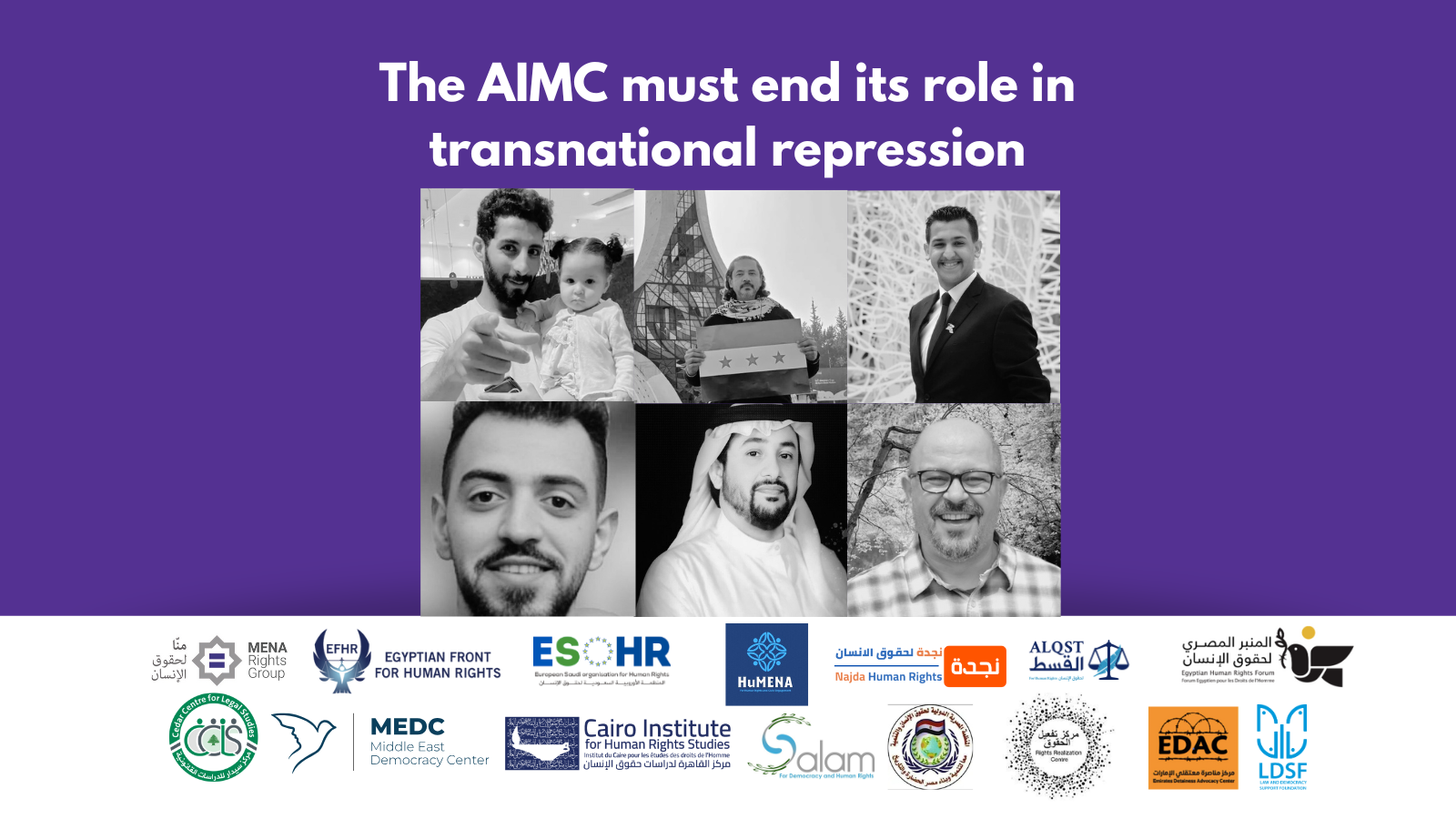
From left to right: Ahmed Kamel, Abdelrahman al-Qaradawi, Salman al-Khaldy, Hassan al-Rabea, Khalaf al-Romaithi, Sherif Osman

February 17, 2025The undersigned organisations call on the Arab Interior Ministers’ Council (AIMC) to cease its facilitation of arbitrary extraditions of peaceful dissidents and human rights defenders across Arab League countries and to align its legal framework and systems with international human rights law.

On Sunday, February 16, 2025, the AIMC held its 42nd annual conference in its headquarters in Tunis. Often misleadingly referred to as “Arab INTERPOL”, the AIMC is an Arab League body tasked with enhancing cooperation among Arab states in the fields of internal security and crime prevention. Through its Department of Criminal Prosecution and Data, the AIMC circulates state-requested warrants to liaison divisions in Member States and facilitates wanted individuals’ extradition.

Although extraditions for “crimes of a political nature” are explicitly prohibited by the AIMC’s legal framework, specifically article 41 of the Riyadh Arab Agreement for Judicial Cooperation, they still occur in practice. Lacking an oversight body to prevent the abuse of its systems, the AIMC has become the perfect tool for Arab League states to request politically motivated extraditions.

Between 2022 and 2025, MENA Rights Group has documented the unlawful extraditions of four individuals: Khalaf al-Romaithi, Hassan al-Rabea, Salman al-Khaldy, and Abdulrahman al-Qaradawi. Currently, one individual is facing an imminent risk of extradition: Ahmed Kamel.

Ahmed Kamel is an Egyptian national currently detained in Saudi Arabia, where he had been living for a decade. In reprisal for peacefully protesting during the Arab Spring in Cairo in 2011 and 2014, Kamel faces imminent extradition to Egypt, where he may be subjected to human rights abuses including torture.

Despite their prohibition, Arab states continue to request and fulfil politically motivated extraditions, weaponising domestic laws which conflate peaceful criticism and human rights activism with terrorism or threats to state security.

Furthermore, the AIMC’s legal framework makes no reference to international human rights standards. More specifically, it fails to mention the principle of non-refoulement, enshrined in article 3 of the UN Convention against Torture, which provides that individuals must not be extradited to a country where they would face torture. 

UN Special Procedures mandate holders have raised concerns over the AIMC’s operations in a communication addressed to the Arab League, notably raising the impossibility for individuals to access their criminal file and challenge their arrest warrant. However, the UN experts have been provided with no response, and the Council has yet to undertake any reform.

As the AIMC continues to facilitate grave human rights violations across the Arab region, substantial change is required to ensure peaceful dissidents and human rights defenders are not at risk of transnational repression.

The undersigned organisations therefore urge the AIMC to immediately halt its facilitation of politically motivated extraditions, and undertake urgent reforms, in consultation with civil society, to align its legal framework and systems with international human rights law.

Signatories:

  1. MENA Rights Group
  2. Egyptian Front for Human Rights
  3. Egyptian Organization for Human Rights
  4. ESOHR
  5. Cedar Centre for Legal Studies 
  6. Law and Democracy Support Foundation – LDSF 
  7. Middle East Democracy Center (MEDC)
  8. ALQST for Human Rights
  9. Egyptian Human Rights Forum ( EHRF)
  10. Rights Realization Centre / مركز تفعيل الحقوق
  11. Salam for Democracy and Human Rights
  12. Najda for Human Rights
  13. Emirates Detainees Advocacy Center (EDAC) 
  14. HuMENA for Human Rights and Civic Engagement
  15. Cairo Institute for Human Rights Studies (CIHRS)

https://menarights.org/en/articles/aimc-must-end-its-role-transnational-repression-say-ngos

Women human rights defenders and journalists in Iraq receive training in Safety and Digital Security

April 29, 2019

To strengthen the resilience of Iraqi women journalists and women human rights defenders against online and offline gender-based attacks, Internews conducts workshops and other activities that focus on digital and physical security:

Iraq is one of the world’s most dangerous countries for journalists according to Reporters without Borders, ranking 160 out of 180 countries in the World Press Freedom Index. Women journalists and activists in Iraq have a particularly difficult time due to online threats and attacks that adversely affect their ability to express themselves freely and advocate effectively. Women have witnessed an escalation in online abuse over the past few years, not just in numbers, but also in methods and sophistication. The risk of harassment and gender-based attacks online is not limited to the digital space as research has shown that online abuse and stalking often escalate into real world physical violence if left unaddressed.

In an interview with The New Arab, Hala ‘Asif, a 24-year-old journalist working as a correspondent for the channel NRT in Baghdad, noted that, “Foreign journalists often investigate political affairs in Iraq, which sometimes is impossible for us to cover as it would be too dangerous and would prevent us from working safely in our country. I would like to go to other provinces in Iraq and carry out investigations about relevant issues, but as a young woman it would cost too much to take care of my safety.”

To address the issue of women’s safety in Iraq, Internews, with funding from the US State Department’s Bureau of Democracy, Human Rights and Labor (DRL), is using a multi-pronged approach – building local networks, coordinating advocacy, and conducting targeted journalism trainings on gender-sensitive issues. Internews’ program, Women Voices (Aswat Al-Maraa), aims to challenge societal attitudes that stigmatize survivors of sexual and gender-based violence (SGBV) by supporting journalists and women human rights defenders to shed light on sensitive issues through coordinated reporting and advocacy. The program works with female Iraqi journalists and media outlets to create a nationwide coalition of women journalists and human rights defenders to strengthen their resilience against gender-based attacks and build the capacity of journalists to report on sensitive human rights and SGBV.

Within the Women’s Voices project, Internews has conducted so far two training-of-trainers (TOT) workshops that focus on the digital and physical security of the project participants. Through a peer-to-peer program, TOT trainees have trained eighty women from Erbil, Najaf, and Halabja how to protect themselves from threats online and in their everyday lives.

….Another participant, from the Erbil workshop, said, “Females often have to face extreme scrutiny of their presence online, and are threatened with death in some instances for photos posted online without family consent or that are considered inappropriate; these kinds of workshops are incredibly important for every female in this country.”

To support the voices and participation of women in some of the world’s most challenging places, Internews’ MENA team ensures the implementation of digital as well as a physical security trainings in all of its projects across the region. ​

See also: https://humanrightsdefenders.blog/2017/05/09/defenddefenders-launched-new-security-manual-for-human-rights-defenders-in-africa/

https://reliefweb.int/report/iraq/uplifting-voices-women-supporting-their-physical-safety-and-digital-security

Gulf Center publishes 2018 survey of human rights in the Middle East

March 12, 2019
A Bahraini woman sits near portraits of jailed political activists, in the village of Sitra, 12 February 2016
A Bahraini woman sits near portraits of jailed political activists, in the village of Sitra, 12 February 2016  MOHAMMED AL-SHAIKH/AFP/Getty Images

The Gulf Centre for Human Rights (GCHR) released its seventh annual report on human rights activism in 2018, entitled Breaking Boundaries. It remembers the women and men human rights defenders imprisoned for their work across the region, particularly in Bahrain, Iran, Iraq, Kuwait, Oman, Saudi Arabia, Syria, the United Arab Emirates and Yemen.

The report features a summary and case updates of 145 women and men human rights defenders across the Gulf and neighbouring countries as well as the legal and political developments relevant to human rights in these countries. Additionally, it summarises GCHR’s research, advocacy and capacity-building activities with regional and international partners. [for my earlier post on the GCHR, see:  https://humanrightsdefenders.blog/tag/gulf-centre-for-human-rights/]

In this 2018 report, GCHR recognises that despite increased restrictions on civic space and aggressive prosecution of human rights defenders, the boundaries crumbling since 2011 are worth celebrating. In the act of breaking these boundaries, solidarity networks nationally, regionally, and internationally have been nurtured and strengthened. With continued activism of journalists, human rights defenders and civil society, GCHR foresees that governments’ disrespect for human rights and freedoms in the region will be increasingly overturned.

The main focus of the report is to shed light on human rights activism. While governments intensified their harassment and prosecution of journalists, human rights defenders, online activists, and civilians, through the advocacy efforts of civil society on different fronts, the defence of human rights in the region has been met with international recognition, including many international awards for human rights defenders from across the Gulf and neighbouring countries.

The spotlight on governments, especially in the Gulf, unveiled the extent to which governments reject accountability to their people and commitment to human rights internationally. To mention a few examples: Bahrain denied the entry of United Nations experts along with extending travel bans on human rights defenders so they continue to miss UN Human Rights Council sessions. In Iraq, peaceful assembly was met with tear gas and live bullets to disperse the protests, leaving dozens killed and hundreds arrested. In Iran, well-known lawyers were among those sentenced to prison for defending women’s rights to reject forced hijab. And notoriously, Saudi Arabia arbitrarily arrested over 20 men and women who defend and advocate for women’s rights, even after the Kingdom formally lifted the driving ban on women.

Khalid Ibrahim, Executive Director of GCHR, says: “It is hard work to support human rights defenders and ensure their safety and security. Yet a success such as having the European Parliament formally and publicly denounce human rights abuses in Saudi Arabia in May 2018 and again in February 2019 shows the importance of diligence, solidarity and commitment to research- and evidence-based advocacy in the pursuit of defending human rights. Not to mention the attention facing Saudi Arabia at the UN Human Rights Council this month, where 36 States, including all EU Member States, called on 7 March 2019 for the release of detained women human rights defenders, sending a strong message to the Saudi authorities that the Council will hold its members accountable.

GCHR presented a number of recommendations at the end of this report to governments, and the international community. Emphasis is placed on guarantees of a legal framework grounded in respect for human rights, especially for the freedom of expression and opinion, to protect the safety of journalists, media workers and online activists whom governments across the region relentlessly harassed, targeted, or prosecuted. Other recommendations are made to ensure the safety of civilians such as in conflict-zones, as well as in countries in transition where respect for freedom of association and assembly are essential for peace and justice.
To download the full report, follow the link.

https://www.ifex.org/middle_east_north_africa/2019/03/11/human-rights-activism/

NEW TACTICS in Human Rights: 2013 accomplishments and plans for 2014

January 3, 2014

We start the year with a little survey of what New Tactics in Human Rights accomplished in 2013: they trained 114 human rights defenders from the Middle East and North Africa [MENA region] on Strategic Effectiveness method and expanded their capacity in the MENA region for training and mentorship for human rights defenders. New material, including 20 new human rights tactics, were added to the website and there is now a French-language landing page. New Tactics also launched an Arabic version of its website and online community. In the Arabic-language community, it hosted 6 online conversations that engaged 60 human rights defenders from around the MENA region. In its English-language community, it hosted 10 online conversation that engaged 153 human rights defenders. Summaries of all of these conversations can be found on its website. In 2014 it will launch its New Tactics Strategy Toolkit, an online collection of tools to help defenders create effective strategies.

via Our 2013 accomplishments & plans for 2014.

Five Women Human Rights Defenders from the Middle East

December 13, 2013

On 12 December 2013 Tasnim Nazeer published a list of 5 women human rights defenders who in spite of setbacks in the “Arab Spring” have no plans to stop fighting:

  1. Tawakkol Karman. The first Yemeni and the first Arab woman to be awarded the Nobel Prize. A Yemeni journalist, human rights activist and politician member of the Al-Islah political party, Karman is the leader of the renowned group “Women Journalists Without Chains,” which she co-founded in 2005. She became the international public face of the Yemeni “Arab Spring” uprising in 2011. The people of Yemen know her as the “Iron Woman” and “Mother of the Revolution” due to her courage in sticking up for human rights injustices in Yemen.
  2. Razan Ghazzawi Razan, an award-winning Syrian blogger, campaigner and human rights activist. She has been actively involved in the events during the Syrian Civil War, and has been particularly outspoken on activists’ arrests and the violations of human rights committed by the Bashar al Assad regime.Razan, who has been arrested by the Syrian regime several times and is forbidden to leave Syria, was named as an “iconic blogger and leading activist” by The Telegraph as well as awarded the 2012’s Human Rights Defenders at Risk award by the Dublin-based Front Line Defenders foundation.
  3. Moushira Mahmoud Khattab, an Egyptian human rights activist, former politician and diplomat. She has previously held the positions as Minister of Family & Population as well as ambassador to South Africa, the Czech Republic and Slovakia. Khattab is a renowned human rights activist who speaks up for the rights of children and women in Egypt and the MENA region. Her efforts to advocate human rights have been recognized internationally through numerous awards, including the two highest honors that can be bestowed on any foreign national in South Africa and Italy.
  4. Nawal El Saadawi,  an Egyptian feminist writer, human rights activist, physician and psychiatrist. Saadawi has authored many books on the subject of women and Islam and advocates human rights issues involving women. The founder and president of the Arab Women’s Solidarity Association and co-founder of the Arab Association for Human Rights, she has been awarded numerous honorary degrees on three continents.
  5. Manal al-Sharif. Women’s rights activist from Saudi Arabia who helped start a groundbreaking women’s right to drive campaign in 2011. An outspoken voice on the rights of women in the Kingdom, she was detained and released on 21 May and rearrested the following day on the conditions of returning for questioning if she were to continue talking to the media about rights for women to drive in Saudi Arabia.

via Five Women Human Rights Activists who are Changing the Middle East | Informed Comment.