Posts Tagged ‘labour rights defenders’

Interview with labour rights defender Prak Pheaktra

January 20, 2024

On 9 January 2024, Global Voices posted an interview with labour rights defender Prak Pheaktra. [This article by Klaing Kimhuoy was originally published by Prachatai, an independent news site in Thailand. An edited version has been republished by Global Voices under a partner content-sharing agreement.]

Despite threats from the Cambodian government, who claim he is damaging the country’s image, 39-year-old Prak Pheaktra, a Cambodian migrant worker-turned-advocate, is striving to help other Cambodian workers facing unfair treatment from their employers.

In 2000, Pheaktra, who is from Pusat province, came to Thailand to find work. His family was facing financial difficulties after the death of his mother, and his father could no longer afford to send him to school. Chasing the promise of better pay and less strenuous work, he decided to come to Thailand.

Pheaktra started out working as a construction worker in Don Mueang province, but he later faced exploitation and abuse from his employer. Once, his employer withheld wages and threatened legal action against him. Having experienced first-hand the unfair treatment and exploitation of migrant workers in Thailand, he became an advocate so he could help other workers get fair treatment in the workplace.

Pheaktra’s dedication led him to become a Khmer-Thai interpreter for the Ministry of Labour of Thailand in from 2018–2019, where he began studying Thai law. After completing his ministry contract, he joined the Labor Rights Promotion Network (LPN) in 2019–2020 as a Complaints Receiving Officer.

Having worked with both government and civil society, he is now working as an independent advocate for migrant workers. He offers assistance to workers dealing with wage issues, pressure from employers, sexual harassment, and other threats — all pro bono. He also uses social media to educate workers on how to legally live and work in Thailand and warn them of exploitation by brokers. He works with NGOs as part of research projects, including one on child exploitation in Phuket and another on labour abuses faced by fishing boat workers.

However, his advocacy has attracted criticism and threats, including from Cambodian officials, who claim he could damage the Cambodian government’s public image. Last February 2023, when he assisted 10 Cambodian workers in Samut Prakan whose employer wasn’t paying them, he faced some questions from the chief of the Labour Attaché Office at the Cambodian Embassy. When he was in Rayong working on another case, he was asked if he knew that what he was doing could affect the public image of the Cambodian government and was threatened with having his passport revoked.

The chief of the Labour Attaché Office threatened to revoke my passport if I continued to engage in activities that negatively impact the public image of the Cambodian government. I said, you can block my passport if you think what I am doing is really wrong. I’m not afraid.

He has also faced threats from Thai officials, who he observed can be biased in favour of employers and accuse him of putting excessive trust in the workers. He gave an example of a particular case he worked on where an inaccurate resolution led to a worker being unfairly blamed.

He suggested the need for greater accuracy within the Ministry of Labour’s processes and expressed frustration at being accused of trusting workers too much. He’s urging a more balanced approach to better serve the rights and interests of migrant workers.

Despite the threats he faces, Phaektra persists. “I love what I’m doing right now, and I will continue to help Cambodian workers no matter what,” he said.

Those who have worked with Phaektra described him as kind and dedicated. Prum Somnang, a Cambodian worker at a plastic bag factory, was assisted by Phaektra after being abruptly dismissed by her Thai employer, citing lack of work. Somnang had worked there for ten years and was laid off along with 40 other workers. Her employer wanted to sue her, she said, because she started a protest against the layoff. At the same time, her visa was expiring in seven days, and she needed to find a new job within the week. Her friend advised her to seek help from Pheatra.

“He’s very kind. He helped me get money back from the employer and even assisted me in finding a new job before my visa expired,” Somnang said…

Pheaktra said that one key concern about the lives of migrant workers in Thailand is the risk of falling victim to scams orchestrated by middlemen or company representatives when filing documents. Pheaktra emphasized the need for workers to take charge of their documentation to prevent such scams.

Looking ahead, Pheaktra expressed a commitment to continue social work aimed at assisting migrant workers. Despite the presence of numerous NGOs and institutions offering help, some workers hesitate to seek assistance directly due to concerns about influential individuals associated with these organizations. Pheaktra sees himself as an advocate for migrant workers, standing by their side and addressing their problems.

https://globalvoices.org/2024/01/09/advocate-for-migrant-rights-persists-despite-threats-from-thai-and-cambodian-officials/
Call for nominations for the Arthur Svensson prize

October 20, 2022

Representatives and employees of trade unions throughout the world are free to nominate candidates for next year’s  Arthur Svensson international prize for trade union rights. 

For more on this award and its laureates, see: https://www.trueheroesfilms.org/thedigest/awards/5c06a870-6053-11e9-aa6c-87381bf77969

The nominees will be judged on to what extent the person or organization has promoted union rights and/or union organizing in the world. More on the award here – https://www.svenssonstiftelsen.com/about

Deadline 1/1/2023.

For nominations please use this form – https://www.svenssonstiftelsen.com/nominate 

Nominations can also be sent with attachments to espen.loken@industrienergi.no

Philippines: UN rapporteurs ask for exceptional investigation, while labour rights defender shot dead

June 7, 2019

The ink on the bill for the protection of human rights defenders [see: https://humanrightsdefenders.blog/2019/06/04/philippines-human-rights-defenders-protection-bill-adopted-in-parliament/] has hardly dried and the following is reported: on 2 June 2019 union organiser Dennis Sequeña was shot dead while meeting with workers. Sequeña was vice-chairperson of labour group Partido Manggagawa; group believes he was murdered for his trade union work. Civil society organisations condemn the killing & demand immediate investigation, as well as action to stop spate of attacks against labour activists.

Also on 7 June a group of UN human rights experts collectively called on the United Nations to establish an independent investigation into human rights violations in the Philippines, citing a sharp deterioration in the situation of human rights across the country, including sustained attacks on people and institutions defending human rights. “Given the scale and seriousness of the reported human rights violations we call on the Human Rights Council to establish an independent investigation into the human rights violations in the Philippines.

We have recorded a staggering number of unlawful deaths and police killings in the context of the so-called war on drugs, as well as killings of human rights defenders. Very few independent and effective investigations have taken place, independent media and journalists are threatened, the law has been weaponised to undermine press freedom, and the independence of the judiciary is undermined,” the experts said. [ndependent human rights experts appointed by the Human Rights Council have raised their concerns with the Government of the Philippines on 33 occasions over the last three years!]

In a statement of 8 May 2019 the ISHR and other NGOs had recalled that: the Philippines is one of the most dangerous countries for human rights defenders. They persevere under harsh conditions, fighting against repression and corruption to make a better society for all. They continue their work so the most vulnerable are protected and their voices are heard.  ISHR – along with CIVICUS, Frontline Defenders, FORUM Asia, FIDH, and the World Organisation Against Torture– released a joint statement denouncing recent death threats addressed to Karapatan Secretary General, Cristina Palabay, and urging the Philippine Government to respond to the threats against human rights defenders by taking genuine and effective measures for their protection.

See also the reactions in the media by the Government: https://www.philstar.com/headlines/2019/06/08/1924735/intellectually-challenged-palace-slams-un-experts-call-probe-staggering-philippines-killings

and https://www.bulatlat.com/2019/06/08/karapatan-to-duterte-allow-un-independent-probe-on-rights-violations-in-ph/

——-

http://www.scoop.co.nz/stories/WO1906/S00047/call-for-independent-probe-into-philippines-violations.htm

https://www.rappler.com/nation/232094-partido-manggagawa-dennis-sequena-killed-cavite-june-2-2019

Philippines: Union organiser Dennis Sequeña shot dead while meeting with workers

http://www.ishr.ch/news/philippines-calling-accountability-violations-against-human-rights-defenders

Plea to see labour rights defenders as human rights defenders

May 21, 2019

Appropriately on  Labour Day, 1 May 2019, Ana Zbona and Sanyu Awori (at the Business & Human Rights Resource Centre). wrote in Open Global Rights “When space closes for labour rights defenders, the situation is far worse for those at the margins. Labour rights are human rights and must be protected“.

Photo: SolidarityCentre/Flickr


…..Several recent examples of human rights movements that have been led and supported by labour rights groups include: coalitions to rebuild democracy in Honduras after a coup; the mobilizing of workers in Tunisia, Egypt and Bahrain during the Arab uprisings; and the pro-democracy movement in Zimbabwe, led by the country’s labour federation…

Distinctions are often made between labour rights defenders and human rights defenders, but as former UN Special Rapporteur on Freedom of Assembly and Association Maina Kiai expressed: these distinctions are artificial. Labour rights are human rights, and any person or organisation defending them is a human rights defender.. As Sharan Burrow, the Secretary General of the ITUC, put it: “Workers and their unions are the defenders of rights and freedoms.” We must be vigilant to any distinctions that try to separate our struggles”.

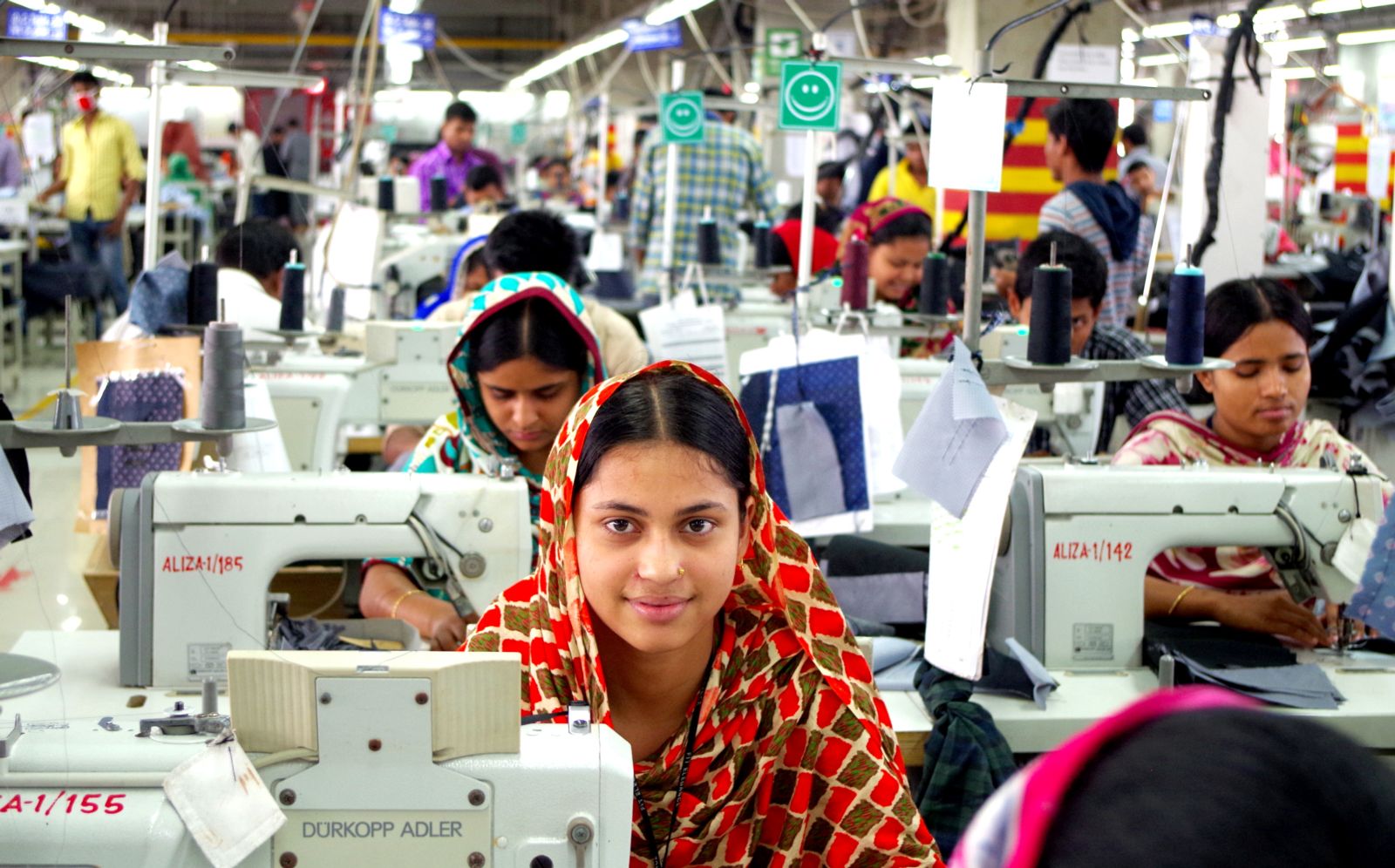
Labour rights defenders regularly experience violence and restrictions on their rights in various ways, including clamp downs on unions where governments and employers obstruct them from functioning freely and independently, laws that limit collective bargaining, and dismissals. In the past year, the International Trade Union Confederation reported an increase in violence, especially to prevent unionizing, and the safety of trade union leaders remains precarious. In Colombia, 19 trade unionists were killed in 2017; in Cambodia, trade union leaders are criminalized; and in Zimbabwe trade union leaders are regularly harassed by government authorities. With respect to laws that limit labour rights, 81% of countries deny some or all workers the right to collective bargaining and 65% of countries exclude some groups of workers from labour law, such as domestic, agricultural and contract workers, up 5% from 2017. Peaceful protests by workers are often met with heavy handed policy or army responses. In addition, the most common reprisal workers face for speaking up about violations are dismissals, a tactic used by employers to stifle civic action. As one example, over 12,000 garment factory workers in Bangladesh were fired for their protests in December 2018 and January 2019 over wages.

The Business & Human Rights Resource documents attacks against defenders working on corporate accountability, and our database shows that agriculture, food and beverage, and apparel are the most dangerous sectors for labour rights defenders. The most common forms of violence against individual union leaders and workers are arbitrary detentions and lawsuits, followed by intimidation and threats, and killings.

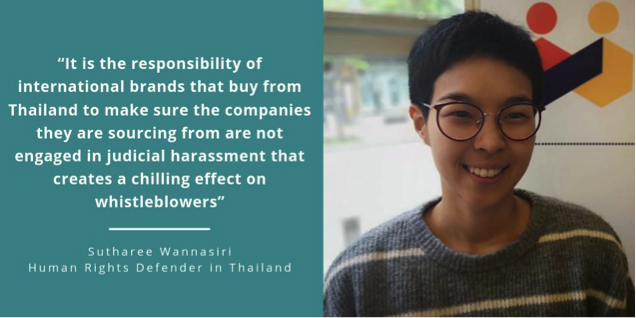
A particularly concerning trend is the use of defamation lawsuits to silence labour rights defenders. As one example, since 2016, Thammakaset Company Limited, a Thai-owned poultry company, filed more than 13 civil and criminal lawsuits against former workers who denounced labour rights violations, as well as against the activists and journalists supporting them. Governments and companies, including international brands, need to ensure such judicial attacks do not happen. As Sutharee Wanasiri, a labour rights defender from Thailand, and one of the people sued by Thammakaset, said: “It is also the responsibility of international brands that buy from Thailand to make sure the companies they are sourcing from are not engaged in judicial harassment that creates a chilling effect on whistle blowers and other defenders. They should establish mechanisms that allow workers and defenders to communicate with the brands directly and ensure that they are protected from any retaliation from suppliers during the investigation. The results should be made public and bring accountability for the abuses.

With long and fragmented supply chains, it is particularly important to ensure that we hear workers’ voices, especially those of the most marginalized at the bottom of economic hierarchies, and guarantee dignified and decent work. This includes people working in the informal economy. Workers and civil society organizations are currently focusing on redefining legal employment terms, and reconsidering union strategy in light of changing labour relations, especially in the gig economy, in which non-conventional workers are not afforded adequate legal protection—either because they do not fall within the definition of a “regular employee” under national laws, or because of gaps in legislation when it comes to regulating new forms of employment. The lack of an applicable legal protection and collectively agreed terms of employment hinders the ability to exercise work-related rights, including the right to organise and collectively bargain.

……..

Labour rights defenders should be seen as critical allies in building equitable and sustainable societies. Several businesses are also beginning to recognise that the protection of human rights defenders and the ability for them to do their work is in their interest, and that an attack on defenders is an attack on responsible business. This is encouraging, as now more than ever we need to be brokering connections and building solidarities across movements and sectors to counter threats to the shared space we all depend upon.

https://www.openglobalrights.org/rising-restrictions-on-labour-rights-threaten-the-heart-of-social-justice/