Posts Tagged ‘judicial proceedings’

EyeWitness to Atrocities: a Decade of Capturing Crimes

June 16, 2025

Mirage news of 14 June 2025 comes with an interesting assessment of eyeWitness to Atrocities (eyeWitness) which marks its tenth anniversary. The International Bar Association (IBA) applauds the work of the pioneering initiative it founded in 2015. The launch of the eyeWitness to Atrocities app for Android phones has harnessed the power of technology in the global fight for justice. The tamper-proof photo, video and audio footage captured using the eyeWitness app, and securely stored by IBA partner LexisNexis , meets the strict evidentiary criteria required to be admissible as evidence in legal proceedings.

Jaime Carey, President of the International Bar Association, stated: ‘As we mark a decade of eyeWitness to Atrocities, we celebrate ten years at the intersection of technology, law, and human rights. .. As President of the IBA, I am proud of our member organisations that have dedicated vast amounts of pro bono work analysing footage captured using the app and I reaffirm IBA support for this vital work and its enduring impact on the global pursuit of justice.’

Mark Ellis, Executive Director of the IBA, added: ‘Footage captured with the eyeWitness to Atrocities app is invaluable in securing justice and bridging the gap between activists and the law. By ensuring that visual evidence is authenticated, the app transforms raw documentation into legally admissible proof. In a world where impunity often thrives in the absence of credible evidence, eyeWitness plays a critical role in bringing truth to light and ensuring that justice is not just a distant ideal, but a real possibility.’

Over the past decade, the eyeWitness app has become an essential tool for human rights defenders, journalists and civil society organisations documenting grave human rights violations and atrocity crimes around the world. Key achievements include:

  • more than 85,000 photos, videos and audio recordings captured using the app;
  • more than 900 training sessions delivered globally, including in active conflict zones;
  • more than 55,000 hours spent reviewing visual evidence;
  • over 104 legal dossiers prepared and submitted to international accountability mechanisms, including United Nations bodies and the International Criminal Court

The impact of eyeWitness has been extensive. The content captured has contributed to numerous cases and reports globally, including:

Carrie Bowker, Director of eyeWitness to Atrocities, commented: ‘The path from documentation to justice is not always straightforward, and as we mark this milestone, we are deeply grateful to the courageous documenters capturing critical evidence of atrocity crimes, to the law firms that provide invaluable pro bono support and to LexisNexis for securely storing footage captured with the app. We aim to continue connecting frontline documenters with legal and investigative bodies that can act on the evidence they collect.’

In a 2023 outcome report the eyeWitness organisation highlighted areas of work including significant footage collection; increased and strengthened partnerships with global human rights organisations dedicated to active documentation for accountability; and expanded pro bono assistance in reviewing and analysing collected footage.

https://www.miragenews.com/eyewitness-to-atrocities-decade-of-capturing-1477953/

Facebook’s ‘supreme court’ is not a court

April 21, 2022
author profile picture

Abe Chauhan (a BCL candidate at the University of Oxford) wrote an interesting opinion about Facebook’s Oversight Board.

The Oversight Board is an independent institution created by Meta which reviews – in light of human rights law – the decisions of its platforms, Facebook and Instagram, on whether posts violate their policies and should be removed. The Board represents a novel, decentralised approach to protecting freedom of expression and other rights, calling into question whether private entities should perform judicial human rights functions.See also: https://humanrightsdefenders.blog/2021/03/17/facebook-launches-a-human-rights-policy-and-fund-aimed-for-human-rights-defenders/

Following calls for more robust, transparent and accountable regulation of Facebook, and after a year of consultations, interviews and research, in October 2020 the Facebook (now Meta) Oversight Board became operational. It is an independent institution, funded indirectly by Meta through a $130 million trust arrangement, which makes binding determinations on content decisions appealed by users. Board members include law professors, human rights practitioners and civil society actors from around the world. Under Article 2, Section 2 of the Board’s Charter, it applies Meta’s Community Standards “in light of human rights norms protecting free expression”. At the time of writing, the Board has released 23 decisions on posts concerning various issues ranging from unmarked graves at former residential schools in Canada to the promotion of ayahuasca. The most widely publicised of these concerned an appeal against Facebook’s decision to block then-President Donald Trump from the platform following his posts in relation to the attack on the US Capitol. The Board decided to uphold the decision, but criticised Facebook’s use of the penalty of indefinite suspension, requiring it to determine a proportionate response. In that case, the Board engaged in extensive discussion on freedom of expression under the ICCPR, deriving a requirement for proportionate limitation from international jurisprudence and developing a number of factors influencing how this assessment should operate.

What, then, is the legal character of the Board? Although it applies human rights law in representative appeals from around the world, like an international human rights court, the Board is a private body and its determinations cannot preclude individual petitions. In this light, the Board is just an additional stage to Meta’s internal review procedure. What cannot be understated, however, is the reach of the Board’s decisions – it makes binding determinations on content decisions about the posts of Facebook’s 3 billion and Instagram’s 1.5 billion active users. Not only are its decisions wide-reaching, but they may have norm-shaping effect as a subsidiary means for interpreting human rights law. Many of the Board’s members are highly qualified human rights scholars and the unanimous decision-making system it applies increases the normative weight of decisions. While in a formal sense the Board is little more than an arbitral tribunal binding only Meta, its decisions have material effects on the rights enjoyment of many individuals around the world. This suggests that rather than merely an internal review procedure, the Board is a private human rights court. Viewed in this light, the Board fills a gap. The effectiveness of the human rights regime depends on the ability of States to protect rights. However, it is large multinational social media corporations which have factual control over many forums of expression. States can only indirectly regulate these, with potentially limited actual impact on the enjoyment of freedom of expression by users. The Board fills this ability gap by implementing rights adjudication internally within Meta.

Some might welcome this novel approach as it signals the greater horizontalisation of human rights. However, while it may be correct that these organisations ought to bear obligations to respect, protect and promote human rights violations, the role the Board is playing goes much further than this. In making final determinations on human rights limitations by Meta, it subsumes – de facto rather than de jure – part of the exclusively State function of human rights adjudication. This is problematic for two reasons. Firstly, it is unacceptable for private institutions to make rights determinations with wide-ranging effects, absent a delegation of this power by the State. Secondly, alongside this absence of legitimacy, the Board may slowly diminish rights protection. Even if it acts in the public interest, the Board is free to develop its own jurisprudence. As Benesch suggests, over time it will have to depart from international human rights law because this field was not designed for application by private companies and its norms and principles need to be adapted accordingly.

While the Board may well be an effective institution – its initial decisions apply close analysis to human rights issues and frequently overturn Meta’s content decisions – it is highly questionable that a private institution should perform the exclusive State function of human rights adjudication.

https://ohrh.law.ox.ac.uk/the-facebook-supreme-court-and-private-human-rights-adjudication/

Land rights defenders in Uganda face tough legal regime

January 14, 2020
DSC_0354 (1)
By witnessradio.org Team

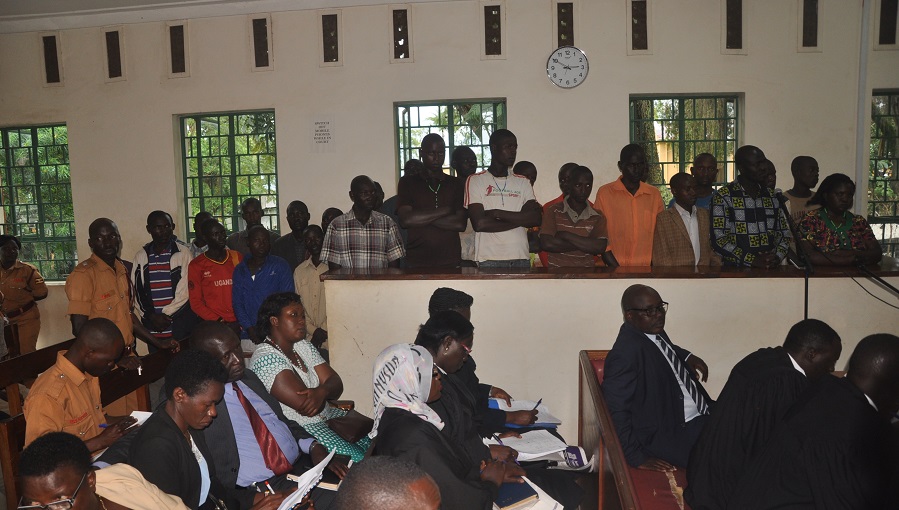
in Uganda reported about the criminal trial of the 28 land rights defenders.

…Grace Nantubiro and Ronald Mugwabya are among the 28 land defenders and also members of witnessradio.org. They were arrested because of being on the frontline defending over 3000 people from were being violently evicted by local businessman George Kaweesi.  Kaweesi was shielded by police and the due process was never followed. Their pleas fell on deaf-ears until a violent crash ensued between the communities and the workers of a businessman that claimed a life of one Yunus Kasajja. Kasajja had been tasked by Kaweesi to supervise the eviction exercise.

The land under dispute is registered on Block 168, Plot 19, 22 and 23 with over 322.5 hectares covering five villages namely, Kambuye, Kikono, Kyabaana, Kanseera and Lwensanga in East Division, Mubende Municipality, Mubende district. The land forcefully taken was hosting some of the families that were evicted by Kaweeri Coffee Plantation limited in the early 2000s. The 600 families are part of the 2000 families, relocated to that land as compensation for what they had lost to Kaweeri Coffee Plantation limited. That land was formerly owned by Emmanuel Kayiwa Bikko who has since passed on.

Lately, the land-grabbing elements have resorted to using the Penal Code to charge land defenders because the law is lethal.  It imposes harsher prison sentences than any other and also obtaining bail once charged under it is either legally hard or too expensive for the rural communities in Uganda. These persecutions are manifesting majorly in districts that host minerals including sub-regions of Karamoja, Bunyoro and Buganda. Essentially, the prosecution alleges that on October, 12th, 2018, the accused:  Nantubiro Grace and Mugwabya Ronald and others at Kambuye-Kanseera, Mubende district, robbed Yunus Kasajja Tabu of his three mobile phones and thereafter proceeded to end his life.  If found guilty of the murder charge, they stand a chance of facing the ultimate punishment which is death.

https://witnessradio.org/the-criminal-trial-of-the-28-land-rights-defenders-is-set-to-resume-today/

Judicial harassment of human rights defender Dimitras in Greece

February 1, 2014

The International Secretariat of OMCT has been informed by the Greek Helsinki Monitor (GHM), a member of OMCT SOS-Torture network, about the ongoing judicial harassment against Panayote Dimitras, GHM Spokesperson. According to the information received, on 14 January 2014, Mr. Panayote Dimitras received an indictment from the Misdemeanours Prosecutor of Athens, summoning him on 27 February 27 before the Court to stand trial on charges of “perjury” and “defamation” of Mr. Konstantinos Plevris, a member lawyer of the Athens Bar Association.

The  accusation relates Panayote Dimitras’ statement as a witness before the First Chamber of the Five Members Appeals Court of Athens on 23 January  2009, during a hearing of a case against Mr. Konstantinos Plevris, who then stood accused of racial discrimination”. During the hearing, Mr. Dimitras testified that “during the last two months Mr. Plevris ha[d]threatened [his] life”. Yet the indictment accuses Mr. Dimitras of making a false statement that could harm the honour and reputation of Mr. Plevris while knowing that it was untrue.

The International Secretariat of OMCT is concerned that Mr. Panayote Dimitras received this indictment merely one week before the charges become time-barred. Although the events took place in January 2009 and a preliminary investigation took place in February 2010, suddenly charges are pressed. The prescription period is now extended by three years.

OMCT is concerned about these new acts of harassment against Mr. Panayote Dimitras, which seems to merely aim at sanctioning his human rights activities, and in particular his activities against discrimination, anti-Semitism and minority rights in Greece, and calls upon the Greek authorities to ensure that he is able to carry out his legitimate activities without any hindrance and fear of reprisals.  OMCT recalls that this is not the first time that Panayote Dimitras is facing judicial harassment by Konstantinos Plevris, who has been referred to trial several times for, among others, violation of [anti-racism] Law 927/79, concurrent aggravated defamation, and false accusation following GHM complaints.

For more on this procedurally complex but interesting case see:

Greece: Ongoing judicial harassment against human rights defender Mr. Panayote Dimitras / January 30, 2014 / Urgent Interventions / Human rights defenders / OMCT.