.unesco.org/news/visualizing-journalism-without-fear-favour (Image by UNESCO)
The ongoing COVID-19 pandemic has made even clearer the importance of being able to access reliable, unbiased information in a time of crisis – and of independent media as the source of such information. But freedom of the media is under attack in many countries all around the world and journalists are subject to harassment, repression and violence. The World Press Freedom Conference 2020 (WPFC) aims to stand up for a free, safe and independent media and protect journalism from new and existing forms of unwanted control, pressure and influence.
The WPFC is co-hosted by UNESCO and the Kingdom of the Netherlands and will take place on 9 – 10 December 2020 in a new, innovative format, merging digital and in-person elements. It will bring together journalists, media companies, human rights defenders, members of the judiciary, policymakers, academics, youth and NGOs from around the world and is open to anyone, anywhere, who is interested in press freedom. [see also https://humanrightsdefenders.blog/tag/world-press-freedom-index/]
RNW Media will be hosting a session called PRESSure is ON: creating an inclusive and enabling online space for digital media communities. This session puts the spotlight on the marginalised voices of young media makers. Bloggers, vloggers and media makers from teams in Libya, the Democratic Republic of Congo and India will discuss their on-the-ground experiences in their local contexts, the challenges they face when it comes to digital rights (both access and content takedowns) and the possible solutions.
The session on 10 December 12:15 – 13:15, will be led by Melody Patry, Advocacy Director at the digital rights NGO Access Now. The audience will be able to use a chat function to share their thoughts on the topics discussed and will be asked to respond to questions that will pop up on their screens throughout the session. These questions are designed to gather the audience’s opinions on such issues as what poses the biggest threat to freedom of speech and whether or not governments should have the right to censor media content they consider harmful to society.
The RNTC media training centre has joined forces with UNESCO and the Netherlands Ministry of Foreign Affairs to hold an online competition in the run-up to the conference offering the chance to win a two-day online Masterclass in Investigative Journalism. People are invited to submit a short story, picture or 10-second video message explaining what press freedom means to them or how they’ve contributed to it, via direct messaging @UnescoNow. A total of 20 winners will be selected to take part in RNTC’s masterclass which will take place in January.
The on-line training will introduce key concepts and tools for investigative journalism and strengthen participants’ capacity to identify and research issues of governance, accountability, corruption, and misuse of power. In order to publicise the competition, RNW Media has been sharing videos on its social media channels of journalists from around the world explaining what press freedom means to them
On 14 Aya Wietzorrek posted a good overview piece on freedom of the press in the Organization for World Peace
…..Functioning as a “watch-dog” of these freedoms, journalism can be considered a public good, as it serves to inform citizens on political, economic, and social issues and ensures governance is transparent and accountable.
Acknowledging the many challenges journalism is currently facing…the focus of this article is on the everyday violations against journalists. This September, the UN Educational, Scientific and Cultural Agency (UNESCO) published a report with findings revealing a “wider upward trend” in the use of unlawful violence by police and security forces against journalists over the last five years. Attacks were reported across 65 countries, and many of the tactics used, violate international laws and norms. Globally, journalists are facing censorship, surveillance, detention and physical attacks by law enforcement. The reported abuses against journalists include harassment, intimidation, beatings, being shot with non-lethal as well as lethal ammunition, sometimes even resulting in death.
The UN High Commissioner for Human Rights, Michelle Bachelet, commented that around 1,000 journalists have been killed in the last decade – and that 9 in 10 cases “are unresolved”. The murders of journalists Daphne Caruana Galizia in 2017 in Malta, Jamal Khashoggi in 2018 in Turkey and Francisco Romero Díaz in 2019 in Mexico are only a few examples. Horrified by the fates of their colleagues, these events have deterring effects for other journalists. Besides the attacks on journalists being a deeply concerning issue in their own right, such attacks thus also constitute a direct threat to civil society and democracy. In democratic states, with separate legislative, executive and judiciary branches, a free press is often considered to be the 4th pillar of democracy. According to Freedom House, however, elected leaders in many democracies have made direct attempts to silence critical media voices and strengthen ones that provide favourable coverage. The trend is linked to a global decline in democracy itself: The erosion of press freedom is both a symptom of and a contributor to the breakdown of other democratic institutions and principles….
To intercept this upward trend of unlawful violence reported by UNESCO, and to ensure that journalists can serve society and do their job, we can improve and implement the following. Firstly, in terms of prevention, developing standard operating protocols and increasing training for law enforcement on the freedom of expression and appropriate behaviour in dealing with journalists – respecting their special status as ‘watch-dogs’ – is vital. Such training would include dialogues between law enforcement and journalists, to establish working relationship between the two groups, respecting the roles of each in society. It is imperative that national legal frameworks for police use of force align with the international standards of necessity and proportionality. Secondly, in terms of protection, countries should renew their international human rights pledges, review relevant domestic laws and practice and revise them as necessary, to ensure conformity with states’ obligations under the UDHR and ICCPR. These legislative frameworks should be subject to periodic review by independent expert bodies, such as Human Rights Watch for instance. Thirdly, as the Committee to Protect Journalists has pointed out in its “Global Campaign Against Impunity”, murder is the ultimate form of censorship and the statistic that justice is not served in 9 out of 10 murders, highlights that urgent action is needed on this front. In terms of prosecution, appointing national ombudsmen to hold police accountable for the unlawful use of force against journalists is key. The implementation of such ombudsmen and the strengthening of criminal law provisions should also operate to deter offences against journalists. Internationally, the freedom of press is only implicitly protected by Article 19.2 of the International Covenant on Civil and Political Rights and deserves to be explicitly mentioned and protected. The appointment of a Special Representative of the UN Secretary-General for the Safety of Journalists, as proposed by Reporters Without Border and 70 media groups and freedom of expression NGOs, would be a valuable appointment. This proposal was officially rejected in 2019 by UN Secretary-General António Guterres. The creation of such a position would however help prevent resolutions and treaties from being largely empty words and would have the political weight, the capacity to move quickly and the legitimacy to coordinate with all UN bodies to implement change.
….. The international community has repeatedly stated the need for a more effective implementation of existing international and regional standards, yet the work still lies ahead of us. Governments should pro-actively (re-)establish their commitment to a free press and the protection of journalists as it is imperative that civil societies across the globe continue to defend right to freedom of expression. This is necessary for the enhancement of people’s lives and for the creation and maintenance of stable and healthy democratic societies.
Aya Wietzorrek is a graduate in International Development from The University of Manchester and is currently a research intern in the Governance and Inclusive Development Group at the Amsterdam Institute of Social Science Research.
Prosecutors said the lengthy prison term for Juan Carlos Moreno set a precedent in cases involving crimes against free expression. This “good news” comes amidst continuing killings of journalists also in this year. Reporter Pablo Morrugares was shot and killed in the city of Iguala in early hours of 2 August 2020, according to newsreports and officials.
Pablo Morrugares was the fifth journalist to be killed in Mexico this year, in attacks which are increasingly also killing police guards assigned to the victims. More than 140 journalists have been killed over the past 20 years.
“We are dismayed that Mexican journalists are being killed while supposedly under federal protection,” said Jan-Albert Hootsen, CPJ’s Mexico representative. “Authorities must do everything in their power to curb this impunity in attacks on the press, bring the culprits in Pablo Morrugares’ murder to justice, and guarantee the safety of reporters it has committed to protect.”
Morrugares, the founder and editor of news website PM Noticias, was attacked shortly before 1:00 a.m. on August 2 in a restaurant in Iguala, some 120 miles south of Mexico City in the state of Guerrero Two heavily armed men entered the restaurant and fired more than 50 rounds at Morrugares, who died instantly. A police officer assigned to Morrugares as part of a federal protection program also died in the attack. The gunmen left the scene immediately after.
Before founding PM Noticias, Morrugares worked as a spokesperson for the Iguala municipal government during the administration of José Luis Abarca. The former mayor was arrested on November 4, 2014, for his alleged involvement in the mass abduction and suspected assassination of 43 students from a Guerrero rural teachers’ college on September 26 of that year. In 2016, Morrugares and his wife were targets of an attack by unidentified gunmen in Iguala, according to newsreports. Following the attack, the reporter was placed in a protection program overseen by the Federal Mechanism for the Protection of Human Rights Defenders and Journalists, which operates under the auspices of the federal Interior Secretariat (Segob). An official of the Mechanism, who asked to remain anonymous as he is not authorized to speak on the matter, told CPJ today that his institution relocated the journalist to a safe house at an undisclosed location in 2018, where he stayed under federal protection until the end of 2019. The official said that Morrugares returned to Iguala at his own request in January of this year and was assigned two state police officers as bodyguards, one of whom died in this week’s attack.
As four Yemeni journalists continue to wonder when or whether the Houthi authorities will execute the death sentences they received in April on spying charges, Reporters Without Borders (RSF) calls for international pressure to make the Houthis understand that they will suffer international opprobrium if they do not overturn the sentences.
Before being abducted by the Houthis in 2015, the four journalists played leading roles in a Sanaa-based network of media outlets and Facebook, Twitter, YouTube, Telegram and WhatsApp pages linked to Al-Islah, the Yemeni branch of the Muslim Brotherhood and ruling party in regions controlled by Yemen’s internationally recognized government.
Abdul Khaleq Amran edited the Al-Islah Online website and ran Yemen Revolution Press, a news agency created from several media outlets in 2011. His staff covered the Yemeni civil war, documented crimes committed by the Houthis and interviewed the Houthis’ opponents.
Akram Al-Walidi supervised the staff of the Alrabie-ye.net news website and the government news agency SABA. He gathered information about developments in the fighting from the Al-Islah side, on the basis of reliable sources and with the help of a network of senior political and administrative officials then based in Ma’rib, which was established as the new capital after the Houthi rebels seized Sanaa.
Hareth Humaid, the head of news at Yemen Revolution Press, covered Houthi human rights violations, including abductions and bombardments of civilians. He produced a daily news bulletin with the latest violations. Its last issue was No. 54.
Tawfiq Al-Mansouri worked for the daily newspaper Al-Masdar until it stopped publishing when the Arab coalition intervened in 2015. He then joined Yemen Revolution Press doing layout and graphic design and helping to give form to the various media outlets linked to the agency.
After their abduction in 2015, the four journalists were secretly moved from one prison to another in Sanaa and were subjected to violent interrogations. Torture and repeated blows left all of them with severe physical and psychological aftereffects, according to the Association of Abductees’ Mothers. Amran has a slipped disc. Humaid has suffered loss of vision and has constant migraines. Walidi has chronic digestive problems.
“Every year the world moves one step closer to the universal abolition of the death penalty, but these four veteran journalists are facing the worst of all sentences just for doing their job,” RSF secretary-general Christophe Deloire said.
“Efforts are urgently needed to end their nightmarish plight and return to humanitarian principles in a country where journalists have already paid a heavy price in the war. The Houthis must overturn this decision or face international opprobrium. We ask all those who may have any influence, direct or indirect, on the Houthis to use it to help bring this madness to an end.”
The four were among a total of ten journalists abducted by the Houthis in Sanaa in 2015 on the absurd grounds that they could potentially provide the Arab coalition with information for use in its air strikes. Accused of “collaborating with the enemy,” they were tried by a Houthi Special Criminal Court that is not recognized by the international community.
In its latest annual round-up, RSF reported that a total of 15 journalists were being held hostage in Yemen, most of them by the Houthis. The others were either being held in provinces controlled by the so-called “legitimate government” (such as Muhammad Ali Al-Moqri) on in areas controlled by separatists (such as Saleh Musawa, who has since been released).
Coronavirus “information heroes” – journalism that saves lives
On 15 June t2020 he NGO Reporters Without Borders (RSF) published a list of 30 coronavirus “information heroes” – 30 journalists, whistleblowers and media outlets whose courage, perseverance or capacity to innovate has helped to circulate reliable and vital information during the Covid-19 pandemic. See the list
Every crisis produces its heroes. Around the world there are journalists, whistleblowers and media outlets that have managed to overcome the barriers to information created since the start of the pandemic. Through their reporting or by means of initiatives that have needed courage, audacity and determination, they have provided access to trustworthy and quality information, helped to resist censorship, and combatted the runaway disinformation that threatens public health.
“Some people have taken such big risks to report the reality of the pandemic that they have died as a result, while others have disappeared or have been jailed,” RSF secretary-general Christophe Deloire said. “Prosecuted, attacked, insulted – many have paid a high price for defending the right to information and for combatting the rumours and disinformation that aggravate the consequences of this public health crisis. These new heroes remind us that journalism can save lives. They deserve our attention and admiration.”…
The list compiled by RSF, which is not intended to be exhaustive, includes both well-known media figures and people the public have not heard of. Although they come from all five main continents, nearly a third of these 30 heroes are from Asia, where the pandemic originated. Six are from Europe and Central Asia, and the others are from Africa, the Americas and the Middle East.
What most of these heroes have in common is the fact that they revealed information highlighting the pandemic’s gravity or their government’s mismanagement of the crisis. Some are veteran reporters like Ana Lalić in Serbia or combative investigators like Blaž Zgaga in Slovenia, Andjouza Abouheir in Comoros and Sergei Satsukin Belarus. However, others are ordinary citizens who, in response to the urgency and gravity of the public health crisis, decided to blow the whistle with the aim of saving as many lives a possible. It was an eye doctor, Li Wenliang, who first alerted the world to the existence of a fast-spreading disease in December 2019. And it was a lawyer, Chen Qiushi, who posted videos on his blog revealing the chaos in the hospitals in Wuhan, the site of the initial Covid-19 outbreak. Li died of the virus while Chen was forcibly quarantined and never reappeared.
You often pay dearly for the truth. In Venezuela, freelance journalist Darvinson Rojas spent 12 days in prison for a tweet questioning official pandemic figures. In India, newspaper reporter Vijay Vineet is facing a possible six-month jail sentence for reporting that lockdown restrictions forced hungry kids to eat cattle fodder. In Bangladesh, the well-known cartoonist Ahmed Kabir Kishore is facing a possible life sentence for posting cartoons on Facebook about politics during the Covid-19 crisis that alluded, inter alia, to corruption.
Others have avoided prison but can no longer work. After a lengthy and violent police interrogation over an article questioning the Kingdom of Eswatini’s handling of the Covid-19 crisis, Swati Newsweek website editor Eugene Dube had to flee to neighbouring South Africa. Chris Buckley, a Beijing-based reporter for the New York Times, was forced to leave China after spending 76 days in Wuhan at the height of the outbreak. For the first time in 24 years, his visa was not renewed.
Many of these heroes displayed courage in resisting pressure and censorship. They include Caixin, an independent English and Chinese-language media outlet in Beijing whose reporting has questioned the Chinese government’s narrative. For some, such as Afghan reporter Anisseh Shahid, it took courage to simply keep reporting in the field with the threat of infection compounding the threat of a Taliban attack. In the United States, several White House correspondents have distinguished themselves by their perseverance in adversity. Despite constant attacks by President Trump and his aides, they continue week after week to question his handling of the pandemic.
This exceptional crisis has also produced innovative initiatives that have helped to get the facts out and combat disinformation. In Africa, the Ivorian web radio WA FM and the Togolese news site TogoCheck were created to combat rumours and fake news and disseminate trustworthy information that the public can use to protect themselves and their health. In Brazil, alternative media outlets pooled resources to form a “Gabinete de crise” to inform the abandoned inhabitants of Rio de Janeiro’s favelas, while the Wayuri Network’s journalists have risen to the challenge of informing more than 750 indigenous communities in the Amazon. In Russia, 25 media outlets formed Syndicate-100 to make it easier for medical personnel, who have been hit hard by the epidemic, to report problems and alert the public.
Finally, RSF pays a special tribute to journalists in Guayaquil, Ecuador’s business capital and the site of Latin America’s biggest Covid-19 outbreak. The photos of bodies in Guayaquil’s streets have gone around the world. Despite being unprepared and lacking personal protective equipment, the city’s journalists have continued to work and to report in locations with a high infection rate. And this has taken a heavy toll. Thirteen of them have died of the virus.
Reporters Without Borders (RSF) published exclusive interviews by Philippine journalist Maria Ressa with Washington Post columnist Rana Ayyub, whistleblower Edward Snowden, Nobel economy laureate Joseph Stiglitz and RSF secretary-general Christophe Deloire on the subject of “Journalism in crisis: a decisive decade.”
“At a moment of a global health emergency, journalism serves a crucial function, and each journalist bears great responsibility,” DW Director General Peter Limbourg said while announcing the award winners in Berlin. “Citizens of any country have the right of access to fact-based information and critical findings,” he said. “Any form of censorship may result in casualties and any attempts to criminalize coverage of the current situation clearly violate the freedom of expression.” For a list of this year’s laureates, see: https://www.dw.com/en/deutsche-welle-freedom-of-speech-award-17-laureates-from-14-countries/a-53306033
Michelle Bachelet, the UN high commissioner for human rights, said in a video message to the journalists honored that the general public needs “full and accurate information about the pandemic, and to be involved in the decisions that are being made on our behalf.” The International Press Institute documented more than 150 violations of press freedom worldwide through the end of April. The IPI has tracked cases of censorship and restrictions on access to information — but the greatest number of violations of press freedom have been arrests of journalists and verbal or physical attacks on them. (https://www.dw.com/en/un-commissioner-michelle-bachelet-honors-journalists/av-53297637)
——
On the occasion of World Press Day, the Syrian Network for Human Rights (SNHR) issued a report demanding the release of 422 citizen journalists in Syria, most of whom are detained by the Syrian regime, and are now threatened by the COVID-19 pandemic. The report notes that 707 citizen journalists have been killed since March 2011 to date, 78% of them by Syrian Regime forces. The 20-page report shows how the Syrian regime has been well aware of the danger posed by press freedom to its tyrannical rule for decades, abolishing all independent newspapers, and allowing only three official newspapers to be published, which are simply Syrian regime mouthpieces, dedicated to promoting, defending and justifying the regime’s actions. As the report further notes, it’s no exaggeration but simply a statement of fact to say that there is no such thing as a free press under the Syrian regime…..The report distributes the total death toll according to the main parties to the conflict, with the Syrian regime being responsible for the deaths of 551 citizen journalists, including five children, one woman, five foreign journalists, and 47 other citizen journalists due to torture in detention centers, while Russian forces were responsible for the deaths of 22 citizen journalists, and ISIS killed 64, including one child, two women, three foreign journalists, and three under torture. Hay’at Tahrir al Sham also killed eight, including two who died due to torture. Factions of the Armed Opposition were responsible for the deaths of 25 citizen journalists, including one child and three women.
The 2020 World Press Freedom Index, annualy compiled by Reporters Without Borders (RSF), shows that the coming decade will be decisive for the future of journalism, with the Covid-19 pandemic highlighting and amplifying the many crises that threaten the right to freely reported, independent, diverse and reliable information.
This 2020 edition of the Index, which evaluates the situation for journalists each year in 180 countries and territories, suggests that the next ten years will be pivotal for press freedom because of converging crises affecting the future of journalism: a geopolitical crisis (due to the aggressiveness of authoritarian regimes); a technological crisis (due to a lack of democratic guarantees); a democratic crisis (due to polarisation and repressive policies); a crisis of trust (due to suspicion and even hatred of the media); and an economic crisis (impoverishing quality journalism).
These five areas of crisis – the effects of which the Index’s methodology allows us to evaluate – are now compounded by a global public health crisis.
“We are entering a decisive decade for journalism linked to crises that affect its future,” RSF secretary-general Christophe Deloire said. “The coronavirus pandemic illustrates the negative factors threatening the right to reliable information, and is itself an exacerbating factor. What will freedom of information, pluralism and reliability look like in 2030? The answer to that question is being determined today.”
There is a clear correlation between suppression of media freedom in response to the coronavirus pandemic, and a country’s ranking in the Index. Both China (177th) and Iran (down 3 at 173rd) censored their major coronavirus outbreaks extensively. In Iraq (down 6 at 162nd), the authorities stripped Reuters of its licence for three months after it published a story questioning official coronavirus figures. Even in Europe, Prime Minister Viktor Orbán of Hungary (down 2 at 89th), had a “coronavirus” law passed with penalties of up to five years in prison for false information, a completely disproportionate and coercive measure.
“The public health crisis provides authoritarian governments with an opportunity to implement the notorious “shock doctrine” – to take advantage of the fact that politics are on hold, the public is stunned and protests are out of the question, in order to impose measures that would be impossible in normal times,” Deloire added. “For this decisive decade to not be a disastrous one, people of goodwill, whoever they are, must campaign for journalists to be able to fulfil their role as society’s trusted third parties, which means they must have the capacity to do so.”
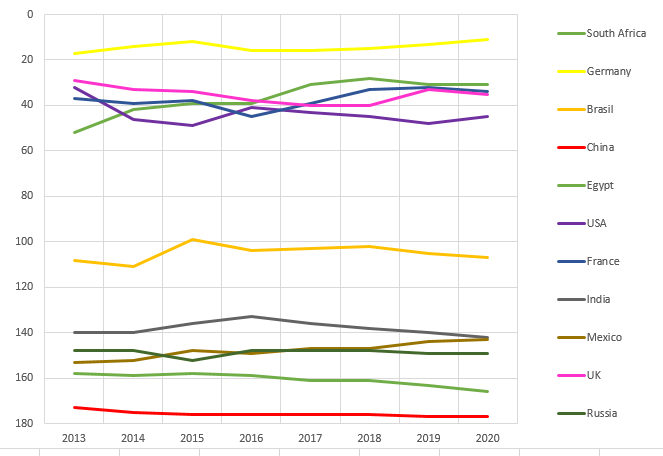
Evolution of some countries ranked since 2013
The main findings of the 2020 Index: Norway tops the Index for the fourth year in a row in 2020, while Finland is again the runner-up. Denmark (up 2 at 3rd) is next as both Sweden (down 1 at 4th) and the Netherlands (down 1 at 5th) have fallen as a result of increases in cyber-harassment. The other end of the Index has seen little change. North Korea (down 1 at 180th) has taken the last position from Turkmenistan, while Eritrea (178th) continues to be Africa’s worst-ranked country.
Malaysia (101st) and the Maldives (79th) registered the biggest rises in the 2020 Index – 22nd and 19th, respectively – thanks to the beneficial effects of changes of government through the polls. The third biggest leap was by Sudan (159th), which rose 16 places after Omar al-Bashir’s removal. The list of biggest declines in the 2020 Index is topped by Haiti, where journalists have often been targeted during violent nationwide protests for the past two years. After falling 21 places, it is now ranked 83rd. The other two biggest falls were in Africa – by Comoros (down 19 at 75th) and Benin (down 17 at 113th), both of which have seen a surge in press freedom violations.
On 9 April 2020, the Committee to Protect Journalists (CPJ) and 80 other media and human rights NGOs have urged ten African Heads of State to release journalists from detention in the context of the COVID-19 pandemic.
To:
President of Algeria Abdelmadjid Tebboune President of Benin Patrice Talon President of Burundi Pierre Nkurunziza President of Cameroon Paul Biya President of Chad Idriss Deby President of Egypt Abdel Fattah el-Sisi President of Eritrea Isaias Afwerki Prime Minister of Ethiopia Abiy Ahmed Ali Prime Minister of Morocco Saad-Eddine El Othmani President of Rwanda Paul Kagame
Your Excellencies,
We the 81 undersigned media, press freedom, and human rights organizations are writing to call on your respective governments to release all jailed journalists amid the sweeping COVID-19 pandemic. Last week, the Committee to Protect Journalists published an open letter to world leaders urging the immediate release of all journalists imprisoned for their work. Given that a staggering number of these imprisoned journalists are held in jails across the African continent, we are reiterating that call to your respective countries at this time of grave public health concern.
As of March 31, at least 11 of these journalists have been released from jails in Somalia, Ethiopia, Tanzania, Nigeria, DRC, Algeria, Comoros, South Sudan, and Egypt, according to CPJ research. However, at least six more journalists and media workers have been jailed since December 1, and remain in prison as of March 31, including four inEthiopia and one each in Cameroon and Algeria.
Article 16 of the African Charter on Human and Peoples’ Rights states, “Every individual shall have the right to enjoy the best attainable state of physical and mental health.” These rights were extended to prisoners and detainees when the African Commission adopted the 1995 Resolution on Prisons in Africa. According to the World Health Organization, “People deprived of their liberty, and those living or working in enclosed environments in their close proximity, are likely to be more vulnerable to the COVID-19 disease than the general population.”
For journalists jailed in countries affected by the virus, freedom is now a matter of life and death. Imprisoned journalists have no control over their surroundings, cannot choose to isolate, and are often denied necessary medical care. Many of these journalists have been held in detention without trial for lengthy periods and are suffering from ill health exacerbated by underlying health conditions and overcrowded prisons, where they have contracted malaria, tuberculosis, and other diseases.
We urge you to release every jailed journalist in your respective countries and to protect the free press and the free flow of information at this crucial time. Journalism must not carry a death sentence.
Sincerely,
(for names of signing organisations see link below)
There is a list – updated monthly – by the One Free Press Coalition of nearly 40 news organizations, which identifies the 10 most urgent cases threatening press freedom around the world. Understanding the COVID-19 requires unbiased journalists, whose work requires protection. Not only does the act of informing the public carry risk to one’s own health but, in many countries, risk of retaliation. In China, freelance video journalist Chen Quishi disappeared on February 6 after informing family of plans to report on a temporary hospital in Wuhan, where the virus originated. Beijing has since expelled journalists from outlets including The Wall Street Journal, The New York Times and The Washington Post and demanded personnel information from Voice of America and TIME. Mohammad Mosaed, a reporter in Iran who criticized the government’s response to the pandemic, has been barred from practicing journalism and suspended from social media. Family members of imprisoned Egyptian journalist Alaa Abdelfattah were detained for protesting on behalf of prisoners who are vulnerable to the spread of the virus. An Azerbaijani journalist freed in mid-March described detention conditions allowing one shower per week, without soap, he told CPJ
Journalist, who warned about pandemic, banned from work and social media.
Freelance economic reporter Mohammad Mosaed awaits a court date, after intelligence agents of the Islamic Revolutionary Guard Corps (IRGC) arrested and interrogated him in February regarding social media accounts critical of government. The criticism included lack of preparedness to tackle the coronavirus outbreak. Until trial, authorities bar him from practicing journalism and suspended his social media accounts. Last year he endured 16 days in Evin prison for his tweets and was released on bail.
Editor facing potential detention, arrested again March 28.
Rappler editor Maria Ressa is scheduled for trial April 24, expecting a verdict on a cyber-libel charge brought by local businessman Wilfredo Keng regarding a May 2012 story. The relevant law took effect four months after the story in question was published. Depending how judges interpret the 2012 Cybercrime Prevention Act, Ressa could face six years in prison.
Family of jailed journalist protests prisons’ inaction to prevent COVID-19 threat.
While blogger Alaa Abdelfattah is held in Cairo’s Tora Prison, three of his family members face charges of unlawful protest, illegal assembly and obstructing traffic in their call to protect prisoners from the spread of coronavirus. They were released on bail exceeding $300 apiece. After reporting about politics and human rights violations, Abdelfattah has endured threats and been told he will never go free if he speaks of guards’ abuse.
Journalist covering coronavirus disappeared more than six weeks ago.
Freelance video journalist Chen Quishi has not been seen since February 6, when he informed family of plans to report on a temporary hospital. In late January, he had traveled from Beijing to the city of Wuhan in Hubei province and began filming and reporting on the coronavirus health crisis, according to his posts on YouTube. Friends running his Twitter account believe he is likely held in residential surveillance.
Journalist fears for her life, amid government-orchestrated threats.
After 19 years of persecution and legal censorship, award-winning journalist Claudia Julieta Duque told IWMF that she learned on February 29 about an ongoing criminal threat against her life. According to Duque, agents of the state institution in charge of protecting human rights defenders and at-risk journalists, called the National Protection Unit (UNP), were reportedly ordered to carry out intelligence activities to infiltrate Duque’s security scheme and threaten her welfare.
Imprisoned publisher undertook hunger strike while awaiting appeal.
No date has been set, following postponement of a March 12 appeal in the case of Martin Inoua Doulguet, publisher of Salam Info. He was found guilty on criminal charges of defamation and conspiracy in September, and sentenced to three years in prison. The privately owned quarterly newspaper reports on crime and politics in Chad, and Doulguet’s penalty includes a $1,675 fine and paying part of $33,514 in plaintiff damages.
Journalist serving life sentence prepares for final appeal.
On April 6, a Kyrgyz court is scheduled to hear the final appeal in the case of award-winning journalist Azimjon Askarov. The ethnic Uzbek, who reported on human rights, has spent more than nine years imprisoned on trumped-up charges that included incitement to ethnic hatred and complicity in the murder of a police officer. The decade-long case has drawn persistent international condemnation, and Kyrgyzstan’s only imprisoned journalist’s health deteriorates.
Cuban journalist Roberto Jesús Quiñones has spent more than six months behind bars, experiencing worsening treatment. Staff listen to all of his phone calls, have served him food containing worms, and upon learning of his secretly publishing from prison, suspended family visits and put him in solitary confinement. A municipal court in Guantánamo sentenced him to serve one year as a result of “resistance” and “disobedience” when police beat and detained him for covering a trial as a CubaNet contributor last April and his refusal to pay a fine imposed on him following this incident.
Reporter experiences repeated retaliation for his work.
On two different occasions last year, Benin courts delivered prison sentences to Ignace Sossou, a reporter for privately owned site Web TV. First was a one-month imprisonment and fine of $850 for publishing “false information” about local business dealings. Then an 18-month sentence and fine of $337 for defamation and disinformation in his reporting public statements made by Public Prosecutor Mario Mètonou.
Turkish and U.S. leaders continue pressuring for murdered journalist’s justice.
On March 25 Turkish officials indicted 20 Saudi nationals in the ongoing pursuit for answers surrounding Jamal Khashoggi’s brazen killing in Istanbul in 2018 and the Saudi crown prince’s role. That follows a March 3 news conference with U.S. Senator Ron Wyden, Representative Tom Malinowsk, and The Washington Post columnist’s fiancé, Hatice Cengiz, announcing that they are invoking procedures within the Senate Intelligence Committee to provide a congressional release of information from intelligence agencies.
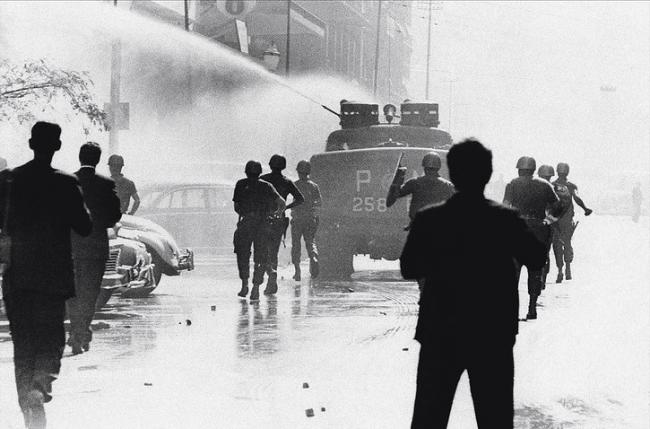
A scene in São Paulo, Brazil, on April 1, 1964, during the military coup against President João Goulart that installed a dictatorship. (Photo via Public Archive of São Paulo State)
Jacob Blanc– a history professor at the University of Edinburgh – published in Nacia of 20 January 2020 a real ‘horror story’ about Aluízio Palmar, a Brazillian human rights defender and tortutre victim being sued by a dictatorship-era torturer. He puts the blame squarely on the climate created by Bolsonaro.
The physical and psychological torture happened 40 years ago, when Palmar was imprisoned by the military dictatorship that ruled Brazil from 1964 to 1985. But it was only last month, in a climate defined by Brazil’s right-wing president Jair Bolsonaro, that Palmar’s abuser felt emboldened to file the suit….In a cruel twist, it is not a case of the victim seeking justice from his abuser. Instead, Ostrovski—who became a lawyer after his military service—has sued Palmar for defamation of character and “moral damages” over his efforts to bring public attention to Ostrovski’s crimes.
Ostrovski’s human rights abuses have been well-documented, including in the 1984 report on torture titled Brasil: Nunca Mais (Brazil: Never Again) and also in the 2014 National Truth Commission, the largest effort to-date to elucidate the repression of Brazil’s military regime. In these reports, multiple victims testified to Ostrovski’s acts of torture. Despite this evidence, Ostrovski has never stood trial. Nor, for that matter, has anyone in Brazil been held accountable for the cruelty of dictatorship. Unlike in neighboring Chile and Argentina where limited trials did take place, not a single member of the Brazilian military has faced criminal charges.
The lack of legal justice for Brazil’s human rights abusers helps explain the lawsuit against Palmar. Since the 1980s, Palmar has been an ardent human rights activist and journalist. He has co-founded a political newspaper, written a book on the forced disappearances of six Brazilian dissidents, maintained a website that publishes declassified documents, and established the Center for Human Rights and Popular Memory in the city of Foz do Iguaçu. So although there has been a concerted absence of political and institutional justice, Palmar and countless Brazilians like him have fought to keep the memory of the past alive. One of these initiatives took place in 2013 and stands as the crux of the current lawsuit.
As part of the investigations for the National Truth Commission, Palmar and three other torture victims testified in a public hearing. In the aftermath of this testimony, protestors engaged in a political action common in Latin America known as an escrache: to expose Ostrovisky—who had been living in relatively anonymity—the crowd marched to his law office and held a noisy rally to “out” him as a torturer. Palmar himself did not take part in the protest, but he did publicize the event on Facebook. And it is precisely Palmar’s act of sharing the protest on Facebook that Ostroviski is now citing in his claim for legal and financial restitution. But if the event in question took place in 2013, why is the lawsuit only now being brought forth?…The answer ties directly to Brazil’s current political landscape. Since Bolsonaro’s election in October 2018, a long-standing culture of impunity has become even more brazen. An army captain in the final years of the dictatorship, Bolsonaro has built his political career on an unapologetic nostalgia for military rule. Among his many headline-grabbing statements, Bolsonaro invoked the dictatorship’s most notorious torturer in voting to impeach the former president Dilma Rousseff—herself a torture victim—and he has stated that the regime’s murder of some 500 citizens did not go far enough.
“Since 1979, torturers have been protected by a law that is interpreted as impunity for them,” Luciana Silva, a professor of history at the State University of Western Paraná, said. “Now they are sheltered by an irresponsible president, who clearly governs for only a portion of the population. The torturer felt comfortable suing his victim as if nothing were going to happen.”
As both a journalist and a human rights defender, Palmar embodies two of the sectors of civil society most under threat in Bolsonaro’s Brazil. Between early December and early January alone, multiple journalists and media outlets in Brazil have suffered abuse, including two reporters in Rondônia receiving suspended jail time in a defamation case and a radio station’s antennae being destroyed by arson. Bolsonaro himself recently renewed his antagonism against the press: When asked in December about the growing corruption scandal surrounding his family, he deflected by verbally assaulted the journalist: “You look terribly like a homosexual.” These threats contribute to a dangerous reality where since 2010, 22 journalists in Brazil have been killed.
And according to the NGO Frontline Defenders, Brazil is also one of the deadliest places on earth for human rights activists, with a frightening increase in the threats, arrests, and physical attacks on activists, particularly around environmental, Indigenous, and LGBTQI+ rights. In 2019, the number of Indigenous leaders and activists killed reached the highest rate in two decades, and the Bolsonaro regime continues to skirt any responsibility to solve the 2018 assassination of Marielle Franco, a city councilwoman, gay Black feminist, and human rights activist. Bolsonaro also lashed out against the media when evidence emerged of apparent links between his family and Franco’s suspected killers. [see also: https://humanrightsdefenders.blog/2019/03/13/marielle-franco-one-year-after-her-killing-in-rio/]
Palmar’s situation is symptomatic of how human rights are being inverted in Brazil. “With Bolsonaro in power, [these abusers] feel free,” Palmar said. “They feel free to go around threatening us, to commit a form of terrorism. And more and more they’re putting Brazilian democracy itself in danger. There is a real enemy, and it’s going to set us back a long time.”


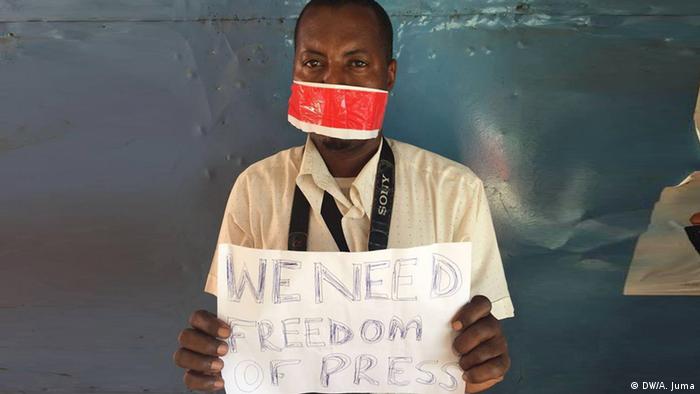
 On the occasion of World Press Day, the Syrian Network for Human Rights (SNHR) issued a report demanding the release of 422 citizen journalists in Syria, most of whom are detained by the Syrian regime, and are now threatened by the COVID-19 pandemic. The report notes that 707 citizen journalists have been killed since March 2011 to date, 78% of them by Syrian Regime forces. The 20-page report shows how the Syrian regime has been well aware of the danger posed by press freedom to its tyrannical rule for decades, abolishing all independent newspapers, and allowing only three official newspapers to be published, which are simply Syrian regime mouthpieces, dedicated to promoting, defending and justifying the regime’s actions. As the report further notes, it’s no exaggeration but simply a statement of fact to say that there is no such thing as a free press under the Syrian regime…..The report distributes the total death toll according to the main parties to the conflict, with the Syrian regime being responsible for the deaths of 551 citizen journalists, including five children, one woman, five foreign journalists, and 47 other citizen journalists due to torture in detention centers, while Russian forces were responsible for the deaths of 22 citizen journalists, and ISIS killed 64, including one child, two women, three foreign journalists, and three under torture. Hay’at Tahrir al Sham also killed eight, including two who died due to torture. Factions of the Armed Opposition were responsible for the deaths of 25 citizen journalists, including one child and three women.