Posts Tagged ‘interview’

Interview with Cédric Herrou, migrants rights defender who is the central person in the film Libre

July 18, 2019

ISHR had the chance to meet with Cédric Herrou for the Geneva premiere of movie ‘Libre’ where director Michel Toesca follows him in his endeavours in France‘s Roya Valley. During our interview, Herrou, a migrant rights defender and president of association ‘Défends Ta Citoyenneté’, shared his testimony, challenges, aspirations and calls to action.  The interview was published on 22 March 2019.

Profile of Abirami Jotheeswaran, Dalit Human Rights Defender

July 17, 2019
In Conversation With Abirami Jotheeswaran: Dalit Human Rights Activist
visiting Geneva to address the UN about issues faced by Dalit Women.

Abirami Jotheeswaran is a human rights defender and the National Program Coordinator of the National Campaign on Dalit Human Rights NCDHR. Most recently, she was part of a fact-finding team in Mirchpur to investigate a case of caste-based violence. Anagha Smrithi interviewed her for Feminism in India (FII) of 1 July 2019:

Anagha Smrithi: Can you describe your journey towards becoming the National Program Coordinator of the NCDHR?

Abirami Jotheeswaran: Residing in Chennai, I experienced many forms of caste-discrimination throughout my lifetime. A striking incident was during my graduation, when a classmate asked me what caste I belonged to in front of all my other classmates. The question was irrelevant, more so because she was aware of my social background as she knew my family. I felt insulted in front of my classmates and realised that caste certainly exists in urban cities like Chennai. After my Masters in Computer Science, I got married and settled in Delhi. A few years later, I got the opportunity to sit for an interview with the NCDHR. Even though I didn’t have a social work or human rights background, as someone who witnessed caste discrimination during my college days, I excelled in the group discussion and interview about caste-based discrimination. NCDHR changed me as a Dalit Human Rights Defender. When I joined as a Monitoring Associate in 2005, the work was new to me and I learnt everything through trial and error. I had to work hard to improve my Hindi to be able to coordinate with the State Coordinators of Northern states. I also equipped myself with legal knowledge of various legislatures surrounding the question of Dalit human rights. I used to work more than 10 hours a day, sometimes even carrying home documents to meet my deadlines. At the same time, I was also a mother. But I persisted at work so that I could be on par with my colleagues, most of whom were men. The 14 years I have been associated with the NCDHR has deepened my understanding of caste, violence, human rights and Dalit perspectives and ideologies. Today I am the National Program Coordinator and my primary responsibilities are to keep track of human rights violations, torture and ill-treatment of Dalits, and to provide legal assistance to the victims and survivors of caste atrocities across 12 States in India.

As a National Program Coordinator, I have participated in conferences and consultations at the State, National and International level to highlight Dalit human right violations in India, and to hold the state accountable. ..My 14 years with NCDHR has taught me the importance of struggling for justice in the courtroom. Because of this, I decided to pursue my higher studies in law. Most importantly, my association with NCDHR built my Dalit ideology and my strength as a leader to deepen the struggle against the caste system.

Anagha Smrithi: You were part of a fact-finding team about caste atrocities in Haryana. How did you obtain facts when the information was hidden/ fudged by the police and administration?

Abirami Jotheeswaran: On 24 April 2010, the National Dalit Movement for Justice (NDMJ) of National Campaign on Dalit Human Rights (NCDHR) and Anhad facilitated a national fact-finding visit to Mirchpur in Haryana’s Hisar district, where a dominant-caste mob had attacked Dalits in the village. The team consisted of a diverse group of people of journalists, activists, publishers and human rights defenders, including myself. The NDMJ Haryana state team visited the site of violence the day after the incident took place. They identified active victims, witnesses and built trust and a relationship with them. During our fact-finding process, we held detailed interviews with the victims—this was crucial in obtaining information that the police otherwise would not reveal. Through the interviews we gained information about the social background of the victims, the occurrence of previous atrocities in the same village and the events leading up to the incident. We discovered how the mob had planned to commit the offence, which differed from the police claim that it was a spontaneous conflict. We surveyed the loss of property and investigated the collusion of the police, administration and the Khap panchayat in committing the crime and obstructing justice.

Anagha Smrithi: Was any action taken after the fact-finding report?

Abirami Jotheeswaran: Soon after the fact-finding report, the NDMJ conducted a press conference to give visibility to the caste and build pressure on the government. We demanded appropriate sections of the SC & ST act be invoked for the immediate arrest of all those involved in the violence, along with resettling the affected Dalits in a secure place. We strove to register cases against the police and administration for the negligence of official duty, and demanded employment to all the members of the affected families, as well as a proper estimation of the damage inflicted upon the families. At the state level, we participated in protests, approached the Human Rights Law Network for legal interventions and took up advocacy with the Minister of Social Justice and other state authorities to ensure immediate arrest, complete investigation, the submission of a charge sheet, relief and rehabilitation for the affected and protection for the involved witnesses. As of today, we are still consistently engaging with the legal system and following up with the victims to achieve justice.

……
Anagha Smrithi: Even in cases of cruel atrocities & oppression, there is often still resistance and assertion from the community. What sort of resistance did you observe during your fact-finding process?

Abirami Jotheeswaran: Before the incident, violence had taken place against Dalits, but no proper action was taken by the police administration. But when this carnage happened, the Dalit community lost 2 lives and immeasurable damage to the property and possessions. Despite the losses, they unanimously decided to fight for justice and not tolerate any more violence by the dominant caste. They left their houses in Mirchpur and moved towards Mini Secretariat, demanding for justice. Their journey took them to Delhi, and finally to a farmhouse in Tanwar, protesting for justice, security, rehabilitation and jobs all the way. The State Government, faced with renewed pressure finally took action against the accused and the negligent administration. Though the victims continue to live away from their homes, in difficult conditions, the spirit of resistance is still alive.

In Conversation With Abirami Jotheeswaran: Dalit Human Rights Activist

Profile of human rights defender Linda RM Baumann from Namibia

May 26, 2019

ISHR published on 25 Octpber 2018 this interview with Namibian women’s rights defender Linda RM BaumannWe carry out the universal responsibility to insure that all people are protected” affirms Linda RM Baumann in her interview with ISHR. Linda is strategic coordinator for Namibia’s Diverse Women Association (NDWA) and she advocates for LBT’s women rights.

Profile of human rights defender Rizal Rozhan from Malaysia.

May 12, 2019

Interview with Rizal Rozhan, Advocacy and Capacity-Builder Officer of EMPOWER in Malaysia, published by ISHR back in December 2018.

The UN Environmental Rights Initiative interviews Donald Hernández Palma

February 26, 2019

On 26 February 2019 the UN Environmental Rights Initiative (launched in Geneva last year during the UN Human Rights Council). The aim is to ensure that human rights defenders can carry out their activism safely, defend their local environments and the planet. 

However, alarming statistics on killings have been reported over the past few years—especially regarding the targeting of indigenous groups. Latin America has seen the highest number of murders in recent years, accounting for almost 60 per cent of the global total in 2016. In Honduras, 128 defenders are estimated to have been murdered since 2010—the world’s worst rate. UN Environment reached out to Donald Hernández Palma, a Honduran lawyer and human rights defender, for his take on the situation facing environmental and human rights defenders. [see also: https://humanrightsdefenders.blog/2014/11/28/peace-brigades-international-officially-launches-its-country-chapter-in-ireland/ ]

Donald specializes in criminal and environmental law, with a particular focus on mining. He is a member of the Latin American Lawyers’ Network, which works against the negative impacts of transnational extractive companies in Latin America. Since 2010, Donald has worked for the Honduran Centre for the Promotion of Community Development as coordinator of its legal department. He is also the coordinator of the Human Rights and Environmental Department.

Could you tell us a little about yourself, where you come from and how you became part of the environmental advocacy movement?

I am the son of peasant parents who cultivated coffee. I grew up in a remote village in Honduras. I studied in a school that only went up to sixth grade and had to walk almost 20 kilometres a day to go to class. Later, I studied agronomy, a profession I practiced for more than 10 years, in direct contact with peasant families across Honduras. I have directly witnessed the serious subsistence difficulties faced by my countrymen far from government aid.

Since graduating in criminal law in 2007, have been working on environmental protection issues in rural communities. In 2010, I began my work at the Honduran Centre for the Promotion of Community Development, allowing me to work in the defence of human rights for the same populations I had known for many years before.

What situations help explain the kinds of challenges environmental human rights defenders face in Honduras?

Different forms of political and economic corruption in Honduras have compromised – and in some cases denied – local communities’ access to natural resources. Many people have resisted mining, hydro and logging projects, and because of this resistance, have found themselves criminalized and harassed—even killed. Honduras is today considered one of the most dangerous countries for those who defend their land and territories.

What kind of resources are being exploited in your country and how is it affecting land, water, air and biodiversity?

Currently, 302 mining concessions have been approved by the Honduran Government for open-pit mining. Projects are awarded to national and international businesses on thousands of hectares of land, affecting populations that are rarely consulted. Meanwhile, rivers are being appropriated in many regions of the country to generate electricity. Projects are also often granted without consultation to business families, as a payback for favors made for political campaigns.

Also, thousands of hectares of land are being used to plant African palm, transgenic corn and sugar cane for biofuels. This is displacing traditional agriculture, and also causing displacement of populations from their territories to urban centres within and outside the country. Laws have also been passed in Congress to privatize criollo seeds, removing the right of indigenous peoples and peasant peoples to trade their seeds as they have been doing for thousands of years.

What has been done to address these problems?

Organizations like ours do permanent research on the concessions of common goods. This information is very difficult to obtain because it is hidden from the people. There is a law on access to public information that is not respected. We give this information to the affected peoples, whom we also organize and train on human rights and indigenous law, among other issues. We also carry out public protests, present unconstitutionality appeals before the Supreme Court of Justice and carry out legal defence actions when the leaders are criminalized for defending their territory.

What kind of national laws have been enacted? Do international laws help you in any way?

We have a mining law that is highly harmful to the population, a plant breeders’ law that harms people’s rights over seeds, and energy laws that facilitate the implementation of electrical projects that avoid environmental impact prevention processes. In addition, the modification of the criminal code criminalizes public protest. It is precisely international law that allows us to exercise defensive actions in favor of indigenous peoples and peasants, since Honduras has been found not to comply with the international treaties that bind the Honduran state to respect human rights defenders.

Are you working with any NGO groups? 

I am the facilitator at The National Coalition of Environmental Networks and Organizations Honduras (CONROA), a joint space that brings together more than 30 organizations.

Has the newly-signed treaty by 24 Latin American and Caribbean countries, formally called the Regional Agreement on Principle 10, provided any protection on people’s rights in Honduras

Unfortunately, the Honduran state was one of the countries in the region that did not sign this important treaty.

Have you encountered any successes, and is attention increasing on this issue on the ground? 

Unfortunately, an advocate such as Bertha Cáceres, our comrade in this struggle, had to die so that the eyes of the world could return to the terrible situation due to the contempt of the state against those who defend common goods. The visits of the rapporteurs (Michel Fort) and the rapporteur of indigenous peoples have been very important in forcing the Honduran State to respect human rights defenders.

Profile of migrants rights defender Mariana Zaragoza from Mexico

December 18, 2018

On 13 December 2018 ISHRGlobal published this interview with Mariana Zaragoza. Our countries are restricting migrants’ rights, and there is always something we can do to demand full protection of people“, says Mariana Zaragoza in her interview. Mariana works in the immigration programme at the Ibero-American University of Mexico and she advocates for migrants and refugees’ rights.

Interview with pro bono director, Michelle Movahed, in Newark

November 5, 2018

Since joining McCarter & English as pro bono director two years ago, Michelle Movahed has helped bring about increases in firmwide pro bono hours (by 3,000 hours annually) and in pro bono-to-billable hours ratio (even as billables increased, according to the firm). The program also has taken up a broader range of cases under Movahed, including immigration detainee asylum matters. And she recently saw through the firm’s creation of a pro bono fellowship to benefit the city of Newark, which includes a full-time attorney position. David Gialanella interviewed her on November 2018 for the New Jersey Law Journal:

What’s your single best piece of advice for handling a crisis?

Focus on what you can control, take ownership of all of it, and move forward.

Name a mentor or someone you admire, and why.

I deeply admire my clients. I’ve been very lucky to work for human rights defenders, for individuals who have stepped up to right a wrong, and, most recently, for asylum-seekers who have made harrowing journeys to escape truly horrendous trauma.

Best advice you ever got…

I’ve never been as nervous as I was the night before my first big oral argument, on our motion for a TRO to keep the doors open at the last comprehensive reproductive health clinic in Mississippi. By around 10 p.m., everyone I worked with was telling me to go to sleep and stop preparing so I’d be well-rested. I just didn’t feel like it was time yet, but I also knew I didn’t know enough to make that judgment call. So I asked for help: I wrote to the judge I’d clerked for, whose opinion I value more than almost anyone, to ask for words of wisdom. The advice he gave me was incredible, and I must have read his email a hundred times over the next 12 hours until I went in to the courthouse. He reminded me that I couldn’t lie to myself about how nervous I was, how high the stakes were, and how hard my case was. So, he said, “don’t f— it up.” If I could have that embroidered on a pillow, I would. I stayed up late, prepared until I knew I had done everything I could to avoid f-ing up, and was completely on my game at the argument. (We got the TRO, and the clinic stayed open.)

What has the #MeToo movement meant to the legal profession?

The hashtag is new, but the issues aren’t. #MeToo, #BlackLivesMatter, and #TimesUp are reminders that lawyers have a responsibility to use our privilege to challenge oppression wherever it appears. Our professional obligations include the duty to speak up when we know another lawyer has violated the rules of professional conduct; but our ability to promote justice is much broader, and we should use it.

In 50 words or less, what does the legal profession need to do to improve opportunities for women lawyers?

Every lawyer should seek out opportunities to teach, mentor, and otherwise make space for lawyers with less privilege: not only women, but also lawyers of color, who are LGBTQIA, who have disabilities, who are from other traditionally marginalized groups, and who are at the intersections of those identities.

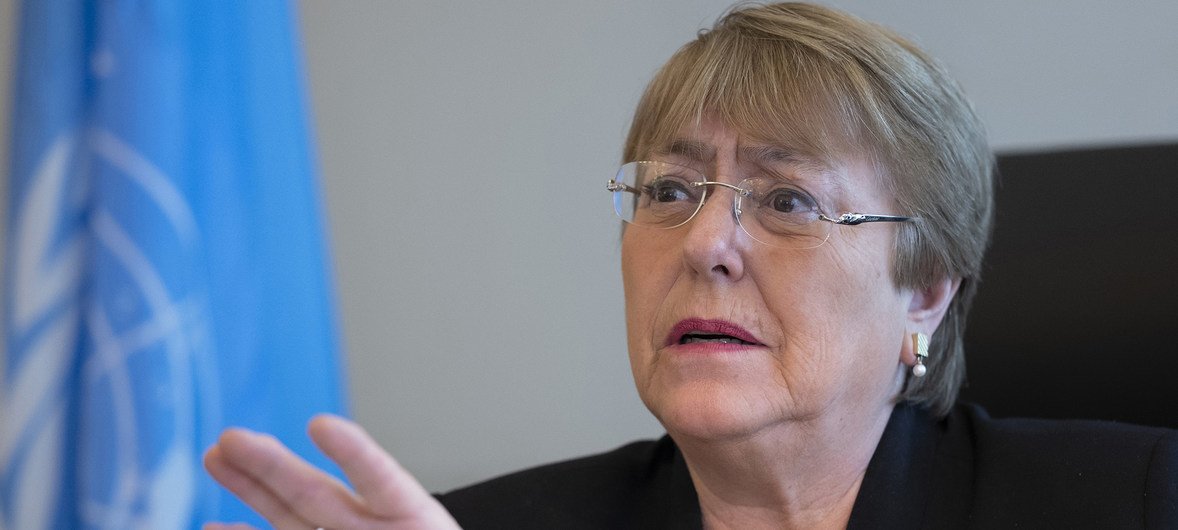
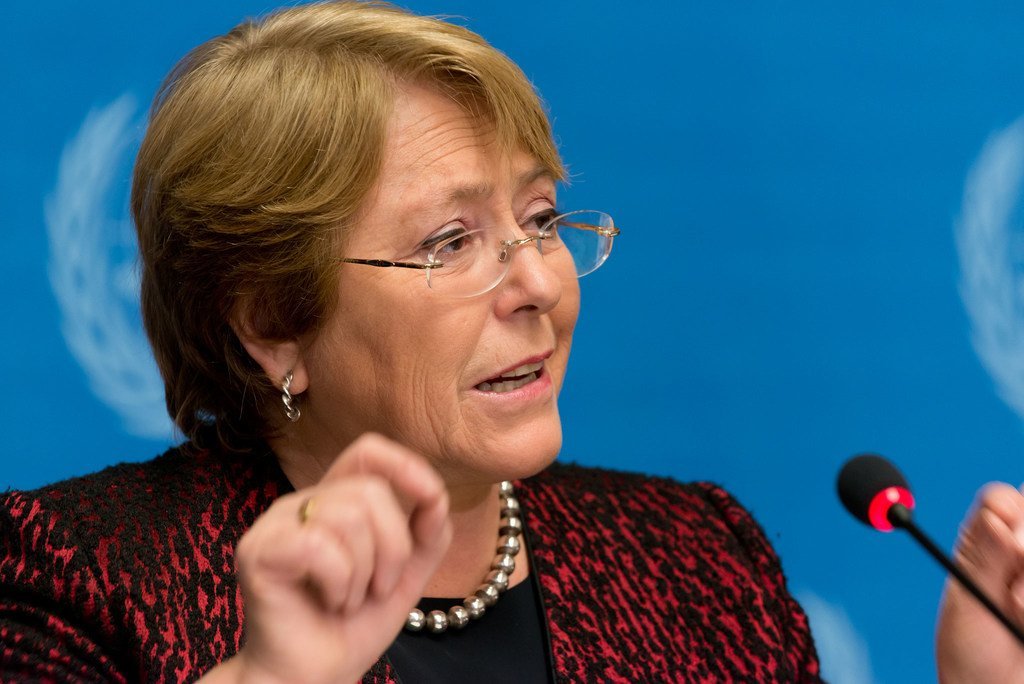
Michelle Bachelet, new UN High Commissioner for Human Rights, gives major interview

October 18, 2018

In August 2018, Michelle Bachelet, twice-elected President of Chile was confirmed as the new UN High Commissioner for Human Rights, replacing Zeid Ra’ad Al Hussein. [see e.g.: https://humanrightsdefenders.blog/2018/08/22/change-of-high-commissioner-for-human-rights-at-the-un-optimism-warranted/]. Minutes after she was approved, UN chief Antonio Guterres told reporters he was “delighted” by the news of her official appointment, describing Ms. Bachelet, a “pioneer”, has been “as formidable a figure in her native Chile, as she has at the United Nations”. Shortly after assuming office in early September, Ms. Bachelet was in New York for the General Assembly’s high-level general debate. She spoke then with UN News on the rights situation around the world, the priorities for her tenure, and how can rights be better protected. It was published on 17 October 2018.

Bearing in mind her own personal experience of being detained and tortured in Chile, the interview started with a question on how she overcame the hardships she suffered under the military dictatorship of Augusto Pinochet.

UN High Commissioner for Human Rights Michelle Bachelet (file photo) ILO/M. Creuset

Michelle Bachelet: ….there was a period of my life that I really hated what was happening – I had so much rage. But afterwards, I started thinking, “you know what, I do not want this to happen anymore in Chile or in any other country of the world. So, what can I do to contribute, that Chile will be a peaceful, democratic society?” So, I sort of put all my energies on that, and that is why I started working on defence issues to be able to speak to the militaries, because I never thought I was going to be Minister of the Defence or President of the Republic.,,I would say it permitted me to understand that, first of all, lessons learned, and if you really want some objective, and in a possible, constructive way, it can be done.

As the High Commissioner, you have come in a time when human rights are under serious attack globally. What your priorities are going to be?

Michelle Bachelet: …. first of all, of course, my priorities are to do what my mandate tells me to do, to be the voice of the voiceless. But also to engage with governments so they respect human rights, protect people from rights violations, and promote human rights.

….But one of my particular priorities from the Secretary-General is prevention. I am not saying I will succeed on that, maybe not. But I will try to design a system where we can have early warning signs and try to think on early action. …..

Right now, some countries do not want to cooperate with OHCHR or question the worth of the Human Rights Council. How do you plan on bringing everyone together?

Michelle Bachelet: In my opening statement, I spoke about, that consensus could be possible, that we should not lose ourselves in sterile disputes. Of course human rights is a very political thing and you see that here in the General Assembly, in the Security Council, so it is not in the Human Rights Council, by itself.

I mean, countries have their visions, their interests, and sometimes, they are not interested in some issues. But what I have been doing is meeting, not only with the whole council, but with groups of countries in Geneva such as the Group of Latin American and Caribbean countries, the African countries, the Arab countries, the Asia-Pacific countries, the West European and Other countries, the Eastern European countries, speaking but also listening. Because, sometimes, you know what you have to do, but the way you do it can be more successful than others. Sometimes you need to speak out. Sometimes you need to strategize in terms of saying, look, it will work better if we do diplomatic prevention, if we start engaging the government. But today the world is complicated, and it is very polarized in some issues………

This year is the 70th anniversary of the Universal Declaration of Human Rights. What progress do you think has been done in the past 70 years?

Michelle Bachelet: …..Think of 1948: how many countries allowed women to vote, for example; how many respected of freedom of speech. If you think of the different aspects of the human rights, even in more complete things that usually people do not think of as human rights, but they are human rights: on health, on education, on sanitation, on housing. The world today is better than 70 years ago. But having said that, there are a lot of threats, there are a lot of threats for multilateralism, there is a lot of threat and pushback on human rights. …We see a pushback, we see that in some documents, human rights is not mentioned, and when you ask, they say, “it is mainstream.” And if it is mainstreamed, it is fantastic, because everybody’s doing their job. But if it is invisible, mainstream, that is not a good thing. On the other hand we see human rights defenders and civil society having their space shrink. They have been under attack. Journalists have been killed.

So there is a lot of challenges. The only thing I can say is that the struggle for human rights probably will never end, because it is a process where you advance, but there will be always people who want to push back, and that could be governments or that could be armed groups. The task of the UN is to ensure and promote the whole human rights system. And I will do what I have to do about it, but it cannot be only the task of the Office of the High Commissioner for Human Rights, it has to be the task of the whole UN system….

I would like to ask you about protecting those who protect: human rights defenders are often targets of abuse and violence. How can they be better protected?

Michelle Bachelet: Well, the curious thing is that, as we are celebrating the 70th year of the Universal Declaration of Human Rights, we are celebrating 20 years of the Declaration on the Protection of Human Rights Defenders. And in November 2017, a resolution on the protection of human rights defenders was approved unanimously by the General Assembly.  No country voted against it. So, the issue is: on paper things can look very good, but reality is another thing. I think we have the task of making people accountable for the things they have approved. Second, to monitor implementation of those agreements that everybody has made, and engage governments, and in the cases where things are happening, holding them accountable and responsible for the killings, the torture, the detentions of many human rights defenders.

You have been a very important defender of women’s rights. How is that going to continue, as the UN High Commissioner for Human Rights?

Michelle Bachelet: The thing is that, people tend to see OHCHR as only concerned with civil and political rights, and that is not it. The Universal Declaration of Human Rights clearly states the rights for migrants, for children, for women; right to health, to education. It is very comprehensive. Even though I am not intending to replace any other agency, I always speak about gender issues, gender empowerment. This morning I was speaking about women who are women’s human rights defenders, who have been attacked, threatened with rape.

I will be always raising the voice for women, trying to support their capacities, and building partnership with UN Women, as we have spoken with Henrietta Fore, the head of UNICEF to see how we can create synergies. …..

One of the most pressing issues for the entire world is climate change. How are human rights linked to the environment?

Michelle Bachelet: ..There are so many concrete consequences that will be effects in people’s lives and their rights. That is why we also believe that working strongly to combat climate change is a very essential task, including of the High Commissioner. I think also that we need to be more part of the 2030 Agenda for Sustainable Development and how we support the Sustainable Development Goals (SDGs). ..

And climate change is of huge importance, because I have seen places where there is no more water and people who depend agriculture, mainly women, and now have to think how they get their incomes. With climate change, we have seen, and scientists tell us … about worsening natural disasters and extreme weather, forest fires. And all of these will have a lot of consequences for the life of people. It is very important to work very closely on that, too. I completely agree with the Secretary-General when said that this is one of the major, major challenges that we have.

Full interview at: Human Rights

Kailash Satyarthi, the man who defends children

January 23, 2018
“There can be no keener revelation of a society’s soul than the way in which it treats its children.” 
Nelson Mandela, Former President of South Africa


 conducted the interview (excerpts): 

P.K:   Namaste Kailash ji! Thank you so much for taking the time to talk with India Currents. As a mother, as an Indian American, it is a matter of great pride to be able to do this interview with you today! Looks like you are back after a lot of travel?

K.S:   Yes. Once the Nobel Prize committee gives you a medal of peace, they take away your ‘peace’ for the rest of your life! (laughs) I am quite used to travel, having been involved in multiple causes, working across 140 countries. As the founder of two largest societal coalitions, Global Campaign for Education & Global Marketing against child labor, my life does involve a considerable amount travel.

……

P.K:   And now with the Nobel Peace Prize, you have a bigger voice, a further reach, a larger umbrella naturally. I looked up your biography online as research for this interview. Born in Madhya Pradesh as Kailash Sharma, subsequent change in last name to Satyarthi , the recipient of several awards etc etc… but I’d like to know about the ‘Man’ within these details.

K.S:   I don’t think of myself as a man – I still consider myself a child! (laughs) For me, childhood does not mean just the age factor. Childhood means so much more… transparency, thirst for learning, curiosity… all these are related to childhood. I feel strongly that there is a child inside each of us. But we keep suppressing him/her all the time and try to be more mature. And maturity brings artificiality, diplomacy, sometimes falsehood. A child does not care to do things only to make others happy. A child is very straight forward. This quality is something to be preserved. And it is my inspiration & learning.

P.K:   I’m looking at the list of awards you have received over the years, starting from 1993 – Elected Ashoka Fellow Award, the Robert. F. Kennedy Human Rights Award – to name a couple. Obviously the Nobel Peace Prize is a distinct honor. It is a matter of pride for India, for Indians abroad and for activists all over the world. Can you speak about how this award is helping to carry your voice?

K.S:   Yes, it has definitely helped me spread my message further. But I do not consider this award solely in my honor. The Nobel Peace Prize has been a major recognition for those most deprived, neglected and marginalized lot of humanity – the children who are enslaved & trafficked. I always say that I represent the ‘voice of silence’. They are my children who are hidden under the cloak of invisibility. So now that people have started to recognize my children – it is the greatest award for me!

…..

P.K:   What made you pick up the mantle as the person who speaks for children? Tell us something about the journey so far.

K.S:   When I started my work in 1981, there was never a question that I do anything other than what I chose to do for children s’ rights. It was a non-issue for me. The conventional wisdom was to collect money or help with charity. And it stopped there. I realized something more should be done. The denial of freedom and human dignity was so deeply rooted. It was non-negotiable. So this inspired me to give up my career. At that time no one was talking about child slavery and child trafficking. As a country, India did not have any laws to address these issues. Even on the international scene there was no legislation that provided me with a path to undertake. The U.N convention on the Rights of Children was adopted by the General assembly in 1989. So in 1981 I started fighting a lonely battle! I had the beginnings of a vision but had no idea about how to make it a reality. I faced total ignorance about these issues and when we brought in strong activism, ignorance turned into denial. People did not want to believe that this problem existed among them. We even faced opposition in the form of local mafia being set against us. So it was a long journey as you can imagine!

P.K:  How does your family, your wife Sumedha, your children – handle the dangers associated with your work? Obviously the values your have imparted have made a big effect on them.

K.S:  Sumedha was part of the whole movement right from the beginning. We did not have much money or materialistic wealth to give our children. There were dangers of course. When we finally got a telephone, it came with death threats made against me and my family! Slowly they gained courage and understood what my wife and I stood for. They helped with the children in the Ashram during their free time. That is how they grew up. My son Bhuvan is a lawyer and he handles most of the legal work for our cause. The cases he has handled have made a huge impact in the legal and judicial discourse in India.

…..

P.K:   Bharath Yatra was a massive social ‘wave’ which happened recently. Could we hear your thoughts on that movement?

K.S:   Bharath Yatra has been an unprecedented success! About a million people took to the streets to condemn and speak out against child sexual abuse. This has never happened before in India. They also demanded strong policy measures to be enforced. This was a turning point. Bharath Yatra’s preparation process began about a year ago before we launched it. The idea behind the Yatra was to take up the initiative and see how people’s response to something this large scale would be.

The most encouraging response came from the youth. Thousands of young girls and boys in schools and colleges across India marched with us. Some even came up to me to say “you are telling MY story”! Many appeared on the stage before hundreds of people and said they were breaking their silence to speak out about their own experiences. This was the most satisfying part of the Yatra for me personally. I consider this the beginning of my ‘war’ on rape.

……

The first incident was the rescue of a group of people which had children, men and women, in 1981. I had started a magazine titled Sangharsh Jaari Rahega – The Struggle Shall Go On – dedicated to educating the public about the problem of child slavery and the struggles of marginalized people. One day a man, Wasal Khan, knocked on my door in Delhi. He was a desperate father whose 15 year old daughter, Sabo, was about to be sold to a brothel. He told me how he, along with his wife and a few others from his village were ‘”taken to work with the promise of good salary and a good life,” to a place about 400 km. from his village in Punjab. The hours were long and the conditions were deplorable. So they ended up in slavery, no money, no freedom, working on brick kilns for close to 17 years. In these conditions, children were born, people lived and died. It was shocking that in the year, 1981, in the largest democracy in the world, people were being subjected to this sort of slavery!

I felt very strongly that I should not limit myself to simply writing about his case. I managed to raise a little money by mortgaging my wife’s wedding jewelry, gathered a group of people and went to the site. The poor man was caught by the owner of the kiln and I was thrown out of the compound along with my people.

I returned empty handed but not with an empty heart. With the help of a friend who was a lawyer we took the matter to the courts. And we managed to secure the release of all those men, women and children – including 15 year old Sabo. 36 people were freed that day! This was the first documented incident where children were freed from slavery through a private/voluntary initiative. And this gave me a clear path that I started charting. Within a few weeks after this incident, people started bringing other cases to my notice. And I never looked back.

The most recent one was only few months ago. This was the rescue of children locked inside bathrooms and held on roof tops in a factory in Delhi. The conditions were unimaginable. The children ranged in ages from 7 – 10 or 11 years. They were working – making toys. When I sat with them and asked about their working and living conditions, they claimed they were very happy, and I could see that they were simply repeating what they had been told to say. They were threatened that the police would come and arrest them if they said anything else.

When I asked the youngest child if he got a chance to play with the toys he helped make, he said no – he was not allowed to. If they made a mistake like that, they were beaten up. Apparently the last time he had played was in his village, with sticks and stones, which were his toys! He also said he missed playing with those stones! What was ironic was that in this day and age, when we claim to have made so many advancements in technology, these children were living in such deplorable conditions right in Delhi.

We conducted a second raid on the same day and also managed to free a bunch of children from a neighboring factory where they were sewing jeans. And they were brought to our ashram – Mukti Ashram – also in Delhi. The next morning we noticed these children were trying to shade their faces and eyes in the sunlight. That is when we discovered that for 3 years that they were kept inside a basement of the factory! They were forced to live, work, eat and sleep in that basement. And they had not seen daylight for 3 whole years! Imagine that!

……

P.K:   You also have the Bal Mitra Gram concept. Can you speak about that concept?

K.S:   Sure. It has been my dream to make the whole world child-friendly, which is easier said than done! Very often the village communities are where child marriages and trafficking etc take place. So the whole idea behind Bal Mitra Gram was to transform the community at the village level – to make them child-friendly.

The first condition is – all children are free from the fears of abuse and exploitation of any sort.

The second condition is – all children irrespective of gender, caste or community are enrolled in schools.

The third condition is – all village children have a chance to form a governing body – called Bal Panchayat. This helps shape them as responsible individuals and to solve their problems through positive governing methods. 

The fourth condition – that the Village Panchayat – the elected assembly of village elders – agrees to not just recognize the Bal Panchayat, but also work hand-in-hand with them, by inviting youth leaders to official Panchayat meetings and vice versa.

When these four important conditions are met, the whole village becomes child-friendly.

P.K:   That sounds idyllic! Have you implemented these four conditions? Are there villages that are truly child-friendly?

K.S:   We have about 560 villages where we have managed this to date! In many cases the youth leaders are the very children who have been freed from child labor. We have about 400 girls who have been elected as Heads of the Bal Panchayats! This is a matter of pride for us! It is my belief that if politicians, leaders, NGOs, corporate bodies, all come together and resolve to protect one generation, then there is no need to worry about the generations of the future.

P.K:   Now Kailashji, when you undertake the kind of work you have done, there is always equal parts reward and criticism that you will face. It has been said that your work is a case of altruism gone wrong, that the children are being freed against their will – because the money they are bringing in makes a huge difference to their families. That is is acceptable for the children to learn the trade the families engage in. How do you respond to things like this?

K.S:   There are micro and macro level issues –  At the micro level, we try to explain to the families of these children how their lives would change when their children can better themselves, with education, with vocational training. We also try to connect them with Government schemes that are already in place. We have volunteers and former child labor victims who take social messages to the villages through street theater staged using local dialects and languages to create awareness. So these are two ways in which we can sensitize the village population to see things differently.

We have a very strong argument that there is a direct relationship between adult unemployment and child labor. Globally 216 million children are engaged in economic activities. Out of this, there are about 152 million children engaged as full-time child laborers. If you draw a comparison with the existing number of youth/adult unemployed globally, the number is 210 million. It is a proven fact that 71% of children are working in the agricultural sector globally. And there is a direct correlation to the number of jobless, unemployed adults! This vicious circle must be broken.

In today’s digital economy, we cannot think of social justice, equality, growth or ways to get rid of poverty in personal or social life without an education. These 216 million children are being denied their chance at escape, by denying them education. So I have been advocating a triangular paradigm to show that – child labor, poverty and illiteracy – form a three way relationship. This is a cause and consequence relationship.

The criticism is part of my work. But the numbers speak for themselves.

….

https://indiacurrents.com/kailash-satyarthi-representing-the-sound-of-silence/


9 December, Human Rights Defenders Day, ‘celebrated’ in Uganda

December 13, 2017

In an article in the Ugandan paper The Independent entitled “Activists mark Human Rights Defenders day” (13 December 2017), Robert Kirenga, the Executive Director of the National Coalition of Human Rights Defenders in Uganda spoke to Flavia Nassaka about his perspective on international human rights defenders day and the general human rights situation in the country. He made some interesting points such as (excerpts):  Read the rest of this entry »