Posts Tagged ‘international human rights and humanitarian law’

Summary of 2024 Human Rights Watch Report

January 29, 2024

On 27 January 2024, Olivia Biliuna and Madison Whittemore in the Davis Vanguard produced a useful summary of the 2024 Human Rights Watch Report
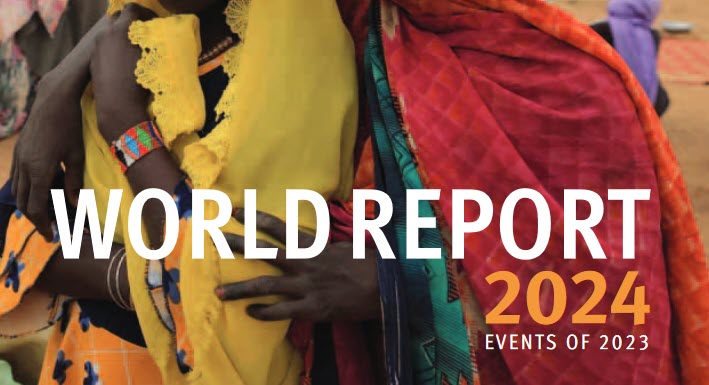
After reflecting on the formidable human rights challenges of 2023, it has become evident that changes in how human rights are approached will be needed in 2024 to prevent the atrocious suppression and human rights crises that have been prominent in the past year, according to Human’s Rights Watch’s “World Report 2024: Our annual review of human rights around the globe.” [see: https://www.hrw.org/world-report/2024]

However, despite the human rights atrocities seen in 2023, the group added that there appears to be some hope for upholding human rights in 2024 through enforcing principles of international human rights law.

Looking back on 2023, the 2024 World Report reflects on renewed conflicts between Israel and Hamas that resulted in the abuse of many and a tragic loss of life, and other countries such as Ukraine and Myanmar that continue to struggle with their own intense conflicts. 

Human Rights Watch notes that in accordance with the aforementioned conflicts, “Economic inequality rose around the world, as did anger about the policy decisions that have left many people struggling to survive.”

However, while many are quick to blame the government for being complicit in these human rights crises, the report maintains action is needed outside of just government action alone to help diminish these threats, since they “often transcend borders and cannot be solved by governments acting alone.” 

In fact, the report notes the often forgotten importance of universal principles of international human rights and the rule of law which are more critical now than ever. 

The 2024 World Report argues governments have the ability to help improve human rights and that they have double standards in “applying the human rights framework,” as stated in the 2024 World Report, and “chips away at trust in the institutions responsible for enforcing and protecting rights.” 

The legitimate laws and universality of human rights are weakened when governments that are vocal about denouncing the Israeli government war crimes against Gaza citizens do not speak up about the crimes against humanity in Xinjiang, China, according to the 2024 World Report.

Governments have found it is easier to disregard international human rights matters because internationally there is no challenge to human rights nationally, writes Tirana Hassan, the executive director.

Hassan also noted that autocrats across regions have taken away both the independence of key institutions to protect human rights and the freedom of dissent, as stated by the 2024 World Report, “with the same endgame in mind: to exercise power without constraint.”

Hassan explains that with campaigning of civil rights groups and years of diplomatic negotiations, 83 countries were able to protect their citizens by adopting a political declaration that provided protection from explosive weapons in populated areas.

The international pledge to recognize the “long-standing practice of warring parties to use aerial bombing, artillery, rockets, and missiles in villages, towns, and cities” is the first to address this issue as the 2024 World Report states.

Some countries are addressing long-marginalized communities. With years of pressure, the Japanese government parliament has passed its first law to protect LGBT people from “unfair discrimination,”  the 2024 World Report states.

With the humanitarian crises there has been questioning on the effectiveness of the human rights framework in the realm of protection, notes the 2024 World Report, adding, “especially in the face of selective government outrage, transactional diplomacy seeking short-term gain, growing transnational repression, and the willingness of autocratic leaders to sacrifice rights to consolidate their power.”

With that, the 2024 World Report also suggests the human rights framework will continue to be the plan to build “thriving, inclusive societies” and governments need to be persistent and, with urgency, defend human rights to handle the global and existential threats to humanity.

As also highlighted by Hassan in the report, the assault on Israel by Hamas-led fighters on Oct. 7 that deliberately killed hundreds of vulnerable civilians led to swift condemnation from many countries around the world.

In retaliation to the Oct. 7 attack, the Israeli government ceased all running water and electricity in the Gaza strip, “blocking the entry of all but a trickle of fuel, food, and humanitarian aid – a form of collective punishment that is a war crime,” the 2024 World Report noted.

The Israeli government and military continue frequently bombing the Gaza strip. Following these attacks, countries were outraged after they found out that Israel used a chemical called white phosphorus during the indiscriminate attacks on Gaza, with many countries even highlighting the attacks as “apparent war crimes,” stated by Human Rights Watch.

However, despite world-wide outrage after Israel’s war crimes on Gaza, countries have failed to publicly call the Israeli government out on its war crimes resulting in severe human rights abuses, the report detailed, noting even the U.S. and the European Union have acknowledged Israel’s human rights abuses on Gaza citizens, yet have continued to be complicit in the “ongoing crimes against humanity of apartheid and persecution against Palestinians.”

The report asserted the repercussions of governments failing to intervene undermine the legitimacy of the rules system designed 75 years ago to safeguard all citizen’s rights. In response to the inconsistencies, Hassan cites that governments like Russia and China aim to take advantage of the shaky legitimacy by attempting to infringe on human rights and take advantage of the system that is supposed to punish both countries.

Another example used by the 2024 World Report that displays these inconsistencies is the power battle between two influential generals in Sudan, Gen. Abdelfattah al-Burhan and Gen. Mohamed Hamdan Dagalo.

This conflict resulted in civilians facing deadly abuses and human rights infringements in the Darfur region—with numerous countries listed in the 2024 world report allegedly ignoring the horrendous abuses and abstaining from intervening.

Despite nations such as Gabon, Ghana, and Mozambique being on the Security Council, “the UN, under pressure from the Sudanese government, shuttered its political mission in Sudan.” the 2024 World Report stated, also concluding that “This marked the conclusion of the UN’s limited capacity in the country to safeguard civilians and openly address the human rights situation.”

Regardless of African governments refusing to hold the Sudanese government accountable, the report highlights that many have been strong advocates for resolving the human rights issues in other places like Palestine, even leading a full-fledged effort to investigate its human rights abuses last November and recently asserting that “Israel violated its obligations under the 1948 Genocide Convention in its military operations in Gaza.”

Domestic policies and foreign policies should hold value in human rights and their rules of laws at the forefront of governments, charged the 2024 World Report.

Even rights-respecting governments hold these principles as “optional, seeking short-term, politically expedient “solutions” at the expense of building the institutions that would be beneficial for security, trade, energy, and migration in the long term,” according to the 2024 World Report, adding transactional diplomacy carries a human cost that extends past borders, the group adds.

The 2024 Report writes that without awareness while making transactional diplomacy, risks are created. Removing human rights and the rule of law from a sensible direction creates leverage for right-violating governments too, the 2024 World Report adds, arguing, “It can also contribute to further human rights violations, including transnational repression,” which governments do when they commit human rights abuses against their nationals abroad or to those families living at home, the report continues.

According to the World Report of 2024, India, a democracy, under its Prime Minister Narenda Modi has moved toward an autocracy “with authorities targeting minorities, tightening repression, and dismantling independent institutions, including federal investigative agencies.”

Additionally, as cited in The Report, the US, Australia, the UK, and France chose trade and security over raising human rights concerns.

As reported by Executive Director Hassan, the Modi government’s repressive tactics went past borders and were empowered to do so from the Indian government’s “silence on the Indian government’s worsening rights record…including to intimidate diaspora activists and academics or restrict their entry into India.”

Rwandan’s government has had three decades of no punishment for their repression of civil and political rights at home, the 2024 World Report states, writing “to stifle dissent beyond its borders,” and noting, Rwanda, despite having risen on the international stage, has failed to recognize its problematic human rights violations.

Similarly, Chinese government abuses in Beijing escalate its repression against both Chinese and non-Chinese with failure of resistance from other countries, according to the 2024 World Report, explaining a Laos lawyer and human rights defender, Lu Siwei, received pressure from the Chinese government to return and authorities pushed out warrants.

The 2024 World Report claims nowhere is safe if repressive governments can get away with “strong approaches to silence human rights defenders, exiled politicians, journalists, and critics beyond their borders.”

As reported by the Human Rights 2024 World Report, with almost half of the global population being eligible to vote in 2024, both citizens and independent institutions need to participate in order to effectively have leaders who defend human rights, regardless of society and many institutions having “become renewed battlegrounds for autocratic leaders around the world looking to eliminate scrutiny of their decisions and actions.”

According to Hassan, the nations of Guatemala and Nicaragua are two stories of autocratic leaders consolidating power and failing to prioritize civil society.

For example,  after Guatemala’s President-elect Bernardo Arévalo ran on an anti-corruption platform, a corrupt judiciary attempted to overturn Arévalo’s election triumph.

Similarly, the report refers to Nicaragua, where corrupt and authoritarian President Daniel Ortega uses “abusive legislation to shut down over 3,500 nongovernmental organizations” in order to dominate the political landscape and wield unchecked power.

The Human Rights report insists these “vital” checks and balances continue to be eroded, it poses great harm to human rights.

Judicial independence has also been drastically sabotaged in Poland, the report alleges, with the Polish government suppressing civil society groups through law enforcement and incarceration. Polish freedom and independence are extremely threatened, with the Law and Justice party most notably encroaching on women’s reproductive rights and essentially banning abortion, Hassan suggested in the report.

“In May 2023, an abortion rights activist was convicted of helping a woman to get abortion pills and was sentenced to eight months of community service – the first known prosecution of its kind in the EU,” the 2024 World Report noted.

On an environmental note, with the impending issue of global warming, the 2024 report highlights activists being shot by governments across the globe who want to “deter the climate movement.”

In another example, the report cites how one of the largest oil producers, the United Arab Emirates (UAE), continues to expand its production of fossil fuels; however, people are discouraged from exposing the UAE unless they are willing to face grave punishment.

Apart from punishing dissent, governments are using technology and social media platforms to “silence critics and censor dissent,” the 2024 World Report notes, citing a 54-year-old retired Saudi Arabian teacher named Muhammad al-Ghamdi, who received the death penalty after he expressed his opinions on X and Youtube and allegedly went against the country’s counterterrorism law.

Despite everything that occurred in 2023, there were also positive moments for human rights where institutions and movements succeeded, the 2024 World Report states, arguing, “Indeed, these successes illustrate why self-serving politicians and repressive governments work so hard to curtail them – and why all governments should recognize and support these fragile successes.”

Additionally, according to the Executive Director Hassan, the ICC issued warrants for Russia’s President Vladimir Putin and his children’s rights commissioner for war crimes related to deporting and transferring children and a court ruled that South Africa had a commitment to arrest Putin. 

According to the 2024 World Report, the Xokleng Indigenous people succeeded when the Brazil Supreme Court, as noted by the 2024 World Report, “upheld all Indigenous peoples’ rights to their traditional lands,” despite efforts by the Santa Catarina state. 

The 2024 World Report said, “These victories highlight the tremendous power of independent, rights-respecting, and inclusive institutions and of civil society to challenge those who wield political power to serve the public interest and chart a rights-respecting path forward” and that “all governments, in their bilateral relations and at the multilateral level, should redouble efforts to uplift key institutions and protect civic space wherever it is under threat.”

The human rights crisis highlights the importance for “mutually agreed principles of international human rights law everywhere,” the 2024 World Report notes. 

It also points out that through governments centering their human rights obligations through moral governing, it will provide a diligent change to those affected. 

The 2024 World Report concludes that consistently upholding human rights, “across the board, no matter who the victims are or where the rights violations are being committed, is the only way to build the world we want to live in.”
THE IMPACT OF COUNTER-TERRORISM LAWS AND POLICIES ON IHL AND HUMANITARIAN ACTION

January 25, 2017

Counter-terrorism is a major concern of many governments today. Since 9/11 and more recently after the attacks in Belgium, France, Germany, Lebanon, Tunisia or Turkey, states have adopted new counter-terrorism measures and legislation intended to address the threat of terrorism.

The steps taken are diverse, ranging from surveillance to emergency legislation as well as the use military force against designated terrorist groups abroad. In some instances, more restrictive conditions of financing and the risk of criminal sanctions in cases of ‘material support’ to listed terrorist organizations – a notion which has been broadly interpreted by US case law- have impacted the implementation of certain IHL rules as well as humanitarian assistance. This has reduced the scope of action of humanitarian agencies and NGOs.

In that context, this third IHL Talk on 26 January 2017 will discuss the legal regime governing terrorism, in particular how IHL addresses acts of terrorism and what is the relationship with other international treaties. More generally, experts will discuss the legal and operational challenges counter-terrorism has created for IHL and humanitarian action.

KEYNOTE SPEAKER

Ambassador Valentin Zellweger, Permanent Representative of Switzerland to the United Nations and the other international organizations in Geneva

MODERATION

Gunilla von Hall, Foreign correspondent in Geneva for the Swedish newspaper Svenska Dagbladet

PANELISTS

Sandra Krähenmann, Research Fellow, Geneva Academy of International Humanitarian Law and Human Rights

Carla Ruta, Legal Adviser, Geneva Call

Where?  Villa Moynier, 120B Rue de Lausanne, Geneva

Source: Upcoming Events – The Geneva Academy of International Humanitarian Law and Human Rights

2017 (1): Are we heading towards a ‘post human rights world’?

January 11, 2017

The start of a new year is often the occasion to make some broader analysis. So it is with the issue of human rights defenders. I have collected some of the more interesting and will report on these in the days to come.

The first is an article (30 December 2016) by ith more states seemingly reluctant to honour human rights treaties – whether we are “heading towards a ‘post human rights world‘?:

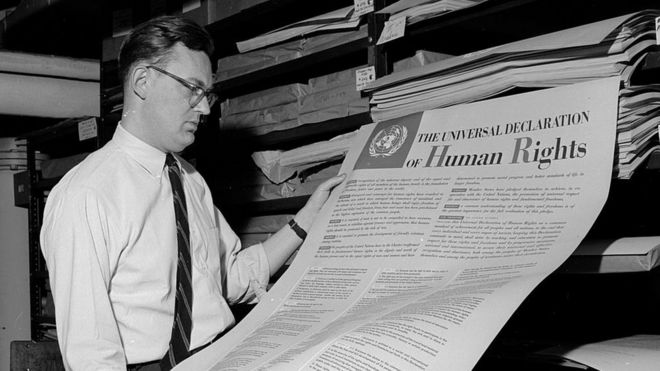
A man looks at one of the first documents published by the United Nations, The Universal Declaration of Human Rights
Image copyright THREE LIONS/GETTY IMAGES

With an increasing number of states seemingly reluctant to honour human rights treaties, is there a future for this type of international agreement? “We stand today at the threshold of a great event both in the life of the UN, and in the life of mankind.” With these words, Eleanor Roosevelt presented the Universal Declaration of Human Rights to the United Nations. It was 1948 and UN member states, determined to prevent a repeat of the horrors of World War Two, were filled with idealism and aspiration…… Mrs Roosevelt’s prophecy that the declaration would become “the international magna carta of all men everywhere” appeared to have been fulfilled.

But fast forward almost 70 years, and the ideals of the 1940s are starting to look a little threadbare. Faced with hundreds of thousands of migrants and asylum seekers at their borders, many European nations appear reluctant to honour their obligations to offer asylum. Instead, their efforts, from Hungary’s fence to the UK’s debate over accepting a few dozen juvenile Afghan asylum seekers, seem focused on keeping people out. Meanwhile across the Atlantic, president-elect Donald Trump, asked during the election campaign whether he would sanction the controversial interrogation technique known as “waterboarding”, answered ‘I’d do much worse… Don’t tell me it doesn’t work, torture works… believe me, it works.” And in Syria, or Yemen, civilians are being bombed and starved, and the doctors and hospitals trying to treat them are being attacked.

Donald Trump
 Image copyrightDREW ANGERER/GETTY IMAGES

 Little wonder then, that in Geneva, home to the UN Human Rights Office, the UN Refugee Agency, and the International Committee of the Red Cross (ICRC), the guardian of the Geneva Conventions, there is talk of a “post human rights” world. “There’s no denying that we face enormous challenges: the roll-back that we see on respect for rights in western Europe, and potentially in the US as well,” says Peggy Hicks, a director at the UN Human Rights Office. Just around the corner, at the ICRC, there is proof that those challenges are real. A survey carried out this summer by the Red Cross shows a growing tolerance of torture. Thirty-six per cent of those responding believed it was acceptable to torture captured enemy fighters in order to gain information. What’s more, less than half of respondents from the five permanent members of the UN Security Council, among them the US and the UK, thought it was wrong to attack densely populated areas, knowing that civilians would be killed. More than a quarter thought that depriving civilians of food, water and medicine was an inevitable part of war.

For ICRC President Peter Maurer these are very worrying figures. “Even in war, everyone deserves to be treated humanely,” he explains. “Using torture only triggers a race to the bottom. It has a devastating impact on the victims, and it brutalises entire societies for generations.” But how many people are listening, outside the Geneva beltway? Peggy Hicks attempts an explanation as to why attitudes to human rights may be changing.

“When confronted with the evil we see in the world today, it doesn’t surprise me that those who might not have thought very deeply about this [torture] might have a visceral idea that this might be a good idea.” But across Europe and the United States, traditional opinion leaders, from politicians to UN officials, have been accused of being out of touch and elitist. Suggesting that some people just haven’t thought deeply enough about torture to understand that it is wrong, could be part of the problem. “I do think the human rights community, myself included, have had a problem with not finding language that connects with people in real dialogue,” admits Ms Hicks. “We need to do that better, I fully acknowledge that.”

What no one in Geneva seems to want to contemplate, however, is that the principles adopted in the 1940s might just not be relevant anymore. They are good, so Geneva thinking goes, just not respected enough. “We aren’t looking for an imaginary fairytale land,” insists Tammam Aloudat, a doctor with the medical charity Medecins sans Frontieres. “We are looking for the sustaining of basic guarantees of protection and assistance for people affected by conflict.” Dr Aloudat is concerned that changing attitudes, in particular towards medical staff working in war zones, will undermine those basic guarantees. He was recently asked why MSF staff do not distinguish between wounded who are civilians, and those who might be fighters, who, if treated, would simply return to the battlefield.

“This is absurd, anyone without a gun deserves to be treated… We have no moral authority to judge their intentions in the future.” Extending the analogy, he suggested that doctors or aid workers could end up being asked not to treat, or feed, children, in case they grew up to be fighters. “It’s an illegal, unethical and immoral view of the world,” he says. “Accepting torture, or deprivation, or siege, or war crimes as inevitable, or ok if they get things done faster is horrifying, and I wouldn’t want to be in a world where that’s the norm.”

And Peggy Hicks warns against hasty criticism of current human rights law, in the absence of any genuine alternatives. “When we look at the alternatives there really aren’t any,” she said. “Whatever flaws there may be in our current framework, if you don’t have something to replace it with, you better be awfully careful about trying to tear it down.”

Source: Are we heading towards a ‘post human rights world’? – BBC News

Next Secretary General of the UN: human rights NGOs know what they want but candidates still vague

April 19, 2016

Who will be the next secretary-general? The field is still wide open but thanks in part to the 1 for 7 Billion campaign, campaigning for the job is – for the first time in UN history – mostly public, even if the decision is ultimately made by General Assembly upon the recommendation of the Security Council. There are strong arguments in favor of a woman (first time ever, see link below) and someone from Eastern Europe (‘their turn’ in the informally agreed regional rotation).  Of the nine candidates currently in the running, UN insiders and others close to the process see UNESCO head Irina Bokova, UNDP Administrator Helen Clark, former High Commissioner for Refugees António Guterres and former Slovenian President Danilo Türk as the frontrunners (if the bookmakers are right).

Last week, for the first time ever, nine candidates presented their visions for the UN to the General Assembly in New York Read the rest of this entry »

Human rights defenders in Ukraine oppose forced mobilisation

February 12, 2015

In the context of the current conflict in Ukraine, the following notice, dated 11 February 2015, from the Ukrainian Helsinki Union is interesting:

Human Rights Defenders: Introduction of Certificate from Military Registration and Enlistment Office for Trips Abroad can Prejudice National Interests of Ukraine

The initiative of the General Staff of the Armed Forces of Ukraine, demanding persons liable for call-up to have the certificate from military registration and enlistment office to travel abroad and even to leave region is contrary to the Constitution of Ukraine and valid legislation, perpetrates human rights and can prejudice national interests of Ukraine.

The representatives of Ukrainian Helsinki Union assert: “The implementation of forced mobilization in no way will strengthen the defensive capacity of our country and will not make better anything in our Armed Forces, except the call-up statistics of military registration and enlistment offices. Yet, Ukraine is extremely interested in free movement of people, wares and capital. Panic about mobilization breakdown is more the product of information war than the result of real processes in the society. The President of the Russian Federation Vladimir Putin was the first one to state the forced mobilization in Ukraine. The contempt of freedom of movement policy must be ceased immediately. Provoked by Russian propaganda, this policy is apparently harmful for the national interests of Ukraine”.

via Human Rights Defenders: Introduction of Certificate from Military Registration and Enlistment Office for Trips Abroad can Prejudice National Interests of Ukraine :: helsinki.org.ua.

Another passionate plea by UN High Commissioner for better education and global leadership

February 6, 2015


High Commissioner Zeid Ra’ad Al Hussein delivers his speech at the United States Holocaust Memorial Museum. Credit: U.S. Holocaust Memorial Museum | Photo: Miriam Lomaskin

In an impressive speech on 5 February 2015 at the Holocaust Memorial Museum in Washington, D.C. – one week after the 70th anniversary of the liberation of Auschwitz – Mr. Zeid Ra’ad Al Hussein emphasized that education devoid of a strong universal human rights component can be next to worthless, especially in a crisis. “What good was it to humanity that…eight out of 15 people who planned the Holocaust at Wannsee in 1942 held PhDs?” he asked. “In the years after the Holocaust, specific treaties were negotiated to cement into law obligations to protect human rights. Countries the world over accepted them – and now alas, all too frequently, they ignore them in practice.” While it has been 70 years since the liberation of Auschwitz extermination camp, some of the processes used by the Nazis to carry out humanity’s largest organized destruction are being implemented again today by Islamic State of Iraq and the Levant (ISIL), explained Mr. Zeid.

This logic is abundant around the world today: I torture because a war justifies it. I spy on my citizens because terrorism, repulsive as it is, requires it. I don’t want new immigrants, or I discriminate against minorities, because our communal identity or my way of life is being threatened as never before. I kill others, because others will kill me – and so it goes, on and on.

Since the world cannot afford “sinking into a state of paralyzing shock…the task is to strengthen our ethics, clarity, openness of thought, and moral courage,” calling for new battle lines to combat extremism – based on the struggle for minds.

Children need to learn what bigotry and chauvinism are…they need to learn that blind obedience can be exploited by authority figures for wicked ends. They should learn that they are not an exception because of where they were born, how they look, what passport they carry, or the social class, caste or creed of their parents; they should learn that no one is intrinsically superior to her or his fellow human beings,” said Mr. Zeid.

The world needs “profound and inspiring” leaders who fully observe human rights and humanitarian law and all the treaties drafted to end discrimination, poverty, war, “with no excuses.”

It is obvious, Mr. Zeid continued, that forceful reprisals against atrocities – including “the savage burning of my compatriot the pilot Mu’ath al Kassassbeh” by ISIL – have had limited impact. Leaders must adopt a “battle-line based on ideas,” to speak out against Takfiri ideology (when one believer apostasies another believer and condemns them as impure). The movement to end that dangerous ideology must be waged by Muslim leaders and Muslim countries, he said.

Just bombing them or choking off their financing has clearly not worked…for these groups have only proliferated and grown in strength,” he said. “The space for dissent in many countries is collapsing under the weight of either poorly-thought out, or indeed, exploitative, counter-terrorism strategies.”

Few crises erupt without warning, he continued. Extremist ideas and violence manifest from years of tyranny, inequalities, fear and bad governance. They build up over years – even decades – of human rights grievances and the denial of basic economic and social rights. He insisted that atrocities can be prevented and extremism curbed through better, human rights-based global leadership and a fundamental rethink of education. “Surely we now know, from bitter experience, that human rights are the only meaningful rampart against barbarity.”

United Nations News Centre – In Washington, UN rights chief says atrocities can be prevented through better global leadership.

13 NGOs urge Human Rights Council to stay focused on Sudan

September 19, 2013

(Sudanese IDPs – (c) AI private)

In a long letter to the UN Human Rights Council now in session a group of 13 NGOs urges the Council to continue monitoring Sudan.  The letter has two main chapters on:

Conflicts in Darfur, Southern Kordofan, and Blue Nile, ………and

Repression of Civil and Political Rights……….

The letter ends with urging the Human Rights Council to:

  • condemn the human rights violations in Darfur, Southern Kordofan and Blue Nile, as well as the government’s continued use of indiscriminate bombing in all three states, attacks on civilians, and other abuses by government forces and allied militia;
  • establish an independent investigation into ongoing human rights violations in Southern Kordofan, Blue Nile, and Darfur, and report back to the Human Rights Council promptly;
  • urge Sudan to grant humanitarian agencies access to Southern Kordofan and Blue Nile states, in compliance with international human rights and humanitarian law obligations;
  • express concern over the continued restrictions of basic civil and political rights, and the continued harassment of critics of the government, including the practice of arbitrary detention, torture and ill-treatment, preventing meaningful public dialogue on critical issues at a time when Sudan is preparing to adopt a new constitution and for national elections in 2015;
  • urge Sudan to reform its repressive National Security Act of 2010 and other laws granting immunity to officials, seriously investigate allegations of human rights violations and hold perpetrators to account;
  • renew the special procedure country mandate on Sudan for at least three years under Item 4 with a clear mandate to monitor and report twice a year to the Human Rights Council and the General Assembly on violations of human rights in all parts of Sudan.

——-

Earlier on AI’s Global Blog, Khairunissa Dhala, Researcher on Sudan/South Sudan team at Amnesty International has answered her own question: “Does the human rights situation in Sudan still require a UN-mandated Independent Expert to monitor and report back on developments?” as follows: “Given Sudan’s dire human rights situation – ongoing armed conflicts in three different states, restrictions on freedoms of expression, association and assembly, including arbitrary arrest and torture of human rights defenders and activists – it is hard to imagine that there is even a question on whether this is needed. But we’ve been here before.  

Two years ago, I attended the HRC’s 18th session where members of the Council reached a “compromise” on human rights monitoring in Sudan. It was a “compromise” because, while the Independent Expert’s mandate was renewed, it solely focused on providing technical assistance and capacity-building support to the national authorities. In other words, the Independent Expert would no longer be asked to monitor the human rights situation in Sudan. [….]Compromising on the Independent Expert’s mandate was seen as a concession to Sudan by the international community. A concession given to a country where widespread and systematic violations and abuses of international human rights and humanitarian law are taking place.

But there should be no compromise on human rights. Since then, the Independent Expert’s mandate has successively been renewed to provide technical assistance, while the awful human rights situation in Sudan calls for a clear need for monitoring.. Conflict remains ongoing in Southern Kordofan and Blue Nile, to the detriment of the civilian population. Over the past two years I have interviewed numerous men, women and children from these two states. They have shared harrowing accounts of how their loved ones were killed when bombs dropped by Antonov aircrafts, from high altitudes, by the Sudanese Armed Forces, landed on their homes. Coupled with ground attacks by Sudanese forces and the armed opposition group the SPLA-N, this conflict has led to more than 200,000 people fleeing to refugee camps in South Sudan and Ethiopia, in addition to the tens of thousands of internally displaced people in the two areas. The Sudanese authorities are still denying unhindered humanitarian access to all affected areas. Meanwhile, in Sudan’s Darfur state, a decade after the start of the armed conflict, the crisis is ongoing and violence has again intensified. This year alone, more than 300,000 people were forced to leave their homes behind, fleeing violent clashes between predominantly ethnic Arab groups.

Across Sudan, freedom of expression, association and assembly also remain restricted. Journalists and activists face constant harassment, arbitrary arrests, as well as torture and other forms of ill-treatment by Sudan’s National Intelligence and Security Service. Given the critical human rights situation, any compromise on the Independent Expert’s mandate is an abdication of the Human Right Council’s duty to promote and protect human rights in Sudan…..The Independent Expert should have their mandate strengthened to monitor Sudan’s human rights situation under item 4 (Human rights situations that require the Council’s attention) and report twice a year to the Council and the UN General Assembly on violations of international human rights and humanitarian law taking place anywhere in the country.”

Read more:

Sudan: Letter to the UNHRC regarding the renewal and strengthening of the special procedure mandate on the situation of human rights in Sudan

Why monitoring human rights in Sudan still matters | Amnestys global human rights blog.