The Honduran authorities’ failure to identify those who ordered the brutal murder of the environmental human rights defenderBerta Cáceresand bring them to justice puts hundreds of human rights defenders at grave risk, said Amnesty International on the second anniversary of her killing on 2 March 2018. “Two years on from Berta Cáceres’ tragic death, the failure to resolve this case and bring all those responsible to justice sends a chilling message that human rights defenders can be killed with impunity if they dare question those with power in Honduras,” said Erika Guevara Rosas, Americas Director at Amnesty International.
A recent report from an independent team of international lawyers hired by the family of Berta Cáceres had exposed serious flaws in the official investigation. The report includes evidence that would implicate high-level business executives and state agents in the crime. The Honduran Attorney General’s office has arrested eight people in connection to Berta’s murder, including some individuals linked to Desarrollos Energéticos S.A. (DESA), the company building the Agua Zarca dam, and others with ties to the military, but COPINH (the NGO Berta worked for) is concerned that no high-ranking officials in the government or the company have been investigated for having allegedly ordered her murder. Ahead of the trial which is scheduled to begin in June, the lawyers of Berta’s family and COPINH have called on the prosecutor office and the judicial authorities to ensure that those responsible for ordering the killing of Berta are also investigated and brought to justice.
Then on the same day as the anniversary of her killing the Honduran authorities (AP reports) arrested Roberto David Castillo Mejia, who at the time of the slaying was executive president of DESA, calling him an intellectual author of the crime. It became the ninth arrest in the killing of Caceres. Two others have been arrested for allegedly impeding the investigation.
The Public Ministry alleges Castillo was “the person in charge of providing logistics and other resources to one of the material authors already being prosecuted for the crime.” In a statement, DESA defended Castillo and its employees as innocent, saying they were “totally unconnected” to the crime and calling the “unjust detention” the result of “international pressure and campaigns by diverse NGOs to discredit the company.”
DESA questioned the coincidence that the arrest came on the second anniversary of Caceres’ killing as her supporters held a protest in Honduran capital of Tegucigalpa. Caceres’ relatives said they were certain of Castillo’s guilt.
Africa on Line of 23 January 2018 report that human rights defenders NGOs have urged Liberian President Weah to prosecute war crimes.
Twenty international, African and Liberia-based human rights organizations have sent an open letter to Liberian President George Weah, calling on his administration to investigate and prosecute war atrocities. According to a release by the Center for Justice and Accountability based in the United States, the groups also called upon President Weah “to make accountability a priority” for his administration and “ensure the protection of Liberian human rights defenders, particularly those working on accountability initiatives.“
The Center for Justice and Accountability describes the two phases of Liberia civil war, which caused the killings of an estimated 250,000 people and request that the atrocities are investigated and prosecuted. “A report by Liberia’s Truth and Reconciliation Commission (TRC) released in June 2009 found all sides responsible for serious violations of domestic and international law, including war crimes, crimes against humanity, widespread and systematic rape and sexual slavery, torture, use and recruitment of child soldiers, and mass executions of civilians,” the release said.
“Although the TRC recommended the establishment of an Extraordinary Criminal Tribunal in Liberia to investigate and prosecute perpetrators of serious violations of international criminal and humanitarian law, the only prosecutions to date have been outside of Liberia,” it added. Hassan Bility, Executive Director of Monrovia based Global Justice and Research Project and one of the authors of the open letter said: “Justice must be one of the cardinal points of the President’s new agenda. There must be justice for war crimes, otherwise there will be no lasting peace in Liberia.” Mr. Bility, a former journalist and torture survivor of the civil war, helped initiate the arrests of several Liberian perpetrators in Europe and the U.S. in partnership with the Swiss based NGO, Civitas Maxima.
President Weah, during his inaugural address, assured that his administration would protect human rights and justice for all Liberians: “Today, we Liberians have reached an important milestone in the never-ending journey for freedom, justice, and democracy; a search that has remained central to our history as a nation,” .
Reacting to the speech on Monday, Mr. Bility told FrontPageAfrica the President’s commitment to social justice and human rights would make some difference…“This is an opportunity for him to right many of the things that probably slipped through the safety net of the Ellen administration,” he added.
Recent cases such as the conviction of Jungle Jabbah in Philadelphia and the indictments of other alleged war criminals in Europe and the U.S. have shown that prosecuting war criminals will not reignite the civil war in Liberia, as has often been feared, added Nushin Sarkarati, Senior Staff Attorney at the Center for Justice and Accountability. “It is time to bring these examples of justice home, and make ending impunity in Liberia a priority.”
However, as the the Economist on 4 January 2018 says: Yet there are doubts about the kind of leader Mr Weah will be. Since his election as a senator in 2014, he has rarely attended parliament. Nor has he introduced or co-sponsored any legislation. Mr Weah’s relative lack of education, though, only seems to make him more popular. His supporters see the former slum-dweller as one of them—a champion from their streets. Much will depend on the ministers and advisers with whom he surrounds himself. Liberia needs better roads and schools, more jobs and electricity, and a thousand other things. Presidents, unlike footballers, must aim at multiple goals.
Then-incumbent Gambian President Yahya Jammeh arrives escorted by his bodyguards for an electoral rally on November 24, 2016. MARCO LONGARI/AFP/GETTY
Ousman Sonko, a former interior minister of Gambia suspected of human rights abuses who was arrested in January 2017, will have to remain in Swiss detention, the Swiss Federal Tribunal has ruled. Switzerland’s highest court has rejected an appeal by Sonko’s lawyers against a second prolongation of his detention. The Federal Tribunal said in a decision published in December that Sonko was still under urgent suspicion. As in a previous judgement on an appeal by Sonko, judges said they based their decision on independent reports by United Nations special observers on Gambia. These observers had not yet been questioned by the Office of the Attorney General (OAG) and the OAG also needed to go through files obtained from Gambia during the mutual assistance procedure, the latest judgement said. Trial International, an international justice organisation, accused Sonko of having personally taken part in what it described as torture between 2006 and 2016. Sonko served under ousted Gambian leader Yahya Jammeh. “As the head of detention centers, Sonko could not have ignored the large-scale torture that political opponents, journalists and human rights defenders suffered there,” said Benedict de Moerloose of TRIAL in a statement in 2017.
Barrow, the new President, had stated that he plans to install a truth and reconciliation commissionin the country in order to take account of alleged abuses under Jammeh, before deciding whether to attempt to prosecute the former president. In May 2017 in the wake of the launch of its global ‘brave’ campaign”, the Regional Director for West and Central Africa of AI, Alioune Tine, had called for justice for United Democratic Party (UDP) activist Ebrima Solo Sandeng, and for all victims of the Jammeh regime. “There must be justice for Ebrima Solo Sandeng and for all victims,” Alioune Tine told Freedom Newspaper. Alioune Tine said that, during his meeting with President Adama Barrow, he received assurances from the Gambian leader that there would be ‘zero tolerance’ for human rights abuses.
This report – published on 5 December – is part of Brave, Amnesty International’s campaign launched in May 2017 calling on states to recognize the work of human rights defenders, and to ensure they are able to carry out their work in a safe and enabling environment. States around the world are failing in their duty to effectively protect people who defend human rights, leading to an escalation in preventable killings and enforced disappearances, Amnesty International said.
The organization’s new report, Deadly but Preventable Attacks: Killings and Enforced Disappearances of Those who Defend Human Rights, highlights the growing risks faced by human rights defenders.
The report includes testimonies from friends, relatives and colleagues of human rights defenders, including environmentalists, LGBTIQ and women’s rights activists, journalists and lawyers, who have been killed or disappeared. Many described how victims’ pleas for protection had been repeatedly ignored by the authorities and how the attackers had evaded justice, fuelling a deadly cycle of impunity. “We spoke to families of killed and forcibly disappeared human rights defenders all over the world, and kept hearing the same thing: these people knew their lives were at risk,” said Guadalupe Marengo, Head of Amnesty International’s Global Human Rights Defenders Programme. “Their deaths or disappearances had been preceded by a string of previous attacks, which authorities turned a blind eye to or even encouraged. If states had taken their human rights obligations seriously and acted diligently on reports of threats and other abuses, lives could have been saved.”
Cases include: Berta Cáceres, a Honduran environmental and Indigenous activist who was shot dead in 2016 after years of threats and attacks. [https://humanrightsdefenders.blog/2016/03/07/exceptional-response-from-ngo-world-on-killing-of-berta-caceres/] Xulhaz Mannan, an LGBTIQ activist who was hacked to death in Bangladesh, along with his colleague, in 2016. Over 18 months later, justice is yet to take place. Pierre Claver Mbonimpa, founder of a human rights organization in Burundi, who was shot in the face and neck in 2015. Months later, while he was recovering abroad, his son and son-in-law were killed. [https://humanrightsdefenders.blog/2017/10/17/mbonimpa-wins-also-the-2017-civil-courage-prize/]
The “Douma 4”, four Syrian activists who were abducted from their office by armed men in December 2013 and have not been seen since.
When the UN General Assembly adopted the Declaration on Human Rights Defenders in 1998, the international community committed to protecting them and recognizing their crucial work. But Amnesty International’s report shows that championing human rights continues to be highly dangerous work, with thousands of human rights defenders killed or forcibly disappeared by state and non-state actors in the two decades since. [https://humanrightsdefenders.blog/2017/11/21/breaking-news-un-adopts-key-resolution-on-human-rights-defenders/]
Amnesty International’s report reveals the motives behind these attacks are multiple and layered. Some people are attacked because of their occupations (for example, journalists, law professionals, trade unionists), for standing up to powerful actors violating human rights, for sharing information or raising awareness. Others are at heightened risk of attack both for what they do and who they are, facing discrimination and violence. These people include those defending the rights of women; sex workers; lesbian, gay, bisexual, transgender and intersex people; Indigenous peoples and other minority groups. Others are attacked in context-specific situations, for example during conflict or where communities are in the grip of organized crime and violent crackdown.
Amnesty International is urging all states to prioritize the recognition and protection of human rights defenders.
Authorities must publicly support their work, and acknowledge their contribution to the advancement of human rights.
They must take all necessary measures to prevent further attacks on them, and bring to justice those responsible for attacks by effectively investigating and prosecuting killings and enforced disappearances.
Human rights defender Mary Aileen Bacalso in the Philippines published a blog post in La Croix International of 3 August 2017 entitled “The imperative of more shepherds for the Lord’s flock“. It describes the case of Redemptorist Father Rosaleo Romano who disappeared 3 decades ago and makes the point that pastors like him are now needed more than ever.
Victims of enforced disappearances in the Philippines, including Redemptorist Father Rosaleo Romano, are remembered during a memorial in Manila. (Photo by Rob Reyes)
The Philippine human rights community has not forgotten Father Rosaleo Romano more than three decades after his disappearance during the dark years of the dictatorship. A “man of the cloth”, Father Romano, “Rudy” to his friends, one of the staunchest human rights defenders during those years, was forcibly made to disappear by the military…Father Rudy did not live his spirituality in the confines of convent walls. He meaningfully lived it out through his apostolate with poor farmers, with striking factory workers, with the poor whose shanties were demolished in the name of development, and with students struggling for academic freedom. The priests consequently suffered persecution during that most obscure time of the dictatorship of Ferdinand Marcos.
In his white cassock, Father Rudy would confront soldiers with their batons and shields. He would link arms with protesters, and suffered arrest and stayed behind the bars of prisons several times. The persecutions did not cow him from following the footsteps of the “Most Holy Redeemer”. It strengthened his resolve to fully embrace the consequences of his actions. “If I die, you will know who killed me,” he told his parents from the province of Samar. He paid the price for concretizing the church’s teaching of preferential option for the poor. He became, and remains to be, one of the more than 2,000 documented cases of disappearances during the Marcos years. The disappearance of the Redemptorist priest brought thousands of people in the central Philippine province of Cebu out in the streets during those years. The perpetrators’ act of cowardice of abducting a committed pastor resulted in an outrage not only among the organized masses in the country but even among international solidarity groups.
More than three decades have passed. There is no trace of Father Rudy’s whereabouts. In a country battered by burning human rights issues, and with the silence of Filipinos who continue to place their trust in a president who openly attacked human rights defenders, the Catholic Church in the Philippines needs to relive the example of Father Rudy. It is sad that there seems to be a dearth of people with the Redemptorist’s zeal and commitment these days. Have we given justice to Father Rudy’s very ideals that earned for him the status of one of the most well-known desaparecidos during the Marcos era? Have his sacrifices in opting for the poor, the deprived, and the oppressed borne fruits for freedom and democracy? Has his exemplary life multiplied a hundredfold through the proliferation of people who are following his footsteps?
Father Rudy’s name is carved on the “Flame of Courage” built by the Redemptorist congregation in Manila in 1994. With hundreds of names of Filipino desaparecidos, the monument of a mother holding a torch and a child holding a picture of his disappeared father manifests the never-ending hope against hope that one day, the long-awaited reunification of families will be realized.
The dream of a “new heaven and a new earth” is far from being realized in this predominantly Catholic country where the teachings of love and justice are blatantly ignored. The “people of God” need, more than ever, pastors who are willing to offer their lives so that others may live.
La Croix International carried a story on the work of bishop Raul Vera: “A Mexican bishop’s dangerous battle against organized crime“. Samuel Lieven described on 14 July, 2017 the priest as “an indefatigable defender of human rights in one of the most violent countries on earth,..[who] … has for thirty years denounced collusion between the Mexican government and the drug cartels. He has stood up to drug lords, traffickers and paramilitaries despite narrowly escaping death several times.” Bishop Vera, a Dominican who was awarded the Rafto Prize for human rights in 2010, has often taken risks in denouncing endemic corruption in Mexico, where the violence has reached record levels. [https://humanrightsdefenders.blog/2015/02/11/mexico-activists-convene-first-peoples-constitutional-assembly/]
Archbishop Raul Vera arrives at the basilica of Our Lady of Guadalupe in Mexico City on December 26, 2016. / Alfredo Estrella / Afp
At a press conference on Tuesday, 11 July, Bishop Raul Vera of Saltillo in Coahuila province in northern Mexico directly accused the Mexican government of complicity in organized crime by facilitating the crimes committed by the drug cartels “by terror”. Bishop Vera’s statement accompanied a complaint lodged on July 6 with the International Criminal Court (ICC) in The Hague for crimes committed by Mexican security forces in collaboration with the powerful Las Zetas cartel. For Bishop Vera, this violence, particularly the violence that has spread in Coahuila province, “is not due to chance”.
In order to establish his complaint with the ICC, Bishop Vera drew on the work of more than 100 civil society organizations as well as reports prepared by the Legal Clinic of the University of Texas. He made particular reference to prosecutions under way against “members of organized crime in American courts which illustrated close collaboration with the government of Coahuila”. In addition, there were dozens of testimonies from victims of crimes committed by Mexican forces between 2009 and 2012 as well as by armed groups of Las Zetas. Overall, 32 recorded cases illustrated the links between the authorities and the cartel with a total of 562 victims involved.
A longstanding and indefatigable defender of indigenous people, prostitutes, homosexuals, prisoners and all oppressed minorities in his own country, Bishop Raul Vera is no beginner in the field of denouncing injustice. In testimony published in 2014, he highlighted the difficulties faced by a bishop standing up to the daily pressure and death threats from local drug lords, paramilitaries or traffickers who respect neither law or religion… Bishop Vera has narrowly escaped death several times….. In the space of ten years, more than forty have been killed. Priests, seminarians, deacons and religious have all become targets. According to an observatory established by the Mexican bishops, violence against the clergy increased by 275% between 1990 and 2015. Mexico also figures along with India, Pakistan or Turkey among the countries where religious freedom is most regularly violated.
At the end of last year I announced the new Front Line project to remember human rights defenders who have been killed [https://humanrightsdefenders.blog/2016/12/02/new-on-line-memorial-to-remember-killed-human-rights-defenders/] and now I am asking you for your cooperation. If you yourself do not know any cases to be included, you could still forward the post to any person or organization you think could be helpful. The main parameters of the project are:
The the aim is to commemorate all human rights defenders who have been killed for their peaceful work in defense of human rights since the United Nations Declaration on Human Rights Defenders came into effect in 1998.
The criteria for inclusion is simply that the person targeted was a HRD killed because of their peaceful human rights work. (The HRD Memorial doesn’t include disappearance cases because of the difficulty in documenting the cases and trying to determine if the person is alive or dead.)
Front Line Defenders have taken a policy decision to only include a case with the permission of the family because of the risk of re-victimisation.
Any inputs (as well questions) can be sent straight to , Head of HRD Memorial Project at Front Line Defenders [jimATfrontlinedefenders.org>]
Repressive governments continue to kill human rights defenders because they think human rights defenders are expendable people, that the killings will have no consequences and that the HRDs will soon be forgotten. The Memorial would be an important tool in the fight against impunity and to keep the flame alive. The Memorial and the participation of national and international NGOs will provide the basis for an international campaign with the theme “Stop the Killings”, which will be launched in the first quarter of 2018.
Since December 2012, on average two human rights defenders have been killed every month in Mexico. During his recent visit to Mexico (25 January 2017), United Nations Special Rapporteur on the situation of human rights defenders, Michel Forst, highlighted the particular dangers faced by indigenous rights defenders and those campaigning to protect the environment from the impact of mega development projects. “The situation of human rights defenders in Mexico is conditioned by the criminalisation of their activities through the deliberate misuse of criminal law and the manipulation of the state’s punitive power by both state and non-state actors, to hinder and even prevent the legitimate activities of defenders to promote and protect human rights,” said Forst. “The failure to investigate and sanction aggressors has signaled a dangerous message that there are no consequences for committing such crimes. This creates an environment conducive to the repetition of violations”. Two major contributory factors are the impunity enjoyed by organised criminal gangs and the failure by state authorities to provide protection to HRDs or to bring the perpetrators of attacks to justice. Nothing demonstrates the problem better than the work and life of Miriam Rodriguez Martinez, who was gunned down on 10 May 2017.
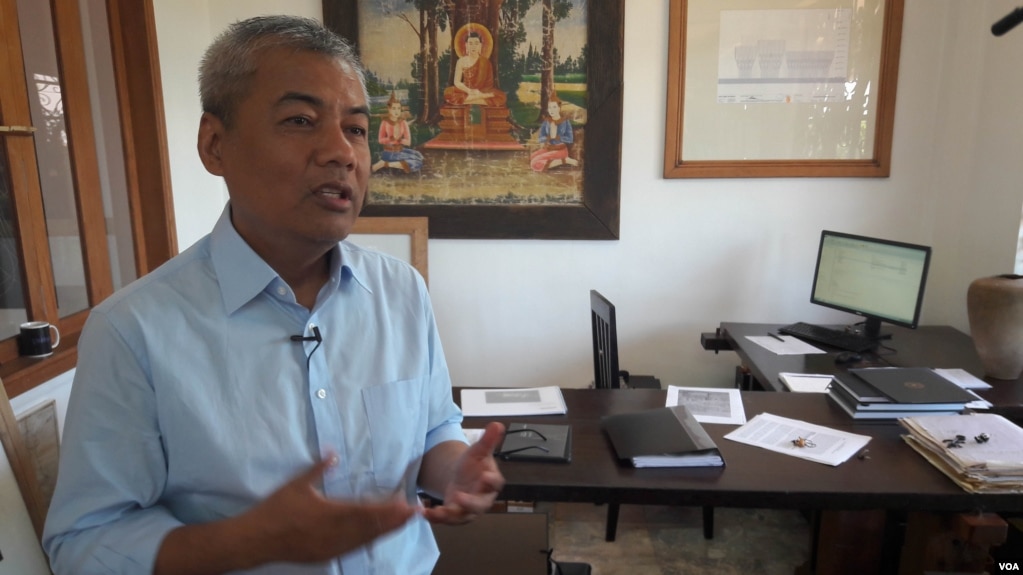
Chhang Youk, director of DC-Cam, talks to VOA Khmer about national reconciliation at his office in Phnom Penh, Cambodia, August 08th, 2016. (Neou Vannarin/VOA Khmer)
Chhang was a survivor of the Khmer Rouge regime. He fled to the United States as a refugee, but memories of the suffering he endured brought him back to his homeland in the early 1990s. He founded DC-Cam and has led the organization since 1995, creating a national genocide education program. Nushin Sarkarati, a senior attorney at CJA, said that without Chhang’s dedication there would be little justice for the victims and survivors.
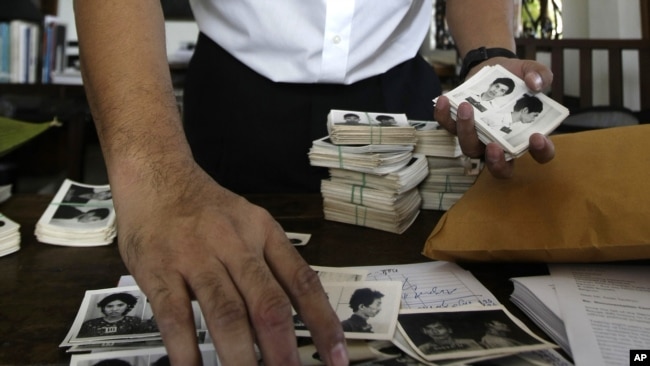
In this photo taken on Aug. 20, 2012, Director of Documentation Center of Cambodia, Youk Chhang arranges photos, a part of about a thousand of newly-discovered photo collection of detainees at the former Khmer Rouge main prison S-21, in his office in Phnom Penh, Cambodia.
Beth Van Schaack, a Stanford law professor who advises DC-Cam, said the group’s orientation towards victims made Chhang a natural choice for the award. “What CJA really admires about DC-Cam is it also has a very victim centered approach, working-hard to help Cambodian victims, experience justice before the ECCC [Extraordinary Chambers in the Courts of Cambodia] and DC-Cam has become in many ways a model for other documentation centers around the world that are collecting information that can be submitted to justice processes where human rights are concerned,” she said.
Nate Thayer, a journalist who has reported on Cambodia for some three decades, said without Chhang’s work, the Khmer Rouge perpetrators would have gotten away with their crimes. “Youk Chhang was a one-man army fighting for justice for those who suffered in Cambodia and his personal passion and devotion bringing those who responsible for mass murder to justice, to face the music, to answer for their crime.”
Peter Maguire, a law professor and an author of “Facing Death in Cambodia,” called Chhang a “Cambodian national treasure” whose efforts bring more truth and reconciliation to the Cambodian people than the combined efforts of the United Nations and ECCC.
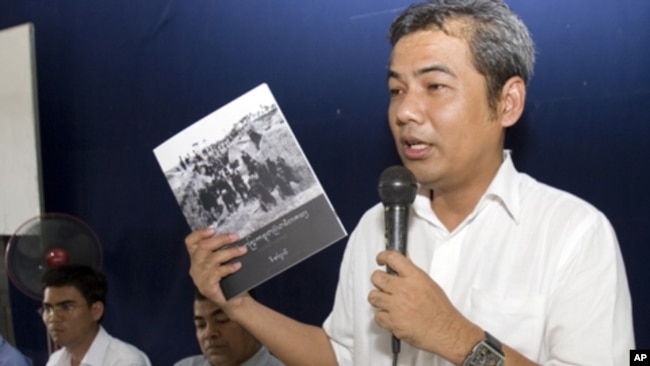
Youk Chhang, a leading Cambodian genocide researcher, shows a copy of the Cambodian version of a Khmer Rouge history textbook to teachers in Takeo province, July 3, 2012.
Neth Pheaktra, ECCC spokesman, told VOA Khmer that DC-Cam deserved the award as it had uncovered valuable evidence that could be used at the court. “The work that DC-Cam has done helps the ECCC save time in finding evidence by ourselves, and it shows us the way, brings us information as well as some historical documents we needed for the trials.”
Chhang is currently working on developing the Sleuk Rith Institute, a permanent hub for genocide studies in Asia based in Phnom Penh.
After my post on Civitas Maxima[https://humanrightsdefenders.blog/2017/03/21/new-magazine-global-geneva-puts-civitas-maxima-in-the-limelight/] I feel that I should complete the picture with a reference to “Make Way for Justice #3” which argues that universal jurisdiction has gathered unprecedented momentum in 2016. In this annual report, ECCHR and its partners FIBGAR, FIDH, REDRESS and TRIAL Internationallook back on its application through 47 recent cases. Five years of conflict, hundreds of thousands of dead. In Syria, large-scale war crimes are committed in all impunity. Effective prosecution has been repeatedly impeded at the international level, yet justice has found a way forward: universal jurisdiction. Thanks to this principle, States can prosecute criminals regardless of their nationality or where the crime was committed. The interest of such procedures for lawless regions is obvious.
2016 alone, five States have brought charges for alleged crimes in Syria. Investigations are ongoing in three others. For victims, these proceedings may be their only chance to obtain justice. Universal jurisdiction has proved a significant tool against impunity in Syria, but it also applies to many more situations: Rwanda, Nepal, Guatemala and Iraq, to name but a few.
To illustrate this breadth, ECCHR, FIBGAR, FIDH, REDRESS and TRIAL International released their annual report on universal jurisdiction, Make way for Justice #3. In 2016 alone, 13 States have made use of this principle in 47 cases – an unprecedented success.



 Hans Thoolen on Human Rights Defenders and their awards