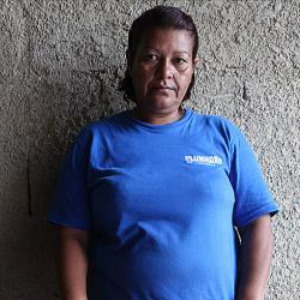
Front Line Defenders reports that on On 7 December 2012, human rights defender Ms Saida Kurbanova was sentenced to 15 days of administrative detention for ‘hooliganism’, after being attacked by two women who alleged that the human rights defender had been the one to attack them. Saida Kurbanova is the head of the branch of the non-governmental Human Rights Society of Uzbekistan (HRSU). It is reported that following the arrest, the hard disk of Saida Kurbanova’s computer was confiscated.
Since her arrest, Saida Kurbanova has been detained in the temporary detention facility at Pakhtakor police station. On 10 December 2012 a representative of Pakhtakor police station reportedly refused to pass on a food parcel and warm clothes to Saida Kurbanova which her family had brought her. In addition, her release on 21 December 2012 is reportedly subject to her paying for the 15 days spent in the temporary detention facility!
Front Line Defenders is concerned about the use of orchestrated attacks on human rights defenders as a means to accuse them of having instigated the incident, and consequently charging them fines or sentencing them to administrative detention. Front Line Defenders believes that Saida Kurbanova’s sentencing is linked to her human rights activities and fears for her physical and psychological integrity and security while in detention.
Yesterday, 12 December 2012, the undersigned Israel based organizations protest the aggressive treatment of three Palestinian civil society organizations by the Israeli military and demand that all property seized be restored and that the work of civil society organizations—and especially those comprised of human rights defenders – be protected and respected.
Early morning yesterday, 11 December 2012, just a few hours after the end of International Human Rights Day, the Israeli military entered the offices of three Palestinian organizations in Ramallah: Addameer Prisoner Support and Human Rights; Union of Palestinian Women’s Committee and the Palestinian NGO Network. The organizations were not provided with any explanation for the search or shown a search warrant and their staff members were not present during the search. The soldiers caused extensive damage to some of the offices and confiscated computers, hard discs, cameras and other essential equipment.
Addameer office after the raid. Photo: Iyad Hadad, B’Tselem, 11 Dec. 2012
The undersigned organizations emphasize that all individuals have the right to freedom of association, and to be free from arbitrary or unlawful interference in their homes and offices, and to due process of law. It is particularly important that human rights organizations enjoy such rights so that they can protect and ensure the rights of others. A free civic space within which Palestinian individuals are able to organize is critical for the protection of Palestinian’s basic rights. Actions such as those taken by the Israeli military threaten this free civic space and damage the protection Palestinian human rights.
The photojournalist Fernando Moreles has been awarded the second Tim Hetherington Grant, an annual visual journalism award focusing on human rights, Human Rights Watch and World Press Photo announced 0n 11 December 2012. Human Rights Watch and World Press Photo established the grant to honor the legacy of Hetherington, a photojournalist and filmmaker who was killed during fighting in Libya in April 2011. The €20,000 grant was given to Moleres for his project “Waiting for an Opportunity,” in which he is documenting the harsh realities of juvenile justice in Sierra Leone. For more than two decades Moleres, who was born and lives in Spain, has been committed to documenting the plight of the most vulnerable populations and covering issues relating to children and labor, juvenile justice, and refugees. “Fernando Moleres’ moral and emotional commitment to his photographic subjects is clear,” said Carroll Bogert, deputy executive director at Human Rights Watch. “Tim Hetherington would have loved this work and Human Rights Watch is thrilled to support it.”
The Asian Human Rights Commission – in spite of its name a NGO – published an elaborate and detailed report on human rights developments in Pakistan this year. The part on HRDs reads as follows:
Human Rights Defenders: Human rights defenders HRDs remain subject to: threats and reprisals against them and their families; harassment; legal and physical attacks; arbitrary arrests and detention; forced disappearance; and torture and extra-judicial killing by state and non-state actors. The government has failed to establish an effective national policy of protection for HRDs or to combat impunity by effectively investigating and prosecuting those responsible for such attacks. The lack of effort to combat impunity mirrors the lack of effort to address the whole range of human rights violations witnessed in Pakistan. And, this, in turn, stems from institutional failings within the police and justice delivery mechanisms, and lack of political will on the part of the government to institute effective institutional reforms. The fact that HRDs expose these failings, places them at particular risk.Persons who work in favour of human rights, but contrary to the interests of radical Islamist groups, face considerable threat, as may be noted in the killings in 2011 of the Governor of Punjab, Salman Taseer, and the Federal Minister of Minority Affairs, Shabaz Bhatti, who were targeted for their efforts to protect minorities, and their opposition to Pakistan’s draconian blasphemy laws.Another accepted recommendation calls for the government to address the repressive effect of civil society monitoring procedures and anti-terrorism legislation on the operation of human rights defenders. The sentencing of six leaders of a power-loom workers union to a total of 490 years in jail, based on fabricated charges under anti-terrorism legislation in November 2011, illustrates the government’s failure in this regard.The killings of HRD’s in Balochistan, while they were documenting cases of forced disappearances as part of the Supreme Court’s efforts to compile a list of cases, illustrates the risks to defenders who work on the gravest rights abuses.
The Government of Pakistan has failed to invite the Special Rapporteur on human rights defenders to visit the country despite accepting a recommendation to do so.
A Turkish court has acquitted four men on trial for their participation in a protest in support of a conscientious objector.
On Thursday 7 December 2012 the court in the north-western city of Eskişehir cleared human rights defender Halil Savda and three others of the charge of “alienating the public from military service”, a criminal offence under Turkey’s Penal Code. The case against them began in 2011 after they protested outside the hearing of fellow conscientious objector Enver Aydemir a year earlier in what became known as the “everyone is born a baby” case – a twist on the Turkish military slogan “every Turk is born a soldier”. In response John Dalhuisen, Director of Amnesty International’s Europe and Central Asia Programme said: “This acquittal should prove that every Turk is born with rights, including the right to freedom of expression”.
In acquitting the defendants, the court ruled that their protest and slogans were protected under the Universal Declaration of Human Rights, the European Convention on Human Rights and the Turkish Constitution, because they did not contain or incite violence, and that a democratic society must allow freedom of expression even if it shocks and disturbs. However, Savda has another similar conviction that is currently pending at the Supreme Court of Appeals.
The Oak Institute for the Study of International Human Rights draws again attention to its call for nominations for the 2013 Oak Human Rights Fellowship, sponsored by the Oak Institute for the Study of International Human Rights at Colby College in Waterville, Maine. The fellowship is a one-semester appointment as a scholar-in-residence. It is designed to provide human rights practitioners doing “on-the-ground” work at some level of personal risk a respite from front-line duties to enable them to reflect, write, and communicate their work to our campus community. The focus of this year’s search is on the protection of the human rights of interned or displaced persons. We are particularly looking for those human rights practitioners involved in international legal rights and basic needs of prisoners of war, civilians detained during occupation or as the result of political violence or states of emergency, and refugees and internally displaced persons fleeing from civil violence, political repression or economic dislocation. The appointment is for mid-August through mid- December 2013. The College provides a stipend of $32,500, plus transportation, housing, health care coverage, and other fringe benefits. We encourage the fellow to bring family with limited financial support for their travel as well. The deadline for completed applications is December 15, 2012 (but first contact the OAK institute with a very good candidate as the first deadline has passed already and forms have to be filled out). Leah Breen Student Assistant, Oak Institute for the Study of International Human Rights oakhr@colby.edu
The Organization of Security and Cooperation in Europe (OSCE) was founded with a commitment to human rights as one of its three key pillars. Sadly, says Dublin-based Front Line Defenders, OSCE member states have not been living up to those ideals and human rights defenders face imprisonment, threats, harassment, defamation and restrictive legislation in countries across the region. “It is time the OSCE backed up fine declarations with effective action,” said Mary Lawlor, Executive Director of Front Line Defenders, “too often it has been the prisoner of consensus and failed to respond when human rights defenders have been jailed, attacked or killed.”Front Line Defenders will undertake a silent vigil outside the OSCE Ministerial Council in Dublin on Thursday 6th December highlighting ten cases of human rights defenders from the region:Vidadi Iskenderov is in prison in Azerbaijan
The LA Times and others report that jailed Iranian human rights lawyer Nasrin Sotoudeh, 2012 nominee of the MEA and winner of the Sacharov Award, has halted her hunger strike after the Iranian judiciary agreed to drop a travel ban against her daughter, her husband Reza Khandan said this Tuesday. Sotoudeh had endured nearly seven weeks without food, drinking salt and sugar solutions, to protest her 12-year-old daughter Mehrave being banned from leaving the country. The couple claimed their daughter was being punished for the alleged crimes of her mother, who has defended dissidents.
Khandan went with a group of female activists to the Iranian parliament on Tuesday, where they met with reformist lawmaker Mohammad Reza Tabesh, who in turn negotiated with the deputy speaker and speaker Ali Larijani to obtain an agreement from the head of the judiciary, Khandan said.
“They agreed to close the dossier of Mehrave and she is no longer banned from leaving the country and there are no charges against her,” Khandan said Tuesday.
The family reunited Tuesday evening in the administration department of Evin Prison, the husband said. Sotoudeh, who had earlier been restricted to talking to her children behind a glass partition, was allowed to hug her son and daughter.
“There she stopped her hunger strike and started eating in front of us,” he said.
The United Nations high commissioner for human rights called again Tuesday for Sotoudeh to be released along with other detained human rights activists. Iranian authorities often target the families of human rights defenders, “a disturbing trend apparently aimed at curbing the freedoms of expression, opinion and association,” spokesman Rupert Colville said in a Tuesday briefing.
Several Pakistani newspapers reported on Monday 3 December that “Prime Minister Raja Pervaiz Ashraf accepted in principle a proposal made by the Ministry of Human Rights to appoint Human Rights Defenders in the ministry”.
It all came from a presentation made by the Ministry of Human Rights. There were several welcome announcements (such as including human rights as a subject in educational institutions and plans to effectively implement its international obligations) but the idea to appoint Human Rights Defenders in the Ministry (as civil servants one has to assume) is baffling. It would completely do away with the idea that HRDs ought to be independent and capable of monitoring authorities. If accepted under this title it would surely confuse the current understanding of what are HRDs. The Minister for Human Rights would soon be called Human Rights Defender in Chief.
The Pakistani newspaper Dawn adds: “The basic idea to have human rights defenders in the country was to help those poor victims who could not afford to plead their cases in courts or seek other remedial measures against oppressors. “The number of human rights defenders and their service structure will be worked out by the ministry in collaboration with other ministries,” the official said. However, critics of the government say as elections were just a few months away, new positions are being created to accommodate pro-PPP voters.”
Let’s hope that the Ministry will revert to the more neutral and clarifying title of ‘human rights officers”.