Posts Tagged ‘human rights violations’

taking on non-response: this blogger’s lone response

March 20, 2011

One of my first posts – almost a year ago (28 April 2010) – dealt with the weakness of enforcement of internationally recognized human rights. It stated, only half-jokingly, that “the best advice one can give a tyrannical regime is to simply ignore all international condemnations, refuse to answer any queries, do not let any UN Rapporteurs or NGOs in, and after a while – usually quite quickly – the furor, if any, will dampen and the media will shine their light elsewhere, most likely where there is some degree of cooperation and access”.  It concluded with some ideas on how to counter trend:

  • Every year on 10 December, Human Rights Day, the human rights movement – through a coalition of major and representative NGOs – makes public a list of the top 10 ‘refusniks’ (countries that stand out in ‘non-cooperation’)
  • Non-enforcement of decisions by any of the UN treaty bodies will have to be strengthened (report to the General Assembly is not enough). The UN High Commissioner for Human Rights could be asked to compile annually a list of non-enforced decisions and give it the widest possible dissemination, including to the meetings of the States Parties. Persistent non-compliance should be routinely followed by inter-state complaints.
  • A business company struck of the list of the Global Compact MUST make this known in the same media and publications in which its joining was announced and with same emphasis (this should be made this part of the code). Non-compliance with this requirement should lead to an active campaign by the UN to explain why the company was struck off the list.

On the LinkedIn platform there were some encouraging reactions, but the truth is that most of the the ideas proposed could only be carried out by large groups of individuals or NGOs. However, there is one thing I can do as a lone small-time blogger, which is to highlight incidents of ‘non-response’ by States to actions concerning HRDs, such as refusing to receive missions, answer specific queries, closing offices, forbid showing of films or publications etc.; all things that tend to get less media attention than they deserve. To keep it manageable, I will limit myself – for the time being – to survey Laureates of the MEA, products of the True Heroes Foundations or actions by the 10 international NGOs on the Jury of the MEA. It may not help a lot but it is within my means to draw attention to the more hidden attacks on human rights and perhaps make that crime pay less.

Any cases you come across are most welcome.
 

NGOs in China and Europe, just published, contains fascinating information

March 8, 2011

One should be careful praising books to which one has contributed oneself. But I make an exception for this volume which makes a comparison of the experiences of NGOs in China and Europe. The chapters on China contain the most comprehensive and up-to-date analysis of various types of NGOs currently active in the country. The contributions on foreign NGOs in China, non-governmental think tanks, public interest legal organizations, labour related NGOs and charity organizations, are the first in English to discuss successful experiences as well as the difficulties they face in the post-Mao era. They show that the Chinese government does not know on which foot to dance. It wants a flourishing civil society (without which social and economic growth cannot be sustained) but also wants to continue to exercise full control over developments less ‘harmony’ is threatened.  This applies specially to NGO work in the sensitive human rights sector.

The European studies draw examples from countries where the experiences of NGOs are at various stages of development. The section on NGOs in Central and Eastern Europe examines the rapid expansion of civil society and their pivotal role in promoting political change and building democracy in a transitional society, as well as the challenges they confront in advancing a strong civil society. Those chapters on NGOs’ experiences in Western European countries, especially in the Netherlands and the UK, provide insightful information and examination of the most contentious issues about NGOs’ accountability, fundraising, governance and relationship with their governments.

Contents: Introduction: challenges and opportunities for NGOs in different parts of the world, Yuwen Li; Part I NGOs in the Context of China: International NGOs in China: current situation, impacts and response of the Chinese Government, Han Junkui; The development and institutional environment of non-governmental think tanks in China, Jia Xijin; Development of charities in China since the reform and opening up, Liu Peifeng; The development of women’s NGOs in China, Shen Guoqin; Public interest legal organizations in China: current situation and prospect for future development, Xie Haiding; A review of the development of labour organizations in China in the 30 years since the reform and opening up, Zhou Shaoqing. Part II Civil Society Organizations in Europe: The voluntary sector and government: perspectives from the UK, Liz Atkins; Creating an enabling environment for NGOs in Central and Eastern Europe, Nilda Bullain; Socially responsible NGOs? A European perspective, Paul Dekker; The role and organization of voluntary action, Richard Fries; Oversight on fundraising by NPOs: Dutch experiences with a European perspective, Adri Kemps; Civil society in the Czech Republic, Petr Jan Pajas; Learning for a lifetime: NGOs, capacity building and nonprofit education in Eastern Europe, Balazs Sator.

My own contribution: ” The international human rights movement: not perfect, but a lot better than many governments think” traces the development of the international human rights movement of the last 60 years and zooms in on those aspects that are the most often misunderstood – or found objectionable – by authoritarian states.

The editor is Yuwen Li, Associate Professor of Chinese Law at the Erasmus University Rotterdam. The publisher is Ashgate, 340 pages, ISBN: 978-1-4094-1959-4 (ebook, ISBN 978-1-4094-1960-0)


Women HRDs in Nepal harassed: over a hundred cases documented

February 28, 2011

The Women’s Rehabilitation Center (WOREC) in Nepal began documenting cases of violations of women’s human rights in the context of armed conflict in 62 districts between 2005 and 2006. During the documentation process, it became clear that Women Human Rights Defenders themselves were at risk. They have been the target of specific threats and harassment in their work, torture, beatings, arbitrary arrest and detention, death threats, harassment and defamation, as well as restrictions on their freedoms of movement, expression, association and assembly. Defenders have been the victims of false accusations and unfair trial and conviction. WOREC-Nepal has been systematically documenting incidents of violence perpetrated against female defenders. WOREC Nepal has documented total of 105 cases of violations done to the HRDs committed by state and non state actors. Some of the 105 cases go back as far as 2004 but the majority of the cases documented have occurred in the last three years. The 105 documented cases of violations of HRDs’ rights, illustrate the extent of the sufferings of HRDs due to the lack of specific protection mechanisms for ensuring their right to defend. There are incidences of Women Human Rights Defenders being raped, murdered and intimidated for their work in strengthening a culture of democracy and human rights in the country. For the full statement see: http://www.humanrights.asia/news/alrc-news/human-rights-council/hrc16/ALRC-CWS-16-09-2011

How to get a real human rights film into the Oscars

February 27, 2011

Back from a long break with interesting news on the film front. Pamela Yates and Paco de Onis are among the best filmmakers specializing in human rights.  Although not linked to the True Heroes Foundation, their work deserves to be supported as it mostly is about the role of the unknown human rights defenders in the midst of one of the worst, large-scale atrocities of the last 30 years.

“Granito” is a unique story of destinies joined by Guatemala’s past, about how a documentary film intertwined with a nation’s turbulent history emerges as an active player in the present. In 1982, Pamela Yates went to Guatemala to direct her first documentary “When the Mountains Tremble” in the middle of an ongoing genocide during the regime of General Efraín Ríos Montt. A quarter century later, film outtakes from “When the Mountains Tremble,” as well as secret military documents and skeletal remains unearthed by courageous human rights defenders, are all being used in a genocide case to prosecute the military dictators that ordered the genocide of the Maya people, resulting in 200,000 killed.

“Granito” means “tiny grain of sand,” and is a Maya concept of collective change, about how all of us persevering together over time can cause change and bring justice to society. If this message of positive change is to reach the tens of millions of people that will tune in to the Oscars 2012 – without the filmmakers selling their souls to the big theatrical distributors – they have to make make an independent Oscar run. This means they have to fulfill the Academy rules on their own, for which they need support and money. So I joined their campaign by becoming “a Granito” and hope you will do the same on https://www.kickstarter.com/projects/granito/granito-how-to-nail-a-dictator.

Observatory for the Protection of Human Rights Defenders also denounces beating of MEA Laureate

November 2, 2010

Today, 2 November 2010, the Observatory for the Protection of Human Rights Defenders, a joint programme of the International Federation for Human Rights (FIDH) and the World Organisation Against Torture (OMCT), also condemned the beating in prison of human rights lawyer Muhannad Al-Hassani. The report describes how Muhannad Al-Hassani, a Syrian lawyer, President of the Syrian Organisation for Human Rights “Sawasiya” and Laureate of the MEA 2010, was attacked by a cell mate, a certain Mr. Mohammad Hamadi. The latter is serving time for rape, armed robbery and forming a criminal gang. It was reported that while he was beating Mr. Al-Hassani, he was screaming at him accusing him of not being a nationalist. The Observatory adds that “Following the assault, the prison authorities opened an investigation on the assault. Though the attacker threatened to kill Mr. Al-Hassani before the investigation committee, these threats were not recorded in the charge sheet. Several days after the assault, Mr. Al-Hassani remains detained in the same cell together with his attacker, despite his request to transfer the latter to another cell.

The Observatory fears that Mr. Al-Hassani could face further acts of violence and expresses its deepest concern about his security while he continues to be arbitrarily detained, as similar attacks against other imprisoned human rights defenders were reported in the past. The Observatory also call the authorities to carry out a prompt, effective, thorough, independent and impartial investigation into the above-mentioned attack, the result of which must be made public, in order to bring all those responsible before a competent court and to release Muhannad Al-Hassani, as his detention is arbitrary and it aims at punishing him for his human

International Commission of Jurists takes up case of Al-Hassani

November 2, 2010

On 1 November 2010 the INTERNATIONAL COMMISSION OF JURISTS (ICJ) followed up on the case of Al-Hassani who was beaten in jail, with a press release entitled: “Syria: Muhannad Al-Hasani, ICJ Commissioner and Martin Ennals Laureate physically assaulted in jail”.  The International Commission of Jurists deplored the failure of the Syrian authorities to protect the physical integrity ICJ Commissioner Muhannad Al-Hasani, an internationally renowned lawyer and human rights defender currently serving a three-year sentence in Adra Prison, Damascus. Some of the key paragraphs are:

“Muhannad Al-Hasani was severely beaten by a prisoner who accused him of working against the interests of the Syrian nation. The prisoner is believed to have been acting at the behest of the Syrian security services. Mr. Al-Hasani is suffering from hematoma and bleeding from his eye and forehead as a result of the assault. The attack on Muhannad Al-Hasani is an attack on human rights defenders everywhere who strive to protect rights under the rule of law. The Syrian authorities have brazenly rebuffed the international community by allowing this assault in the immediate aftermath of his receiving the Martin Ennals award said Wilder Tayler, ICJ Secretary General. It is the responsibility of the Syrian authorities to protect Mr. Al-Hasani from any form of ill-treatment and they must be held accountable for these attacks, added Wilder Tayler.”

“This assault intensifies a campaign of harassment and intimidation against Mr. Al-Hasani, because A of his work as a lawyer and as a human rights defender. His present prison sentence comes after his conviction by the second criminal court of Damascus for “weakening national sentiments” following an unfair trial. Prior to this he was permanently disbarred from practicing law by the non-independent Syrian Bar Association.”

For more information, please contact Saïd Benarbia, Middle East & North Africa Legal Advisor, via: info@icj.org


Al-Hassani, MEA 2010 Laureate on You Tube and reaction by the EU

October 21, 2010

The portrait of the 2010 MEA Laureate Muhannad Al-Hassani (duration approximately 15 mn) can now be found on:
VIMEO: http://vimeo.com/16030613 as well as YouTube (where it had to be in 2 parts) http://www.youtube.com/watch?v=TiZOF_8OOdM PART 1 andhttp://www.youtube.com/watch?v=zkZ5ZOwU5KQ PART 2.
It was made by True Heroes, Films for Human Rights Defenders.
There is also a strongly worded EU statement that can be found on:  http://ec.europa.eu/delegations/syria/press_corner/all_news/news/2010/20101018_ar.htm (in Arabic)  and http://ec.europa.eu/delegations/syria/press_corner/all_news/news/2010/20101018_en.htm (in English)

Please pass on this information to those who need to know

Introducing the MEA Laureate Al Hassani at his ceremony

October 19, 2010

Last Friday – 15 October 2010 – I had the honour to introduce MUHANNAD AL-HASSANI, the 2010 Laureate of the Martin Ennals Award for Human Rights Defenders. The ceremony took place at the beautiful Victoria Hall in Geneva in front of an audience of five hundred people and with more watching it on the internet because the event was being streamed in English as well as Arabic.

I first briefed the audience on what happened to Emad Baghi, last year’s Laureate from Iran. He was arrested at his home on December 28, 2009 and detained without charge. After elaborate campaigns NGOs on the Jury and many others, he was released on bail in June this year.  However, immediately the regime revived the pending charges against him and in July and September Baghi was sentenced to respectively one and six years in prison and banned from media and political activities for five years. He remains free from imprisonment for now, pending an appeal, but he and other human rights defenders in Iran should not be forgotten.


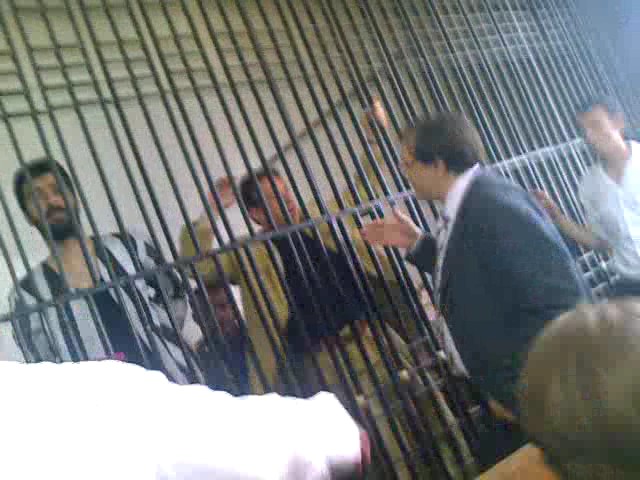
al hassani in court

Al-Hassani was unanimously selected as Laureate 2010 by the MEA Jury which is composed of 10 leading human rights NGOs. If Al-Hassani looked sad on the huge posters that were placed throughout Geneva there are good reasons. He was sentenced to 3 years imprisonment for – pay attention to the dangerously vague wording – “weakening national sentiments” and “spreading false news” and…, on top of it, he had to prove his own innocence against these ludicrous charges. Muhannad Al-Hassani, as a well-established lawyer, has challenged the oppressive legal framework imposed by the Syrian government. He decided to report on legal proceedings before the State Security Court (which are supposed to be public). His NGO Swasiya has been denied registration for the past six years. He has been subjected to a travel ban and his office and communications have been under constant surveillance by Syrian security. I think that the Government of Syria should understand that its efforts to gain respect in the international community will lack credibility as long as it keeps imprisoning those defending human rights. In addition, in an appalling demonstration of servility to the Government, the Syrian Bar Association in 2009 prohibited Mr Al-Hassani from practicing law for the rest of his life… It should be the Bar Association itself that is debarred and I hope that the International Bar Association will soon address this shocking issue. The single most important goal of the Martin Ennals Award is to increase the visibility of Mr Al-Hassani’s situation and that of the many other Human Rights Defenders in Syria. The ceremony in Geneva was a show of solidarity with Al-Hassani and his family, who were not allowed to travel to Geneva and receive the award.


IMPRISONED SYRIAN HUMAN RIGHTS DEFENDER HONORED IN CEREMONY ON INTERNET: 15 October 18h00 GMT

October 12, 2010

WATCH Friday 15 October 18h00 GMT http:/www.martinennalsaward.org ceremony for the Laureate of the MEA in both English and Arabic.
Muhannad Al-Hassani, the Laureate of this year’s MEA, lingers in jail in Syria. He is a lawyer who has bravely defended human rights and challenged the oppressive Syrian government. A three-year prison term prevents him from being able to attend the award ceremony in person.

The Martin Ennals Award is granted each year to a person who has demonstrated an exceptional record of combating human rights violations by courageous and innovative means. Mr. Al-Hassani is a man of exceptional courage, who has been arbitrarily detained for defending the rule of law and the freedom of association. The MEA is the result of a unique collaboration of ten of the world’s leading human rights NGOs, who form the Jury.
Awarding the Martin Ennals Award and broadcasting the ceremony on the internet will increase the visibility of Mr. Al-Hassani’s situation and his valuable work. He has suffered enough.