Posts Tagged ‘Human Rights Defenders’
April 30, 2013

(Professor Paul Gready at York University with Nagi Musa, a human rights activist from Sudan)
Sheena Hastings reports in the Yorkshire Post of 30 April 2013 on the programme offered by York University that lets human rights defenders stay on a fellowship that provides a safe haven and adds to their skills .
“In the few months that Nagi Musa has lived in York, he has not lost the learned panicky response to the odd creaking noise in the night, and he does still find himself scanning any group of people in case there’s someone who looks like a threat. He tends to position himself where he can see the nearest exit, too. Read the rest of this entry »
Posted in human rights, Human Rights Defenders | Leave a Comment »
Tags: Advocacy Organizations, CAHR, fellowship, Human right, human rights activist, Human Rights and Liberties, Human rights defender, Human Rights Defenders, Karak Denyok, Nagi Musa, Paul Gready, protection, Protective Fellowship Scheme for Human Rights Defenders at Risk, safety, South Sudan, Sudan, UK, York university, Yorkshire Post
April 29, 2013
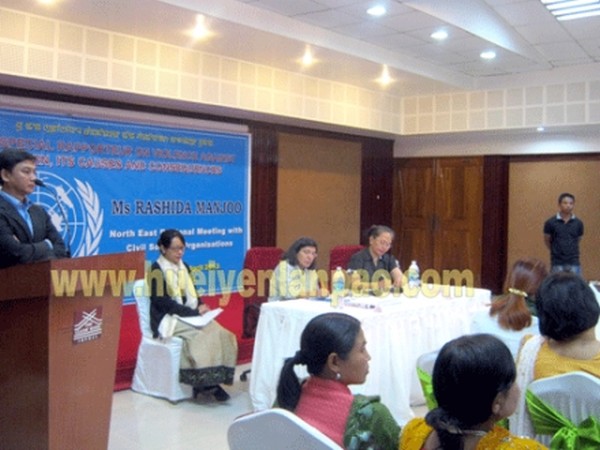
(Executive Director of HRA Babloo Loitongbam delivering the vote of thanks of the meeting)
The Indian agency E-Paonet reports in some detail on the visit by a UN Special Rapporteur to India. Let’s start by acknowledging India’s willingness to accept the Rapporteur (unlike other countries such as Eritrea I just reported on today)!
The Rapporteur in question is Rashida Manjoo the United Nations Special Rapporteur on Violence Against Women, its Causes and Consequences who held a consultative meeting with representatives of civil society organizations, women human rights defenders, victims and other advocates working on violence against women at Classic Hotel, on 28 April. As many as forty separate depositions were made during the meeting, the largest one during her current 10-day long official mission to India from April 22 to May 1. After hearing all the depositions, Rashida observed that it was not her mandate to comment on the depositions made before her, but assured that her report and recommendations would be based on facts and they would be placed on the table of the forthcoming session of the United Nations Commission on Human Rights, which is scheduled to take place June this year at Geneva for necessary actions. Read the rest of this entry »
Posted in human rights, Human Rights Defenders | Leave a Comment »
Tags: Assam Rifles, civil society organizations, consultation, Convention on the Rights of the Child, E-Paonet, fact finding, Human Rights Defenders, India, national ngos, New Delhi, Rashida Manjoo, UN Special Rapporteur, United Nations Special Rapporteur, Violence against women, West Bengal, women human rights defenders
April 29, 2013
The United Nations Special Rapporteur on the human rights situation in Eritrea, Sheila B. Keetharuth, will carry out an official visit to Ethiopia and Djibouti from 30 April to 9 May 2013 to collect information directly from Eritrean refugees on the human rights situation in their country. As in the case of Iran, Eritrea refuses access to the UN Rapporteur. “Due to lack of access to Eritrea, I will engage with all others concerned by human rights in Eritrea, including those who consider themselves to be victims of alleged human rights violations, human rights defenders and other civil society actors,” Ms. Keetharuth said. Another case of non-cooperation with UN mechanisms that should not be rewarded. Read the rest of this entry »
Posted in human rights, UN | Leave a Comment »
Tags: Djibouti, Eritrea, Ethiopia, human rights, Human Rights Council, Human Rights Defenders, Human rights in Eritrea, human rights violations, Politics of Eritrea, refugees, Sheila B. Keetharuth, UN, United Nations Special Rapporteur
April 27, 2013
I am re-publishing this excellent editorial that appeared in the Bangkok Post of 25 Apr 2013 about the lack of protection for environmental human rights defenders in Thailand. If only more newspapers carried such succinct and clear opinions:
“The rally in front of the Appeal Court on Tuesday by 300 residents from Prachuap Khiri Khan to demand transparency in the murder case of environment defender Charoen Wat-aksorn attracted scant media attention.That is not surprising at all as most mainstream media have lost interest in the case, which has dragged on for almost a decade since the victim’s murder on June 21, 2004, regrettably with justice yet to be served _ at least in the mind of Charoen’s widow, his friends and supporters. It is understandable why these rural residents had to travel from their hometown more than 200 kilometres away to gather in front of the court, albeit in a peaceful and civilised manner, to demonstrate their “reaction” against the courts recent acquittal of the last suspect in Charoen’s murder case, 51-year-old Thanu Hinkaew. Their presence in Bangkok was not meant to protest against the Appeal Courts acquittal but merely to seek an explanation from the court and to ensure the case would be treated with transparency when prosecutors appeal against the verdict to the Supreme Court. Read the rest of this entry »
Posted in human rights | 1 Comment »
Tags: Appeal Court, Appellate court, Bangkok, Bangkok Post, Charoen Wat-aksorn, Chiang Mai, Criminal justice, disappearances, environmental issues, Human right, Human Rights Defenders, illegal logging, murder, Prachuap Khiri Khan, protection
April 26, 2013
This is the way the NGO “Chinese Human Rights Defenders” (CDHR) presents itself at the Ministerial Conference of the Community of Democracies in Ulaan Bator, so close to ‘home’:
“Do the names Zhou Decai, Cao Haibo, Chen Wei, Chen Xi or Cui Fufang ring a bell to you? They are all prisoners of conscience in China. The Chinese Human Right Defenders (CHRD) are doing all they can to make the stories of prisoners of consciousness heard.

On its website, CHRD defines itself as “a network of Chinese and international activists promoting human rights and empowering rights defenders in China. A non-governmental organization, CHRD provides logistical support and capacity-building services to human rights advocates, monitors human rights developments, and assists victims of human rights abuses. CHRD advocates the peaceful realization of human rights protection through democratization and rule of law reform.”
There are many activities of the network: just to name numerous reports have been published, the last one of them being the “2012 annual report on the situation of human rights in China”; It also submits constant reports and appeals to the UN on the situation of human rights in China, urging it to act for its improvement; their website and Twitter account provide constant updates on human rights violations in China, as well as pictures and videos, with stories which do not usually reach the mainstream media.”
via Chinese Human Rights Defenders- Promoting human rights and empowering grassroots activism in China | Ulaanbaatar Ministerial Conference- Civil Society.
Posted in human rights, Human Rights Defenders | Leave a Comment »
Tags: Cao Haibo, Chen Wei, China, CHRD, Community of Democracies, human rights, Human Rights Defenders, Ministerial Conference, Non-governmental organization, twitter, Ulaanbaatar, Ulan Bator, Zhou Decai
April 25, 2013
The Martin Ennals Award has from the beginning used film images to portray the work of human rights defenders. Most you can find through http://www.martinennalsaward.org or on:
YOU TUBE: http://www.youtube.com/user/martinennalsaward (the most recent ones but others to follow)
and
VIMEO: https://vimeo.com/martinennalsaward/videos (29 of them)
and the best is to subscribe to these channels so that they alert you when there is something new.
Posted in Al-Hassani, Emad baghi, human rights, Human Rights Defenders, MEA, Ruiz Garcia | Leave a Comment »
Tags: award, films, Human Rights and Liberties, Human rights defender, Human Rights Defenders, laureates, Martin Ennals Award, Martin Ennals Award for Human Rights Defenders, MEA, portraits, video clips, Vimeo, YouTube
April 25, 2013
(EU) High Representative Catherine Ashton should publicly raise concerns over ongoing and persistent human rights violations in China when she visits Beijing, said Human Rights Watch. “As EU’s top foreign policy official, Ashton cannot ignore the deteriorating human rights environment in China,” said Lotte Leicht, European Union advocacy director. “She needs to make it a central part of her agenda in Beijing.” Ashton should also urge top Chinese officials to stop obstructing Security Council action on Syria, including humanitarian access to all civilians in need, and referring jurisdiction over war crimes and crimes against humanity to the International Criminal Court.
In recent months the EU has issued strong statements, including ones at the United Nations Human Rights Council, on China’s use of the death penalty and the crisis of self-immolations in Tibet, among other issues.
The EU also provides some support to human rights defenders in China…..Yet, the EU’s engagement on human rights in China has been extremely weak since Ashton was nominated as the EU’s first foreign policy chief. The more than thirty rounds of the official EU-China dialogue on human rights have had little discernible positive effect for those standing up for human rights in China, and at other levels of political dialogue the EU has failed to give human rights and the rule of law a degree of public attention commensurate with the importance of these issues in China…
…Although the new Chinese leadership has expressed rhetorical support for reform on some key human rights concerns, such as re-education through labor, abuses remain rampant throughout the country. The Chinese government denies people the full exercise of basic rights such as freedom of expression, association, and religion, and systematically suppresses dissidents and human rights activists…
“Ashton should be prepared to tell her Chinese government interlocutors who speak of the need for reform that a good start would be freeing Liu Xiaobo and lifting the appalling and abusive house arrest imposed on Liu Xia,” said Leicht.
Even the new leadership’s commitment to robustly grappling with rampant corruption – identified as a high priority – is already being called into question. In early April, eight activists were arrested for their involvement in a grass-roots anti-corruption campaign.
China: EU Commitments Demand Tough Response | Human Rights Watch.
Posted in human rights | 3 Comments »
Tags: Beijing, Catherine Ashton, China, dialogue, European Union, HRW, Human right, human rights, Human Rights Defenders, human rights violations, Human Rights Watch, International Criminal Court, Liu Xiaobo, Lotte Leicht, repression, Syria, United Nations Human Rights Council
April 24, 2013
On 20 April 2013, human rights defenders from the Association of Lesbian, Gay, Bisexual and Transgender People ‘LGBT United’ and the Coalition for Sexual and Health Rights of Marginalized Communities were attacked by seven unknown persons in the city of Bitola, while putting up posters advocating for the human rights of LGBTI people and marching peacefully carrying a rainbow flag.

(Photo credit: Wikipedia)
The attack took place in front of the Diamond Hostel, in Bitola, down which the human rights defenders had just walked. They were first set upon by four unknown persons, who were later joined by three more. The human rights defenders were insulted, spat on and hit in the face and head. Their posters were taken, and when one of the human rights defenders took his phone to call for help, the phone was also taken and he was told he would be killed. The attack was reported to the police.
Since the attack took place, insulting messages and threats, including death threats, have been posted on LGBT United’s Facebook page, specifically directed at the LGBT United’s members who were attacked in Bitola. The threatening messages included the following: “if you are stupid enough to come to Bitola again … be sure that you will end up in a hospital with your bones broken, and some might end up in a graveyard”, “Kill and slaughter a fag” and “you deserve to die”. On 22 April 2013, photos portraying members of the LGBT United were posted on the Facebook page of the Macedonian Sports Fans group, along with further threatening messages.
 is deeply concerned for the safety of human rights defenders affiliated with these organisations.
Posted in human rights | Leave a Comment »
Tags: Bitola, facebook, Front Line Defenders, FYROM, Human right, human rights, Human Rights and Liberties, Human rights defender, Human Rights Defenders, insulting messages, LGBT, LGBT United, Macedonia, Rainbow flag (LGBT movement), sexual minorities, violence
April 24, 2013


In its 2013 Annual Report, the Observatory for the Protection of Human Rights Defenders focuses on a new setback impeding the work of human rights defenders. Access to funding, in particular foreign funding, is increasingly being hindered by governments, whose primary intentions are to silence human rights defenders. The Report of the Observatory, a joint programme of the World Organisation Against Torture (OMCT) and the International Federation for Human Rights (FIDH), provides a global review of the violations of NGOs’ right to funding via various forms of restrictions imposed by States. It provides a detailed picture of this as yet insufficiently studied problem. This analysis is illustrated by concrete cases in 35 countries.
As also highlighted by Maina Kiai, United Nations Special Rapporteur on the Rights to Freedom of Peaceful Assembly and of Association, in the Foreword to the Report, “The topic of this year’s Report is most pertinent as lately we have witnessed increased stigmatization and undue restrictions in relation to access to funding and resources for civil society organizations, in an attempt to stifle any forms of criticism […]”.
Based on the legal framework surrounding the right to access to funding and the embryonic jurisprudence on this subject, the Report seeks to foster an in-depth analysis of the negative impacts of these restrictive measures, and addresses recommendations to all stakeholders – beneficiaries, donors, governments and intergovernmental organisations.
Two of the three Final Nominees of the MEA this year (in Egypt and Russia) have to deal with these kind of restrictions.
For those who missed the publication when announced in February: Annual Reports : OBS Annual Report 2013: Violations of the right … – FIDH.
Posted in FIDH, human rights, Human Rights Defenders, OMCT | Leave a Comment »
Tags: annual report 2013, civil society organisations, civil society organizations, FIDH, funding, Human right, Human rights defender, Human Rights Defenders, International Federation for Human Rights, Maina Kiai, MEA nominees 2013, Non-governmental organization, Observatory, OMCT, United Nations Special Rapporteur, World Organisation Against Torture
April 24, 2013
Rule of law, freedom of the press, women’s rights – these were just a few of the issues recently discussed at a conference which brought together human rights defenders from Central America and the Caribbean. Twenty human rights defenders from 13 countries and representatives from the German embassies attended the event, which took place from 17 to 18 April in Panama and was organized by the Federal Foreign Office. Also participating were the Federal Government Commissioner for Human Rights Policy and Humanitarian Aid at the Federal Foreign Office, Markus Löning, and the Regional Director for Latin America and the Caribbean, Thomas Karl Neisinger.
The discussions were dominated by the key issues affecting the region, such as the rule of law and women’s rights. Special attention was given to the subject of coöperation between embassies and human rights defenders as well as building networks and strengthening regional civil society. Despite the different situations in countries such as Honduras, Costa Rica and Jamaica, many states in the region face similar challenges. Consequently it is especially important to improve civil society networks so that human rights defenders can learn from one another’s experiences and coöperate more closely in the future.
This event was the fourth regional human rights seminar organized by the Federal Foreign Office. This format is to be retained for future events, for example in Southern Africa in June 2013.
Auswärtiges Amt – Latin America – Better networks for human rights.
Posted in human rights, Human Rights Defenders | 1 Comment »
Tags: Central America, civil society organisations, conference, Germany, Human right, human rights, Human rights defender, Human Rights Defenders, human rights policy, Latin America, Markus Löning, networking, Non-governmental organization, Panama, southern africa, training



 Hans Thoolen on Human Rights Defenders and their awards