Posts Tagged ‘Human rights defender’
April 1, 2012
A leading Bahraini human rights defender, Al-Khawaja’s appeal is set to be heard in Bahrain’s Court of Cassation on 2 April. He is currently serving a life sentence for his role in anti-government protests last year. The activist is at risk of death after 50 days on hunger strike (according to his lawyer, he has lost 16 kg since his hunger strike began on 8 February). Abdulhadi Al-Khawaja, 52, is a former protection co-ordinator with Frontline, an NGO on the Jury of the MEA. He was arrested in April last year for being one of the leaders of anti-government protests and was sentenced to life imprisonment in a grossly unfair trial by a military court last June. “Bahrain must ensure that Al-Khawaja is released immediately and unconditionally,” said Philip Luther of Amnesty International, another member of the MEA Jury. He added: “The continued imprisonment of Al-Khawaja demonstrates that the Bahraini authorities are not serious about fulfilling their promises to release people imprisoned for exercising their right to free spHe has not used or advocated violence in his participation in the anti-government protests, and no such evidence was shown by the authorities during the trial.
Activists in Bahrain have repeatedly called for ’s release. Demonstrators in Manama attempted to stage a sit-in at a main highway on Monday, but were quickly dispersed by riot police. Al-Khawaja, who is married with four daughters, is also a citizen of Denmark, where he lived in exile for decades. He returned to Bahrain after the government announced a general amnesty in 2001. Danish diplomats have visited him in prison several times and confirmed his deteriorating health.
Posted in AI, Front Line | 4 Comments »
Tags: Abdulhadi Alkhawaja, Amnesty International, Bahrain, Denmark, freedom of expression, Frontline, Human rights defender, hungerstrike, justice, MEA, Non-governmental organization
March 23, 2012

The man pictured here is Rupert Colville, spokesperson for the
UN High Commissioner for Human Rights, who has tremendous helped the OHCHR during the last years to have a more penetrating presence in the media. On this occasion on 23 March 2012, it was to warn that there must be no reprisals against Sri Lankan human rights defenders in the wake of a resolution calling on its Government to probe alleged abuses during the country’s civil war. The warning from the UN High Commissioner for Human Rights,
Navi Pillay, follows the adoption of a resolution yesterday by the
UN Human Rights Council in Geneva, calling on Sri Lanka to take “credible” steps to ensure accountability for alleged serious violations committed in 2009 during the final stages of the conflict between the Government and the rebel Liberation Tigers of Tamil Eelam (LTTE) and to ensure accountability.
“During this Human Rights Council session, there has been an unprecedented and totally unacceptable level of threats, harassment and intimidation directed at Sri Lankan activists who had travelled to Geneva to engage in the debate, including by members of the 71-member official Sri Lankan government delegation,” said Rupert Colville, at a press briefing in Geneva. Mr. Colville said that intimidation and harassment of Sri Lankan civil society activists have also been reported in other locations around Geneva. Also, the Sri Lankan ambassador in Geneva received an anonymous threatening letter which is being followed up by the police and UN security.
At the same time, newspapers, news websites and TV and radio stations in Sri Lanka have been running, since January, a “continuous campaign of vilification,” including naming and in many cases showing images of activists, describing them as an ‘NGO gang’ and repeatedly accusing them of treason, mercenary activities and association with terrorism. “Some of these reports have contained barely veiled incitement and threats of retaliation,” Mr. Colville said. “At least two comments posted by readers of articles of this type have called for burning down of the houses of the civil society activists named in the articles, and at least one such comment called openly for them to be killed.”
The spokesperson said the High Commissioner had noted that some of the attacks on human rights defenders were carried in Sri Lankan state media and Government websites or were filed by journalists who had been officially accredited to the Council session by the Sri Lankan permanent mission. “She is calling on the Government to ensure the protection of human rights defenders, to publicly disassociate itself from such statements, and to clearly uphold the right of Sri Lankan citizens to freely engage in international debate of this kind,” Mr. Colville said.
from: http://www.un.org/apps/news/story.asp?NewsID=41617&Cr=Sri%20Lanka&Cr1=
Posted in human rights, UN | 2 Comments »
Tags: Geneva, harassment, High Commissioner, Human rights defender, Liberation Tigers of Tamil Eelam, Rupert Colville, Sri Lanka, United Nations Human Rights Council
March 19, 2012
The newspaper the Zimbabwean comes with the following story: the MDC – although technically part of a unity government – denounces today’s conviction of human rights activist, Munyaradzi Gwisai and five others of conspiracy to commit crime by plotting to topple the government of Zimbabwe. The MDC dissociates itself from claims by the State that the six human rights defenders wanted to topple the government of Zimbabwe through watching video clips.
“We totally condemn the persecution through prosecution of the six in the first place and their conviction today at the Harare Magistrates’ Courts is another assault on democracy and human rights. All the six are innocent victims of a barbaric and senseless Zanu PF dictatorship.”
Gwisai, a former MP for Highfield, is the general coordinator of International Socialist Organisation (ISO). The others who were found guilty today are; Antoinette Choto, Tatenda Mombeyarara, Edson Chakuma, Hopewell Gumbo and Welcome Zimuto. The MDC quite rightly calls it “beyond belief” to assume that people can topple a government by simply viewing old video footage of events from Tunisia and Egypt.
How can anyone be convicted for watching video material that is already in the public domain and can be accessed by anyone from anywhere in the world?
Posted in films, human rights, Human Rights Defenders | Leave a Comment »
Tags: Egypt, freedom of information, Human rights defender, International Socialist Organisation, MDC, Munyaradzi Gwisai, repression, Tunisia, video clips, Zimbabwe
March 13, 2012
Governments are becoming increasingly ‘sophisticated’ in their repression of human rights defenders. Probably as a result of the remarkable worldwide acceptance of human rights as a universal set of standards, Governments that want to continue to suppress criticism are resorting to more and more indirect methods of repression.
The basic universality of human rights is nowadays accepted by the quasi-totality of mankind. In the words of Normand and Zaidi, ‘the speed by which human rights has penetrated every corner of the globe is astounding. Compared to human rights, no other system of universal values spread so fast’. This has not stopped a small number of governments (e.g. Iran, Zimbabwe, North Korea) to continue to oppose the idea and depict human rights as a ‘western’ or ‘foreign’ product, alien to their culture. But the big majority seems to have accepted that there is a crucial distinction between the universality of human rights and its universalisation (or universal application). The first is the moral and legal principle that a core of human rights exists and applies to every person in the world irrespective of his or her culture, country, etc. The second is the process by which these universal standards become a reality. Here one cannot make the same optimistic observation about the speed by which human rights are spreading, but this is not only due to the ever-present gap between rhetoric and reality. The international system itself allows for differing interpretations by giving a margin of appreciation at the regional and national level and by permitting States to make reservations to international agreements. The big question is then, to what extent local cultural, legal and religious practices can be accommodated by the international system without losing its coherence.
In this context one sees increasingly that Governments use ‘tricks’ or at least more roundabout ways to tackle those they want to silence. Recent examples are the disbarment of lawyer Intigam Aliyev in Azerbijan (continuing legal work without license), financial fraud charges against Ales Bialiatski in Belarus (NGO refused recognition, therefore no bank account in Belarus, thus acceptance of grants in neighboring countries illegal), withdrawal of recognition of the Bahrain Center for Human Rights. Now Amnesty International has come with a report on Ethiopia ‘Stifling human rights work: The impact of civil society legislation in Ethiopia’ (PDF). It describes in detail how the 2009 Charities and Societies Proclamation imposes heavy restrictions on human rights groups operating in the east African country, and allows for excessive government interference. The result is that Ethiopians have less access to independent human rights assistance. Amnesty International’s Deputy Africa Director Michelle Kagari said: ‘Rather than creating an enabling environment for human rights defenders to work in, the government has implemented a law which has crippled human rights work in Ethiopia. The space to make legitimate criticism is more restricted than ever.’ Human rights defenders risk imprisonment if they violate vaguely defined provisions within the 2009 law, making them afraid to speak out, and often resort to self-censorship, in order to avoid repercussions.
There are surely many other examples and it goes to show that those of us who want to assist HRDs in their work have to become also more sophisticated and cut through the maze of legalistic and bureaucratic measures to unearth the truth about the situation of HRDs. We have our work cut out!
Posted in Amnesty international, human rights, Human Rights Defenders | Leave a Comment »
Tags: Ales Bialiatski, Amnesty International, Azerbaijian, Bahrain, Belarus, Ethiopia, freedom of association, Human right, Human rights defender, Human Rights Defenders, Non-governmental organization, repression
February 28, 2012
For 2012 Civil Rights Defenders, a NGO based in Stockholm, has started an interesting campaign: the Human Rights Defenders of the Month. Amnesty International has long done this for the ‘prisoner of the month’ and we should welcome the effort to focus similarly on HRDs. Whether the organisation will manage to keep a good international spread in view its current strong emphasis on Eastern Europe (understandable as it is the successor of the Helsinki committee) is another matter. The case of Svetlana Lukic is certainly a very deserving one which reminds me of the work done by Natasha Kandic, the 1999 MEA laureate.
During the Balkan wars in the 1990s the Serbian journalist Svetlana Lukic was suspended twice from her post at Radio Belgrade because of the way she chose to report. Even after the fall of Milosevic’s regime in year 2000, the pressure continued. Today most media outlets in Serbia are heavily controlled by political and business elites. One exception is the radio program Pescanik (in English: The Hourglass), which has gone from 100.000 listeners per week to 475.000 in the past five years. The Pescanik web portal has around 7.000 visitors a day. Several media houses, among them the national Public Broadcasting Service, have described Pescanik as ‘anti-Serbian’ or ‘treacherous’; an opinion also shared by right wing and fascist groups.
“Whenever I feel afraid for my safety, I am ashamed because I remember all those people I saw during the wars in the 90s who suffered and had real reasons to be afraid. Some of them are not alive any more.”
Ten years after the fall of Slobodan Milosevic’s regime, Serbia is still dealing with the political, economic and cultural burden inherited from the conflicts that lasted for more than 10 years in the 1990-s. The country is deeply affected by issues like dealing with the past, the inability to secure continuity in the reform processes, a deep division between pro-European and right wing blocks and a lack of awareness on basic human rights and accountability of duty holders. Governments are ultimately responsible for human rights and democratic reforms. In transitional societies, however, like Serbia, the civil society is the driving force for the observance of human rights. They play a key role by continually monitoring the machinery of power, providing independent information and space for debate, as well as working to ensure that the state and its representatives take responsibility when mistakes are made. The majority of media outlets in Serbia are heavily controlled by political and business elites. There is a tendency to support policies of the current government uncritically, and to avoid coverage of issues that could politically damage the current holders of political power.
According to Reporters without Borders’ Press Freedom Index for 2011-2012, Serbia is ranked 80 out of 179: “In a new and regular phenomenon since national independence, journalists have been the victims of reprisals for investigating the country’s criminal underworld and its growing influence in political and financial circles.”
For the full story see: http://www.civilrightsdefenders.org/campaigns/human-rights-defender-of-the-month/svenska-manadens-manniskorattsforsvarare-svetlana-lukic/
Posted in human rights, Human Rights Defenders | Leave a Comment »
Tags: Amnesty International, Civil Rights Defenders, Eastern Europe, human rights, Human rights defender, MEA, Natasha Kandic, Non-governmental organization, Pescanik, RSF, Serbia, Svetlana Lukic
February 23, 2012
Earlier this month, 16 prominent human rights activists were arrested in Dar es Salaam on the grounds of unlawful assembly. The human rights defenders were arrested at the Muhimbili National Hospital, where the police allege they had gathered illegally and were intending to hold an illegal demonstration, although the group maintained that they were merely going to observe the dialogue between the government and health officials.
Article 20 of the Constitution of Tanzania enshrines the right for people; “to freely and peaceably assemble, associate and cooperate with other persons”. However, as expressed in the constitution, this right can be limited by other national legislation for certain purposes, including ensuring public order or where it is in the public interest. The Police Force and Auxiliary Services Act forms part of the national legislation, which regulates public assemblies. This Act states that notification must be provided to the police 48 hours in advance of a planned public assembly. The police are given broad powers to prohibit the assembly if they believe it “is likely to cause a breach of the peace, or to prejudice public safety or the maintenance of public order”.
Africa Review who reports on this rightly asks the question : did the 16 activists cause a breach of the peace, or prejudice public safety and the maintenance of public order? Were the police, by prohibiting the alleged assembly and subsequently arresting the activists, using their discretion appropriately? Arguably a “breach of the peace” could be interpreted very broadly by police, allowing them to use their discretion to prohibit all public assemblies. Without further explanation by the Tanzanian police this is bound to be considered an unnecessary restriction in international law.
Posted in human rights, Human Rights Defenders | Leave a Comment »
Tags: Africa Review, demonstrations, freedom of assembly, human rights, Human rights defender, Police, Tanzania
February 21, 2012

The Women Human Rights Defenders International Coalition (WHRD IC) is a resource and advocacy network for the protection and support of women human rights defenders.
The Global Report gives a contextual analysis of the environment in which WHRDs work and the violations they face because of their gender. The Global Report wants to rectify the neglect of gender-specific documentation by drawing on individual and collective analysis of WHRD IC members during the life of the Coalition, which began in 2005. The analysis is informed by five key phenomena – fundamentalisms; militarization and situations of conflict; globalization; crises of democracy or governance; and heteronormativity. The Global Report uses 43 cases studies that illuminate specific trends and experiences of WHRDs. The case studies also surface connections between context, identities of WHRDs and violations experienced. The use of the cases examples provide a vivid glimpse of the landscape in which WHRDs live and work.
The Global Report is primarily an advocacy and capacity building tool, both important measures for WHRDs’ protection and the prevention of further abuses. The Global Report is a contribution to the ongoing documentation of the situation of WHRDs that will enable informed advocacy from the local to regional and international level.
The report – and a short abstract of the report in English, French and Spanish – will soon be available to download from the website: http://www.defendingwomen-defendingrights.org/, hard copies are available by email request to whrd@apwld.org.
Posted in Human Rights Defenders | Leave a Comment »
Tags: Advocacy Organizations, announcement, global report, Human right, Human rights defender, WHRD IC, Women Human Rights Defenders International Coalition
February 13, 2012
The following story illustrates very well how HRDs straddle the issue of civil rights in relation to social and economic rights. It comes from the reliable Asian Human Rights Commission (AHRC).
A troop of twenty-five rangers illegally raided the house of Mr. Muhammad Ali Shah, a human rights activist and chairperson of the Pakistan Fisherfolk Forum.
On Thursday 9 February, 2012 around 7pm in the evening, Mr. Shah participated in a protest organised by the labourers of M/S MASCO (A German Garments Factory in Karachi) against the unjust and inhuman working conditions imposed by the management. The peaceful protesters were fired upon resulting in many casualties. Moreover, a number of protesters were abducted by the police. They were given no reason for their arrest. Mr. Shah condemned the acts of the factory management and unlawful support of the police. He talked to the officials and had the labourers released. This infuriated the factory owner and he contacted one of his friends in the Rangers named Lt. Col. Jawaid.
The Rangers already had a grudge against Mr. Shah and. Lt. Col. Jawaid therefore wasted no time in taking up his friend’s unofficial complaint. The same evening he phoned Mr. Muhammad Ali Shah, abused him verbally and threatened him with kidnapping and death. He warned Mr. Shah to keep himself away from social work or get ready to bear the harsh consequences. Mr. Shah replied that he was not undertaking any unlawful acts and that he was only showing support to the people who are victims of injustice.
Lt. Col. Jawaid became even angrier and sent 20-25 armed Rangers at around midnight to kidnap Mr. Shah and teach him a lesson. The soldiers cordoned off the area where Mr. Shah lives as if they were acting against some terrorist threat and raided his house without having any legal order or complaint in black and white. Fortunately, Mr, Shah was not at home at that time otherwise he might have been treated brutally before being abducted.
The urgent appeal by the Asian Human Rights Commission then goes on to give more detailed background information and to issue a call for action. See: http://www.humanrights.asia/news/urgent-appeals/AHRC-UAC-022-2012
Posted in AHRC, human rights, Human Rights Defenders | Leave a Comment »
Tags: Asian Human Rights Commission, Human Rights and Liberties, Human rights defender, Pakistan, Pakistan Fisherfolk Forum, protest, Rangers
February 9, 2012
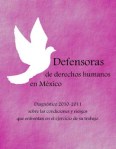
Three out of every four female human rights defenders in Mexico have been violently attacked for their work, according to the book “Human Rights Defenders in Mexico: A Diagnostic of 2010-2011 on the Risks of Performing their Work”, which was presented on 19 January this year.
The report, which was researched by organizations such as the Association for Justice and Women´s Network of Ciudad Juárez, say that the activists are the target of persecution and threats, regardless of whether they work defending the environment, sexual health rights or against violence against women. Between 2010 and 2011 nine Mexican women who worked in human rights were killed.
“In recent years, the risk and attacks against women human rights defenders has increased in the entire country,” said the report.
 Journalists, indigenous leaders, and LGBT activists are among the main persons at risk.
The human rights defenders tend to be targets of violence just for being women, and for being women who promote and defend human rights, which breaks with the traditionally accepted female identity, said the report. In other words: “Sexual violence is the main threat to women activists”. For the full report, in Spanish, go to: http://issuu.com/cencos/docs/diagnostico-defensoras-imprenta-final
Journalists, indigenous leaders, and LGBT activists are among the main persons at risk.
The human rights defenders tend to be targets of violence just for being women, and for being women who promote and defend human rights, which breaks with the traditionally accepted female identity, said the report. In other words: “Sexual violence is the main threat to women activists”. For the full report, in Spanish, go to: http://issuu.com/cencos/docs/diagnostico-defensoras-imprenta-final
Posted in books, Human Rights Defenders | 3 Comments »
Tags: book, Human rights defender, Mexico, Violence against women, women human rights defenders




