Posts Tagged ‘Human rights defender’

ATTACK ON HRD OKIYA OMTATAH SHOULD BE INVESTIGATED IMPARTIALLY

November 11, 2012

Reports indicate that Mr. Okiya Okoiti Omtatah was attacked in the evening on 8 November 2012 by unknown assailants at Nairobi’s Central Business District. He suffered broken teeth and a deep cut on the head. He was taken to hospital in Nairobi for medical examination. Mr. Omtatah is a known human rights defender who has been at the forefront of condemning human rights violations in Kenya, corruption and abuse of offices by state officials. Mr Omtatah has recently publicly raised concern regarding the Biometric Voter Registration Kits’ procurement process in Kenya.

The Government of Kenya should ensure that thorough and impartial investigations are carried out into the attack on Mr. Omtatah the National Coalition of Human Rights Defenders in Kenya said on 9 November.

This incident has taken place at a period when Human rights defenders in Kenya, including journalists have reported increasing threats, physical attacks and arbitrary arrest in the past few months.
The National Coalition of Human Rights Defenders condemns this incident and ongoing threats and targeting of human rights defenders as they conduct their legitimate work. We call upon the government, particularly the police to assure citizens of safety and protection of all people particularly as the country head towards elections in March 2013.

The National Coalition of HRDs further urges the Government of Kenya to fight impunity by ensuring that impartial, thorough and timely investigations are carried out into this and other incidents, and that the perpetrators are held to account in prosecutions that meet international fair trial standards.

For inquiries, please contact Kamau Ngugi, Coordinator, NCHRD on info@nchrdk.org
Related articles

HRD Sayed Yusuf arrested in Bahrain

November 8, 2012

Many organizations have called on the Bahraini authorities to immediately release the human rights activist Sayed Yusuf al-Muhafadha and drop all “illegal gathering” charges against him. On October 30, 2012, the government issued an indefinite ban on public protests. Security forces arrested al-Muhafadha, acting vice president of the Bahrain Center for Human Rights (BCHR), in al-Diraz, west of Manama, on November 2. Al-Muhafadha was taken into custody after he tried to photograph an injured protester at a protest against the ban. Earlier in the day he had tweeted photos of security forces attacking protesters with teargas in the village of Bilad al-Qadeem, the Washington Post reported. The day after he was arrested, the public prosecutor decided to hold him in detention for a week pending investigation on charges of  “illegal gathering of more than five people.”

Sayed Yusuf al-Muhafadha is acting vice president of the Bahrain Center for Human Rights (BCHR) and represented them at the MEA ceremony on 2 October in Geneva. For images see the website: http://www.martinennalsaward.org, summary of the 2012 ceremony.

Human rights defender of the month: Sapiyat Magomedova from Dagestan

November 6, 2012

The North Caucasian republic of Dagestan is one of the most dangerous places for lawyers today in Russia. In this region Sapiyat Magomedova defends victims of grave human rights violations like enforced disappearances, extra judicial killings and torture. She has taken on cases that many lawyers would reject due to security reasons, and although it is considered almost impossible, she has won several of them. She was chosen by Stockholm-based Civil Rights Defenders as its HRD of the month. Last week I reported that she had received an important award from Sweden.

When asked about everyday life in Dagestan, local human rights lawyer Sapiyat Magomedova answers straight: ”I would not call it life.” The conflict in Dagestan is bridging on civil war. During the last two years Dagestan is considered to be the most violent region in the North Caucasus, followed by Chechnya. Local human rights defenders constantly face harassment, assaults and threats to their life.

Portrait Sapiyat Magomedova Photo: Private

In 2010 Sapiyat Magomedova was severely beaten by police officers when visiting one of her clients. When pressing charges, she was herself charged with using violence against state officials and insulting police officers on duty. Sapiyat Magomedova had already in 2009 been subjected to an unfounded criminal case for allegedly offending an Investigator from the Prosecutor’s Office. She believes that the case was a form of retaliation for her standing up to law enforcement agencies and fighting impunity. “The criminal case against me was opened to put pressure on me, to force me to retract my statement against the police officers”, Sapiyat Magomedova later said in an interview.

Sapiyat Magomedova represents victims in very sensitive cases, such as allegations that the police have tortured individuals suspected of involvement with the insurgency, and cases of sexual- and gender based violence. Normally, cases of sexual- and gender based violence go unreported in Dagestan. Sexual violence is a taboo subject in a region where honour killings, bride kidnapping, and child marriage occur. There is an absence of debate on the political level on these issues. Women’s rights are not high on the political agenda and gender based violence and other kind of abuses against women occur on a regular basis.

In 2011, Sapiyat Magomedova defended a 13-year-old girl who had been kidnapped and raped for three days by five young men. Two of the suspected rapists were sons of police officers. After strong pressure on the girl and her family, she succumbed and changed her statement. The case, however, got rather great resonance in society and might lead to inspiring other victims to dare press charges. Sapiyat Magomedova further highlighted the case on one of the first conferences on women’s rights in the region. At the conference she spoke about the problem with impunity in cases of sexual- and gender based violence.

Being a woman, Sapiyat Magomedova must also exert much effort just to be taken seriously in her legal profession. Caucasian women are commonly housewives and that “leaves its mark”, as Sapiyat Magomedova puts it. Woman lawyers have a lot of misconceptions to fight against.

Human rights defenders constantly face harassment and threats to their life in Dagestan. Since 2010, Dagestan is considered to be the most violent region in the North Caucasus, followed by Chechnya. The conflict nearly approach the level of civil war. Russian law enforcement bodies are reluctant to investigate cases of human rights abuses. Even though Russia has been convicted approximately 210 times for violations linked to North Caucasus, by the European Court of Human Rights, not even one perpetrator has been put to justice.

In many cases, violations are committed by those who are supposed to uphold the rule of law, under the pretext of fighting terrorism. In order to keep up statistics in terror crimes, it frequently occurs that law enforcement bodies fabricate evidence against innocent people and extract a confession by using torture. This in turn nurtures the insurgency that has been on the rise in the past years. A decade of failure to stabilize the region and deal with the rampant impunity has created an environment where ordinary people live in fear and have almost nowhere to turn to seek justice.

The Russian government invests enormous sums of money each year to dampen the conflicts throughout the North Caucasus. The number of dead terrorists is used as evidence that the Russian government’s initiative leads to results. Military and security forces, and the Police are being rewarded for each person that can be added to the toll of terrorists. This has led to civilians being accused of joining the separatists. Kidnappings, torture and extrajudicial executions are common.

Read more in Civil Rights Defenders country report: Human rights in Russia

Barbara Hendricks – a human rights defender of a special kind

November 2, 2012

Barbara Hendricks at MEA ceremony 2003 with late Sergio Vieira de Mello and Alirio Uribe Munoz

The trigger to write about this very special person is that she has just been celebrated as UNHCR’s Goodwill ambassador for 25 years.

You are really the princess of the humanitarian and human rights world,” High Commissioner for Refugees António Guterres said at a special UNHCR staff ceremony in Geneva. “The authority of your voice is a precious instrument for our fight,” he added. “Twenty-five years – it’s a long time and the cause of refugees has been a part of my life since my first mission,” said Hendricks, adding that it had been an honour to work for UNHCR. She praised the refugees who inspire her and the UNHCR staff who help them. “Thank you so much. It has been a fantastic journey and I look forward to continuing for as long as I can.

What many people do not know is that Barbara Hendricks has not only been a dedicated and outspoken advocate for refugees for the past 25 years, but also been a strong supporter of other causes including human rights, e.g. as a Patron of the Martin Ennals Award for Human Rights Defenders or in giving her support to creating the True Heroes Foundation, Films for Human Rights Defenders in 2007.

The American-born Swedish citizen was inspired by the struggle for civil rights in the USA as a child and never let off. The human rights world needs celebrities but even more it needs celebrities with real and long-term commitment. This is what makes Barbara Hendricks a Human Rights Defender in her own name! Thanks.

Ayman Nasser, Palestinian HRD in Israeli detention

October 23, 2012
Map showing the West Bank and Gaza Strip in re...

(Photo credit: Wikipedia)

The Middle East and the Israeli-Palestinian conflict in general may get a lot of media attention but the issue of individual HRDs in Palestine often remains outside the limelight. Here is a recent example:

The Jerusalem based NGO Addameer reports that its staff researcher and longtime prisoner advocate Ayman Nasser was abducted from his home by occupation forces early on October 15. On October 18, he appeared in a military court in Jerusalem where his interrogation period was extended by seven days. Ayman addressed the court directly with the following words: “I believe that every human being has opinions and positions and if it’s not violating the law he can freely think and speak these opinions. I am a human rights defender who supports the Palestinian prisoners and I represent my opinions in the public media. My thoughts are not secret, they are public, and everyone knows them.”

Like many Palestinian prisoners, Ayman is subject to medical neglect – he is currently only receiving two out of the five medications that he requires daily. Addameer reported, “The judge ruled that based on ‘secret evidence’ he would extend Ayman’s interrogation period for another seven days and referred the situation of the medicine to the doctor at Moskobiyyeh detention center.” Moskobiyyeh, where Ayman is now held, is one of the most notorious detention centres in the Israeli occupation system; he was interrogated for 10 hours straight on October 17 and his interrogation has continued with similar intensity since that time.

Ayman spent six years in Israeli prisons, from 1992 to 1997. He has worked at Addameer since 2008, lectures in social work at Al-Quds Open University, and directs the Handala Centre, a cultural centre in Saffa village. On October 21, it was announced that he won a seat on his village’s municipal council in the weekend’s West Bank municipal elections, from his cell in Israeli detention.

Click here to send a letter to Israeli officials demanding the immediate release of Ayman Nasser and an end to the persecution of Palestinian human rights defenders.

Martin Ennals Foundation expresses concern regarding Nabeel Rajab’s upcoming trial

October 10, 2012
English: Nabeel Rajab protesting outside Muhar...

Nabeel Rajab May 2011 (Photo credit: Wikipedia)

The Martin Ennals Foundation would like to express its growing concern regarding the upcoming hearing on October 16th concerning the appeal of Nabeel Rajab’s conviction.

Mr. Rajab is appealing a three year sentence handed down by the Bahraini Courts. This sentence is widely viewed as an attempt to block his freedom of expression and prevent him from supporting peaceful protests.

The Bahrain Center for Human Rights was one of three Finalist Nominees for the Martin Ennals Award, which was handed out in Geneva on October 2nd. The Martin Ennals Award is selected by a Jury of ten leading Human Rights organizations and aims to publicize the work and protect a Human Rights Defender. Regrettably, Mr. Rajab was not able to attend the ceremony due to his detention.The Martin Ennals Foundation supports the widespread calls for his release made by many leading Human Rights Organizations including members of our Jury. We urge the Bahraini Courts to release Mr. Rajab.

from : http://www.martinennalsaward.org

Who is the laureate of the MEA 2012? – answer tonight at 18h45 in Geneva

October 2, 2012


This morning the Jury of the Martin Ennals Award for human rights Defenders (MEA) came together in Geneva to decide who will ultimately be the Laureate of the MEA 2012. I was there and know the result but it stays under wraps until approximately 18h45 Geneva time when the UN High Commissioner for Human Rights will make the announcement during the ceremony which can be followed live on http://www.martinennalsaward.org as from 18h00.


Indonesia’s Febi Yonesta interviewed by HRF

September 24, 2012

Human Rights First is running a series of profiles on human rights defenders we work with in various countries. These profiles help to explain their work, motivations, and challenges. On 19 September 2012 it was the turn of Febi

Photo of Febi Yonesta

How did you become an activist? When I was still a law student, I was active in various student organizations including the ASEAN Law Student Association, Law Student Assembly, Hasanuddin English Debating Society, and Makassar Judicial Monitoring. I found myself more involved in Human Rights Advocacy when I joined The Jakarta Legal Aid Institute (LBH Jakarta) in 2005 through its Legal Aid Workshop. At that time, my mind opened up to the ugly truth of the human rights situation in Indonesia. The poor and the oppressed suffer from unjust policies imposed by the Indonesian government. They are forcibly evicted from their houses without any adequate compensation or even relocation and the poor are left homeless. Companies that enact downsizing policies do not compensate the labor force that remains jobless. Minority groups also suffer continuous discrimination and violence yet, no clear government policies exist to overcome all of these issues. I learned that The Legal Aid Institute has made significant contributions to the human rights and democracy struggle in Indonesia. It is because of this that I’m thrilled and encouraged to follow the legal aid lawyer path in maintaining the human rights struggle.

Do you even see yourself as a human rights defender?

I see myself simply as a lawyer who is very concerned about human right issues and strives to always give my best as a human rights advocate.

How do you perceive the current situation in Indonesia i.e. blasphemy laws, internet freedoms, religious minority groups?

The current situation in Indonesia regarding religious freedom is extremely bad. Religious based intolerance; discrimination and violence have increased into something that is really horrifying and difficult to resolve without any sincere willingness on the part of the government and key figures to take part in resolving it. The biggest problem is, in most incidents, that the government acquiesces in the act of intolerance and discrimination by using the situation to gain a political advantage which only adds more suffering to the religious minorities who are always the victims.

Religious based intolerance and discrimination in Indonesia is legitimized by the anti-blasphemy law no. 1/pnps/1965 where different religious teachings, interpretation, as well as expression are prone to criminalization or violence under the law. Some cases have shown that this law has been abusively applied to those who deemed as heretic or deviant from the mainstream religious perspective.

Information technology such as the Internet, has actually become the easiest way to disseminate ideas but in the same sense has been utilized to spread religious hatred. The information and electronic transaction law is sometimes used to restrict as well as criminalize ideas and religious expression that contradict the mainstream ideology, and is used as another means to pursue religious hatred incited through the Internet.

What do you want to see happen in Indonesia – outcome based?

As long as the anti-blasphemy law and the problematic provision in the Information and Electronic Transaction law still exist, they can be abused and exploited by the intolerant groups to pressure the government to enact laws against religious minorities in a discriminatory manner. We have once filed a petition against the anti-blasphemy law where the Constitutional court saw the law as problematic therefore recommended that the law be revised to avoid exploitation and abuse. However, up until now there has been no sign from the government to revise the law anytime in the near future. Therefore, I am keeping a close eye on the continued struggle for a legal framework that guarantees religious freedom and will continue to advocate for any legislation, including amendments to said laws which lay ground for religious intolerance and discrimination.

What risks do you see are posed on your everyday life, if any?

Working in the human right field is not easy especially in terms of fulfilling the economic needs of my family. With my education and professional background I should ordinarily be able to earn more than enough to fulfill my family needs. Along with working with the religious freedom issue, the risks are quite apparent, especially when I have to stand face to face with the intolerant groups and receive constant assault, harassment, and threats for defending religious freedom. The temptation to leave my human rights work sometimes crosses my mind but my commitment to keep on working in human right area does not waiver because as long as the poor and the oppressed still exist and suffer from human rights violation and religious minorities are still facing severe acts of intolerance and discrimination then I will continue doing what I am doing in hope of a better future for Indonesia.

What is a normal day in the life of…Febionesta?

Although I am based in Jakarta, I reside in Bogor (a suburban city), which is my hometown. I was born and raised there. Thus during the week, I need to get up early in the morning around 6am to leave for work around 7am. It usually takes one and half hours by train to get my office.

I always spend my train ride reading the news, tweeting and checking my emails. However, with my new post as director of LBH Jakarta it has certainly impacted my daily life. I really need to use as much of my spare time to think about management, coordination, and responding to all my emails. Most of the time, I return home around 9pm or even 11pm and I don’t have enough time to play with my kids. I do try to spend any spare time I have left to have quality time with my family. Most of my time now is spent organizing meetings, talking to communities, discussing cases, maintaining advocacy networks, talking to the media, and so on. I also try to relax by playing musical instruments and writing songs (where some of them are written about people’s suffering and human rights issues).


WOZA’s case shows that meetings can help generate support for HRDs

September 18, 2012

From 6 to 8 June 2012, Women of Zimbabwe Arise (WOZA) national coordinator Jenni Williams attended an international human rights experts meeting is Oslo, hosted by the Norwegian Ministry of Foreign Affairs.
She presented the story of WOZA and its mandate of peaceful protest and the brutality of the state in responding with violence.
Amongst those attending were the United Nations Special Rapporteur on freedom of assembly and association, Maina Kai; the Special Rapporteur on freedom of opinion and
expression, Frank La Rue; and the Special Rapporteur on human rights defenders, Margaret Sekaggya as well as the Special Rapporteur on Human Rights Defenders of the Africa commission on human and people rights, Reine
Alapini-Gansou.
The African Commission Special Rapporteur Reine Alapini-Gansou and two United Nations Special Rapporteurs have since released statements.
http://wozazimbabwe.org/wp-content/uploads/2012/09/Oslo-statement-FINAL1.pdf
and http://wozazimbabwe.org/wp-content/uploads/2012/09/Press-release-PEACEFUL-PROTEST.pdf

Visit WOZA website at http://www.wozazimbabwe.org or follow on Twitter at http://twitter.com/wozazimbabwe.

This information was provided by the International Secretariat of the Women Human Rights Defenders International Coalition (WHRD IC)

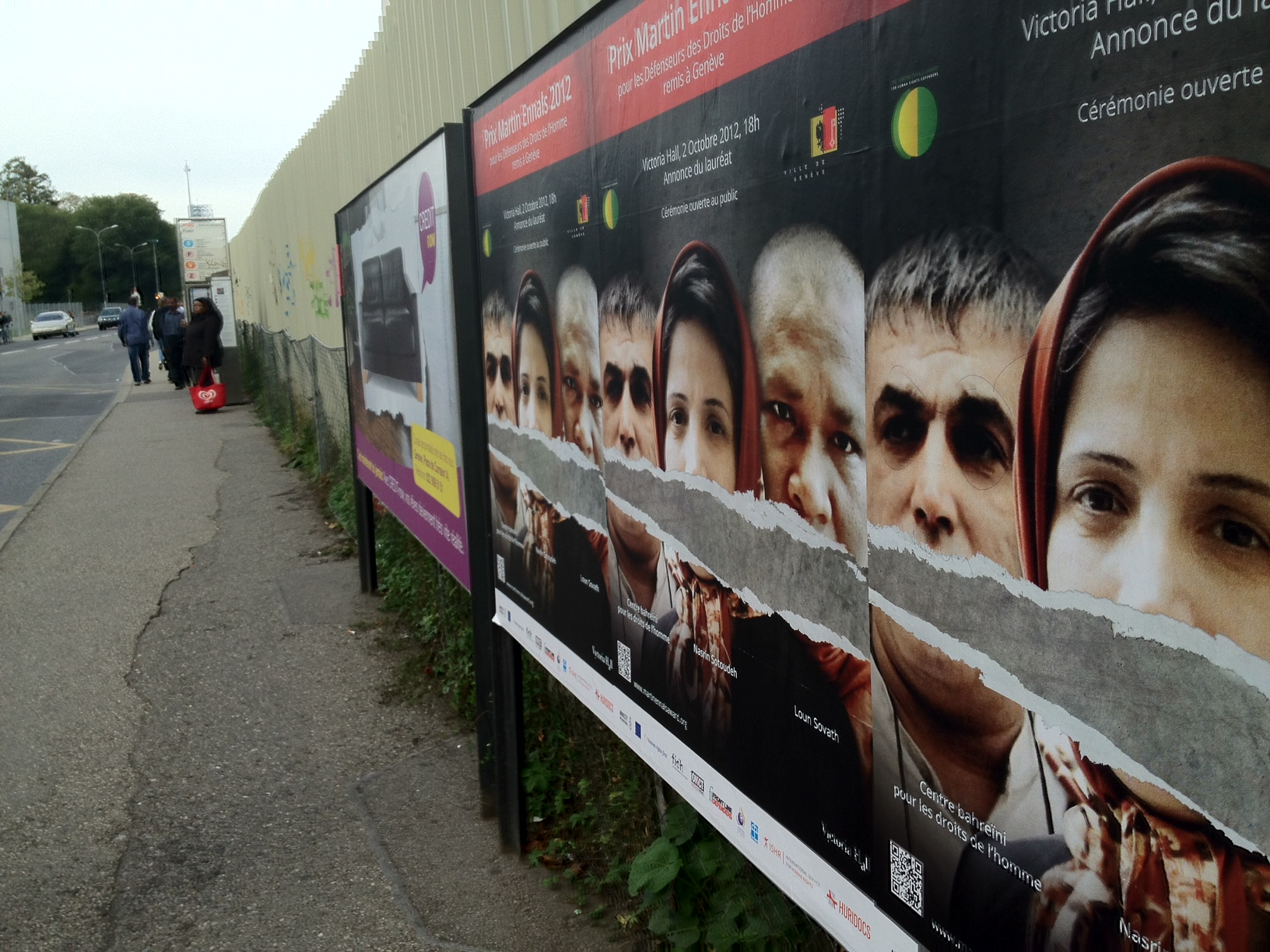
Posters MEA ceremony up in Geneva

September 18, 2012

courtesy Nat Daudrich

Thanks to the partnership with the City of Geneva hundreds of posters are lining the streets of Geneva in anticipation of the ceremony of the Martin Ennals Award for Human Rights Defenders (MEA) on 2 October in the splendid Victoria Hall. The laureate will be announced that evening but all three nominees will be honored and films on their work shown. The nominees are: Luon Sovath (Cambodia), Nasrin Sotoudeh (Iran) and the Bahrain Centre for Human Rights.