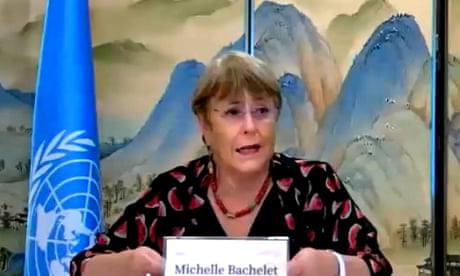
Many have been the reactions to the UN High Commissioner’s visit to China, some even expressing doubt BEFORE the visit took place [see: https://www.aljazeera.com/news/2022/5/24/what-will-the-un-human-rights-commissioner-see-in-xinjiang and https://www.hrw.org/news/2022/05/20/un-rights-chiefs-credibility-stake-china-visit]. The open referred to in the Guardian of 9 June 2022 was signed by academics in wake of Michelle Bachelet’s China visit and demands release of UN report on human rights abuses.
Agnes Callamard, the secretary general of Amnesty International, said on 28 June that Bachelet should condemn human rights violations in Xinjiang, and call on China to release people arbitrarily detained and end systematic attacks on ethnic minorities in the region. “The high commissioner’s visit has been characterized by photo opportunities with senior government officials and manipulation of her statements by Chinese state media, leaving an impression that she has walked straight into a highly predictable propaganda exercise for the Chinese government,“.
Dozens of scholars have accused the UN human rights chief of having ignored or contradicted academic findings on abuses in Xinjiang with her statements on the region. In an open letter published this week, 39 academics from across Europe, the US and Australia called on Michelle Bachelet to release a long-awaited UN report on human rights abuses in China.
The letter, published online, included some academics with whom Bachelet had consulted prior to her visit to Xinjiang. The letter’s signatories expressed gratitude for this, but said they were “deeply disturbed” by her official statement, delivered at a press conference in Guangzhou at the end of her six-day tour. They said her statement “ignored and even contradicted the academic findings that our colleagues, including two signatories to this letter, provided”.
“It is rare that an academic field arrives at the level of consensus that specialists in the study of Xinjiang have reached,” the letter said. “While we disagree on some questions of why Beijing is enacting its atrocities in Xinjiang, we are unanimous in our understanding of what it is that the Chinese state is doing on the ground.”.
Rights organisations and several governments have labelled the campaign a genocide or crime against humanity. Beijing denies all allegations of mistreatment and says its policies are to counter terrorism and religious extremism.
At the end of her visit Bachelet said she had urged the Chinese government to review its counter-terrorism policies in Xinjiang and appealed for information about missing Uyghurs. She was quickly criticised by some rights groups for giving few details or condemnation of China while readily giving long unrelated statements about US issues in response to questions from Chinese state media.
The academics’ letter is among growing criticism of Bachelet for not speaking out more forcefully against Chinese abuses after her visit, as well as a continued failure to release the UN report, which is believed to have been completed in late 2021. On Wednesday dozens of rights groups, predominately national and local chapters of organisations associated with Uyghur and Tibetan campaigns, demanded her resignation. See: http://www.phayul.com/2022/06/09/47195/
The 230 organisations accused Bachelet of having “whitewashed the Chinese government’s human rights atrocities” and having “legitimised Beijing’s attempt to cover up its crimes by using the Chinese government’s false ‘counter-terrorism’ framing”.
“The failed visit by the high commissioner has not only worsened the human rights crisis of those living under the Chinese government’s rule, but also severely compromised the integrity of the Office of the High Commissioner for Human Rights in promoting and protecting human rights globally,” the statement said.
They also decried that she had repeatedly referred to the detention camps in Xinjiang by the Chinese government’s preferred term: “vocational education and training centres”.
All this led to speculation that Mrs Bachelet’s decision not to seek a second term was related to the critcism [see: https://www.theguardian.com/world/2022/jun/13/un-human-rights-chief-michelle-bachelet-no-second-term-china]



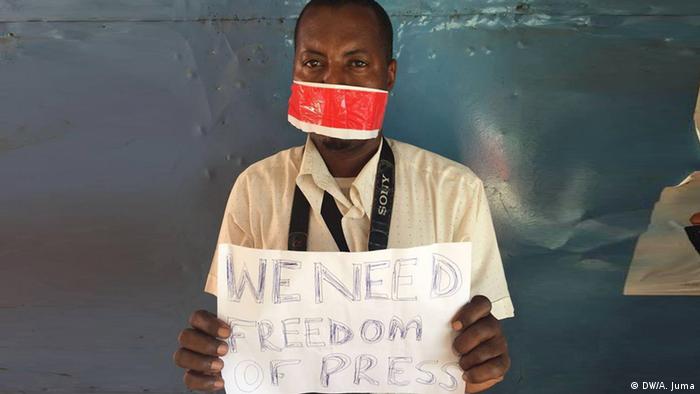
 On the occasion of World Press Day, the Syrian Network for Human Rights (SNHR) issued a report demanding the release of 422 citizen journalists in Syria, most of whom are detained by the Syrian regime, and are now threatened by the COVID-19 pandemic. The report notes that 707 citizen journalists have been killed since March 2011 to date, 78% of them by Syrian Regime forces. The 20-page report shows how the Syrian regime has been well aware of the danger posed by press freedom to its tyrannical rule for decades, abolishing all independent newspapers, and allowing only three official newspapers to be published, which are simply Syrian regime mouthpieces, dedicated to promoting, defending and justifying the regime’s actions. As the report further notes, it’s no exaggeration but simply a statement of fact to say that there is no such thing as a free press under the Syrian regime…..The report distributes the total death toll according to the main parties to the conflict, with the Syrian regime being responsible for the deaths of 551 citizen journalists, including five children, one woman, five foreign journalists, and 47 other citizen journalists due to torture in detention centers, while Russian forces were responsible for the deaths of 22 citizen journalists, and ISIS killed 64, including one child, two women, three foreign journalists, and three under torture. Hay’at Tahrir al Sham also killed eight, including two who died due to torture. Factions of the Armed Opposition were responsible for the deaths of 25 citizen journalists, including one child and three women.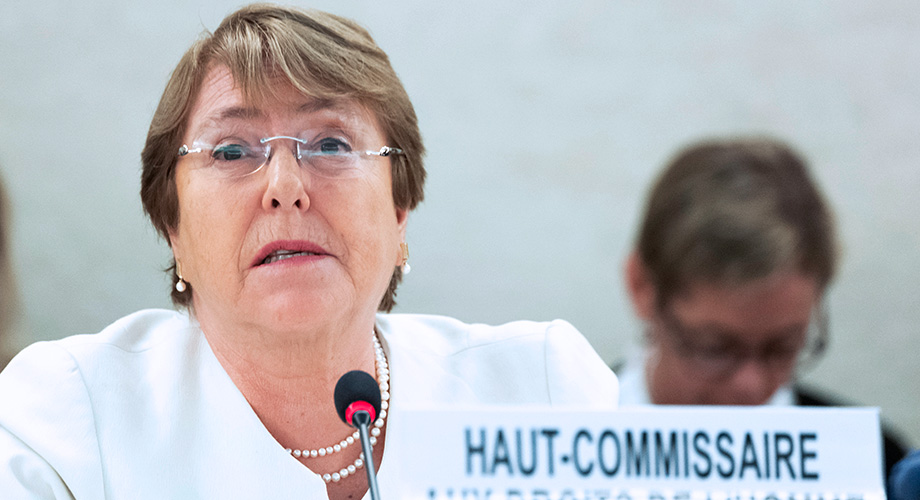
 Hans Thoolen on Human Rights Defenders and their awards