Book Launch: A Practical Anatomy of the Human Rights Council
authored by one of the persons who knows best this institution: Eric Tistounet, Chief of the #HRC Branch at #OHCHR.
This book is the outcome of a six-month #researchfellowship at the Geneva Academy.
Tuesday, October 20, 2020 at 12:30 PM UTC+02
Online and at Villa Moynier (120B Rue de Lausanne, Geneva)
Posts Tagged ‘Geneva’
Book Launch 20 October: A Practical Anatomy of the Human Rights Council
October 10, 2020Former UN High Commissioner for Human Rights, Zeid, speaks freely
June 28, 2020
Imogen Foulkes – who regularly reports from Geneva – wonders whether being UN High Commissioner for Human Rights is it the toughest job at the UN? On 27 June 2020 she published a lengthy interview with Zeid Ra’ad Al Hussein, who was UN High Commissioner for Human Rights 2014-2018.
Zeid, as he likes to be known, is from a privileged background. He is a member of Jordan’s royal family, but never seems to have been comfortable with the term ‘prince’. His career with the UN began, he told me, almost by accident, when he accompanied his brother on a trip to the United States. He ended up in New York, where a friend at the United Nations told him the UN was recruiting for its work during the conflict in former Yugoslavia.….
Almost 20 years later, in 2014, Zeid was approached to become UN High Commissioner for Human Rights. His initial reaction, perhaps based on his experience in former Yugoslavia, and his knowledge that the UN could at times be frustratingly ineffective, was to refuse. But he took a walk around New York’s Central Park to think about it. “That was probably fatal,” he remembers with a laugh. “If I had just said no, that would have been the end of it, but once I had thought about it I couldn’t say no.”
.…His maiden speech to the Geneva-based UN Human Rights Council in September 2014 contained a withering attack on Islamic State, warning that any territory it controlled would be ‘a harsh, mean-spirited house of blood’. He also turned his attention to Europe’s rightwing populist leaders, calling the UK’s Nigel Farage and Geert Wilders of the Netherlands ‘demagogues’. And when Donald Trump was running for office, Zeid described him as a ‘bigot’, and suggested it would be dangerous for him to get elected.
Clearly this is not a strategy designed to win friends in governments, but Zeid is unapologetic. Trying to keep governments on side, whatever their actions, is, he believes, a mistake the UN makes far too often.’…[see: https://humanrightsdefenders.blog/2018/06/15/not-so-diplomatic-diplomat-of-the-year-zeid/]..
Rather than worry what the reactions of government leaders might be to the words and deeds of UN officials, Zeid believes it is governments who should have a wary respect for the UN.
And while we may remember Zeid most for his outspoken comments about Donald Trump, in fact during his four years in office, he and the UN Human Rights Office were hard at work, often quietly behind the scenes, investigating human rights violations around the world. ,(Syria, investigations into the conflict in Ukraine, into the persecution of the Rohingya in Myanmar, …..He described the violence as containing ‘elements of genocide’, and, in a final interview before leaving office, told me Aung San Suu Kyi should have resigned rather than preside over such atrocities.
Nowadays, Zeid is Professor of Law and Human Rights at the University of Pennsylvania, and a member of The Elders [see: https://humanrightsdefenders.blog/2019/01/25/two-human-rights-personalities-join-the-elders/]
But he remains a keen observer of the United Nations,and thinks to key to progress is persuading the permanent members of the UN Security Council to give up their veto when atrocity crimes are taking place. “That would unlock the possibility for collective action… and we can see the Security Council operating in the way it ought to be operating,” he said……
https://www.swissinfo.ch/eng/is-it-the-toughest-job-at-the-un-/45863026
Human Rights Defenders and the 44th session of the UN Human Rights Council
June 25, 2020The ISHR published on 24 June its usual and irreplacable “HRC44 – Key issues on agenda of June 2020 session”

As usual I have lifted out of this the issues that would seem to affect most directly Human Rights Defenders. To stay up-to-date on all issues: follow @ISHRglobal and #HRC44 on Twitter, and look out for its Human Rights Council Monitor.

The UN Human Rights Council (the Council) will hold its 44th regular session at Palais des Nations in Geneva from 30 June to 21 July 2020.
Modalities for participation in HRC44
State delegations not wishing to enter the plenary room physically will be able to deliver their statements by pre-recorded video-message, as provided for under HRC decision 19/119. Similarly, NGOs in consultative status with ECOSOC will be given the opportunity to do the same insofar as interactive dialogues, panels and UPR adoptions are concerned. It won’t be possible to hold “official” side events during the 44th session (online or in-person). Any events happening on the sidelines of the session will be considered independent events and won’t be publicised in the Bulletin of Informal meetings by the Secretariat. Read here the information note by the Secretariat which is updated according to the latest information, and an additional explainer by HRC-net.
Human Rights implications of COVID-19
The High Commissioner will present an oral update on the human rights impact of COVID-19 at the 44th session, as mandated by the presidential statement adopted by the Council in May 2020. The presidential statement also calls on the High Commissioner to produce a report on the impact of the COVID-19 pandemic on the enjoyment of human rights around the world to be presented at the 46th session in March 2021. In addition to their previously mandated reports, some mandateholders will present additional reports to address the impact of COVID-19 as related to their mandate, including the Special rapporteur on freedom of opinion and expression, David Kaye. [for some of my earlier posts on covid and human rights see: https://humanrightsdefenders.blog/tag/covid-19/]
Here are some highlights of the session’s thematic discussions:
Business and human rights
At this session, the Working Group on Business and Human Rights is expected to present reports on their activities over 2019, including a country visit to Honduras and on the theme of anti-corruption and the UN Guiding Principles (UNGPs). They are also meant to present groundbreaking guidance on human rights defenders and the role of business. ISHR expects that such guidance should provide companies with concrete suggestions for how to engage human rights defenders in the development and implementation of their human rights policies. It is important that the guidance explains why this is not simply good practice, but is also aligned with the Guiding Principles’ word and spirit – and thus should be widely mainstreamed for any company committed to the UNGPs. There will tentatively be a resolution presented to renew the mandate of the UN Working Group on Business and Human Rights, as well as to welcome the thematic reporting.
Sexual orientation and gender identity
ISHR joined a coalition of 187 organisations to draw the attention of the Human Rights Council to the situation of LGBTI persons and those who defend their rights in the context of the COVID-19 pandemic outbreak. In line with the call to action signed by 96 human rights experts, organisations working for the protection of the human rights of persons of diverse sexual orientation, gender identity and expression and sex characteristics (SOGIESC) globally urged States and stakeholders to ensure that this public health emergency will neither exacerbate existing prejudices, inequalities or structural barriers, nor lead to increased violence and discrimination [see: https://humanrightsdefenders.blog/2020/06/11/coalition-of-187-global-organisations-issues-joint-statement-re-the-impact-of-covid-19-pandemic-on-lgbti/]
Reprisals
Reports of cases of intimidation and reprisal against those cooperating or seeking to cooperate with the UN not only continue, but grow. Intimidation and reprisals violate the rights of the individuals concerned, they constitute violations of international human rights law, and undermine the UN human rights system. [agains for earlier posts see: https://humanrightsdefenders.blog/tag/reprisals/]
During the 42nd session, the Council adopted a resolution which listed key trends such as the patterns of reprisals, increasing self-censorship, as well as the use of national security arguments and counter-terrorism strategies by States as justification for blocking access to the UN. The resolution acknowledged the specific risks to individuals in vulnerable situations or belonging to marginalised groups, and called on the UN to implement gender-responsive policies to end reprisals. The Council called on States to combat impunity and to report back to it on how they are preventing reprisals, both online and offline.
Item 5 of the Human Rights Council’s agenda provides a key opportunity for States to raise concerns about reprisals, and for governments involved in existing cases to provide an update to the Council on any investigation or action taken toward accountability to be carried out.
Other thematic reports :
At this 44th session, the Council will discuss a range of civil, political, economic, social and cultural rights through dedicated debates with the mandate holders, including interactive dialogues with:
The Working Group on the issue of human rights and transnational corporations and other business enterprises (includes recommendations from 2019 visit to Peru)
The Special Rapporteur on contemporary forms of racism, racial discrimination, xenophobia and related intolerance
The Special Rapporteur on extrajudicial, summary or arbitrary executions
The Special Rapporteur on the rights to freedom of peaceful assembly and of association
The Special Rapporteur on the promotion and protection of the right to freedom of opinion and expression
In addition, the Council will hold dedicated debates on the rights of specific groups including:
- The Special Rapporteur on trafficking in persons, especially women and children
- The Special Rapporteur on the independence of judges and lawyers
- The Special Rapporteur on the human rights of migrants
- The Working Group on discrimination against women and girls
- The Special Rapporteur on the human rights of internally displaced persons
- The Special Rapporteur on violence against women, its causes and consequences
- The Independent Expert on protection against violence and discrimination based on sexual orientation and gender identity
#HRC44 | Country-specific developments
China (Hong Kong and Uyghur regions)
Violations in China, especially those linked to freedom of association, were made even more clear during the government’s efforts to respond to the COVID-19 epidemic. …..States should ensure continued calls for access to UN human rights experts, in line with last year’s joint letter condemning China’s suppression of minorities. Finally, following nearly a year of protests – largely of peaceful civilians – the central government in Beijing launched an initiative to draft and pass National Security Legislation in Hong Kong. This alarming development was foreshadowed by increasing police violence and use of chemical weapons; the arrest and political prosecution of more than a dozen pro-democracy leaders; and further restrictions on the free press. Many activists, and the European Parliament, are calling for UN Secretary-General António Guterres to appoint an envoy, rightly recognising that China’s actions violate international agreements aimed at ensuring peace and security.
United States of America
Last week, the Council held an urgent debate and adopted a resolution in reaction to systemic racism and police violence in the US and elsewhere. The UN Special Rapporteur on contemporary forms of racism and the UN Working Group on Experts on People of African Descent had also voiced their support for an international commission of inquiry. They have urged the Human Rights Council to ensure the following outcomes from the debate: (1) the creation of an international commission of inquiry to investigate systemic racism in law enforcement in the United States; and (2) the creation of a thematic international commission of inquiry to investigate systemic racism in law enforcement globally, with a focus on systemic racism rooted in legacies of colonialism and transatlantic slavery. They stressed that “both measures described above are necessary and cannot be substituted for one another”.
Saudi Arabia
Women human rights defenders (WHRDs) have been in prison for over two years, only because they demanded that women be treated equally as men, and no one has been held accountable for their torture. While the Council has sustained pressure on Saudi Arabia in 2019, it is essential that this scrutiny continues as the situation on the ground has not improved. ISHR calls on all States to jointly call on Saudi Arabia to immediately and unconditionally release the WHRDs and drop the charges against them; and implement the bench-marks set out in the two joint statements delivered by Iceland and Australia in 2019, underlining that should these benchmarks not be met, more formal Council action would follow.
Saudi Arabia is running for Human Rights Council election in October 2020 and hosting the G20 in November 2020. These all provide windows of opportunity to push for the immediate and unconditional release of the women human rights defenders and all those detained for exercising their rights.
Nicaragua
The COVID-19 crisis has not prevented the Nicaraguan government from making further use of repressive methods to continue targeting released political prisoners, human rights defenders, as well as indigenous people and other social groups, and their relatives. In a rapidly-deteriorating human rights situation, the authorities’ dangerous denial and inaction in the face of the pandemic have additionally fueled an alarming health crisis.
It is in this context that Council Members renewed a resolution on Nicaragua this week at the resumed 43rd session of the Human Rights Council. ISHR joined Race and Equality and a number of national and international organisations in urging the Council to ensure strong support for the resolution on the human rights situation in Nicaragua. To ensure the international community is fully informed of the worsening national situation, the resolution requests the High Commissioner to prepare a report and two oral updates, the first of which should be presented at the Council’s 44th session.
Honduras
The Working Group on Business and Human Rights will present the report on its official visit to Honduras (carried out between the 19 and 28 August 2019). …According to the end of mission statement, a significant number of human rights defenders who work for the respect and protection of human rights in the context of business activity have been arbitrarily arrested, intimidated, stigmatised, criminalised, threatened and some killed.
This was particularly evident in reference to those working in the field of extractive and hydro-electric industries. The murder of leading land,environment and indigenous peoples´ rights defender Berta Cáceres, who had been campaigning against the construction of the Agua Zarca dam, is one case cited where impunity is ongoing. Individuals responsible for the killing have been tried and jailed. However, those suspected of planning the crime, including senior management from the company building the dam (DESA) according to the independent mission of experts GAIPE, have not been investigated or prosecuted. [see also: https://humanrightsdefenders.blog/2020/06/10/nina-lakhanis-who-killed-berta-caceres-reviewed/]. Another Special Procedure expert – the Special Rapporteur on the independence of judges and lawyers – will also be presenting a report on its official visit to Honduras in August 2019. After completion of the visit, he called on Honduras to take urgent action to end corruption and guarantee an independent judiciary, stressing that ‘the justice system, as well as the political class’ are being ‘called strongly into question by the citizens’.
Burundi
The Commission of Inquiry on Burundi will present its oral briefing during the 44th session of the HRC. ISHR continues to remain highly concerned about the human rights situation in Burundi and its refusal to cooperate with the Council’s mechanisms.
Egypt
Seven UN experts have expressed concern about the collective and corrosive effects of Egypt’s counter-terrorism laws and practices on the promotion and protection of human rights. They stated that “Despite repeated communications by UN experts over arbitrary detention of individuals, human rights defenders and activists, the Egyptian Government has not changed its laws of practice”. The ‘Terrorism Circuit courts’ in Egypt, are enabling pre-trial detention as a form of punishment including against human rights defenders and journalists, such as Ibrahim Metwally, Mohamed El-Baqer and Esraa Abdel Fattah, Ramy Kamel, Alaa Abdel-Fattah, Patrick Zaky, Ramy Shaat, Eman Al-Helw, Solafa Magdy and Hossam El-Sayed. All of the individuals that the Special Procedures and the High Commissioner have written about since September 2019 are still in pre-trial detention by these courts. Once the terrorism courts resumed after they were suspended due to COVID-19, they renewed their detention retroactively.
The government’s response to the UPR in March 2020 demonstrated its lack of political will to address key concerns raised by States and to engage constructively with the Council. For example, the government refused to acknowledge the systematic and widespread attacks against defenders, the practice of torture and ill-treatment in detention centres, and to receive visits by Special Rapporteurs on torture and human rights defenders. The government claimed that no one is detained for exercising their rights, despite the fact that the UN Working Group on Arbitrary Detention found that arbitrary detention is a systematic problem in Egypt and could constitute a crime against humanity.
ISHR urges States to call on Egypt to immediately and unconditionally release all those detained for exercising their human rights, to stop using pre-trial detention as a punishment, and to take immediate measures to guarantee their rights to contact their families on a regular and continuous basis and to ease sending and receiving letters, food and medical supplies to them.
Philippines
The OHCHR issued its report (A/HRC/44/22) on the human rights situation in the Philippines, drawing on extensive engagement with and information provided by civil society in the country, the region and globally. The report refers to the killing of 208 human rights defenders, journalists and trade unionists, including 30 women, between January 2015 and December 2019. Confirming practices of vilification, criminalisation, restrictions of fundamental rights, as well as the continuing attacks including ‘red-tagging,’ the report notes existing impunity and the failure of domestic mechanisms to ensure accountability. The presentation of this report provides an important opportunity for debate on the key findings, and to consider options for how to advance recommendations to address the government’s violations of human rights overall, and restrictions on human rights defenders in particular.
Other country situations:
The Council will hold an interactive dialogue on the High Commissioner’s annual report on 2 July 2020. The Council will consider reports on and is expected to consider resolutions addressing a range of country situations, in some instances involving the renewal of the relevant expert mandates. These include:
- Interactive Dialogue with the High Commissioner on the human rights situation of Rohingya people
- Enhanced Interactive Dialogue with the High Commissioner on the situation of human rights in the Philippines
- Interactive Dialogue with the SR on the situation of human rights in Eritrea
- Oral update by the High Commissioner on the situation of human rights in Nicaragua
- Interactive Dialogue with the SR on the situation of human rights in Belarus
- Interactive Dialogue with the High Commissioner on the situation of human rights in the Bolivarian Republic of Venezuela
- Interactive Dialogue with the Commission of Inquiry on Burundi
- Interactive Dialogue with the SR on the situation of human rights in Myanmar
- Interactive Dialogue with the Commission of Inquiry on the Syrian Arab Republic
- Interactive Dialogue with the SR on the situation of human rights in the Palestinian Territories occupied since 1967
- Enhanced ID on the oral reports of the Government of the Sudan and OHCHR on progress towards the opening of a country office
- Oral update of the High Commissioner on cooperation with Georgia
Adoption of Universal Periodic Review (UPR) reports
During this session, the Council will adopt the UPR working group reports on Armenia, Grenada, Guinea, Guinea-Bissau, Guyana, Kenya, Kiribati, Kuwait, Kyrgyzstan, Lao People’s Democratic Republic, Lesotho, Spain, Sweden, and Turkey.
ISHR supports human rights defenders in their interaction with the UPR. We publish and submit briefing papers regarding the situation facing human rights defenders in some States under review and advocate for the UPR to be used as a mechanism to support and protect human rights defenders on the ground. This session of the Council will provide an opportunity for Turkey, Kuwait and Guinea to accept recommendations made in relation to human rights defenders, as proposed in ISHR’s briefing papers.
#HRC44 | Council programme, appointments and resolutions
During the organisational meeting for the 44th session held on 12 and 15 June 2020, the President of the Human Rights Council presented the programme of work. It includes five panels of discussion and 81 reports. States also announced at least 17 resolutions.
Appointment of mandate holders
The President of the Human Rights Council has proposed candidates for inter alia the Special Rapporteur on freedom of opinion and expression and the Special Rapporteur on trafficking.
Resolutions to be presented to the Council’s 44th session
At the organisational meeting the following resolutions were announced (States leading the resolution in brackets) especially relevant:
- Elimination of discrimination against women (Colombia, Mexico)
- Human rights situation in Eritrea (Australia, Austria, Belgium, France, Germany, Netherlands) mandate renewal
- Business and human rights (Norway, Russian Federation, Ghana, Argentina) Working Group + Accountability and Remedy project mandate renewals
- Extrajudicial, summary or arbitrary executions (Sweden) mandate renewal
- Human rights and climate change (Bangladesh, Philippines, Viet Nam)
- Independence and impartiality of the judiciary, jurors and assessors, and the independence of lawyers (Hungary, Australia, Botswana, Maldives, Mexico, Thailand) + mandate renewal
- Trafficking in persons, especially women and children (Germany, Argentina, Philippines) + mandate renewal
- Freedom of opinion and expression: access to information (Canada, Namibia, Brazil, Fiji, Netherlands, Sweden)
- Rights of persons with disabilities (Mexico, New Zealand) mandate renewal
- The human rights situation in Belarus (EU)
- The right to peaceful protest (Switzerland, Costa Rica)
Panel discussions
During each Council session, panel discussions are held to provide member States and NGOs with opportunities to hear from subject-matter experts and raise questions. All panel discussions are broadcast live and archived on http://webtv.un.org. Five panel discussions are scheduled for this upcoming session:
- Annual full-day meeting on the rights of the child (two panels, theme: “Realizing the rights of the child through a healthy environment”)
- Annual full-day discussion on the human rights of women
- Panel discussion on the impacts, opportunities and challenges of new and emerging digital technologies with regard to the promotion and protection of human rights; including an oral update of the Advisory Committee on its report on new and emerging digital technologies
- Panel discussion on promoting and protecting the rights of persons with disabilities in the context of climate change
- Annual thematic panel discussion on technical cooperation in the promotion and protection of human rights (theme: “Upholding the human rights of prisoners, including women prisoners and offenders: enhancing technical cooperation and capacity-building in the implementation of the Nelson Mandela Rules and the Bangkok Rules”)
For the latest session see: https://humanrightsdefenders.blog/2020/02/24/human-rights-defenders-issues-on-the-agenda-of-43rd-human-rights-council/
https://www.ishr.ch/news/hrc44-key-issues-agenda-june-2020-session
“HRCnet” explained
June 23, 2020HRCnet was established in 2006 to enhance NGO engagement with the Human Rights Council and to strengthen the Council’s impact and influence on the ground. Since then, HRCnet members working in coordination and solidarity, or as a network as a whole, have contributed significantly to some of the most important initiatives and outputs of the Human Rights Council and its mechanisms.
HRCnet’s membership comprises 16 NGOs and organisations working at the international level and across almost all regions:
Africa
- African Centre for Democracy and Human Rights Studies (The Gambia)
- DefendDefenders (East and Horn of Africa Human Rights Defenders Project) (Uganda)
- Southern African Human Rights Defenders Network (Zimbabwe)
- West African Human Rights Defenders Network (Togo)
Asia-Pacific
- Asian Legal Resource Centre (Hong Kong, China)
- Asian Forum for Human Rights and Development (FORUM ASIA) (Thailand)
- Commonwealth Human Rights Initiative (India)
- Human Rights Law Centre (Australia)
Latin America
- Centro de Estudios Legales y Sociales (CELS) (Argentina)
- Conectas Direitos Humanos (Brazil)
Middle East and North Africa
- Cairo Institute for Human Rights Studies (Egypt)
- Egyptian Initiative for Personal Rights (Egypt)
International
- CIVICUS (South Africa)
- Human Rights Watch (USA)
- International Service for Human Rights (Switzerland)
- Open Society Foundations (USA)
HRCnet members have substantially shaped debates and made influential policy proposals on country situations, as well as thematic and institutional issues. HRCnet works to:
- Safeguard civil society: through securing actions by key actors that have, in a number of cases, assisted in the release of human rights defenders from detention or in alleviating pressure on NGOs.
- Enhance access: by assisting rights holders from the Global South in engaging with the international human rights system and strengthening capacity to influence States, and harness civil society, from all regions.
- Amplify impact: by facilitating coordination and collaboration between international and regional NGOs.
- Promote accountability: seeking the establishment of commissions of inquiry or other independent expert mechanisms to investigate and promote accountability for gross human rights violations.
- Enhance scrutiny: through the mandating of new Special Procedures to monitor human rights and document violations.
- Strengthen protection: through the establishment of new Special Procedures and other mechanisms.
see also: https://humanrightsdefenders.blog/2020/01/01/welcoming-the-new-year-with-civil-society-in-geneva/
For more information, please contact Fabiana Leibl, HRCnet Coordinator, f.leibl@ishr.ch.
15 June: the 44th UN Human Rights Council goes ahead in a special way
June 15, 2020
Lisa Schlein reported on 14 June 2020 that the U.N. Human Rights Council will be faced with many important issues left hanging when its 43rd session was suspended in March because of COVID-19. [see also: https://humanrightsdefenders.blog/2020/02/24/human-rights-defenders-issues-on-the-agenda-of-43rd-human-rights-council/] The 44th session, which opens today, will employ a so-called hybrid approach, with a mix of both real and virtual presentations. To ensure the safety of participants during this time of coronavirus, U.N. officials say social distancing measures will be strictly enforced. Delegations will have a reduced number of representatives attending the session and hundreds of side events by nongovernmental organizations will not take place on U.N. premises.
Presentation of reports and interactive dialogues on human rights issues will involve experts who are either physically present or speaking by video conference. Countries that will come under review include the Democratic Republic of the Congo, Mali, Ukraine, Libya, Afghanistan, and the Central African Republic.
One of the highlights of the weeklong meeting will be an urgent debate on institutionalized racism in the United States underlined by the killing of African American George Floyd while in police custody.
The ISHR states on this topic that it is committed to highlighting how the voices of the families of those killed by police in the U.S., including George Floyd, Breonna Taylor and Michael Brown, and the organisations supporting them are driving the UN to call for action to stop the killings and address deep-seated racism and inequality. This is necessary but not sufficient; we echo the call of the UN independent human rights experts and the Chair of the Committee on the Elimination of Racial Discrimination that ‘this is a time for action and not just talk’.
This is why we’ve joined more than 600 organisations, from the U.S. and around the world, in calling on the UN Human Rights Council to hold a Special Session on the situation of human rights in the U.S.
The international community has a critical role to play in advancing independent, expert inquiry into systemic racism in law enforcement in the U.S., starting with the uprising in Ferguson, Missouri, and the concerns of excessive use of force against protestors and journalists since George Floyd’s murder.
Geneva director of Human Rights Watch John Fisher calls this a moment of reckoning for the United States. He said the event will likely be used by some countries to advance their own agendas. “We are also very concerned that China is seeking to exploit this moment of global chaos and the disarray within the U.S. to crack down on rights and freedoms in Hong Kong … And, we are calling upon states to take this moment to bring more attention to Hong Kong, as I mentioned. We feel this is a time when China will be watching the international response, and, if that response is muted, will feel emboldened to go even further down the track,” he said.
At the end of the week, the council will take action on decisions and the adoption of more than 40 resolutions. They include recommendations on improving human rights in countries such as Libya, Iran, Nicaragua, South Sudan, and Myanmar.
https://www.ishr.ch/news/ishr-stands-solidarity-all-those-calling-racial-justice-and-radical-reform
https://www.voanews.com/europe/racism-conflict-country-violations-top-un-rights-council-agenda
https://www.ungeneva.org/en/news-media/press/taxonomy/term/175/60215/human-rights-council-holds-urgent-debate-current-racially
https://www.nytimes.com/aponline/2020/06/17/world/asia/ap-human-rights-us-racism.html
The Flags of the Geneva Human Rights Platform Fly on the Mont-Blanc Bridge
June 3, 2020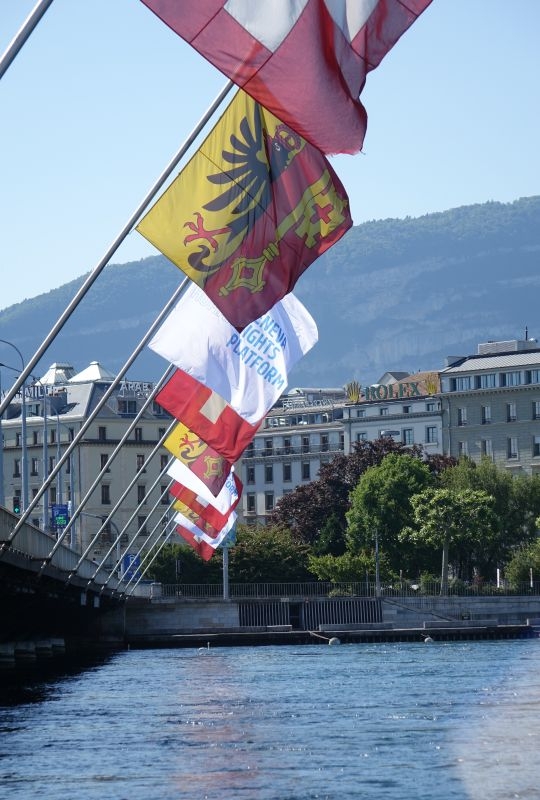
From today until Sunday 7 June 2020, flags with the Geneva Human Rights Platform (GHRP) logo will be flying on the Mont-Blanc Bridge. This should have coincided with the GHRP annual conference – an annual event open to all human rights actors in and outside Geneva that addresses current issues and challenges related to the work of Geneva-based human rights mechanisms. However, due to the COVID-19 situation, we postponed the conference to 15 October 2020.
‘As the space on the bridge was already booked in October, we decided to keep this slot to raise awareness about the platform in Geneva and beyond. This is also the occasion to announce the new date of the 2020 annual conference that will discuss the connectivity between the Geneva-based human rights system and regional human rights mechanisms’ explains Felix Kirchmeier, Executive Director of the Geneva Human Rights Platform..
In memoriam Leandro Despouy: Argentinean human rights defender at the global level
March 16, 2020 When a good friend and soul mate dies, it is sometimes difficult to write something meaningful. So it was when I learned that Argentine human rights lawyer Leandro Despouy – whom I have known since 1976 – had died on 18 December 2019 in Buenos Aires, after a two-year battle with cancer. He was born on 4 April 1947 in San Luis.
The Argentine media paid quite a bit of attention to his passing but (understandably?) focused on his place in Argentinean politics (in the Radical Party) and his institutional role as Head of the Auditoría General de la Nación from 2002 – 2016. But Leandro Despouy was of great importance to the international human rights movement as it developed in the last quarter of the 20th century. I hope that this ‘obituary’ does some justice:
He started as a lawyer and university teacher before state terrorism (in the form of the far-right death squad Alianza Anticomunista Argentina, known as Triple A) pushed him into exile in 1975 to France. He stayed a refugee until 1983 when he was able to return to his beloved country where he was appointed Extraordinary and Plenipotentiary Ambassador for Human Rights by President Alfonsin. More about what he was able to do in that capacity follows below but I wanted to give special attention how remarkably active Leandro was during his exile. He did not succumb to porosity and made the best of his chances. Always upbeat and entrepreneurial he had great social skills.
Friends helped him with a part-time job (between 1975-1977) as professor of Political Economy at the Université de Paris VIII. In order to make ends meet he accepted many different part-time jobs, including (his favorite!) driving around fashion models and their clothes. The models were quickly enamored of this elegant Latino and sometimes donated suits making him the best dressed refugee in Paris. His own work situation improved when he became one of the assistants of well-known parliamentarian Nicole Questiaux for the 13th arrondissement in Paris and as from July 1981 for her replacement, Louis Moulinet.
Interestingly enough his first activist attention while in exile went to the repressive situation in Uruguay (he told me it was easier to keep politics out of it than in the case of his own country) and it was in that context that we set up SIJAU (Secretariat Internationale des Juristes pour l’Amnestie en Uruguay). Leandro – with the help of French lawyers like Joinet and Weil – managed to organise in December 1978 in the French Senate (!) an international conference that helped the opposition to unite and put pressure on Uruguay.
He undertook a similar effort on Paraguay with the creation of SIJADEP (Secretariat Internationale des Juristes pour l’Amnestie et Democratie en Paraguay).
Leandro was regularly in Geneva to follow up with the UN (and sleeping on my couch) and when the first UN mandate for disappearances was created he was briefly hired as a consultant by the then Director Theo van Boven. The Argentine Ambassador got wind of it and with ‘terrorist’ accusations this had to be terminated quickly. In the summer of 1982 he did a short stint as Professor of Human Rights at the Centre International des Droits de l`Homme, in Strasburg, France.
Then comes the return to Argentina with the slow process of normalisation and the question of how to deal with the crimes of the recent past. From 1984-1989 he is General Director of Human Rights at the Ministry for Foreign Affaires and with it comes a series of opportunities at the international level. Here some examples:
President of the First International Conference of States Parties on the Convention against Torture and other Cruel, Inhuman or Degrading Treatment or Punishment (1987).
In 1983 Leandro becomes a Member of the UN Sub-Commission on the Prevention of Discrimination and Protection of Minorities (later reduced to an advisory body for the new Human Rights Council). He plays a very active role, as Chairman and as:
- Special Rapporteur of the Subcommission on disabled persons and human rights to study the connection between human rights, violations of fundamental human freedoms and disability which resulted in his final report, “Human Rights and Disabled Persons.” Which was adopted by ECOSOC resolution 1992/48 of March 1992
- Special Rapporteur of the same on extreme poverty and human rights. Interim report adopted on 10 June 1994, E/CN.4/Sub.2/1994/19
In 2000 Leandro heads the Argentine Delegation at the 57th Session of the United Nations Commission on Human Rights and from March 2001 to March 2002 he is President of this Commission (currently the United Nations Human Rights Council).
In 2002 in Argentina he becomes the President of the Auditor General’s office (a function reserved for a member of the opposition under the Argentine constitution) but continues to accept assignments of an international nature:
In 2003: he is appointed as Special Rapporteur on the Independence of Judges and Lawyers, United Nations Human Rights Council (until 2009). In that capacity he and four other special rapporteurs asked in 2005 to be admitted to Guantanamo Bay to visit the prisoners held at the US naval base. He and one other was refused permission (see: https://newsarchive.ohchr.org/EN/NewsEvents/Pages/DisplayNews.aspx?NewsID=608&LangID=E}
He remained a sought-after speaker at courses and conferences, such as those organized by the International Institute of Humanitarian Law of San Remo, the Committee of the International Red Cross, FLACSO Argentina ,Harvard University, the European Society of International Law, and the Université de la Sorbonne Nouvelle.
In 1993 he becomes the Assistant Special Representative of the Secretary Generals of the United Nations and Organization of American States, in the context of the UN and OAS joint mission to Haiti. Between 1999 and 2006 he regularly carried out Expert tasks mandated by a variety of UN agencies for short jobs in e.g.: Brazil, Paraguay, Equatorial Guinea, Colombia, Russia and Ecuador.
This is of course not a complete biography and any additional information would be most welcome. Leandro certainly deserves a lot more recognition at the international level. When Ben Whitaker died in 2014. Leandro was one of the first to honor his contribution [see: https://humanrightsdefenders.blog/2014/07/16/ben-whitaker-died-one-of-the-early-human-rights-defenders-at-the-international-scene/]. I hope this does the same for Leandro.
International Women’s Day 2020: Joint Statement at 43rd session of UN Human Rights Council
March 9, 2020Many organisations, especially NGOs, used the occasion of International Women’s Day 2020 to highlight work carried out by women human rights defenders. See also: https://humanrightsdefenders.blog/2020/02/27/women-human-rights-defenders-in-focus-at-43rd-human-rights-council/. Here an example of how 18 NGOs came together for a Joint Statement during the 43rd session of the UN Human Rights Council
The speaker was: Paola Salwan Daher, Center for Reproductive Rights:
UN cancels all human rights side events because of Covid-19
March 4, 2020Late last week, Swiss authorities took the unprecedented step of prohibiting large public events in response to a growing number of coronavirus cases. As a consequence, events such as the International Motor Show, which attracts a half-million people and Swiss watch exhibits, which draw enthusiastic crowds of thousands of people, have been canceled. See also: https://humanrightsdefenders.blog/2020/03/03/another-covid-19-casualty-the-2020-human-rights-film-festival-of-geneva-fifdh/
Human Rights spokesman Rolando Gomez says 200 side events will be canceled until the end of this council session on March 20. He says that is an unfortunate, but responsible measure to take in order to prevent the coronavirus from spreading. He tells VOA the meetings generally attract on average 4,000 to 6,000 participants during the course of the session. He says those side events are very important.
“I should point out just as a technical note they are not official council side events,” said Gomez. “They take place in parallel and they are important as they inform the discussions in the formal proceedings. Of course, those lobbying efforts will continue unabated, which are important.” Side events are organized by non-governmental organizations and states. The Office of the U.N. High Commissioner for Human Rights also has spent a lot of time and effort in organizing several gatherings aimed at exploring particular aspects of human rights that demand a more comprehensive hearing and analysis. They will not be held.
Changes in the governance of the Martin Ennals Foundation
February 23, 2020
Martin Ennals Award for Human Rights Defenders
Having just reported on the laureate of the Martin Ennals Award 2020 [ https://humanrightsdefenders.blog/2020/02/22/huda-al-sarari-is-the-laureate-of-the-2020-martin-ennals-award-for-human-rights-defenders/], I should add that the Martin Ennals Foundation has undergone several changes in its managment. A new Chairman, Philippe Currat, a well-known Geneva lawyer (see: https://www.martinennalsaward.org/boards/philippe-currat/), takes over from Dick Oosting (Oosting is a former Amnesty International staff member who worked closely with Martin Ennals himself as deputy SG). At the same time a new vice-chair was appointed: Barbara Lochbihler, a prominent human rights expert from Germany who last year completed ten years in the European Parliament and is now a member of the UN Committee on Enforced Disappearances. Since last summer, Isabel de Sola is the new director (see: https://www.martinennalsaward.org/boards/isabel-de-sola/). Together with a new team at the Ville de Genève, good progress was made to redesign the award ceremony of 19 February. This year’s finalists are offered so-called ‘residencies’ to benefit from their presence in Geneva and Switzerland as well as to be able to share their experiences more widely. First steps were taken to open up local educational activities. Communications have been significantly upgraded.
Dick Oosting said that the hand-over marks a broader process of change in the way that the foundation operates. In sharpened its strategy in several ways: by developing activities and profile in Geneva; by exploring the scope for more sustained work with past laureates and finalists; by working more closely with the jury organizations; and by strengthening overall communications.
Philippe Curat was present at the press conference of this year and stated: “The Martin Ennals Foundation is particularly proud to honour and support three resilient women human rights defenders this year, our laureate Huda Al-Sarari, as well as our two finalists Sizani Ngubane and Norma Librada Ledezma for their achievements. We hope that the award will shed a light on their achievements, and strengthen protection mechanisms around them”.

