Posts Tagged ‘Front Line (NGO)’

Syrian woman human rights defender Hiba Ezzideen Al-Hajji threatened

August 10, 2023

On 26 July 2023 Front Line Defenders stated that it stands in solidarity with Hiba Ezzideen Al-Hajji, and calls on the de facto authorities in Idlib to put an end to the targeting of the Syrian woman human rights defender.

Despite the efforts of human rights organisations, women human rights defenders in Syria continue to face many forms of restrictions and threats. In this context, Hiba Ezzideen Al-Hajji, a woman human rights defender and CEO of the feminist organisation Equity and Empowerment, has recently been targeted by a malicious online defamation campaign because of her work on women’s rights and democracy in Syria. On 4 July 2023, Hiba Ezzideen Al-Hajji received death threats from unknown individuals who disagreed with her advocacy efforts for “equality and democracy,” asserting that such work went against the teachings of Islam. Subsequently, the Facebook page of her organisation Equity and Empowerment was overwhelmed with hateful comments and threats, further escalating the distressing situation.

Those behind the defamation campaign are believed to be Jihadists operating in Idlib, northwestern Syria, where the woman human rights defender conducts her human rights work. The woman human rights defender has previously reported that these radical groups were responsible for similar threats, indicating a pattern of persecution and harassment against her and other human rights defenders in the area.

The attacks have also manifested in offline harm. On 18 July 2023, a family member of the woman human rights defender was insulted by a stranger who threatened them saying that if Hiba Ezzideen Al-Hajji does not stop her work, one of her family members will be killed. The defamatory narrative against Hiba Ezzideen Al-Hajji aims at inciting further hatred and violence against her, all in an effort to undermine her human rights work.

On 21 July 2023, an imam in the countryside outside of Idlib gave a sermon which mentioned the woman human rights defender Hiba Ezzideen Al-Hajji and the organisation Equity and Empowerment. The sermon called for the organisation to be closed, incorrectly mentioning its links to western states as a means of discrediting its work.

On 2 March 2020, Ahmed Shaheed, the UN Special Rapporteur on freedom of religion or belief declared that they “firmly reject any claim that religious beliefs can be invoked as a legitimate ‘justification’ for violence or discrimination against women or girls.

The campaign has taken place over various online platforms, including WhatsApp, Facebook, Twitter and Telegram, using fake and verified accounts to post derogatory fake images of the human rights defender along with hateful captions. In addition to this, she has been subjected to death threats, harassment, and incitements against her and her family, along with doxing, deep fakes, threats of rape and sexual slurs.

Front Line Defenders believes that the defamation campaign is directly related to Hiba Ezzideen Al-Hajji’s work in defence of human rights, in particular her work towards the promotion of women’s rights in Syria. Front Line Defenders strongly condemns the defamation campaign against the woman human rights defender Hiba Ezzideen Al-Hajji. It calls on the de facto authorities in Idlib to put an end to the targeting of the woman human rights defender, including the defamation campaign, and demands that Hiba Ezzideen Al-Hajji’s safety and well-being be protected as well as that of all women human rights defenders facing similar threats and attacks in the country.

https://www.frontlinedefenders.org/en/statement-report/defamation-campaign-against-syrian-woman-human-rights-defender-hiba-ezzideen-al

Algerian human rights defenders Slimane Bouhafs and Kamira Nait Sid 3-year sentence confirmed

July 20, 2023

On 18 July 2023 Front Line Defenders reported that on 4 July, a court of appeal in Algiers confirmed the three-year prison sentence of human rights defenders Slimane Bouhafs and Kamira Nait Sid, in addition to confirming the fine of DZD 100,000 (approx. EUR 660). The charges against both human rights defenders include “belonging to a terrorist organisation”; “receiving funds from abroad for the purpose of political propaganda”; “hate speech and discrimination”; “use of technology to spread false information”; and “conspiracy”, among others.

Slimane Bouhafs is a human rights defender advocating for freedom of expression and democracy in Algeria through social media. He is the Chairman of the St. Augustine Coordination of Christians in Algeria which defends minority rights and freedom of religion in the country. Kamira Nait Sid is a woman human rights defender and co-president of the World Amazigh Congress (WAC), an international NGO defending the rights of the Amazigh people. The mission of the WAC is to ensure the defence and promotion of political, economic, social, cultural, historical and civil rights of the Amazigh people.

The human rights defender Slimane Bouhafs, who was granted refugee status in Tunisia before being illegally transferred back to Algeria, received the same three-year prison sentence as the one previously handed down at the first instance. Meanwhile, the woman human rights defender Kamira Nait Sid received a three-year prison sentence, which was a two-year reduction of the original sentence handed down by the court of first instance.

Both Slimane Bouhafs and Kamira Nait Sid reject and deny all the charges against them and maintain that they have been targeted because of their peaceful human rights work and advocacy for freedom of expression and belief. The defence counsel, which represented both human rights defenders, reportedly emphasised the lack of due process and fair trial guarantees during the trial and the appeal processes, including a lack of evidence supporting the charges.

In December 2022, Slimane Bouhafs and Kamira Nait Sid were sentenced to three and five years respectively by the court of first instance mainly on the basis of an alleged association with the Movement for the Autonomy of Kabylie (MAK), classified as a terrorist group by the Algerian authorities. The human rights defenders continue to deny any involvement with the MAK group.

The two human rights defenders have been arbitrarily detained since the summer of 2021. On 25 August 2021, the human rights defender Slimane Bouhafs was abducted, subjected to ill-treatment and forcibly returned to Algeria from Tunisia, where he had been granted refugee status, in a gross violation of international law. On 24 August 2021, the woman human rights defender Kamira Nait Sid was also abducted by Algerian security forces from her home in Draa-Ben-Kheddaas in northern Algeria and detained at an unknown location. On 1 September 2021, the two human rights defenders appeared before an investigating judge in an Algerian court to be charged with several terrorism-related accusations based on an alleged connection with the MAK.

Front Line Defenders condemns the confirmation of the sentence of human rights defenders Slimane Bouhafs and Kamira Nait Sid and calls on the authorities of Algeria to immediately release them and quash their conviction as it believes that it is solely motivated by their legitimate and peaceful work in the defence of human rights. It urges the authorities to guarantee the physical and psychological security and integrity of the human rights defenders while in detention.

Front Line Defenders also calls on the authorities to cease targeting all human rights defenders in Algeria and guarantee in all circumstances that they are able to carry out their legitimate human rights activities without fear of reprisals and free of all restrictions including judicial harassment.

https://www.frontlinedefenders.org/en/case/court-appeal-confirms-three-year-prison-sentence-human-rights-defenders-slimane-bouhafs-and

Ukrainian woman human rights defender and writer Viktoria Amelina killed in Russian missile strike on Kramatorsk

July 20, 2023

On 1 July 2023, woman human rights defender and author Viktoria Amelina died in hospital in Dnipro, Ukraine after sustaining fatal injuries during the Russian missile attack on Kramatorsk, Ukraine on 27 June 2023. PEN Ukraine reported the death of the woman human rights defender on 3 July 2023 with the consent of her relatives. Viktoria is survived by her husband and 10-year old son.

Viktoria Amelina was a woman human rights defender and writer. In June 2022, after the beginning of Russia’s full-scale invasion of Ukraine on 24 February 2022, she joined the Ukrainian human rights organisation Truth Hounds to document war crimes. She had been documenting apparent Russian war crimes in the liberated territories of eastern, southern and northern Ukraine, and particularly the village of Kapytolivka in Kharkiv region. During one of her missions, Viktoria Amelina discovered a diary of Volodymyr Vakulenko, a Ukrainian writer who was abducted and killed by the Russian military. She was also working on a non-fiction project “War and Justice Diary: Looking at Women Looking at War”, a research project about the Ukrainian women human rights defenders documenting and investigating war crimes committed by the Russian military. Before joining Truth Hounds, Viktoria Amelina actively campaigned for the liberation of Oleh Sentsov, a Ukrainian film director from Crimea who was a political prisoner of the Russian authorities from 2014 to 2019.

Viktoria Amelina won the Joseph Conrad Literature Prize for her prose works, including the novels Dom’s Dream Kingdom and Fall Syndrome, and was a finalist for the European Union Prize for Literature. In 2021, she founded the New York book festival in the Donetsk region of Ukraine, where New York refers to a village in Donetsk that is very close to the military frontline.

On 27 June 2023, the woman human rights defender Viktoria Amelina was in Kramatorsk, in the Donetsk region of Ukraine, accompanying a delegation of Colombian writers and journalists who represented #AguantaUcrania, a group that raises awareness about Russia’s full-scale invasion of Ukraine in Latin America. Before coming to Kramatorsk, the group took part in a prominent Ukraninan literary fair “Book Arsenal.” They all arrived to Kramatorsk to document the situation in Ukrainian cities in the Donetsk region to support the visibility work of #AguantaUcrania.

On the evening of 27 June 2023, the group was having dinner in the Ria Lounge restaurant in Kramatorsk, when a Russian missile hit the building in which the restaurant was located. This missile killed 13 civilians and injured a further 60. As a result of the missile strike, Viktoria Amelina suffered a severe head injury and was hospitalised in Kramatorsk, before being transferred to the hospital in Dnipro. The woman human rights defender died in the hospital in Dnipro three days later, on 1 June 2023.

Truth Hounds and PEN Ukraine reported that, in the aftermath of the attack, Russian state propaganda media falsely claimed that the target of the missile was the temporary headquarters of one of the Ukrainian Armed Forces brigades. In reality, the Ria Lounge restaurant in Kramatorsk was one of the most popular restaurants in the city and was frequented by Ukrainian and international human rights and civil society actors, humanitarian volunteers, and media and film crews. Truth Hounds and PEN Ukraine’s report stated that there were no military objectives that the Russian military could have have been targetting with a missile attack that day. Together, the human rights organisations made a public statement concerning the strike, stating that the precision of the Iskander missiles leads them to believe that the missile strike was an attack against the civilian population.

In light of the death of the woman human rights defender Viktoria Amelina, Front Line Defenders once again reiterates its grave concern about the killings of Ukrainian human rights defenders, civil society activists, humanitarian volunteers and other community leaders as a result of Russia’s full-scale invasion in Ukraine. According to Front Line Defenders’ HRD Memorial, at least 50 human rights defenders were killed in Ukraine in 2022, including humanitarian actors and human rights journalists, as a result of the activities of the Russian military forces.

Front Line Defenders strongly condemns the killing of the woman human rights defender Viktoria Amelina and urges the authorities of the Russian Federation to cease targeting civilian objects in accordance with Russia’s international humanitarian and human rights law obligations, recalling that the deliberate targeting of civilians is prohibited under the Fourth Geneva Convention. The attack on the Ria Lounge restaurant may qualify as a war crime pursuant to Article 8(2)(b)(ii) of the Rome Statute of the International Criminal Court (ICC) – “intentionally directing attacks against civilian objects.” Alternatively, such an attack may be qualified under Article 8(2)(b)(i) – “intentionally directing attacks against the civilian population”; or Article 8(2)(b)(iii) – “intentionally directing attacks against personnel, installations, material, units or vehicles involved in a humanitarian assistance […] mission.” Front Line Defenders calls for an impartial and independent investigation into the killing of human rights defender Viktoria Amelina while she was on mission conducting her human rights work. All those involved in the commission of this crime must be brought to justice.

https://www.frontlinedefenders.org/en/statement-report/ukrainian-woman-human-rights-defender-and-writer-viktoria-amelina-killed-russian

Journalist Elena Milashina and lawyer Alexander Nemov severely attacked in Chechnya

July 10, 2023

Rights defenders are sure of Chechen law enforcers’ involvement in attack on Milashina says Roman Kuzhev, СK correspondent

The attack on the journalist Elena Milashina and the advocate Alexander Nemov has to do with Milashina’s publications in which she wrote about human rights violations in Chechnya, human rights defenders have noted.

The “Caucasian Knot” reported that on July 4, Elena Milashina, a journalist of the “Novaya Gazeta” outlet, and Alexander Nemov, an advocate for Zarema Musaeva, were attacked in Chechnya. They were beaten up by masked gunmen when they were on the way from the airport to Grozny, where the verdict in the case of Zarema Musaeva was to be announced. The head of Chechnya, Ramzan Kadyrov, has promised to “sort things out”; and Akhmed Dudaev, the head of the Chechen Press Ministry, have pointed out that “the style of Western intelligence services” is seen in the attack.

Svetlana Gannushkina, the head of the “Civic Assistance” Committee, is sure that the attack had to do with Milashina’s human rights activities. “They were waiting for her there to beat her for her so much writing on human rights issues, conducts inquiries and shows the real Chechnya,” Ms Gannushkina has stated.

According to her version, the attackers are definitely law enforcers. Gannushkina* has also added that the attackers would not be identified and punished. Oyub Titiev, a human rights defender, is also sure that Milashina was the attackers’ target. “Only law enforcers can beat a woman so openly and with such cruelty,” he has stated.

Ruslan Kutaev, the president of the Assembly of Caucasian Nations, is sure that Milashina would have been attacked at any moment while in Grozny.

A criminal case on the attack on Milashina and Nemov can be initiated under several articles, said Galina Tarasova, a lawyer. According to her story, the case should have been transferred to the central office of the Investigating Committee of the Russian Federation (ICRF).

This article was originally published on the Russian page of 24/7 Internet agency ‘Caucasian Knot’ on July 5, 2023 at 08:07 pm MSK. https://eng.kavkaz-uzel.eu/articles/62817

Many other human rights groups reported on this:

https://www.frontlinedefenders.org/en/case/human-rights-defenders-aleksandr-nemov-and-elena-milashina-attacked-and-severely-beaten-0

https://www.democracynow.org/2023/7/6/elena_milashina_attack

https://www.hrw.org/news/2023/07/04/journalist-and-human-rights-lawyer-viciously-attacked-chechnya

https://www.ohchr.org/en/press-releases/2023/07/russia-un-experts-dismayed-violent-attack-against-journalist-yelena

Researcher puts bomb under ‘traditional’ protection of human rights defenders

July 7, 2023

On 6 July 2023 Janika Spannagel in Open Global Rights comes with a study of great importance to the work for human rights defenders. The researcher states that “focusing only on defenders’ physical integrity risks undermining the very idea of supporting agents of human rights change” and that there is a need to Rethink campaigns on human rights defenders

Spannnagel’s work featured in this blog before [see: https://humanrightsdefenders.blog/tag/janika-spannagel/] but this work questions more directly the core of HRD protection.

Instead of summarising I will provide large quotes:

,,,,The theory of change put forward by actors, including Front Line Defenders, International Service for Human Rights, and many others, claims that by protecting local human rights activists, international campaigns can support them in their work to advance human rights protection on the ground. This assumption appears plausible and aligns with prominent accounts in academic human rights literature, where domestic activists’ protection from repression is seen as a way to open spaces for them to challenge the regime and enact change.

That said, empirical evidence from UN casework and the experience of Tunisian defenders shows that this promise has not been fulfilled when it comes to human rights defenders in authoritarian regimes, as I show in my recent book. There, I argue that, while international attention can have important protective benefits, it does little to support individual human rights defenders as agents of change in repressive contexts. [Emphasis added]

The reason for this is that international casework on defenders, including urgent action–like campaigns or UN communications, maintain the traditional focus on physical integrity rights that has guided the long-standing casework on political imprisonment, torture, or enforced disappearances. In doing so, it overlooks the many administrative, discursive, and covert forms of repression that typically bypass international scrutiny more broadly but that often very effectively disrupt and thwart defenders’ work toward change.

The analysis of over 12,000 individual cases of human rights activists taken up by the UN special rapporteur on human rights defenders between 2000 and 2016 reveals that, in almost three-quarters of them, at least one of the violations described fell within the category of physical integrity violations. Detention cases alone made up 56% of all cases raised during that period. In contrast, only 4% of the cases dealt exclusively with softer types of repression, such as travel bans, bureaucratic issues, job dismissals, surveillance, or defamation.

This distribution far from represents the everyday experience of human rights defenders in authoritarian states—instead, it is reflective of a humanitarian instinct in human rights casework to privilege cases that are considered most severe. One could argue that UN communications, and perhaps attention-based campaigning more broadly, are inherently humanitarian, not transformative instruments. But one should ask: What, then, is the purpose of focusing on human rights defenders, as opposed to any victim of repression? [Emphasis added]

The priority given to physical integrity violations has two important adverse consequences. First, we can see that the data profoundly shape our understanding of what human rights defenders are struggling with. For example, on the basis of such data a CIVICUS report claims that in order to repress civic space, states resort “most often” to detention of activists, attacks against journalists, and excessive use of force against protesters. The human rights community’s own focus on violent repression thus paradoxically misleads us to believe that this is where most attention is needed.

Secondly, this focus reinforces a protection gap for violations that fall outside of the conventional notion of state repression as physically harmful and as undeniably politically motivated. Research on repression highlights that authoritarian states engage in repressive substitution, where they replace highly scrutinized coercive tactics—typically harder and overt types of repression—with softer and more covert measures. The case of Tunisia under Ben Ali aptly illustrates the strong impact of such tactics on defenders’ ability to carry out meaningful work.

When analyzing the further development of cases taken up by the UN, I also found that, while some positive effects of the UN’s attention could be identified for most of them, many did not see an actual improvement relative to the reported violations over the course of the next year; where they did, it was mostly an easing of harder repression. Ultimately, there is a real risk that governments continue to use hard repression to increase their bargaining power and then pass off a release from prison as a costly concession, while in reality imposing softer but equally effective measures against the activist in question.

With this problem in mind, what could be done differently? Casework that follows a transformative logic should not seek to maximize the reduction of physical harm—the humanitarian logic—but should define protection needs in terms of safeguarding a defender’s ability to do effective human rights work. 

Those engaging in casework and campaigns on human rights defenders should actively revisit their priorities in terms of the violations they tend to address. Far too often, softer repression remains unreported, unnoticed, and not acted upon, which effectively creates a twilight zone in which authoritarian states can comfortably stifle opposition voices without risking much pushback. We owe it to the countless number of human rights activists around the world to ensure that the label of “human rights defender” does not merely serve to laud their heroism and excite donors and the media, but that it is dedicated to fulfilling its promise of human rights change.

https://www.openglobalrights.org/rethinking-campaigns-human-rights-defenders/index.cfm

For the more traditional approach, see e.g. https://www.ipsnews.net/2023/07/recognising-human-rights-defenders-remarkable-agents-positive-change/
RFK Human Rights calls to strengthen protection mechanisms for environmental defenders on International Earth Day

April 30, 2023

April 22, 2023

Being an environmental human rights defender is one of the most dangerous jobs in the world. Every day, government authorities, companies and other non-state actors seek to silence environmental defenders on the frontlines of the global climate and environmental movement through unwarranted persecution, harassment, detention and even murder. As we commemorate International Earth Day on 22 April, an annual celebration honouring those who fight for a clean environment, RFK Human Rights is calling for the international community and national authorities to redouble efforts to strengthen and fortify protection mechanisms for environmental defenders.

According to Front Line Defenders, land, indigenous peoples’ and environmental rights defenders were the most targeted human rights defender (HRD) sector in 2022. Representatives of national governments, private companies, militias and other non-state actors killed 194 land, environmental and indigenous defenders in 2022 accounting for 48 percent of all murdered defenders. Environmental defenders also face routine arbitrary arrest and detention, criminalization, physical abuse, death threats and other forms of repression. Across the world, sparse and tepid investigations into killings of environmental defenders have led to endemic levels of impunity and limited prosecutions. See: https://humanrightsdefenders.blog/2023/04/04/front-line-defenders-just-published-its-global-analysis-2022-new-record-of-over-400-killings-in-one-year/

As part of our work to protect civic space by defending fundamental freedoms, Robert F. Kennedy Human Rights regularly works to ensure that environmental defenders have ready access to protection and accountability mechanisms. Through our strategic litigation programs, we collaborate with local partners to confront these systematic abuses through active litigation at the Inter-American Commission on Human Rights and at the United Nations. Under the auspices of our Speak Truth to Power campaign, we continue to provide human rights education programs that combine storytelling and interactive learning to provide the next generation of environmental defenders with the tools they will need to create change.

Together with various coalitions we constantly bring attention to the critical and invaluable work for environmental defenders. Just last week, RFK Human Rights joined dozens of civil society groups from across the globe to raise awareness about the forced disappearance of Mexican environmental defenders Ricardo Arturo Lagunes Gasca and Antonio Díaz Valencia. Both defenders disappeared on Jan. 15 only hours after participating in an anti-mining community meeting. The disappearances take place amid ongoing violence and persecution of land, indigenous and environmental defenders seeking to protect the environment in Mexico. Impunity for the killing of environmental defenders remains disturbingly high in Mexico– in 2021, according to Global Witness, nearly 95 percent of murders did not result in prosecution.

On 20 March 2023, following the release of the Intergovernmental Panel on Climate Change (IPCC) findings, United Secretary-General Antonio Guterres issued a clarion call “to massively fast-track climate efforts by every country and every sector and on every timeframe.” From the UN Sustainable Development Summit to the UN Climate Conference (COP 28), 2023 is replete with opportunities to institutionalize and codify the cherished ideals of environmentalism which we celebrate on International Earth Day. The international community, together with national governments and the private sector, must seize these crucial moments to publicly recognize the essential work of environmental defenders and recommit to ensure that they can conduct their crucial activities free from repression, reprisal and persecution.

VOICES FOR HUMAN RIGHTS

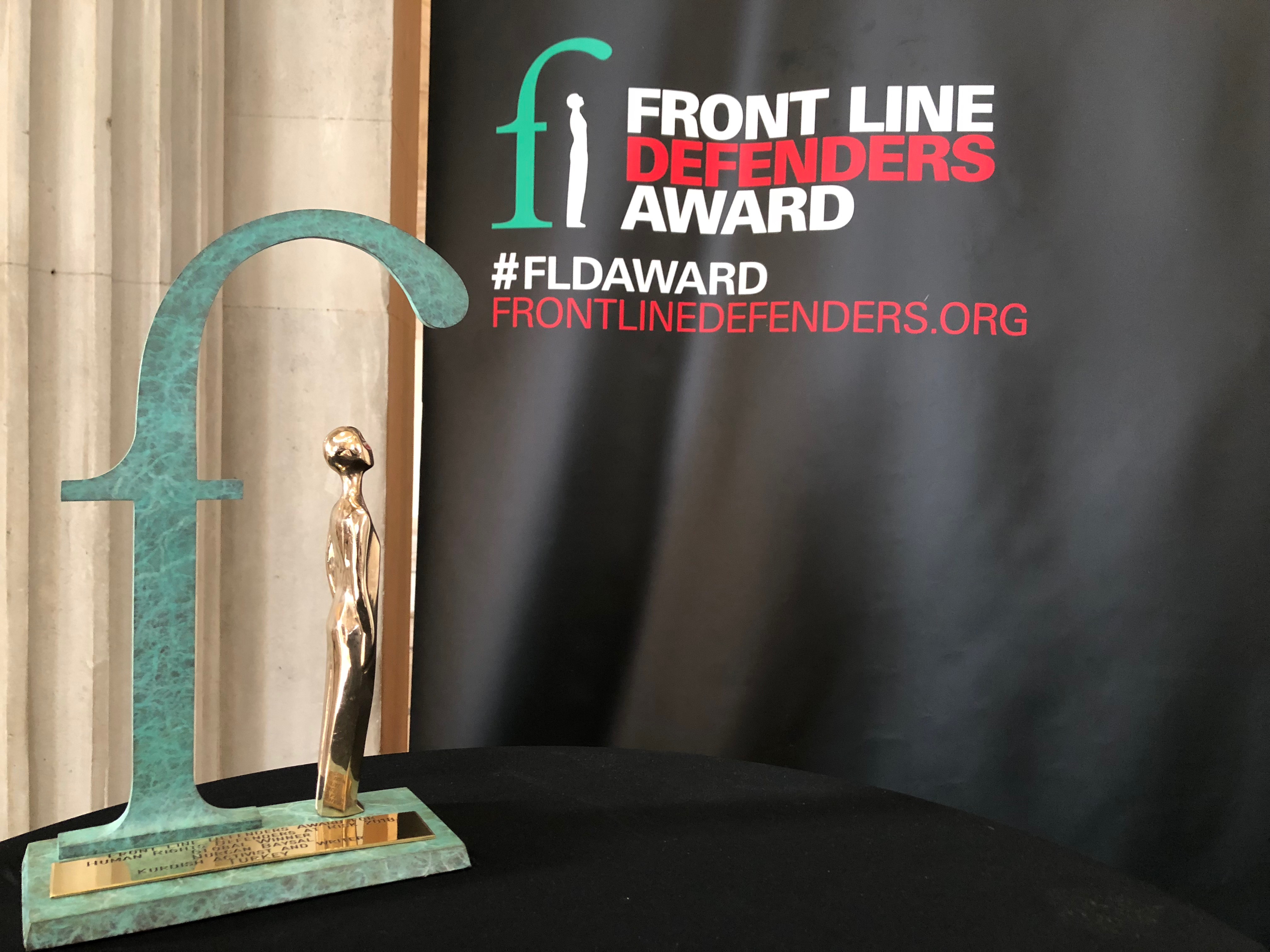
Front Line Defenders Award for human rights defenders at risk 2023: call for nominations

December 2, 2022

Front Line Defenders is currently accepting nominations for the 2023 Front Line Defenders Award for Human Rights Defenders at Risk:

award banner

For more this annual award and its laureates, see: https://www.trueheroesfilms.org/thedigest/awards/2E90A0F4-6DFE-497B-8C08-56F4E831B47D

Starting in 2018, Front Line Defenders changed the format of the Award, naming 5 Regional Award Winners, with one chosen as the Global Laureate by a jury comprised of representatives of Ireland’s parliament from a number of political parties. In 2021, Front Line Defenders took the decision to name all 5 regional winners as Global Laureates, in response to the overwhelming positive response to the greater visibility and recognition of the winners of the Award.

For each region of the world (Africa; Americas; Asia-Pacific; Europe & Central Asia; and Middle East & North Africa) there will be one winner selected and Front Line Defenders will recognize all five as the 2023 Front Line Defenders Award Laureates.

The nomination process is open for anyone to submit a nomination of a human rights defender, collective, organisation or community working on any human rights issue and facing significant risk due to their work or operating in an environment that itself is characterised as insecure. The purpose of the Award is to give visibility to HRDs who are not normally acknowledged or recognised at the international level. At the same time, the Award should not bring additional risk for which the HRD is not prepared. In addition to the Award, winners will receive:

  • a modest financial prize;
  • a security grant to improve their security measures;
  • collaboration with Front Line Defenders for media work in recognition of the Award;
  • advocacy by Front Line Defenders related to the Award and the work of the winners;
  • an event co-organized by the HRD, local partners and Front Line Defenders to give visibility to the Award in the winners’ countries (as determined and guided by the winners);
  • the Global Laureates will attend a ceremony in Dublin at a date to be determined;
  • ongoing security consultation with Front Line Defenders

If you would like to nominate a HRD for the 2023 Front Line Defenders Award for Human Rights Defenders at Risk, please follow this link to the secure online nomination form

2023 Front Line Defenders Award – Nomination Form

As the person, group or organisation making the nomination, you will be consulted by Front Line Defenders to verify the information submitted and possibly for additional information. Please complete all parts of the nomination form to the best of your ability. Please submit nominations via the online form. If there are any problems using the form, or if you have any questions, please contact: award@frontlinedefenders.org

Deadline for nominations: 13 January 2023

https://www.frontlinedefenders.org/en/call-nominations-2023-front-line-defenders-award-human-rights-defenders-risk

Palestinian NGOs dubbed terrorist were hacked with Pegasus spyware

November 10, 2021

Investigation by Front Line Defenders finds NGO employees’ phones were infiltrated months before Israel designated them as ‘terrorist organisations’

Phones of Palestinians working for human rights organisations recently designated by Israel as “terrorist organisations” [see: https://humanrightsdefenders.blog/2021/10/23/assault-by-israel-on-palestinian-human-rights-ngos/] were hacked using the Israeli-made spyware at the heart of a global surveillance scandal. [see: https://humanrightsdefenders.blog/2021/07/21/nsos-pegasus-spyware-now-really-in-the-firing-line/]

Dublin-based Front Line Defenders (FDL) examined 75 phones belonging to Palestinian human rights workers and detected that six were infected with Pegasus spyware between July 2020 and April 202. Four out of the six phones belong to staff members at NGOs that were blacklisted last month for alleged ties to a group labelled by some states as a “terrorist organisation”, a move that has sparked international condemnation.

Those alleged to have been hacked include US citizen Ubai al-Aboudi, who heads the Bisan Center for Research and Development, and French national Salah Hammouri, a researcher at Addameer. 

At a press conference in Ramallah on Monday, representatives of the six organisations called for the international community to take action. “We call on the United Nations to launch an investigation to disclose the party that stood behind using this programme on the phones of human rights activists, a move that put their lives at risk,” Tahseen Elayyan, a legal researcher with Al-Haq, told Reuters.

FDL’s findings, which were reviewed and confirmed by Citizen Lab and Amnesty International Security Lab, will raise further concerns about Pegasus, the controversial spyware alleged to have been used to hack heads of state, journalists and activists in a series of explosive stories published this summer.

NSO Group, the Israeli-based tech firm behind Pegasus, only licences the product to sovereign states or the law enforcement or intelligence agencies of those states.

Haaretz reported on Monday that the export licence issued by the Israeli defence ministry to NSO Group only permits Israeli security services to monitor Israeli phone numbers.

An FDL spokesperson told Middle East Eye on Monday that the organisation does not know which state was behind the hacking it uncovered, but believes that the timeline of events over the past month may be critical in answering that question.

On 16 October, three days before the organisations were designated, Al-Haq approached FDL, suspecting that a staff member’s phone had been hacked. The same day, an FDL investigator found initial traces of Pegasus on the phone.

The following day, on 17 October, FDL said it held a meeting with all six organisations to inform them of the initial findings and see if others would want their phones investigated. NSO Group: US blacklists Israeli firms for harming ‘national security interests’.

On 18 October, Israel’s interior ministry notified Hammouri of its decision to revoke his permanent residency in Jerusalem and deport him on the basis of his alleged “breach of allegiance to the State of Israel”.

Then on 19 October, Israeli Defence Minister Benny Gantz designated all six organisations which had gathered with FDL as “terrorist organisations.”

At this point, the organisations were reportedly only considered “terrorist” groups in Israel. But on 3 November – just ahead of the release of FDL’s findings –  Israel’s commander-in-chief of the Central Command issued an order to outlaw the organisations in the West Bank.

“It seems to us that [Israeli officials] were slow to react to what was transpiring and they were unprepared,” FDL spokesperson Adam Shapiro told MEE. “It suggests we caught them doing something they didn’t want us to.”

However, Shapiro emphasised that FDL could not say definitively what state was behind the hacking, a comment echoed by Addameer’s director, Sahar Francis.

“We don’t have evidence. We can’t accuse a certain party since we don’t have yet enough information about who carried out that action,” she told Reuters, calling on the UN to launch an investigation.

Israeli officials have not made a public statement yet about FDL’s findings. NSO Group told Reuters the company “does not operate the products itself … and we are not privy to the details of individuals monitored”.

The US government last week blacklisted the NSO Group and a second Israeli spyware firm, Candiru, saying their activities are contrary to US foreign policy and national security interests.

https://www.middleeasteye.net/news/israel-spyware-pegasus-used-hack-palestinian-rights-activists-phones

https://www.theguardian.com/world/2021/nov/08/hacking-activists-latest-long-line-cyber-attacks-palestinians-nso-group-pegasus-spyware

https://www.occrp.org/en/daily/15450-experts-pegasus-spyware-found-in-phones-of-palestinian-activists

https://www.timesofisrael.com/report-palestinian-activists-phones-hacked-with-controversial-nso-group-tech/

CALL FOR NOMINATIONS Front Line Defenders 2021 Award for human rights defenders

March 16, 2021

Front Line Defenders is currently accepting nominations for the 2021 Front Line Defenders Award for Human Rights Defenders at Risk:

award banner

For more on the annual Front Line Defenders Award and its Laureates see https://www.trueheroesfilms.org/thedigest/awards/2E90A0F4-6DFE-497B-8C08-56F4E831B47D.

Starting in 2018, Front Line Defenders changed the format of the Award, naming 5 Regional Award Winners, with one chosen as the Global Laureate by a jury comprised of representatives of Ireland’s parliament from a number of political parties. In 2021, Front Line Defenders took the decision to name all 5 regional winners as Global Laureates, in response to the overwhelming positive response to the greater visibility and recognition of the winners of the Award.

For each region of the world (Africa; Americas; Asia-Pacific; Europe & Central Asia; and Middle East & North Africa) there will be one winner selected and Front Line Defenders will recognize all five as the 2021 Front Line Defenders Award Laureates.

In addition to the Award, winners will receive:

  • a modest financial prize;
  • a security grant to improve their security measures;
  • collaboration with Front Line Defenders for media work in recognition of the Award;
  • advocacy by Front Line Defenders related to the Award and the work of the winners;
  • an event co-organized by the HRD, local partners and Front Line Defenders to give visibility to the Award in the winners’ countries (as determined and guided by the winners);
  • the Global Laureates will attend a ceremony in Dublin at a date to be determined;
  • ongoing security consultation with Front Line Defenders

If you would like to nominate a HRD for the 2021 Front Line Defenders Award for Human Rights Defenders at Risk, please follow this link to the secure online nomination form

2021 Front Line Defenders Award – Nomination Form

As the person, group or organisation making the nomination, you will be consulted by Front Line Defenders to verify the information submitted and possibly for additional information. Please complete all parts of the nomination form to the best of your ability.

Please submit nominations via the online form. If there are any problems using the form, or if you have any questions, please contact: campaigns@frontlinedefenders.org

Second issue of Cypher Comics is out

August 25, 2020

In July 2020, Front Line Defenders launched Cypher (@cypher_comics on Instagram), a digital comics magazine that advances the organization’s storytelling and narrative framing work in collaboration with and in support of HRDs. Working with artists from around the world, including the award-winning visual storyteller, Beldan Sezen, as creative director, the ’zine is a monthly publication featuring stories of HRDs, their work and the challenges they face. [see: https://humanrightsdefenders.blog/2020/07/23/new-cypher-comics-for-human-rights-defenders/]

If you are interested in an annual subscription to receive printed editions of Cypher, please email campaigns@frontlinedefenders.org, with ‘Subscription’ in the subject line, and you will be sent more information about options.

Cypher 02 (published on 18 July 2020) features an audio interview with Palestinian HRD and artist Hafez Omar – listen to the interview by clicking on the ‘Hafez Talks’ buttons when viewing the comcis in the ‘zine viewer below (the PDF file does not support the audio files).

Download Cypher Edition 02 PDF (no audio)