Posts Tagged ‘Front Line (NGO)’

Journalist Elena Milashina and lawyer Alexander Nemov severely attacked in Chechnya

July 10, 2023

Rights defenders are sure of Chechen law enforcers’ involvement in attack on Milashina says Roman Kuzhev, СK correspondent

The attack on the journalist Elena Milashina and the advocate Alexander Nemov has to do with Milashina’s publications in which she wrote about human rights violations in Chechnya, human rights defenders have noted.

The “Caucasian Knot” reported that on July 4, Elena Milashina, a journalist of the “Novaya Gazeta” outlet, and Alexander Nemov, an advocate for Zarema Musaeva, were attacked in Chechnya. They were beaten up by masked gunmen when they were on the way from the airport to Grozny, where the verdict in the case of Zarema Musaeva was to be announced. The head of Chechnya, Ramzan Kadyrov, has promised to “sort things out”; and Akhmed Dudaev, the head of the Chechen Press Ministry, have pointed out that “the style of Western intelligence services” is seen in the attack.

Svetlana Gannushkina, the head of the “Civic Assistance” Committee, is sure that the attack had to do with Milashina’s human rights activities. “They were waiting for her there to beat her for her so much writing on human rights issues, conducts inquiries and shows the real Chechnya,” Ms Gannushkina has stated.

According to her version, the attackers are definitely law enforcers. Gannushkina* has also added that the attackers would not be identified and punished. Oyub Titiev, a human rights defender, is also sure that Milashina was the attackers’ target. “Only law enforcers can beat a woman so openly and with such cruelty,” he has stated.

Ruslan Kutaev, the president of the Assembly of Caucasian Nations, is sure that Milashina would have been attacked at any moment while in Grozny.

A criminal case on the attack on Milashina and Nemov can be initiated under several articles, said Galina Tarasova, a lawyer. According to her story, the case should have been transferred to the central office of the Investigating Committee of the Russian Federation (ICRF).

This article was originally published on the Russian page of 24/7 Internet agency ‘Caucasian Knot’ on July 5, 2023 at 08:07 pm MSK. https://eng.kavkaz-uzel.eu/articles/62817

Many other human rights groups reported on this:

https://www.frontlinedefenders.org/en/case/human-rights-defenders-aleksandr-nemov-and-elena-milashina-attacked-and-severely-beaten-0

https://www.democracynow.org/2023/7/6/elena_milashina_attack

https://www.hrw.org/news/2023/07/04/journalist-and-human-rights-lawyer-viciously-attacked-chechnya

https://www.ohchr.org/en/press-releases/2023/07/russia-un-experts-dismayed-violent-attack-against-journalist-yelena

Researcher puts bomb under ‘traditional’ protection of human rights defenders

July 7, 2023

On 6 July 2023 Janika Spannagel in Open Global Rights comes with a study of great importance to the work for human rights defenders. The researcher states that “focusing only on defenders’ physical integrity risks undermining the very idea of supporting agents of human rights change” and that there is a need to Rethink campaigns on human rights defenders

Spannnagel’s work featured in this blog before [see: https://humanrightsdefenders.blog/tag/janika-spannagel/] but this work questions more directly the core of HRD protection.

Instead of summarising I will provide large quotes:

,,,,The theory of change put forward by actors, including Front Line Defenders, International Service for Human Rights, and many others, claims that by protecting local human rights activists, international campaigns can support them in their work to advance human rights protection on the ground. This assumption appears plausible and aligns with prominent accounts in academic human rights literature, where domestic activists’ protection from repression is seen as a way to open spaces for them to challenge the regime and enact change.

That said, empirical evidence from UN casework and the experience of Tunisian defenders shows that this promise has not been fulfilled when it comes to human rights defenders in authoritarian regimes, as I show in my recent book. There, I argue that, while international attention can have important protective benefits, it does little to support individual human rights defenders as agents of change in repressive contexts. [Emphasis added]

The reason for this is that international casework on defenders, including urgent action–like campaigns or UN communications, maintain the traditional focus on physical integrity rights that has guided the long-standing casework on political imprisonment, torture, or enforced disappearances. In doing so, it overlooks the many administrative, discursive, and covert forms of repression that typically bypass international scrutiny more broadly but that often very effectively disrupt and thwart defenders’ work toward change.

The analysis of over 12,000 individual cases of human rights activists taken up by the UN special rapporteur on human rights defenders between 2000 and 2016 reveals that, in almost three-quarters of them, at least one of the violations described fell within the category of physical integrity violations. Detention cases alone made up 56% of all cases raised during that period. In contrast, only 4% of the cases dealt exclusively with softer types of repression, such as travel bans, bureaucratic issues, job dismissals, surveillance, or defamation.

This distribution far from represents the everyday experience of human rights defenders in authoritarian states—instead, it is reflective of a humanitarian instinct in human rights casework to privilege cases that are considered most severe. One could argue that UN communications, and perhaps attention-based campaigning more broadly, are inherently humanitarian, not transformative instruments. But one should ask: What, then, is the purpose of focusing on human rights defenders, as opposed to any victim of repression? [Emphasis added]

The priority given to physical integrity violations has two important adverse consequences. First, we can see that the data profoundly shape our understanding of what human rights defenders are struggling with. For example, on the basis of such data a CIVICUS report claims that in order to repress civic space, states resort “most often” to detention of activists, attacks against journalists, and excessive use of force against protesters. The human rights community’s own focus on violent repression thus paradoxically misleads us to believe that this is where most attention is needed.

Secondly, this focus reinforces a protection gap for violations that fall outside of the conventional notion of state repression as physically harmful and as undeniably politically motivated. Research on repression highlights that authoritarian states engage in repressive substitution, where they replace highly scrutinized coercive tactics—typically harder and overt types of repression—with softer and more covert measures. The case of Tunisia under Ben Ali aptly illustrates the strong impact of such tactics on defenders’ ability to carry out meaningful work.

When analyzing the further development of cases taken up by the UN, I also found that, while some positive effects of the UN’s attention could be identified for most of them, many did not see an actual improvement relative to the reported violations over the course of the next year; where they did, it was mostly an easing of harder repression. Ultimately, there is a real risk that governments continue to use hard repression to increase their bargaining power and then pass off a release from prison as a costly concession, while in reality imposing softer but equally effective measures against the activist in question.

With this problem in mind, what could be done differently? Casework that follows a transformative logic should not seek to maximize the reduction of physical harm—the humanitarian logic—but should define protection needs in terms of safeguarding a defender’s ability to do effective human rights work. 

Those engaging in casework and campaigns on human rights defenders should actively revisit their priorities in terms of the violations they tend to address. Far too often, softer repression remains unreported, unnoticed, and not acted upon, which effectively creates a twilight zone in which authoritarian states can comfortably stifle opposition voices without risking much pushback. We owe it to the countless number of human rights activists around the world to ensure that the label of “human rights defender” does not merely serve to laud their heroism and excite donors and the media, but that it is dedicated to fulfilling its promise of human rights change.

https://www.openglobalrights.org/rethinking-campaigns-human-rights-defenders/index.cfm

For the more traditional approach, see e.g. https://www.ipsnews.net/2023/07/recognising-human-rights-defenders-remarkable-agents-positive-change/

RFK Human Rights calls to strengthen protection mechanisms for environmental defenders on International Earth Day

April 30, 2023

April 22, 2023

Being an environmental human rights defender is one of the most dangerous jobs in the world. Every day, government authorities, companies and other non-state actors seek to silence environmental defenders on the frontlines of the global climate and environmental movement through unwarranted persecution, harassment, detention and even murder. As we commemorate International Earth Day on 22 April, an annual celebration honouring those who fight for a clean environment, RFK Human Rights is calling for the international community and national authorities to redouble efforts to strengthen and fortify protection mechanisms for environmental defenders.

According to Front Line Defenders, land, indigenous peoples’ and environmental rights defenders were the most targeted human rights defender (HRD) sector in 2022. Representatives of national governments, private companies, militias and other non-state actors killed 194 land, environmental and indigenous defenders in 2022 accounting for 48 percent of all murdered defenders. Environmental defenders also face routine arbitrary arrest and detention, criminalization, physical abuse, death threats and other forms of repression. Across the world, sparse and tepid investigations into killings of environmental defenders have led to endemic levels of impunity and limited prosecutions. See: https://humanrightsdefenders.blog/2023/04/04/front-line-defenders-just-published-its-global-analysis-2022-new-record-of-over-400-killings-in-one-year/

As part of our work to protect civic space by defending fundamental freedoms, Robert F. Kennedy Human Rights regularly works to ensure that environmental defenders have ready access to protection and accountability mechanisms. Through our strategic litigation programs, we collaborate with local partners to confront these systematic abuses through active litigation at the Inter-American Commission on Human Rights and at the United Nations. Under the auspices of our Speak Truth to Power campaign, we continue to provide human rights education programs that combine storytelling and interactive learning to provide the next generation of environmental defenders with the tools they will need to create change.

Together with various coalitions we constantly bring attention to the critical and invaluable work for environmental defenders. Just last week, RFK Human Rights joined dozens of civil society groups from across the globe to raise awareness about the forced disappearance of Mexican environmental defenders Ricardo Arturo Lagunes Gasca and Antonio Díaz Valencia. Both defenders disappeared on Jan. 15 only hours after participating in an anti-mining community meeting. The disappearances take place amid ongoing violence and persecution of land, indigenous and environmental defenders seeking to protect the environment in Mexico. Impunity for the killing of environmental defenders remains disturbingly high in Mexico– in 2021, according to Global Witness, nearly 95 percent of murders did not result in prosecution.

On 20 March 2023, following the release of the Intergovernmental Panel on Climate Change (IPCC) findings, United Secretary-General Antonio Guterres issued a clarion call “to massively fast-track climate efforts by every country and every sector and on every timeframe.” From the UN Sustainable Development Summit to the UN Climate Conference (COP 28), 2023 is replete with opportunities to institutionalize and codify the cherished ideals of environmentalism which we celebrate on International Earth Day. The international community, together with national governments and the private sector, must seize these crucial moments to publicly recognize the essential work of environmental defenders and recommit to ensure that they can conduct their crucial activities free from repression, reprisal and persecution.

VOICES FOR HUMAN RIGHTS

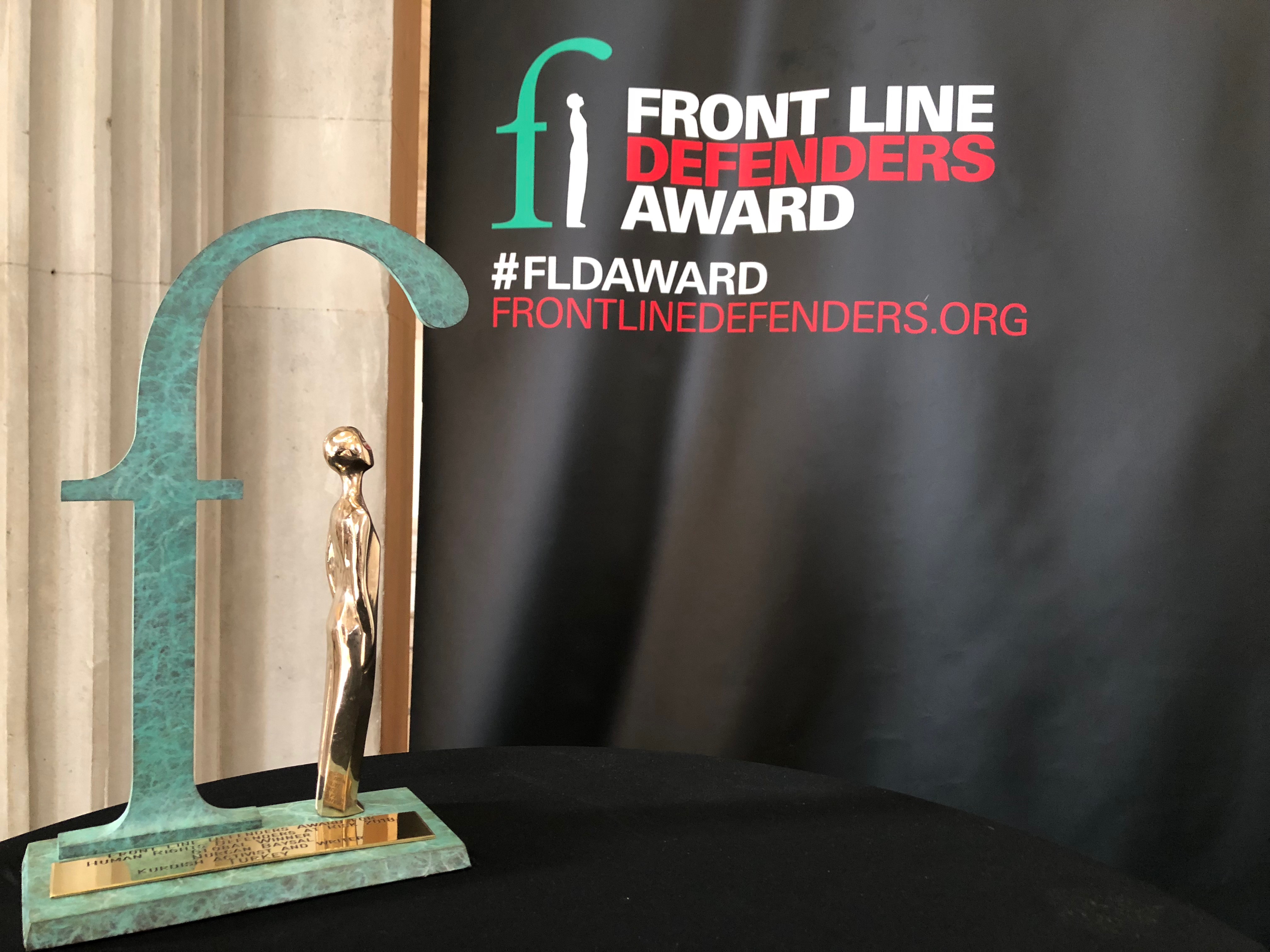
Front Line Defenders Award for human rights defenders at risk 2023: call for nominations

December 2, 2022

Front Line Defenders is currently accepting nominations for the 2023 Front Line Defenders Award for Human Rights Defenders at Risk:

award banner

For more this annual award and its laureates, see: https://www.trueheroesfilms.org/thedigest/awards/2E90A0F4-6DFE-497B-8C08-56F4E831B47D

Starting in 2018, Front Line Defenders changed the format of the Award, naming 5 Regional Award Winners, with one chosen as the Global Laureate by a jury comprised of representatives of Ireland’s parliament from a number of political parties. In 2021, Front Line Defenders took the decision to name all 5 regional winners as Global Laureates, in response to the overwhelming positive response to the greater visibility and recognition of the winners of the Award.

For each region of the world (Africa; Americas; Asia-Pacific; Europe & Central Asia; and Middle East & North Africa) there will be one winner selected and Front Line Defenders will recognize all five as the 2023 Front Line Defenders Award Laureates.

The nomination process is open for anyone to submit a nomination of a human rights defender, collective, organisation or community working on any human rights issue and facing significant risk due to their work or operating in an environment that itself is characterised as insecure. The purpose of the Award is to give visibility to HRDs who are not normally acknowledged or recognised at the international level. At the same time, the Award should not bring additional risk for which the HRD is not prepared. In addition to the Award, winners will receive:

  • a modest financial prize;
  • a security grant to improve their security measures;
  • collaboration with Front Line Defenders for media work in recognition of the Award;
  • advocacy by Front Line Defenders related to the Award and the work of the winners;
  • an event co-organized by the HRD, local partners and Front Line Defenders to give visibility to the Award in the winners’ countries (as determined and guided by the winners);
  • the Global Laureates will attend a ceremony in Dublin at a date to be determined;
  • ongoing security consultation with Front Line Defenders

If you would like to nominate a HRD for the 2023 Front Line Defenders Award for Human Rights Defenders at Risk, please follow this link to the secure online nomination form

2023 Front Line Defenders Award – Nomination Form

As the person, group or organisation making the nomination, you will be consulted by Front Line Defenders to verify the information submitted and possibly for additional information. Please complete all parts of the nomination form to the best of your ability. Please submit nominations via the online form. If there are any problems using the form, or if you have any questions, please contact: award@frontlinedefenders.org

Deadline for nominations: 13 January 2023

https://www.frontlinedefenders.org/en/call-nominations-2023-front-line-defenders-award-human-rights-defenders-risk

Palestinian NGOs dubbed terrorist were hacked with Pegasus spyware

November 10, 2021

Investigation by Front Line Defenders finds NGO employees’ phones were infiltrated months before Israel designated them as ‘terrorist organisations’

Phones of Palestinians working for human rights organisations recently designated by Israel as “terrorist organisations” [see: https://humanrightsdefenders.blog/2021/10/23/assault-by-israel-on-palestinian-human-rights-ngos/] were hacked using the Israeli-made spyware at the heart of a global surveillance scandal. [see: https://humanrightsdefenders.blog/2021/07/21/nsos-pegasus-spyware-now-really-in-the-firing-line/]

Dublin-based Front Line Defenders (FDL) examined 75 phones belonging to Palestinian human rights workers and detected that six were infected with Pegasus spyware between July 2020 and April 202. Four out of the six phones belong to staff members at NGOs that were blacklisted last month for alleged ties to a group labelled by some states as a “terrorist organisation”, a move that has sparked international condemnation.

Those alleged to have been hacked include US citizen Ubai al-Aboudi, who heads the Bisan Center for Research and Development, and French national Salah Hammouri, a researcher at Addameer. 

At a press conference in Ramallah on Monday, representatives of the six organisations called for the international community to take action. “We call on the United Nations to launch an investigation to disclose the party that stood behind using this programme on the phones of human rights activists, a move that put their lives at risk,” Tahseen Elayyan, a legal researcher with Al-Haq, told Reuters.

FDL’s findings, which were reviewed and confirmed by Citizen Lab and Amnesty International Security Lab, will raise further concerns about Pegasus, the controversial spyware alleged to have been used to hack heads of state, journalists and activists in a series of explosive stories published this summer.

NSO Group, the Israeli-based tech firm behind Pegasus, only licences the product to sovereign states or the law enforcement or intelligence agencies of those states.

Haaretz reported on Monday that the export licence issued by the Israeli defence ministry to NSO Group only permits Israeli security services to monitor Israeli phone numbers.

An FDL spokesperson told Middle East Eye on Monday that the organisation does not know which state was behind the hacking it uncovered, but believes that the timeline of events over the past month may be critical in answering that question.

On 16 October, three days before the organisations were designated, Al-Haq approached FDL, suspecting that a staff member’s phone had been hacked. The same day, an FDL investigator found initial traces of Pegasus on the phone.

The following day, on 17 October, FDL said it held a meeting with all six organisations to inform them of the initial findings and see if others would want their phones investigated. NSO Group: US blacklists Israeli firms for harming ‘national security interests’.

On 18 October, Israel’s interior ministry notified Hammouri of its decision to revoke his permanent residency in Jerusalem and deport him on the basis of his alleged “breach of allegiance to the State of Israel”.

Then on 19 October, Israeli Defence Minister Benny Gantz designated all six organisations which had gathered with FDL as “terrorist organisations.”

At this point, the organisations were reportedly only considered “terrorist” groups in Israel. But on 3 November – just ahead of the release of FDL’s findings –  Israel’s commander-in-chief of the Central Command issued an order to outlaw the organisations in the West Bank.

“It seems to us that [Israeli officials] were slow to react to what was transpiring and they were unprepared,” FDL spokesperson Adam Shapiro told MEE. “It suggests we caught them doing something they didn’t want us to.”

However, Shapiro emphasised that FDL could not say definitively what state was behind the hacking, a comment echoed by Addameer’s director, Sahar Francis.

“We don’t have evidence. We can’t accuse a certain party since we don’t have yet enough information about who carried out that action,” she told Reuters, calling on the UN to launch an investigation.

Israeli officials have not made a public statement yet about FDL’s findings. NSO Group told Reuters the company “does not operate the products itself … and we are not privy to the details of individuals monitored”.

The US government last week blacklisted the NSO Group and a second Israeli spyware firm, Candiru, saying their activities are contrary to US foreign policy and national security interests.

https://www.middleeasteye.net/news/israel-spyware-pegasus-used-hack-palestinian-rights-activists-phones

https://www.theguardian.com/world/2021/nov/08/hacking-activists-latest-long-line-cyber-attacks-palestinians-nso-group-pegasus-spyware

https://www.occrp.org/en/daily/15450-experts-pegasus-spyware-found-in-phones-of-palestinian-activists

https://www.timesofisrael.com/report-palestinian-activists-phones-hacked-with-controversial-nso-group-tech/

CALL FOR NOMINATIONS Front Line Defenders 2021 Award for human rights defenders

March 16, 2021

Front Line Defenders is currently accepting nominations for the 2021 Front Line Defenders Award for Human Rights Defenders at Risk:

award banner

For more on the annual Front Line Defenders Award and its Laureates see https://www.trueheroesfilms.org/thedigest/awards/2E90A0F4-6DFE-497B-8C08-56F4E831B47D.

Starting in 2018, Front Line Defenders changed the format of the Award, naming 5 Regional Award Winners, with one chosen as the Global Laureate by a jury comprised of representatives of Ireland’s parliament from a number of political parties. In 2021, Front Line Defenders took the decision to name all 5 regional winners as Global Laureates, in response to the overwhelming positive response to the greater visibility and recognition of the winners of the Award.

For each region of the world (Africa; Americas; Asia-Pacific; Europe & Central Asia; and Middle East & North Africa) there will be one winner selected and Front Line Defenders will recognize all five as the 2021 Front Line Defenders Award Laureates.

In addition to the Award, winners will receive:

  • a modest financial prize;
  • a security grant to improve their security measures;
  • collaboration with Front Line Defenders for media work in recognition of the Award;
  • advocacy by Front Line Defenders related to the Award and the work of the winners;
  • an event co-organized by the HRD, local partners and Front Line Defenders to give visibility to the Award in the winners’ countries (as determined and guided by the winners);
  • the Global Laureates will attend a ceremony in Dublin at a date to be determined;
  • ongoing security consultation with Front Line Defenders

If you would like to nominate a HRD for the 2021 Front Line Defenders Award for Human Rights Defenders at Risk, please follow this link to the secure online nomination form

2021 Front Line Defenders Award – Nomination Form

As the person, group or organisation making the nomination, you will be consulted by Front Line Defenders to verify the information submitted and possibly for additional information. Please complete all parts of the nomination form to the best of your ability.

Please submit nominations via the online form. If there are any problems using the form, or if you have any questions, please contact: campaigns@frontlinedefenders.org

Second issue of Cypher Comics is out

August 25, 2020

In July 2020, Front Line Defenders launched Cypher (@cypher_comics on Instagram), a digital comics magazine that advances the organization’s storytelling and narrative framing work in collaboration with and in support of HRDs. Working with artists from around the world, including the award-winning visual storyteller, Beldan Sezen, as creative director, the ’zine is a monthly publication featuring stories of HRDs, their work and the challenges they face. [see: https://humanrightsdefenders.blog/2020/07/23/new-cypher-comics-for-human-rights-defenders/]

If you are interested in an annual subscription to receive printed editions of Cypher, please email campaigns@frontlinedefenders.org, with ‘Subscription’ in the subject line, and you will be sent more information about options.

Cypher 02 (published on 18 July 2020) features an audio interview with Palestinian HRD and artist Hafez Omar – listen to the interview by clicking on the ‘Hafez Talks’ buttons when viewing the comcis in the ‘zine viewer below (the PDF file does not support the audio files).

Download Cypher Edition 02 PDF (no audio)

Anti-Censorship initiative with free VPN accounts for human rights defenders

July 15, 2020

On 14 July Business-Wire reported that the VPN company TunnelBear has partnered with NGOs to give away 20,000 accounts (these NGOs inlcude Access Now, Frontline Defenders, Internews, and one other undisclosed participant).

This program aims to empower individuals and organizations with the tools they need to browse a safe and open internet environment, regardless of where they live. The VPN provider is encouraging other NGOs or media organizations across the world to reach out if they too are in need of support. “At TunnelBear, we strongly believe in an open and uncensored internet. Whenever we can use our technology to help people towards that end, we will,” said TunnelBear Cofounder Ryan Dochuk.

TunnelBear’s VPN encrypts its user’s internet traffic to enable a private and censor-free browsing experience.

By undergoing and releasing independent audits of their systems, adopting open source tools, and collaborating with the open source community, TunnelBear has proven itself to be an industry leader in the VPN space and a valuable private sector partner within the internet freedom movement. Internews is happy to support TunnelBear in extending its VPN service to the media organizations, journalists, activists, and human rights defenders around the globe who can benefit from it,” said Jon Camfield, Director of Global Technology Strategy at Internews.

Contact: Shames Abdelwahab press@tunnelbear.com

See also: https://humanrightsdefenders.blog/2020/06/23/trump-now-starts-dismanteling-the-open-technology-fund/

https://www.businesswire.com/news/home/20200714005302/en/TunnelBear-Kicks-Anti-Censorship-Initiative-Free-Accounts-Activists

New EU Toolkit on Women Human Rights Defenders

July 8, 2020

On 7 July 2020 Front Line Defenders made public the toolkit on woman HRDs, a companion to the EU Guidelines of Human Rights Defenders (2004) which provide practical actions for EU staff in Brussels and in human rights defenders’ (HRDs) home countries to support and protect HRDs.

While useful, the Guidelines do not contain recommendations or actions that consider the varied experiences of women human rights defenders (WHRDs) with regard to gender, sexuality, race, class, family life, etc. This EU Toolkit on WHRDs provides practical steps for the EU to better meet the needs of WHRDs, from a gendered, intersectional perspective.

You can Download the EU Toolkit on WHRDs here.

As outlined in the UN Resolution on Women Human Rights Defenders, WHRDs experience violence in differentiated ways because of the work they do and who they are, as women. The UN Special Rapporteur on HRDs reports that “women defenders often face additional and different risks and obstacles that are gendered, intersectional and shaped by entrenched gender stereotypes and deeply held ideas and norms about who women are and how women should be.” In addition, there are many economic, social, cultural and geographical factors that affect how WHRDs experience violations. These factors include class, religion, age, language, sexual orientation, location, race and ethnicity. The UN calls all actors to develop specific gendered protection measures, and the inclusion of WHRDs in their design and implementation. The need for the toolkit has arisen because many protection measures are difficult to access for WHRDs as they face not only societal barriers to their work, but also in accessing the international community. The toolkit will help bridge that divide.

Following consultations with international WHRD networks, the EU Office of Front Line Defenders drafted a Toolkit for diplomats on how to address the specific protection needs of women human rights defenders at risk. It was presented to the EU Council Working Group on Human Rights, bringing together the EU institutions and diplomats from the 28 Member States, in Helsinki in October 2019, and shared again on occasion of the preparation of the Guidance Note for Delegations and Embassies by the EU Council Working Group on Human Rights. There are plans to have it tested in collaboration with WHRDs and diplomats in one or two countries per continent; the goal is to have this Toolkit adopted as an annex to the EU Guidelines on HRDs.

https://www.frontlinedefenders.org/en/resource-publication/eu-toolkit-whrds

Policy response from Human Rights NGOs to COVID-19: Front Line (tips for human rights defenders working from home)

April 10, 2020

In the midst of the COVID-19 crisis, many human rights organisations have been formulating a policy response. While I cannot be complete or undertake comparisons, I will try and give some examples in the course of these weeks. Here one by Front Line Defenders on the “Physical, emotional and digital protection while using home as office in times of COVID-19

Ideas & tips for human rights defenders

….. Front Line Defenders has experience advising HRDs working remotely and part of its own team has been working remotely – and securely – for years. Below is some of our thinking and learning around the challenges of this modality of work. It is hard to put down one size fits all solutions, especially for physical and emotional protection. This is offered as inspiration to evaluate and improve protection of your particular situation. And if you are a HRD or HRO at risk in your country, you may always reach out to Front Line Defenders for help – the organisation is at work and fully operational during this time.

We encourage you to communicate clearly and promptly with your donors and partners regarding your particular situation. Donors in the human rights space are highly sensitive to the difficulties this crisis is posing to its partners and grantees, even as they face a variety of unprecedented challenges. We believe it makes situation much more manageable if they know what is possible and impossible at this moment for you and your organisation regarding your work or cooperation with them. They also may be able to help you with your specific needs right now, things like portable equipment to work from home or additional at-home security measures.

Physical protection

physical_protection.jpg

Consider which place or room is best to be working on sensitive issues. Is, for example, a basement a best option? How easy is it to get to your work space from entry doors to your apartment or house? Can people see your computer screen or desk/papers from the outside? Do you want/can you avoid house-mates see you working? Or overhear sensitive conversations on the phone or over the internet. You can try to talk quietly if neighbours can overhear conversations, use a headset, close windows when you talk, or use veiled/coded language.

Try not to leave your work around the house (leaving USBs & documents around). Stay organised and protect sensitive information. Think about getting locks on drawers, or lockable cabinets etc. Consider locating some good hiding places (or some kind of safety box) for your valuable information if you need to quickly hide them. Be creative eg. taking out a brick or tile in the floor or wall, in the rooftop, under a floorboard, taped inside a shower drain, etc. At the end of each day, put everything away in a safe space including documents, computers and phones. Keep a clean desk policy. Turn off computers, don’t just put them to sleep or leave them on. Have a system for destroying sensitive information and files. This could be shredding it, tearing into small pieces, burning it, etc.

Consider using a simple surveillance system of the space at times when you are not there. This could be simple traps to detect if someone has entered has the house or room, or opened a drawer. Alternatively, there are digital solutions such as mobile phone applications such as Haven app which you could use with an old Android phone to monitor your work space.

Make sure you have a good ergonomic set up of your work station so that you are sitting comfortably without straining your back, neck or other parts of your body – and take regular breaks.  Reduce tripping hazards. Have first aid kits and sufficient medications. Have enough water for 4 days, and some hibernation kits.

If you share accommodation with others (family, friends, room-mates), have a meeting to make sure everyone is aware of the security rules you want to apply ( i.e. don’t open the door without first checking who it is, don’t touch the laptop, etc.) It is good to have a security check-in meeting with them everyday to see how situation is changing and if they notice anything new or out of place.

Prepare emergency numbers and have them handy such as written/printed and stuck up on the wall, saved in your phone, and kept in your wallet. Consider having a household communication planin case you need support. This means calling one or two people, and then they themselves know who to call and what to do to give you support.

Have an evacuation plan prepared, with different exits and an outside meeting point. It is recommended that you practice it. Sometimes simply placing a ladder near a fence can make a big security improvement in your home. Some people also have a pre-packed bag that they keep next to the exits, that contains copies of sensitive documents, some cash, phone charger, torch/flashlight, medication and other items you would want to have with you.

If you consider the risks are increasing as an HRD and you might need to relocate, review your relocation plan. Are the travel arrangements and end destination still feasible? How can you adapt your plan to reduce your visibility and physical presence?

If you are considering having sensitive in-person meetings in your home, be aware of the restrictions in place and comply with health advisories. Prepare a cover story with your visitors, including who are they and why are they visiting you, in case your neighbours or somebody else asks. Also, it can be a good idea for visitors not to tell taxis (including ride-hailing apps) your exact address, but somewhere close like a well-known place of worship, park, shop, etc. If they come in their own vehicle, it is better that they not park out the front of your house – they can park further down the street so they are not immediately connected with you. Make sure you give very clear instructions so visitors do not have to ask anybody how to find you.

Always consider safety risks like fire in homes. You might be cooking more indoors, using more electricity outlets, smoking indoors, children might be more housebound, and your neighbours will also be home, increasing the risk of them starting a fire. Have a fire plan. Consider things like woollen blankets as fire blankets, smoke detectors if possible, manage your electricity usage and try to use surge protectors, reduce fuel load, etc.

Consider having a personal alarm with you in the home and when you leave to attract attention if you need, this could be something like a whistle.

Keep your doors locked, with the key in the lock on the inside of the door – unless someone on the outside can reach through to open it. In this case, keep the key in a set location, away from the door (and out of sight) ready in case it is needed in an emergency. Consider what is a pattern of criminal attacks in your area. Rates of home burglaries generally fall when more people are at home, but other crime (against offices or shops) may increase. Protect (or take with you) the valuable information from your office before leaving. Consider how your adversaries will try to benefit from you working from home and then mitigate that.

Avoid regular routines especially in leaving and travelling around. When leaving your home to go shopping, consider the risks of leaving your devices in the home vs taking the devices with you. If you leave home, switch off devices and hide them. When leaving, ensure that someone knows where you are going, how you will get there (the route), what time you are expected to return, how to contact you if there is any reason, etc. You may also use things like live location sharing, check-in procedures (“I’ve arrived”, “I’m leaving now”, “should be there in 20 minutes”, etc.)

Be discreet and avoid being targeted by police or security forces by violating any legal local rules.

It is easier said than done but try to plan for economic security or sustainability, this situation could go on for longer than currently envisaged. If possible discuss this with donors or supporters. Try to identify an emergency fund you can establish or have access to – perhaps in cooperation with others. Connect online with your local communities to see what are possible self-organizing strategies for mutual support.

Let Front Line know of your protection ideas or suggestions based on your experience that may benefit other HRDs or HROs at risk, it will develop this guide further.

See also: https://humanrightsdefenders.blog/2020/04/10/policy-response-from-human-rights-ngos-to-covid-19-civicus-protocol/