Posts Tagged ‘Fatia Maulidiyanti’

Indonesian human rights lawyer Haris Azhar speaks out

May 19, 2024

Haris Azhar

On 17 May 2024 – in Global Voices – Lawyer Haris Azhar shares how the law has been used to intimidate human rights defenders in Indonesia..

Haris Azhar is an advocate, human rights defender, and lecturer in Indonesia who has been involved in human rights work for over 25 years. In January 2024 Azhar, along with another human rights defender, Fatia Maulidiyanti, were acquitted of defamation charges . [see also: https://humanrightsdefenders.blog/2023/11/14/defamation-indictment-for-fatia-maulidiyanti-and-haris-azhar-two-human-rights-defenders-in-indonesia/]

Here Haris Azhar shares how and why he believes the law can be used as a powerful tool to deal with repression of democratic voices and their rights. Read more from our In My Own Words series here.


My name is Haris Azhar. I would say I’ve been working, in general terms, on human rights issues for the last 25 years. I work across the country in Indonesia on some human rights, issues or situations, and in some conflict areas such as in Papua.

I have been working for and dealing with some vulnerable groups such as labour groups, as well as the indigenous people and victims from the violence as well. These days I practise as a lawyer, I do pro bono and also professional for-profit work where I use the profits work to subsidise the pro bono and public interest legal work. I have also joined some organisations, and I was director for two human rights organisations. So that’s why I’ve been very human rights focused.

In early 2024 me and my friend Fatia were brought to court. We won, and we got a good decision from the court. But this is not the final one, because the attorney general has appealed to the Supreme Court. I think this whole process was meant to serve as an example.

The whole process, especially last year, was intended to be intimidation. The litigation or the pre-trial process was intended to intimidate me [and] not to not say more about the practice of business oligarchs in this country. But myself, lawyers, and groups here said, we would not say sorry. We would not stop speaking, and that those in power could continue their judicial harassment of us and that we would fight them.

And during the fight, a lot of things happened [such as] intimidations, negative accusations and campaigns. They accused us of hoax stories, but actually they did the hoax stories. They took over and intercepted my mobile phone as well. These are the lengths and practices of intimidation in place.

However, the process of the court for people like us, we pretty much don’t really care about the final decisions. We can see the shadow of the prisons, because what the government thinks is important for them is for us to not have democratic voices. There aremany cases by politicians and by business groups that aim to criminalise decent voices, and it has become a [common] practice. There are even consultants that can help you if you would like to know how to criminalise decent/democratic voices.

It’s become an industry against freedom of expression, to show that, “This is what happens if you are against us.” They wanted to show they could bring me to court so the warning was that anyone who becomes the client of Haris should be aware. It was symbolic, and that’s what I mean it is a message to intimidate and to intimidate vulnerable groups especially.

Widespread engagement on human rights, working through organisations, has developed not only my knowledge, my skill, but also my networks. This has also developed my interest in what some of the ways we (as a nation) would like to put on the table with regards to issues of human rights.

As a practising lawyer, we have always believed here that we can use the law [to achieve justice]. However the movement here is not like in South Africa, as an example, where at one point in South Africa there was no real equality. There was no legal institution that could be used to secure fairness. We don’t have that kind of situation here [in Indonesia], but we are still looking for the formalisation of equality and fairness.

We like to use the legal debate, space, and discourse as a way to combat evil, because the law provides the kind of tools or ammunition to attack evil. Those in power hide behind the law and therefore here in Indonesia, most of the battle and discourse always has an element of legality.

I believe that the law is one of the crucial things that need to be handled, in addition to other advocacy issues. Because we know that the law or legal mechanisms are [also] being used by the bad guys, by the oligarchs to justify and legalise their plans and to do their own business. Those in power always say that they have complied with the law, that they uphold the rule of law, but actually we know that the law they comply with is their own creation. It is their own definition. That’s why we [as legal practitioners] need to step in, even though it’s not the popular action to do so.

If those in, and adjacent to, power cannot be left to create what is good and not good within the framework of law. We need to bring in the voices from the ground. We need to bring the voices from the indigenous people. We need to bring the voices from the labour groups, from the students, from the women’s groups, and many other vulnerable groups who are connected to the issues.

This is instead of the politicians and the business groups alone making their own arguments and developing their own definitions. We cannot let them be, and let them take over in that kind of way. Rule of law and legislation, has to be accompanied and coloured by the vulnerable voices and interests. This is why we insist that a part of the campaign, part of the research, is that we take the legal action as well.

The gap between the haves and the political groups on the ground is huge. This has been happening year on year, and it is getting worse every year. The new regulations and legislations that we have here, which very much comply with the interests of the business groups which belong to some politicians, create more loose protection of rights of workers and women. For the youth and the students, they are getting fewer protections for their education and freedom.

There’s no freedom on campus for students anymore, [because of] intervention from the government and the police on campuses. It’s getting obvious these days. So I think we need at least two things. First, figuring out how to protect vulnerable groups, because why they were attacked or would be attacked is because they found irregularities, and problematic issues behind the policies of the government, or the law.

These issues have led to economic issues, social issues, business issues and so the vulnerable groups make a choice where they complain or protest, but they get attacked by police, government and intelligence. That is why we need more collaborations with vulnerable groups.

We also need more friends — lawyers, international advocates, researchers — coming down into the rural areas, and into the urban areas to capture what is happening and make a noise, to campaign. That’s why we need to have the first group that I mentioned before. We need not to deal with the substance of the problem, but with the second layer of the problem, [which is] the attacks of the participation, the effects to the participation. For this we need to have a lot of groups [working on] how to deal with this kind of shrinking space.

We just had the 2024 elections where we campaigned around the threat to our freedoms of speech and expression. Some of the candidates responded very well, but the one that was supported by the current regime didn’t have a strong resonance with what we are saying. In addition to the campaign, along with my criminalisation, myself, some friends and organisations submitted a complaint to the Constitutional Court.

Our complaint was regarding some legal articles which were being used against me and against some journalists. We won the case in the Constitutional Court earlier this year, and an article which had been used to criminalise a lot of people has now been dropped. But this win is very short [lived] because we have some articles within certain laws which allow the police to criminalise speech.

When I said we won, that’s regarding just one article in our criminal code. But in the next year and a half we will have a new criminal code implemented and new articles to criminalise speeches. We will need to challenge those articles in the next two years. It’s like Tom and Jerry, where we play hide and seek. It seems politicians and business need a shield to protect themselves from the public, hence these situations but we keep fighting them using the same law.

Legal institutions are not our institutions yet. They are still their institutions [meaning the powerful]. However to a certain degree, the legal space is an open stage for you to perform, to have a say. I think if we don’t fill the space, it will be filled by those who are not supportive of freedom of speech or freedom of expression.

These are the reasons why I think we have to join legal action. So as to not give space for evil to come in and occupy. Also, legal action is not the only type of work needed. It has to be one among others. For instance there is advocacy work too. But law cannot be neglected and that’s why this current situation (and the coming situations), require more than just focusing on the legal system. It has to be about a collaborative methodology and approach.

https://www.globalcitizen.org/en/content/ive-been-fighting-for-human-rights-for-25-years-he/
Defamation indictment for Fatia Maulidiyanti and Haris Azhar, two human rights defenders in Indonesia

November 14, 2023

Responding to the indictment of two prominent human rights defenders, Fatia Maulidiyanti and Haris Azhar, Amnesty International Indonesia’s Executive Director Usman Hamid said on 13 November 2023:

This disgraceful indictment will have a destructive effect on the work of human rights defenders in Indonesia. Instead of protecting the right to freedom of expression, the Indonesian authorities are obliterating civic space. These alarming indictments illustrate the increasing oppression faced by activists who express dissenting opinions. We urge the Indonesian authorities to immediately release Fatia Maulidiyanti and Haris Azhar. The right to freedom of expression must be respected and guaranteed.” See also: https://humanrightsdefenders.blog/2021/10/15/indonesia-human-rights-defenders-under-pressure/

The prosecutor demanded that Fatia should be imprisoned for three years and six months, and Haris for four years. They were deemed guilty after being sued by the Coordinating Minister for Maritime Affairs and Investment, Luhut Binsar Pandjaitan. The minister filed a defamation case against Fatia and Haris in September 2021. Both were charged by the police on 17 March 2022 with defamation under Article 27 section (3) of the Electronic Information and Transactions (EIT) Law. Amnesty International Indonesia has voiced concerns related to problematic provisions in Indonesian EIT Law, including this provision.

The police investigation relates to a YouTube video of a conversation between the two human rights defenders where they discussed the findings of a report on the alleged involvement of several military figures in the mining industry.

Amnesty International Indonesia has recorded that at least 1,021 human rights defenders were prosecuted, arrested, attacked and intimidated by various actors from January 2019 to December 2022. Meanwhile, there are at least 332 people that have been charged under the EIT Law, most of them accused of defamation, between January 2019 and May 2022.

https://www.amnestyusa.org/press-releases/alarming-defamation-indictment-for-two-human-rights-defenders-in-indonesia/

Others also came out in support:

https://www.frontlinedefenders.org/en/statement-report/solidarity-human-rights-defenders-fatia-maulidiyanti-and-haris-azhar

But then on 8 January 2024 comes the good news: https://www.straitstimes.com/asia/se-asia/two-activists-cleared-of-defaming-indonesian-senior-cabinet-minister-luhut-pandjaitan

And on 21 March 2024: https://www.ucanews.com/news/indonesian-court-scraps-defamation-laws/104540

https://forum-asia.org/?p=38920

Also worth reading on this topic: https://www.icj.org/indonesia-criminalization-of-disinformation-threatens-freedom-of-expression/

Indonesia: Human Rights Defenders under pressure

October 15, 2021

Here a bit of wrap up on recent developments in Indonesia. First two disclaimers:

(1) I have a long-standing interest in this country [see: Indonesia and the Rule of Law, 20 Years of “New Order” Government, a Study prepared for the ICJ, published by Frances Pinter Publishers, London, 1987, pp 208 (ISBN: 0 86187 919 8) and previous posts: https://humanrightsdefenders.blog/tag/indonesia/]

(2) the human rights situation has generally improved since that book in 1987 and is a lot better compared to other countries in Asia such as China and Myanmar.

Still, there is no case for complacency as many of the hopes raised with the election of President Jokowi were dashed (see e.g.: https://www.economist.com/asia/2021/08/19/indonesias-president-promised-reform-yet-it-is-he-who-has-changed)

Over the past two years, human rights defenders (HRDs) have faced unprecedented challenges in Asia, where existing risks were exacerbated, while new threats have emerged. Governments enacted and used repressive laws, online harassment became widespread, and Asian HRDs have seen their families and loved ones increasingly subjected to harassment and threats. The COVID-19 pandemic has also significantly increased violations against defenders, and created new challenges for them to safely conduct their work.

Asian Forum for Human Rights and Development (FORUM-ASIA) and the Commission for Disappeared Persons and Victims of Violence (KontraS) presented a joint analysis, “Refusing Silence: A joint analysis on the situation of Human Rights Defenders”, as part of a collaboration in documenting cases of violations against human rights defenders in Asia, and particularly in Indonesia since 2020. [For the full PDF version of this analysis in English, click here]

The Indonesian government should put an end to the judicial harassment against human rights defenders Fatia Maulidiyanti and Haris Azhar, and uphold the right to freedom of expression, the human rights organisations said.

‘The Government of Indonesia must uphold its international human rights obligations under the International Covenant on Civil and Political Rights (ICCPR) as well as its own national constitution which protects the right to freedom of expression,’ said the groups.

The groups urged the Indonesian government to ensure that all persons can express their opinions without fear of reprisals, and to ensure its actions are compliant with Indonesia’s Constitutional protections for human rights and the ICCPR, of which Indonesia is a State Party. The National Human Rights Institution, Komnas HAM, must also work towards ensuring the protection of defenders facing judicial harassment, the groups said.

On 22 September, Luhut Binsar Pandjaitan, the Indonesian Coordinating Minister for Maritime Affairs and Investment filed a police report against human rights defenders Fatia Maulidiyanti, Coordinator of the Commission for the Disappeared and Victims of Violence (Kontras), and Haris Azhar, Founder of Lokataru Foundation. The police report alleges that the two individuals violated criminal defamation provisions (Article 310 (1) of the Penal Code), and the controversial Electronic Information and Transaction Law (EIT Law). Luhut Binsar Pandjaitan has reportedly demanded IDR 300 billion, approximately USD 21 million, in compensation.

The report was filed after subpoenas were earlier sent to the two human rights defenders following a talk show on Haris Azhar’s YouTube channel, titled ‘Ada Lord Luhut di balik Relasi Ekonomi-Ops Militer Intan Jaya!! Jenderal BIN Juga Ada!!’, (There is Lord Luhut behind the relation of Economy-Military Operation Intan Jaya!! General of State Intelligence Agency is also there!!) in which Haris Azhar and Fatia Maulidiyanti discussed the findings of a multi-stakeholder report revealing the alleged involvement of active and retired Indonesian army officials in the business operations of the gold mining sector…

The report also recorded the escalation of violent and armed conflict triggered by military operations, one of which occurred in the Intan Jaya Regency. The conflict resulted in the loss of civilian lives and the displacement of thousands of people, including children and women.

The legal actions by the Coordinating Minister constitute judicial harassment and abuse of power. It criminalises the rights of these two human rights defenders to express their opinions on public affairs and creates a chilling environment for individuals who criticise the government,’ the groups said.

We call on the Indonesian government to amend all repressive laws and legal provisions that hinder the protection of freedom of expression, and ensure the laws align with international human rights standards. The criminalisation of defamation is an inherently disproportionate and unnecessary restriction to the right to freedom of opinion and expression, under international human rights law.[4] Indonesia must immediately drop the charges against Fatia and Haris and take steps towards preventing the misuse of litigation against human rights defenders and civil society that erode the exercise of their rights,’ they concluded.

And then there is the situation of Papua:

Indonesia regularly receives criticism for its strategy in relation to separatist groups in Papua, a strategy that relies heavily on a security-based approach and which has raised questions about the government’s commitment to human rights. Most recently, the nation found itself included on a list of 45 countries cited as being culpable of intimidation and reprisals against human rights defenders seeking to cooperate with the UN, according to an annual report from the UN Secretary General’s Office distributed on September 17.

Between May 2020 and April this year, five individuals seeking to cooperate with UN human rights agencies – Wensislaus Fatubun, Yones Douw, Victor Mambor, Veronica Koman [see also: https://humanrightsdefenders.blog/2019/10/24/indonesian-human-rights-defender-veronica-koman-receives-sir-ronald-wilson-human-rights-award/]and Victor Yeimo – were “subject to threats, harassment and surveillance by government, non-state and private actors, including business enterprises and local political actors”, the report said.

On 21 September 2021 A U.N. expert has urged Indonesia to provide an independence activist in its Papua province with proper medical care to “keep him from dying in prison”, after reports that his health had deteriorated.

Victor Yeimo, 39, who is the international spokesman of the West Papua National Committee, was arrested in the provincial capital of Jayapura in May. He has been charged with treason and inciting violence and social unrest in relation to pro-independence protests that swept the remote, resource-rich region for several weeks in 2019. Yeimo has denied the charges.

His trial went ahead in August despite repeated requests from his lawyer for a delay on medical grounds, Mary Lawlor, U.N. special rapporteur on the situation of human rights defenders, said in a statement on Monday. “I’ve seen it before: States deny medical care to ailing, imprisoned human rights defenders, which results in serious illness or death,” said Lawlor. “Indonesia must take urgent steps to ensure the fate does not await Mr Yeimo,” she said, adding that his access to medical care had been restricted and his prison conditions “may have amounted to torture”. Yeimo is being treated at a Jayapura hospital after a court ordered he receive medical attention. Papuan activist Rosa Javiera told a news conference organised by the rights group Amnesty International on Tuesday that Yeimo was suffering from chronic tuberculosis that required continuous medical treatmentt.

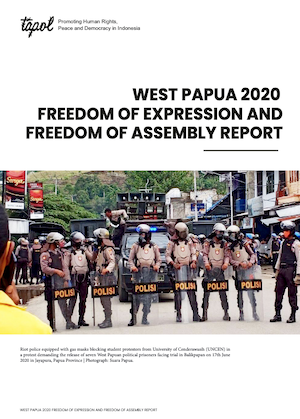
The Indonesian government has used the covid-19 pandemic as a pretext to crack down on West Papuan street protests and to impose online censorship, according to new research published by the human rights watchdog TAPOL. Covid-19 protocols have given more power to the police and military to crush protests but they are not fairly implemented across Indonesia in general. The findings are in a new study, the West Papua 2020: Freedom Of Expression And Freedom Of Assembly Report, in which TAPOL has collated and analysed incidents recorded by West Papuan and Indonesian civil society organisations.

The West Papua 2020 Report
The West Papua 2020 Report. Image: Tapol screenshot APR

https://www.phnompenhpost.com/international/indonesia-faces-scrutiny-over-papua

https://www.ucanews.com/news/widodo-criticized-for-rights-violations-in-indonesia/94647#