Posts Tagged ‘EU’

EU – China Summit on 1 April should not be a joke

March 30, 2022

European Union leaders should announce specific policy responses to the Chinese government’s atrocity crimes, Human Rights Watch said today, 30 March 2022. A virtual summit between the EU and China is scheduled for April 1, 2022.

The summit takes place at a time of heightened tensions between the EU and the Chinese government, which retaliated against Lithuania for its relations with Taiwan, baselessly sanctioned EU bodies and European research institutions, and has not condemned Russian war crimes in Ukraine. The Chinese government’s disregard for international human rights norms mirrors its domestic track record of grave abuses without accountability.

The EU’s foreign policy chief has pointed with alarm to the Chinese government’s ‘revisionist campaign’ against universal human rights and institutions,” said Sophie Richardson, China director at Human Rights Watch. “Brussels should revise its approach to match the magnitude of that threat.”

In a March 18 joint letter from 10 nongovernmental organizations to Ursula von der Leyen, president of the European Commission, and Charles Michel, president of the European Council, Human Rights Watch cited Chinese authorities’ deepening assault on human rights, including crimes against humanity targeting Uyghurs and other Turkic communities in Xinjiang, and heightened repression in Tibet and Hong Kong. Human rights defenders across the country – including the citizen journalist Zhang Zhan, the Uyghur intellectual and Sakharov Prize laureate Ilham Tohti, the Swedish publisher Gui Minhai, and many others – remain arbitrarily detained. {see https://www.trueheroesfilms.org/thedigest/laureates/37AE7DC4-16DB-51E9-4CF8-AB0828AEF491, and https://humanrightsdefenders.blog/2020/02/25/gui-minhai-10-years-jail-sentence-in-china/

While the EU has taken important steps in reaction to these developments, including some targeted sanctions and strong condemnations of Beijing’s abuses at the United Nations, these efforts lack the consequences to bring significant change. The rights groups urged Michel and von der Leyen to use their time with the Chinese leaders to announce further steps to counter Beijing’s abuses, and cautioned them against calling for yet another round of the bilateral human rights dialogue, which after 37 rounds has proven unable to secure concrete progress.

Stronger, better coordinated action is also supported by the European Parliament, which has remained a staunch critic of the Chinese government’s crackdown and has repeatedly denounced its abuses. Beijing responded by sanctioning several members of the European Parliament. In response, the European Parliament froze consideration of a bilateral trade deal and called for a new, and more assertive, EU strategy on China, including further targeted sanctions and closer coordination with like-minded partners. [see: https://humanrightsdefenders.blog/2021/05/21/china-eu-investment-deal-off-the-rail/]

Presidents Michel and von der Leyen should go beyond words of condemnation at the summit if they want to deter Chinese government violations now and in the future,” said Claudio Francavilla, EU advocate at Human Rights Watch. “Bolder steps are needed to counter Beijing’s crimes against humanity and anti-rights agenda, and EU leaders should announce their determination to pursue them.”

https://www.hrw.org/news/2022/03/18/joint-ngo-letter-ahead-eu-china-summit

https://www.hrw.org/news/2022/03/30/eu-no-business-usual-china-summit

Russia refuses to further participate in the Council of Europe

March 11, 2022

In a short statement that was issued on 10 March 2022, the Russian Ministry of Foreign Affairs indicated that they will no longer participate in the Council of Europe in response to ‘the EU’s and NATO’s continued efforts to destroy the Council of Europe and the common humanitarian and legal space in Europe’. It could mean that Russia may leave Europe’s main organisation on human rights, rin response to its recent suspension related to the war in Ukraine.

Russia will not participate in the transformation by NATO and the EU obediently following them of the oldest European organization into another platform for incantations about Western superiority and narcissism,” the ministry said, according to Russian media outlet RIA News. “Let them enjoy communicating with each other without Russia.

Russia joined the Council of Europe in the winter of 1996, and since then the country has had a moratorium on the death penalty. Two years later, Moscow ratified the European Convention for the Protection of Human Rights and Freedoms (ECHR).

Several times Russia was deprived of the right to vote in the Parliamentary Assembly of the Council of Europe, despite the fact that it is one of the five largest sponsors of the organization. After the start of the special operation in Ukraine, the Council of Europe suspended Moscow’s membership.

On 17 March 2022 the Committee of Ministers of the Council of Europe has formally decided that the Russian Federation ceases to be a member of the organisation. This happens after just over a quarter century of membership, since Russia joined on 28 February 1996. 

See also: https://humanrightsdefenders.blog/2019/05/09/ruxit-a-real-possibility-and-bad-for-human-rights-defenders/

https://www.dailysabah.com/world/europe/russia-refuses-to-participate-in-council-of-europe

https://www.echrblog.com/2022/03/russia-will-no-longer-participate-in.html

https://www.echrblog.com/2022/03/what-would-russias-departure-from.html

https://www.echrblog.com/2022/03/formal-end-of-russias-council-of-europe.html

but…https://www.echrblog.com/2022/03/echr-continues-to-apply-for-russia.html

EU by far biggest funder of human rights defenders

February 28, 2022

The European Union (EU) provided roughly €10 billion to support non-government organisations (NGOs) in its partner countries over the past seven years (2014-2021) EU High Representative and Vice-President Josep Borrell said in a statement in celebration of World NGO day, 26 February.

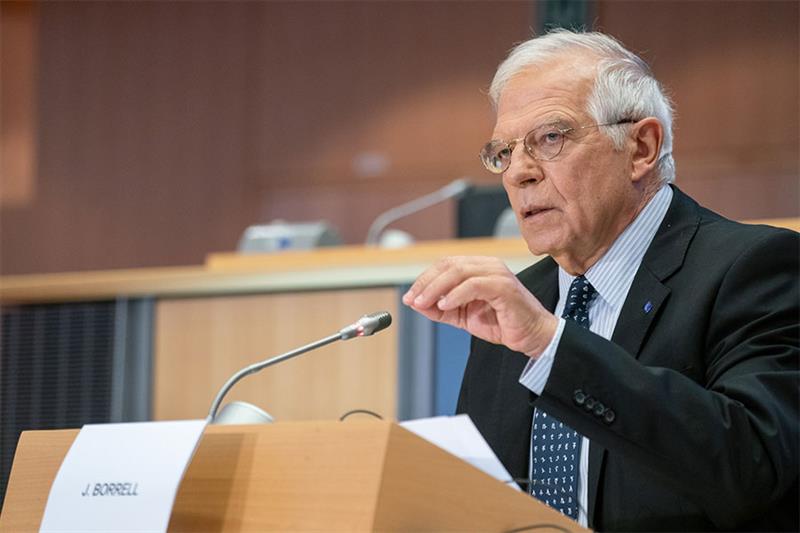
Josep Borrell

File Photo: EU s High Representative and Vice-President Josep Borrell. Photo courtesy of European parliament website.

With these allocations, the EU represents the world’s largest provider of support to local NGOs in partner countries, Borrell noted. He also stated that it has been a leading donor for the protection and support of human rights defenders, with 53,000 defenders and their families taken care of through the website ProtectDefenders.eu since 2015. See also: https://humanrightsdefenders.blog/2021/12/17/eu-launches-a-e1-5-billion-6-year-plan-to-promote-human-rights-and-its-defenders/

On World NGO Day, we honour all civil society actors who, every day, are at the forefront of the fight for human rights, the respect of democratic values and the rule of law. The EU commends their role in supporting and giving a voice to the most vulnerable as well as their essential contribution to building peaceful, just, and inclusive societies.

Today, with the unprovoked and unjustified military aggression against Ukraine by the Russian Federation, international peace and the rule of law are under attack. The EU stands firmly by the Ukrainian and Russian people along with their civil society and youths, whose future and voices are threatened by President Putin’s disregard of democracy, human rights, and international rules,” Borrell stated.

Borrell added that countries that curtail NGOs’ activity through legal and administrative measures hamper universal human rights and fundamental freedoms. See e.g.: https://humanrightsdefenders.blog/tag/foreign-agents/

Nicaragua: death in detention and sham trial

February 21, 2022

The United Nations Human Rights Council’s 49th session, which begins on February 28 in Geneva, presents an opportunity to send a powerful message to the Ortega-Murillo government that these human rights violations will not be tolerated. Governments should support a strong resolution on Nicaragua, demanding the release of all detainees subjected to arbitrary detention and prosecutions and establishing an independent mechanism to investigate rights violations.

Tamara Taraciuk Broner, Acting Director, Americas Division of HRW, describes the latest in the Nicaraguan Government’s Attempts to Tighten its Authoritarian Grip:

Nicaragua’s courts are scheduled to hold a sham trial of seven government critics and opposition leaders, all arbitrarily imprisoned since June 2021. It’s the latest in a slew of trials of people detained on absurd charges months on end.

This week’s trial epitomizes Nicaragua’s mockery of justice: A joint trial, with no due process, on charges of “conspiracy to undermine national integrity,” in most cases based solely on the defendants’ exercise of their right to free expression, that will most likely result in swift convictions for all.

Since February 1, at least 14 detainees have been found guilty of “undermining national integrity” during closed-door trials at “El Chipote” prison, rather than at public courthouses, as Nicaraguan law requires. Each trial has lasted just a few hours and has resulted in swift convictions and sentences of several years in prison.

Announcing the trials on January 31, the Attorney General’s Office called the detainees “criminals and thieves.” Authorities had suspended the trials in October 2021 without offering a clear reason.

Between May and November 2021, the government unleashed a wave of arbitrary arrests to pave the way for President Daniel Ortega’s reelection to a fourth consecutive term. Nicaraguan authorities arrested at least 40 critics, including student and business leaders, campesino representatives, defense lawyers, journalists, activists, and seven presidential candidates. More than 130 others were detained earlier and remain in detention.

Criminal proceedings have lacked basic due process. In many cases, detainees were held incommunicado for weeks or months at El Chipote, some in prolonged solitary confinement. When allowed visits, families described abusive conditions, including repeated interrogations and insufficient food.

On February 12, Hugo Torres died in detention. Torres a 73-year-old former companion of Nicaraguan President Daniel Ortega, had been arbitrarily arrested in early June and accused of “treason.”

Prosecutors have based serious accusations solely on claims that the accused had given interviews to media outlets, shared WhatsApp messages, participated in meetings, or signed letters calling for free elections, demanding international condemnation of government abuses, or expressing support for sanctions against Nicaraguan officials.   

These trials contribute to President Ortega’s mounting record of abuse. Given the lack of judicial independence of Nicaraguan courts, this would provide victims the possibility of being heard by an independent body with a chance to holding perpetrators accountable.

Other inmates also are in dire straits, according to family members and rights defenders, who say the prisoners are malnourished, losing weight, teeth and memory, and getting weaker by the day.

Many are facing a serious risk to health and life,” the former president of the Inter-American Commission on Human Rights (IACHR), Antonia Urrejola, said on Twitter.

Ortega, who secured a fourth consecutive term in November elections, has faced widespread criticism from rights groups, opposition figures and international observers who decried the vote as “a sham”.

On Monday, the European Union’s external affairs spokesman, Peter Stano, sent “deep condolences” to Torres’s family and called for an independent investigation into his death. “We reiterate our call for the immediate and unconditional release of all political prisoners … subjected to inhumane detention conditions” in Nicaragua, Stano tweeted.

See also: https://humanrightsdefenders.blog/2021/12/24/vilma-nunez-human-rights-defender-who-stays-in-nicaragua/

https://www.hrw.org/news/2022/02/14/nicaraguas-ultimate-sham-trial

https://www.aljazeera.com/news/2022/2/14/calls-grow-for-nicaragua-to-release-jailed-opposition-figures

Human Rights Defenders and the EU’s mandatory due diligence initiative

February 21, 2022

Since Mary Lawlor took up her mandate of Special Rapporteur on the situation of Human Rights Defenders, she has been paying close attention to the EU’s legislative initiative on sustainable corporate governance, and in particular to the proposed creation of binding obligations for companies to carry out due diligence to identify and address human rights and environmental risks linked to their activities. See also: https://humanrightsdefenders.blog/2021/09/07/un-experts-urge-eu-to-take-the-lead-on-protecting-human-rights-defenders-in-context-of-business/

The reason is that defenders who draw attention to the human rights and environmental risks associated with business projects, including of EU companies, and who seek accountability where violations and harms actually occur, are often at high risk of retaliation for their actions, in particular where they themselves are from the communities directly affected.

With this in mind, in September 2021, she issued the public statement referred to above calling on the EU Commission to seize the moment and craft a powerful, progressive proposal which would include safeguards for Human Rights Defenders highlighting corporate harms. She followed this up in November with a series of meetings with key EU Commissioners and their teams in Brussels, during which she outlined what she believes to be the key provisions to include in their proposal on due diligence for it to empower human rights defenders. This position has now become public through the paper below:

EU Rule of law enforcement: road is now free

February 17, 2022
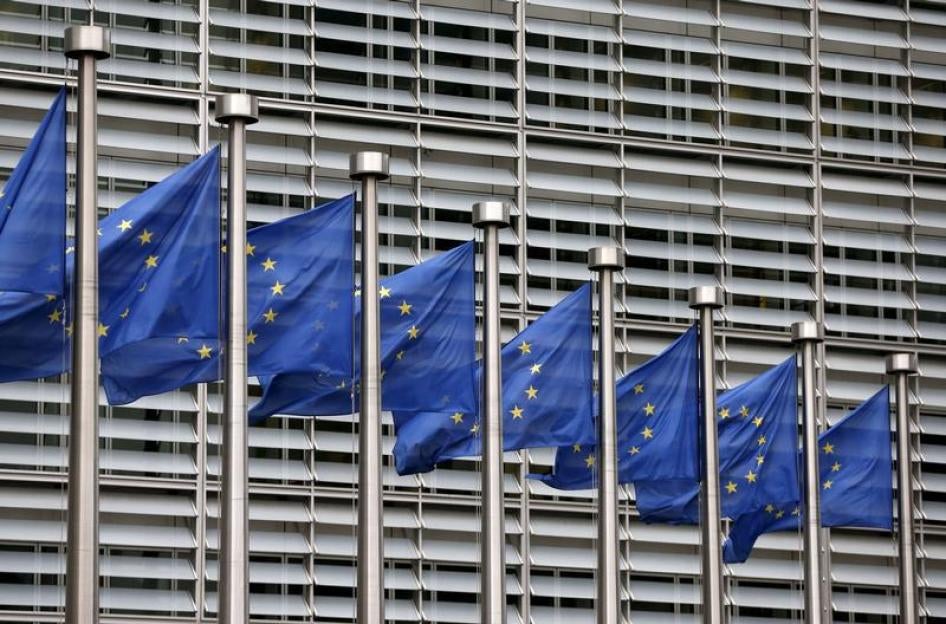
European Union flags flutter outside the EU Commission headquarters in Brussels, Belgium, October 28, 2015.
European Union flags flutter outside the EU Commission headquarters in Brussels, Belgium, October 28, 2015. © 2015 Reuters

The decision on February 16, 2022 by the Court of Justice of the European Union to allow EU institutions to tie funding to EU states to respect for the rule of law clears the way for strong action by the European Commission, Human Rights Watch said. The EU Court’s ruling dismissed the actions brought by Hungary and Poland against the new conditionality mechanism.

The EU Court has sent a clear signal that EU funds should be used in ways that uphold rather than undermine Europe’s democratic values,” said Philippe Dam, Europe and Central Asia Advocacy Director at Human Rights Watch. “The EU Commission should now act swiftly and demonstrate that defending the rule of law is at the top of its agenda.”

In December 2020 the EU adopted a regulation creating a new conditionality mechanism to protect the EU budget from rule of law breaches by an EU member state. A last-minute deal among EU member states obliged the Commission to wait for a ruling by the EU Court of Justice before finalizing the guidelines for applying the conditionality mechanism. Hungary and Poland brought legal action before the EU Court seeking to annul the rule of law conditionality mechanism in March 2021, initiating that process…

The court’s ruling confirms that “compliance by the Member States with the common values on which the European Union is founded (…) such as the rule of law and solidarity, justifies the mutual trust between those States.” The Court added that the EU “must be able to defend those values.”

The European Commission should demonstrate its stated commitment to protect the rule of law and democratic values in the EU by swiftly initiating procedures provided by the regulation, Human Rights Watch said. It should seek to suspend, reduce, or prevent new agreements to provide EU funds to a member state if it finds that the state has failed to respect the rule of law.

In applying the conditionality mechanism, the European Commission should ensure that a broad range of breaches to EU’s democratic values could lead it to recommend cutting funds to EU member states. These should include attacks on the independence of the judiciary, as well as state interference with media and civil society. The Commission should also seek to ensure that EU funding cannot be used to promote intolerance or discriminatory policies, including against women and lesbian, gay, bisexual, and transgender (LGBT) people and other minorities.

The Commission should also ensure that carrying out this procedure does not punish EU citizens for the actions of their governments, including by negatively affecting their economic and social rights. The Commission should conduct human rights impact assessments to determine the risk that people’s rights would be harmed by any decision and should divert rather than cut funding as required, to ensure that beneficiaries’ rights are not affected.

Hungary and Poland, the two EU countries that initiated legal action against the regulation, are already facing scrutiny for their poor rule of law records under the Article 7 procedure – the EU treaty provision dealing with governments that flout EU values, which can ultimately lead to the suspension of their voting rights in the Council. Hungary is among the largest recipients of EU funding per capita, and Poland is the largest overall net recipient.

Poland’s government has eroded judicial independence and ignored recent EU Court of Justice decisions. It also used its politically compromised constitutional tribunal to undermine women’s rights and the binding nature of EU law. LGBT and women’s rights activists face threats and harassment. In Hungary, restrictive laws target civil society groups, and the government or its supporters control most media outlets. A June 2021 law banned discussion on gender identity and sexual orientation, putting health providers, educators, artists, and broadcasters at risk of sanctions.

EU member states also have a serious responsibility to ensure that all member states respect EU’s democratic values and the rule of law. On February 22 they will hold a hearing on the situation of the rule of law in Poland under the Article 7 procedure. But since Article 7 was triggered in 2017 on Poland and in 2018 on Hungary, other EU member states have failed to take further action to hold those two governments to account.

..Proceedings under Article 7 should remain the cornerstone of the action against the erosion of EU values in countries like Hungary and Poland. The EU is equipped with the tools needed to stand up against member states that disregard the EU’s own democratic values, Human Rights Watch said. What has been missing is political will by the EU Commission and by leading EU member states to take decisive action and to hold states responsible for abuses to account.

The EU Court ruling underscores that EU institutions can fight back against the erosion of the rule of law within the bloc, but much depends on the European Commission quickly building on this momentum,” Dam said. “Tying EU money to EU values and strengthening scrutiny of rule of law abuses should go hand in hand to demonstrate that EU membership and respect for the rule of law are inseparable.

See also: https://humanrightsdefenders.blog/2020/01/13/european-judges-demonstrate-in-poland-against-the-muzzle-law/

https://www.hrw.org/news/2022/02/16/eu-top-court-approves-linking-eu-funds-rule-law

https://www.aljazeera.com/news/2022/2/16/poland-hungary-lose-legal-challenge-against-eu-rule-of-law-tool

Myanmar: one year after the coup – only getting worse

February 2, 2022
A crowd of protesters wearing face masks, holding up an image of a woman, Aung San Suu Kyi.

On 1 February last year, the military seized power over Myanmar/Burma by overturning the election results and detaining State Counsellor Aung San Suu Kyi. The military is still controlling power by force and uses brutal violence against human rights defenders, civil society groups, and journalists in order to silence all forms of protest and dissent. More than 1,500 people have been killed by the military and over 8,000 people have been arrested.

The coup prompted mass protests and more than 1,500 people have been killed by the military. Over 8,000 people have been arrested in the harsh crackdowns. In a series of charges, Aung San Suu Kyi has been sentenced to several years in prison. Most recently, five new corruption charges against her were announced and in all she faces up to 164 years in jail. See also: https://humanrightsdefenders.blog/2021/09/30/rohingya-human-rights-leader-mohibullah-murdered-in-bangladesh-refugee/

Despite the military’s brutal response, people have come together to fight the dictatorship. Nationwide protests, boycotts, strikes, and coordinated civil disobedience movements have taken place. Journalists across the country have continued their work despite severe attacks by the military.  

A new report by Athan looks at how the military coup has affected journalists’ work and press freedom in the country. Throughout the country’s history, military coups have led to severe attacks on press freedom and the 2021 coup is no exception.  Since the launch of the coup, 141 journalists have been arrested and 13 have been sentenced to prison. On 10 December, photojournalists Ko Soe Naing and Ko Zaw Tun were arrested while taking photos of a nationwide silent strike. Ko Soe Naing was tortured to death at the interrogation centre four days later. Just a couple of weeks after that, editor of the Federal Journal, A Sai Kay (Aka) Sai Win Aung, was shot dead by the military in Lay Kay Kaw.  See also: https://humanrightsdefenders.blog/2021/05/11/three-democratic-voice-of-burma-journalists-and-two-activists-risk-refoulement-by-thailand/

According to Athan, the attacks on press freedom since the 2021 military coup have been the worst the country has seen.  “Journalists and news media require continuous support to sustain local media and its journalists in order to secure journalists’ careers and their safety, and to enable an environment for journalistic professionals and the industry,” says a representative from Athan about the report. 

On the one-year anniversary of the military coup in Myanmar, the High Representative on behalf of the European Union and the Foreign Ministers of Albania, Australia, Canada, New Zealand, Norway, Republic of Korea, Switzerland, the United Kingdom, and the United States, have made the following declaration:

….The European Union is deeply concerned by the continuing escalation of violence and the evolution towards a protracted conflict with regional implications. Since the military coup, the situation has continuously and gravely deteriorated. A large part of the population is now in a highly precarious situation, experiencing poverty, food shortages, displacement, and violence. ..

The European Union condemns in the strongest terms continuing grave human rights violations including torture, sexual and gender-based violence, the continued persecution of civil society, human rights defenders, and journalists, attacks on the civilian population, including ethnic and religious minorities by the Myanmar armed forces. Therefore, the EU calls for full accountability of the leaders responsible for the coup as well as of the perpetrators of violence and human rights violations. The EU also reiterates its firm demand for the immediate and unconditional release of all prisoners arbitrarily detained in relation to the coup and the return to power of democratically elected leaders.

As a matter of priority, the EU reiterates its calls for an immediate cessation of all hostilities, and an end to the disproportionate use of force and the state of emergency. The military authorities must ensure rapid, safe, and unhindered humanitarian access to all displaced persons and people in need, in all parts of the country. The European Union will continue to provide humanitarian assistance, in accordance with the principles of humanity, neutrality, impartiality, and independence and reiterates its call for the full and immediate respect of international humanitarian law…

In view of the escalating violence in Myanmar, increased international action is required in line with the already existing EU arms embargo on Myanmar. Since the military coup on 1 February 2021, the EU has imposed targeted sanctions on the Myanmar military, its leaders, and entities. In the absence of any swift progress of the situation in Myanmar, the EU stands ready to adopt further restrictive measures against those responsible for undermining democracy and the serious human rights violations in Myanmar.

It is a failed coup,” said Yanghee Lee, co-founder of the Special Advisory Group on Myanmar and former UN special rapporteur for human rights in the country in a CNN report of 1 February. “The coup has not succeeded in the past year. And that is why they are taking even more drastic measures to finish out the coup.” He reported on problems for human rights defenders already in 2015, see: https://humanrightsdefenders.blog/2015/03/19/myanmar-backsliding-by-prosecuting-human-rights-defenders-instead-of-perpetrators/

https://edition.cnn.com/2022/01/31/asia/myanmar-coup-anniversary-resistance-junta-intl-hnk-dst/index.html

EU launches a €1.5 billion 6-year plan to promote human rights and its defenders

December 17, 2021

w

On the eve of Human Rights Day (10 December 2021) and coinciding with the Summit for Democracy, the European Union launched the Global Europe Human Rights and Democracy programme. This programme, worth €1.5 billion, steps up EU support in promoting and protecting human rights and fundamental freedoms, democracy, and the rule of law and the work of civil society organisations and human rights defenders around the world during the period 2021–2027. The programme will promote and protect the universality of human rights, strengthen the rule of law and accountability for human rights violations and abuses, and defend the full and effective exercise of fundamental freedoms, including the freedom of expression, supporting independent journalism and media, while seizing opportunities and countering risks associated with digital and new technologies.

High Representative/Vice President Josep Borrell said: “Courageous people from all backgrounds are fighting on a daily basis for their civil liberties, for independent media and to safeguard democratic institutions, often at great personal risk. The European Union stands with them. The Global Europe Human Rights and Democracy programme will allow us to strengthen our support to and protection of universal human rights and democratic principles worldwide: for everyone, at any time and everywhere. Together with civil society organisations, human rights defenders, the UN Human Rights Office and the International Criminal Court, we will leave no one behind.”

International Partnerships Commissioner Jutta Urpilainen, said: “Human rights and democracy are a cornerstone of sustainable and inclusive development, and essential to addressing global challenges and ensure citizens reach their full potential and realise their aspirations. In whichever way you measure it – in stability, equality, economic growth, health or longevity – democracies always outperform other forms of government in the long run. I am proud to think of the countless human rights defenders, young people, women, girls and civil society organisations that the €1.5 billion Global Europe Human Rights and Democracy programme will empower to build a better tomorrow for all of us.

It has five overarching priorities:

  • Protecting and empowering individuals€704 million

Uphold all human rights, including by working towards the universal abolition of the death penalty, the eradication of torture and cruel and inhumane treatment, the fulfilment of basic needs, decent working conditions, the eradication of child labour, and a safe, clean, healthy and sustainable environment. The programme will promote equality, inclusion and respect for diversity, support human rights defenders and counter shrinking space for civil society, and strengthen the rule of law, ensure a fair and effective administration of justice, and close the accountability gap.

  • Building resilient, inclusive and democratic societies – €463 million

The programme will support functioning pluralist, participatory and representative democracies, and protect the integrity of electoral processes. It will, for instance, engage civil society observers in election observation and support pro-democracy organisations, networks and alliances.

  • Promoting a global system for human rights and democracy – €144 million

Enhance strategic partnerships with key actors, such as the Office of the UN High Commissioner for Human Rights (OHCHR), the International Criminal Court (ICC), regional human rights systems, national human rights institutions, the private sector, and the Global Campus of Human Rights.

  • Safeguarding fundamental freedoms, including harnessing the opportunities and addressing the challenges of digital and new technologies €195 million

Create and maintain an environment conducive to the full exercise of all fundamental freedoms both offline and online. For example, it will help strengthen the capacity of independent, pluralistic and quality media, including investigative journalists, bloggers and fact-checkers, to provide the public with reliable information through responsible and professional reporting. It will support civil society in fostering online media literacy and digital skills and in promoting an open, global, free and secure internet equally accessible to all.

  • Delivering by working together – €6.6 million

The earmarked funds can support the civil society in engaging with national authorities within the framework of the human rights dialogues that the EU conducts with partner countries, or finance training, studies, or exchanges of best practice. It underpins all of the activities.

In the first year of implementation, the EU will focus on promoting a global system for human rights and democracy. For example, in 2022–2024, the EU will support the Office of the United Nations High Commissioner for Human Rights with €16 million, the Global Campus of Human Rights with €10 million, and the International Criminal Court with €3 million. The EU will also support in 2022 the launch of a Team Europe Democracy initiative to reinforce the impact of EU and Member States’ global support to democracy. The 2021 action plan complements a number of urgent individual measures under the programme adopted earlier.

Background

The Global Europe Human Rights and Democracy programme is flexible as regards procedures, and supports civil society actions independently of the consent of partner countries’ governments and other public authorities. A substantial part of the programme will be implemented at country level. Subsequent calls for proposals covering the different activities, open to civil society organisations across the world, will be published in the coming months. See also: https://humanrightsdefenders.blog/2018/02/27/10611/

Funded under the thematic pillar of the new Neighbourhood, Development and International Cooperation Instrument (NDICI) – Global Europe, the Global Europe Human Rights and Democracy programme is the successor of the European Instrument for Democracy and Human Rights (EIDHR), which was established in 2006 to support civil society-led actions in the area of human rights and democracy in countries outside the EU. Under the previous financial period 2014–2020, the European Instrument for Democracy and Human Rights was allocated €1.33 billion.

NGOs demand EU to impose sanctions on NSO Group

December 7, 2021

Dozens of rights groups are urging the European Union to impose sanctions on the Israeli NSO Group to ban the company’s Pegasus surveillance technology. The letter sent to the EU was signed by 86 rights groups and independent experts, including Reporters Without Borders, Amnesty International, Human Rights Watch, the Electronic Frontier Foundation and Privacy International, among others. A consortium of media revealed that this powerful spyware was used extensively by several governments to spy on lawyers, journalists, political opponents and human rights activists.

Several victims of illegal surveillance have been identified in Hungary, where the government initially denied being a client of NSO Group, before admitting to having purchased the software. See also: https://humanrightsdefenders.blog/2021/11/10/palestinian-ngos-dubbed-terrorist-were-hacked-with-pegasus-spyware/

A good resource is here: https://www.haaretz.com/israel-news/MAGAZINE-nso-pegasus-spyware-file-complete-list-of-individuals-targeted-1.10549510

Several victims of illegal surveillance have been identified in Hungary, where the government initially denied being a client of NSO Group, before admitting to having purchased the software. See also:

There is overwhelming evidence that Pegasus spyware has been repeatedly used by abusive governments to clamp down on peaceful human rights defenders, activists and perceived critics,” Deborah Brown, senior digital rights researcher and advocate at Human Rights Watch, said in a statement. “The EU should immediately sanction NSO Group and ban any use of its technologies.”

The EU’s global human rights sanctions would allow the EU to adopt “ “targeted sanctions against entities deemed responsible for violations or abuses that are “of serious concern as regards the objectives of the common foreign and security policy”, including violations or abuses of freedom of peaceful assembly and of association, or of freedom of opinion and expression,” the letter read.

According to Human Rights Watch, these rights have been “repeatedly violated using NSO technology,” and, as highlighted by the UN Special Rapporteur on freedom of opinion and expression, “the use of spyware by abusive governments can also facilitate extrajudicial, summary or arbitrary executions and killings, or enforced disappearance of persons.” See also: https://humanrightsdefenders.blog/2021/10/04/big-coalition-urges-un-to-denounce-abuses-facilitated-by-spyware-technologies/

NSO Group was blacklisted by the US State Department at the beginning of November, and slapped with a sanction that drastically limited the business relationships the US company had with US customers or suppliers, according to the French newspaper Le Monde. “The EU should unequivocally close its doors to business with NSO Group,” Brown said.

“Targeted sanctions are necessary to that end, and to add to growing international pressure against the company and the out-of-control spyware industry.”

In Europe, several investigations are ongoing, but no sanctions have been formally imposed on the company. In addition to Hungary, several other countries are, or have been, customers of NSO Group – although this does not mean that all these countries have made illegal use of Pegasus.

In addition to Germany, several EU countries have purchased access to the software, according to Le Monde.

See also: https://www.haaretz.com/israel-news/tech-news/.premium.HIGHLIGHT.MAGAZINE-citizen-lab-vs-nso-the-institute-taking-down-israel-s-mercenary-spyware-firms-1.10536773

https://slate.com/technology/2021/12/apple-lawsuit-nso-group-q-cyber-pegasus.html

https://www.euronews.com/next/2021/12/03/pegasus-spyware-ngos-urge-the-eu-to-sanction-israeli-group-nso

And the latest: https://marketresearchtelecast.com/spyware-sale-at-nso-group-the-end-of-pegasus/226205/

as well as

https://www.irishtimes.com/news/ireland/irish-news/concern-activist-s-phone-infected-with-spyware-during-dublin-conference-1.4778962

in 2022 the following items can be added:

https://www.hrw.org/news/2022/01/26/human-rights-watch-among-pegasus-spyware-targets

https://thewire.in/tech/nso-chairman-quits-says-departure-unrelated-to-recent-scandals

Alexei Navalny wins EU’s Sakharov Prize

October 21, 2021

Imprisoned Russian opposition leader Alexei Navalny has been awarded with the Sakharov Prize for Freedom of Thought. The award winner was selected by the leaders of the political parties represented in the European Parliament during a plenary session in Strasbourg on Wednesday 20 October 2021. [For more on this and other awards in the name of Sakharov, see: https://www.trueheroesfilms.org/thedigest/awards/BDE3E41A-8706-42F1-A6C5-ECBBC4CDB449]

Navalny, the most prominent foe of Russian President Vladimir Putin, was nominated alongside Afghan women, whose plight has taken centre stage after the Taliban takeover, and Jeanine Áñez, a Bolivian politician who became interim president in 2019 after alleged electoral fraud by Evo Morales. Áñez was later arrested for allegedly plotting coup d’état against Morales. [see: https://humanrightsdefenders.blog/2021/09/29/the-nominees-for-the-eus-sakharov-prize-2021/]

The award is supposed to be presented during a European Parliament session in Strasbourg on December 15, although this seems unlikely to happen in the case of Navalny since he’s currently serving a two-and-a-half-year jail sentence for fraud in Russia.

See also: https://www.trueheroesfilms.org/thedigest/laureates/c549c081-1c9f-489a-8ba6-6e2323cb9fcb

He says the charges were politically motivated to halt his challenge to the Kremlin. Russian authorities have opened a new criminal case against Navalny that could see him stay in jail for another decade.

Today’s prize recognises his immense bravery and we reiterate our call for his immediate release,” said David Sassoli, President of the European Parliament, in a tweet. The main political parties also celebrated the laureate’s work and recognition, although some

“His unbroken commitment for a democratic Russia is representative of the many activists who are fighting for liberal rights,” wrote David McAllister, a German MEP of the centre-right EPP group and chairman of the parliament’s committee on foreign affairs.

His bravery for freedom of thought and expression show how they are the precondition for democratic politics, human dignity & peace,” said Belgian MEP Guy Verhofstadt, from Renew Europe.

https://www.euronews.com/2021/10/20/alexei-navalny-wins-sakharov-prize-the-eu-s-highest-award-for-human-rights-work