Hans Thoolen on Human Rights Defenders and their awards

share information on human rights defenders, with special focus on human rights awards and laureates


Posts Tagged ‘environmental activists’

« Older posts
Newer posts »

Protective accompaniment for land, water and human rights defenders badly needed

January 17, 2019
Photo: Peace Brigades International
Those who work to defend land, water, Indigenous, LGBTQI+ and human rights around the world face many dangers, including death- Photo: Peace Brigades International

Brent Patterson wrote on 16 January, 2019 a blog post: “Protective accompaniment supports land, water and human rights defenders”. It is a timely reminder of the work done by PBI:

According to Front Line Defenders, 2018 saw the highest number ever on record of human rights defenders killed [https://humanrightsdefenders.blog/2019/01/09/front-line-defenders-says-record-number-of-activists-killed-in-2018/]. One way to support these defenders is through protective accompaniment (often popularly describes ed as the ‘human shiled’). According to NGO Peace Brigades International (PBI), “Protective accompaniment is a strategy pioneered by PBI for protecting human rights defenders and communities whose lives and work are threatened by political violence.” The strategy involves recruiting volunteers from around the world who want to help “defend the defender,” providing them with training, and then sending them into areas of conflict in a highly visible way to provide increased security and moral support to defenders.

Normally volunteers spend a minimum of one year in the field. “When the level of threat is high accompaniment is sometimes round the clock. In other situations volunteers stay with threatened communities or remain in the offices of organizations, and accompany threatened activists when they travel,” PBI notes. “Another form of accompaniment is regular phone calls to organizations to check on their safety.“

These volunteers are backed by an international network that raises the profile of the defender and their struggle, provides analysis and international solidarity, and increases the stakes and risk of repercussions for potential attackers. “Accompaniment increases the perceived political costs of ordering an attack in front of international witnesses — witnesses whose organization is committed to making such attacks as costly as possible for those responsible,” PBI notes. The political costs can be amplified by garnering local, national and international media coverage, mobilizing embassies, governments and international bodies, challenging with facts the official rhetoric that a human rights situation is improving, and making risk-adverse investors aware they could lose money with controversial mega-projects. Hundreds of defenders have received protective accompaniment over the years.

Those accompanied by PBI have included activists from Indigenous communities, environmental organizations, women’s organizations, trade unions, community organizations, as well as LGBTQI+ activists, journalists, lawyers and relatives of the disappeared.

Brent Patterson is an activist-blogger who writes this monthly column on inspiring stories of global resistance to neoliberalism and climate change.

http://rabble.ca/columnists/2019/01/protective-accompaniment-supports-land-water-and-human-rights-defenders

Posted in Human Rights Defenders | Leave a Comment »
Tags: Brent Patterson, environmental activists, Human Rights Defenders, human shield, land rights defender, PBI, Peace Brigades International, protection of HRDs, Protective accompaniment

Global Witness report 2018 on environmental defenders: bad (but 2017 was worse)

January 9, 2019

This morning I blogged about Front Line Defenders Global Analysis 2018 report which notes a record number of human rights defenders killed in 2018 with the majority being environmental defenders [see: https://humanrightsdefenders.blog/2019/01/09/front-line-defenders-says-record-number-of-activists-killed-in-2018/]. On 24 December 2018 Taran Volckhausen, referring to a preliminary Global Witness report, wrote that – while the numbers were still being finalized – the death toll for this group in 2018 was slightly lower than in 2017 (“For embattled environmental defenders, a reprieve of sorts in 2018”). This is most likely due to definition issues.

Read the rest of this entry »

Posted in human rights, Human Rights Defenders | 4 Comments »
Tags: annual report 2018, Berta Carceres, Brazil, environmental activists, Global Witness, Indigenous rights, Jair Bolsonaro, Mongabay, Muhammad Yusuf, Philippines, Taran Volckhausen, Victoria Tauli-Corpuz

Front Line Defenders says record number of activists killed in 2018

January 9, 2019
In 2018, 321 defenders in 27 countries were targeted and killed for their work – the highest number ever on record – according to data collected by Front Line Defenders. More than three-quarters of these, 77% of the total number of activists killed, were defending land, environmental or indigenous peoples’ rights, often in the context of extractive industries and state-aligned mega-projects. [see also: https://humanrightsdefenders.blog/2018/04/28/annual-reports-2017-by-front-line-defenders/]

Front Line Defenders reports that the murders of HRDs were not isolated events, but were preceded by judicial harassment, threats and physical attacks. At least 49% of those killed had previously received a specific death threat, and in an additional 43% of killings there had been general threats made to HRDs in the area. In the vast majority of cases, HRDs did not receive the necessary protection and support from state authorities from the time they reported threats to the time they were murdered.

According to the Front Line Defenders Global Analysis 2018, in addition to the threats experienced by male colleagues, WHRDs face gendered and sexualized attacks from both state and non-state actors, as well as from within their own human rights movements. Such violations include removal from public or high-ranking positions in NGOs, trade unions, and political societies; smear campaigns questioning their commitment to their families; sexual assault and rape; militarized violence; and the harassment and targeting of their children. In Saudi Arabia, authorities arrested, sexually assaulted, and tortured WHRDs who led the successful campaign for the abolition of the driving ban in 2018. Despite these attacks and the ongoing threats to stay silent, WHRDs in Saudi Arabia, as well as their family members, have publicly reported and condemned the abuses and are receiving unprecedented national, regional, and international visibility for their activism.

In addition to physical attacks and torture, the Front Line Defenders Global Analysis 2018 highlights the continuing trend towards restrictive legislation aimed at stifling the powerful work of HRDs and WHRDs, including:

  • A Digital Security Act in Bangladesh carrying a 14-year sentence for using digital media to “cause damage to the state”;
  • Retrospective legislation in Xinjiang province, China, legalising the use of “re-education” camps for the minority Uyghur population, including HRDs;
  • Anti-terror legislation in Nicaragua widening the definition of terrorism to include those accused of damaging property, leading to dozens of arrests of protesters now facing terrorism charges and 20 years in prison.

Front Line Defenders Digital Protection Team responded to a high number of reports from Brazil, Egypt, Guatemala, Honduras, Iraq, Mexico, Nicaragua and Venezuela in 2018. According to the Global Analysis, authorities around the world frequently used phone and email surveillance to target LGBTI+ defenders, WHRDs and environmental activists in particular. The report notes that in Tanzania, Pakistan, Russia, Malaysia, Nicaragua, Turkey, and many countries in MENA, governments claimed that HRDs were threatening “national security” as an excuse for censoring and blocking NGO websites.

Despite the severe and sometimes life-threatening risks faced by HRDs and WHRDs, Global Analysis 2018 highlights a number of major success achieved by HRDs and WHRDs in 2018, including:

  • The critical and leading role played by HRDs in securing The Escazu Agreement, now signed by 24 states in Latin America and the Caribbean, which stipulates a participatory approach to environmental projects and the mitigation of conflicts;
  • The monumental vote for reproductive rights in Ireland, secured through the extensive, decades-long campaigning of Irish WHRDs in the face of defamation, smear campaigns, and threats;
  • The Coalition of Women Leaders for the Environment and Sustainable Development in the Democratic Republic of Congo (DRC), who successfully campaigned for a province-wide decree in Equateur protecting women’s land and forest rights.

In response to attacks against HRDs in 2018, Front Line Defenders is working with HRDs to promote their security with a range of protection programming. In addition to risk management and digital protection trainings, advocacy at the national, international, and EU level, emergency relocation, Front Line Defenders provided nearly 550 protection grants to activists at risk in 2018. Front Line Defenders also works with HRDs to devise visibility campaigns to counteract the defamation and smear campaigns that put them at risk.

https://www.frontlinedefenders.org/en/resource-publication/global-analysis-2018


Posted in books, Human Rights Defenders | 6 Comments »
Tags: annual report 2018, environmental activists, Front Line (NGO), Global Analysis 2018, Human Rights Defenders, killings, Latin America, threats

Profile of William Leslie Amanzuru, Africa’s defender of the month

November 7, 2018

On 6 November 2018, the African network NGO DefendDefenders published this profile of their ‘Defender of the month’: William Leslie Amanzuru from Uganda:

Read the rest of this entry »

Posted in Human Rights Defenders | Leave a Comment »
Tags: Africa, climate, DefendDefenders, environmental activists, forrest, Human rights defender, profile, Uganda, William Leslie Amanzuru

Joint Statement by NGOs: Ukraine should address attacks against Human Rights Defenders

October 8, 2018

On 3 October 2018 a number of NGOs published a Joint Statement on Ukraine deploying the many attacks against Human Rights Defenders:

More than 50 attacks on activists and human rights defenders in Ukraine have been recorded by local human rights organisations in just the last nine months, Amnesty International, Human Rights Watch, Freedom House and Front Line Defenders said today. Those under attack include people working to defend the rights of lesbian, gay, bisexual, and transgender (LGBT) people, protect the environment, and campaign against corruption. 

The organisations criticised the lack of effective investigations into these incidents and of prosecutions of those responsible, which heightens the risk to human rights defenders and sends a message that the authorities tolerate such attacks and assaults. Recently, the prosecutor general suggested that civil society activists brought the attacks on themselves <https://www.pravda.com.ua/news/2018/09/27/7193378/&gt;  for criticising the authorities, giving an impression that human rights defenders can be openly targeted.

In most cases, the attacks have targeted individuals or groups that campaign against corruption in the local community, shine a light on the operation of local government and businesses, or defend people’s rights. The purpose of such attacks is clear: to silence activists and human rights defenders and to discourage others from speaking out against injustice and standing up for human rights. 

Two recent examples of the kind of vicious attacks that have yet to be effectively investigated took place on 22 September, in Odessa and Kryvyi Rih. Oleh Mikhaylyk, an anti-corruption activist, was shot in Odessa, in southern Ukraine, and remains in the hospital. Mikhaylyk had campaigned with the Syla Lyudei (People’s Power) movement against illegal construction in Odessa. Three hundred kilometers away, in Kryvyi Rih, unidentified assailants broke into the home of Artem Moroka after he criticised the local police on Facebook. The assailants severely beat him, breaking his nose, Moroka told Ukrainian human rights monitors.

In June, an environmental activist, Mykola Bychko, was found dead under suspicious circumstances in a village in Kharkiv region. Villagers found Bychko hanged in the woods near the village of Eskhar on June 5. The local police initially started a suicide investigation, but have yet to investigate the possibility that he was killed in connection with his activism. At the time, Bychko was documenting the pollution of a local river, allegedly caused by a nearby waste treatment plant.  A lawyer representing Bychko’s family questioned the conduct of the local police for ignoring the possibility that this was an intentional killing, and for allegedly intentionally delaying the investigation. The lawyer told Freedom House that police lost relevant evidence from the site where Bychko’s body was found, such as the rope from the improvised gallows. The authorities have also not pursued allegations that Bychko had received threats related to his documentation work, such as questioning people from the waste treatment plant. 

On July 31, an unidentified assailant threw acid on Kateryna Handzyuk, a local council member who monitored police activities, in Kherson. ……….

The Ukrainian authorities should take effective steps to prevent further threats and attacks against activists and human rights defenders, and ensure prompt, thorough, impartial and independent investigations into such threats and attacks and bring those responsible to justice in fair trials. 

The Interior Ministry, the National Police, the prosecutor general’s office, and other relevant institutions should explicitly recognise the important work of human rights defenders in protecting human rights and uncovering corruption. The authorities should publicly denounce any threats and attacks against human rights defenders. They should take decisive measures to ensure that government critics can work in a safe and enabling environment in which they can exercise the rights to freedom of expression, peaceful assembly and association, and conduct their activities without fear of reprisals. 

https://www.frontlinedefenders.org/en/statement-report/ukraine-address-attacks-against-activists-and-human-rights-defenders

https://freedomhouse.org/article/ukraine-address-attacks-against-activists-and-human-rights-defenders

Click to access EUR5092012018ENGLISH.pdf

Posted in AI, Freedom House, Front Line, human rights, Human Rights Defenders | Leave a Comment »
Tags: AI, environmental activists, Freedom House, Front Line (NGO), Human Rights Defenders, joint statement, Kateryna Handzyuk, killings, Mykola Bychko, Oleh Mikhaylyk, protection, Ukraine

Campaign to give the Nobel Peace Prize 2018 to the global community of Human Rights Defenders

September 18, 2018

Over 200 organisations from all over the world have signed on to an open letter endorsing the idea of giving the Nobel Peace Prize 2018 to the global community of Human Rights Defenders.


12 September 2018

Dear Members of the Norwegian Nobel Committee,

9 December 2018 will mark the 20th anniversary of the UN’s Declaration on Human Rights Defenders (HRDs). It is an ideal and opportune moment to recognise and celebrate the efforts of these extraordinary individuals who despite threats of violence and unlawful imprisonment, harassment, intimidation, torture and assassination, continue to peacefully challenge injustice and call for the implementation and strengthening of the rule of law. Since 1998, over 3000 human rights defenders have been killed for defending the fundamental values enshrined in the Universal Declaration of Human Rights adopted by the UN.

In recognising the increasingly hostile environments globally, in which human rights defenders must work, the late Former Secretary-General to the United Nations, Kofi Annan, recently said:

“To stand up for human rights requires courage, perseverance, vigilance and a strong foundation of knowledge and evidence. We need to be vigilant in the protection of human rights defenders, for when the defenders’ rights are violated, all our rights are injured.”

In the same vein and emphasising the critical role that human rights defenders play in promoting and fostering stable democracies and sustainable peace, Permanent Representative of Norway to the Organisation for Security and Cooperation in Europe, Ambassador Steffen Kongstad said: “Threats and attacks against human rights defenders may hamper the realisation of economic, social and cultural rights, undermining social cohesion, and ultimately stability and development.”

Despite this recognition and respect at the highest levels of the international community, human rights defenders are killed every day. HRDs who suffer disproportionately are those activists working at grassroots and community levels, in isolated regions and from marginalised populations, who lack networks and resources to command international attention. Human rights defenders can be community leaders, lawyers, journalists, environmental activists, victims of abuse, trade unionists and teachers.

It is for these urgent reasons that Peace Brigades International with the support of the UK All-Party Parliamentary Human Rights Group has nominated the global community of HRDs for the 2018 Nobel Peace Prize. It is the highest humanitarian achievement through which to recognise HRDs and celebrate their commitment to advocating for and building societies that are peaceful, safe, inclusive, tolerant, just and sustainable for all. The nomination is currently supported by the UN Special Rapporteur on the situation of HRDs and some governments, diplomats and parliamentarians around the world.

We believe that awarding the Nobel Peace Prize to the global community of HRDs will mark a milestone in legitimising the crucial work they undertake to protect humanity and bring the trends of persecution they suffer to the public eye.

Furthermore, this collective award would mark a world first. By nominating a community rather than individuals or organisations, we emphasise that the trends making the defence of human rights ever more risky and ever more admirable, are global. We seek to highlight that the community itself is integral to the defence of human rights and it is the idea of community that motivates people to take enormous risks defending the rights of others and advancing peace.


For some of my earlier post on the Declaration: https://humanrightsdefenders.blog/tag/20th-anniversary-un-declaration-on-hrds/

The release of the open letter is accompanied by a public petition: Human Rights Defenders for the Nobel Peace Prize, which can be signed here.

https://peacebrigades.org.uk/open-civil-society-letter-support-nobel-peace-prize-human-rights-defenders

Posted in awards, Human Rights Defenders | 1 Comment »
Tags: 20th anniversary UN Declaration on HRDs, collective, environmental activists, human rights awards, Human Rights Defenders, international campaign, legitimate, Nobel Peace Prize, open letter, Peace Brigades International

DRAMATIC ESCALATION OF HRDS KILLED IN RECENT YEARS

June 21, 2018

On Wednesday 20 June 2018, Dublin based international human rights organisation, Front Line Defenders along with the HRD Memorial Network, launched a major new report on the killing of human rights defenders (HRDs) at the UN Human Rights Council in Geneva. The report, Stop the Killings, analyses the root causes of killings of HRDs in 6 countries: Brazil, Colombia, Guatemala, Honduras, Mexico and the Philippines, which between them have accounted for 80%  HRDs killed in the last three years. 

In its Annual Reports for the last 4 years, Front Line Defenders has reported the killing of 879 HRDs. These were not random killings but the targeted elimination of those working to improve their own communities.  The use of lethal violence to silence those who defend the rights of the most vulnerable has become widespread, and is endemic in a number of countries. In its 2017 Annual Report, Front Line Defenders reported the killing of 312 HRDs in 27 countries; the true figure is certainly higher. Two-thirds of those killed were working on the environment, land rights and indigenous peoples’ rights, often in remote, rural areas.

Among the key drivers of killings and violence against HRDs detailed in the report are::

  • state failure to recognise the legitimacy and importance of the work of HRDs;
  • smear campaigns against HRDs by the state and/or its agents;
  • economic policies which prioritise the ruthless exploitation of natural resources over the protection of the environment and the land;
  • rights of peasant communities and indigenous peoples;
  • lack of effective systems to document and investigate attacks on HRDs and provide protection;
  • collusion by the state and/or its agents in the killing of HRDs.

The report was launched by United Nations Special Rapporteur on Extrajudicial, Summary or Arbitrary Executions, Agnes Callamard, at a special side event during  Human Rights Council proceedings on Wednesday 20 June 2018.

The full text of the report can be downloaded from: https://share.riseup.net/#VWzkKTN4f-156VE4dc-r_Q

See also my: https://humanrightsdefenders.blog/2018/01/05/front-lines-2017-report-confirms-worst-expectation-over-300-hrds-killed/

https://humanrightsdefenders.blog/2017/07/15/documenting-the-killings-of-environmental-defenders-guardian-and-global-witness/


Posted in books, Human Rights Defenders | Leave a Comment »
Tags: Agnes Callamard, environmental activists, Front Line (NGO), HRD Memorial Network, Human Rights Defenders, Indigenous rights, killings, Latin America, Philippines, report, side event, STOP THE KILLINGS

Seven more land rights defenders killed in Guatemala in a single month

June 13, 2018
On 11 June 2018 Amnesty International demanded that the Guatemalan authorities must take immediate and effective measures to protect human rights defenders and launch thorough, impartial and independent investigations into all attacks against them following the killing of seven human rights defenders in the space of a month. “Guatemala’s brave human rights defenders are being killed with impunity on a terrifyingly regular basis. The authorities must take urgent action to protect them from these savage and calculated attacks before more lives are lost,” said Erika Guevara-Rosas, Americas Director at Amnesty International.

The seven people killed in the last four weeks were all involved in defending their communities’ land, territory or the environment, and they were all members of the Campesino Development Committee (CODECA) or the Altiplano Campesino Committee (CCDA). The wave of attacks began on 9 May, when CODECA coordinator Luis Arturo Marroquín, 47, was shot dead by unidentified assailants in San Luis Jilotepeque. The next day, CCDA member José Can Xol, 37, was also shot to death by unidentified assailants in Choctún Basilá in the municipality of Cobán.

On 13 May, 31-year-old Mateo Chamám Paau, another CCDA member, was found dead in San Juan Tres Ríos, also part of Cobán. He had previously been threatened because of his activism. Then, on 30 May, two men attacked Ramón Choc Sacrab, an Indigenous Q’echí’ leader and regional CCDA leader in Ixloq San Pedrito, Cobán. He died two days later from the injuries sustained to his throat and face. On 4 June, the CODECA community leaders Florencio Pérez Nájera, 42, and Alejandro Hernández García, 40, were found dead in the southern Jutiapa region shortly after attending a community meeting. Their bodies bore machete wounds. Four days later, 68-year-old Francisco Munguia, another CODECA community leader, was also hacked to death by assailants with machetes in Guatemala’s Jalapa region.

To date, no one has been arrested or charged in connection with these killings, which have occurred within a context of extreme violence, including threats, attacks and smear campaigns to demonize human rights defenders. President Jimmy Morales has referred to CODECA using stigmatizing and defamatory language in recent weeks, thus contributing to the atmosphere of hostility and violence against its members. The Unit for the Protection of Human Rights Defenders in Guatemala (UDEFEGUA), a non-governmental organization, documented 493 attacks against human rights defenders in 2017, and there have already been 12 killings this year. Those working on rights related to land, territory and the environment are among the most commonly targeted.

The ray of hope I signaled recently [https://humanrightsdefenders.blog/2018/05/25/ray-of-hope-2-guatemala-and-impunity/], turned out be just a ray. On 16 January 2018 Cargill’s withdrawal sendt an important signal to the palm oil industry, and set an important precedent for environmental and social accountability. “However, it brings with it real concern for ongoing repression,”​ said Jeff Conant, Senior International Forests Program Director for Friends of the Earth. “Unfortunately, land defenders continue to be under threat, and companies that have profited from activities in the region have a responsibility to prevent these threats.”​

https://www.amnesty.org/en/latest/news/2018/06/guatemala-seven-human-rights-defenders-killed-in-four-weeks/

https://www.telesurtv.net/english/news/Guatemala-Campesino-GroupsDenounce-Murder-of-Members-Leaders-20180605-0015.html

http://www.blackseagrain.net/novosti/cargill-suspends-business-with-guatemalan-palm-oil-supplier

Posted in Amnesty international, Human Rights Defenders | Leave a Comment »
Tags: Altiplano Campesino Committee (CCDA), attacks, Campesino Development Committee (CODECA), Cargill, environmental activists, Friends of the Earth, Guatemala, Human Rights Defenders, killings, land rights defender, Luis Arturo Marroquín

Poland and Israel: human rights defenders not welcome

May 9, 2018

For those who think that muzzling human rights defenders is an exclusively non-western affair, look at these examples: Poland and Israel.

On 9 May 2018 Katharina Rall, environment researcher at Human Rights Watch, critically looks at Poland‘s efforts to hamper the freedom of expression and demonstration by human rights defenders at the forthcoming climate summit, known as the COP24. It will bring together state parties to the UN Framework Convention on Climate Change (UNFCCC), and thousands of experts, journalists, businesses and nongovernmental groups.  UN experts cite concerns about the ban on spontaneous assemblies in Katowice during the talks, which will make it difficult for groups to respond to developments at the negotiations. In a letter sent to the Polish government last month they said that by “curtail[ing] the possibility of spontaneously expressing views about the unfolding of the climate talks and organizing peaceful assemblies to this effect”, the new law appears to go beyond the rights restrictions necessary to ensure security and safety at the conference. The UN experts also noted that the law “appears to give sweeping surveillance powers to the police and secret services to collect and process personal data about all COP24 participants”. This is a serious issue for the safety of climate activists at the summit. [The Polish government has yet to respond to the UN rights experts. But a reply from the Polish environment minister to similar concerns raised by the Bureau of the Aarhus Convention, a regional human rights and environmental body, has done little to dispel them.]

Just the day before, 8 May 2018, AP reported that Israel’s Interior Minister, Arieh Deri, has ordered the head of the local office of Human Rights Watch to leave the country within 14 days for allegedly supporting boycotts of Israel. HRW responded that it stands by Omar Shakir, a U.S. citizen of Iraqi descent, and accused Israel of trying to muzzle criticism of its human rights record. It says neither it nor Shakir support boycotts, and that it will challenge the decision in court. Iain Levine, a Human Rights Watch official, says Israel’s actions, such as compiling a dossier on Shakir, and “deporting human rights defenders is a page out of the Russian or Egyptian security services’ playbook.” [In April last year his appointment had already let to controversy, see: https://humanrightsdefenders.blog/2017/04/27/human-rights-watch-granted-israeli-work-permit-in-the-end/]

http://news.trust.org//item/20180509072953-izwk3/

https://abcnews.go.com/International/wireStory/israel-expel-human-rights-watch-rep-boycott-claims-55019948

Posted in HRW, Human Rights Defenders | 1 Comment »
Tags: boycott, climate talks, environmental activists, expulsion, freedom to demonstrate, HRW, Human Rights Defenders, Human Rights Watch, Israel, Omar Shakir, Poland, UN Framework Convention on Climate Change

2018: Latin America still the graveyard for environmental human rights defenders

April 28, 2018

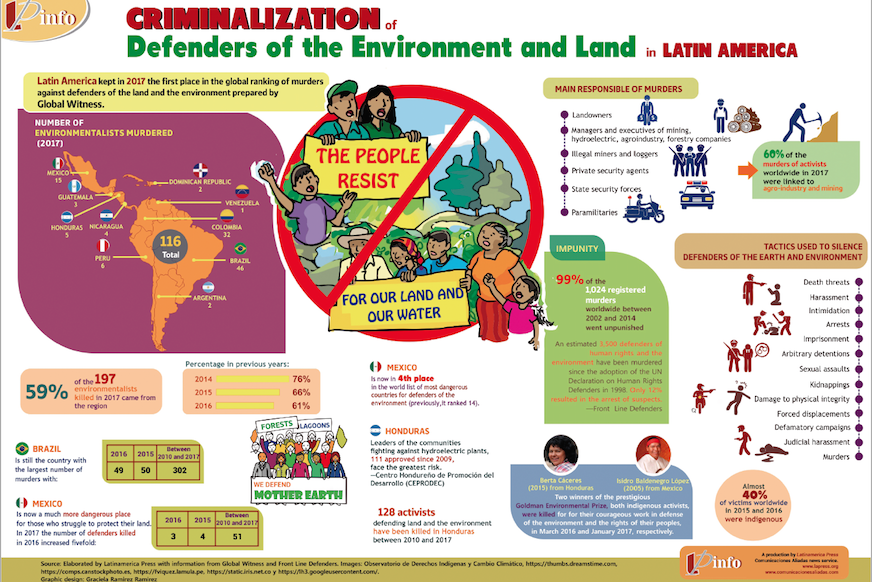
This blog has on several occasions drawn attention to reports that show that Latin America is among the deadliest places to be a human rights defender [e.g. https://humanrightsdefenders.blog/2016/01/06/latin-america-philippines-most-dangerous-places-for-human-rights-defenders/]. An infographic – published on 27 March 2018 by Latin America Press – summarises criminalization of land & environmental rights defenders in Latin America.

 
http://www.lapress.org/objetos/informe/48PI_criminalization-defenders-of-the-land.pdf
In 2016/17 an Amnesty International team took two trips to Peru and one to Paraguay and spoke with representatives of 10 human rights groups in Peru and 14 in Paraguay. AI concludes that environmental leaders are under constant threat. Authorities in Paraguay and Peru are unjustly criminalizing activists who speak out to protect their environment and land, an Amnesty International report released Thursday revealed. [see also: https://humanrightsdefenders.blog/2016/02/27/alarming-criminalisation-of-human-rights-defenders-in-latin-america/]

The report, A Recipe for Criminalization: Defenders of the Environment, Territory and Land in Peru and Paraguay, outlined the three “ingredients” both countries use to undermine the efforts of human rights defenders. First, they delegitimize activists through smear campaigns. Second, they apply laws and regulations that allow for forced evictions. And, third, they misuse the criminal justice system to prosecute activists for unfounded reasons.

“Those who bravely stand up to defend their land and the environment are frequently targeted because of their work. These attacks have a devastating impact on their physical, mental and emotional wellbeing, as well as that of their families and communities,” Amnesty International Americas director Erika Guevara-Rosas said in a press release.

The report included examples of how these ingredients combine on the ground. For example, Amnesty International highlighted the case of community activists working to protect their home in Peru’s Cajamarca region from the gold and copper Conga mining project. On 26 April 2013, police arrested 16 protesters on trumped up charges of abduction and coercion. The state prosecutor sought 30-year prison sentences. But the evidence presented was secondhand and so spotty and contradictory that a court dismissed the case in 2017.

In Paraguay, the Tekoha Sauce community of the Avá Guaraní People was evicted from their ancestral lands by a court order following a dispute with local businessman German Hultz. The community was forced onto a nature reserve where they struggle to survive because hunting and fishing is not allowed. During the court proceedings leading up to the eviction, their opponents stigmatized the indigenous community by referring to them as a “gang of criminals.”

On 24 April 2018, Front Line reported that on 19 April 2018, Olivia Arévalo Lomas, a woman human rights defender and spiritual leader of the Shipibo-Konibo indigenous peoples, was killed by unknown assailants just a few feet from her home in the community of ‘Victoria Gracia’, in Peru. The defender was shot in the chest and died instantly. Her body was left on the street in full view of her local community (https://www.frontlinedefenders.org/en/profile/olivia-arevalo).  The killing of Olivia Arévalo Lomas comes after a spike in violence, threats and intimidation against members of FECONAU communities in Ucayalí, such as Santa Clara de Uchunya. In the past six months, several members of FECONAU have been subjects of attacks. A representative of FECONAU, Edinson Mahua, was shot at close range and narrowly escaped serious injury, while community leaders in Ucayalí have received anonymous death threats. 

In the meantime Colombia has seen a spike in assassinations of human rights defenders in 2018, according to study by Colombian NGO Somos Defensores. A total of 46 human rights leaders have been killed so far this year, up from 26 in the same period last year; paramilitary groups were responsible for three of the killings, four were murdered by guerrilla groups and another four were killed at the hands of security forces. The investigative body also recognized a total of 132 acts of aggression against public defenders so far this year. Of the registered acts, there were 12 attacks, 66 death threats and one case of forced disappearance. The provinces in which the aggression occurred were predominately in areas at the heart of the country’s conflict, with Cauca, Antioquia and Norte de Santander figuring heavily in the statistics.

The UN has said it is “extremely concerned” about the increase in violence surrounding social leaders while Inspector General Fernando Carrillo has “urged” authorities to “assume their commitments to defend the lives of social leaders.” While the government has attempted to reel in the varying armed criminal groups responsible for a lot of these acts — as seen with the 2016 peace deal with the FARC guerrilla organisation, and ongoing peace negotiations with the ELN rebel group — it has clearly failed to provide basic security, and protect human rights defenders, rural community leaders and other social activists.

—-

https://www.ecowatch.com/environmental-activists-amnesty-international-2563882266.html

https://reliefweb.int/report/peru/recipe-criminalization-defenders-environment-territory-and-land-peru-and-paraguay

https://colombiareports.com/killing-of-human-rights-leaders-in-colombia-more-than-doubles-study/

https://www.business-humanrights.org/en/latin-america-infographic-summarises-criminalization-of-land-environmental-rights-defenders-in-the-region

Posted in AI, Front Line, human rights, Human Rights Defenders | 5 Comments »
Tags: AI, Colombia, criminalisation, environmental activists, forced evictions, Front Line (NGO), Human Rights Defenders, infographic, land rights defender, Latin America, Latin America Press, Olivia Arévalo Lomas, Paraguay, Peru, Somos Defensores

« Older posts
Newer posts »
  • Enter your email address to subscribe to this blog and receive notifications of new posts by email.

    Join 1,786 other subscribers
  • Recent Posts

    • Ales Bialiatski free but more human rights defenders must be released in Belarus
    • New study shows that on-line attacks against women human rights defenders doubled
    • International Federation for Human Rights keeps growing
    • Human rights defender: Cressida Kuala from Papua New Guinea
    • Human Rights Defenders in Greece on trial for baseless charges for assisting people on the move
    • 10 NGOs Taking Action for Transitional Justice
    • UN experts concerned by Interpol red notices against human rights defenders from El Salvador
    • NGOs call on Malaysian authorities to stop intimidating human rights defenders
Blog at WordPress.com.
Entries and comments feeds.Valid XHTML and CSS.
  • Subscribe Subscribed
    • Hans Thoolen on Human Rights Defenders and their awards
    • Join 441 other subscribers
    • Already have a WordPress.com account? Log in now.
    • Hans Thoolen on Human Rights Defenders and their awards
    • Subscribe Subscribed
    • Sign up
    • Log in
    • Report this content
    • View site in Reader
    • Manage subscriptions
    • Collapse this bar
 

Loading Comments...