Philippe Dam, Advocacy Director, Europe and Central Asia Division of Human Rights Watch, on 2 June 2O21, writes aavout Azimjon Askarov, a 69-year-old human rights defender from Kyrgyzstan, who died in prison after contracting pneumonia. Askarov had been in prison for 10 years, having been given a life sentence following an unjust and unfair trial in 2010, in retaliation for his investigations into the tragic wave of inter-ethnic violence that year in southern Kyrgyzstan. [see: https://www.trueheroesfilms.org/thedigest/laureates/D8B31FA3-E648-4F92-81B9-8C3A4270F80E]
Askarov’s trial in 2010 was marred by serious procedural violations and allegations of torture that were never investigated. A United Nations human rights body ruled in 2016 his detention was illegal and called for his immediate release, but Kyrgyz authorities looked the other way.
Since his death, many have called for a full inquiry into the causes and responsibilities for his death. A toothless internal inquiry ordered by Kyrgyzstan has gone nowhere. The documentary “Last Chance for Justice,” by filmmaker Marina Shupac, is a touching portrayal of the fight by Khadicha Askarova, Askarov’s wife, for justice and his release from prison.
The screening is on June 4 as part of the One World Film Festival in Brussels. The panel discussion of the film will be joined by Eamon Gilmore, the EU’s top human rights envoy; Heidi Hautala, a European Parliament vice-president; and a representative of the Office of the EU’s Special Representative to Central Asia.
On the same day as the screening, the EU is set to hold its highest-level annual meeting with Kyrgyz officials. This is a crucial opportunity for the EU to make it clear that closer ties with Kyrgyzstan will depend on the resolve of Kyrgyzstan President Japarov’s administration to investigate Askarov’s death, clean up his judicial record, and grant compensation to his family.
This week’s high-profile screening makes clear: Kyrgyzstan will continue to be in the international spotlight on Askarov until it fulfils its human rights obligations to account for his death.
The 19thGeneva’s International Film Festival and Forum on Human Rights (FIFDH) has wrapped its first digital edition with the announcement of its winners. Running from 5 to 14 March, the event gathered nearly 45,000 people who watched the films, debates and various content available online. “While we regret not having been able to open this Festival to a physical audience, some of the experiments carried out this year will be perpetuated. We must pay tribute to the FIFDH team, which has been able to adapt to many challenges with increased energy,” mentioned general director Isabelle Gattiker.
Starting with the Creative Documentary Competition, the jury headed by Ukrainian filmmaker Oleg Sentsov, and featuring Lamia Maria Abillama, Yulia Mahr, and Arnaud Robert, bestowed the Grand Prize of Geneva valued at CHF 10,000 – offered by the city and state of Geneva – upon Shadow Game by Eefje Blankevoort and Els Van Driel. The jury’s statement mentions that the film “deals with a crucial issue in modern time: young migrants alone on their road, trying to cross boundaries and as they say: ‘playing their game’.With the use of videos and social media material produced by the teenagers themselves, it has innovative filmmaking, and it is pushing cinematic boundaries in many ways.”
Shadow Game also picked the Youth Jury Prize, as it “brings to our attention the fact that we need not look far to find human rights’ violations. This confrontation makes it necessary to take greater responsibility at the sight of this injustice and to abandon the often-stereotypical image of migrants,” the jury stated.
The CHF 5,000 Gilda Vieira de Mello Prize in tribute to her son Sergio Vieira de Mello, went to Downstream to Kinshasa [+] by Dieudo Hamadi for its “powerful and brave character-orientated filmmaking, about reparations for forgotten communities who endured atrocities (the Six-Day War in the Democratic Republic of the Congo in 2000). This film is haunting and shows such a rage of the protagonists seeking justice and reparations.” Once Upon a Time in Venezuela [+] by Anabel Rodríguez Ríos received a Special Mention by the jury as the director “approaches the protagonists in a very crude and yet subtle way, showing brilliantly the inextricable relation between industrial pollution, political and electoral constraints as well as citizens’ welfare.”
In the Fiction Competition, the Grand Prize Fiction and Human Rights, valued at CHF 10,000 and offered by the Hélène and Victor Barbour Foundation, went to Veins of the World [+] by Byambasuren Davaa as it “points beyond itself, towards a formless totality, a shared human experience often forgotten and instantly remembered where the beauty and pain of a profoundly essential human longing is unearthed and laid bare,” according to the jury presided by American filmmaker Danielle Lessovitz, with Santiago Amigorena, Laïla Marrakchi and Philippe Cottier. The film also won the Youth Jury Prize.
The Special Mention went to Should the Wind Drop [+] by Nora Martirosyan, “an important film, especially in the current context where borders are moving and closing and where it is difficult to travel.”
Finally, in the Grand Reportage Competition, the CHF 5,000 Prize of OMCT (World Organisation Against Torture), went to Coded Bias by Shalini Kantayya which, according to the jury, “powerfully depicts the threats that artificial intelligence poses to our liberties, including by hardwiring into algorithms racist and sexist biases.” The Public Award went to Dear Future Children [+] by Franz Böhm, which received CHF 5,000 from the FIFDH.
Revealed for the first time: Reminiscent of what is happening in Hong Kong today, this is a story about underground film-making, radical art, and censorship. In 1979, Chi Xiaoning created his “Film of Star Group Activities of 1979.” It is the only known video documenting the radical activities of the Stars Group, avant-garde artists from China who championed individuality and freedom of expression. The only copy of the footage is in the M+ Collections in Hong Kong. American film-maker Andy Cohen, a regular Global Insights Magazine contributor, portrays this story in his 2020 film ‘Beijing Spring’, which is being premiered internationally at the Geneva Human Rights Film Festival (FIFDH) in March, 2021. [see https://fifdh.org/en/2021/film/120-beijing-spring]
In Global Geneva of 11 February 2021 Andy Cohen writes about the challenges behind Chi Xiaoning’s daring film-making during a period that was subject to severe censorship in favour of official propaganda art.
Before the 1980s, documentary films in China were mostly propaganda made to serve the ideological purposes of the Communist Party. Views critical of the party were prohibited. Only one official voice could be heard: that of the government. Film-makers obeyed Mao Zedong’s dictum that artists’ works should reflect the lives of the masses — the workers, peasants, and soldiers—for whom they were made. These films, scripted and staged using ‘model people’ instead of ordinary subjects, were crafted in a dogmatic, formulaic style that put a positive spin on government policies.
By 1979, however, the political tide in the People’s Republic had turned and the scent of reform began to fill the air, heralding what would become known as the Beijing Spring. Mao Zedong had died a few years earlier, and the nation had begun to reawaken after thirty years of oppression that had claimed more than fifty million lives. Deng Xiaoping, the new ‘paramount leader’, experimented with not only economic reforms but also loosening restrictions on freedom of speech. He even tolerated the open postings of government criticisms in one easily monitored locale in central Beijing — a long brick wall running along Xidan Street just west of Tiananmen Square that came to be known as Democracy Wall.
Originally intended for workers and peasants to post the grievances they’d suffered during the Cultural Revolution, the wall was quickly overtaken by artists and activists, who seized the opportunity to post their radical works in such a prominent place. These artworks and writings not only exposed the suffering the country had been through but also focused on the present plights of ordinary people, emphasising that every individual is unique, equal, and imbued with the right to openly express thoughts and emotions without being crushed or silenced.
A young Beijing film-maker named Chi Xiaoning used this moment to shoot an unofficial documentary about the Democracy Wall movement in a style different from its predecessors. Chi chose to focus his film on the daring activities of one specific group that had arisen from the underground magazine Today: a band of artists who called themselves the Stars Group (Xingxing). Explaining the imagery behind the choice of the name, the group’s co-founder Ma Desheng said: ‘When I was growing up there was only one star in the sky: the red sun, Mao Zedong. Many stars mean many people. Every individual is a star.’
In order to realise his vision, Chi needed to overcome one major obstacle: finding a camera and film stock, both of which were unavailable to the average person. Luckily for Chi, his faithful friend Ren Shulin was among the precious few who not only knew how to operate a camera but actually had access to one.
In May 1979, Ren was assigned to work at the Institute of Coal and Carbon Science. His job was to film official documentaries about safety in coal mines. ‘To smuggle one or two boxes of film out of my service was easy. To get more? That took some time. And to get the movie camera out — that racked my brains,” Ren later stated. In the end, Ren succeeded and the two began filming on 27 September, 1979, the first day that the Stars Group hung an unofficial exhibition on the perimeter fence outside of Beijing’s China Art Gallery (now known as the National Art Museum of China). Simultaneously, an official propaganda art show was being held inside the space.
Adding to this paradox was the name of the film Ren had smuggled out: Every Generation Is Red (Dai Dai Hong). Ren’s knowledge and courage enabled him to play the crucial role of camera assistant, steadily unloading and reloading the reels under the cover of trees at the eastern wall of the gallery. By keeping the film stock safe from the crowds, avoiding the scrutiny of undercover police, and feeding him reels, Ren enabled Chi to continuously film the Stars exhibition on the fence.
The camera Ren smuggled out was a hand-wound Gansu’s Light model (Gan Guang). This made Chi’s already difficult task all the more so, as he aimed to capture real events unfolding in real time. A fully wound camera could shoot for only thirty seconds, and an entire box of film produced only three minutes of footage. This time constraint, coupled with having to avoid the police, tested Chi’s improvisational style.
Chi climbed the back of the fence to capture the impressions of onlookers as they stared at the artworks with shock and awe. Chi’s method, like the Stars artists’, focused on ordinary people such as factory workers, teachers with students, and the elderly. He recorded their genuine emotions and free expressions typically hidden beneath the outer masks that had become the default after years of toeing the party line.
The fact the Stars artists also employed original, modernist styles and content, utilising free forms and abstraction, added a meta-artistic layer to the undertaking. Chi shot an avant-garde film about avant-garde artists during a time when the act of filming was also considered an act of protest. This was art for art’s sake, produced about and with the aim of freedom of expression. Chi’s lens revealed faces viewing never-before-seen artworks that challenged the aesthetic conventions of the party, and that depicted the naked female body in twisted modern forms. The first day was a success for both the Stars artists and the greater artistic principle.
Early the next morning, Chi and Ren were back at the fence, locked, loaded, and ready to film, when the police suddenly arrived to take down the Stars Group exhibit. As the police closed in, Chi wound his way through the crowds, in and out of the chaos ‘like a wartime journalist in a battlefield’, as Ren later described it. After tearing the art off the fence, the police surrounded Chi and Ren. They had no chance to escape. The police confiscated the camera from Chi. From Ren, they took the camera bag containing the used and unused film stock.
“I was very nervous,” Ren recounted. “If the camera was confiscated, I’d be fired from my job at the institute. But Xiaoning was calm, arguing with the other side.” After being kept in a windowless room inside the museum for hours, the film and the camera were abruptly and inexplicably returned to Chi and Ren. For some reason, the authorities’ mood was sympathetic to the artists that day.
The Stars Group artists, on the other hand, were angry that their show had been terminated and their artworks confiscated. Together with other political activists, they planned a protest rally and march. Everyone knew this could mean jail time for the ringleaders.
The Stars rally was an enormous provocation to the Communist leaders — it was reported on and documented by foreign media at the time — and it was planned for 1 October: National Day and the thirtieth anniversary of the founding of the People’s Republic. The big parade had been cancelled in light of Mao’s death in 1976; now, in its stead, the Stars and their supporters took it upon themselves to march from Democracy Wall to the Municipal Building. Chi planned to film it but told Ren not to assist him. If caught, there was no sense in both of them going to jail, as he would need Ren to develop the reels and edit the film.
Chi stood atop Democracy Wall, filming as the rally began. When the group headed for the Municipal Building, Chi and his camera weaved in and out. He went inside factories and shot from windows to capture workers’ perspectives; he zoomed in on passengers’ reactions as they peered from the windows of passing buses; he filmed the crowds of protestors marching along rainy streets, zooming in on their puddle-pounding feet.
While the crowds marched on, Ren waited anxiously all day for news of his friend. This was an era before cell phones and pagers. It was inevitable that, with a 16mm camera in hand, filming in highly visible locations, Chi once again attracted the omnipresent authorities’ attention. When asked how Chi had saved his film, Stars Group artist and friend Wang Keping recounted that Chi had told him he’d exposed the part that had not yet been filmed, tricking the police into thinking it was useless. Beyond showcasing his enormous talent, what makes Chi’s footage even more spectacular and immediate is the constant risk of arrest he faced while filming.
In stark contrast to his main action footage of the protest march, Chi also shot B-roll focusing on scenes by the lake in the park of the Old Summer Palace. In its deceptively quiet manner, however, the B-roll is just as avant-garde. From the weather conditions it is evident that he filmed on two different occasions. On the first day, the water was calm, as were the demeanours of the subjects—rowing on the lake, playing guitars or mah-jong, strolling along tree-lined trails, and picnicking. This idleness was diametrically opposed to the ‘heroic’ actions of the ‘model people’ in official documentaries. The calmness of the lake mirrors the first quiet day of the exhibit.
On the second day of B-roll, the wind was flapping the red flags on the bridge and bending the branches of trees, reflecting the chaos of the protest march. Chi’s use of contrasting weather filmed at the park echoes the inner emotions of his subjects as well as the political events surrounding them. The B-roll shows close-ups of everyday objects with an anthropomorphic introspection: the empty rowboats lined up like cadres, crates of empty soda bottles (Coca-Cola had just entered China in December 1978), goldfish swimming in a vendor’s water-filled plastic bag—all shots considered unsuitable for documentaries at the time.
When asked why the style of this footage can now be considered groundbreaking, Ren replied, “Documentary films in China were almost all propaganda, not the expression of the author himself. We were conscious of this, so our film, from idea to structure to visual language, was different from documentaries of that time.”
Despite its significance, almost no one knew about this unfinished film until recently. In total, it comprises forty-seven minutes of raw footage, out of sequence, that was hidden from the authorities for the past thirty-five years. Fearing for the safety of his friends and his family, Chi hid the salvaged footage in a confidant’s home, swearing him to secrecy.
After Chi’s untimely death in 2007, no one knew the whereabouts of the footage, not even Ren, as it had been kept underground, passed from friend to friend. The footage was eventually recovered and the only copy now resides in the M+ Collections.
Film of Star Group Activities of 1979 by Chi Xiaoning and Ren Shulin reflects on and documents the social, cultural, and political changes that took place during the Beijing Spring. This treasure trove will be mined for years to come by film-makers, historians, and art historians alike. This pivotal moment in China’s history, which gave birth to its democracy movement, could not have been possible without the powerful combination of art and activism that coalesced at Democracy Wall. And because of the courageous feats of one documentarian and his assistant cameraman, history will forever have the visual accounts of those exciting times.
Andy Cohen is an American documentary film-maker, journalist and author based in Geneva. Much of his work is investigative and human rights-based. Cohen’s films have been shown at the FIFDH Geneva, Venice Film Festival, Telluride, Tribeca, Traverse City, Toronto International Film Festival, Berlin Film Festival, and the Sundance Film Festival, among others, and broadcast on PBS, BBC, UK Ch4, ARTE, Netflix, and Amazon.For more information about AC Films, please go to his website.
A version of this article was first published byM+ HK.
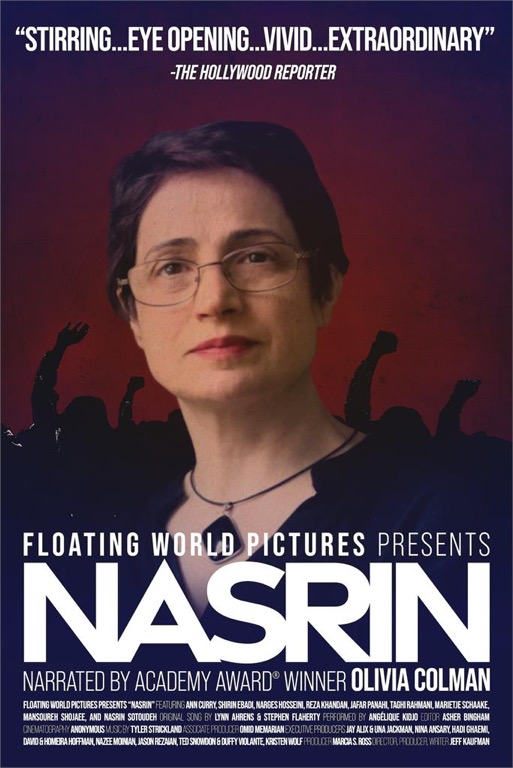
On 16 December 2020 Arab News carries an interview with Filmmaker Jeff Kaufman who tells of his admiration forNasrin Sotoudeh and the activists who shot his documentary in secret inside Iran over a two-year period, ending in June 2018.
It is one thing to criticize the brutality of the Iranian regime from outside of the country; it is quite another to do so from within, under constant surveillance by the nation’s secret police or even from the inside of a prison cell. Yet that is exactly what Nasrin Sotoudeh has been doing for most of her life. As a lawyer she fought for the rights of dissidents who dare to condemn the oppressive actions of Iran’s religious rulers. See e.g.: https://humanrightsdefenders.blog/tag/nasrin-sotoudeh/
Her poignant and inspirational story is told in a new feature-length documentary film that was secretly recorded inside Iran. “Nasrin,” which is narrated by Oscar-winning British actress Olivia Coleman, reveals how a woman who was one of her country’s leading lawyers, fighting to preserve freedom of speech and human rights, was torn from the arms of her husband and two children by Iran’s secret police and locked up.
“Nasrin Sotoudeh is one of the most remarkable human-rights activists on the planet,” said Emmy-nominated filmmaker Jeff Kaufman, the film’s producer, director and writer.
Kaufman explained that his film aims to show international audiences the reality of life as an Iranian in modern-day Iran. “(The film) profiles Nasrin and her work but we also really wanted to bring alive the rich culture of Iran and show that there is a difference between the leadership of that country and the people of that country,” he said.
“Rather than release Nasrin, they sent her to another prison where she contracted COVID herself and she (was sent) home on a temporary health leave, having both COVID-19 and a heart condition,” he added. “She was told that health leave would stay active for a while but last week she was abruptly sent back and is in prison now.”
“Nasrin” will be available to stream online from 18 December. Visit www.NasrinFilm.com for more details and to watch the trailer.
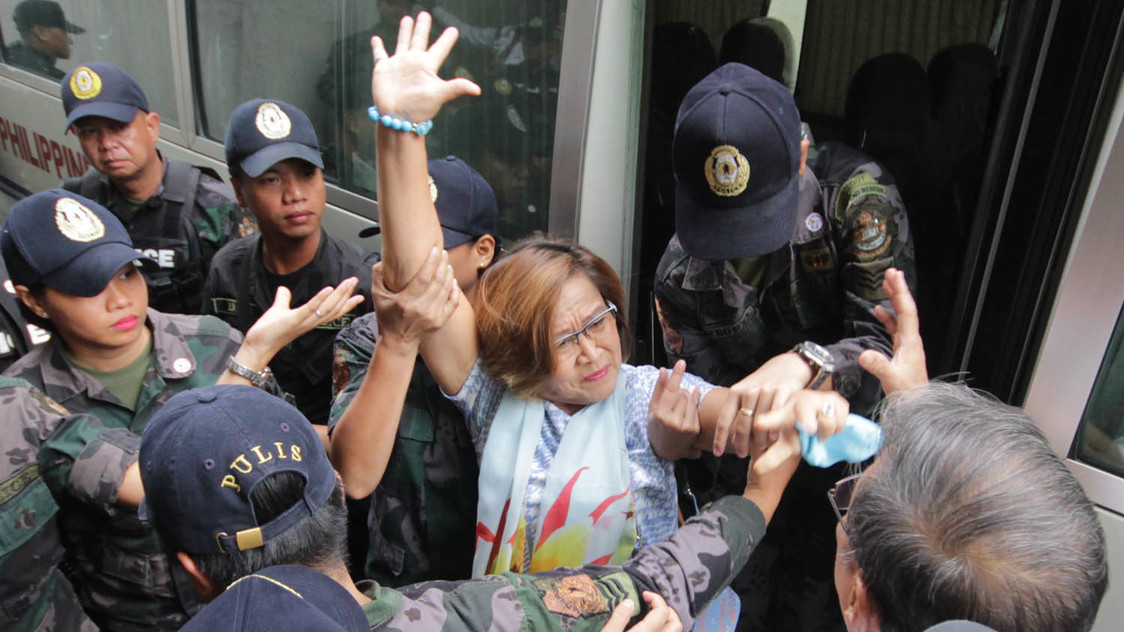
On 9 December 2020 Rappler announced that supporters of embattled Senator Leila de Lima will mark Human Rights Day on Thursday, December 10, with an online film screening titled “CinemaLeila 2020.”
The screenings will include films and documentaries about human rights issues in the Philippines Spearheaded by the Free Leila de Lima Movement, the screening will feature select short films and documentaries about human rights issues in the Philippines.
The line up includes the following titles:
Bad Elements
Miss You ‘Nay
Hayop
I Believe
Marapat Lang
Counter Terror
Paranoia of the Guilty
Dakilang Pagbabago 2020
Sober
Titser Gennie
Selda
Sino si Reina Mae Nasino?
PKNP (Pambili ng Karapatang Pantao)
Pawns
Ili Ili, Tulog Anay
These and other films and documentaries will be streamed on the Facebook page of the Free Leila de Lima Movement and, on De Lima’s official Facebook page.
There will be screenings on Wednesday, December 9 – Human Rights Defenders Day – from 7:30 pm to 9 pm, and on Thursday, December 10, also from 7:30 pm to 9 pm:
Katharine Houreld writes for Reuters on 21 October 2020 a very interesting piece about a documentary that puts the focus on the difficult dilemmas facing human rights defenders.
…Njeri and Boniface Mwangi are activists – they protest together and are arrested together – but as the film progresses, the focus moves from whether their crusade will succeed to whether their family will implode.
“Families of human rights defenders or activists … I want people to know we exist,” Njeri, a movie buff and avid motorcyclist, told Reuters at the film’s Kenya premiere this week. “Our children really struggle.”
Softie – an award-winner at the Sundance and Durban film festivals – shows the evolution of Boniface from an activist outraged by the 2007-8 election violence into a political candidate promising his new Ukweli party will change the system from within, a decade later.
His family grapple with his absence, a house permanently full of people, and death threats targeting their three young children. Njeri, fearing for their lives, eventually takes the kids to the Unites States in 2016.
In one tense on-camera exchange before his family leaves, Boniface pleads with his wife: “you need to have an ideal that you live for, that’s worth dying for.” “You think it will be better if you die?” Njeri replies sadly.
A later scene lays out the stakes. The couple’s eldest son Nate returns from his American school with something he has made for father’s day: a loving card for his mother. When filmmaker Sam Soko asks from behind the camera why there’s no message for his father, Nate shrugs.
Moments like that forced a reckoning, said Boniface, who appeared with his family at the premiere, all in matching purple outfits. Now he’s building his party, taking a rest from protests and spending time making meals for his family. He’s finally realised he can’t – and shouldn’t – try to change everything himself.
“Change is not an event… it’s not a popcorn that pops in a microwave,” he told Reuters. “It’s a very slow painful marathon – and then the marathon doesn’t end.”
The film started out as a five-minute Youtube clip about organising a protest, said Soko, who is an activist himself. It sprawled into a seven year project, now streaming on PBS in the United States and Britain’s BBC.
“It’s essentially still an activist manual,” he said. “But a different kind of manual … (about) what it means to love.”
Tonight 5 October 2020 you can participate in the virtual private screening of Boys State, which won this year’s Sundance Grand Jury Prize for documentary. This engaging film tells the story of 1,100 boys who come together to build a representative government from the ground up, and in the process examines our divided country and the health of the American democracy. Rolling Stone calls it “both sweeping and intimate” and “exhilarating.” The screening will be followed by a Q&A session with the filmmakers and two of the film’s subjects, moderated by Kerry Kennedy.
On 27 August 2020 Bezinga reported that award-winning producer and voiceover actor Laurel Harris narrates “Shirin Ebadi: Until We Are Free”, world premier at Venice International Film Festival. Harris also narrated “The Dalai Lama – Scientist,” a PeaceJam Nobel Legacy Film Series Doc, which Won over 50 Film Fest Awards.
“Shirin Ebadi: Until We Are Free”, is directed by Dawn Gifford Engle – one of only 28 feature length films selected for the Venice International Film Festival’s Gap Financing Market. The film hosts its World Premiere virtually on 2 September 2020. The film tells the story of Shirin Ebadi’s struggle for women’s rights and human rights in Iran.
Harris says, “It’s been an honor to work with many remarkable Nobel Peace Laureates, including the Dalai Lama, Archbishop Desmond Tutu and Shirin Ebadi, as part of the PeaceJam Nobel Legacy film series and to lend my voice to Shirin’s story of fighting for women and children to be treated with basic human dignities.”
Warren was charged with one count of conspiracy to transport illegal aliens and two counts of harboring, and faced up to twenty years in prison. The lead-up to his first trial, in May, 2019, is chronicled in the short documentary “USA v Scott.”….
“USA v Scott” is directed by Ora DeKornfeld, a twenty-nine-year-old filmmaker, and Isabel Castro, a thirty-year-old multimedia journalist who was born in Mexico. “I think we were both fundamentally inspired” to make the film, Castro told me, “because we saw it as such a seminal case.” In 2017 and early 2018, several No More Deaths volunteers, including Warren, were charged with federal misdemeanors for “littering” and “trespassing”—that is, for leaving water and other supplies along crossing routes in federal wildlife areas. But Warren’s arrest at the Barn proved a turning point in immigration enforcement. In early 2017, Jeff Sessions, Donald Trump’s first Attorney General, directed federal prosecutors to use the law against harboring unauthorized migrants as a tool to help enforce the Administration’s zero-tolerance immigration agenda—until then, the law had been used almost exclusively against smugglers who trafficked migrants for profit. Warren was charged by Michael Bailey, the U.S. Attorney for the District of Arizona, a Trump appointee.
The film, which has screened at the Tribeca and Mountainfilm festivals, largely skirts politics, focussing instead on how the situation raised “moral questions for people who were living in Arizona,” Castro said. Warren frequently hosts roundtable discussions on immigration in Ajo, and the film opens on one such meeting. “Borders are supposed to keep us safe,” one member of the community says. “And now I have fear.” Another says, “My thing is, they wanna come here, they wanna come here for a better life so badly, but then they also wanna say, ‘Well, do it my old-country way.’ ” Warren listens patiently, nods. “Thank you for sharing that,” he says. The film also shows individual interviews with residents of Ajo. “To us, it’s normal,” one man says. “We’ve lived with [crossing migrants] all of our lives. It was never a big deal. And then the government stepped in and made a big deal out of it.”
Warren’s felony trial began in May, 2019. The documentary shows the tense months leading up to it, as he remains calm and diligently continues his work with No More Deaths. “We saw in Scott . . . someone who was doing very radical work but who was carrying himself in a very open and mild-mannered way,” DeKornfeld told me—someone who “could potentially connect not only with people who already agree with his politics but also those who don’t.” The trial ended, in June, in a hung jury.
Because the prosecution declined to drop all charges against Warren, the case went to a second trial, in November, where Warren was tried on the harboring charges. (The conspiracy charge was dropped, and the judge ruled that no mention of the Trump Administration’s policies could be included in the arguments.) The jury found him not guilty. After the verdict, Warren said, “The government failed in its attempt to criminalize basic human kindness.” Although Warren was vindicated, the fate of Sacaria-Goday and Perez-Villanueva remains unknown.
A counter-protester gives a white supremacist the middle finger. The white supremacists responds with a Nazi salute. Charlottesville August 12, 2017. (Photo: Evan Nesterak)
Jack Xiong writes in Citizen Truth of 17 October 2019 about a new documentary series titled “Why We Hate” which premiered Sunday on the Discovery Channel and explores “one of humanity’s most primal and destructive emotions – hate.” Directed by Sam Pollard and Geeta Gandbhir and produced by Hollywood veteran Steven Spielberg, the six-part docuseries aims to help people understand their own minds to prevent hatred from spreading.
Pollard made no bones about the subject matter’s relation to America today, telling NPR: “If you think about where we are in the United States with Trump as president, the idea that he demonizes people from other countries, specifically Mexico — that’s another way to sort of separate us from them.” He then went on to compare it to the worst outcomes for such divisiveness: genocide, as with the Holocaust in Germany during World War II, and Cambodia.
The isolation of disadvantaged persons and groups can also lead to extremism, Pollard believes — referencing skinheads and gang members who are seeking a family to belong to. This appeals to the tribal nature of humans, which in turn leads to contempt towards outsiders.
Co-director Gandbhir insists that hate “is something that we all have in common. It is not unique to one society or one group of people.” “Why We Hate” manages to show a wide variety of how hate is manifested, such as: a campaign in Colombia to reunify a bitterly divided country from the decades of war between government forces and FARC guerrillas; a de-radicalized white American man who now works to reform white supremacists; pro- and anti-Trump activists; the Israeli and Palestinian conflict; easily angered soccer hooligans and survivors of the Rohingya genocide in Myanmar….Surely in our culturally and politically divisive times, this is a timely subject to tackle and learn more about.