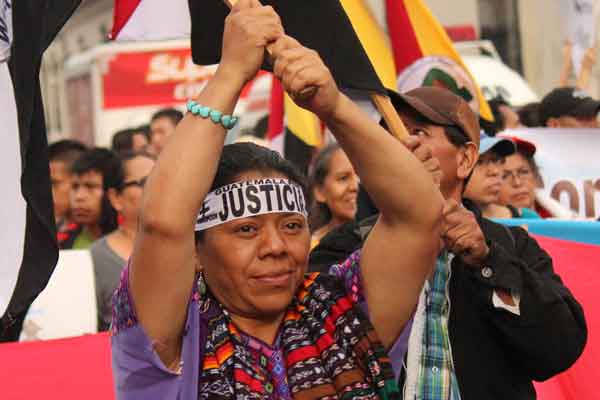
On Tuesday 23 March, 2021 the University of Dayton announced that Aura Lolita Chávez Ixcaquic, leader of the Council of Ki’che’ Peoples,is the winner of its Oscar Romero award.
Environmental and climate justice will be at the heart of a series of University of Dayton events to honour the legacy of Saint Oscar Romero. The series will culminate with the University bestowing its human rights award named in his honour to Aura Lolita Chávez Ixcaquic, leader of the Council of Ki’che’ Peoples which helps preserve indigenous lands against corporate exploitation in Guatemala.
“As a result of her frontline advocacy work, Lolita has faced persecution and has lived in exile since 2017,” said Shelley Inglis, executive director of the University of Dayton Human Rights Center. “Her story brings awareness to the role of indigenous women in the fight for environmental justice despite the high levels of gender-based and other violence against them.“
“Pope Francis has called for urgent action to combat climate change and protect our integral ecology. Yet, environmental and climate justice defenders remain under attack, with governments, corporations and financiers failing to protect their vital and peaceful efforts. The majority of the human rights activists killed last year were working on environmental, land or indigenous peoples’ rights, predominantly in Latin America.”
The University will honour Chávez Ixcaquic April 20 during an event that will include Mauricio López Oropeza reflecting on Romero’s legacy. López Oropeza is a former executive secretary of the Red Eclesial Pan-Amazónica, which connects bishops conferences and church communities in the Amazon region. All events in the series start at 3:30 p.m. ET, are free and open to the public, and will be held virtually. Register for and find more information about events here.
On 18 March, 2021 a Joint NGO Statement on Belarus was published: End Reprisals Against Human Rights Defenders:
The Belarusian authorities are conducting a targeted campaign of intimidation against civil society in an effort to silence all critics of the government. Following the disputed presidential election on 9 August 2020, hundreds of thousands of people across the country took to the streets to protest the announced result. Peaceful protests continue and reprisals against protesters continue too, with frightening regularity and increasing severity. Riot police have used unlawful force, detaining thousands of people. Allegations of torture and other ill-treatment in detention are widespread. Over 33,000 people have been arbitrarily arrested for taking part in peaceful demonstrations or voicing their dissent and an increasing number are being prosecuted under trumped up criminal charges and handed prison sentences. [see: https://www.trueheroesfilms.org/thedigest/laureates/b5785052-8efa-42e7-8508-d6de0a8c1b3d]
Human rights defenders have played an invaluable role in documenting these violations, providing legal assistance, and advising people of their rights. The Belarusian authorities are now escalating pressure on human rights defenders by imposing unfounded criminal charges, opening bogus criminal investigations, and conducting raids and searches in retaliation for these defenders’ legitimate human rights work. Some are in pre-trial detention or under house arrest and there are allegations they have been subjected to torture and other ill-treatment. The authorities have compelled lawyers for most of these activists to sign non-disclosure agreements that bar them from sharing any information about the investigation.
Office for the Rights of People with Disabilities
In January 2021, authorities targeted the Office for the Rights of People with Disabilities, and its director, Syarhei Drazdouski, and lawyer, Aleh Hrableuski, are now under house arrest and in pretrial detention, respectively. The Office is a well-respected NGO that has been supporting people with disabilities by offering them legal advice and advocating for compliance with the Convention on the Rights of Persons with Disabilities.
On 21 January, the Financial Investigations Department of the State Control Committee of Belarus visited the office and the homes of Syarhei Drazdouski and Aleh Hrableuski simultaneously (allegedly to inspect the scene of the crime). They removed computers, phones, and some documents. They also took statements from both men.
On 21 January, the Financial Investigations Department published a message on its official website launching a process of verification into the activities of the members of the Office for the Rights of Persons with Disabilities as a part of an investigation into “possible inappropriate acquisition of funds received in the form of charitable contributions and international support in the period from 2020 to the present for the purpose of providing assistance to Belarusian citizens with disabilities”.
Siarhei Drazdouski commented in a Facebook post on 3 February:
“Allegedly we were financially supporting people accused of taking part in protest actions. In fact, we advised several victims [of human rights violations] – both people with disabilities and without – to seek help from lawyers.”
Allegations of Torture and Other Ill-Treatment
On 2 February 2021, Syarhei Drazdouski and Aleh Hrableuski were questioned for seven hours at the Financial Investigations Department. Their lawyers were not allowed to accompany them, and they were subjected to ill-treatment.
According to Syarhei Drazdouski, the interrogators, who did not introduce themselves, openly called him a “criminal, a fraudster, a liar and an accomplice.” While the interrogation was mostly conducted politely, several times other staff members came in and insulted and aggressively swore at him.
Aleh Hrableuski reported that, when he continued to refuse to give them the information they demanded, he was restrained, forcibly stripped naked and made to sit naked on a chair and not raise his eyes. Investigators eventually released him.
On 3 February 2021, both men were taken for questioning again, but this time Hrableuski was remanded in custody and Drazdouski was put under house arrest. Their lawyers were forced to sign non-disclosure agreements, as is increasingly the practice in Belarus, and very little information is available about the charges against them.
Viasna
On 16 February 2021, the Belarusian authorities carried out raids simultaneously throughout the country on the homes of staff and offices of Human Rights Centre Viasna, the Belarusian Association of Journalists and the independent trade union REP. The raids were carried out in Minsk, Homel, Mahilyou, Vitsebsk, and Brest as part of unfounded criminal proceedings under Article 342 of the Criminal Code of Belarus (organization and preparation of actions that grossly violate public order), which the authorities have launched to target civil society activists, journalists, and human rights monitors. According to Belarus’ Investigative Committee, the investigation is aimed at “establishing the circumstances of the financing of protest activities”. (see also: https://humanrightsdefenders.blog/2021/02/24/fake-letter-tries-to-discredit-viasna-in-belarus/]
Dzmitry Salauyou, a human rights defender and member of the Board of Human Rights Centre Viasna, was among those whose homes were searched on 16 February. Special forces and officers from the Department for the Prevention of Organized Crime and Corruption, a police unit also involved in the harassment of protesters, broke down the door to his flat to enter and carry out the search. They confiscated computers and telephones and demanded that his wife tell them the password for her mobile phone. They threatened that if she did not comply, she would go to prison, and their 13-year-old child would be put in state custody. Dzmitry Salauyou was detained and alleges that he was beaten by special forces in the mini-bus on the way to the pretrial detention centre. Subsequent medical reports documented head trauma consistent with being hit on the head, increased intracranial pressure, and suspected damage to cervical vertebrae.
On 18 February, he was sentenced to 12 days’ detention on administrative charges for holding an “illegal picket.” The conviction was based solely on the fact that the building in which Dzmitry Salauyou lives has a concrete frieze depicting Belarus’ historical coat of arms, Pahonia, which has been adopted as one of the symbols of the protest movement. According to the judge, the Pahonia is considered a symbol of protest and could be considered evidence of “staging a one-person picket”. Dzmitry Salauyou told the court that the frieze had been installed when the house was built about eight years ago.
On 1 March, the day following his release, Dzmitry Salauyou was detained at Minsk airport as he was trying to leave the country with his family. The Investigative Committee interrogated him at their offices as a suspect in a criminal case under Article 342(2) of the Criminal Code of Belarus (‘training or other preparation of individuals to take part in group actions that gravely violate public order’), which carries a maximum sentence of two years’ imprisonment. He was released but is under travel restrictions. Both Dzmitry Salauyou and his lawyer were forced to sign non-disclosure agreements.
Other Members of Viasna Accused of Criminal Offences
Marfa Rabkova, the youth coordinator of Human Rights Centre Viasna, was arrested on 17 September 2020, and has been in pretrial detention ever since. On 25 September, she was charged under Article 293(3) of the Criminal Code of Belarus (‘training and other preparation of people for participation in mass riots’), which carries a maximum prison sentence of three years. On 11 February 2021, she was also charged under Article 130(3) of the Criminal Code, (‘incitement of racial, national, religious or other social hatred or discord committed by a group’), and under Article 285 (2) of the Criminal Code (‘membership of a criminal organization’) which carries a maximum sentence of 12 years’ imprisonment.
Andrei Chepyuk, a volunteer for Human Rights Centre Viasna in Minsk, was detained on 2 October 2020 and on 9 October he was charged under Article 293(2) of the Criminal Code of Belarus (participation in mass disorder). On 28 January 2021, it became known that he is also charged under Article 285(2) of the Criminal Code (‘membership of a criminal organization’). He is being held in pretrial detention centre No.1 in Minsk.
Tatsyana Lasitsa, an activist who volunteers for Human Rights Centre Viasna in Homel, was detained on 21 January. She had assisted with the legal defense of people detained and fined for their participation in protests. She has been charged under Article 342 (1) and (2) of the Criminal Code of Belarus (‘organization or participation in group actions that gravely violate public order’). She is being held in the pretrial detention centre in Homel.
Leanid Sudalenka, the director of the Homel branch of Human Rights Centre Viasna, was detained on his way to the office on 18 January 2021. He has been charged under Article 342 of the Criminal Code (‘organizing and preparing actions that gravely violate public order or active participation in such actions’). Sudalenka had provided legal assistance to dozens of Homel region residents who were detained and charged for their participation in post-election protests. He is being held in pretrial detention in Homel. In 2019 he was awarded two prizes for his human rights work over 20 years, the French prize Freedom Equality and Brotherhood, and a National Belarusian Prize as Human Rights Defender of the Year.
We call on the Belarusian authorities:
To abide by their international human rights obligations as a party to the International Covenant on Civil and Political Rights to respect the rights to freedom of association, peaceful assembly, and expression of all people in Belarus.
To fully respect and protect the work of human rights defenders and ensure that everybody has the right to complain about the policies and actions of individual officials and government bodies and to offer and provide professionally qualified legal assistance or other relevant advice and assistance in defending human rights and fundamental freedoms.
In line with these obligations, to release Marfa Rabkova, Andrei Chepyuk, Tatsyana Lasitsa, Leanid Sudalenka, Syarhei Drazdouski, and Aleh Hrableuski immediately and unconditionally as they have been detained for their legitimate human rights work, drop charges against them and ensure their right to a remedy for unfounded criminal prosecution.
To comply with their international human rights obligations under the UN Convention against Torture and carry out prompt, independent, and impartial investigations into the allegations of torture and other ill-treatment by Syarhei Drazdouski, Aleh Hrableuski, and Dzmitry Salauyou
To comply with their international human rights obligations under the UN Convention on the Rights of Persons with Disabilities, including the rights of all persons deprived of their liberty to reasonable accommodations and the right to effective access to justice on an equal basis with others, including through the provision of procedural accommodations in all legal proceedings, including at investigative and other preliminary stage.
The chair of the Mo Ibrahim Prize Committee, Festus Mogae, a former president of Botswana and himself a recipient of the prize, said that Issoufou had “led his people on a path of progress.” The committee noted that Issoufou had faced “severe political and economic issues.” Niger in the best of times is one of the poorest countries in the world, facing recurrent, severe drought. It has been buffeted by jihadi terrorism, a host of economic issues, and COVID-19. Unlike many other African presidents, Issoufou did not try to remain in office beyond his constitutionally mandated two terms by amending the constitution or pursuing other extralegal means. Since its inception in 2007 the Ibrahim Foundation has granted the award to only seven other presidents. On eight occasions it found no eligible candidate. [see also: https://humanrightsdefenders.blog/2018/02/12/mo-ibrahim-prize-2017-to-ellen-johnson-sirleaf/]
However, there is some criticism of this choice. e.g. from Sebastian Elischer, Associate Professor of Political Science, University of Florida, who writes that:
“During his time in office, his regime has had a heavy-handed reaction to dissent. It also hasn’t upheld the law. In 2017 students protesting for better living and studying conditions were arrested and injured; there were even some deaths. The same is true for broader protests denouncing corruption and calling for improved living conditions. Hundreds of civil society activists found themselves in prison without due process…
In addition, Amnesty International identified a recent surge in human rights violations in Niger. For instance, journalists reporting critically on the government’s war against Boko Haram or on corruption within the state bureaucracy frequently faced expulsion or arbitrary arrest. When Issoufou took office in 2011, the World Press Freedom Index ranked Niger 29th worldwide. In 2020 Niger occupies position 57. This constitutes a significant decline.“
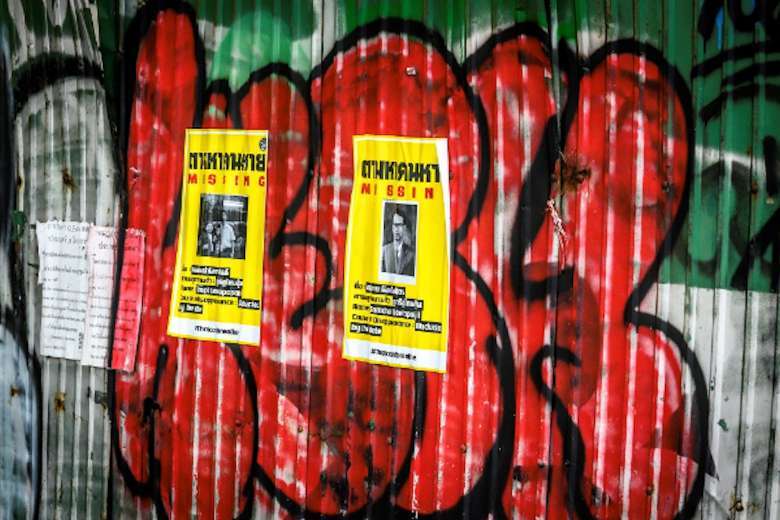
I was taking a train in Manila in March 2004 when I received a call from Munir Said Thalib, then chairperson of my former organization, the Asian Federation Against Involuntary Disappearances. Munir requested me to issue a statement on the enforced disappearance of Thai lawyer Somchai Neelaphaijit on March 12, 2004. It has been exactly 17 years since Somchai involuntarily disappeared. Somchai, a prominent Muslim lawyer who was seen being dragged into a car in Bangkok, had filed a case of torture against the police in southern Thailand on behalf of five men who were in its custody.
Five policemen who were charged with pulling Somchai away from his car were released. Police major Ngern Thongsuk was convicted by the Court of First Instance in 2006. Five years later, the Supreme Court overturned the decision. All the accused were acquitted.
I witnessed one of the first hearings of the Somchai case in 2004. It was then that I met his wife Angkhana, a nurse, who vowed never to leave any stone unturned to uncover the hidden truth about her husband’s disappearance….
Angkhana is as determined and as indefatigable as Argentina’s members of the Madres de Plaza de Mayo-Linea Fundadora. She has learned to wholeheartedly embrace the issue of enforced disappearance as her own. She became one of Thailand’s commissioners on the National Commission on Human Rights but had to resign over issues of independence. Angkhana is one of the family members of the disappeared who transcended their state of victimization and chose to become human rights defenders. [
With them and with the innumerable victims of enforced disappearances, she finds the real meaning of solidarity. She forges lasting friendships with people who, like her, envision a world without desaparecidos. By virtue of her crusade to search for truth and justice for her husband and for the countless other victims in her country and in the rest of the world, she has garnered prestigious human rights awards, which include, among many, the Gwangju Prize for Human Rights and the Ramon Magsaysay Award. See: https://www.trueheroesfilms.org/thedigest/laureates/0D5DED3E-F79F-4AB4-8261-F6A19486F062]…
Unknown to many, Thailand is smeared with many other cases of enforced disappearance and human rights violations, including the unresolved case of the 1992 Black May massacre. The Democracy Monument immortalizes the 1992 victims of enforced disappearance and other rights violations and is a manifestation of the Thai people’s continuing struggle for democracy.
Anathema to democracy, enforced disappearance is one of the cruelest forms of human rights violations. The 17-year old unresolved case of Somchai Neelaphaijit is in stark contrast to Thailand’s beautiful image as the “Land of the Free.”
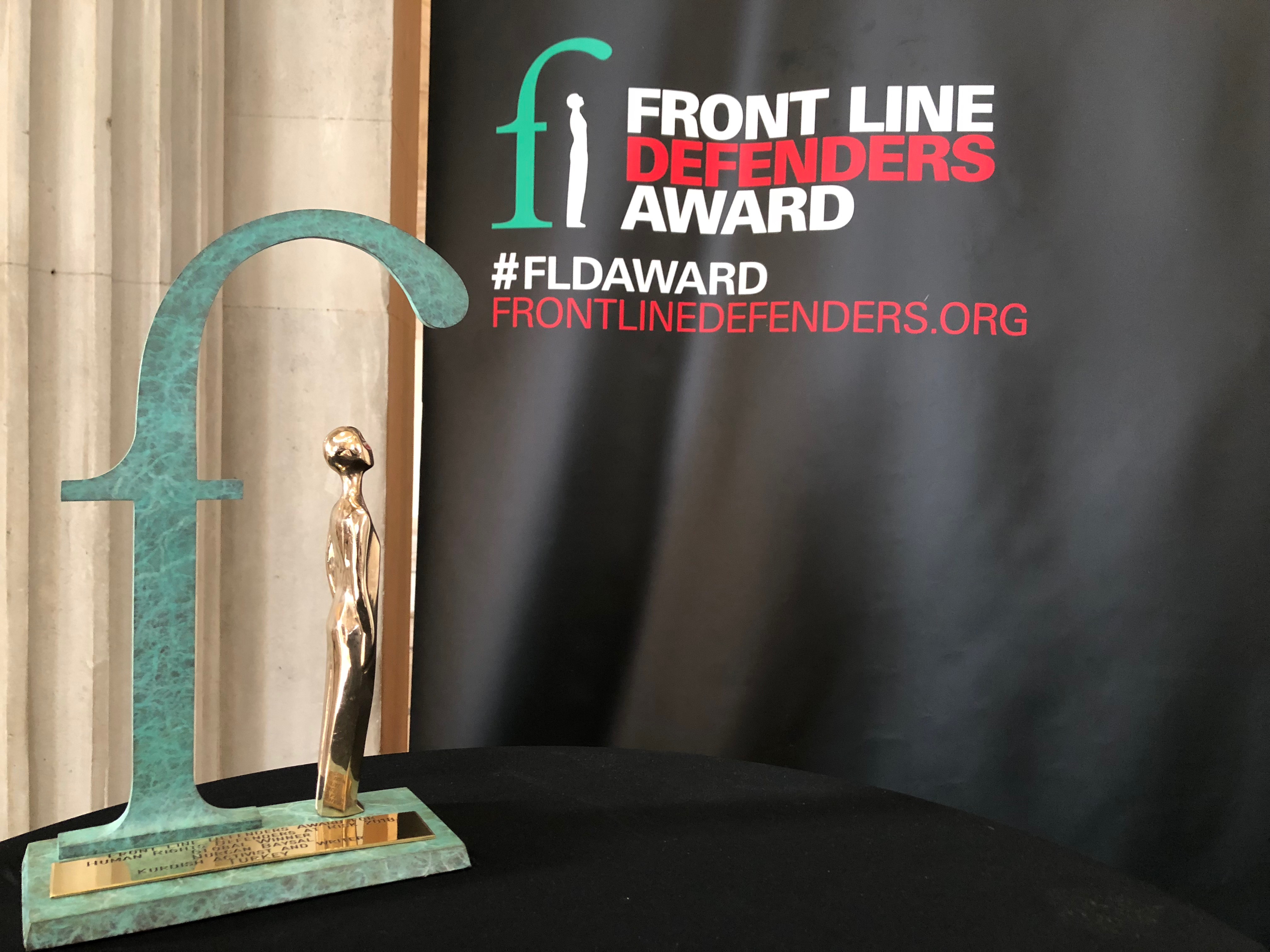
Starting in 2018, Front Line Defenders changed the format of the Award, naming 5 Regional Award Winners, with one chosen as the Global Laureate by a jury comprised of representatives of Ireland’s parliament from a number of political parties. In 2021, Front Line Defenders took the decision to name all 5 regional winners as Global Laureates, in response to the overwhelming positive response to the greater visibility and recognition of the winners of the Award.
For each region of the world (Africa; Americas; Asia-Pacific; Europe & Central Asia; and Middle East & North Africa) there will be one winner selected and Front Line Defenders will recognize all five as the 2021 Front Line Defenders Award Laureates.
In addition to the Award, winners will receive:
a modest financial prize;
a security grant to improve their security measures;
collaboration with Front Line Defenders for media work in recognition of the Award;
advocacy by Front Line Defenders related to the Award and the work of the winners;
an event co-organized by the HRD, local partners and Front Line Defenders to give visibility to the Award in the winners’ countries (as determined and guided by the winners);
the Global Laureates will attend a ceremony in Dublin at a date to be determined;
ongoing security consultation with Front Line Defenders
If you would like to nominate a HRD for the 2021 Front Line Defenders Award for Human Rights Defenders at Risk, please follow this link to the secure online nomination form
As the person, group or organisation making the nomination, you will be consulted by Front Line Defenders to verify the information submitted and possibly for additional information. Please complete all parts of the nomination form to the best of your ability.
Please submit nominations via the online form. If there are any problems using the form, or if you have any questions, please contact: campaigns@frontlinedefenders.org
This year includes an honorary award for seven women leaders and activists from Afghanistan who were assassinated for their dedication to improving the lives of Afghans:
Fatema Natasha Khalil, an official with the Afghanistan Independent Human Rights Commission who was killed, along with her driver, in June 2020 by an IED in Kabul, on her way to her office.
General Sharmila Frough, the head of the Gender Unit in the National Directorate of Security (NDS) was one of the longest-serving female NDS officers, having served as chief of the anti-kidnapping division and working undercover combating criminal networks. General Frough was assassinated in an IED explosion targeting her vehicle in March 2020 in Kabul.
Maryam Noorzad, a midwife who served remote locations in Wardak and Bamyan provinces before working for Médecins Sans Frontières Kabul PD13 hospital. On May 12, 2020, three gunmen attacked the maternity ward of the hospital, but Maryam refused to leave her patient, who was in labor. Maryam, her patient, and the newborn baby were killed in the delivery suite.
Fatima Rajabi, a 23-year-old police officer originally from Ghazni province and a member of the anti-narcotics division. She was traveling to her home village in Jaghori district in a civilian minibus in July 2020 when the Taliban stopped the vehicle and took her captive. Two weeks later, the Taliban killed her and sent her remains, which had gunshot wounds and signs of torture, to her family.
Freshta, daughter of Amir Mohamed, a 35-year-old prison guard with the Office of Prison Administration. She was walking from her residence in Kandahar City to a taxi on her way to work when she was murdered by an unknown gunman on October 25, 2020.
Malalai Maiwand, a reporter at Enikas Radio and TV, was shot and killed, along with her driver, by a gunman on December 10, 2020, in an attack on her vehicle in Jalalabad. Malalai was not the first in her family to be targeted. Five years earlier, her mother, an activist, was also killed by unknown gunmen.
Freshta Kohistani, a 29-year-old women’s rights and democracy activist, was assassinated by unknown gunmen near her home in Kapsia province on December 24, 2020. Kohistani regularly organized events advocating for women’s rights in Afghanistan and used social media as a platform for her messaging.
The other 2021 awardees are:
Belarus – Maria Kalesnikava
Ahead of the August 9, 2020, presidential election, Belarusian women emerged as a dominant political force and driver of societal change in Belarus due in no small part to Maria Kalesnikava. After authorities jailed or exiled the three most popular male opposition candidates, Maria and her partners mounted a historic and sustained challenge to the 26-year rule of Alyaksandr Lukashenka. Maria continues to be the face of the opposition inside Belarus, courageously facing imprisonment in the aftermath of the disputed election. Despite her detention, Maria continues to keep the democratic movement alive inside Belarus and serves as a source of inspiration for all those seeking to win freedom for themselves and their countries.
Burma – Phyoe Phyoe Aung
An emerging leader who is likely to play a role in shaping the country in the coming years, Phyoe Phyoe Aung is the co-founder of the Wings Institute for Reconciliation, an organization that facilitates exchanges between youth of different ethnic and religious groups. Her work promotes peacebuilding and reconciliation and enables a vital dialogue on federalism and transitional justice. She organized a 2015 protest march from Mandalay to Yangon that was violently suppressed by the Myanmar Police Force as it neared Yangon, and she and her husband were arrested and imprisoned. Phyoe Phyoe was released in April 2016 after 13 months as part of a broad pardon of political prisoners facing court trials. See also: https://humanrightsdefenders.blog/2016/05/11/finalists-runners-up-front-line-defenders-award-human-rights-defenders-2016-announcement/#more-7981
Cameroon – Maximilienne C. Ngo Mbe
Maximilienne C. Ngo Mbe has demonstrated extraordinary leadership, courage, and perseverance through adversity in promoting human rights in Cameroon and Central Africa. She has been an outspoken voice among civil society actors, often sacrificing her personal safety, in the push for a peaceful solution to the Anglophone crisis in Cameroon. She has called for an end to human rights abuses committed by separatists and security forces in the Northwest and Southwest regions and by security forces in the Far North. Maximilienne has also spoken out against the increased constraints placed on civil society, journalists, and political opposition by the Government of Cameroon. Her commitment to promoting human rights has been unwavering despite the intimidation, threats, and assault she has endured.
China – Wang Yu
Wang Yu was one of the country’s most prominent human rights lawyers until her arrest and imprisonment following China’s nationwide persecution of lawyers and rights advocates during the “709 crackdown.” She had taken on multiple politically sensitive cases, representing activists, scholars, Falun Gong practitioners, farmers, and petitioners in cases involving a wide array of issues, including women’s and children’s rights, and the rights to religion, freedom of expression, assembly, and association. She is now under an exit ban and has been harassed, threatened, searched, and physically assaulted by police since she began to take on rights abuse cases in 2011. [see also https://humanrightsdefenders.blog/2016/08/02/another-chinese-human-rights-lawyer-wang-yu-spontaneous-video-confession/]
Colombia – Mayerlis Angarita
Mayerlis Angarita has courageously advanced peace and human rights in Colombia, often at great personal risk. Her work has improved the security, livelihoods, and resilience of countless women leaders, conflict victims, and her community. Finding healing in storytelling after her own mother was forcibly disappeared during Colombia’s conflict, she founded the civil society organization “Narrate to Live,” which now serves over 800 women victims of conflict. Additionally, after the most recent attempt on her life, she engaged the highest levels of the Colombian government to advance a comprehensive action plan to prevent violence against women leaders in her community. Her constructive engagement across 27 government entities, civil society, and the international community has been key to the plan’s success and propelled it to become a model for human rights defender protection throughout Colombia.
Democratic Republic of the Congo – Julienne Lusenge
Since 1978, Julienne Lusenge has been the leading female activist in Democratic Republic of the Congo (DRC) fighting against gender-based violence (GBV) and the promotion of the rights of women and girls in conflict situations. In 2000, she created Women’s Solidarity for Peace and Integral Development, the DRC’s foremost organization defending the rights of women and girls against impunity for GBV. Julienne’s vocal testimony has contributed to the adoption of international agreements such as UN 1820, which recognizes sexual violence as a weapon of war. Julienne has touched the lives of millions of women across the DRC, harnessing the attention of the international community to acknowledge and act on the extent of sexual violence shattering DRC’s communities.
Guatemala – Judge Erika Aifan
Judge Erika Lorena Aifan is a trial judge working in the High-Risk Criminal Court with responsibility for high-impact crimes. She has presided over high-profile corruption and war atrocity cases, leading to defamation and threats of violence against her. Despite these challenges, Judge Aifan persisted as a Guatemalan judge independent of political influence. She has demonstrated determination and fortitude in upholding the rule of law in Guatemala. Despite the strong opposition she has faced throughout her tenure, Judge Aifan has become an icon in Guatemala in the fight against corruption, efforts to increase transparency, and actions to improve independence in the justice sector.
Iran – Shohreh Bayat
When Shohreh Bayat boarded her flight on her way to the 2020 Women’s Chess World Championship, she had no idea she might be seeing her native Iran for the last time. Shohreh, the first female Category A international chess arbiter in Asia, was photographed at the Championship without her hijab visible, which is compulsory in Iran. Within 24 hours, the Iranian Chess Federation – which Shohreh had previously led – refused to guarantee Shohreh’s safety if she returned to Iran without first apologizing. Fearing for her safety and unwilling to apologize for the incident, Shohreh made the heart-wrenching decision to seek refuge in the UK, leaving her husband – who lacked a UK visa – in Iran. In that moment, Shohreh chose to be a champion for women’s rights rather than be cowed by the Iranian government’s threats.
Nepal – Muskan Khatun
Muskan Khatun has been instrumental in bringing about new legislation criminalizing acid attacks and imposing strong penalties against perpetrators in Nepal. When Muskan was 15, she was critically injured in an acid attack after she rejected a boy’s romantic propositions. With the help of a social worker, Muskan lobbied for stronger legal action against the perpetrators of acid attacks under duress of threats and the strong social stigma associated with acid attack victims. She went before a parliamentary committee, wrote a letter to Nepal’s Prime Minister, and eventually met with him in person, to request a stronger law. Within a year of her attack, Nepal’s President issued an ordinance with harsh penalties for acid attacks and regulations on the sale of acids, a testament to Muskan’s significant advocacy.
Somalia – Zahra Mohamed Ahmad
For more than 20 years, Zahra Mohamed Ahmad has been at the forefront of defending human rights in Somalia, especially for its most vulnerable groups. As an accomplished lawyer, Zahra began providing legal aid, for sexual and gender-based violence (SGBV) survivors, women on remand status, and women in pre-trial detention. Zahra is the founder of and legal advisor for the Somali Women Development Center, an organization that reports on human rights violations and cases of abuse; supports survivors through legal assistance; established Somalia’s first free hotline service to combat SGBV; and operates one-stop centers for SGBV survivors, mobile legal clinics, family care centers, safe spaces for women and girls, and community child protection centers for internally displaced children.
Spain – Sister Alicia Vacas Moro
A registered nurse, Sister Alicia Vacas Moro ran a medical clinic in Egypt for eight years, helping 150 low income patients a day treat their maladies. She then moved to the biblical town of Bethany to help an impoverished Bedouin community, especially women and children. She set up training programs for women that provided them with previously unavailable economic opportunities, and established kindergartens in Bedouin camps, providing an educational foundation for children. In an environment shaped by the Israeli-Palestinian conflict, Sister Alicia also assisted traumatized refugees and asylum seekers, a job she continues to perform on a larger scale in her current role as the regional coordinator for the Comboni Sisters in the Middle East. When the COVID-19 pandemic struck northern Italy, she flew to Italy to assist and treat fellow sister nuns, undeterred by extreme danger to herself.
Sri Lanka – Ranitha Gnanarajah
Ranitha Gnanarajah, a lawyer, continues to fight for and defend the rights of the marginalized and vulnerable communities in the country, despite threats and challenges by the state. Ranitha has dedicated her career to accountability and justice for victims of enforced disappearances and prisoners detained often for years without charge under Sri Lanka’s Prevention of Terrorism Act by providing free legal aid and related services. As an individual personally affected by the conflict and based on her extensive experience working with victims and their families, Ranitha has demonstrated tremendous passion and dedication to justice and accountability, especially for Sri Lanka’s most vulnerable populations.
Turkey – Canan Gullu
Canan Gullu has been an activist and organizer for 31 years and is the president of the Turkish Federation of Women’s Associations, an umbrella organization of women’s NGOs; she leads186 branches and 52,500 members. Canan has been a steadfast champion of gender equality, working to promote women’s participation in governance, labor force, and education. In 2007, the Turkish Federation of Women Associations established the first emergency hotline for victims of violence in Turkey, which continues its operations. Over the past two years, Canan launched an education and advocacy campaign focused on failures in the Turkish government’s implementation since 2012 of the Istanbul Convention, the Council of Europe’s Convention on preventing and combating violence against women and domestic violence. Canan’s activism has been critical to educating the public about the convention and reinforcing the need to combat gender-based violence, which quelled some politicians’ calls for Turkey’s withdrawal.
Venezuela – Ana Rosario Contreras
As president of the Caracas Nurses’ Association, Ana Rosario Contreras has been on the front lines in the fight for the rights of healthcare professionals, patients, and labor unions. Contreras’ fierce activism has generated widespread support from the Venezuelan people and is at the center of the civil-political movement pushing for democratic change. In a climate where the government routinely jails, tortures, harasses, threatens, or restricts the movement of its opponents, Contreras defends citizens’ rights at great personal risk. She has advocated for labor rights and has worked tirelessly to ensure that healthcare workers could receive a subsidy through Interim President Juan Guido’s Health Heroes program..
Human rights groups called on the Philippine government to investigate what they said was the use of “lethal force” during police raids on Sunday that left at least nine activists dead. The raids in four provinces south of Manila resulted in the death of an environmental activist as well as a coordinator of left-wing group Bagong Alyansang Makabayan, among others, and resulted in the arrest of four others, activist groups said.
“These raids appear to be part of a coordinated plan by the authorities to raid, arrest, and even kill activists in their homes and offices,” Human Rights Watch Deputy Asia Director Phil Robertson said in a statement.
These incidents, he said, were “clearly part of the government’s increasingly brutal counter-insurgency campaign“. “The fundamental problem is (that) this campaign no longer makes any distinction between armed rebels and noncombatant activists, labour leaders, and rights defenders.” The United Nations has warned in a report that “red-tagging”, or labelling people and groups as communists or terrorists, and incitement to violence have been rife in the Southeast Asian nation.
“The Philippines government should act now to investigate the use of lethal force in these raids, stop the mayhem and killings that has gone hand in hand with the practice of red-tagging,” Robertson said.
Sunday’s raids, which human rights group Karapatan condemned, came two days after President Rodrigo Duterte ordered the police and military to “kill” communist rebels and “ignore human rights”.
“Nothing could be more apt than calling this day a ‘Bloody Sunday,’” Karapatan’s Cristina Palabay said.
Lieutenant General Antonio Parlade, head of an anti-rebel task force, told Reuters the raids were “legitimate law enforcement operations”, and authorities acted on the basis of search warrants for possession of firearms and explosives.
“As usual these groups are so quick in assuming that the subjects were activists and that they were killed. If (the) motive was to kill them they should all be dead but there were those who did not resist arrest so they were collared,” Parlade told Reuters in a phone message. — Reuters
In the meantime on 7 March 2021 Rappler.com reported that UK lawmakers called for release of jailed Duterte critic De Lima
Signatories include Rt Hon Dame Diana Johnson, MP (chair, All Party Parliamentary Human Rights Group), Tonia Antoniazzi MP, Harriett Baldwin MP, Paul Blomfield MP, Tracy Brabin MP, Lyn Brown MP, and Dawn Butler MP, according to the Office of Senator Leila de Lima.
“President Duterte’s self-styled ‘war on drugs’ has seen an estimated 30,000 extra-judicial killings – along with increased targeting of journalists and human rights defenders, and the undermining of judicial independence,” they added.
A Muntinlupa court on Friday, March 5, dismissed her second drug case appeal, even as she was earlier acquitted in another case. A third case against her is pending before another court.
Ales Bialiatski laying flowers at a memorial to Aliaksandr Taraikouski, a protester who was killed during a demonstration on August 10, 2020. Credit: HRC Viasna
On February 16, Ales Bialiatski’s home and the offices of his human rights organisation Viasna in Minsk were raided by police. He was targeted along with more than 40 other human rights defenders, journalists and their relative in towns across the country, with reports of officials using excessive force while seizing phones, computers and credit cards.
Bialiatski, one of Belarus’ most prominent human rights defenders, says the authorities were looking for any evidence of organisations or journalists “financing” peaceful protests against the country’s president Alexander Lukashenko. The raids are the latest development in the government’s brutal crackdown on mass protests which have been ongoing in the country since Lukashenko claimed victory in a rigged election last August. [see also: https://humanrightsdefenders.blog/tag/ales-bialiatski/]
The authorities have recently opened a criminal case against Viasna and Bialiatski himself. A former political prisoner who spent nearly three years jailed in Minsk, he says that, by the time this article is published, he may once again be behind bars.
“Millions of people want change, and the answer of the government is repression,” says Bialiatski, speaking to Geneva Solutions from the Right Livelihood Foundation offices in Geneva. He and Viasna received the prestigious award in 2020.
Seven months on from the election, more than 33,000 people have been detained, and there are widespread reports of police brutality, arbitrary arrests, kidnapping, and torture of detainees.
The human rights situation in Belarus is, in Bialiatski’s words, “an absolute catastrophe”. “The situation is quite horrible because it’s not only human rights defenders that suffer,” he explains. “It’s all levels of society. Anybody who can think.”
Over half a year since the first protests broke out in the capital Minsk, he says the authorities are still tightening their grip on personal freedoms and carrying out grave human rights violations, targeting activists, journalists and anyone who opposes the regime. But the people of Belarus are not giving up.
What’s going on in Belarus? The government’s crackdown in Belarus follows mass protests in the country last summer after a fraudulent election in which Lukashenko, known as “Europe’s last dictator”, claimed to have won 80 per cent of the vote. The poll is widely accepted to have been rigged to extend his 25-year rule, prompting the largest demonstrations in the country’s history.
Elections in Belarus have never been considered free and fair by many international observers. Bialiatski has been working to advocate for democratic freedoms in the country since his early twenties, when the country was still under Soviet rule.
He founded Viasna in 1996, five years after Belarus gained independence from the Soviet Union and two years after Lukashenko came to power. The organisation’s initial aim was to help thousands of protesters arrested during mass pro-democracy rallies after Lukashenko brought in sweeping constitutional reforms that consolidated his authoritarian rule.
“[My colleagues and I] thought that this work would finish in a few years because the problem would disappear,” says Bialiatski. “But it’s been 25 years and there’s still work to do. It’s never ended. Unfortunately, the human rights situation never got better.”
Accusations of rigged elections, brutal suppression of civil rights and corruption have been hallmarks of Lukashenko’s half a century in power. However, Bialiatski says last year’s poll acted as a catalyst. It was then that Belarusian society finally “woke up” and demanded change.
Breaking the silence. In the run-up to elections in Belarus in 2020, a number of opposition figures became extremely popular, including former members of Lukashenko’s government and Sergei Tikhanovskya, a well-known blogger who travelled the country interviewing former loyal supporters of the ruler about why they had turned against him.
Although Lukashenko jailed or exiled many of his opponents, he did not see Sviatlana Tsikhanovskaya – who ran in the place of her husband when he was imprisoned – as a significant threat. However, Tsikhanovskaya became hugely popular, gaining the support of fellow opposition figures and attracting large crowds of supporters to her rallies.
Events in 2020 drastically impacted the Lukashenko’s loyal following and damaged his reputation. The country’s already dire economic situation was exacerbated by the Covid-19 crisis, which the ruler has fervently denied, refusing to bring in restrictions and joking that the virus could be fought with vodka and work in the country’s potato fields. “Lukashenko was laughing into the world’s face and denying the existence of the virus, while people all around were dying,” says Bialiatski.
Tsikhanovskaya was widely expected to win the vote in a landslide. Although independent polling is illegal in Belarus, making it difficult to measure her lead in the run up to the election, some independent exit polls conducted outside polling stations in foreign embassies on election day showed her to have received 79.69 per cent of the vote while Lukashenko received just 6.25 per cent.
When the government announced it had won 80 per cent of the vote, claiming that Tsikhanovskaya had received less than 10 per cent, Belarusians realised the election had been rigged. “It was an open lie in the face of the people,” says Bialiatski. “Of course there were rallies – nobody believed the result.”
“The very first mass protests on the street were a result of despair and disappointment and disagreement with this injustice that had happened in the country,” he adds.
Thousands of people took to the streets across the country to peacefully protest the result, but they were met with a brutal crackdown from authorities. In Minsk, which saw the worst of the violence, police and the army deployed water cannons, stun grenades and rounds of rubber bullets against protesters. Police vans were reportedly driven into crowds and hundreds were injured, with journalists and independent observers apparently targeted.
As reports circulated of extreme violence against protesters, including systematic torture of detainees by police and security forces, thousands more Belarusians rallied. Over 200,000 people took part in the largest protest in the country’s history, and there were hopes that the pressure may finally topple Lukashenko.
However, the result was an even more brutal crackdown, in which thousands were injured and arrested. “Unfortunately, the peaceful protests didn’t lead to a change of government as was hoped and expected,” says Bialiatski. “Instead, daily repressions started against different people at different layers of society, at different organisations and activists.”
Crackdown on human rights and freedom of speech. According to Viasna, over 2,300 criminal cases have been opened against human rights defenders and activists since the protests erupted in August 2020. In February alone, during the latest spate of arrests, a further 511 people were detained, 102 people received sentences and 49 people imprisoned.
There is currently a criminal case open against Viasna and Bialiatski himself for inciting “public disorder” through allegedly financing ongoing protests by paying the huge fines imposed on protesters. He says the latest raids in which police seized phones, laptops and credit cards were an attempt to collect evidence. “This is considered as financial proof against the regime,” he explains. “They are not allowing us to exercise our human rights protection work, which is our right.
“We are working all the time on the edge of the knife because [we] don’t know when this criminal case will take force and [we] will be sentenced for it,” he says.
It’s not just activists who are being targeted. According to Viasna, there are currently 258 political prisoners in the country, including journalists and bloggers. On 17 February, two journalists, Katsiaryna Andreyeva and Darya Chultsova, both of the Polish-funded Belsat TV channel, were convicted of violating public order and sentenced to two years in prison for covering the protests.
“They are looking for ‘criminals’ among those who help political prisoners and write about the struggle of Belarusians for freedom,” wrote Tsikhanovskaya on Twitter in response to the latest raids. Tsikhanovskaya was forced to flee to Lithuania following last year’s elections.
“But in search of criminals, they should look into the offices of the riot police, the GUBOPiK (interior ministry directorate) and all those responsible for the repression.”
A number of Bialiatski’s colleagues are incarcerated in the country’s jails, imprisoned for as little as sending food parcels to jailed protesters. A former political prisoner himself who spent nearly three years behind bars from 2011-2014, Bialitksi knows all too well how terrible the conditions in Belarus’ prisons can be. With widespread reports of detainees being tortured and subjected to brutal treatment, he says he’s deeply concerned for their welfare.
“How people are treated in Belarusian jails is not a humane way to treat people,” he says. “I really hope that my colleagues and my friends can survive it and I really hope that one day they will be released.”
Pressure from the international community. Last summer’s crackdown prompted western countries to impose sanctions on Minsk, but Lukashenko has refused to resign, bolstered by diplomatic and financial support from long-standing ally Russia. Tikhanovskaya, who remains in Lithuania after the country rejected the Belarusian authority’s request for her extradition, is leading a campaign to encourage external pressure on Belarus in the hope that tougher measures against the regime may succeed in toppling Lukashenko.
Her efforts could be paying off. In December, the EU imposed a third round of economic sanctions against key individuals and companies in Belarus, while in February the Biden administration expanded the list of senior officials in the country who are no longer welcome in the United States.
Tikhanovskaya has also created a Coordination Council, effectively a government in waiting, which is headed by Bialiatski. The council is drafting a new constitution and keeps in contact with key figures in Belarus to ensure that the exiled opposition does not become detached from those who are keeping up the pressure on Lukashenko from within.
The situation in Belarus is also being closely watched by the United Nations. Human Rights chief Michelle Bachelet recently presented her report on the aftermath of August’s elections to the 46th session of the Human Rights Council at the end of February. Bachelet warned of a “human rights crisis” in the country and called for an immediate end to the policy of systematic intimidation used by the Belarusian authorities against peaceful protesters and for the release of political prisoners.
Viasna has supported a number of other rights organisations including Amnesty International and Human Rights Watch in calling on the Human Rights Council to establish a new mechanism on Belarus. Bialiatski explains that the situation in the country must be kept high up on the international agenda if there is any hope of bringing down Lukashenko’s regime.
“It is very important to continue to exercise international pressure on Belarus, pointing out that human rights have to be preserved in the country,” he says. “This help of international society is required today – not tomorrow, today. Because tomorrow it might be too late.”
Hope for the future. Bialiatski says it is impossible to predict what the coming weeks, and even days, will bring to the people of Belarus. He says the latest crackdown has had a “very, very intimating result. People are scared. ”
“One thing is for sure,” he continues. “The administrative and criminal charges, and punishments and sentences against the activists and human rights defenders will get harsher. This I can guarantee. The current power is continuing to tighten the screws.
“I ask myself often how long the people can continue to bear this pressure, and if they will continue to bear it much longer.”
There are hopes that the spring could bring another wave of protests in Belarus. Speaking during a trip to Finland last week, exiled opposition leader Tikhanovskaya said she expected mass protest against Lukashenko to start up again soon after a lull in public demonstrations due to the authorities brutal suppression.
Bialiatski shares some of her cautious optimism. “The crisis has not gone, we are not beyond it,” he says. “The disagreement, disapproval and unhappiness of the people is so strong that I think there will be another breakout soon.”
He says that it is only a matter of time before Lukashenko loses his grip on Belarus – be it a result of peaceful protests, international pressure or the deteriorating economic situation in the country, although most likely a combination of all three. “This is the first time we have clearly seen that the current regime is in the minority and this gives us a significant certainty that the regime, the current power, cannot stay much longer,” he says.
After spending most of his life tirelessly working to uphold human rights in the face of relentless persecution at the hands of the Belarusian authorities, Bialiatski has managed to retain faith that his country will one day become a free democracy. What gives him hope that this could finally be the turning point in Belarus’s history? The country’s young people, he says, who have led the movement against Lukashenko.
“These young people in Belarus who strive for a change have totally different values to Lukashenko and his entourage,” he says. “And it’s difficult to change the minds of young people. They are born with it. They will keep on fighting. ”
On 2 March 2021, Mary Lawlor – the UN’s Special Rapporteur on Human Rights Defenders – wrote for Amnesty International “Five years after Berta Cáceres was murdered, states are still failing to protect human rights defenders". With the presentation of Mary Lawlor's report to the UN Human Rights Council coming up this week, the piece is worth reading in full:
She was one of hundreds of human rights defenders killed that year because of their peaceful work, and hundreds more defenders have been killed every year since. Those responsible are rarely brought to justice. Although some have been convicted of Berta Cáceres’ killing, others believed to have been involved have still not been brought to account. [see: https://humanrightsdefenders.blog/2020/06/10/nina-lakhanis-who-killed-berta-caceres-reviewed/]
It’s a familiar and continuing story, in Honduras and across the world, where those responsible for the murder of a human rights defender often enjoy impunity. This week I am presenting my latest report to the United National Human Rights Council in Geneva, and it is on the killings of human rights defenders and the threats that often precede them.
At least 281 human rights defenders were killed in 2019, with a similar number expected to be recorded for 2020. Unless radical, immediate action is taken we can expect hundreds more murders again this year.
Since 2015, at least 1,323 defenders have been killed. While Latin America is consistently the most affected region, and environmental human rights defenders like Berta Cáceres often the most targeted, it is a worldwide issue. At least 281 human rights defenders were killed in 2019, with a similar number expected to be recorded for 2020
Between 2015 to 2019, human rights defenders were killed in at least 64 countries, that’s a third of all U.N. member states. Those collecting the data agree that underreporting is a common problem. The number of defenders killed is likely significantly higher than the figures we have.
We know that on every continent, in cities and the countryside, in democracies and dictatorships, governments and other forces threatened and killed human rights defenders. Many, like Berta Cáceres, are killed in the context of large business projects.
Why do so many governments and others kill human rights defenders working peacefully for the rights of others? Partly because they can, safe in the knowledge that there is unlikely to be the political will to punish the perpetrators.
While some states, particularly those with high numbers of such killings, have established dedicated protection mechanisms to prevent and respond to risks and attacks against human rights defenders, defenders often complain that the mechanisms are under-resourced.
And in too many cases, businesses are also shirking their responsibilities to prevent attacks on defenders or are even responsible for the attacks.
These murders are not random acts of violence that come out of nowhere. Many of the killings are preceded by threats. As Amnesty International noted, Berta Cáceres’ murder “was a tragedy waiting to happen,” and she had “repeatedly denounced aggression and death threats against her. They had increased as she campaigned against the construction of a hydroelectric dam project called Agua Zarca and the impact it would have on the territory of the Lenca Indigenous people.”
And yet her government failed to protect her, as so many governments fail to protect their defenders. Since I took up this mandate in May last year I have spoken to hundreds of human rights defenders. Many have told me about their real fears of being murdered, and have shown me death threats made against them, often in public.
They tell me how some threats shouted in person, posted on social media, delivered in phone calls or text messages, or in written notes pushed under a door. Some are threatened by being included on published hit lists, receiving a message passed through an intermediary or having their houses graffitied. Others are sent pictures through the mail showing that they or their families have been under long-term surveillance, while others are told their family members will be killed. It’s not that complicated. It’s up to states to find the political will to prevent killings by responding better to threats against human rights defenders, and to hold murderers to account
I’ve been told by defenders about a coffin being delivered to the office of an NGO; a bullet being left on a dining room table in their home; edited pictures of them being posted on Twitter, showing them having been attacked with axes or knives; and an animal head being tied to the door of their organization’s office.
Those advocating for lesbian, gay, bisexual, transgender and intersex rights, and women and transgender human rights defenders, are often attacked with gendered threats, and targeted because of who they are as well as what they do. Women and LGBTI people demanding rights in a patriarchal, racist, or discriminatory contexts often suffer specific forms of attack, including sexual violence, smears and stigmatisation.
The murders of human rights defenders are not inevitable, many are signalled in advance, and yet governments fail, year after year, to provide enough resources to prevent them, and fail, year after year, to hold the murderers to account. In fact, states should not only end impunity but also publicly applaud the vital contribution that human rights make to societies.
This week I’ll again remind the U.N. that their members are failing in their moral and legal obligations to prevent the killings of human rights defenders. It’s no use for government officials to wring their hands and agree that the murder of Berta Cáceres and other defenders is a terrible problem and that someone should do something about it.
It’s not that complicated. It’s up to states to find the political will to prevent killings by responding better to threats against human rights defenders, and to hold murderers to account.
The Lawyers for Lawyers Award aims to honour lawyers who have made significant contributions to the protection of the rule of law and human rights in challenging environments. Through the bi-annual Award, Lawyers for Lawyers generates public recognition for the work and outstanding achievements of lawyers at risk. See for the award and its laureates: https://www.trueheroesfilms.org/thedigest/awards/B40861B3-0BE3-4CAF-A417-BC4F976E9CB0

 Hans Thoolen on Human Rights Defenders and their awards