Posts Tagged ‘Chinese Human Rights Defenders (CHRD)’

China on dissent: over 1,500 convicted in six years, report finds

March 11, 2025

Alan Lu for RFA on 5 March 2025 refers to a a new report which shows the extent of Beijing’s arbitrary detentions, with severe sentences for prisoners of conscience.

Chinese authorities have arbitrarily detained thousands of people for peacefully defending or exercising their rights over the past six years and convicted 1,545 prisoners of conscience, a rights group said on Wednesday.

Chinese Human Rights Defenders, or CHRD, a non-government organization of domestic and overseas Chinese rights activists, said the scope and scale of wrongful detention by Chinese authorities may constitute crimes against humanity.

“They were sentenced and imprisoned on charges that stem from laws that are not in conformity with the Chinese government’s domestic and international human rights obligations,” the group said in a report.

“Their cases proceeded through the full criminal justice system, with police, prosecutors, and courts arbitrarily depriving them of their liberty in violation of their human rights.”

Prisoners of conscience have faced severe penalties, with an average sentence of six years, increasing to seven for national security charges.

Three people, identified as Tashpolat Tiyip, Sattar Sawut and Yang Hengjun, were sentenced to death, while two, Rahile Dawut and Abdurazaq Sayim, received life sentences, the group said, adding that 48 were jailed for at least a decade.
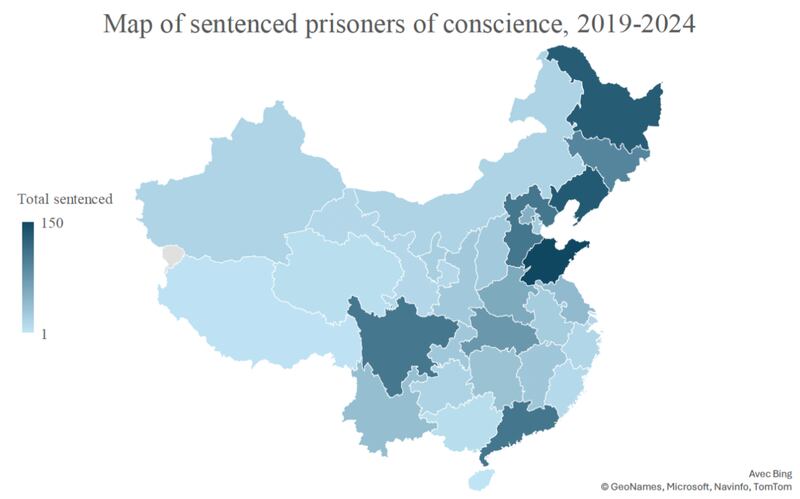
Map of sentenced prisoners of conscience in mainland China, excluding Hong Kong and Macao.
Map of sentenced prisoners of conscience in mainland China, excluding Hong Kong and Macao. (CHRD)

Among the convicted, women activists and marginalized groups, including ethnic Tibetans and Uyghurs, were disproportionately represented among those wrongfully detained, the group said.

Out of all the prisoners of conscience aged 60 or older, two-thirds were women, it added.

“Human rights experts and international experts have raised that people over the age of 60 should generally not be held in custody due to the effects on their physical and mental health,” Angeli Datt, research consultant with CHRD, told journalists in a press briefing Wednesday.

“That two-thirds of them are women was really shocking to me,” she said.

“Worse still, the impunity Chinese government officials enjoy at home emboldens them to commit abuses abroad,” the group said.

China dismissed a Swiss report last month alleging that it pressures Tibetans and Uyghurs in Switzerland to spy on their communities.

‘Endangering national security’

The CHRD said that under Chinese leader Xi Jinping, the scope and scale of the use of arbitrary detention to silence critics and punish human rights personnel had grown.

The organization documented a total of 58 individuals known to have been convicted of “endangering national security.”

“The overall average prison sentence for a national security crime is 6.72 years, though this figure excludes those sentenced to death with a two-year reprieve or life imprisonment,” it said.

In Hong Kong, more people were convicted of “subversion” and “inciting subversion” — terms that the U.N. describes as “broad and imprecise, making them prone to misapplication and misuse.”

In one 2024 case, authorities convicted 45 people for participating in a primary election, an act fully protected under both domestic and international law. Subversion charges accounted for 37% of all prisoners of conscience sentenced in Hong Kong during this period.

https://www.rfa.org/english/china/2025/03/06/chia-dissent-crack-down-humgn-rights/

https://thediplomat.com/2025/03/chinas-system-of-mass-arbitrary-detention/

35th anniversary of Tiananmen Square: 14 still in prison

June 4, 2024

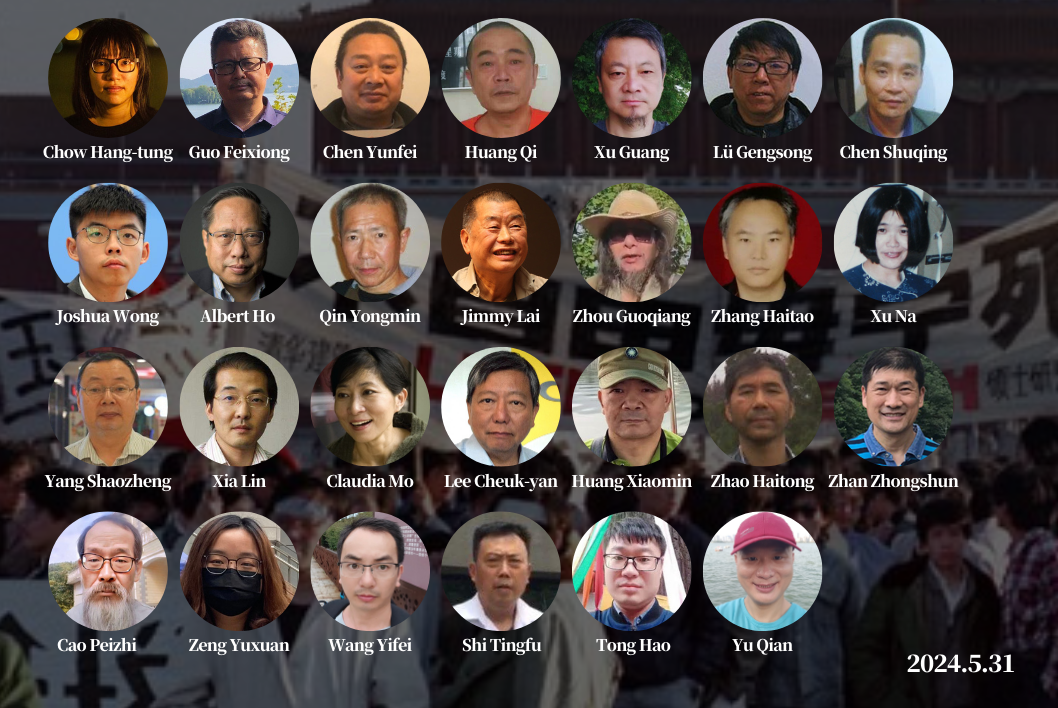
While China is systematically erasing the memory of the brutal repression of student protests on 4 June 1989, 14 prominent participants of that movement are still behind bars, rearrested for their struggle for democracy. Chinese Human Rights Defenders issued an appeal for their release.

Chinese Human Rights Defenders (CHRD), an international NGO supporting Chinese dissidents, issued an appeal last week to mark the 35th anniversary of the Tiananmen Square massacre. [see also: https://humanrightsdefenders.blog/2014/06/13/25-years-tiananmen-celebrated-with-over-100-detentions/]

For 35 years, all top Chinese leaders, from Li Peng to Xi Jinping, have been fixated on erasing memories of June 4 by persecuting those who peacefully seek accountability,” reads the CHRD statement. “Everyone who cares about justice should call on Beijing to immediately and unconditionally release these and all other prisoners of conscience in China.”

The appeal includes a list of 27 people who, for various reasons, are still in prison in relation to the Tiananmen Square movement. “[F]ar from being complete, [. . .] it is a window to the severity, scale, and persistence of reprisals by the Chinese government over the past 35 years,” the statement reads. In particular, 14 names belong to people who participated directly in the events of 35 years ago and are currently in prison after they were rearrested for promoting democracy in China.

Zhou Guoqiang (周国强) was imprisoned for organising a strike in support of student protests in Beijing in 1989, and served four years in a re-education camp. He was arrested again for online comments in October 2023. His current whereabouts and charges remain unknown.

Guangdong activist Guo Feixiong (郭飞雄), who took part in the 1989 movement as a student in Shanghai, has been serving a six-year sentence since 2015 for his human rights activism.

Another university student from that time, Chen Shuqing (陈树庆) from Hangzhou, has been serving a 10-and-a-half-year sentence since 2016 for pro-democracy activism.

Lü Gengsong (吕耿松), a teacher fired in 1993 for supporting the pro-democracy movement, has been serving an 11-year sentence since 2016 for his pro-democracy work.

Beijing-based lawyer Xia Lin (夏霖) has been serving an 11-year sentence since 2016 for his professional work as a lawyer; he participated in the 1989 movement as a student at the Southwest Institute of Political Science and Law in Chongqing.

Xinjiang activist Zhao Haitong (赵海通) has been serving a 14-year sentence since 2014 for his activities as a human rights defender. He, too, had been imprisoned in the aftermath of the 1989 massacre.

Xu Na (许那), artist, poet, and a Falun Gong follower, took part in the hunger strike in Tiananmen Square. She was arrested in 2020 and sentenced to eight years in prison for “using an evil cult to disrupt law enforcement.”

Sichuan activist Chen Yunfei (陈云飞) served a four-year sentence from 2015 to 2019, in part for organising a commemoration for the victims of 4 June. He had participated in the 1989 movement as a student at the China Agricultural University in Beijing.

Another member of the student movements at the time, Xu Guang (徐光), was arrested in 2022 and is serving a four-year sentence on charges of “picking quarrels and provoking trouble” in Hangzhou, Zhejiang province.

Huang Xiaomin (黄晓敏), who was arrested in Sichuan province in 2021, suffered th same fate, and was sentenced to four years, while Cao Peizhi (曹培植) was arrested in 2022 and sentenced to 2.2 years in Henan province.

Zhang Zhongshun (张忠顺), another student who participated in the 1989 protests, was reported to police in 2007 for talking to his students about the events of 4 June. He was jailed for three years and is now in jail for continuing to support activism and faces charges of subversion in Shandong province.

Wang Yifei (王一飞) disappeared into police custody after he was detained in 2021. Before his arrest in 2018, he had been demanding justice for the victims of 1989 for several years.

Shi Tingfu (史庭福), already convicted of organiing a public vigil in Nanjing in 2017 and giving a speech in memory of the victims of Tiananmen, was rearrested in January 2024 and is awaiting trial on several charges, including “spreading false information, and inciting terrorism and extremism in the Xinjiang Uyghur Autonomous Region.”

The other 13 names belong to people who were not directly involved in the events of 1989 in Beijing, but fought in mainland China and Hong Kong to keep alive the memory of what happened.

This second list includes Tong Hao (仝浩), a young doctor born in 1987, who was jailed for 1.5 years for publishing a post on 4 June 2020. He was arrested in August 2023 and has been in police custody in Jiangsu province ever since.

Some of the jailed are dissidents in Hong Kong, like Lee Cheuk-yan, Albert Ho, and Chow Hang-tung; the latter, a lawyer, was recently issued a new arrest warrant in prison together with seven other people (including her mother) for commemorating the Tainanmen massacre online.

As Chinese Human Rights Defenders note, three witnesses to events in Tianamen Square have died in prison in the past 35 years. The most prominent is Nobel Peace Prize laureate Liu Xiaobo (刘晓波), who died in July 2017 from liver cancer in police custody while serving an 11-year sentence since 2009 for his role as a leader in the Charter 08 campaign. A university lecturer in 1989, he was jailed for 18 months for taking part in the 1989 movement.

Jiangsu writer Yang Tongyan (杨同彦) died a few months after Liu, in November 2017, from a brain tumor. He was serving a 12-year sentence imposed in 2006 for his political activism. He had already spent 10 years in prison for taking part in the 1989 movement.

Last but not least, we must remember labour activist Li Wangyang (李旺阳), who died under suspicious circumstances on 6 June 2012 while in a hospital guarded by police in Shaoyang, Hunan province. Li, leader of the 1989 pro-democracy movement, was sentenced to a total of 23 years in prison. Chinese authorities claimed he committed suicide by hanging himself in his hospital room, a claim his family has disputed since Li was blind and deaf from torture and would not have been physically able to hang himself. Against the wishes of Li’s family, Hunan authorities conducted their own autopsy and then cremated the body.

https://www.asianews.it/news-en/Still-in-prison-35-years-after-Tiananmen-Square-60873.html

https://www.usnews.com/opinion/articles/2024-06-04/china-is-erasing-the-memory-of-the-tiananmen-massacre-we-cant-let-them

Yu Wensheng and Xu Yan detained again in China

April 24, 2023

On 18 April 2023 CHRD called on the Chinese government to immediately release human rights lawyer Yu Wensheng and his wife Xu Yan, who have been criminally detained and denied access to lawyers of their choice. CHRD also calls on the Chinese government to end its de facto house arrest of Yu Wensheng and Xu Yan’s 18-year-old son. CHRD urges the EU, EU member states, the US, UN bodies, and other member of the international community to forcefully condemn the Chinese government’s detention of Yu Wensheng and Xu Yan. See also: https://humanrightsdefenders.blog/2022/03/03/breaking-news-mea-laureate-yu-wensheng-released/

On April 13 at approximately 4:00 pm, human rights lawyer Yu Wensheng and his wife Xu Yan left their home in Beijing to travel by subway to attend an event at the European Delegation. They were invited to an event with the EU’s Ambassador to China Jorge Toledo Albiñana according to Politico.  

However, Yu and Xu were prevented from accessing the subway by four plainclothes police officers. One of the officers, a state security police officer, told them that they were being summoned to a police station, which Yu Wensheng announced on Twitter. The four police officers took them to the Shijingshan Bajiao police station. Human rights lawyers Wang QuanzhangLi Heping, and Bao Longjun were also harassed by authorities during this period.

The EU Delegation to China tweeted on April 13, “We demand their immediate, unconditional release. We have lodged a protest with MFA [China’s Ministry of Foreign Affairs] against this unacceptable treatment.

According to Rights and Livelihood Watch, on April 15 in the evening, approximately seven police officers came to Yu Wensheng and Xu Yan’s home, and they orally read a criminal detention notice to the couple’s son, who had just turned 18 years old. The pair were criminally detained on the charge of “picking quarrels and provoking trouble.” Police would not allow the son to take photos, nor would they give him the criminal detention notice. Also, even though no warrant was presented, police proceeded to search the home and carried off many items.

On April 16, two lawyers, Song Yusheng and Peng Jian, paid a visit to Yu and Xu’s son to bring him fruit, and fill out paperwork to obtain legal status to represent Yu and Xu.  There were two people guarding the door of Yu and Xu’s home. Lawyer Song knocked on the door, and it was answered by the son, but the lawyer saw that in the home there were also two officers inside, one plainclothes and one wearing a uniform. The plainclothes officer, who said his name was Lu Kai, asked what they wanted. The lawyers said that they were there to visit the son and have him sign an agreement (委托书) to entrust them as lawyers. However, the plainclothes police officers said that Yu Wensheng told them that he “doesn’t want to have lawyers at this stage” and that Xu Yan had already found two lawyers.

Yu Wensheng’s detention may also be related to his condemnation of the sentencing of Xu Zhiyong and Ding Jiaxi, two prominent pro-democracy figures. On April 12, Yu Wensheng wrote on Twitter that he had been visited at his home by Shijingshan police for a tweet he had sent out on April 9 that said, “[I] strongly condemn the Chinese authorities heavy sentence of scholar Xu Zhiyong to 14 years and of Lawyer Ding Jiaxi to 12 years! I pay my respects to Xu Zhiyong and Ding Jiaxi, who have worked hard in the struggle for freedom, democracy, human rights, and the rule of law. I believe that one day the Dream of a Beautiful China will be realized.

In March 2022, Yu Wensheng was released from prison after serving four years and three months on the charge of “inciting subversion of state power.” Yu was taken away by police in 2018 the day after he released an open letter recommending changes to China’s Constitution, including a call for elections and the creation of an oversight system for the Chinese Communist Party.

The Chinese government has put heightened pressure on human rights award winners. Yu Wensheng was the recipient of the prestigious Martin Ennals Award in 2021 [see: https://www.trueheroesfilms.org/thedigest/laureates/69fc7057-b583-40c3-b6fa-b8603531248e] and the winner of the Franco-German Prize for Human Rights and the Rule of Law in 2018. Previous winners of awards have been subjected to extra-legal abuse. While Nobel Peace Prize Laureate Liu Xiaobo was at one point granted “medical parole,” he was not allowed the freedom of movement to seek medical treatment outside of China and died in de facto state custody. Likewise, Hu Jia, a prominent human rights defender and winner of the Sakharov Prize for Freedom of Thought in 2008, was prevented from seeing his dying father in his final days. Hu Jia was deprived of his liberty and “forcibly traveled” starting from March 4 of this year. Being “traveled” is a common tactic used by state security officers to ensure journalists at the annual March Two Sessions meetings or other “sensitive” political events do not talk to dissidents. Hu Jia’s father passed away from pancreatic cancer on March 9, 2023. 

The Chinese government is preventing defendants in sensitive cases from having lawyers of their own choice and instead mandating government-approved lawyers in order to prevent real legal defense. On February 10, 2023, digital rights activist Ruan Xiaohuan was sentenced to seven years in prison on the charge of “inciting subversion of state power.” His wife, Ms. Bei, wanted to hire an experienced lawyer for the appeals stage, and so she went to Beijing to talk with Shang Baojun. However, upon landing in Beijing, she was taken away by eight Shanghai police. Meanwhile lawyer Shang Baojun tried to visit Ruan at the Yangpu Detention Center in Shanghai, but staff there would not allow for the visit since they claimed that Ruan already had two legal aid lawyers. 

https://www.feedspot.com/fo/2238712/fe/4614987?hash=feed/fof_fo_2238712__f_4614987?dd=7644857710522777

Human rights defender Ji Sizun- in jail – awarded 5th Cao Shunli Memorial Award for Human Rights Defenders

March 16, 2019

RFA reported on 14 March 2019 that jailed rights activist Ji Sizun was awarded the fifth Cao Shunli Memorial Award for Human Rights Defenders, for his contribution in promoting legal rights and education at the grassroots level in China. [see also: https://humanrightsdefenders.blog/2016/02/12/cao-shunli-a-profile-and-new-award-in-her-name/]

The award has been given to those who carry on Cao’s grassroots advocacy while facing threats and risks in promoting human rights, protecting vulnerable social groups from abuses, pushing for civil society participation in international human rights mechanisms, and monitoring the Chinese government’s implementation of its human rights obligations,” the overseas-based Chinese Human Rights Defenders (CHRD) network said in a statement on its website.

Ji, 70, is a self-taught legal activist from the southeastern province of Fujian who was detained in October 2014 for publicly supporting the pro-democracy protests in Hong Kong. He was later handed a four-and-a-half-year jail term for “gathering a crowd to disrupt public order” and “picking quarrels and stirring up trouble” for helping petitioners to organize two protests in August and September 2014. “Ji Sizun’s health has seriously deteriorated during his incarceration, and he suffered a debilitating stroke in 2016 and has not received sufficient medical treatment for a number of severe health conditions,” CHRD said. He should be released from Putian Prison in Fujian Province on 26 April, 2019.

https://www.rfa.org/english/news/china/un-calls-for-probe-into-activists-death-03142019112234.html