Posts Tagged ‘China’

Right Livelihood Award 2019 lauds ‘practical visionaries’

September 26, 2019

On its 40th anniversary, the Right Livelihood Award is honoring the efforts of an activist, a lawyer, a rainforest protector and Greta Thunberg. Deutsche Welle takes a closer look at the people who have inspired others.

German-Swedish writer Jakob von Uexküll thought there weren’t enough Nobel Prize categories to truly address the challenges faced by humanity. So in 1980, he founded the Right Livelihood Award [see: http://www.trueheroesfilms.org/thedigest/awards/right-livelihood-award]

This year, the recipients hail from Western Sahara, China, Sweden and Brazil. “With the 40th Right Livelihood Awards we honor four people whose leadership inspires millions of people to defend their rights and fight for a livable future on planet Earth,” said Ole von Uexküll, Jakob von Uexküll’s nephew and the current executive director of the Right Livelihood Foundation.

Aminatou Haidar speaks at a podium (Right Livelihood Foundation)

Aminatou Haidar spent four years in a secret prison, isolated from the outside world

By the time she was a teenager, Aminatou Haidar was already an activist. She has continued to campaign peacefully for the independence of her home country, Western Sahara, ever since. Haidar has become the face of a movement that is committed to Sahrawi self-determination, and fights for their fundamental human rights to be respected. She is also co-founder and president of the Collective of Sahrawi Human Rights Defenders (CODESA) humanitarian organization. Haidar has organized demonstrations, documented torture and gone on a hunger strike to draw attention to the plight of her people. These actions are often not tolerated by Moroccan authorities: Haidar has been imprisoned without being charged or tried many times. She even spent four years in a secret prison isolated from the outside world. Yet in the face of harassment, attacks and death threats — including against her children — she continues to fight tirelessly for a solution to the long-standing conflict in Western Sahara. Her enduring stamina and nonviolent protests earned her the moniker “Gandhi of Western Sahara.” The jury said she was chosen to for her “steadfast nonviolent action, despite imprisonment and torture, in pursuit of justice and self-determination for the people of Western Sahara.” [see also: https://humanrightsdefenders.blog/2013/10/30/saharawis-human-rights-defender-aminatou-haidar-awarded-bremen-solidarity-award/].


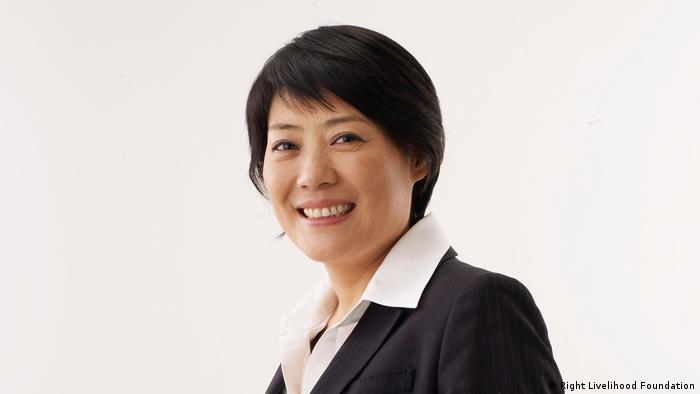
Guo Juanmei (Right Livelihood Foundation)

Guo Juanmei has been working for women’s rights in China for 25 years

It wasn’t until 2014, when official figures were released, that it became known just how endemic domestic violence is in China: one in four married Chinese women is beaten by their husbands. It was a topic that had long been hushed up. Two years later, the Chinese government passed a law against domestic violence, an achievement owing to the tireless efforts of women’s rights activists like Guo Jianmei. Guo is one of China’s most prominent women’s rights lawyers. Over the past 25 years, she and her team have provided free legal advice to 120,000 women. She is the first lawyer in the country to work full-time in non-profit legal assistance. Guo supports campaigns on issues such as unequal pay, sexual harassment and widespread employment contracts that prohibit pregnancy across the country. In rural areas, Guo helps women who are denied land rights where patriarchal systems leave women dependent on their husbands. She founded an association of more than 600 lawyers that handles cases in the country’s most remote regions. Guo received this year’s award “for her pioneering and persistent work in securing women’s rights in China.”


Davi Kopenawa Yanomami (Right Livelihood Foundation)

Davi Kopenawa Yanomami has long been committed to protecting indigenous rights and land

The Amazon is burning, and the world is worried about the effects the burning rainforest will have on the climate. But local inhabitants are feeling the immediate impact. The award organizers wanted to draw attention to the plight of the indigenous people of Brazil by jointly recognizing Davi Kopenawa Yanomami, one of Brazil’s most respected advocates for the indigenous peoples, and the Hutukara Yanomami Association, which he founded in 2015. Kopenawa belongs to the Yanomami tribe, one of Brazil’s most populous indigenous tribes with some 35,000 members. The well-known Hutukara Yanomami Association is committed to protecting the rights, culture and lands of the indigenous people of the Amazon region. Increasing destruction and deforestation for agricultural purposes poses a threat to the environment, but also to the livelihood of the indigenous people. In the 1980s and 1990s, gold miners destroyed villages, shot people and spread diseases. Now such attacks are on the increase again. In 1992, Kopenawa was instrumental in ensuring that a 96,000 square kilometer (37,000 square mile) area in Brazil became Yanomami protected area. He also plays a crucial role in bringing different indigenous groups together to protect themselves from exploitation. It was for this purpose that he founded the Hutukara Yanomami Association, which represents different Yanomami communities. Kopenawa and the Yanomami Hutukara Association have been jointly awarded “for their courageous determination to protect the forests and biodiversity of the Amazon, and the lands and culture of its indigenous peoples.”

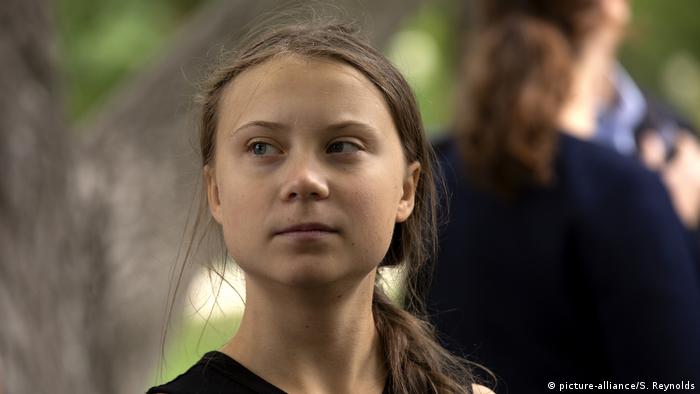
Greta Thunberg in the USA (picture-alliance/S. Reynolds)

Greta Thunberg has become the face of a generation fighting climate change

Swedish climate activist Greta Thunberg is without a doubt the most well-known of the 2019 laureates. In August 2018, the then 15-year-old started a solitary school strike in front of the parliament building in Stockholm a few weeks before elections. She has since become the face of a generation who view climate change as an enormous threat to their future. Her campaign has pushed for worldwide political action to limit global warming to 1.5 degrees Celsius (2.7 Fahrenheit). See also: https://humanrightsdefenders.blog/2019/09/17/greta-thunberg-receives-amnestys-ambassador-of-conscience-award/

Around the world, millions of young people have joined her in skipping school and taking to the streets for the “Fridays for Future” demonstrations, which culminated in a huge global climate strike last Friday. Thunberg speaks at major conferences and meets with world leaders. Her message is clear: Humanity must acknowledge climate change, the urgency of the crisis and act accordingly. Thunberg has been awarded “for inspiring and amplifying political demands for urgent climate action reflecting scientific facts.” The jury added that she is “the powerful voice of a young generation that will have to bear the consequences of today’s political failure to stop climate change,” and that her efforts have inspired millions of people to take action.”

For last year see: https://humanrightsdefenders.blog/2018/09/24/laureates-of-the-2018-right-livelihood-award-announced/

———

https://www.dw.com/en/right-livelihood-award-2019-lauds-practical-visionaries/a-50554572

Human Rights Defenders issues at the 42nd session of the UN Human Rights Council

September 5, 2019

As usual the International Service for Human Rights has come out with an excellent preview of  key issues on the agenda of the 42nd session of the UN Human Rights Council, starting on Monday 9 September 2019. And – also as usual – I provide here an extract of the key elements affecting human rights defenders more directly. The 42nd session will consider issues such as reprisals, indigenous peoples, death penalty, arbitrary detention and enforced disappearances. To stay up-to-date on the whole session: follow @ISHRglobal and #HRC42 on Twitter. Side events will the subject of a separate post.

Reprisals

On 18 September, the ASG for Human Rights will present his annual Reprisals Report  (report on the cooperation with the United Nations) in his capacity as UN senior official on reprisals. [see https://humanrightsdefenders.blog/2016/10/05/assistant-secretary-general-andrew-gilmour-appointed-as-the-uns-focal-point-to-combat-reprisals-against-human-rights-defenders/]

It will be interesting to see the difference with the first such interactive dialogue in September 2018 [https://humanrightsdefenders.blog/2018/10/05/no-naming-and-shaming-on-reprisals-at-39th-human-right-council-session/]. Ghana, Fiji, Hungary, Ireland and Uruguay will present a draft resolution at this session which aims to strengthen the responses by the UN and States to end to acts of intimidation and reprisals.

The ISHR states that reports of cases of reprisals against those cooperating or seeking to cooperate with the UN not only continue, but grow. [see in this context one of my earliest posts, still sadly relevant: https://humanrightsdefenders.blog/2014/03/13/zero-tolerance-for-states-that-take-reprisals-against-hrds-lets-up-the-ante/]..

Other key thematic reports

The Council will consider on 13 September two reports on the death penalty: the report of the UN Secretary General on capital punishment and the implementation of the safeguards guaranteeing protection of the rights of those facing the death penalty, and the summary report of OHCHR on the biennial high-level panel discussion on human rights violations related to the use of the death penalty, in particular with respect to the rights to non-discrimination and equality. The Council will also consider a resolution on the issue.

The Council will hold dedicated debates and consider the reports of several mandates relating to civil, political, economic, social and cultural rights, such as:

  • The Special Rapporteur on contemporary forms of slavery will present her report on current and emerging forms of slavery and country visit report to Italy on 9 September.
  • The Working Group on Enforced or Involuntary Disappearances will present a report on public policies for effective investigation of disappearances, as well as its annual report and country visit report to Ukraine, on 11 September.
  • The Special Rapporteur on the promotion of truth, justice, reparation and guarantees of non-recurrence will present his report and country visit report to Sri Lanka on 11 September.
  • The Working Group on Arbitrary Detention will present its annual report and country visit report to Bhutan on 13 September.
  • The Special Rapporteur on the rights of indigenous peoples will present her annual report and country visit reports to Ecuador and Timor-Leste on 18 September. The Council will also consider during the same debate three reports of the Expert Mechanism on the Rights of Indigenous Peoples.

Country-specific developments

China: The harassment, surveillance, and mass detention of more than one million Uyghurs and other Turkic Muslims in the People’s Republic of China continues to be the most pressing issue with regards to China for the international community to address.

At the same time, China has continued its crackdown on human rights activists: Jiang Tianyong a victim of reprisals for his engagement with UN experts, has been ‘free’ for six months, but remains under heavy-handed surveillance. Citizen journalist Huang Qi was sentenced to 12 years, despite serious health concerns.[https://humanrightsdefenders.blog/2019/07/30/chinas-cyber-dissident-huang-qi-get-12-years-jail/]. Grassroots activist Ji Sizun died in custody [https://humanrightsdefenders.blog/2019/07/15/in-memoriam-chinese-human-rights-defender-ji-sizun/] while Chen Jianfang, recipient of the Cao Shunli award, is being held incommunicado in an unknown location. [https://humanrightsdefenders.blog/2016/02/12/cao-shunli-a-profile-and-new-award-in-her-name/]

Saudi Arabia: The September session provides an invaluable opportunity for the Council and States to follow up on the joint statement delivered on behalf of 36 States by Iceland [https://humanrightsdefenders.blog/2019/07/22/why-iceland-led-the-un-resolution-on-the-philippines/] During the June session, a broad range of cross-regional States called for accountability and guarantees of non-recurrence during the discussion of the Special Rapporteur on extrajudicial, summary or arbitrary executions’ report on the killing of Saudi journalist Jamal Khashoggi

ISHR calls on States to advancing a HRC resolution establishing a monitoring mechanism over the human rights violations in the country and calling explicitly for the immediate and unconditional release of the detained Saudi women human rights defenders and to drop all charges against them.

Egypt: ISHR remains deeply concerned about the situation of human rights defenders in Egypt ..ISHR recalls that defenders who engaged with Egypt’s UPR in 2014 have since then faced travel bans, closure of NGOs, assets freezing, and are facing up to 25 years imprisonment in the ‘NGO Foreign Funding case no. 173.’ ISHR also recalls that individuals and communities who engaged with the Special Rapporteur on the right to housing during her visit in September 2018 faced systematic reprisals. [see also: https://humanrightsdefenders.blog/2019/08/21/un-pulls-anti-torture-conference-from-egypt-to-seek-other-regional-venue/]

Venezuela: Several Venezuelan human rights organisations and international NGOs think  are calling on States to create an investigation. On 10 September, the High Commissioner is scheduled to provide an update to the Council, as a follow up to her report delivered in July. She is expected to outline further deterioration in the situation in the country.

Burundi: The Commission of Inquiry on Burundi will present its oral briefing on 17 September. Burundi continues to refuse to cooperate with the Council’s mechanisms. ISHR calls on States to renew the mandate of the Commission of Inquiry.

The Burundian Government suspended one of the last remaining independent civil society organisations (PARCEM), suspended the operating license of the Voice of America, revoked the license of the BBC, and forced at least 30 international non-governmental organisations to cease their activities. On 17 July 2019, the Ntahangwa Court of Appeal upheld the 32-year prison sentence against HRD Germain Rukuki. [see also: https://humanrightsdefenders.blog/2019/03/29/ngo-statement-condemns-new-irregularities-in-the-case-of-germain-rukuki-burundi/]

Interactive dialogue with the Special Rapporteur on Myanmar and the international fact-finding mission on the situation of human rights of Rohingya Muslims and other minorities in Myanmar on 17 September as well as the presentation of the report of the Independent Investigative Mechanism on Myanmar on 10 September. Among other things, the FFM sheds light on the economic interests of Myanmar’s military and the strong connections between the Tatmadaw and businesses and investors.

Enhanced interactive dialogue on the report of the High Commissioner on the human rights situation in Nicaragua on 10 September

Interactive dialogue on the oral update by the Commission on Human Rights in South Sudan on 16 September

Interactive dialogue on the updated written report of the Commission of Inquiry on Syria on 17 September

Interactive dialogue with the High Commissioner on the situation of human rights in Ukraine on 24 September

Interactive dialogue with the High Commissioner on the situation of human rights in Libya on 25 September

Adoption of Universal Periodic Review (UPR) reports: During this session, the Council will adopt the UPR working group reports on – inter alia – Albania, Côte d’Ivoire, the Democratic People’s Republic of Korea, the Democratic Republic of the Congo, Equatorial Guinea, Ethiopia, Nicaragua, and Qatar.  ISHR supports human rights defenders in their interaction with the UPR. It publishes briefing papers regarding the situation facing human rights defenders in some States under review. This session of the Council will provide an opportunity for the Democratic Republic of the Congo and Côte d’Ivoire to accept recommendations made in relation to human rights defenders, as proposed in ISHR’s briefing papers.

Council programme, appointments and resolutions

The President of the Human Rights Council has proposed a candidate for the mandate of the Independent Expert on the situation of human rights in the Central African Republic.

At the organisational meeting the following resolutions were already announced (States sponsoring the resolution in brackets) which are especially relevant to HRDs :

  1. Arbitrary detention (mandate renewal, France)
  2. Technical assistance and capacity-building for Yemen in the field of human rights (Arab Group)
  3. Contemporary forms of slavery (mandate renewal, United Kingdom)
  4. Cooperation with the United Nations, its representatives and mechanisms in the field of human rights – ‘the reprisals resolution’ (Fiji, Ghana, Hungary, Ireland, Uruguay).
  5. Human rights and indigenous peoples (mandate renewal of the SR, Guatemala, Mexico).
  6. Human rights and indigenous peoples (Guatemala, Mexico).
  7. Promoting international cooperation to support national human rights follow-up systems, processes and related mechanisms (Brazil, Paraguay).
  8. The question of the death penalty (Belgium, Benin, Costa Rica, France, Mexico, Mongolia, Republic of Moldova, Switzerland).
  9. World program on human rights education and training (Slovenia)
  10. Technical cooperation and capacity building in the field of human rights (Brazil, Honduras, Indonesia, Morocco, Norway, Qatar, Singapore, Thailand, Turkey).
  11. Human rights situation in Yemen (Belgium, Canada, Ireland, Luxembourg, Netherlands)
  12. The human rights situation in the Syrian Arab Republic (France, Germany, Italy, Jordan, Kuwait, Morocco, Netherlands, Qatar, Turkey, United Kingdom of Great Britain and Northern Ireland)
  13. Situation of human rights in Burundi (European Union)
  14. Advisory services and technical assistance for Cambodia (Japan)
  15. The right to privacy in the digital age (Brazil, Austria, Germany, Lichtenstein, Mexico)
  16. Assistance to Somalia in the field of human rights (Somalia, United Kingdom)
  17. Technical assistance and capacity-building to improve human rights in the Sudan (African Group)
  18. The human rights situation in Venezuela (Argentina, Canada, Chile, Colombia, Costa Rica, Guatemala, Guyana, Honduras, Mexico, Paraguay, Peru)
  19. Situation of human rights of Rohingya Muslims and other minorities in Myanmar (the Organization of Islamic Cooperation)

——

https://www.ishr.ch/news/hrc42-key-issues-agenda-september-2019-session


Hollywood celebrities and human rights: backlash from China

August 30, 2019

Jocelyn Neo in the Epoch Times of 17 August 2019 traces the backlash from China against some of Hollywood’s best-know names for standing up against China on human rights related matters. As most of this is some time ago it is mostly for the record as this blog likes to keep up with star power and human rights [see e.g.: https://humanrightsdefenders.blog/2014/02/10/star-power-and-human-rights-a-difficult-but-doable-mix/%5D.

Read the rest of this entry »

Ilham Tohti one of the finalists for the Vaclav Havel Human Rights Prize

August 29, 2019

Photo courtesy of Martin Ennals Award

Ilham Tohti, a Uyghur scholar who has been serving a life sentence in Chinese prison since 2014, has been chosen as a finalist for the Vaclav Havel Human Rights Prize.  [see: http://www.trueheroesfilms.org/thedigest/awards/vaclav-havel-prize-for-human-rights-pace].  The Germany-based Ilham Tohti Initiative e.V. (ITI) had nominated Prof. Tohti to the Prize on April 29, with support of four other human rights activists and NGOs. [see also: https://humanrightsdefenders.blog/2018/01/15/today-ilham-tohti-completes-his-fourth-year-in-chinese-detention/].

The decision as to the Prize winner will be made by the Selection Panel on 29 September 2019, and its name will be announced in the Chamber of the Parliamentary Assembly of the Council of Europe in Strasbourg, on 30 September 2019 at 12:30pm. The award ceremony for the Prize will subsequently take place in the presence of all three shortlisted candidates. Two other candidates, who have also been shortlisted are Mr Buzurgmehr Yorov (Tajikistan) and the Youth Initiative for Human Rights.

The UNPO is currently campaigning for Mr. Tohti to also be awarded the Sakharov Prize saying that such prizes are an excellent way in which the international community can continue to show support for the Uyghur people in the face of hostile oppression.

China’s predictable reaction came quickly: “Beijing slammed on Thursday the nomination of a jailed academic from China’s Uighur minority for one of Europe’s top human rights awards, saying it equated to “supporting terrorism”.

https://unpo.org/article/21639

https://www.straitstimes.com/asia/east-asia/china-says-uighur-award-nomination-is-supporting-terrorism

China’s cyber-dissident Huang Qi get 12 years jail

July 30, 2019

Quite a few mainstream media have paid attention on 29 July 2019 to the sentening of human rights defender Huang Qi, often referred to as the country’s “first cyber-dissident”, to 12 years in jail. Huang Qi is the founder of 64 Tianwang, a news website blocked in mainland China that covers alleged human rights abuses and protests. See: https://humanrightsdefenders.blog/2018/11/06/14-major-ngos-call-for-immediate-release-of-chinese-human-rights-defender-huang-qi/

He had been found guilty of intentionally leaking state secrets to foreigners. The statement, from Mianyang Intermediate People’s Court, added Mr Huang would be deprived of his political rights for four years and had also been fined $2,900. Huang has kidney and heart disease and high blood pressure. And supporters have voiced concern about the consequences of the 56-year-old remaining imprisoned.

This decision is equivalent to a death sentence, considering Huang Qi’s health has already deteriorated from a decade spent in harsh confinement,” said Christophe Deloire, the secretary-general of Reporters Without Borders. The press-freedom campaign group has previously awarded Huang its Cyberfreedom Prize. It has now called on President Xi Jinping to “show mercy” and issue a pardon.

Amnesty International has called the sentence “harsh and unjust”. “The authorities are using his case to scare other human rights defenders who do similar work exposing abuses, especially those using online platforms,” said the group’s China researcher Patrick Poon.

And in December 2018, a group of the United Nations’ leading human rights experts also pressed for Huang to be set free and be paid compensation. According to Reporters Without Borders, China currently holds more than 114 journalists in prison.

https://www.jurist.org/news/2019/07/chinese-journalist-huang-qi-sentenced-to-12-years-for-allegedly-leaking-state-secrets/

https://www.bbc.com/news/technology-49150906

Alarm bells about China’s growing coalition of the ‘unwilling’

July 20, 2019

On 18 July 2019ecturer on Human Rights, School of Law, University of Essex, wrote in The Conversation a piece that sounds alarm bells about “China is building a global coalition of human rights violators to defend its record in Xinjiang – what is its endgame? Worth taking note:

Read the rest of this entry »

Human rights defenders of minorities having a hard time in the UN finds UNPO

July 19, 2019

On 17 July 2019 the Unrepresented Nations and Peoples Organization (UNPO) is launched a report, Compromised Space: Bullying and Blocking at the UN Human Rights Mechanisms, with its partners at the University of Oxford and Tibet Justice Centre which details how China, Russia, Iran and other repressive regimes are manipulating the United Nations Human Rights System to block and attack those seeking to hold them accountable for gross human rights violations perpetrated against minorities, indigenous communities and other unrepresented peoples…

The report is based on three years of study conducted by the UNPO and its partners at the University of Oxford and the Tibet Justice Center, supported by the UK’s Economic and Social Research Council. It is based largely on interviews and testimonies from 77 human rights defenders working on behalf of minorities, indigenous communities and other people living in nation states whose political systems do not create governance structures representative of all. It identifies a systemic attack on the United Nations human rights system by these governments, led largely by China, Russia and Iran, designed to shield them from accountability for human rights violations and crimes against humanity. This includes efforts to deny civil society groups participatory status at the UN (so called “ECOSOC status”), to bully and block them when they are able to access the UN, to crowd out the UN space with “GONGOs” – government-sponsored organisations posing as NGOs – and to harass, intimidate and take reprisals against activists and their families, whether at home or abroad.

Among the indicative findings of the report are the facts that:

China has regularly detained or imprisoned activists from its Southern Mongolian, Uyghur and Tibetan communities who have sought to travel to the UN, with such success that, for example, no Tibetan from Tibet who is acting independently of the Chinese government has ever managed to leave Chinese- occupied Tibet to testify at the UN in Geneva or New York, and then return safely;

Russia, in order to shield itself from accountability for its crimes in Russian-occupied Crimea, has asked for rules of participation in forums, such as the UN Minority Forum, to be changed to restrict NGO participation to groups acceptable to Russia, and its Crimea occupation authorities have attacked Crimean Tatar activists and destroyed or confiscated their passports in order to prevent their travel;

Iran regularly engages in practices designed to intimidate activists from their minority communities, even while they are operating within the United Nations buildings, and have taken out reprisals against the family members of these activists still living within the Islamic Republic of Iran.

The story of Dolkun Isa, President of the World Uyghur Congress and Vice President of the UNPO, is indicative of all of these actions. Mr. Isa and his organization have regularly been denied ECOSOC status at the United Nations, his access to the UN buildings and events have been restricted due to Chinese demands, he and his supporters have been followed and harassed in the UN building, his mother was held in China’s anti-Muslim concentration camps as a result of his work and for many years his ability to travel freely around the world was frustrated by Chinese efforts to involve European and other states in his persecution by falsely labelling him a “terrorist”.

Reacting to the launch of the report, UNPO’s General Secretary, Ralph Bunche, stated that “the report presents the disturbing finding that the United Nations Human Rights system, which is the only outlet for many peoples living under repressive regimes to seek accountability for crimes committed against them, is being systemically undermined by perpetrator regimes. Unfortunately, democratic states are not doing nearly enough to push back against this phenomenon and in some instances are even adopting the conduct that we see from the repressive states. The withdrawal of the USA from the UN’s Human Rights Council has certainly not helped matters, but other states are simply not doing enough to counter this problem and protect human rights defenders.

DOWNLOAD THE FULL REPORT HERE

https://unpo.org/article/21583

41st UN Human Rights Council: what the NGOs see as its result

July 16, 2019

On 12 july 2019, ISHR published what key civil society organisations thought of the just finished 41st session of the UN Human Rights Council.

Civil society organisations welcomed significant outcomes of the Human Rights Council’s 41st session, including the extension of the SOGI mandate, adopting the first resolution on the Philippines and extending its scrutiny over Eritrea, the Democratic Republic of Congo, Belarus and Ukraine. This session witnessed heightened scrutiny of Council members by shedding light on the situations in Saudi Arabia and China. It missed an opportunity, however, to ensure that human rights are not sidelined in Sudan.

16 leading human rights organisations (see below) expressed regrets that Council members seek to use their seats to shield themselves and others from scrutiny. They called on States to stand with victims of human rights violations. They welcomed the renewal of the mandate of the Special Rapporteur on freedom of peaceful assembly association, that the Council stood up to the global backlash against the rights of women and girls, and that it continued to address the threat posed by climate change to human rights. They also welcomed the reports on Venezuela, called on the High Commissioner to immediately release the UN database of businesses engaged with Israeli settlements, and on all States to pursue accountability for victims of intimidation and reprisals.

Full statement below:

By renewing the mandate of the Independent Expert on sexual orientation and gender identity (SOGI), the Council has sent a clear message that violence and discrimination against people of diverse sexual orientations and gender identities cannot be tolerated. It reaffirmed that specific, sustained and systematic attention is needed to address these human rights violations and ensure that LGBT people can live a life of dignity. We welcome the Core Group’s commitment to engage in dialogue with all States, resulting in over 50 original co-sponsors across all regions. However, we regret that some States have again attempted to prevent the Council from addressing discrimination and violence on the basis of SOGI.

This Council session also sent a clear message that Council membership comes with scrutiny by addressing the situations of Eritrea, the Philippines, China, Saudi Arabia and the Democratic Republic of Congo. This shows the potential the Council has to leverage its membership to become more effective and responsive to rights holders and victims.

The Council did the right thing by extending its monitoring of the situation in Eritrea. The onus is on the Eritrean Government to cooperate with Council mechanisms, including the Special Rapporteur, in line with its membership obligations.

We welcome the first Council resolution on the Philippines as an important first step towards justice and accountability. We urge the Council to closely follow this situation and be ready to follow up with additional action, if the situation does not improve or deteriorates further. We deeply regret that such a resolution was necessary, due to the continuation of serious violations and repeated refusal of the Philippines – despite its membership of the Council– to cooperate with existing mechanisms.

We deplore that the Philippines and Eritrea sought to use their seats in this Council to seek to shield themselves from scrutiny, and those States [1] who stood with the authorities and perpetrators who continue to commit grave violations with impunity, rather than with the victims.

We welcome the written statement by 22 States on China expressing collective concern over widespread surveillance, restrictions to freedoms of religion and movement, and large-scale arbitrary detention of Uyghurs and other minorities in Xinjiang. We consider it as a first step towards sustained Council attention and in the absence of progress look to those governments that have signed this letter to follow up at the September session with a resolution calling for China to allow access to the region to independent human rights experts and to end country-wide the arbitrary detention of individuals based on their religious beliefs or political opinions.

We welcome the progress made in resolutions on the rights of women and girls: violence against women and girls in the world of work, on discrimination against women and girls and on the consequences of child, early and forced marriage. We particularly welcome the renewal of the mandate of the Working Group on Discrimination Against Women and Girls under its new name and mandate to focus on the intersections of gender and age and their impact on girls. The Council showed that it was willing to stand up to the global backlash against the rights of women and girls by ensuring that these resolutions reflect the current international legal framework and resisted cultural relativism, despite several amendments put forward to try and weaken the strong content of these resolutions.

However, in the text on the contribution of development to the enjoyment of all human rights, long standing consensus language from the Vienna Declaration for Programme of Action (VDPA) recognising that, at the same time, “the lack of development may not be invoked to justify the abridgment of internationally recognized human rights” has again been deliberately excluded, disturbing the careful balance established and maintained for several decades on this issue.

We welcome the continuous engagement of the Council in addressing the threat posed by climate change to human rights, through its annual resolution and the panel discussion on women’s rights and climate change at this session. We call on the Council to continue to strengthen its work on this issue, given its increasing urgency for the protection of all human rights.

The Council has missed an opportunity on Sudan where it could have supported regional efforts and ensured that human rights are not sidelined in the process. We now look to African leadership to ensure that human rights are upheld in the transition. The Council should stand ready to act, including through setting up a full-fledged inquiry into all instances of violence against peaceful protesters and civilians across the country.

During the interactive dialogue with the Special Rapporteur on extrajudicial and summary executions, States heard loud and clear that the time to hold Saudi Arabia accountable is now  for the extrajudicial killing of journalist Jamal Khashoggi. We recall that women human rights defenders continue to be arbitrarily detained despite the calls by 36 States at the March session. We urge States to adopt a resolution at the September session to establish a monitoring mechanism over the human rights situation in the country.

We welcome the landmark report of the High Commissioner on the situation for human rights in Venezuela; in response to the grave findings in the report and the absence of any fundamental improvement of the situation in the meantime, we urge the Council to adopt a Commission of Inquiry or similar mechanism in September, to reinforce the ongoing efforts of the High Commissioner and other actors to address the situation.

We welcome the renewal of the mandate on freedom of peaceful assembly and association. This mandate is at the core of our work as civil society and we trust that the mandate will continue to protect and promote these fundamental freedoms towards a more open civic space.

We welcome the renewal of the mandate of the Special Rapporteur on Belarus. We acknowledge some positive signs of re-engagement in dialogue by Belarus, and an attempted negotiation process with the EU on a potential Item 10 resolution. However, in the absence of systemic human rights reforms in Belarus, the mandate and resolution process remains an essential tool for Belarusian civil society. In addition, there are fears of a spike in violations around upcoming elections and we are pleased that the resolution highlights the need for Belarus to provide safeguards against such an increase.

We welcome the renewal of the quarterly reporting process on the human rights situation in Ukraine. However, we also urge States to think creatively about how best to use this regular mechanism on Ukraine to make better progress on the human rights situation.

The continued delay in the release of the UN database of businesses engaged with Israeli settlements established pursuant to Council resolution 31/36 in March 2016 is of deep concern.  We join others including Tunisia speaking on behalf of 65 states and Peru speaking on behalf of 26 States in calling on the High Commissioner to urgently and fully fulfill this mandate as a matter of urgency and on all States to  cooperate with all Council mandates, including this one, and without political interference.

Numerous States and stakeholders highlighted the importance of the OHCHR report on Kashmir; while its release only a few days ago meant it did not receive substantive consideration at the present session, we look forward to discussing it in depth at the September session.

Finally, we welcome the principled leadership shown by Belgium, Luxembourg and the Netherlands, in pursuing accountability for individual victims of acts of intimidation and reprisals under General Debate Item 5, contrasting with other States which tend to make only general statements of concern. We call on States to raise all individual cases at the interactive dialogue on reprisals and intimidation in the September session.

[1]States who voted against the resolution on the Eritrea: Bahrain, Burkina Faso, Cameroon, China, Cuba, Egypt, Eritrea, Iraq, India, Saudi Arabia, Somalia, the Philippines and Pakistan.
States who voted against the resolution on the Philippines: Angola, Bahrain, Cameroon, China, Cuba, Egypt, Eritrea, Hungary, Iraq, India, Qatar, Saudi Arabia, Somalia, and the Philippines.

*Statement delivered by the International Service for Human Rights (ISHR) on behalf of: DefendDefenders (the East and Horn of Africa Human Rights Defenders Project); Global Initiative for Economic, Social and Cultural Rights; Asian Forum for Human Rights and Development (FORUM-ASIA); International Federation for Human Rights (FIDH); International Commission of Jurists (ICJ); Center for Reproductive Rights; ARTICLE 19; Cairo Institute for Human Rights Studies; Human Rights House Foundation; CIVICUS: World Alliance for Citizen Participation; Franciscans International; Association for Progressive Communications (APC); Amnesty International; Human Rights Watch; International Lesbian and Gay Association (ILGA).
For the preview of the the 41st session, see: https://humanrightsdefenders.blog/2019/06/14/guide-to-human-rights-defenders-issues-at-the-41st-human-rights-council-starting-on-24-june/

http://www.ishr.ch/news/hrc41-civil-society-presents-key-takeaways-human-rights-council

In memoriam Chinese human rights defender Ji Sizun

July 15, 2019

Undated photo of award-winning Chinese human rights activist Ji Sizun, who died of cancer at 71, weeks after the end of his prison term, July 10, 2019.

Undated photo of award-winning Chinese human rights activist Ji Sizun, who died of cancer at 71, weeks after the end of his prison term, July 10, 2019. Courtesy of an RFA listener.

Award-winning Chinese human rights activist Ji Sizun has died of cancer, pn 10 July 2019 weeks after the end of his prison term. He was 71. Ji, a self-taught legal activist from the southeastern province of Fujian, died of colorectal cancer on Wednesday afternoon at the Zhangzhou Xiangcheng Hospital in Zhangzhou city, his family said.

He had just finished serving a four-and-a-half year jail term for publicly supporting the 2014 pro-democracy movement in Hong Kong, and had been held incommunicado and under close surveillance by the authorities since his “release” in April. His family members were denied permission to visit or speak with him until he was unconscious (!), and Ji’s body was sent directly for cremation after his death by the authorities. His sister said her brother had dedicated his life to human rights work, which was why he had never married. “He would say that his work was too dangerous, so he didn’t want to have a wife and child to care about him.”

Ji’s cancer was diagnosed while he was in prison, and he was offered treatment in a local hospital, according to Ji Zhongjiu, a lawyer who had tried to visit him there.

A source close to the case said Ji’s remains had been handed over to his local neighborhood committee, rather than to his family, sparking suspicions that Ji’s death may not have been entirely due to natural causes. “There are huge question marks over this whole thing … as for the family’s letter entrusting them with this task, the family are very confused about that,” the source said. “The letter was signed on June 12, and Ji suddenly died less than a month after they signed it, so clearly there are suspicions that the authorities have been playing god.” He said the family never wanted Ji to be cremated.

Earlier this year, Ji was awarded the fifth Cao Shunli Memorial Award for Human Rights Defenders, for his contribution in promoting legal rights and education at the grassroots level in China. Cao died in March 2014 after she was denied medical treatment for months while in detention. See: https://humanrightsdefenders.blog/2019/03/16/human-rights-defender-ji-sizun-in-jail-awarded-5th-cao-shunli-memorial-award-for-human-rights-defenders/

The Chinese authorities should investigate the circumstances and causes of human rights activist Ji Sizun’s death, Human Rights Watch said.

Reported by Gao Feng for RFA’s Mandarin Service, and by Wong Lok-to for the Cantonese Service. Translated and edited by Luisetta Mudie.

https://www.rfa.org/english/news/china/activist-death-07102019113636.html

https://www.hrw.org/news/2019/07/10/china-account-activists-death

Joint letter by 22 States to Human Rights Council re China’s Uighurs

July 12, 2019
A Chinese flag behind razor wire at a housing compound in Yangisar, south of Kashgar, in China’s western Xinjiang region
China is reportedly holding one million people, mostly ethnic Uighurs, in internment camps in Xinjiang Photograph: Greg Baker/AFP/Getty Images

UN ambassadors  – including Australia, Britain, Canada, France, Germany and Japan – co-signed the letter released Wednesday and sent to the Human Rights Council president, Coly Seck, and the High Commissioner for Human Rights, Michelle Bachelet.

Rights groups and former inmates describe them as “concentration camps” where mainly Muslim Uighurs and other minorities are being forcefully assimilated into China’s majority ethnic Han society. The letter expresses concern “about credible reports of arbitrary detention… as well as widespread surveillance and restrictions, particularly targeting Uighurs and other minorities in Xinjiang.” It calls on China to stop arbitrary detention and allow “freedom of movement of Uighurs and other Muslim and minority communities in Xinjiang.” The authors, who include ambassadors from across the EU as well as Switzerland, requested that the letter become an official document of the Human Rights Council, which ends its 41st session in Geneva on Friday. Chinese officials describe the camps as voluntary “vocational education centres” where Turkic-speaking Uighurs receive job training.

The letter may have been the only available option with China having enough support in the UN Council to vote down a formal resolution. See also: ttps://www.reuters.com/article/us-china-xinjiang-rights-idUSKCN1U721X?utm_campaign=trueAnthem:+Trending+Content&utm_content=5d28c3e00ca7240001cb2eef&utm_medium=trueAnthem&utm_source=twitter

On the same day Human Rights Watch commented: Most importantly, the joint letter sends a strong message that we are moving beyond the era of selectivity, and that no country, large or small, is exempt from the scrutiny of this Council. We understand that the joint letter remains open for additional signatures, and we encourage those delegations that have not yet signed to do so. We are particularly disappointed that OIC member states have not yet engaged meaningfully or credibly with the human rights situation affecting Muslims in Xinjiang, while they have spoken out on other situations. This risks fueling perceptions of double standards and politicization; supporting the constructive joint statement would be a useful step towards addressing such perceptions.

We also welcome China’s acceptance of a UPR recommendation to respond positively to a country visit request by the UN Special Rapporteur on freedom of religion or belief.

We would suggest that China could benefit from technical assistance by drawing on the expertise of other UN Special Rapporteurs, such as the Special Rapporteur on the promotion of human rights while countering terrorism. Given that China has advanced the need to counter terrorism as its rationale for mass programs directed at Uyghurs and others in Xinjiang, the Special Rapporteur could offer useful guidance on whether there are more rights-respecting ways to counter terrorism than mass surveillance, detaining over a million Muslims, and stripping an entire population of its rights to freedom of religion, privacy, culture and expression.

See also: https://humanrightsdefenders.blog/2016/10/11/hot-news-ilham-tohti-chinas-mandela-wins-2016-martin-ennals-awad/

https://www.theguardian.com/world/2019/jul/11/more-than-20-ambassadors-condemn-chinas-treatment-of-uighurs-in-xinjiang

https://www.hrw.org/news/2019/07/11/independent-reporting-xinjiang-abuses-requires-unfettered-access-not-stage-managed