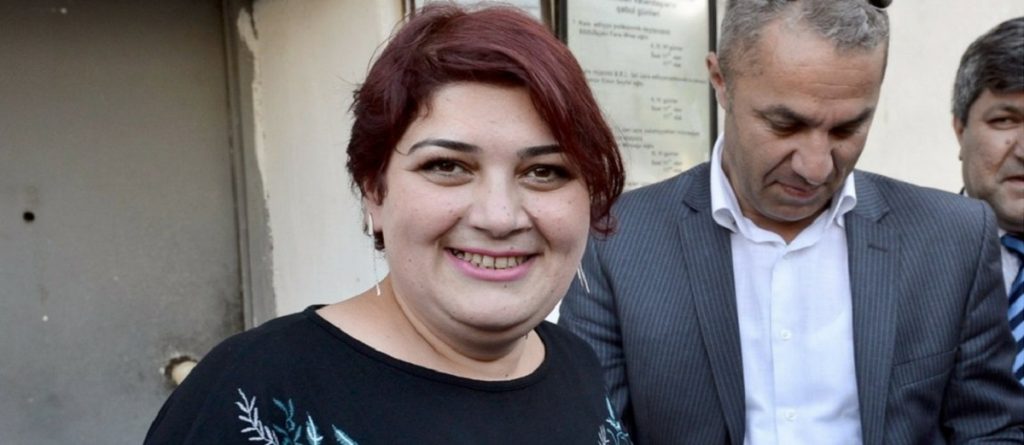
On 26.July 2020 Jam News comes the interesting news that the Azerbaijani investigative journalist Khadija ismayilovahas been offered a $250,000 cash award from Qatar’s Rule of Law and Anti-Corruption Centre. After looking into the activities of the centre and discovering the fund was created by the emir of Qatar, who had closed the center for investigative journalism in Qatar, Khadija Ismail declined the award.
Khadija Ismail
The journalist also added that the reason why the foundation wants to give her the prize is to keep famous journalists under its influence with this award: “Why me? They have been distributing the prize for three years, not a single famous person has yet agreed to receive the prize. It is the famous winners who legitimize such initiatives. I don’t want to sound immodest, but a friend explained to me that they need my name.
“I answered them. I said, thank you, I investigated the issue and do not believe in your sincerity, and I do not sell my reputation for money.”
By the decision of the European Court of Human Rights, in this case, the rights of the journalist, protected by Articles 5 (liberty and security of person), 6 (fair trial), 10 (freedom of expression) and 18 (limits on the use of restrictions on rights) of the European Convention were violated.For these violations, the Azerbaijani government as a whole must pay the journalist compensation to the amount of 25,000 euros, but the journalist says that she has not yet received this money.
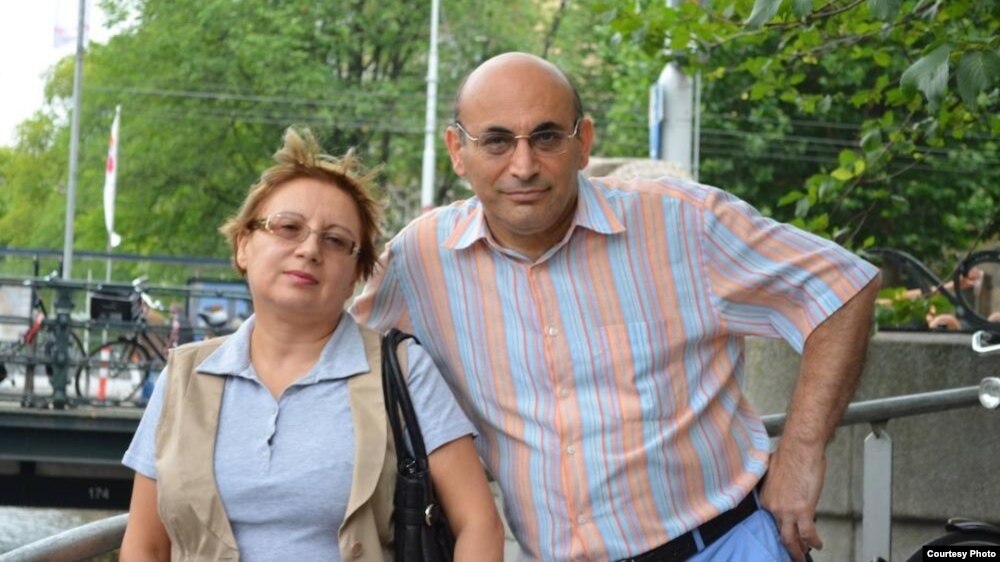
Two of Azerbaijan‘s most prominent human rights defenders have arrived in the Netherlands after the authorities in Baku suddenly granted them permission to leave.
Leyla and Arif Yunus
RFE/RL’s Azerbaijani Service reported on 19 April 2016 that Leyla Yunus and her husband, Arif, were greeted by their daughter, Dinara Yunus, who lives in the Netherlands, upon landing at Amsterdam’s Schiphol airport on April 19, according to Dutch media reports. Welcoming the two, Dutch Foreign Minister Bert Koenders said Leyla and Arif Yunus, who are seeking asylum in the Netherlands, “had put their own safety and happiness at stake in the struggle for democracy and human rights“.
Having paid so much attention to Azerbaijan in the past years [https://thoolen.wordpress.com/tag/azerbaijan/] it would be almost unfair not to mention that the Supreme Court in Baku today released Azerbaijan’s leading human rights lawyer, Intigam Aliyev. The court converted his seven-and-a-half year prison sentence to a five-year suspended term.
[Aliyev, an award winning human rights lawyer is also chair of the Legal Education Society, which litigated human rights cases in Azerbaijan. He was one of the first Azerbaijani lawyers to bring cases to the European Court of Human Rights and has mentored a new generation of human rights lawyers in the country. In April 2015, Baku’s Grave Crimes Court convicted Aliyev on politically motivated charges of tax evasion, illegal business activities, embezzlement, and abuse of authority.]
This blog has had many occasions to be negative about Azerbaijan [https://thoolen.wordpress.com/tag/azerbaijan/], but this time some good news: President Ilham Aliyev of Azerbaijan signed a decree yesterday (17 March 2016) for the Novruz holiday, pardoning 148 prisoners, among them thirteen journalists, human rights defenders and activists.
The list includes: human rights campaigner Rasul Jafarov; the head of a local election monitoring group Anar Mammadli; youth activists from NIDA movement Rashad Hasanov, Rashadat Akhundov, Mammad Azizov, and Omar Mammadov; human rights defenders Taleh Khasmamedov and Hilal Mammadov; opposition Musavat party deputy chair Tofig Yagublu; journalists Parviz Hashimli and Yadigar Mammadli; also a blogger Siraj Karimov. Also today, the Baku Appeals Court converted a six-year prison sentence imposed on journalist Rauf Mirgadirov to a five-year suspended term, and released him from the courtroom.
While this is a great moment for those released, among those still behind bars on bogus charges are: political analyst Ilgar Mammadov, in defiance of the European Court of Human Rights decision on his case and the repeated calls by the Council of Europe Committee of Ministers to free him; human rights lawyer Intigam Aliyev; and Azerbaijan’s prominent investigative journalist, Khadija Ismayilova. Also youth activist Ilkin Rustamzadeh and journalist Seymur Hazi.
“We are overjoyed for the journalists, human rights defenders, and activists who were released today after being imprisoned for exercising their basic rights of free speech and free assembly,” said Nenad Pejic, Radio Free Europe editor in chief. “But Khadija should have been among them”. [https://thoolen.wordpress.com/2015/12/18/azerbaijan-khadija-ismayilova-remains-in-jail-but-council-of-europe-takes-exceptional-step/] In recent correspondence with RFE/RL, international human rights lawyer Amal Clooney, who will represent Ismayilova before the European Court of Human Rights, said that “the case involved a politically motivated prosecution to restrict [Ismayilova’s] freedom of speech… This is about a government that is abusing its power to silence journalists like Khadija, as well as other critics of the ruling regime.”
While there has been a small let up in the incarceration of human rights defenders in Azerbaijan [see e.g. https://thoolen.wordpress.com/tag/leyla-yunus/], it remains the worst place in Europe for human rights defenders. On 25 November the appeal lodged by investigative journalist and human rights defender Khadija Ismayilova was dismissed. She has to remain in jail for 7.5 years!
[Ms. Ismayilova was arrested on December 5, 2014 on charges of “inciting” her ex-partner “to commit suicide”. Although in April 2015 the alleged victim retreated his accusations, claiming his testimony was given under pressure, blackmail and torture, the prosecution did not take it into account and maintained the charges. In February 2015, Ms. Ismayilova was further accused of embezzlement, illegal entrepreneurship, tax evasion and abuse of office. During the hearings in first instance, no evidence of these accusations was presented.On September 1, 2015, the Baku Court of Grave Crimes had sentenced Ms. Khadija Ismayilova to 7,5 years imprisonment on charges of “embezzlement”, “illegal entrepreneurship”, “tax evasion”, and “abuse of office].
As an independent reporter and journalist of the Azerbaijani radio Azadliq (“Radio Freedom”) she has shown great courage (see: https://thoolen.wordpress.com/2014/12/11/khadija-ismayilova-azerbaijan-is-not-deterred/), and received several international prizes, such as the 2015 Alison Des Forges Award for Extraordinary Activism (HRW), the 2015 Freedom to Write Award, the 2012 Fritt Ord/Zeit Press Prize, and the 2012 Courage of Journalism Award by the Washington-based International Women’s Media Foundation. Read the rest of this entry »
Many NGOs have welcomed as a good Human Rights Day present the announcement of the freeing of Leyla Yunus in Azerbaijan. Here the views of the Deputy Director, Europe and Central Asia Division of Human Rights Watch, Rachel Denber:
An interesting read is the latest report to the Council of Europe’s Parliamentary Assembly by Rapporteur: Ms Mailis REPS, Estonia, Alliance of Liberals and Democrats for Europe. The (draft) report is entitled: “Strengthening the protection and role of human rights defenders in Council of Europe member States“.
[On 19 March 2013, the Committee on Legal Affairs and Human Rights appointed Ms Mailis as rapporteur, following the departure from the Assembly of the previous rapporteur, Mr György Frunda.]
The Draft resolution and draft recommendation (AS/Jur (2015) 37) were adopted by the Committee on Legal Affairs and Human Rights on 8 December 2015 and here are some highlights:
Governments are becoming increasingly ‘sophisticated’ in their repression of human rights defenders. Probably as a result of the remarkable worldwide acceptance of human rights as a universal set of standards, Governments that want to continue to suppress criticism are resorting to more and more indirect methods of repression.
The basic universality of human rights is nowadays accepted by the quasi-totality of mankind. In the words of Normand and Zaidi, ‘the speed by which human rights has penetrated every corner of the globe is astounding. Compared to human rights, no other system of universal values spread so fast’. This has not stopped a small number of governments (e.g. Iran, Zimbabwe, North Korea) to continue to oppose the idea and depict human rights as a ‘western’ or ‘foreign’ product, alien to their culture. But the big majority seems to have accepted that there is a crucial distinction between the universality of human rights and its universalisation (or universal application). The first is the moral and legal principle that a core of human rights exists and applies to every person in the world irrespective of his or her culture, country, etc. The second is the process by which these universal standards become a reality. Here one cannot make the same optimistic observation about the speed by which human rights are spreading, but this is not only due to the ever-present gap between rhetoric and reality. The international system itself allows for differing interpretations by giving a margin of appreciation at the regional and national level and by permitting States to make reservations to international agreements. The big question is then, to what extent local cultural, legal and religious practices can be accommodated by the international system without losing its coherence.
In this context one sees increasingly that Governments use ‘tricks’ or at least more roundabout ways to tackle those they want to silence. Recent examples are the disbarment of lawyer Intigam Aliyev in Azerbijan (continuing legal work without license), financial fraud charges against Ales Bialiatski in Belarus (NGO refused recognition, therefore no bank account in Belarus, thus acceptance of grants in neighboring countries illegal), withdrawal of recognition of the Bahrain Center for Human Rights. Now Amnesty International has come with a report on Ethiopia‘Stifling human rights work: The impact of civil society legislation in Ethiopia’ (PDF). It describes in detail how the 2009 Charities and Societies Proclamation imposes heavy restrictions on human rights groups operating in the east African country, and allows for excessive government interference. The result is that Ethiopians have less access to independent human rights assistance. Amnesty International’s Deputy Africa Director Michelle Kagari said: ‘Rather than creating an enabling environment for human rights defenders to work in, the government has implemented a law which has crippled human rights work in Ethiopia. The space to make legitimate criticism is more restricted than ever.’ Human rights defenders risk imprisonment if they violate vaguely defined provisions within the 2009 law, making them afraid to speak out, and often resort to self-censorship, in order to avoid repercussions.
There are surely many other examples and it goes to show that those of us who want to assist HRDs in their work have to become also more sophisticated and cut through the maze of legalistic and bureaucratic measures to unearth the truth about the situation of HRDs. We have our work cut out!
This is just a quick reference to the excellent work of the Oslo-based Human Rights House Foundation and its network over the last 2 months. They continue to call on the OSCE and the Council of Europe to monitor the situation of HRDs and to react against increasing repression against them. The focus is on Belarus, Azerbaijan, Georgia and Armenia, countries which often stay out of the limelight when it comes to human rights protection.


 Hans Thoolen on Human Rights Defenders and their awards