On 16 July 2019, the Committee to Protect Journalists announced that journalists from Brazil, India, Nicaragua, and Tanzania will receive the 2019 International Press Freedom Awards amid the erosion of press freedom in democracies around the globe. The journalists have faced online harassment, legal and physical threats, and imprisonment in their pursuit of the news
CPJ’s 2019 awardees are:
Patrícia Campos Mello, a reporter and columnist at Brazil’s daily Folha de S. Paulo. During the Brazilian presidential election campaign in 2018, Campos Mello was attacked online and doxxed in response to her coverage of supporters of then presidential-candidate Jair Bolsonaro allegedly sponsoring bulk messaging in WhatsApp.
Neha Dixit, a freelance investigative journalist in India who covers human rights. She has faced legal and physical threats, as well as online harassment, after reporting on alleged wrongdoing by right-wing nationalist groups and police.
Lucía Pineda Ubau, news director, and Miguel Mora, founder and editor, of Nicaraguan broadcaster 100% Noticias. The pair was imprisoned in December 2018 in relation to their coverage of political unrest. They were freed on June 11 after six months behind bars, under surveillance and in isolation most of the time.
Maxence Melo Mubyazi, champion of online freedom of expression in Tanzania, who co-founded and is the managing director of Jamii Forums, an online discussion site and source of breaking news. Melo has been charged under the country’s restrictive CyberCrimes Act and, in 2017, appeared in court 81 times.
All of the winners will be honored at CPJ’s annual awards and benefit dinner, which will be chaired by Laurene Powell Jobs and Peter Lattman of the Emerson Collective. The event will be held at the Grand Hyatt New York in New York City on November 21, 2019.
Gulf News (12 July 2019) manages to announce with a straight face that “the fourth edition of the Mansour Bin Mohammad Short Film Award in Dubai is back and UAE’s youth can send their entries until November 7″.
The annual short film award is an initiative by the Community Development Authority (CDA) in Dubai aimed at encouraging creativity and innovation mixing creative media skills and human rights values together…It follows a four-pronged objective: Increase community awareness about human rights; encourage the youth to use their creative skills in highlighting human rights values; develop creative capabilities of the youth in arts, and to establish the values of tolerance, cultural diversity, combating discrimination and extremism among today’s younger generation. ..Maitha Al Shamsi, CEO, Human Rights Sector, CDA, explained that the award has been able to generate key success as an innovative channel that aims to increase awareness of human rights issues while also encouraging young people to express these rights through the use of their creative and artistic skills and talents. Al Shamsi said, “Tolerance has been a long-followed value that the UAE has encouraged since its establishment as a nation. The country is widely known for its promotion of the values of tolerance, peace and respect of others.”
Usha Ramanathan. Credit: Youtube/Satyen K. Bordoloi
Jahnavi Sen, writing in the Wire of 10 June 2019, reports Usha Ramanathan, a legal researcher and activist based in Delhi, has been declared a ‘human rights hero’ by international rights group Access Now for her criticism of the Aadhaar programme. Since the scheme was launched in 2009, Ramanathan has been raising the security and privacy risks associated with it, as well as the concerns on linking the programme to welfare schemes. While facilitating Ramanathan’s “tireless” efforts to highlight the issues related to Aadhaar, Access Now has said that it also wants to “recognise the entire community that has protested and litigated against Aadhaar”. In September 2018, the Indian Supreme Court upheld the validity of the Aadhaar law, but placed strict restrictions on its scope. Before the final judgment, the court had passed a number of orders which were conveniently ignored by the administration, Ramanathan and others have pointed out. Ramanathan has written a number of articles on why the programme needs to be rebooted, and the risks it poses to people’s privacy. A number of her articles have been published in The Wire.
The award function will be held in Tunis between June 11 and 14, as a part of RightsCon. The awards will be handed out by Michelle Bachelet, the United Nations high commissioner for human rights.
Since 2014 Access Now issues the anual award “in celebration of…the work of people around the globe to protect human rights in the digital age, naming “heroes” and “villains” who have either protected the principles of freedom online, or worked to undermine them.”
There are a total of five winners this year. Other than Ramanathan, Bahraini activist and digital security consultant Mohammed Al-Maskati, Australian human rights lawyer, broadcaster and writer Lizzie O’Shea, Tanzanian digital security trainer Zaituni Njovu and Venezuelan lawyer, writer and human rights activist Marianne Díaz Hernández have also been designated ‘heroes’.
On 6 March 2019, two days before international women’s day, the Right Livelihood Award Foundation brought together 5 women Laureates from around the world to discuss ‘local realities and shared global challenges’ facing Women Human Rights Defenders. The side event, organised in parallel to the Human Rights Council’s fortieth session, was co-sponsored by CIVICUS, Human Rights House Foundation, International Network for Human Rights, and supported by the International Platform against impunity and the International Dalit Solidarity Network.
Fabiana Leibl, Sima Samar, Mozn Hassan, Helen Mack Chang, Ruth Manorama, and Charlotte Dos Santos Pruth. Photo by: Amy Au
Here are a few takeaways from the discussion:
Fabiana Leibl, Head of Protection and Advocacy at the Right Livelihood Award Foundation, opened the meeting by describing the worsening trend for women human rights defenders who are prevented from working, not only because they are advocating for human rights, but also because they are women. As the Special Rapporteur on Human Rights Defenders noted in his recent report, this trend is often fuelled by deeply rooted ideas about ‘who women are, and who they should be’. Nahla Haidar, a member of the Committee on the Elimination of Discrimination against Women, remarked that women are frequently ‘targeted with charges of counter-terrorism’, which allows their oppressors to act with impunity.
Sima Samar, Chair of the Afghanistan Independent Human Rights Commission and a leading women human rights defender in Afghanistan, emphasised that achieving parity in educating people of all genders was a key starting point. As we approach the 70th anniversary of the Universal Declaration of Human Rights, she explained, “we need female human rights defenders in order to really change the environment on the ground, and to make the environment conducive for the women to exercise their basic human rights.” She called for an end to the misuse and misappropriation of culture, tradition, and religion as justifications for male dominance. Access to paid work, reproductive services, and justice mechanisms was also identified as crucial in the struggle for gender equality. Samar received the Right Livelihood Award in 2012 “for her longstanding and courageous dedication to human rights, especially the rights of women, in one of the most complex and dangerous regions in the world.” See also: https://humanrightsdefenders.blog/2018/08/31/major-piece-by-departing-high-commissioner-in-the-economist/
Mozn Hassan, founder of Nazra for Feminist studies, is one of the defendants in the well-known NGO Foreign Funding case targeting civil society organisations in Egypt. Her career’s focus on sexual and reproductive rights adds additional restrictions to her work. In July 2018, she was charged with, among other things, establishing an entity in violation of the law and receiving foreign funding with the intention of harming national security. The charges – which are clearly politically motivated – could lead to life imprisonment. Hassan could not attend the event due to a travel ban imposed by the Egyptian government since 2016. However, via video message, she conveyed the serious dangers for human rights defenders, ranging from asset freezing to arrests, arbitrary detention and forced disappearances. On top of this, women must confront gender-specific threats from state and non-state actors. As Mozn noted, “women are facing various gender-based violence in their custodies from harassment to threats of rape.” Mozn Hassan received the Right Livelihood Award together with Nazra in 2016 “for asserting the equality and rights of women in circumstances where they are subject to ongoing violence, abuse and discrimination.” See also: https://humanrightsdefenders.blog/2017/02/02/right-livelihood-has-to-go-to-egypt-to-hand-mozn-hassan-her-2016-award/
Helen Mack Chang, who has persistently sought justice and an end to impunity in Guatemala as head of the Myrna Mack Foundation, emphasised that women often suffer multiple dimensions of discrimination. Indigenous women, for instance, “suffer double discrimination (…) when defending their land or territory against the claims of international corporations.” She noted that recent years have seen a resurgence of conservatism and of global threats to the rule of law and democracy. Corruption and impunity, she stressed, go to the heart of this challenge, in Guatemala and elsewhere. Helen Mack Chang received the Right Livelihood Award in 1992 “for her personal courage and persistence in seeking justice and an end to the impunity of political murderers.
Ruth Manorama is India’s most effective organiser of, and advocate for, Dalit women, belonging to the “scheduled castes” sometimes also called “untouchables.” She is, among other things, President of the National Alliance of Women (NAWO) and National Convenor to the National Federation of Dalit Women. Ruth called for counter-narratives to combat the negative view of human rights defenders in the media. In India, for instance, activists are routinely called “enemies of the State,” “militants,” “anti-nationals,” “traitors,” and “terrorists.” She stated: “I am a patriot. I am an Indian citizen. I must enjoy my constitutional rights. (…) Protecting human rights defenders is a state obligation.” Dalit women are particularly vulnerable to systematic sexual abuse at work, forced sexual slavery such as the Devadasi system, and forced labour. Manorama received the Right Livelihood Award in 2006 “for her commitment over decades to achieving equality for Dalit women, building effective and committed women’s organisations and working for their rights at national and international levels.” See also: https://humanrightsdefenders.blog/2016/11/07/forum-asia-25th-anniversary-event-in-geneva-on-16-november-2016/
Charlotte Dos Santos Pruth is an Advocacy and Policy Advisor at Kvinna till Kvinna, a Swedish organisation working to strengthen and promote women’s organisations in several regions of the world. She presented the findings of their recent report, “Suffocating the movement – shrinking space for women’s rights”, which identifies the main effects of shrinking civic space for women. “A strong feminist movement is the single most important factor to advance women’s rights and gender equality”, she stated, adding that women often have limited access to formal decision-making processes. “This makes defending civil society space particularly crucial”, Dos Santos Pruth continued by saying. She suggested that addressing the lack of funding for women’s organisations would be an important first step.
The speakers brought together experiences from very different cultural contexts. Nevertheless, there were important parallels in their descriptions of defending human rights on the ground. The panellists all showed that the crackdown on women human rights defenders must be viewed within the context of other global trends including growing material inequality, counter-terrorism, corporate impunity, environmental degradation, and corruption. As Sima Samar pointed out, in this worrying global landscape, international solidarity must remain an important principle. In her words: “We don’t only need women in positions of power, we need feminist women; women who don’t support male domination in order to keep their own space and position”.
While major NGOs are involved in a campaign to save the life of human rights defenderAhmed Mansoor, Sharjah– the third largest and third most populous city in the United Arab Emirates – launches an international award for refugee work.
Mansoor is being kept in an isolation ward in Al-Sadr prison in Abu Dhabi, where he is being held in “terrible conditions” in a cell with no bed, no water and no access to a shower. His health has deteriorated significantly, and he is in bad shape, moving slowly when he is allowed out of his cell. He is not allowed to have regular family visits, another reason he started his hunger strike in mid-March. The NGOs – Arabic Network for Human Rights Information (ANHRI), ARTICLE 19, Cairo Institute for Human Rights Studies (CIHRS), CIVICUS, English PEN, FIDH and the World Organisation Against Torture (OMCT) under the Observatory for the Protection of Human Rights Defenders, Front Line Defenders (FLD), the Gulf Centre for Human Rights (GCHR), IFEX, International Service for Human Rights (ISHR), Martin Ennals Foundation, PEN International and Reporters Without Borders (RSF)- call on the UAE to immediately and unconditionally release Ahmed Mansoor, and other unlawfully detained human rights defenders.
————–
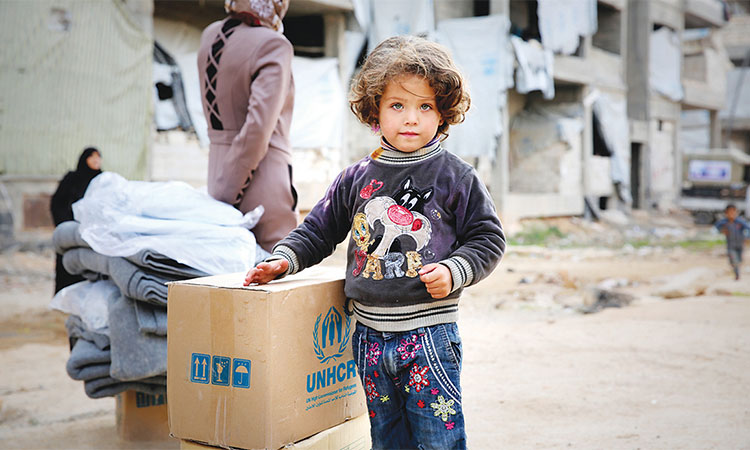
We need to step up support for refugees, said Filippo Grandi.
On 30 April 2019 the fawning press agency Gulf News reported that “the United Nations High Commissioner for Refugees, Filippo Grandi, has said that the Sharjah International Award for Refugee Advocacy and Support should be commended for making the refugee issue more relatable by bringing the human face of the crisis to the fore. Grandi said the award launched by Her Highness Sheikha Jawaher Bint Mohammed Al Qasimi, Wife of His Highness the Ruler of Sharjah, Eminent Advocate for Refugee Children at the United Nations High Commissioner for Refugees and Chairperson of the Big Heart Foundation, had been instrumental in highlighting both individual and organisational efforts and their substantial achievements. Such recognitions can help inspire others to act on supporting the refugee cause within their own capacity“.
...The SIARA award was established to recognise the contributions of an inspirational individual or group making a real difference in alleviating the plight of refugees, IDPs and other vulnerable groups of people. UNHCR’s Nansen Refugee Award has been doing so since 1954.
At a time when some are demonstrating intolerance and calling for more restrictive policies, do you think these awards have a role to play in inspiring collective solidarity and action towards this important cause? Absolutely. Humanitarian awards are significant occasions to highlight both individual and organisational efforts and their substantial achievements. People who have made exceptional contributions that make a difference in the lives of the disadvantaged should be recognised and acknowledged as role models. This recognition can help inspire others to act on supporting the refugee cause within their own capacity.
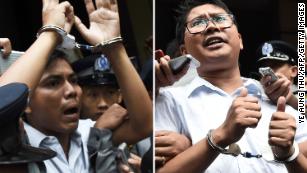
The reporting was “not just based on testimonies of victims, which are key and incredibly important, but it includes one after another stories from the people who actually did this, and in some cases were actually proud of what they had done,” Reuters Myanmar bureau chief Antoni Slodkowski told CNN late last year. In April 2018 seven soldiers were sentenced to “10 years in prison with hard labor in a remote area” for their part in the Inn Dinn massacre, where the victims were forced to dig their own graves the day before they were beaten, stabbed and shot to death. The Reuters reporting elicited the only admission of guilt from the Myanmar government, which routinely rejects criticism of the actions of its troops in Muslim-majority villages in the far west of the mainly Buddhist nation.
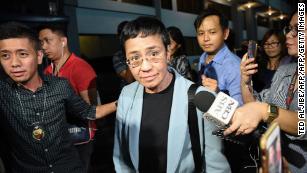
Fellow prize-winning journalist Maria Ressa is facing increasing legal scrutiny in the Philippines. Ressa shared Time’s 2018 Person of The Year award with the Reuters pair and other journalists as a ‘Guardian’ of truth, standing against what the magazine described as a global assault on the free press. [see: https://humanrightsdefenders.blog/2019/02/07/philippines-killing-and-harassment-of-hrds-goes-on/]
On Tuesday Ressa appeared in a Manila court to continue her appeal against a “cyber libel” charge brought against her organization, Rappler. The case is just one of 11 that Ressa and her staff face in what she says is a politically motivated attack on her ability to cover the presidency of Rodrigo Duterte. “This is not just about Rappler — it has very serious implications for anyone writing on the internet. And we will fight,” she told CNN.
The activist is making waves globally (Photo: Anders Hellberg)
Teen climate activist Greta Thunberg – who is a vegan – has won the newly created Prix Liberté, launched last year by the Region of Normandy in France, reports Maria Chiorando in Plantbasednews. Thunberg, 16, is the first recipient of this new award, which was designed to honor a young person ‘engaged in a fight for peace and freedom’. The award comes with prize money of €25,000. [see: http://www.trueheroesfilms.org/thedigest/awards/prix-libert-normandy ] The campaigner has made global headlines through her efforts, which includes encouraging students to attend demonstrations demanding political action on climate change while ‘on strike’ from school. Her influence has spread beyond her native Sweden throughout Europe and beyond
“I am very grateful and honoured to have won the Prix Liberté!” Thunberg said in a post on social media. “The other final nominees have stood up for human rights in a way that I can’t even imagine. We must constantly be reminded of the sacrifices they have made. Lu Guang and Raif Badawi are true heroes of our time.”
Thunberg said she will be splitting all of the prize money between four organizations dedicated to climate justice: These include CARE, which helps women and girls in the global south to cope with the effects of rising temperatures and a changing climate, and The Adaptation Fund – which helps vulnerable communities in developing countries adapt and build resilience to climate change, 350.org and Greenpeace International who in Thunberg’s words ‘both fight for climate justice, the environment, and to keep the fossil fuels in the ground’, will also receive donations. Thunberg will receive her award on June 4, 2019, at the Normandy International Forum for Peace.
Amnesty International UK runs a successful series of (national) media awards. Amnesty’s Media Awards, which have been running annually since 1992, celebrate excellence in human rights journalism and applaud the courage and determination of journalists who often put their lives on the line to report on vital human rights issues. Kate Allen, Director of Amnesty International UK, said at the 3 April 2019 ceremony: “Media work is vitally important for Amnesty and everything we do. This evening we’ve seen some brilliant journalism that has had enormous human rights impact…Without a free press, it’s extremely difficult to expose wrong-doing and hold leaders to account. But even here in the UK we’re seeing it being threatened – especially with the sinister arrest of Trevor Birney and Barry McCaffrey in Northern Ireland last year…That’s why our awards are about congratulating the achievements of the media and championing its role in creating a fairer, more open world.” The awards, hosted by Channel 4 News presenter Cathy Newman, held a moment of silence for the approximately 90 journalists imprisoned last year for doing their jobs. Canada and the USA are undertaking similar events.
The winners of the 2019 AI UK Media Awards include:
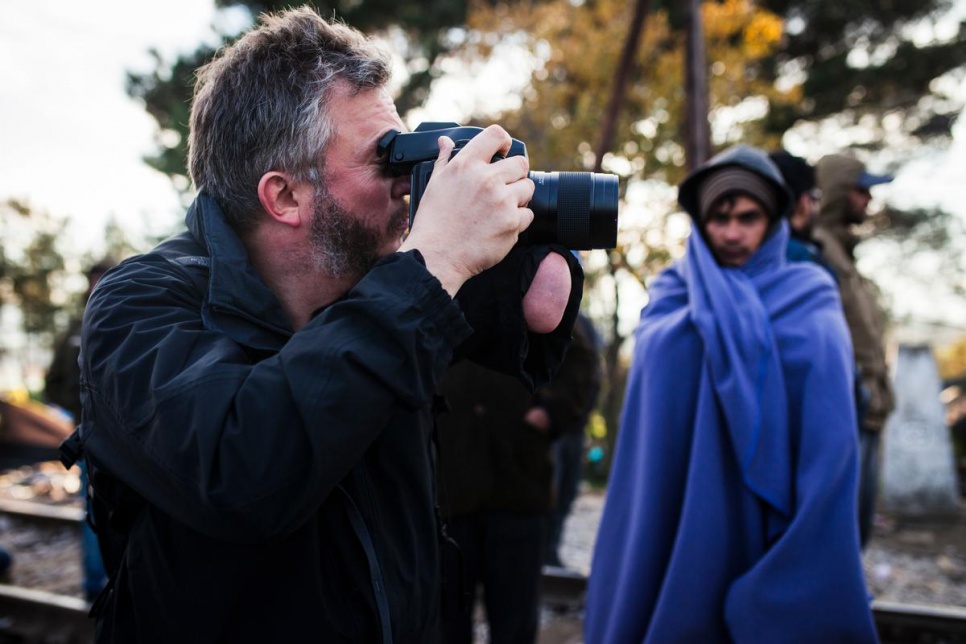
Humanitarian photographer Giles Duley won a Media Award for his powerful series depicting the plight and resilience of Congolese female refugees in Angola. His photo essay, “We Are Here Because We Are Strong”, was commissioned by UNHCR and published in Humanity magazine. The subjects of his project were forced to flee the Kasai region of Democratic Republic of the Congo after violence erupted in March 2017, triggering massive displacement.
The full Media Awards 2019 shortlist can be found here.
Jessikka Aro was to receive a “Women of Courage” prize. Then officials read her Twitter feed.
Jessikka Aro, a Finnish investigative journalist, has faced down death threats and harassment over her work exposing Russia’s propaganda machine long before the 2016 U.S. presidential elections. In January, the U.S. State Department took notice, telling Aro she would be honored with the prestigious International Women of Courage Award, to be presented in Washington by Secretary of State Mike Pompeo. Weeks later, the State Department rescinded the award offer. A State Department spokesperson said it was due to a “regrettable error,” but Aro and U.S. officials familiar with the internal deliberations tell a different story. They say the department revoked her award after U.S. officials went through Aro’s social media posts and found she had also frequently criticized President Donald Trump.
“It created a shitstorm of getting her unceremoniously kicked off the list,” said one U.S. diplomatic source familiar with the internal deliberations. “I think it was absolutely the wrong decision on so many levels,” the source said. The decision “had nothing to do with her work.”
The State Department spokesperson said in an email that Aro was “incorrectly notified” that she had been chosen for the award and that it was a mistake that resulted from “a lack of coordination in communications with candidates and our embassies.” “We regret this error. We admire Ms. Aro’s achievements as a journalist, which were the basis of U.S. Embassy Helsinki’s nomination,” the spokesperson said.
Aro received a formal invitation to the award ceremony not from the embassy but from the State Department’s Office of the Chief of Protocol on Feb. 12.
There is no indication that the decision to revoke the award came from the secretary of state or the White House. Officials who spoke to FP have suggested the decision came from lower-level State Department officials wary of the optics of Pompeo granting an award to an outspoken critic of the Trump administration. The department spokesperson did not respond to questions on who made the decision or why.
To U.S. officials who spoke to FP, the incident underscores how skittish some officials—career and political alike—have become over government dealings with vocal critics of a notoriously thin-skinned president. ….In the minds of some diplomats, this has created an atmosphere where lower-level officials self-censor dealings with critics of the administration abroad, even without senior officials weighing in.
Aro said the decision to cancel her award and corresponding trip to the United States caught her completely by surprise. “[When] I was informed about the withdrawal out of the blue, I felt appalled and shocked,” Aro told FP. …
Peter Nkanga, multilingual investigative journalist and former West Africa Representative of the Committee to Protect Journalists (CPJ), has been declared the laureate of the first “Jamal Khashoggi Award for Courageous Journalism” in 2019.
In a letter signed by Anas Talalqa, Human Rights Advisor at Inti Raymi Fund, the organisation congratulated Mr Nkanga for his selection for the award, noting that the “The Award honors the brave journalists who expose abuse of power and corruption, share difficult truths, discuss taboo topics, and work in hostile environments/”
“Today … dedicate this Award to all journalists and human rights defenders in #Africa. The struggle is real, but it is not over until We Win. #JusticeForJamal,” Peter Nkanga tweeted about the award.
Nigerian Peter Nkanga has been at the forefront of the campaign for the rights of journalists in Nigeria and across sub-Saharan Africa. Last year, he spearheaded the advocacy for the release of a journalist, Jones Abiri, publisher of Bayelsa State-based weekly paper, Weekly Source. He also coordinated the advocacy and protests in Nigeria on Jamal Khashoggi, the Saudi journalist who was murdered at the Saudi Arabian Consulate in Istanbul, Turkey, on October 2, 2018.






 Hans Thoolen on Human Rights Defenders and their awards