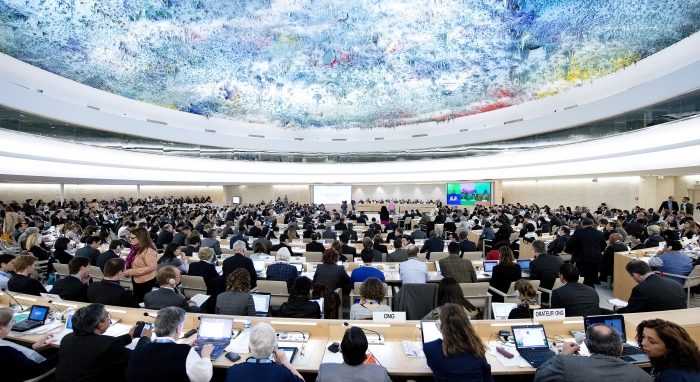
On my ‘favorite’ topic of reprisals [see e.g.: https://humanrightsdefenders.blog/tag/reprisals/ ] the ISHR reported that for the first time, the Human Rights Council had a chance to have a dialogue on the Secretary-General’s annual report on reprisals on 20 September 2018. Civil society had hoped States would seize this opportunity to denounce States carrying out reprisals against defenders engaging with the UN. Regrettably only one State, Germany, made explicit reference to a case of reprisal in the report. ‘We welcome in particular Germany’s intervention in the dialogue, citing the case of Egyptian lawyer Ibrahim Metwally, detained since October 2017 by the Egyptian authorities’, said Salma El Hosseiny, ISHR Human Rights Council Advocate. ‘This is precisely what we need more of—States having the courage and conviction to stand up for defenders and call out countries that attack and intimidate them. What we see now is defenders dissuaded from engaging because the cost is too high. What we need is for States to turn away from repression and attacks, because the cost to them is too high’.
The senior official on reprisals, Andrew Gilmour [https://humanrightsdefenders.blog/tag/andrew-gilmour/], presented the Secretary-General’s annual report on reprisals during the first ever interactive dialogue with the Human Rights Council. The report catalogues 45 new cases of reprisals, ranging from travel bans and smear campaigns to arbitrary arrests and detention, inhuman treatment, torture, and killing. The ASG made it clear in his presentation that reported cases are just the ‘tip of the iceberg’ and spoke of three significant trends:
(1) the systematic denigration of human rights defenders and civil society organizations as “terrorists”;
(2) reprisals often being disguised as legal, political and administrative measures; and
(3) the use of accreditation and security procedures to hinder people from speaking out at UN headquarters and elsewhere.
ISHR delivered a statement during the session citing cases of reprisals against Chinese defenders not included in the report—Wang Qiaoling, Li Wenzu, Cao Shunli, and Uyghur activist Dolkun Isa—and calling for systematic follow-up by the Council on cases in the report.
‘We are especially concerned, once again, about the high number of Council Members or candidates for Council membership cited in the report, including: Bahrain, Burundi, Cameroon, China, Cuba, Democratic Republic of Congo, Egypt, Hungary, India, Iraq, Japan, Kyrgyzstan, Mexico, Pakistan, Philippines, Rwanda, Saudi Arabia, United Arab Emirates, and Venezuela,’ said El Hosseiny.
Half of the States cited in the report intervened during the dialogue to deny the allegations against them. While a significant number of States engaging in the dialogue supported the mandate to varying degrees and asked the ASG what could be taken to strengthen it, another group questioned the ASG’s methodology. Still others firmly opposed the work of the ASG on reprisals, including China and Cuba. China said it ‘regrets and objects’ to the report and the mechanism, and its use of ‘unproven information’, which it deems an interference with its sovereignty.
A side event organised by ISHR following the dialogue highlighted the urgent need to improve both the physical and digital security of defenders at risk of reprisals, and for States and the OHCHR to take a stronger position on this issue at a time when powerful States are threatening the UN system and its core values. ISHR in particular noted its disappointment with the low number of States in the dialogue that took due note of the allegations in the report, as opposed to attacking the methodology of the report and the reliability of the information.
Civil society organisations welcomed significant outcomes of the Human Rights Council’s 39th session, including the creation of independent investigative mechanism on Myanmar, the renewal of the mandate of the Group of Eminent Experts on Yemen and the Commission of Inquiry on Burundi, and a dedicated space on the Council’s agenda in 2019 to discuss the human rights situation in Venezuela. [see alsohttps://humanrightsdefenders.blog/2018/09/08/many-hrd-issues-at-the-39th-session-of-the-un-human-rights-council/]
In a joint statement, several NGOs (ISHR The African Centre for Democracy and Human Rights Studies (ACDHRS), Amnesty International, Article 19, Center for Reproductive Rights. CIVICUS, DefendDefenders, FIDH, Forum Asia, Human Rights House Foundation (HRHF), Human Rights Watch, International Commission of Jurists) welcomed the Council’s adoption of landmark resolutions on several country situations:
On Myanmar, the creation of the independent investigative mechanism is an important step towards accountability for the horrific crimes committed in Myanmar, as elaborated in the Fact Finding Mission’s report to this session. The overwhelming support for the resolution, notwithstanding China’s shameful blocking of consensus, was a clear message to victims and survivors that the international community stands with them in their fight for justice.
On Yemen, the Council demonstrated that principled action is possible, and has sent a strong message to victims of human rights violations in Yemen that accountability is a priority for the international community, by voting in favor of renewing the mandate of the Group of Eminent Experts to continue international investigations into violations committed by all parties to the conflict.
Furthermore, the leadership by a group of States, including Latin American countries, on the landmark resolution on Venezuela, was as an important step for the Council applying objective criteria to address country situations that warrant its attention. The resolution, adopted with support from all regions, sends a strong message of support to the Venezuelan people. By opening up a space for dialogue at the Council, the resolution brings scrutiny to the tragic human rights and humanitarian crisis unfolding in the country.
The Council also adopted a resolution on Syria, which among other things condemns all violations and abuses of international human rights law and all violations of international humanitarian law committed by all parties to the conflict.
However, on other country situations including China, Sudan, Cambodia and the Philippines, the Council failed to take appropriate action.
On Sudan, the Council adopted a weak resolution that envisions an end to the Independent Expert’s mandate once an OHCHR office is set up; a “deal” Sudan has already indicated it does not feel bound by, and which is an abdication of the Council’s responsibility to human rights victims in Sudan while grave violations are ongoing. At a minimum, States should ensure the planned country office monitors and publicly reports on the human rights situation across Sudan, and that the High Commissioner is mandated to report to the Council on the Office’s findings.
The Council failed to take action on the Philippines, in spite of the need to establish independent international and national investigations into extrajudicial killings in the government’s ‘war on drugs’, and to monitor and respond to the government’s moves toward authoritarianism.
In addition, the Council continued with its weak response to the deepening human rights and the rule of law crisis in Cambodia, failing to change its approach even when faced with clear findings by the Special Rapporteur demonstrating that the exclusive focus on technical assistance and capacity building in the country, is failing.
Many States, NGOs and the High Commissioner, raised concerns about China’s human rights record, specifically noting serious violations of the rights of Uyghurs and other predominantly Muslim minorities in Xinjiang province. It is regrettable that States did not make a concrete and collective call for action by China to cease the internment of estimates ranging up to 1 million individuals from these communities.
On thematic resolutions, the Council adopted by consensus a resolution on equal participation in political and public affairs, as well as a resolution on the safety of journalists. The latter sets out a clear roadmap of practical actions to end impunity for attacks.
The Council also adopted by consensus a resolution on preventable maternal mortality and morbidity and human rights in humanitarian settings. Women and girls affected by conflict have been denied accountability for too long. The implementation of this resolution will ensure that their rights, including their sexual and reproductive health and rights, are respected, protected and fulfilled.
Finally, the Council’s first interactive dialogue on acts of reprisals and intimidation was an important step to ensure accountability for this shameful practice. More States need to have the courage and conviction to stand up for human rights defenders and call out countries that attack and intimidate them. [https://humanrightsdefenders.blog/tag/reprisals/]
On 28 September the United Nations’ Committee on the Rights of the Child held a Day of General Discussion on the topic “Children as Human Rights Defenders”.United Nations Deputy High Commissioner for Human Rights, Kate Gilmore, gave the opening speech; here some excerpts:
….It is my great pleasure to join in welcoming you all to this Day of General Discussion on Children Human Rights Defenders..I am most excited of course to be welcoming the members of the Child Advisory Team. You make this such a very special moment for us all – for us personally who work here and for the human rights work we try to do here. This year is the 20th birthday of the UN Human Rights Defenders Declaration and the 70th birthday of the UDHR. ….
Today, we will talk with you, about you. We will listen to you, …….
….We older people have failed you – have failed children. In so many places, in so many ways – older people are still failing children…….
Yet, the strange thing about this, is that it was older people – even older people – including some working 70 years ago – who made those laws and standards that recognise you have those rights, and yet it is older people who are breaking those promises.
……………If young age is no barrier to experiencing the worst consequences of older people’s decisions, then why use young age as an excuse to leave you out, to lock you out, from the places where those decisions could be changed. As human rights defenders, you know far better than I do why it is so important that we rethink the power relationship between older and young people. If we would just change how we older people relate to children, make more room for you, listen to you more respectfully, value your experiences more, keep our promises to you then maybe we too would grow up and with you, just get on with changing the world for better.
When India was named as a major sinner in this year’s report on reprisals against human rights defenders, there was understandable shock. Many NGOs and newspapers reported on this (a small selection below).
ARUNA ROY published on 21 September a piece called: “Attack on the conscience keepers; Attempt to silence the messenger”, which is an excellent overview of the issues at stake:
There have been a set of simultaneous raids and arrests of eminent social activists and public intellectuals over which the BJP government in Maharashtra and the Centre, and many human rights organizations have been locked in a sharp polarized debate. The arrest of Sudha Bharadwaj, Gautam Navlakha, Vernon Gonsalves, Varavara Rao and Arun Ferreira, in the Bhima Koregaon is a case that has all the elements of an attempt to use an FIR to target a particular kind of dissenting voice, and use undefined terms like “urban naxal” to divert from the main issue itself. This is not just baffling for the ordinary reader – but is a new kind of threat to the democratic practices in India.
The attack on human rights workers is an attempt to silence the messenger. Given the very high credibility of the people concerned, an orchestrated campaign with the media has been used. News has itself become a strange brew of half-truths, rhetorical statements and deliberate mis-communication. In addition, the state and corporate interests exercise huge commercial control over the media, and many of the causes of tribal communities that are espoused by these activists are in direct conflict with the commercial interests of the media ownership. Users of “social media” advocate causes, make twisted statistical representations, and generate propaganda –all under the credibility that “media” enjoys in large part. The citizen is caught in a web of cross cutting information, where truth is elusive, and it is difficult to differentiate between fact and fiction.
Let’s try and examine some of the facts of this FIR. The Elgar Parishad was an event organized by Dalits in celebration of an old tradition- a historic defeat of the Peshwas at the hands of the Mahars in the 1800s. Two ex judges, Justice Patil and Justice Sawant, former Supreme Court judge and former Chair of the Press Council, were part of the organizing team. On January 1, 2018, there was a clash between the Dalits and the upper castes. FIRs were lodged by the Dalits and a cross case later by the others. The accusations now added to the list, were not in the FIR and none of those arrested were present either at the Elgar Parishad, or on the of January 1. The first claim made by the Pune police was, that these were Maoists responsible for planning and fomenting the violence that took place on January 1. The claim that the arrested activists were a threat to the state and national security has been added subsequently.
There is no doubt that rising inequalities in India are the leading marginalized communities – particularly Dalits and Tribals– to organize to fight for survival and reclaiming citizenship. The citizen’s exercise of sovereignty, ie asking questions about land and natural resources, non-delivery of services, justice and dignity, especially for the most marginalized and discriminated, is branded as anti- national to escape scrutiny. Their advocates suffer the same fate and are hounded to prevent the amplification of the voices against corruption and injustice. The categorization of “anti-national” has now a twin in “urban naxal”. Vague and subjective and incomprehensible; and yet they are used to prosecute and silence people.
The governments, normally riddled with corruption and arbitrary use of power, are afraid of disclosures, accountability and the rule of and by law. When they are confronted by public scrutiny into the exercise of unconstitutional power, they take refuge in accusations of terrorism, sedition etc. to suppress all questioning. The suffering communities and individuals are often the victims of the privileged elite. The RTI has legitimized questioning and the corrupt system is feeling threatened by it, as the attempts to amend and the killing of RTI users amply prove.
Branding of opposition as “Maoists or terrorists”, and “urban naxalites” has enabled governments to build public acceptability, supporting arbitrary decisions made in camera. Rationality falls victim to the fear of government vendetta and silence prevails.
The system protects its charges with dossiers and secret files created to indict activists. The use of the RTI has proven quite clearly that the sovereign citizen is often in ignorance of acts done in her/his name. Therefore any claim of “evidence” is suspect unless it is allowed public scrutiny. There are few tools besides the RTI to test sources of the evidence and the veracity of the testimonies.
This attack on civil rights defenders is in some ways worse than the declaration of the Emergency in 1975, where the motivation was to cling to political power. This is not just about political power, but to change the ideas of justice and equity. Like then, civic space is being narrowed down and an atmosphere of fear is created. But today, people who have dedicated their lives to and speak for constitutional rights are branded as criminals and terrorists and there is a vicious attempt to destroy their credibility. An attack on the rights of civil society by gagging its spokespersons will destroy the idea of India. This idea was crafted carefully by the constituent assembly to give legitimate space for the peaceful and just co-existence of disparate cultures, ideologies and thought, to enable a steady, though difficult journey towards a more just and equitable India.
In a briefing paper for the new UN High Commissioner for Human Rights, Michelle Bachelet, ISHR has set out ten concrete and practical ways in which the High Commissioner and her Office can contribute to protecting human rights defenders and promoting a safe and enabling environment for their work at the international and national-levels.
‘Supporting and empowering these defenders – and protecting them against those governments, corporations and fundamentalists whose currency is prejudice, profit or privilege – should be the new High Commissioner’s highest priority. She should consult closely with defenders, speak out and pursue accountability when they are attacked, push for laws and mechanisms to protect them at the national level, and ensure that the UN human rights system is safe, accessible and effective for them,‘ ISHR Director Phil Lynch said.
Recommendations for the High Commissioner to support human rights defenders
Be proactive in regularly consulting and working in partnership with human rights defenders and other independent civil society actors.
Make clear and regular statements on the essential role played by human rights defenders and the need to ensure they can work in a safe and enabling environment without fear or hindrance, acknowledging the protection needs of particular groups of defenders.
Speak out and demand accountability on cases of threats, attacks and reprisals against human rights defenders, including by calling for and supporting impartial investigations, prosecution of perpetrators, and effective remedies for victims.
Push and work with States to fulfil the commitments laid out in the UN Declaration on Human Rights Defenders, including through repealing restrictive legislation and developing specific laws, policies and mechanisms to protect defenders.
Establish a comprehensive set of indicators to assess State fulfilment of human rights obligations related to human rights defenders, which could be used as an evidentiary basis for assessing compliance.
Build strategic alliances with States, civil society, academics, business enterprises and other actors with a shared interest in human rights, ensuring an enabling environment for civil society and respect for the rule of law.
Define an operating procedure at OHCHR to ensure that all offices establish and apply minimum standards in regard to their work on and with human rights defenders.
Encourage the Secretary General to carry out a full audit of UN work on human rights defenders and to develop an organisation-wide policy on supporting and protecting defenders. More generally, work closely with the Secretary-General to ensure that all UN agencies contribute to, and coordinate on, the protection of defenders and ensuring an enabling environment for their work.
Encourage the development and implementation of an effective UN-wide policy on preventing and addressing reprisals and strongly support continuation and adequate resourcing of the mandate of the UN Senior Official on reprisals.
Work to ensure that UN human rights bodies and mechanisms are accessible, effective and protective for human rights defenders, in particular by ensuring that any reform efforts are informed by the full and meaningful participation of civil society. Strong leadership from the High Commissioner is essential to ensure that the process to strengthen the Treaty Bodies in 2020, and the General Assembly mandated status review of the Human Rights Council in 2021, are underpinned by these principles.
Shared Space under Pressure launch of guidance document on business support for civic freedoms and human rights defenders is an event organised by ISHR and took place on 17 September from 13:30 to 14:30 in Room XXVII. The panelists will present and discuss a new publication by the Business Network on Civic Freedoms and Human Rights Defenders, which provides concrete advice to companies on how to protect human rights defenders.
Ending reprisals: Discussion with human rights defenders and experts. The event will highlight the nature and extent of reprisals and intimidation for those cooperating with the UN, discuss and expand on the Secretary General’s report on cooperation with the UN and consider efforts to date to address reprisals as well as ways to further develop and strengthen policies to prevent and address reprisals. It will take place on 20 September from 10:00 to 11:00 in Room XXV.
Accountability and the need to end impunity for human rights violations in Yemen: Human rights defenders including bloggers, Internet activists and journalists at extreme risk of persecution is an event organised by the Gulf Center for Human Rights and co-sponsored by ISHR, CIVICUS and FIDH. It took place on 10 September from 12:00 to 13:00 in Room XXIV.
Saudi Arabia’s 3rd Cycle UPR: a Refusal to Reform is an event organised by Americans for Democracy and Human Rights in Bahrain. It will review the Kingdom’s human rights record over the past five years, taking a look at some of the recommendations offered during the previous cycle in October 2013 that have gone unfulfilled, from women’s rights to capital punishment, torture to the lack of a written penal code, and human rights defenders and civil society. It took place on 11 September from 12:00 to 13:00 in Room XXIII.
Gross human rights violations in Myanmar: options for international criminal accountability is an event organised by the International Commission of Jurists (ICJ), Human Rights Watch and Amnesty International and took place on 13 September at 12:00 in Room XXVII. The discussion will focus on means of documenting violations, possible evidence-gathering mechanisms and the role of the International Criminal Court.
Burundi: ending the crisis and paving the way for accountability is an event organised by DefendDefenders in collaboration with a range of Burundian and international partners including ISHR. It will highlight ongoing grave violations in Burundi, lack of domestic accountability, and the need to renew the mandate of the Commission of Inquiry (CoI) on Burundi to avoid a monitoring and reporting gap and to prepare for accountability at the international level took place on Thursday 13 September from 13:00-14:00 in Room XXIV.
Bridging the gap: HRC resolutions and the human rights situation in Sudan will examine Sudan’s human rights and humanitarian situation and the last UN Human Rights Council resolutions, which have failed to adequately reflect it. During this side event organised by DefendDefenders, panelists will discuss Sudan’s record, ongoing violations and abuses, and what the HRC needs to do to fulfil its mandate and prioritize the rights of all Sudanese. It took place on Friday 14 September from 14:00-15:00 in Room XXIV.
Women’s Access to Justice is an event organised by the International Commission of Jurists (ICJ) and took place on 17 September at 14:00 in Room XXIV. The discussion will focus on how to implement a women-centred approach in strengthening access to justice, considering ways to ensure that gender issues are robustly integrated into human rights investigations and judicial mechanisms and implemented by the actors operating within these areas. The discussion will draw on themes relevant to the annual discussion on the integration of a gender perspective taking place on 24 September.
Human Rights in Myanmar is an event organised by Forum Asia on 17 September from 10:00 to 11:00 in Room XXV. Human rights defenders from Myanmar presented their perspectives on the findings of the report of the Independent International Fact-Finding Mission on Myanmar, and key recommendations for the UN Human Rights Council.
From Documenting Violations to Preparing for Prosecutions: How can the UN respond effectively to crimes under international law in situations of crisis? is an event organised by the International Commission of Jurists (ICJ) and the Permanent Mission of the Netherlands and will take place on 18 September at 15:30 in Room XXII. The discussion will focus on why the Council and other international bodies need to move quickly to preserve evidence of crimes under international law, and options for doing so, with the International Impartial and Independent Mechanism (IIIM) for Syria, and the Commission on Human Rights in South Sudan, as examples to inform possible future mechanisms or a permanent standing mechanism.
Crisis in the DRC: a country-wide perspective is an event organised by CIVICUS that will take place on 18 September. The exact time and room will be announced soon.
Human Rights in Cambodia is an event organised by Forum Asia on 19 September from 10:00 to 11:00 in Room XXV. Civil society will discuss the closure of civic space in Cambodia following the July 2018 national elections, which have been widely condemned as neither free nor fair, as well as what the UN Human Rights Council should do to respond to attacks on civil society and the degradation of democratic freedoms.
States and NGOs are holding a lot more side events. You can download the list of State events here and NGO events here.
On Wednesday 19 September (16:00-17:30 – Room XXIV, Palais des Nations, Geneva) the International Service for Human Rights (ISHR) is organizing a side event Ending reprisals: Discussion with human rights defenders and experts.
This event seeks to provide a space for human rights defenders and experts to shed light on the nature and extent of reprisals and intimidation against those cooperating with the UN; discuss and expand on the Secretary-General’s report; and to consider efforts to date to address reprisals and intimidation against those cooperating with the UN as well as ways to further develop and strengthen policies and practices to prevent and address reprisals.
Participants:
Andrew Gilmour, Assistant Secretary General for Human Rights
Victoria Tauli-Corpuz, Special Rapporteur on the Rights of Indigenous Peoples
The event is co-sponsored by the Permanent Mission of Ireland to the United Nations and the Permanent Mission of Uruguay to the Office of the United Nations.
The 39th session of the UN Human Rights Council is held from coming Monday to 28 September 2018. Human Rights Defenders issues abound. Thanks to the excellent overview of the ISHR I can provide a short summary. To stay up-to-date, follow @ISHRglobal and #HRC39 on Twitter.
Reprisals
On 19 September, the Council will hold its first dedicated interactive dialogue on reprisals. It will engage with the Assistant Secretary General for Human Rights (Andrew Gilmour) who as UN senior official on reprisals will present the Secretary General’s annual report on the United Nations’ “the reprisals report”. The dedicated dialogue to address acts of intimidation and reprisals was mandated by the resolution on reprisals in September 2017 and provides a key opportunity for States to raise concerns about reprisals, and demand that Governments involved in existing cases provide an update on any investigation or action taken toward accountability. [for some of my earlier posts on reprisals: https://humanrightsdefenders.blog/tag/reprisals/]
The Council will consider the human rights of indigenous peoples on several occasions: it will hold a panel on the issue (see further below), the annual reports by the High Commissioner, the Special Rapporteur on the rights of indigenous peoples, including on her visits to Mexico and Guatemala, and the Expert Mechanism on the Rights of Indigenous Peoples.
The Special Rapporteur on the promotion of truth, justice, reparation and guarantees of non-recurrence will also present his annual report, followed by an interactive dialogue, in addition to discussing the Secretary General report on the prevention of genocide.
The Council will discuss the report of the Secretary-General on capital punishment and the implementation of the safeguards guaranteeing protection of the rights of those facing the death penalty.
The Council will also discuss the report of the High Commissioner on mechanisms concerned with ensuring the safety of journalists and the Council will consider a resolution on the issue. The first informal consultation is scheduled for 11 September at 15:30.
The Special Rapporteur on the implications for human rights of the environmentally sound management and disposal of hazardous substances and wastes will present a set of principles for States, businesses and other actors to protect workers, including the need to protect worker representatives and human rights defenders from reprisal.
Country-specific developments
Burundi. During its 36th session, the Council passed two resolutions on Burundi (read here ISHR’s analysis of these two resolutions). At the 39th session, the Council will hold an interactive dialogue with the High Commissioner on his final report on Burundi on 11 September from 15:00 to 18:00. The Council will also hold an interactive dialogue with the Commission of Inquiry on 17 September between 09:00 and 12:00. ISHR continues to remain highly concerned about the human rights situation in Burundi and its refusal to cooperate with the Council’s mechanisms, which clearly warrant an invitation to the General Assembly to consider the suspension of Burundi as a member of the Council. ISHR joined a group of NGOs in calling for the renewal of the mandate of the Commission of Inquiry. [for earlier posts on Burundi: https://humanrightsdefenders.blog/tag/burundi/]
Yemen. Last September, the Council appointed a Group of Eminent Experts to carry out a comprehensive examination of all alleged violations of international human rights law committed by all parties to the conflict since September 2014. They will present their report followed by an interactive dialogue on 26 September from 09:00 to 12:00. The Council will also consider a report of the High Commissioner on the human rights situation in Yemen and on the implementation of the technical assistance. The Group of Eminent Experts’ report strongly suggests that parties to the armed conflict have perpetrated, and continue to perpetrate, violations and crimes under international law. Over 50 civil society organisations have called on the Council to renew and strengthen the mandate of the Group of Eminent Experts through the enhancement of its reporting structure and strengthening language on accountability.
China. The 39th session is the final session before China’s Universal Periodic Review. [https://humanrightsdefenders.blog/2016/03/15/remember-2nd-anniversary-of-the-death-of-cao-shunli/; https://humanrightsdefenders.blog/2018/03/26/chinas-win-win-resolution-gets-the-votes-in-the-un-council/ and many more]
Other country situations where HRD issues are relevant
The Council will hear reports on and is expected to consider resolutions addressing a range of country situations, in some instances involving the renewal of the relevant expert mandates.
They include:
Interactive dialogue with the Commission on Syria
Interactive dialogue with the Commission on human rights in South Sudan
Interactive dialogue with the Fact-finding mission on Myanmar
Interactive dialogue on the High Commissioner’s oral update on Ukraine
Interactive dialogue on the High Commissioner’s report on the Democratic Republic of the Congo
Interactive dialogue on the High Commissioner’s oral update on Libya
Interactive dialogue with the Special Rapporteur on Cambodia
Interactive dialogue with the Independent Expert on Somalia
Interactive dialogue with the Independent Expert on Sudan
Interactive dialogue with the Independent Expert on the Central African Republic
Adoption of Universal Periodic Review (UPR) reports
During this session, the Council will adopt the UPR working group reports on Turkmenistan, Burkina Faso, Cabo Verde, Colombia, Uzbekistan, Tuvalu, Germany, Djibouti, Canada, Bangladesh, Russian Federation, Azerbaijan, Cameroon, and Cuba.
Appointment of mandate holders
The President of the Human Rights Council has proposed candidates for the following two vacancies of mandate holders to be filled at this session:
Special Rapporteur on the situation of human rights in Belarus
Special Rapporteur on the situation of human rights in Eritrea
Resolutions to be presented to the Council’s 39th session
At the organisational meeting the following resolutions relevant to HRDs were announced (States sponsoring the resolution in brackets):
The human rights situation in Yemen (Yemen and a group of countries)
The protection of human rights in the Democratic Republic of Congo (Togo on behalf of the African group)
The protection of human rights in the Sudan (Togo on behalf of the African group)
World Programme for Human Rights Education (Brazil, Costa Rica, Italy, Morocco, Slovenia, Senegal, Philippines, Thailand)
The human rights situation in Syria (France, Germany, Italy, Jordan, Kuwait, Morocco, Qatar, Saudi Arabia, Turkey, the United Kingdom)
The human rights situation in Somalia (the UK and a group of countries)
The safety of journalists (Austria, Brazil, France, Greece, Morocco, Qatar and Tunisia)
The human rights of indigenous peoples (Guatemala and Mexico)
The promotion and protection of the human rights of peasants and other people working in rural areas (Bolivia, Cuba, Ecuador, South Africa)
The human rights situation in Burundi (the European Union)
The human rights situation in Myanmar (the European Union)
Equal participation in political and public affairs (Botswana, Czech Republic, Indonesia, Netherlands, Peru)
The situation of Rohingya muslims and other minorities in Myanmar (Pakistan on behalf of the Organisation for Islamic Cooperation)
Panel discussions
During each Council session, panel discussions are held to provide member States and NGOs with opportunities to hear from subject-matter experts and raise questions. All panel discussions will be broadcast live and archived on http://webtv.un.org. Three panel discussions are scheduled for this upcoming session:
The high-level panel discussion to commemorate the seventieth anniversary of the Convention on the Prevention and Punishment of the Crime of Genocide will take place on 13 September from 10:00 to 12:00.
The annual half-day panel discussion on the rights of indigenous peoples will take place on 19 September from 9:00 to 11:00. The theme will be the participation and inclusion of indigenous peoples in the development and implementation of strategies and projects in the context of the 2030 Agenda for Sustainable Development.
The annual discussion on the integration of a gender perspective throughout the work of the Human Rights Council and that of its mechanisms will take place on 24 September from 16:00 to 18:00. The theme will be gender integration and human rights investigations: strengthening a victim-centred approach.
Side events. As always there will be many side events concerning HRDs to which I will refer in the future.
As local, national, regional, and international civil society organizations from every corner of the world, we offer warm congratulations on your appointment as United Nations (UN) High Commissioner for Human Rights. We are committed to a world in which every person enjoys human rights and dignity and in which our communities are fair, just and sustainable. We consider that a strong High Commissioner, working in strategic partnership with independent civil society, can contribute significantly to the realization of this vision.
You take up office at a time when human rights are under attack and when we risk the reversal of many of the achievements of the modern human rights movement. We look to you in these troubled times to be an unwavering voice in the defence of human rights, and of victims, rights-holders and human rights defenders around the world.
On every continent, the rights of individuals, communities and peoples are being violated and abused by governments and non-state actors, often with complete impunity. Civil society, peaceful dissidents, and the media are often brutally silenced. The role of your Office in ensuring robust monitoring of, and reporting on, such situations is essential for curbing violations and deterring further abuse, as well as for ensuring justice and accountability. Technical-assistance and capacity building by the OHCHR is also critical and, to be effective, should be approached holistically alongside a rigorous assessment of the rights challenges in the country, including through key indicators to measure progress and assess the degree of engagement and cooperation by the State.
As High Commissioner, you have a unique role to play in bringing country situations of concern to the attention of the UN Human Rights Council and other UN bodies, particularly situations that may not be on their agenda or which receive limited attention, often because of political pressure. This role should extend to providing briefings to the Security Council on situations either on its agenda or that, if left unattended, could represent a threat to international peace and security. Monitoring missions and inter-sessional briefings to the HRC can be initiated at the High Commissioner’s prerogative, on the basis of your Office’s universal mandate, bringing attention to neglected country situations and contributing towards the achievement of the Council’s mandate to prevent human rights violations.
We are aware that the position of High Commissioner comes with its own challenges. Many States will insist you avoid “naming and shaming” and push you to engage in “quiet diplomacy” and to respect national sovereignty. Often, those most intolerant of criticism and most forceful in suppressing dissent will speak the loudest in seeking to mute your voice. Survivors, victims and defenders on the front line in countries where their rights are being violated will rely on you as a human rights champion, to have the courage and conviction to call out violators clearly and publicly, even when it’s challenging or unpopular with governments.
Globally, the rights essential to civic space are being systematically undermined. Civil society and human rights defenders face severe daily risks in their struggle to defend human rights on the ground, including imprisonment, asset-freezes, defamatory campaigns, torture, enforced disappearance, and even death. Risks are also present in the UN context, where individuals frequently face intimidation, harassment or reprisals for their engagement with the UN. We urge you to be a staunch defender of the rights of defenders both on the ground and at the UN, to publicly call out violators, and to undertake or push for investigations into attacks and reprisals. We also encourage you to take full advantage of the distinct, often innovative complementary role of civil society to the work of the OHCHR, and ensure the Office works closely with civil society as a strategic partner at the national, regional, and international levels.
Currently, the human rights framework itself is under unparalleled attack. Authoritarian populists are attacking the universality of human rights, disproportionately and unlawfully restricting rights in the purported interests of “national security,” often tacitly or openly encouraging attacks by their followers or vigilantes on rights defenders as well as the vulnerable and poor, while selectively interpreting human rights and seeking to co-opt or subvert human rights mechanisms to suit their political agendas. Safeguarding and strengthening universal human rights norms and mechanisms should be a core responsibility of the High Commissioner.
The current climate highlights the need for a strong public advocacy role for your mandate in the defence of international human rights law and the international human rights system, as well as a strong role internally within the UN to mainstream respect for human rights throughout the work of UN organs and agencies, and within the Sustainable Development Agenda.
Once again, we congratulate you on your new role, and stand ready to support you and your Office in the fulfilment of your vital mandate.
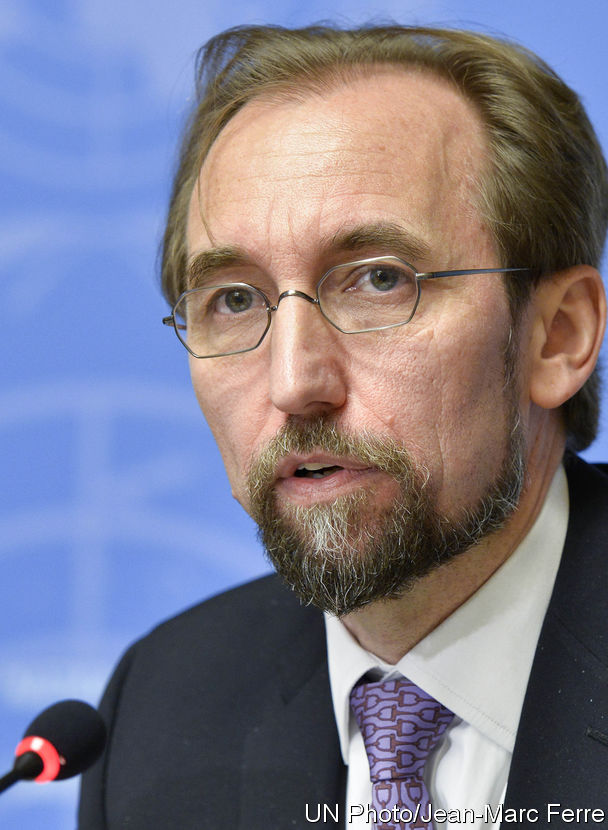
Zeid Ra’ad Al Hussein, the UN High Commissioner for Human Rights, who steps down on 1 September wrote a long and hard-hitting piece under the title “Grassroots leaders provide the best hope to a troubled world” in the Economist of 30 August 2018. Just some excerpts here, please read the whole thing:
…………….Now look at today’s politicians. First, those who occupy so much of the news media’s attention: the Trumps, the Orbans, the Salvinis. Keen to be viewed as the virile leaders of their respective countries; eager to inflate their image by harming migrants and refugees, the most vulnerable in society. If there is courage in that, I fail to see it. Authoritarian leaders, or elected leaders inclined toward it, are bullies, deceivers, selfish cowards.
If they are growing in number it is because (with exceptions) many other politicians are mediocre. They, too, are focused on their own image, the vanities associated with protocol and re-election. Too busy with themselves, or too afraid to stand up to the demagogues and for others, they seem to shelter in the safety of silence and shuffled papers. Only when they leave public office do some speak up, discovering their courage rather belatedly. Many come and go; no one really notices.
In consequence, too many summits and conferences held between states are tortured affairs that lack profundity but are full of jargon and tiresome clichés that are, in a word, meaningless. What is absent is a sincere will to work together, though all will claim—again, under the lights and on camera—that they are wholly committed to doing so. The systems for states to act collectively at higher levels in pursuit of solutions are decomposing. There are signs of it everywhere we care to look.
….
I believe it is only a matter of time, for example, before we see a Takfiri confrontation with Buddhist extremism in Asia. Where this is likely to occur, geographically, and who is likely to be involved, can already be surmised. The how and the when are, as always, indeterminate. It will depend on the outcome of regional presidential elections and how the situations in Cox’s Bazaar and Myanmar play out. The current signs are not encouraging. What is clear is that our systems for fixing this are broken.
When Myanmar inflicts enormous suffering on the Rohingya—burns them in their homes, cuts the throats of their children, rapes and terrorises, sends 700,000 people fleeing to Bangladesh in only three weeks—and the government pays no penalty for this—what are we saying to the perpetrators? Or to the victims? And to other potential perpetrators across the globe? Xi Jinping openly backs the government of Myanmar and, unusually for the US, given the extent of the horrors, President Trump did not even mention Rakhine when he addressed the UN General Assembly in September 2017. Strong evidence indicates the Burmese military and others may have committed acts of genocide. How much more cruel can humanity be, and how much chaos and pain are we fomenting?
….
And when multiple stress fractures already exist—the result of decades of mediocre leadership—all that’s required is a tripwire. To heal those fractures, whether in the Middle East or elsewhere, we must think differently, think more about human rights, and do this with some urgency.
A fracture within society is often shorthand for human suffering or the existence of burning grievances. Before conflicts begin, suffering stems from three types of human rights violations. One is the denial of fundamental freedoms, such as of opinion, expression and peaceful assembly, creating a situation where life and fear of the state become inseparable. A second is the deprivation of basic services, such as legal and social protections or rights to education and healthcare, which often only confirms the hold of political elites over others. And third, feeding the first two, discrimination, structural and deep, propped up by racism, chauvinism and bigotry.
When multiple stress fractures already exist—the result of decades of mediocre leadership—all that’s required is a tripwire
…If we do not change course quickly, we will inevitably encounter an incident where that first domino is tipped—triggering a sequence of unstoppable events that will mark the end of our time on this tiny planet. Can we swerve in time?
My hope lies in a set of people not widely known internationally, but familiar to those in the human rights community. Unlike the self-promoters—the elected xenophobes and charlatans—these people do have courage. They have no state power to hide behind: instead, they step forward. They are the leaders of communities and social movements, big and small, who are willing to forfeit everything—including their lives—in defence of human rights. Their valour is unalloyed; it is selfless. There is no discretion or weakness here. They represent the best of us, and I have had the privilege of knowing some of them personally, while others are well known to my office.
Suffering reflects a massive dereliction of the duty to serve, by those who exercise sovereignty on behalf of their people
This is what true leaders look like. Bertha Zuniga Caceres from Honduras, the young daughter of the murdered environmental activist, Bertha Caceres, who has bravely continued her mother’s struggle. Dr Sima Samar in Afghanistan, who leads the country’s independent human rights commission and is utterly fearless, even when threats to her personal safety abound. The same could be said of Senator Leila de Lima in the Philippines, who has now been arbitrarily imprisoned without trial for 18 months. Pierre Claver Mbonimpa from Burundi, a gentle yet principled soul, undeterred even after his son was murdered and he himself survived repeated attacks.
I have also been deeply impressed by the dignity and courage of Denis Mukwege from the Democratic Republic of Congo, an extraordinary human being by any measure. Likewise, I have been humbled by the determination of Angkhana Neelapaijit from Thailand, whose husband, a lawyer, disappeared in 2004 leaving her to become a most courageous activist, fighting against enforced disappearances.
There are others too, from Bahrain for example: the Khawaja family, Nabeel Rajab, Maytham Al Salman and Ebtisam Al Sayegh, who have all have shown extraordinary courage in the face of considerable adversity. Hatoon Ajwad Al Fassi and Samar Badawi in Saudi Arabia: courageous leading voices for the rights of Saudi women, both currently in detention. Amal Fathy in Egypt and Radhya Al Mutawakel in Yemen are also two brave individuals who have put their own safety at risk as they have spoken out against injustice and on behalf of victims of human-rights violations.
Likewise, Ludmila Popovici, an activist against torture in Moldova. In Poland, Barbara Nowacka has been active in organising protests against measures to pull back women’s rights. Sonia Viveros Padilla in Ecuador is fighting for the rights of people of African descent. Close by, in El Salvador, Karla Avelar, the courageous transgender activist, deserves high praise—as does the Peruvian Maxima Acuna, a well-known environmental human rights defender.
I could continue. There are grassroots leaders of movements against discrimination and inequalities in every region. These names are just a sample of the real store of moral courage and leadership that exists among us today.
While some speak from an individual vantage point, fighting specific battles on behalf of their local communities, others lead broader social movements. World-wide, they are not coordinated. But what if they were? What would happen if all the movements supported each other, openly and actively?
There are grassroots leaders of movements against discrimination and inequalities in every region…the real store of moral courage and leadership among us.
……What if this coordinated, focused, human-rights movement had the backing of business leaders? There are business leaders who are also real leaders, and who have thought seriously about human rights; people like Barbara Novick of Blackrock, Paul Polman of Unilever, Microsoft’s Brad Smith and Deepmind’s Mustafa Suleyman. This has never been done before; but if we did do it, it might just deliver a sort of shock therapy to those dangerous or useless politicians who now threaten humanity. Maybe, just maybe, it would be enough to stop the rot, so that when a fool tips that first domino or strikes the tripwire they hurt no one but themselves, and we can hope that the injury is only a slight one.
I leave you with that thought. This is my parting note: one of courage and defiance, and a longing for the leadership of the just.


 Hans Thoolen on Human Rights Defenders and their awards