Anderson’s “Gloss, Not Glory: The Dangerous Game of Sportswashing” says it more eloquently:
Brutal and corrupt dictatorships trying to use sport to improve their image is nothing new, as TheGuardiannoted in February when it compared club ownership and the Champions League to Mussolini and the 1934 World Cup. However, the absurd news that the Dakar Rally will take place in Saudi Arabia in 2020 – compounded by reports that an offer is under consideration to bring the Spanish Super Cup to the same country in a €30 million per year, 6-year deal- brings blood drenched sportswashing to new depths.
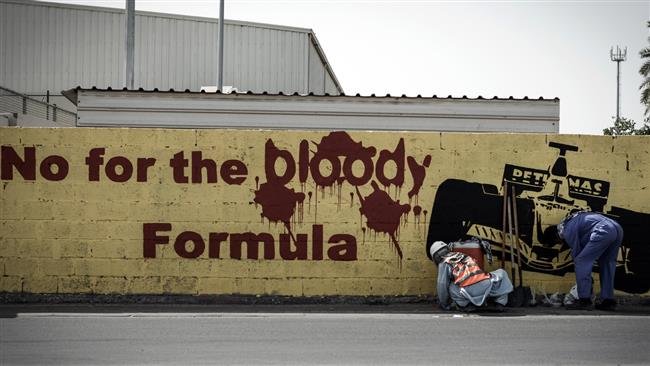
Protest graffitti against the Formula One race in Bahrain.
As the International Federation for Human Rights reported the Dakar Rally announcement comes not only in the wake of the murder of journalist Jamal Kashoggi and amidst Saudi war crimes in Yemen, but as women human rights defenders are being tortured in detention for campaigning, amongst other things, for the right of women to drive. The same Saudi rulers who order the killings and torture are seeking to buy positive coverage through sport. “The same Saudi rulers who order the killings and torture are seeking to buy positive coverage through sport.”
As someone who was at Wembley in 1992 to see Barcelona lift their first European Cup, it is particularly galling to contemplate the Cruyff-inspired masters of the beautiful game being dragged into the sportswashing of Mohammad bin Salman. The Barcelona slogan is “More Than a Club” and is explicitly linked to both values and social change. It is difficult to reconcile these noble aspirations with a PR exercise for a misogynist regime, itself the antithesis of those values.
We are, of course, already far down the slippery slope. The rulers of the UAE have also long-used sport as part of their self-promotion. The owners of Manchester City and the sponsors of Real Madrid are similarly involved in war crimes in Yemen, and routinely detain and torture those who dare to speak out for human rights. Ahmed Mansoor, winner of the Martin Ennals Prize in 2015 for his peaceful work for human rights, is currently on hunger strike in protest against prison conditions and his sentencing to 10 years in prison after an unfair trial. Front Line Defenders is gravely concerned for his health and is calling for his release.
Sunday, 28th April, Formula One will hold the Azerbaijan Grand Prix in Baku. The Azeri dictator, Ilham Aliyev, who routinely detains human rights defenders and journalists, is also President of the country’s Olympic committee. He has embraced sportswashing enthusiastically. Azerbaijan hosted the European Games in 2015 under the auspices of the European Olympic Committees. The 2019 European Games are to be in Belarus. The Formula One calendar also includes Bahrain, Abu Dhabi (UAE) and China, all countries where Front Line Defenders is campaigning for the release of unjustly detained human rights defenders.
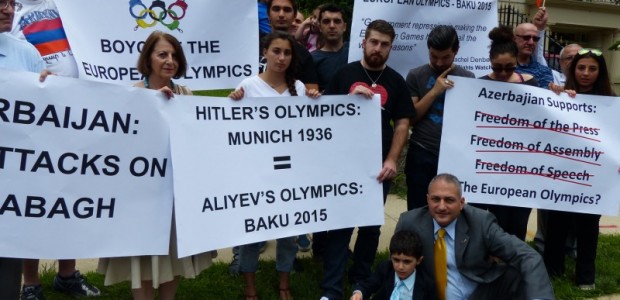
Protest against first European Games in Baku in 2015.
Many sports fans will shrug their shoulders and say that money is awash in international sport, and what can you do? The International Olympic Committee and football’s world governing body FIFA have been mired in corruption scandals and the use of international sporting events and national Olympic committees have long been seen by dictators, authoritarians and fascists as tools for advancing propaganda. But it is surely time to draw a line in the sand, and where better to do it than Saudi Arabia? The Dakar Rally should not take place there while women human rights defenders like Lujain Al-Hathloul are detained and tortured. And the Spanish Football authorities must reject the proposed Saudi deal in spite of the vast sums of money on the table.
Sportswashing is more than a game, it is a corrupt exercise of cover-up and repression. And sport must reject the tyrants.
On 16 May 2019 the NGO EuroMed Rights announced that it has appointed Rasmus Alenius Boserup as its new Executive Director. He will assume the position on 1 June, 2019, succeeding Marc Schade-Poulsen, who will take up a position as consultant and research fellow at the University of Roskilde.
A Danish national, Rasmus Alenius Boserup has a background in social science research and organisation management. Until 2019, he worked as Senior Researcher at the Danish Institute for International Studies focusing on power and politics in the Middle East and North Africa. Prior to this, he served as Executive Director of the Danish-Egyptian Dialogue Institute in Cairo from 2008 to 2011. An expert and opinion writer in Danish and international media, Boserup holds a doctoral degree in culture and civilisation from École des Hautes Études en Sciences Sociales in Paris and a PhD degree in Arabic Studies from the University of Copenhagen.
Boserup said: “I look forward to take up the position with EuroMed Rights. I have followed the network since its creation in 1997 and have collaborated with several of its outstanding member organisations in the South and in the North.” “Today we face numerous worrying trends in the Euro-Mediterranean region. The crumbling of the liberal order and rise of international authoritarianism add fuel to populism and illiberalism in Europe. And it further emboldens repressive and autocratic leaders in the Middle East and North African. Under these urgent conditions, I look forward to engage fully in promoting and defending human rights and democracy as a part of a prestigious organisation like EuroMed Rights.”
EuroMed Rights President Wadih Al-Asmaradded: “We are pleased to have Rasmus on board and look forward to leveraging his expertise in steering EuroMed Rights forward. Our network has grown to occupy a strategically important position while Marc Schade-Poulsen held the position of Executive Director and we are eager to capitalise on this with Rasmus Alenius Boserup”.
Thalif Deen wrting for IPS on 20 May 2019 relates that the “UN’s Mandate to Protect Human Rights Takes Another Hit’.
The Geneva-based Office of the UN High Commissioner for Human Rights (OHCHR) says six of the UN’s 10 treaty bodies are being forced to cancel their sessions this year due to financial reasons. The situation has been described as “an unprecedented consequence of some UN member States delaying payments due to the Organisation.” Anna-Karin Holmlund, Senior UN Advocate at Amnesty International, told IPS: “Amnesty is deeply concerned by member states’ delay in paying their assessed contributions, which will have a direct effect on the ability of the UN to carry out its vital human rights work.” By 10 May, only 44 UN member states – out of 193 — had paid all their assessments due, with the United States owing the largest amount.
The OHCHR said last week the cancellations meant that reviews already scheduled with member states, as well as consideration of complaints by individual victims of serious human rights violations — including torture, extra-judicial killings, enforced disappearances -– will not take place as scheduled. “The cancellation of sessions will also have numerous other negative consequences, and will seriously undermine the system of protections which States themselves have put in place over decades,” said a statement released by the OHCHR.
The chairpersons of the 10 Committees are deeply concerned about the practical consequences of cancelling these sessions and have sent a letter to the UN Secretary General and the High Commissioner for Human Rights, requesting they, together with Member States, explore ways of addressing this situation, “as a matter of urgency.”..
Two recent cases of criminalization of human rights defenders in Europe helping people at sea:
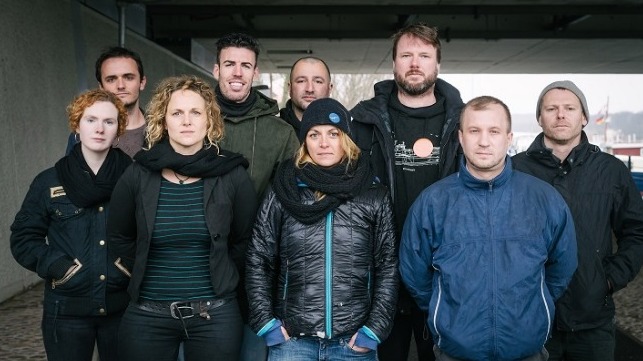
Iuventa crew
On 13 May 2019 MarEx reported that the crew of the rescue ship Iuventa operated by the German NGO Jugend Rettet has received the Swiss Paul Grüninger human rights award for saving the lives of around 14,000 of men, women and children in the central Mediterranean. For more on this award, see: http://www.trueheroesfilms.org/thedigest/awards/paul-grueninger-award
The award is seen as a statement against the criminalization of those helping people at sea and comes whilst the crew is under criminal investigations in Italy for “aiding and abetting illegal immigration.” They face up to 20 years in prison and fines of 15,000 Euro ($16,900) per saved person. The prize money of 50,000 Swiss francs contributes to the defense.
The Iuventa was the first rescue vessel seized in Italy in August 2017. Captain Dariush was master of the Iuventa for three voyages off the Libyan coast: “We’re being charged for saving lives. This is absurd,” he said. “It is European politicians who block any safe way for people in need, so we had to act.”
The crew says: “Although we have to stand trial, it is us who accuses Europe. We accuse European politicians of turning their backs on people in need. We accuse the E.U. of collaborating with regimes who violate human rights.” The Italian public prosecutor’s office has been investigating the crew for almost two years. Covert investigators claim to have observed the Iuventa crew cooperating with smugglers. However, the NGO claims that scientists at Goldsmiths, University of London have said there is no evidence for this. “They have compared the accusations of the Italian police with all available data, meteorological measurements, logbooks and recordings of the Reuters agency. In their study for Forensic Architecture, they conclude that the allegations are false.” The trial is expected to begin in autumn, and it is expected that charges will be brought against the 10 crew members. It is a precedent for Europe, says lead lawyer Nicola Canestrini: “This trial will show whether Europe can continue to stand for fundamental rights and solidarity in the world.”
——–
Tom Ciotkowski is facing up to five years in prison and a fine of up to 7,500 Euros on trumped up charges. In July 2018, he was observing French riot police preventing volunteers from distributing food to migrants and refugees in Calais. He was charged with contempt and assault after he challenged the violent actions of a policeman against another volunteer. “Tom Ciotkowski is a compassionate young volunteer who was taking action to support migrants and refugees when he was arrested. He has committed no crime and is being unjustly targeted for documenting the abusive behaviour of the police in Calais,” said Amnesty International’s Senior Campaigner on Migration Maria Serrano.
“Tom’s case is sadly emblematic of the harassment, intimidation and attacks that human rights defenders supporting migrants and refugees face at the hands of police in Calais. His case also reflects a wider European trend of criminalizing acts of solidarity, as a way of discouraging others from standing up for human rights. We need courageous, compassionate people like Tom more than ever
[BACKGROUND At the end of July 2018, Tom Ciotkowski was observing French riot police ID-checking volunteers who were trying to distribute food to migrants and refugees. He recorded on his mobile phone an official pushing and kicking a volunteer. When Tom complained about the behaviour of the police, an officer approached him and another female volunteer, who he hit with a baton. When Tom asked the officer for his identification number and told the policeman not to hit women, he was pushed hard by an officer and fell backwards over a metal barrier separating the pavement from the road. As Tom fell backwards, a passing lorry narrowly missed him. He was then arrested, put in custody for 36 hours and charged with contempt and assault (“outrage et violence”). In May 2019, Tom filed a complaint against the police officer who pushed him and against other officers who provided reports stating false facts against Tom to support his arrest and prosecution.]
On 1 May 2019 Friedhelm Weinberg, Executive Director, HURIDOCS, published “3 ways activists are being targeted by cyberattacks’ on the website of World Economic Forum (see below). A timely piece in view of the current turmoil surrounding the discovery of spyware crafted by a sophisticated hackers-for-hire, who took advantage of a flaw in WhatsApp. The Financial Times identified the actor as Israel’s NSO Group, and WhatsApp all but confirmed the identification, describing hackers as “a private company that has been known to work with governments to deliver spyware.” .. As late as Sunday, as WhatsApp engineers raced to close the loophole, a UK-based human rights lawyer’s phone was targeted using the same method. Researchers at the University of Toronto’s Citizen Lab said they believed that the spyware attack on Sunday was linked to the same vulnerability that WhatsApp was trying to patch. NSO’s flagship product is Pegasus, a program that can turn on a phone’s microphone and camera, trawl through emails and messages and collect location data. NSO advertises its products to Middle Eastern and western intelligence agencies, and says Pegasus is intended for governments to fight terrorism and crime. … Asked about the WhatsApp attacks, NSO said it was investigating the issue. “Under no circumstances would NSO be involved in the operating or identifying of targets of its technology, which is solely operated by intelligence and law enforcement agencies,” the company said. “NSO would not, or could not, use its technology in its own right to target any person or organisation, including this individual [the UK lawyer].”
Several reports have shown Israeli technology being used by Gulf states against their own citizens (AFP/File photo)
Middle East Eye of 13 May 2019 reports that Amnesty International is pushing for Israel’s defence ministry to withdraw an export license for NSO Group, an Israeli tech firm that the human rights group has accused of selling spyware to repressive governments to spy on activists. In a statement on Monday, Amnesty said it plans to file a legal petition to the District Court of Tel Aviv on Tuesday to block the export licenses. Danna Ingleton, deputy director of Amnesty Tech, said in an affidavit on Monday that NSO Group has not done its job to protect human rights defenders from being targeted. Instead, many reports have shown that governments have deployed Pegasus spyware “to surveil human rights defenders”, Ingleton said.
NSO Group has been under increased scrutiny after a series of reports about the ways in which its spyware programme has been used against prominent human rights activists. Last year, a report by CitizenLab, a group at the University of Toronto, showed that human rights defenders in Saudi Arabia, the United Arab Emirates and Bahrain were targeted with the software.
In October, US whistleblower Edward Snowden said Pegasus had been used by the Saudi authorities to surveil journalist Jamal Khashoggi before his death. “They are the worst of the worst,” Snowden said of the firm. Amnesty International said in August that a staffer’s phone was infected with the Pegasus software via a WhatsApp message.
——-
Friedhelm Weinberg‘s piece of 1 May is almost prescient and contains good, broader advice:
When activists open their inboxes, they find more than the standard spam messages telling them they’ve finally won the lottery. Instead, they receive highly sophisticated emails that look like they are real, purport to be from friends and invite them to meetings that are actually happening. The catch is: at one point the emails will attempt to trick them.
1. Phishing for accounts, not compliments
In 2017, the Citizen Lab at the University of Toronto and the Egyptian Initiative for Personal Rights, documented what they called the “Nile Phish” campaign, a set of emails luring activists into giving access to their most sensitive accounts – email and file-sharing tools in the cloud. The Seoul-based Transitional Justice Working Group recently warned on its Facebook page about a very similar campaign. As attacks like these have mounted in recent years, civil society activists have come together to defend themselves, support each other and document what is happening. The Rarenet is a global group of individuals and organizations that provides emergency support for activists – but together it also works to educate civil society actors to dodge attacks before damage is done. The Internet Freedom Festival is a gathering dedicated to supporting people at risk online, bringing together more than 1,000 people from across the globe. The emails from campaigns like Nile Phish may be cunning and carefully crafted to target individual activists.. – they are not cutting-edge technology. Protection is stunningly simple: do nothing. Simply don’t click the link and enter information – as hard as it is when you are promised something in return.
Often digital security is about being calm and controlled as much as it is about being savvy in the digital sphere. And that is precisely what makes it difficult for passionate and stressed activists!
2. The million-dollar virus
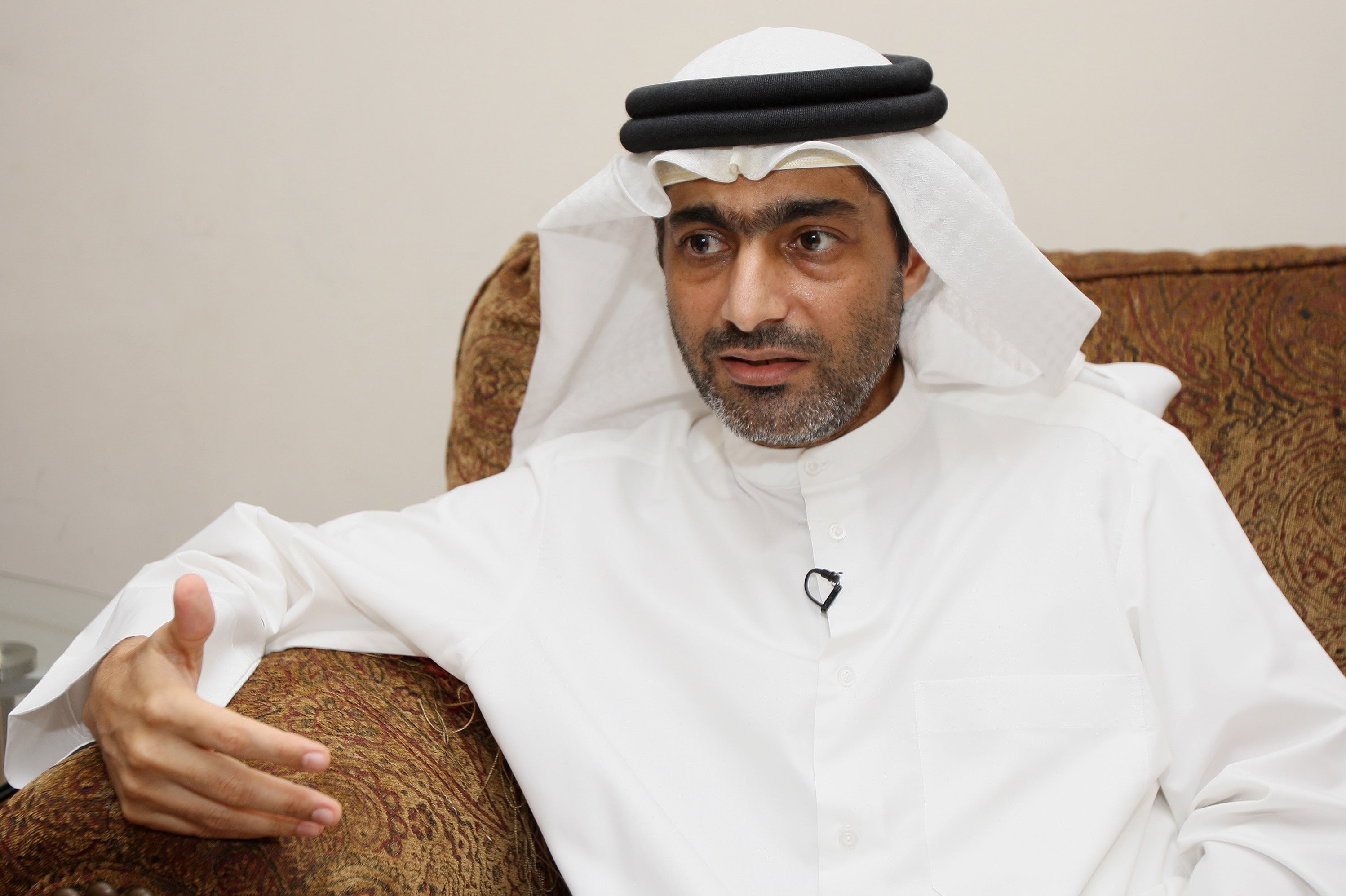
Unfortunately, calm is not always enough. Activists have also been targeted with sophisticated spyware that is incredibly expensive to procure and difficult to spot. Ahmed Mansoor, a human-rights defender from the United Arab Emirates, received messages with malware (commonly known as computer viruses) that cost one million dollars on the grey market, where unethical hackers and spyware firms meet. See also: https://humanrightsdefenders.blog/2016/08/29/apple-tackles-iphone-one-tap-spyware-flaws-after-mea-laureate-discovers-hacking-attempt/]
Rights defender Ahmed Mansoor in Dubai in 2011. Image: Reuters/Nikhil Monteiro
3. Shutting down real news with fake readers
Both phishing and malware are attacks directed against the messengers, but there are also attacks against the message itself. This is typically achieved by directing hordes of fake readers to the real news – that is, by sending so many requests through bot visitors to websites that the servers break down under the load. Commonly referred to as “denial of service” attacks, these bot armies have also earned their own response from civil society. Specialised packages from Virtual Road or Deflect sort fake visitors from real ones to make sure the message stays up.
How distributed denial of service (DDoS) attacks have grown. Image: Kinsta.com; data from EasyDNS
Recently, these companies also started investigating who is behind these attacks– a notoriously difficult task, because it is so easy to hide traces online. Interestingly, whenever Virtual Road were so confident in their findings that they publicly named attackers, the attacks stopped. Immediately. Online, as offline, one of the most effective ways to ensure that attacks end is to name the offenders, whether they are cocky kids or governments seeking to stiffle dissent. But more important than shaming attackers is supporting civil society’s resilience and capacity to weather the storms. For this, digital leadership, trusted networks and creative collaborations between technologists and governments will pave the way to an internet where the vulnerable are protected and spaces for activism are thriving.
On 6 May 2019 the International Service for Human Rights(ISHR) submitted two reports to the UN Secretary General on the topic of reprisals against human rights defenders. The conclusion is that many defenders still face unacceptable risks and are unable to cooperate safely with the UN and regional human rights bodies and mechanisms. The reports were prepared in response to the call made by the United Nations High Commissioner for Human Rights inviting representatives of civil society to provide information on preventing and addressing acts of intimidation and reprisals related to cooperation with the United Nations. This blog has devoted many posts to this nefarious issue, see e.g.: https://humanrightsdefenders.blog/tag/reprisals/
On 10 May 2019, a number of NGOs issued a joint statement on the defamation campaign by Egypt against human rights defender Mohamed Soltan:
We, the undersigned organizations strongly condemn the defamation campaign by the Egyptian authorities against human rights defender Mohamed Soltan, … Mohamed Soltan is a prominent human rights defender from The Freedom Initiative, an independent human rights advocacy group in Washington D.C. He spent nearly two years in prison in the case known as “Raba’ Operations Room,” in which authorities pressed politically-motivated charges in 2014-2015 against scores of critical journalists and political figures for “membership in an illegal group”, “publishing false news” and “planning to overthrow the ruling regime”, among other charges. Some of the charges do not constitute recognizable crimes under international law. In any case, the US State Department, and Human Rights Watch’s analysis of the casefile in April 2015, found that prosecutors failed to present any credible evidence to establish him as a suspect, let alone establishing Soltan’s individual criminal responsibility for the alleged crimes. An Egyptian court sentenced him to life in prison in 2015. In protest of his unjust detention by the Egyptian authorities, Soltan entered into an open-ended hunger strike and was supported by a worldwide campaign effort. The U.S. government intervened at the highest levels and successfully facilitated his release and return to the United States on May 30th, 2015. Since his release, Soltan has become a full-time human right advocate relentlessly defending democratic values and human rights. The Freedom Initiative has worked diligently with Egyptian and international human rights organizations to shed light on the deteriorating human rights situation in Egypt. The organization’s annual flagship event, the Egypt Advocacy Day, involved two award-winning actors who joined over 100 Egyptians and Egyptian Americans from over 25 U.S. states and six countries for meetings with members of the U.S. Congress and State Department. The aim of the meetings was to engage the Egyptian diaspora in the U.S. with their elected representatives on human rights and democratic governance issues in Egypt In response, the Egyptian authorities have apparently unleashed a systematic defamation campaign against some of those who participated in the meetings and against the organizers, particularly the award-winning actors, The Freedom Initiative and Soltan. The Egyptian government,as well as privately owned newspapers, falsely accused him of being a convicted terrorist, a member of the Muslim Brotherhood and working on behalf of foreign agents. The defamatory statements were reported on government-sponsored media outlets in Egypt and Saudi Arabia. The coordinated harassment of Soltan is part of a broader repression of rights and freedoms in Egypt and is aimed to stigmatize human rights defenders, both nationally and abroad, and undermine the effectiveness of their work. We stand in solidarity with Mohamed Soltan, The Freedom Initiative and all Egyptians who peacefully speak out against human rights abuses despite the hefty price. We urge the Egyptian government to respect its obligations under international human rights treaties and the Egyptian constitution, end the crackdown on critics, halt the persecution of human rights defenders and release all those detained for peacefully expressing their opinions.
Adalah Center for Rights and Freedoms
Amnesty International
Andalus Institute for Tolerance and Anti-Violence Studies
Cairo Institute for Human Rights Studies
Committee for Justice
Egyptian Front for Human Rights
Egyptian Human Rights Forum
EuroMed Rights
Front Line Defenders
Human Rights First
Human Rights Watch
International Federation for Human Rights (FIDH), under the Observatory for the Protection of Human Rights Defenders
Project on Middle East Democracy (POMED)
The Freedom Initiative
Google announced on 7 May 2019 that the Geneva-based NGO is one of 20 organizations that will share 25 million US dollars in grants from the Google Artificial Intelligence Impact Challenge. The Google Artificial Intelligence Impact Challenge was an open call to nonprofits, social enterprises, and research institutions to submit their ideas to use artificial intelligence (AI) to help address societal challenges. Over 2600 organizations from around the world applied.
Geneva-based HURIDOCS will receive a grant of 1 million US dollars to develop and use machine learning methods to extract, explore and connect relevant information in laws, jurisprudence, victim testimonies, and resolutions. Thanks to these, the NGO will work with partners to make documents better and freely accessible. This will benefit anyone interested in using human rights precedents and laws, for example to lawyers representing victims of human rights violations or students researching non-discrimination.
The machine learning work to liberate information from documents is grounded in more than a decade of work that HURIDOCS has done to provide free access to information. Through pioneering partnerships with the Institute for Human Rights and Development in Africa (IHRDA) and the Center for Justice and International Law (CEJIL), HURIDOCS has co-created some of the most used public human rights databases. A key challenge in creating these databases has been the time-consuming and error-prone manual adding of information – a challenge the machine learning techniques will be used to overcome.
“We have been experimenting with machine learning techniques for more than two years”, said Natalie Widmann, Artificial Intelligence Specialist at HURIDOCS. “We have changed our approach countless times, but we see a clear path to how they can be leveraged in groundbreaking ways to democratise access to information.” HURIDOCS will use the grant from Google to work with partners to co-create the solutions, carefully weighing ethical concerns of automation and focusing on social impact. All the work will be done in the open, including all code being released publicly.
“We are truly excited by the opportunity to use these technologies to address a problem that has been holding the human rights movement back”, said Friedhelm Weinberg, Executive Director of HURIDOCS. “We are thankful to Google for the support and look forward to be working with their experts and what will be a fantastic cohort of co-grantees.”
“We received thousands of applications to the Google AI Impact Challenge and are excited that HURIDOCS was selected to receive funding and expertise from Google. AI is at a nascent stage when it comes to the value it can have for the social impact sector, and we look forward to seeing the outcomes of this work and considering where there is potential for use to do even more.” – Jacquelline Fuller, President of Google.org
Next week, the HURIDOCS team will travel to San Francisco to work with the other grantees, Google AI experts, Project Managers and the startup specialists from Google’s Launchpad Accelerator for a program that will last six months, from May to November 2019. Each organization will be paired a Google expert who will meet with them regularly for coaching sessions, and will also have access to other Google resources and expert mentorship.