The Philippines government’s practice of ” red tagging” – i.e. labelling HRDs as communists or terrorists – has been repeatedy criticised by human rights defenders, NGOs, government and the UN. “We are saddened and appalled by the ongoing violence and threats against human rights defenders in the Philippines, including the killing of two human rights defenders over the past two weeks,” said Liz Throssell, a spokesperson for the Office of the UN High Commissioner for Human Rights (OHCHR). Randall “Randy” Echanis, an agrarian reform advocate and peace consultant, was killed in his home in Quezon City, located just outside capital Manila, on 10 August, added the OHCHR spokesperson, noting that reports indicated that he suffered brutal treatment before he died, including blunt force trauma to the head and stab wounds. On 17 August, the day that Mr. Echanis was buried, another long-standing human rights defender, Zara Alvarez, was shot dead in Bacolod City on Negros Island, some 490 kilometres south east of Manila. Investigations into both cases are underway.
According to OHCHR, both Mr. Echanis and Ms. Alvarez had been repeatedly “red-tagged” – labelled as communists or terrorists – in relation to their work. Ms. Alvarez’s name appeared, for example, on a list of 649 people that the Government sought to designate as terrorists on 28 March 2020. “While the list was later truncated, many who were removed from the list, including Ms. Alvarez, continued to report harassment and threats, as highlighted in the High Commissioner’s human rights report on the Philippines published in June this year,” added Ms. Throssell.
Ms. Alvarez’s photo also appeared in a publicly displayed poster purporting to depict terrorists. She was pictured alongside two other human rights defenders who had been killed – Benjamin Ramos Jr. and Bernardino Patigas, both of whose murder cases remain unsolved. She had also spent two years in prison on murder charges before she was acquitted in March for lack of evidence. Following the murder of Ms. Alvarez, her colleague Clarizza Singson, received a death threat on Facebook warning her that she would be next. “This is particularly worrying as Ms. Singson’s name also appeared on the abovementioned list of suspected terrorists and her photo is included in the same poster,” added Ms. Throssell.
“We have raised our concerns with the Government and the Commission on Human Rights on these cases, and look forward to continuing to engage with them,” said Ms. Throssell.
Eighty-nine cases involving the deaths of human rights activists from 2017 to 2019 are now being investigated by the Commission on Human Rights (CHR), an official said Friday. “The data that we have from 2017 to 2019, we have a total of 89, not to include the ones happening now. We call them human rights defenders,” CHR commissioner Leah Armamento said over ABS-CBN News Channel when asked about the number of killings of activists and members of progressive groups being investigated by the commission.
‘The endless killings of activists in the Philippines have become systematic in Duterte’s regime, and demonstrate the continuing impunity in the country. The government should end these killings immediately and take genuine steps towards ensuring justice for victims and their family members,’ said Shamini Darshni Kaliemuthu, Executive Director at FORUM-ASIA.
A photo of human rights defender Nandini Sundar, one of those the Chhattisgarh Police had falsely charged for the murder of a man in Sukma district in 2016. | Nandini Sundar/Twitter
The National Human Rights Commission has ordered the Chhattisgarh government to compensate human rights defenders Rs 1 lakh each, for allegedly false cases filed against them. The commission had in February asked the Congress government in the state to comply within six weeks.
Human rights defenders Nandini Sundar, Archana Prasad, Manju Kawasi, Vineet Tiwari, Sanjay Parate and Mangla Ram Karma said that on November 5, 2016, the Chhattisgarh Police lodged first information reports against them under various sections of the Indian Penal Code, Arms Act and Unlawful Activities (Prevention) Act for the alleged murder of a person in Nama village of Sukma district. The Bharatiya Janata Party was in power at that time. “The case was supposedly filed on the written complaint of Shyamnath Baghel’s widow, Vimla Baghel,” they said in a press release. “However, she is on record saying she did not name anyone.” On November 15, 2016, the Supreme Court gave the individuals protection from arrest. However, they filed a fresh plea in the Supreme Court in 2018 as the matter had not yet been investigated or closed. The Congress-led Chhattisgarh government initiated a probe in the matter and in February 2019, concluded that the defenders were innocent.
In February this year, noting that the Chhattisgarh Police’s admission that there was no case to be made out against the signatories, the NHRC said that the individuals would have “certainly suffered a great mental pain and agony as a result of registration of false FIRs against them by the police”. “Therefore we recommend and direct the Government of Chhattisgarh through its Chief Secretary to pay a sum of Rs One Lakh each as monetary compensations to the six persons namely Prof Nandini Sundar, Ms. Archana Prasad, Shri Vineet Tiwari, Shri Sanjay Parate, Ms. Manju and Shri Mangla Ram Karma, whose human rights were gravely violated by the Chhattisgarh police,” the NHRC ruled.
The commission also directed the Chhattisgarh government to provide the same compensation to a group of lawyers from Telangana who were acquitted of all charges after being put in jail in Sukma for seven months. However, the six human rights defenders indicated that they had not yet received the compensation. “We welcome the NHRC order and hope that the Chhattisgarh government will act promptly to redress the reputational loss and mental agony suffered by us,” the press release said.
The signatories also said they hoped the police officers responsible for filing false charges against them, especially SRP Kalluri who was then the Bastar inspector general of police, will be investigated and prosecuted.
The defenders added: “To date, despite NHRC recommendations in 2008 and repeated Supreme Court directions, the Government of Chhattisgarh has not compensated the thousands of villagers whose homes were burnt by Salwa Judum or prosecuted those responsible for rapes and murders. Fake encounters and false arrests continue to be a grave concern in Chhattisgarh.”
Salwa Judum was a militia organised and mobilised by the government in Chhattisgarh to break the back of Maoist violence in the region. In July 2011, the Supreme Court declared Salwa Judum an illegal organisation, and ordered it to disband. However, the organisation continues to survive in the form of various vigilante groups operating in Chhattisgarh.
The signatories thanked the People’s Union of Civil Liberties for taking up all the cases of human rights defenders in Chhattisgarh, and said it was unfortunate that PUCL Secretary Sudha Bharadwaj had been arrested and imprisoned under “false charges” in the Elgar Parishad case.
Here follow some long excerpts that give you a flavour of a profile worth reading in full:
Behrouz Boochani’s book, “No Friend but the Mountains,” won the prestigious Victorian Prize for Literature in 2019 while he was still detained on Manus Island.Credit…Birgit Krippner for The New York Times
He fled Iran’s Revolutionary Guard. He exposed Australia’s offshore detention camps — from the inside. He survived, stateless, for seven years. What’s next?
..The cellphone was everything on Manus. Boochani and the other detainees hoarded their cigarettes for weeks to barter for phones with the detention center’s local employees. Once acquired, the phones had to be hidden from the guards, who conducted surprise dawn inspections to hunt for contraband. Boochani’s phone was confiscated twice; each time, there was no recourse but to start over again, one sacrificed smoke at a time.
The phones quickly became the only tool successful at breaking through the shroud of secrecy that Australia tried to throw over the migrants’ detention. Locked up in the disused rooms of the old naval base, the asylum seekers were called by serial numbers instead of names. Communications were tightly restricted. Under Australian law, workers who spoke publicly about what they saw or heard at the detention sites faced up to two years in prison. But official documents and accounts from survivors and whistle blowers gradually leaked out, along with accusations of sexual and physical abuse. Asylum seekers sought solace in self-harm as their mental and physical health crumbled under the strain of prolonged and uncertain detention.
Boochani wrote “No Friend but the Mountains” in Persian, sending texts of ideas and descriptive fragments to nonexistent WhatsApp numbers that he used to organize his thoughts. Once satisfied with a passage, he sent it to Moones Mansoubi, a translator in Sydney, who organized the material into chapters before sending it along to Omid Tofighian, an Iranian-Australian philosophy professor. Slowly, haltingly, Boochani and Tofighian texted back and forth about how best to translate and arrange the passages into a draft. Together they blended poetry and prose into a genre Tofighian calls “horrific surrealism.”
First-person narratives that paint historical events from the perspective of the persecuted have proven powerful and enduring. These stories are subversive; the images slip into a reader’s mind and create empathy where there was little before. They can permanently alter the way history is recorded and understood.
Boochani’s book challenges readers to acknowledge that we are living in the age of camps. The camps lie scattered throughout the Middle East, cluster on Greek islands and stretch like an ugly tattoo along the U.S.-Mexican border. Camps sprawl through Bangladesh, Chad and Colombia. People are suspended in a stateless and extralegal limbo on the tiny Pacific island nation Nauru, in Guantánamo and in the Syrian town of al-Hawl. At no time since humans first drew borders have there been more migrants and refugees than today. Countless individual lives weave into a collective panorama of displacement and statelessness and detention. These truncated journeys are a defining experience of our times.
As for Boochani, he refuses to cede the story of his hardships to third-party observers. He criticizes journalists who depict refugees as faceless victims. He bristles at perceived condescension from academics or activists who benefit from what he describes as an industry built around the plight of refugees. When Kristina Keneally, a prominent center-left senator in Australia, sent a tweet supporting Boochani, he tweeted in anger: “Such a rediclilius [sic] and unacceptable statement by Labor Party. You exiled me to Manus and you have supported this exile policy for years…
The miseries of offshore detention were meant to pressure migrants to abandon their asylum claims so they could legally be sent back whence they came and — more crucial — to create a spectacle so chilling that “boat people” would stop coming to Australia altogether. That was the first and last point of this byzantine enterprise.
…After six months of misery and unanswered questions, immigration officials appeared at the camp and warned asylum seekers that they would be stuck in Manus for a long time yet. Enraged detainees rioted that night, lunging at the guards and hurling chairs. Local police and Manus residents rushed into the compound to quell the unrest. Dozens of detainees were injured, some suffering broken bones and severe lacerations. One man lost an eye; another’s throat was slashed, reportedly by a guard. Barati, Boochani’s close friend, was viciously attacked by a group that included an employee of the Salvation Army, which had a $50 million contract from the Australian government to provide counseling to the asylum seekers. The assailants killed Barati by dropping a heavy rock onto his head. He was the first detainee to die on Manus.
In 2019, most of the asylum seekers were moved to motels in Port Moresby because, it seemed, nobody knew what else to do with them.
The first time I saw Boochani, he was still being detained on Manus Island. It was a chilly, wind-scraped morning in 2019. Boochani was discussing his book via video link at the annual writers festival in Byron Bay, Australia. When his face flickered onto the screen, the overflowing crowd that jammed the seaside auditorium gasped and burst into applause. Boochani looked haggard and detached; dangling hair framed his craggy features. “Oh, God,” said a woman near me. “He looks so alone.”…
Peter Dutton, Australia’s home affairs minister, frequently says the asylum seekers in Papua New Guinea include men “of bad character” — “Labour’s mess” that he has been forced to “clean up.” Pauline Hanson, a right-wing populist senator, called the men “rapists” on the floor of Parliament this past winter. “These people are thugs,” she said. “They don’t belong here in Australia.”..
All told, Australia has locked up thousands of desperate people, including children, in de facto prisons on Manus and Nauru. The detentions have been harsh but effective, officials say: The flow of boats slowed and eventually stopped. Asylum seekers are still stuck on Nauru; until last year, they included children. The Australian government recently spent about $130 million to reopen the detention center on Christmas Island — despite the lack of new arrivals to lock up. In other words, the policy is still unapologetically intact, ready and waiting for any boats that make it to Australian waters.
It was a brilliant January day in Christchurch, New Zealand. Screeching gulls wheeled in off the Pacific; swollen roses bobbed in the breeze. In the hydrangea-fringed garden of a spare, tidy house, Boochani sat smoking. He couldn’t smoke inside because the house wasn’t exactly his; it was on loan from the University of Canterbury. Boochani’s neighborhood looked as if Beatrix Potter had painted it in watercolors: prim, ivy-laced cottages and tidy beds of hollyhocks and lavender. It was nice, Boochani conceded. Too nice, sometimes. “It’s too much, you know?” he said. “It’s too much peace and too much beauty. It’s hard to deal with this. It’s like you go from a very cold place to a very hot place.”
During these early and disorienting weeks, Boochani got word that it was finally time to begin the final steps to resettle in the United States. He’d been awaiting this news for months, but when his chance came, he backed out. Reports of tensions between the U.S. and Iran, immigration crackdowns and political tumult had eroded his eagerness. “I don’t feel safe in America now,” he said simply. “I don’t mean that someone would kill me. But I don’t trust the American system. It’s like chaos there now.”
Instead, Boochani took a bold gamble: He applied for asylum in New Zealand. He accepted a fellowship with the university’s Ngai Tahu Research Center, which specializes in Maori and Indigenous studies — a nod to his Kurdish identity — although the post would remain a secret while his application to stay in New Zealand was pending. Neither his whereabouts nor his plans were public knowledge. Conservative politicians in both New Zealand and Australia were calling for Boochani to be turned out. What would he do then, where would he go? He shrugged; he didn’t answer; instead, he began to roll another cigarette. ..
..This is the complication and the delicacy of Boochani: His most famous work was derived from the considerable suffering he endured at the hands of the state. He is proud, even cocky at times. And yet this pride must wrestle with the dehumanization he has endured. His existence was controlled by a hostile bureaucracy for years; now his days were arranged by benevolent well-wishers.
Then, on July 23, Boochani’s birthday, he finally got word from his lawyer: His application had been accepted. Boochani could stay in New Zealand. He was free. On the phone, he let out a wild and incredulous laugh. Of course! When else? It had been his birthday, too, the day he was lifted from the sea and taken into Australian custody. Hearing him laugh like that, I remembered one of his stories: When he was born, his parents asked a visiting cousin who knew how to read to choose a name for the baby. The cousin opened a book and poked his finger onto the page at random, striking the word “Behrouz” — Farsi for “fortunate.” Literally, “good day.”
Boochani rode his bike from his house to the sea. He looked at the expanse of ocean, these waters that had almost killed him, the sea he suspected of absconding with years of his life, the waves that crashed now on the mineral grains of this new land he called home. He looked at the ocean, at all of that past and all of that future, the churn of time and destiny, and he smoked a cigarette. Just one cigarette. One cigarette and the sea in his eyes. And then he rode home again.
Tanzania’s President John Magufuli addresses members of the ruling Chama Cha Mapinduzi Party (CCM) at the party’s sub-head office on Lumumba road in Dar es Salaam, October 30, 2015 Emmanuel Herman / REUTERS
Michelle Gavin – In a blog post of 29 July, 2020 – draws attention to the deterioriation in Tanzania where President John Magufuli claims that Tanzania is free from the virus and tourists should feel confident about visiting the country. To ensure that the public will take his word for it, official data on the number of positive cases has not been released since the end of April, part of a pattern of hiding, or tightly controlling information that in most countries can be accessed and interrogated without incident. Since his election in 2015 on an anti-corruption platform, Magufuli’s penchant for eliminating or suppressing discordant narratives has proven toxic to his country’s democracy.
In this climate, it’s difficult to be optimistic about the upcoming October elections. The legal context in which opposition parties operate has changed, limiting their capacity to mobilize voters, and major civil society organizations have been disqualified from observing the polling. In Zanzibar, where citizens’ civil and political rights have been denied multiple times in the context of elections, the voter registration system has only added to citizens’ mistrust of the process. The stage increasingly looks to be set for an election that serves the interests of the current leader, but erodes popular trust in democracy itself.
in the meantime in neighbouring Zimbabwe dozens of people have been arrested and detained in the past few weeks over protests against government officials and corruption. Speaking on Tuesday 5 August 2020, President Emmerson Mnangagwa accused who he referred to as “rogue Zimbabweans” of working together with foreign detractors to destabilise Zimbabwe. “We will overcome attempts at destabilisation of our society by a few rogue Zimbabweans acting in league with foreign detractors,” Mnangagwa said.
Inflation in Zimbabwe is more than 700 per cent and last month the World Food Programme projected that by the end of the year 60 per cent of the country’s population will lack reliable access to sufficient food.
Footage of violence carried out by security forces and the detaining of opposition politicians and government critics has drawn international condemnation. Inspired by the Black Lives Matter call to action, Zimbabweans have expressed their thoughts and demands for actions on social media using the hashtag #ZimbabweanLivesMatter.
The UN Human Rights Council is among those expressing concern about claims the authorities in Zimbabwe are using the COVID-19 outbreak to crackdown on freedom of expression and peaceful protest.
“While recognising the government’s efforts to contain the pandemic”, the OHCHR spokesperson said, “it is important to remind the authorities that any lockdown measures and restrictions should be necessary, proportionate and time-limited, and enforced humanely without resorting to unnecessary or excessive force”.
Amnesty International said in a statement released last week that a number of activists had gone into hiding after police published a list of names of those wanted for questioning in connection with the planned protests.
Muleya Mwananyanda, Amnesty International’s deputy director for Southern Africa, said: “The brutal assault on political activists and human rights defenders who have had the courage to call out alleged corruption and demand accountability from their government is intensifying. The persecution of these activists is a blatant abuse of the criminal justice system and mockery of justice.”
Shannon Ebrahim – Independent Media’s foreign editor – on 5 August 2020 wrote from Pretoria that a week ago she was a speaker at a webinar on Zimbabwe organised by the South African Liaison Office, and sh spoke after the spokesperson of the MDC Alliance, Fadzayi Mahere. I was impressed by her eloquence, professionalism and commitment to human rights and the rule of law.…It never occurred to me, looking at this immaculately-dressed young lawyer, that in three days she would find herself in a filthy police holding cell overnight with other women, no water, no sanitiser, only an overflowing pit latrine and a few filthy blankets.
,,Mahere saw her colleagues, Terrence and Loveridge, in the other holding cells. They had been abducted, beaten and tortured, and had bleeding head injuries. They had been blindfolded, told they were at Lake Chivero and were going to be fed to the crocodiles.…
…It is a great tragedy that 40 years after liberation, Zimbabweans are asking themselves how there is no rule of law or political freedom.
Trough Reliefweb NGOWG posted on 14 July 2020 the following: In October 2020, women activists, peacebuilders, and human rights defenders along with UN Member States and agencies, will celebrate the 20th anniversary of the adoption of UN Security Council Resolution 1325 (2000) and the establishment of the WPS agenda.
20 years since the adoption of Resolution 1325, despite the fact that conflicts disproportionately impact the health, safety, and human rights of women and girls, they remain excluded from decision-making processes that determine their future. Specific provisions on women and gender were almost universally absent from ceasefire and peace agreements resulting from UN-led or co-led processes in 2018. Nearly five years since the three peace and security reviews in 2015, only 50% of the recommendations on WPS directed towards the UN have progressed, and only two recommendations out of 30 were fully implemented (S/2019/800). Meanwhile, within the very bodies tasked with protecting human rights and maintaining international peace and security, we have witnessed increasing and direct attacks on core principles of international humanitarian and human rights law, including as they apply to sexual and reproductive rights, and sexual orientation, gender identity, gender expression or sex characteristics (SOGIESC).
As we highlighted in our Policy Brief 2018, the Security Council is far from meeting its WPS obligations 20 years since the inception of the agenda. Despite some progress, WPS is often tokenized and only addressed at the most superficial of levels.
The continued ad hoc and inconsistent implementation of the WPS agenda over the last two decades by the Security Council reflects a selective approach to WPS and a lack of accountability for meaningful implementation of the agenda. Without civil society briefers raising WPS issues in their statements, our analysis shows that there would be far fewer references to WPS and that those references would be less substantive. We found a clear correlation between civil society briefers raising specific WPS issues, and those issues being addressed by Council members.
The Security Council continues to make decisions based on information that is mostly gender-blind. Less than 10% of WPS references in reports of the Secretary-General could be considered “analytical” — failure to embed intersectional, gender-sensitive conflict analysis in reports of the Secretary-General is contrary to guidance provided on reporting and internal good practice.
Women’s experiences tend to be instrumentalized at the Security Council, and violations of women’s rights are used to illustrate the seriousness of specific conflict situations and justify certain Council actions, rather than to meaningfully promote protection of women’s rights. Women’s participation in peace and security processes is also instrumentalized by use of the argument that their participation is necessary in order to make peace processes more effective, rather than that women have a right to equal participation in all areas of decision-making.
Over the last 20 years, several studies have found that gender inequality is a key predictor of conflict and instability — gender inequality increases the likelihood of conflict, and countries with weak human rights standards “are more likely to have militarized and violent interstate disputes.” A recent analysis found that 79% of armed conflict in situations for which there is data on gender equality took place in contexts with medium, high or very high levels of gender discrimination. Relatedly, strong feminist movements are also predictors of, and contributors to, efforts that reduce gender inequality. Addressing gender equality, as well as inequality more broadly, is therefore essential to preventing conflict, and requires, at its core, protection and promotion of human rights and efforts to address discriminatory structures and institutions.
In addition, as has been widely recognized and as we highlighted in our article on why women’s rights must be central to responses to COVID-19, the current pandemic is amplifying existing gender, racial, economic and political inequalities, and impacting those most marginalized, including people with diverse SOGIESC, people with disabilities, the elderly, the poor, and the displaced. Women are impacted due to their role as primary caregivers or healthcare workers, and are often less likely to be able to meet their own needs due to structural inequalities. As for women and girls in conflict-affected communities, COVID-19 is likely to hit them harder — as recognized by the UN Secretary-General, there has been an alarming surge in gender-based violence (GBV); combined with restrictions to essential services, such violence compounds existing risks for women and girls. The current pandemic underlines why preventing all forms of GBV against women requires ensuring the autonomy of those who are targeted and the full scope of their human rights, as well as the importance of enabling them to lead and contribute to the solutions to the crisis, rather than only seeking to protect them from violence.
The upcoming anniversary of the WPS agenda must be a call to action to the UN, Security Council and Member States to redouble their commitment to fully implement and advance the WPS agenda, defend the full scope of human rights, and galvanize efforts to address clearly identified gaps.
As a coalition dedicated to peace, gender equality and women’s rights, we firmly believe that the following 6 principles should guide any action:
Every conflict and crisis has specific gendered dimensions; there is no situation in which gender equality and women’s rights are not relevant. We advocate for the systematic incorporation of gender analysis and WPS obligations, including as enshrined in the ten WPS resolutions, in all conflict and crisis work, particularly within the country-specific discussions on the Security Council’s agenda, not only in thematic discussions on WPS.
Gender equality and human rights are legal obligations in conflict-affected situations, and violation of these rights must be recognized as an early warning sign and a root cause of conflict. The WPS agenda is both a peace and security issue, and a critical part of the human rights agenda. We therefore advocate for a rights-based approach to addressing all dimensions of the WPS agenda and for clear and outspoken leadership by the UN, Security Council and Member States on the importance of gender equality and human rights in maintaining peace and security.
We cannot achieve sustainable peace without the full, equal and meaningful participation and leadership of diverse women in all levels of decision-making. There is no substitute for direct participation of women in all aspects of peace and security, yet civil society continues to be regularly consigned to observer or other ad hoc roles despite the Global Study on the Implementation of Security Council 1325 (2000) specifically calling for an end to this practice. In addition, although parity in representation is an important first step in addressing gender inequality, it is not the fulfillment of feminist leadership, nor is it a substitute for fully implementing all components of the WPS agenda. Ensuring meaningful participation also requires dismantling the barriers to participation for the majority of women, not just supporting a small number of women to reach leadership positions.
An intersectional approach to gender equality is fundamental to the WPS agenda, and to the NGO Working Group’s (NGOWG) work. We recognize that race, ethnicity, religion, class, SOGIESC, age, marital status, pregnancy status, disability, migratory status, geographic location, economic status and other characteristics can be sources of both oppression and resilience, and intersecting forms of discrimination reflected in structural barriers must be recognized and addressed in order to achieve gender equality and the vision of the WPS agenda. Yet women are primarily referred to as a monolithic group throughout the work of the Security Council — our analysis showed that the experiences of particular groups of women and girls comprised less than 7% of all references in outcome documents and 6% of all references in reports of the Secretary-General in 2019, reflecting little acknowledgment of the unique challenges they face. Enabling the participation of diverse women — representative of a range of backgrounds and identities, including women with disabilities, women of diverse sexual orientation and gender identities, as well as women of diverse ethnic, cultural and religious backgrounds — is critical in order to ensure gender equality, and that “women” are not treated as a homogenous group.
Civil society, including conflict-affected communities, peacebuilders, women-led and women’s rights organizations, and human rights defenders, are an integral part of the WPS agenda. Ensuring full and meaningful participation of diverse civil society organizations and representatives requires timely, systematic, transparent, inclusive, and substantive consultation in formal and informal processes in order to ensure that any action addresses clearly identified gaps and delivers real change to communities affected by conflict.
Without real accountability, there can be no real progress. As was highlighted by all three peace and security reviews undertaken in 2015 and reinforced by the independent assessment commissioned by the UN in 2019, greater accountability of all actors, particularly senior UN leadership and Member States, is a requirement for real progress on the WPS agenda. This requires fundamental recognition that addressing gender inequality is both an international legal obligation and a collective responsibility of the UN. Prioritizing and resourcing for women’s human rights, establishing clear standards for performance and implementation, as well as raising the cost of failure to implement, are essential for driving forward the WPS agenda.
With the above principles in mind, below we share concrete recommendations on how the UN, Security Council and Member States can advance WPS in five key areas in advance of the 20th anniversary of the adoption of Resolution 1325.
1. Prevention of conflict. Take decisive action to prevent conflict, end violence and avert crisis, including by addressing gendered drivers of conflict and instability. 2. Women’s meaningful participation. Ensure women’s full, equal, and meaningful participation in all aspects of peace and security. 3. Human rights defenders, peacebuilders and civil society space. Defend the legitimacy of the work of all human rights defenders and peacebuilders and their role in promoting peace and security, and effectively prevent and address attacks against them. 4. Gender equality and the human rights of all women and girls, including access to comprehensive sexual and reproductive health and rights (SRHR), must be central to maintaining international peace and security. 5. Accountability for implementation. In addition to ensuring implementation by Member States, promoting system-wide accountability of the UN for implementation of the WPS agenda.
Asfreeas Jafri in Politics, of 14th July, 2020 wrote a fascinating opinion piece which I think deserves more attention. It is mostly about India but has wider implications: for ease of reference here the full text:
One complaint I often get from friends is that I say very “offensive” things online. My Facebook, Twitter, and Instagram, they accuse, are filled with the same sad and angry words against Islamophobia. Although despite my repetitive rants, they continue to ignore the agony of these words.
On July 10, 2020, the Turkish president announced that Hagia Sophia would be a mosque again.
Amongst other things, I am accused of being biased. Also, I am accused to be writing for a vested agenda. Usually, my Hindu friends make these allegations since I write a lot about the persecution of Indian Muslims. However, recently I noticed Muslim friends on social media making the same kind of accusations against those who expressed displeasure at the conversion of Hagia Sofia into a mosque.[ see also: https://humanrightsdefenders.blog/2020/07/06/the-unholy-wisdom-of-invoking-sovereignty/]
A few days back, some of them were irked after being questioned for running a homophobic WhySoProud trend on Twitter. This time the allegation against those Muslims who opposed this conversion is that they are doing this to please “Hindu liberals”.
Those who make these charges are undermining our agency and reason. It is insulting for me to think that what I and several other Muslims write, is not out of our individual agency and free will. When someone as outspoken as Umar Khalid is accused of doing that by several Muslims, I feel that we need to introspect.
The attackers are overlooking Umar’s incisive critique of Islamophobia in the Indian left. Muslims who are opposed to this are being called apologetic. I never pledged allegiance to the new sultan of Turkey. Not calling out Erdogan’s vile actions or political gimmicks does not fill any Muslims with a sense of vicarious guilt, at least in front of people we are allegedly supposed to be pleasing. But to say that those who dislike Erdogan are apologetic is quite irresponsible.
I will any day stand with someone like Umar Khalid who has been a constant ally in the fight against Islamophobia, rather than choosing a faraway ‘Sultan’ who is hardly bothered about the existence of Indian Muslims. It is people like Umar whose strong and sharp words have made young Muslims more unapologetic and bothered about their rights than their predecessors.
The other charge was against those liberals who wanted schools and hospitals on that disputed land, some congress leaders and “practising Hindu atheist” liberals like Dhruv Rathee who had strongly supported the Ayodhya verdict but are now opposed to Erdogan’s move. To many people’s shock, they had claimed that the Ayodhya verdict was respectable to all sides and that it will put a halt to the hate against Muslims. It did not halt. It actually increased.
I agree that this hypocrisy should be called out but when you also support either of the two majoritarian displays of power, are you not a hypocrite too? Also, what about those who have been vehemently opposed to the demolition and protested the SC verdict on Ayodhya? Do they have the right to comment on this?
Some found the comparison of Hagia Sofia with Babri Masjid as problematic. They said that it is not as bad in Turkey as it is in India. Umar rightly asks, ‘are we waiting for it to be that bad?’ Babri was illegally demolished and mobs killed hundreds. The history of these two events is different but what makes the comparison fair is how the Indian and Turkish governments and judiciary ignored the sentiment of the Muslim and Christian minorities. That the majoritarian will become the conscience of the state is starkly similar in both these cases.
As per media reports, Christians were blamed for spreading Coronavirus in Turkey. Consequently, some churches were attacked. The Christian community has faced mysterious disappearances and deaths, attacks and propaganda in recent years.
Turkey’s President Recep Tayyip Erdogan
Recently, a group of Erdogan backed lawyers published an article to “redo” what happened in Armenia. As somebody who often hears Hindutva extremists warning to repeat 2002, which they eventually did in North East Delhi earlier this year, I understand the consequences of these hateful words. The increasing murderous hate attacks on Kurds in Erdogan’s Turkey are known to everybody except those who deny the Armenian genocide.
Erdogan supporters see him as the emperor of the neo-Ottoman empire. The majority rallies behind his brand of Islamic nationalism. Through a constitutional referendum, he has vested immense new authority in himself. Institutions look timid. Rogue opposition is either tamed or jailed. Rivals have been pushed into a tunnel of silence.
The pandemic was used to target the feeble opposition while political prisoners languishing in jails were given no relief. Amnesty International observed that rivals have been targeted using anti-terror laws during the pandemic.
Apart from the political opposition, universities, intellectuals, writers and journalists have invited the severe wrath of the Sultan. Many “Anti-national” academics have lost their jobs in recent years. Many renowned Human rights defenders and lawyers are behind bars.
Ever since the failed coup, suspicion and divisions amongst the Turks has reached new heights. The recent losses in elections, a growing economic crisis and waning popularity of the ruling party are being seen as the reasons behind these desperate populist decisions.
Many wrote that the mosque was “bought” by the Ottomans centuries ago. I did not want to argue about that since copies of the receipt in modern digital font and scanned PDFs of the transaction are easily available on WhatsApp! Several individuals shared stories of Israel, Greece and Spain converting mosques into other structures. This was followed by “where were you then” and whataboutery. Ironically, if you are opposed to what the aforesaid nations did, then you should be opposed to what Turkey did as well.
At the same, I also acknowledge that the western media and academia in the post-cold war world villainised Islam and Muslims. The “Muslim victim” did not fit into the “war on terror” narrative pushed by the west.
The attack on Islam and Muslims did not receive the same kind of recognition or outrage, and was side-lined. Writers like Chomsky and Edward Said have noted the West’s white-washing of its crimes in that part of the world and its malicious contempt for Islam. This has increased anti-West hostility in that region.
A few months ago, I read a blog post while casually scrolling on social media. A young Erdogan critic made a very significant point which I think should be thought about more in the above-mentioned context. He said that as long as the western standards of Human rights will be limited to the people living on the American soil, as long as the west hates on ordinary refugees and working-class innocent Muslims, as long as the occupation and Persecution of Palestine are seen as Israel’s sovereign right, as long as people deny what the US did to ordinary Iraqis, people in the Middle East will continue to invest in defenders who eventually oppress.
In December, while protesting the CAA at Jantar Mantar, I spoke to the Wire and NDTV. That video went viral on social media. It was shared by hundreds of Muslims in Pakistan including actress Mehwish Hayat.
On that thread, many Pakistanis had expressed solidarity with Indian Muslims. I replied to one of the comments, “The best Pakistani Muslims can do in the interest of Indian Muslims is to set a good example for India’s Hindus by treating their minorities well.”
It angered a lot of people. They replied with “Thank you Jinnah” taunts. Many users made the same comments on Indian Muslim handles after the Delhi violence.
What were they actually mocking? They were mocking the fact that Indian Muslims refused to go to Pakistan to be a majority and instead chose to live as a minority in India. This also suggests that they believe minority persecution is natural and that Indian Muslims missed an opportunity to be a persecuting majority. The recent demolition of a Hindu religious structure in Islamabad or the post-Babri demolitions and attack on Hindu religious sites in Pakistan and Bangladesh describe majoritarian solidarity aptly.
On the recent Krishna temple debate, I saw an interesting thread on Twitter where a Pakistani Muslim was explaining it to a Pakistani Hindu that Temples are not essential to the faith20 of Hinduism while mosques are essential to the faith of Islam.
People demolishing the Babri Masjid.
In India, the judiciary applied the same principle to say that mosques are not necessary for prayers. This opens a door to another important debate: Are laws merely a manifestation of the majoritarian interpretation of morality and righteousness?
Even in the West, the so-called cradle of secularism, minorities face rampant discrimination and attacks. The recent murder of George Floyd in broad daylight attests to that. The need of the hour is strong debate around majoritarianism. It must gain global momentum.
As long as we are afraid of losing friends and being unpopular, such a debate is not possible. Right now, our only “agenda” is to rattle our people’s numbed conscience. We need to be courageous to be truthful. Sometimes, we have to offend those who like us when we offend others.
When violence becomes an everyday character of society, when irrationality overpowers reasons, when cruelty is seen defence, when injustice flows in a people’s vein, when malice rules their heads, oppression pleases their hearts and vulgarity embeds itself in their “proud” nation’s soul, writers are bound to protest, annoy, and be repetitive in what they write.
Lisa Schlein reported on 14 July 2020 that UN Investigators are skeptical of reform promises by new President, while HRW sent a letter to the new President Ndayishimiye
The U.N. Commission of Inquiry on Burundi is doubting that promises of reform made by Burundi’s newly-elected president will result in hoped-for improvements in the country’s human rights situation. The commission has submitted its report on prevailing conditions in the country to the U.N. Human Rights Council.
The three-member panel welcomes promises of political reconciliation, judicial reform and protection of the population made by President Ndayishimiye, in his inaugural address. But, the chair of the U.N. commission, Doudou Diene, says the president’s comments were full of ambiguities and contradictions.
For example, he notes the president’s remarks seemed to justify the imposition of restrictions on some public liberties such as freedom of expression, information and assembly under the guise of preserving Burundian culture.
Speaking on a video link from Paris, he said, “Such remarks are concerning, especially given that the new president’s policies will be implemented by a government composed primarily of the old guard of the late President Nkurunziza’s regime — some of whom are under sanctions for their involvement in grave human rights violations.”
FILE – Burundi’s President Pierre Nkurunziza queues at a polling station during elections, under the simmering political violence and the growing threat of the coronavirus, in Ngozi, Burundi, May 20, 2020.
President Pierre Nkurunziza died of cardiac arrest on June 8, after a brief hospitalization, while his wife was in Kenya undergoing medical treatment. A number of news outlets report he died of the coronavirus.
Commission chair Diene says gross, widespread human rights violations continue in Burundi and that it would be premature to make any pronouncements on the possible evolution of the situation under the new government.
He said, “We solemnly urge the new president of the republic to demonstrate his willingness for change by fully cooperating with the international human rights mechanisms. The immediate release of the four journalists of Iwacu, of human rights defenders … would be a significant gesture of this.” {see: https://humanrightsdefenders.blog/2020/02/05/burundi-elections-start-with-convicting-4-journalists/]
Burundi’s ambassador to the United Nations in Geneva, Renovat Gabu, rejects the commission’s report. He accuses the commission of interfering in the domestic affairs of his country and of slandering and insulting public authorities with the blessing of the U.N. council.
Letter to President Ndayishimiye: Protecting Human Rights in Burundi, 13 July, 2020
Re: Protecting Human Rights in Burundi
… We have reported on human rights concerns in Burundi since 1995. We are writing to raise important concerns and share our recommendations on steps your government should take to advance and protect human rights in Burundi. We hope that you will address these issues and make the protection and promotion of human rights a top priority throughout your presidency. We urge you to work to make systemic changes to end the violence and abuse, fueled by widespread impunity, that have plagued the country for far too long, especially since 2015.
While we regret the former administration’s withdrawal of Burundi from the International Criminal Court, which took effect in 2017, we are encouraged by the commitments stated in your inaugural speech to reform the judiciary and ensure that all government or other officials who commit offenses are held accountable. Your assurances that measures will be taken to protect victims and witnesses are critical to delivering this promise, as is your commitment to ensuring that corruption will not be tolerated….
To address these challenges and demonstrate a real commitment to promoting rights and turning the page on decades of violence, abuse, mismanagement, and impunity, we urge you to take the following steps during your first year in office:
Remove from security services posts and other executive branches, officials who have been credibly implicated in serious human rights violations, according to reports by the United Nations Commission of Inquiry on Burundi, the UN Human Rights Council, the African Commission on Human and Peoples’ Rights’ fact-finding mission report, and Burundian and international human rights organizations. Ensure that no one who may be subject to criminal or other investigation into human rights abuses is in a position to influence that investigation.
Instruct the security forces, the local administrators, and the Imbonerakure to stop extortion, the use of forced labor, beatings, arbitrary arrests, threats, harassment, and collection of contributions for state-led projects. Order the Imbonerakure and other officials to dismantle all unauthorized roadblocks.
Ensure a thorough and independent investigation into the crimes and abuses committed by the Imbonerakure. These investigations should lead to fair and transparent prosecutions, and your government should ensure that your party’s youth league is disarmed and not used for any official state security or similar duties.
Fully protect everyone’s rights to freedom of expression, assembly, and association in accordance with international standards. Lift the suspension on the operations of independent media and human rights organizations, and ensure journalists and human rights activists who are in exile can return safely. Members and supporters of political parties, Burundian and international journalists, and Burundian and international human rights defenders should be able to conduct their work freely, criticize government policies, and organize peaceful protests without fear of intimidation, reprisals, harassment, arrests, or the excessive use of force by the security forces.
Cooperate with and support regional and international human rights mechanisms and treaties, and act to ensure that Burundian law adequately reflects international human rights commitments. This should include full cooperation with the UN Human Rights Council’s special procedures, including giving the UN Commission of Inquiry on Burundi unfettered access to the country; the resumption of cooperation with the Office of the High Commissioner for Human Rights; finalization of a memorandum of understanding with the African Union’s human rights observer mission and ensuring the observers get unfettered access to the country and its detention facilities; and allow international NGOs to operate without interference.
Ratify the Rome Statute and align national legislation provisions to cooperate promptly and fully with the International Criminal Court as a court of last resort. Cooperate with the ongoing ICC investigations into alleged crimes against humanity committed in Burundi or by nationals of Burundi outside Burundi until 26 October 2017.
As four Yemeni journalists continue to wonder when or whether the Houthi authorities will execute the death sentences they received in April on spying charges, Reporters Without Borders (RSF) calls for international pressure to make the Houthis understand that they will suffer international opprobrium if they do not overturn the sentences.
Before being abducted by the Houthis in 2015, the four journalists played leading roles in a Sanaa-based network of media outlets and Facebook, Twitter, YouTube, Telegram and WhatsApp pages linked to Al-Islah, the Yemeni branch of the Muslim Brotherhood and ruling party in regions controlled by Yemen’s internationally recognized government.
Abdul Khaleq Amran edited the Al-Islah Online website and ran Yemen Revolution Press, a news agency created from several media outlets in 2011. His staff covered the Yemeni civil war, documented crimes committed by the Houthis and interviewed the Houthis’ opponents.
Akram Al-Walidi supervised the staff of the Alrabie-ye.net news website and the government news agency SABA. He gathered information about developments in the fighting from the Al-Islah side, on the basis of reliable sources and with the help of a network of senior political and administrative officials then based in Ma’rib, which was established as the new capital after the Houthi rebels seized Sanaa.
Hareth Humaid, the head of news at Yemen Revolution Press, covered Houthi human rights violations, including abductions and bombardments of civilians. He produced a daily news bulletin with the latest violations. Its last issue was No. 54.
Tawfiq Al-Mansouri worked for the daily newspaper Al-Masdar until it stopped publishing when the Arab coalition intervened in 2015. He then joined Yemen Revolution Press doing layout and graphic design and helping to give form to the various media outlets linked to the agency.
After their abduction in 2015, the four journalists were secretly moved from one prison to another in Sanaa and were subjected to violent interrogations. Torture and repeated blows left all of them with severe physical and psychological aftereffects, according to the Association of Abductees’ Mothers. Amran has a slipped disc. Humaid has suffered loss of vision and has constant migraines. Walidi has chronic digestive problems.
“Every year the world moves one step closer to the universal abolition of the death penalty, but these four veteran journalists are facing the worst of all sentences just for doing their job,” RSF secretary-general Christophe Deloire said.
“Efforts are urgently needed to end their nightmarish plight and return to humanitarian principles in a country where journalists have already paid a heavy price in the war. The Houthis must overturn this decision or face international opprobrium. We ask all those who may have any influence, direct or indirect, on the Houthis to use it to help bring this madness to an end.”
The four were among a total of ten journalists abducted by the Houthis in Sanaa in 2015 on the absurd grounds that they could potentially provide the Arab coalition with information for use in its air strikes. Accused of “collaborating with the enemy,” they were tried by a Houthi Special Criminal Court that is not recognized by the international community.
In its latest annual round-up, RSF reported that a total of 15 journalists were being held hostage in Yemen, most of them by the Houthis. The others were either being held in provinces controlled by the so-called “legitimate government” (such as Muhammad Ali Al-Moqri) on in areas controlled by separatists (such as Saleh Musawa, who has since been released).
Judge Phyllis Hamilton, in her ruling on the cases, stated that she was not convinced by NSO Group’s claims and arguments that it had no hand in targeting WhatsApp users. Moving forward in the trial, the NSO Group might be forced to reveal its clients and make the list public.
The judge also added that even if NSO was operating at the direction of its customer, it still appeared to have a hand in targeting WhatsApp users. As per reports, a WhatsApp spokesperson said the Facebook-owned venture was pleasd with the court’s decision and will now be able to uncover the practices of NSO Group.
Even in the face of criticism from privacy advocates, the company has claimed that law enforcement agencies are facing difficulties due to the proliferation of encrypted messaging apps like WhatsApp.
The law firm King & Spalding has reportedly been hired by the NSO group to represent them. Among the company’s legal team is Rod Rosenstein, Trump administration’s former attorney general. The NSO Group has reportedly had multiple government clients like Saudi Arabia, Mexico, and the United Arab Emirates who have used spyware to target political opponents and human rights, campaigners.
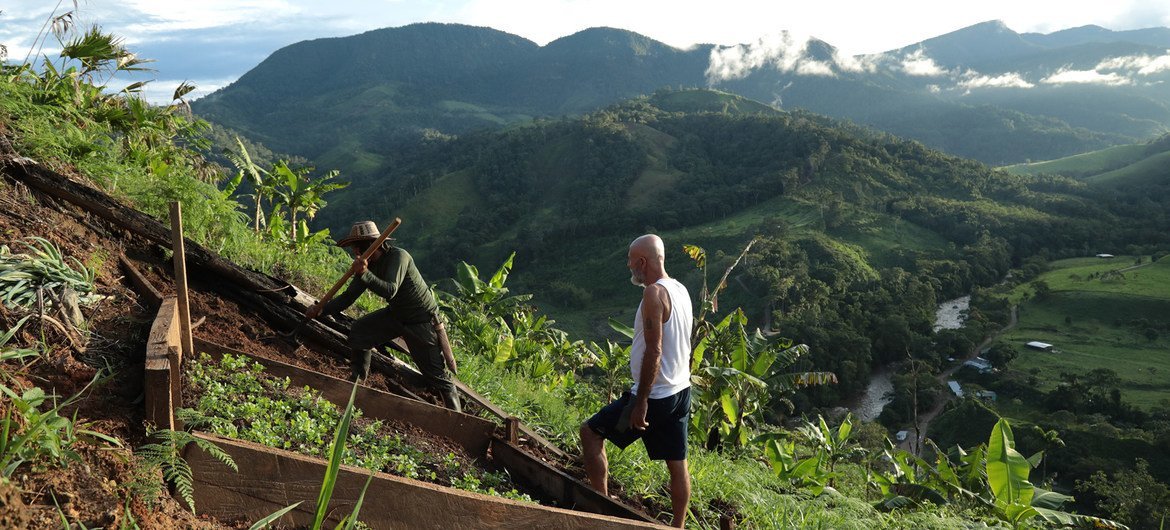
Some former combatants in Colombia, have now turned to farming following the historic 2016 Peace Agreement – UN Verification Mission in Colombia/Marcos Guevara.
On 14 July 2020 UN News made public the following assessement:
The killing of former combatants, human rights defenders and social leaders of communities devastated by decades of conflict, remains the most serious threat to peace in Colombia since the signing of a landmark peace agreement in 2016, the top UN official in the country told the Security Council on Tuesday, meeting in-person at UN Headquarters in New York, for the first time in four months.
Carlos Ruiz Massieu, Special Representative and head of the UN Verification Mission in Colombia, said authorities on 6 July arrested an individual allegedly behind the killing of Alexander Parra, a former member of the Revolutionary Armed Forces of Colombia—People’s Army, and leader of the former territorial area for training and reintegration in Mesetas, “These arrests are an example of the results that the mechanisms in the Peace Agreement can deliver”, Mr. Massieu said, and a reminder of the need to provide them with the support required to carry out their tasks. e.
Safety essential for those who laid down arms
After months of uncertainty and mounting security risks from illegal armed groups, Mr. Massieu said operations are now underway to transfer the former territorial area for training and reintegration in Ituango – where 11 former FARC-EP members and seven of their relatives were killed – to a new location in Mutatá…..
Presenting the Secretary-General’s report on the Mission, he said the COVID-19 pandemic has laid bare the vulnerable situation of roughly two-thirds of accredited former combatants who currently reside outside the former territorial areas for training and reintegration.
Offering a perspective from her own life, Clemencia Carabalí Rodallega, of the Municipal Association of Women, in Cauca, introduced herself as a survivor of a 4 May 2019 attack, which also threatened the lives of 25 other people working to defend the ethnic and territorial rights of communities in Colombia.
“Ethnocide in Colombia has not stopped,” she said. Not a day has passed since the Spanish invasion 528 years ago that a black or indigenous person has not been killed, a member of the indigenous or cimarrona guard has not been threatened, a woman has not been raped, or a human rights defender has not died by violence.
She said that since the signing of the Peace Agreement, 686 leaders and human rights defenders have been murdered, 160 of them in this year alone. She described the 2019 assassinations of a mayoral candidate from Suárez municipality and a governor of the Nasa indigenous community, along with the dismemberment, earlier this month, of a member of the Renacer Afro-Colombian Community Council, in Cañón del Micay.
“These situations have increased exponentially due to the COVID-19 pandemic”, she stressed.
She urged the President to fully implement the Comprehensive Programme of Safeguards for Women Leaders and Human Rights Defenders, and the Comprehensive Protection and Security Programme for Communities and Organizations in the Territories.
More broadly, she said the Government must comply with the entire Peace Agreement – especially its Ethnic Chapter and provisions on gender – and effectively investigate and prosecute those behind the violations.
She invited the international community to “put yourselves in our shoes” and visit the territories, accompanying Colombians in their peacebuilding initiatives, “not only through technical and economic support, but also with political commitment, as guarantors.”




 Hans Thoolen on Human Rights Defenders and their awards