Archive for the 'human rights' Category

European Parliament calls – again – for more attention for Human Rights Defenders

May 2, 2012

The European Parliament adopts every year a Resolution based on the report it receives on the EU’s human rights action and policy. So, it did again on 18 April 2012.

The official emblem of the European Parliament.

The official emblem of the European Parliament. (Photo credit: Wikipedia)

It is quite a long resolution and I only copy here the general paragraphs relevant to Human Rights Defenders (the chapter also includes a somewhat ill-fitting paragraph 91 on Western Sahara and a correct but detailed observation re the Sacharov prize in para 93, which you can consult in the full text):

…….

Re Human rights defenders

87.  Welcomes the EU’s political commitment to supporting human rights defenders, as a long-established component of the EU’s human rights external relations policy, and the many positive examples of demarches, trial observations, prison visits, and other concrete actions undertaken by EU missions and delegations, such as regular, institutionalised meetings with human rights defenders, but remains concerned at the lack of implementation of the EU Guidelines on Human Rights Defenders in some third countries; considers that the VP/HR should make recommendations for enhanced action to those missions where implementation has been noticeably weak;

88.  Urges the EU and its Member States to encourage EU missions and delegations to show their support and solidarity for the work undertaken by human rights defenders and their organisations, by regularly meeting and proactively engaging with them and incorporating their contributions into the development of the specific country strategies on human rights and democracy, and regularly engaging with Parliament;

89.  Reiterates its call on the EU to systematically raise individual cases of human rights defenders in the ongoing human rights dialogues it has with those third countries where human rights defenders continue to suffer harassment and attacks;

90.  Stresses the importance of systematic follow up to contacts with independent civil society, as well as more direct and easier access for human rights defenders to EU Delegations in third countries; welcomes the appointment of liaison officers, in the Delegations and/or in Member State embassies, for human rights defenders, and stresses that these should be experienced and appropriately trained officials whose functions are well-publicised both internally and externally; very much welcomes the fact that the VP/HR has indicated that she will always meet with human rights defenders in the course of her visits to third countries and calls for this practice to be followed by all Commissioners with responsibilities in the external relations field, and for reports on these contacts to be made available to Parliament;

91…….

92.  Reiterates its call for greater inter-institutional cooperation on human rights defenders; considers that the EU’s response capacity and the coherence between the actions of the different institutions on urgent crises for human rights defenders would be well served by a shared alert system based on focal points, and encourages the EEAS and the Commission to explore this avenue further with the European Parliament;

93.  ……

94.  Undertakes to include women’s rights more systematically in its own human rights debates and resolutions and to use the Sakharov Prize network, and especially female winners of the Prize, to advocate women’s rights in the world;

 full text: http://www.europarl.europa.eu/sides/getDoc.do?type=TA&reference=P7-TA-2012-0126&language=EN&ring=A7-2012-0086

‘media framing’ and the independence of the judiciary: the case of water boarding

April 30, 2012

What follows are my  SPEAKING NOTES ON THE OCCASION OF THE NJCM-THOOLEN AWARD  on Thursday 26 April 2012, the Hague. At this gathering of the Dutch Lawyers Committee for Human Rights (NJCM) I had the honor to hand over the award for the best master thesis on human rights. 

Dear friends,

When the Dutch Lawyers Committee, in 2005, decided to make an award in my name, I was most touched, especially as they had apparently dropped the requirement that I should die first.  Being alive has the additional advantage that on occasion I will be able to hand over the award myself, which I will do with the greatest pleasure in a few moments. This pleasure is the greater as the winning master paper touched on a topic very close to my heart: the role of the media or as it is sometimes referred to the “Fourth Estate”. There is some controversy about who exactly coined the term, but the most telling statement comes from Oscar Wilde who wrote: “Somebody — was it Burke? — called journalism the fourth estate. That was true at the time no doubt. But at the present moment it is the only estate. It has eaten up the other three. …”. That was said in 1981 and it is hard to imagine that that Oscar Wilde would come to a different conclusion more than a century later.

Spinning (an important element in the toolkit of media framing) has become a profession and the title ‘spin doctor’ is quite appropriate as the results are indeed often doctored. There are surely great historical cases that we cannot recognise because we ourselves have been successfully framed; who knows what positive image Attila the Hun could have enjoyed if only his PR people had done a more professional job. To take a more serious and recent case: let’s look at the so-called ‘failure’ of the UN in Somalia. This was a combined UN-US operation with a humanitarian mandate. When in October 1993, 18 U.S. Rangers were killed in a fierce battle with Aideed’s forces and television showed the body of a dead American soldier being dragged through the streets, American public opinion overnight turned against further U.S. involvement in Somalia and Clinton pulled out all troops soon afterwards. Although the Rangers were part of Washington’s own separate Somalia operation, and the US did not want to function under UN command, the incident was played and replayed as a major “UN failure.” The UN was widely, and wrongly, blamed for the gruesome deaths of the U.S. Rangers, despite the fact that they were not part of the UN operation, something that President Clinton finally acknowledged in 1996. Yet most people around the worlds continue to hold the UN responsible. I am afraid that each of us can probably come up with a favorite case of the media having got the better of the truth but that should not be tonight’s debate.

Laura Henderson in her paper “Tortured reality” has gone one important step further. She has investigated how media framing of waterboarding affects judicial independence. She had to limit herself to the US judiciary and to the specific case of ‘waterboarding’ in order to create an environment stable enough to draw some statistical conclusions. Her research is done very neatly. She makes clear that the concept of independence of the judiciary has always been defined broadly and not just as a prohibition of interference by the state, although that remains the classical background.  Cases of media pressure are dealt with in jurisprudence but they have always been considered in the context of an independent judge who is well-trained and not easily swayed by what the flimsy press has to say. The little jurisprudence there is does not contemplate a case of wilful, orchestrated influencing of all the media with the purpose of changing the perception and language of an existing concept.

What makes the study of Henderson stand out that it exactly tries pin down to what extent this has happened with the question whether the technique of ‘waterboarding’ changed in the minds of the judges after the 11 September watershed (no pun intended). The torrent of rhetoric not only framed everything in a ‘war’ context but also specifically tried to downplay the labelling of waterboarding as torture. And she did find the evidence. I will not reveal it all – you have to read for yourself the whole article once the NJCM has rightly published it. Laura herself indicates that further work is needed on how the independence of the judiciary is undermined by media framing and I hope that will be the case. She also gives some very useful indications of how the media framing could be countered, e.g. by strengthening the pluriformity of the media and raising the awareness of the judiciary. She describes her recommendations as ‘simple, yet effective”.  Here I beg to differ. There is nothing simple about changing the media landscape, especially if one adds the television and social media, which her study understandably had to leave out. The magnitude and multitude of media is such that no-one can really do much about it. All recent studies on the effect of the internet on our information intake show that they tend to solidify the dominant opinions/news/books etc, while giving great potential to small niche items, including the nutty and the genial. What gets squeezed is the moderate, considered, well-argued, balanced stuff in the middle. My fear is that the voice of the NJCM may well have the qualities described above!

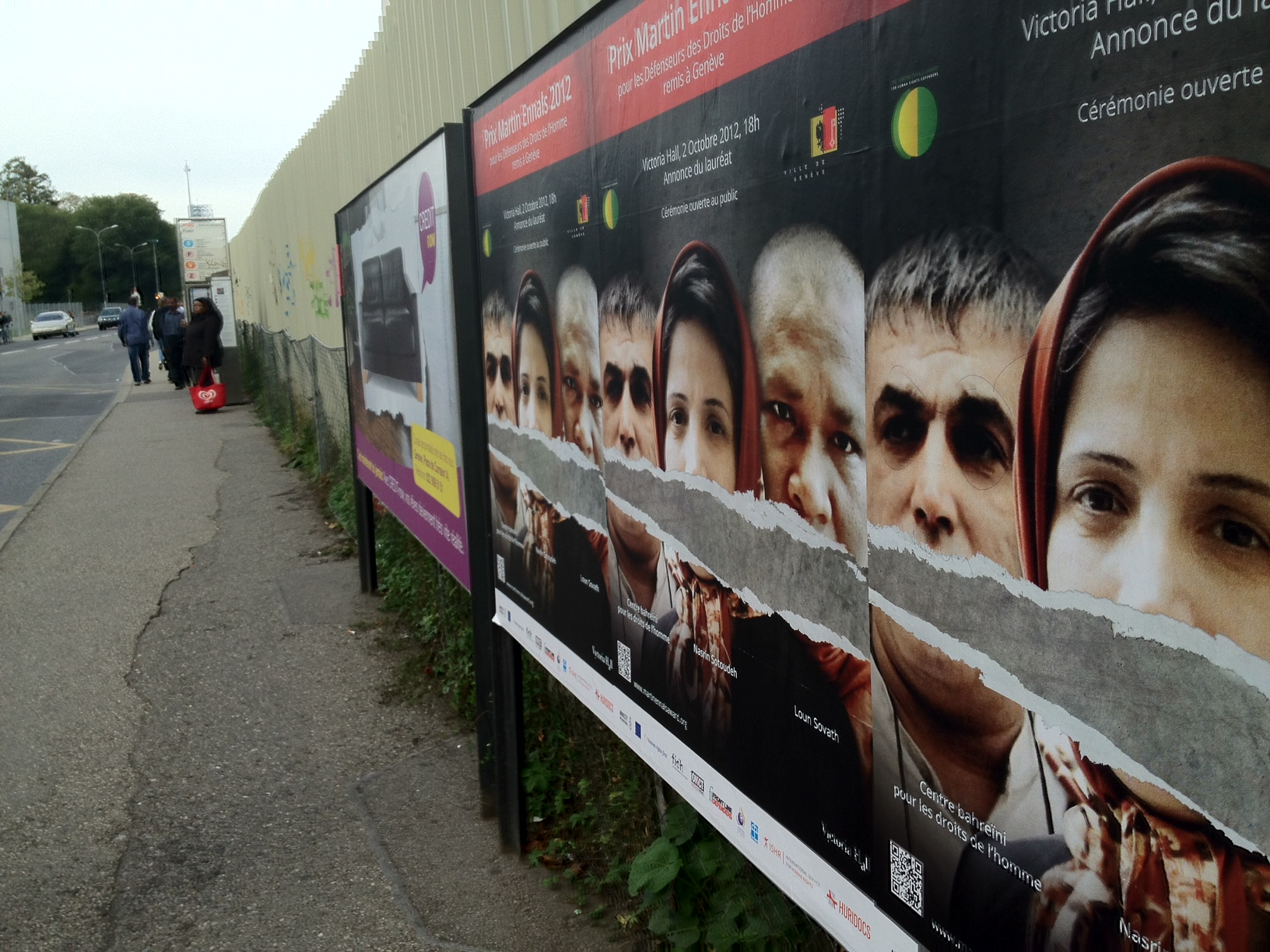
In the end there can be only one winner. A feature of almost any award and painfully brought home two days ago in Geneva where I was for the announcement of the 3 nominees for 2012 Martin Ennals Award for Human Rights Defenders. All 3 nominees are extremely courageous Human Rights Defenders (Bahrain Centre for Human Rights, the multimedia monk form Cambodia, and Shirin Ebadi’s former lawyer: Nasrin Sotoudeh) and the Jury making the final choice on 2 October will have a hard time.

Still, the hard choices have been made already for the NJCM Thoolen Award – may I take this occasion to thank the Jury and Franka for their excellent work – and I am proud to hand over the prizes to the 3 finalists.

Breaking news: the Bahrain Centre for Human Rights – MEA 2012 nominee

April 24, 2012

Today the nominees of the Martin Ennals Award for Human Rights Defenders 2012 are announced in Geneva. The ann0uncement was made by the new Chair of the Martin Ennals Foundation, Mrs Micheline Calmy Rey, until last year the President of and Minister of Foreign Affairs of Switzerland.  Each nominee deserves its own post!  One of the 3 nominees is the Bahrain Center for Human Rights (BCHR).

BCHR is a nongovernmental organization that conducts research, documents human rights abuses, provides information to international NGOs and the diplomatic community in Bahrain and advocates locally and internationally.  Several of its leaders have been arrested wihout cause. BCHR has continued its human rights activities despite a hostile environment, in particular the numerous threats issued by the Government, warning that further ‘legal’ action will be taken against the members should they continue their activities.  Through its website (www.bahrainrights.org) BCHR struggles to promote democracy and human rights in accordance with international norms, encourages and supports individuals and groups to be proactive in the protection of their own and others’ rights. BCHR has emerged as a model NGO in the region on how to continue to operate and leverage national and international advocacy despite a repressive national context. It is only the second time in the 20-year history of the MEA that an organisation is one of the nominees.

Breaking news: Nasrin Sotoudeh from Iran – MEA 2012 nominee

April 24, 2012

Today the nominees of the Martin Ennals Award for Human Rights Defenders 2012 are announced in Geneva. The ann0uncement was made by the new Chair of the Martin Ennals Foundation, Mrs Micheline Calmy Rey, until last year the President of and Minister of Foreign Affairs of Switzerland.  Each nominee deserves its own post!  One of the 3 nominees is Nasrin Sotoudeh from Iran.

Nasrin Sotoudeh is a human rights lawyer and a member of the now closed Defenders of Human Rights Centre (DHRC); she was imprisoned for “spreading propaganda against the State”, “collusion and gathering with the aim of acting against national security” and “membership in an illegal organisation”. She worked for Shirin Ebadi‘s law firm, and represented imprisoned opposition activists following the June 2009 presidential elections. In this regard, she represented Shirin Ebadi after she left Iran and her assets were confiscated. On September 4, 2010, Nasrin Sotoudeh was arrested, and later sentenced to 6-year of prison and a 10-year ban on practising as lawyer. She remains detained in Evin prison and on several occasions subjected to solitary confinement. Unlike fur common criminals her family visits and furlongs are limited. Despite real danger for her security and liberty, Nasrin Sotoudeh has relentlessly defended those most vulnerable. As started by Iranian Nobel Peace Prize winner Shirin Ebadi “Ms. Sotoudeh is one of the last remaining courageous human rights lawyers who has accepted all risks for defending the victims of human rights violations in Iran”. After Akbar Ganji (2006) and Baghi (2009) this is the third human rights defender from Iran chosen by the Jury in the last seven years. The Government will surely portray this as a bias, but the rest of the world will understand that Iran is one of the worst when it comes to respect HRDs.

Breaking news: the venerable Luon Sovath from Cambodia – MEA 2012 nominee

April 24, 2012

Today the nominees of the Martin Ennals Award for Human Rights Defenders 2012 are announced in Geneva. The ann0uncement was made by the new Chair of the Martin Ennals Foundation, Mrs Micheline Calmy Rey, until last year the President of and Minister of Foreign Affairs of Switzerland.  Each nominee deserves its own post!

One of the 3 nominees is the venerable Luon Sovath from Cambodia. In Cambodia forced evictions remove families from their homes and lands with little or no notice, without genuine consultation, and often without compensation. Despite threats of violence, arrest and disrobing, the venerable Luon Sovath, a non-violent, innovative human rights defender, firmly supports and documents at-risk rural and urban communities, mainly by advocating to stop forced evictions, documenting their struggles with videos (the venerable Sovath  is also known as the ‘Multimedia Monk’ as he is never without his camera, his mobile phone and his laptop), poems and songs, defending their right to housing, as well as for adequate compensation and alternative housing, organizing public forums to educate communities on how Buddhism, human rights and democracy are in the same line. His peaceful, non-violent approach (the venerable Sovath also composes songs to unite and inspire – regularly distributing the songs on CDs to the communities) is crucial in the nascent grassroots mobilization of affected communities nationwide; his increasingly prominent role has drawn the reaction of the authorities, and his advocacy against forced evictions touches powerful economic interests. The threats against the venerable Sovath are very real, from powerful businessmen, from the authorities and even from some of the conservative clergy.

Upon handing over the Martin Ennals Foundation to Mrs Micheline Calmy Rey

April 24, 2012

Deutsch: Schweizer Bundesrätin de:Micheline Ca...

It took almost 20 years but I finally have been able to step down as Chair of the Martin Ennals Foundation. Yesterday the Board accepted my resignation and selected Micheline Calmy Rey as my successor (now that is upgrading!). In an hour from now she will be announced as such at the press conference in Geneva which is being streamed on http://www.martinennalsaward.org.

My departure has been carefully crafted since November last year but we have been most fortunate that in the meantime Micheline Calmy Rey left her government position and accepted the challenge to lead the MEA to its destiny as the most influential human rights award in the world. I realize that this is not a modest thing to say but I think that facts speak for themselves:

The MEA has a Jury composed of the world’s leading international human rights organisations, a unique cooperation among sometimes competing NGOs. The Laureates over the last twenty years have been outstanding examples and have all claimed that the recognition of the award has helped them in continuing their work.

The growth of the impact of the award has a lot to do, not only with its longevity, but also with the joining of forces by other entities, in the first place the City of Geneva which is now the main organiser of the ceremony at Victoria Hall.

I am sure that the foundation will be able to pursue the increased use of multimedia techniques for protecting the HRDs.  As this is often a question of resources, I will continue to advise the MEA in particular with regard to fundraising and publicity.

So, I am not really retiring; there are simply too many Human Rights Defenders out there who need support. This year’s nominees, who will be introduced to you in a few hours, illustrate the need for international recognition and protection.

Geneva, 24 April 2012

Announcement of nominees MEA 2012 streamed on internet: 24 April

April 21, 2012

The announcement of the three nominees of the Martin Ennals Award for Human Rights Defenders 2012 will take place on Tuesday 24 April 2012, from 11h00 to 11h30 in Geneva (that is 09h00 – 09h30 GMT). For the first time this short event is being ‘broadcast’ live on the internet (www.martinennalsaward.org). There will be brief film images shown of the 3 nominees. The event also includes the announcement of the new Chairperson of  the Martin Ennals Foundation.

New UN rapporteur for truth, justice and reparation important for HRDs

April 6, 2012

The Mail & Guardian Online carried an interesting piece that may have gone unnoticed. It is about the appointment of the first ever Rapporteur ‘on the promotion of truth, justice, reparation and guarantees of non-recurrence’. On March 23, the United Nations Human Rights Council appointed Pablo de Greiff, a Colombian national, who is currently the New York-based director of research at the International Centre for Transitional Justice. His tenure as special rapporteur begins on May 1.

The article refers to a recent meeting entitled “African Perspectives on the Appointment and Mandate of the UN Special Rapporteur on the Promotion of Truth, Justice, Reparation and Guarantees of Non-Recurrence”, of which a comprehensive report is forthcoming.

The article also gives a useful background to the what “Special procedures” are and underlines rightly that civil society (i.e. HRDs) should play a vital role in relation to the special rapporteur. Feeding the special rapporteur with succinct, reliable and accurate information on urgent matters relating to the mandate is one important function civil society can take on. Raising awareness about the special rapporteur and the relevant mandate as well as how it translates into reality is equally important in order to ensure increased participation in the broader process.

UN appoints rapporteur for justice – Opinion – Mail & Guardian Online.

Turkmenistan and the UN: a rare comprehensive review of human rights shortcomings

April 3, 2012
On 30 March Human Rights Watch (HRW)  together with the International Partnership for Human Rights, and Turkmen Initiative for Human Rights made public a report that on the result of the Turkmen government’s hearing at the UN Human Rights Committee. Both the hearing and the original NGO submission  show its abysmal human rights record.  “The UN review leaves no doubt about the urgent need for human rights reform in Turkmenistan. What’s key now is to make sure the Turkmen government does what it takes to rectify abuses” stated Veronika Szente Goldston, Europe and Central Asia advocacy director at Human Rights Watch.  Given Turkmenistan’s exceptionally poor record of cooperation with the UN’s human rights bodies, sustained external pressure is essential to enforce compliance, the organizations said.
The Turkmen government’s clampdown on freedom of expression and repression of civil society activism, torture and ill-treatment in places of detention, and the lack of an independent judiciary topped the committee’s concerns. It directed the Turkmen government to report back within one year on measures taken to address them. The committee also highlighted other important areas of concern, such as: Incommunicado detention and imprisonment and restrictions on “the exit and entry into [the country] by certain individuals.  Other concerns raised by the committee include: The Law on Public Associations, which “severely restricts freedom of association; reports of the use of child labor in cotton harvesting; criminalization of homosexuality; and the “alleged use of a forced assimilation policy of ‘Turkmenisation,’ for ethnic minorities.
For the full report go to: http://www.hrw.org/news/2012/03/30/turkmenistan-damning-un-report-shows-need-urgent-action
RELATED MATERIALS:

Bahrain again: Court postpones decision – Al-Khawaja in critical condition

April 3, 2012

In my post of 1 April I wondered whether the would be justice for the Bahraini HRD on hunger strike, Abdulhadi Al-Khawaja. Now we know that the Court of Cassation on Monday did not order the requested release but announced that the decision will be read on April 23. His deteriorating health condition simply cannot wait until that date. The Government remains responsible for the consequences.