Archive for the 'human rights' Category
January 6, 2013
HRF in Washington DC is looking for a Senior Associate responsible for devising, planning, coordinating, and executing strategies for influencing U.S. human rights policy on the range of issues covered by Human Rights First’s Human Rights Defenders HRD program. Deadline 25 January 2013!
via Senior Associate – Human Rights Defenders Program Washington, DC.
Posted in human rights, Human Rights Defenders | Leave a Comment »
Tags: HRF, Human Rights Defenders, Human Rights First, job opportunity, USA, vacancy
January 4, 2013
The Observatory for the Protection of Human Rights Defenders, a joint programme of the International Federation for Human Rights (FIDH) and the World Organisation Against Torture (OMCT), reports the arbitrary detention of Mr. Le Quoc Quan, a human rights lawyer and blogger.
On December 27, 2012, Mr. Le Quoc Quan was arrested by the police in Hanoi while dropping off his daughter at school. The police also searched his office and home and confiscated some documents. The police told his family that he would be charged under Article 161 of the Criminal Code, which relates to tax evasion. If condemned, he risks three years in prison and a heavy fine. Mr. Le Quoc Quan, who began a hunger strike on December 28, is currently detained incommunicado in Hoa Lo Prison No. 1. Neither his lawyer nor his family have been able to visit him to date.
Mr. Le Quoc Quan’s arrest follows a recent order by Prime Minister Nguyen Tan Dung that authorities renew the fight against anyone using the Internet to “defame and spread propaganda against the State”.Mr. Le Quoc Quan has been harassed constantly since 2007 by the Vietnamese authorities because of his human rights activities. On October 3, 2012, some 50 security police and plain-clothed militia forced entry into the head office of VietNam Credit in Hanoi and its branch office in Saigon. The firm belongs to Mr. Le Quoc Quan and his two brothers. Police seized files and documents belonging to the firm, assaulted the staff and detained the brothers for interrogation. In addition, on August 18, 2012, Mr. Le Quoc Quan was brutally beaten by two unidentified men with iron bars outside his home in Hanoi.
The Observatory recalls that allegations of tax evasion have previously been levelled against human rights defenders. Blogger Nguyen Van Hai, alias Dieu Cay, founding member of the Club of Free Journalists, was initially jailed for tax evasion but then sentenced in September 2012 to 12 years in jail for spreading anti-State propaganda under Article 88 of the Criminal Code, along with two other bloggers and members of the Club of Free Journalists.
via Viet Nam: Arbitrary detention of Mr. Le Quoc Quan / January 4, 2013 / Urgent Interventions / Human rights defenders / OMCT.
Posted in human rights, Human Rights Defenders | Leave a Comment »
Tags: blogger, FIDH, harassment, Human Rights Defenders, illegal detention, lawyer, Le Quoc Quan, Observatory for the Protection of HRDs, OMCT, Viet Nam, Vietnam
January 2, 2013
The Gambian Government must stop immediately intimidation and harassment of HRDs, journalists, lawyers and government critics generally says a joint statement by ARTICLE 19, the Commonwealth Human Rights Initiative and Amnesty International. Since the beginning of December, at least nine cases of arbitrary arrest and illegal detention have been documented.
via Human Rights Groups Urge Gambia Govt to Stop Crackdown on Critics.
Posted in human rights, Human Rights Defenders | Leave a Comment »
Tags: Amnesty International, arbitrary arrest, Article 19, Commonwealth Human Rights Initiative, crackdown, Gambia, Human Rights Defenders, illegal detention, journalists, urgent
January 2, 2013
“The Cause of Progress” tells the story of the lives of three Cambodians caught up in the country’s chaotic and often violent economic progress, set against the backdrop of the shifting political, religious and familial landscapes of modern-day Cambodia. Shot over the course of three years, the film is a unique and intimate portrait of modern Cambodia. At times poignant and emotional, at others violent and chaotic, the film explores the impact of progress on modern society – from the corruption of the national religion, to the disintegration of the family, to the abusive power and kleptocracy of the ruling political elite.
What is happening in Cambodia is happening all over the developing world, from South America to Africa to Eastern Europe – land is being colonised by the developed world and the local elites, while the rightful owners are being displaced. This film addresses one of the most pressing issues of our time.
Each of the three personal narratives focuses on a different aspect of the story but forced evictions and land grabbing recur across all three. The Venerable Loun Sovath is a Human Rights Defender who uses video as part of his activist campaigning, all the while fighting against the corruption within his religious order. He is the 2012 Laureate of the MEA. Sopheap, facing eviction and waiting for a new home, is struggling to start a new business while she tries to cope with her slowly disintegrating family. And Srey Pov – at the front lines of a high profile forced eviction – comes face to face with a corrupt political elite and the sometimes difficult relationship between global institutions and the developing world.
This film will offer a unique insight into a country at a pivotal time in its development, finally shaking off the legacy of the past and the atrocities of the Khmer Rouge, Cambodia’s future direction is uncertain.
Those who want to keep up to date on future developments of this project should sign up to the film’s blog, join its facebook group, and mailing list and follow on twitter @chriskellyfilm
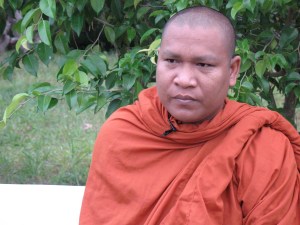
Luon Sovath by Dovona

Filmmaker Chris Kelly filming at Boeung Kak lake. Image © Nicolas Axelrod 2010.
Posted in films, human rights, Human Rights Defenders | Leave a Comment »
Tags: Africa, Cambodia, Chris Kelly, documentary, Eviction, film, Human rights defender, Human Rights Defenders, Khmer Rouge, land disputes, Loun Sovath, MEA, The Cause of Progress
January 2, 2013
The new year starts with a report on Sudan where the Government is confirming a worrying trend – observed already in 2012 by several NGOs in a growing number of countries including recently Russia – of hitting dissident voices and Human Rights Defenders with more sophisticated but equally effective measures such as stopping foreign funding or using this kind of funding as a reason to simply close the institution or revoke its license.
Based on information in the Sudan Tribune of 25 and 31 December, and Bakhita Radio of 1 January 2013 this is what happened to the Sudanese Studies Center (SSC) on Monday 25 December and hardly a week later the Al Khatim Adlan Center for Enlightenment and Human Development (KACE), which were forced to close.
Sudan’s ministry of information cites activities aiming to overthrow the regime and financial support from outside the country. Aiming to promote peace, democracy and diversity, KACE organized workshops on the Darfur and South Kordofan crises, elections, and South Sudan and Abyei referendums as well as projects on violence against women and youth. Many of its different activities are indeed funded by foreign embassies in Khartoum, and international foundations. KACE is also working on a project about the reform of school curriculum funded by the National Endowment for Democracy and another one related to the civil society participation in public affairs supported by the Open Society Institute.
Albaqir Alafif (director of KACE) and Haydar Ibrahim Ali and Abdallah Abu Al-Reesh (respectively the founder and director of the SSC) have denied the government accusations against their centers saying this support is free of any political agenda and aims to promote the different activities of the organizations.
To show that the ‘old’, crude methods of repression are still functioning, Sudanese security on Monday arrested the executive director of Sudanese Studies Center Abdallah Abu Al-Reesh, following a gathering of Sudanese activists outside the National Human Rights Commission in Khartoum to deliver a memo against its closure. Abdallah’s family said security agents came in the early morning of Monday and conducted him to unknown destination. His family members said they are concerned for his health as they refused to allow him to bring his medications.
Posted in human rights | 1 Comment »
Tags: Abdallah Abu Al-Reesh, Al Khatim Adlan Center, Albaqir Alafif, banning, civil society organizations, closure, Government, Haydar Ibrahim Ali, Human Rights Defenders, KACE, Khartoum, NGOs, Open Society Institute, repression, South Kordofan, South Sudan, Sudan, Sudanese Studies Center
December 22, 2012
The wicked never sleep but we are still going to have a short break around Christmas and will not bother you unless it is extremely urgent and pertinent. For those who want some more serious reading over the holidays I refer to the
interesting study on the state of affairs with regard to the protection of women human rights defenders made public by :

on http://urgent-responses.awid.org/index.php/Home
A concrete overview of its work is on behalf of women human rights defenders is included in: study on women HRDs and urgent responses
With this I wish you a pleasant holiday
Posted in human rights, Human Rights Defenders | Leave a Comment »
Tags: Advocacy Organizations, AWID, Christmas, human rights, Human Rights and Liberties, Human Rights Defenders, United Nations Special Rapporteur, urgent, women human rights defenders
December 21, 2012
The Committee to Protect Journalists (CPJ) and Reporters without Borders (RSF) have just released their annual counts of killed journalists. Although their figures differ somewhat: 67 killed for CPJ and 88 for RSF, both organizations show a sharp increase in the number of killings.The main reason is Syrian where journalists are also directly targeted by the governemnt security services or jihadist fighters.
For more information:
CPJ report http://www.cpj.org/reports/2012/12/journalist-deaths-spike-in-2012-due-to-syria-somal.php
RSF report http://en.rsf.org/2012-journalists-netizens-decimated-19-12-2012,43806.html
via Media and human rights: End of year: a sharp increase in the number of killed journalists.
Posted in human rights | Leave a Comment »
Tags: annual report, Committee to Protect Journalists, freedom of information, journalists, Media and Human Rights, netizens, Reporters without Borders, Syria
December 20, 2012
On 17 December 2012, a group of four armed men carried out an attack on human rights defender Mr Gunaratne Waninnayaka, the president of the Colombo Magistrate’s Court Lawyers’ Association and the convenor of People’s March. Gunaratne Waninnayaka is an outspoken campaigner for the independence of the judiciary. Over the past years, Gunaratne Waninnayaka has figured prominently in campaigns to protect the independence of the judiciary in Sri Lanka. Most recently he has been at the forefront of the campaign opposing the Sri Lanka government’s move to impeach Chief Justice Shirani Bandaranayake, who was a member of the Supreme Court when it delivered an adverse ruling to the government.
In the morning of 17 December, Gunaratne Waninnayaka was ambushed outside his house by four unidentified persons armed with automatic weapons who had been waiting for him to return home. As he approached his home, he saw the armed group and managed to enter his residence in his car, enter his home and block the entrances. The armed persons tried to enter the house but failed.
http://www.frontlinedefenders.org/ar/
Posted in Front Line, human rights, Human Rights Defenders | Leave a Comment »
Tags: Asia, attack, Chief Justice, Colombo, Colombo Magistrate's Court Lawyers' Association, Gunaratne Waninnayaka, Human rights defender, independence of the judiciary, Sri Lanka, threat
December 20, 2012
Today, 20 December, Front Line Defenders  reports that on 15 December 2012, human rights defender Mr Sombath Somphone disappeared after last being seen driving away from his office. Since then, his whereabouts have been unknown, although sources have reported having seen video footage of the human rights defender in the custody of the police. Sombath Somphone is the founder and executive director of the Participatory Development Training Centre (PADETC), which trains young people in order to promote sustainable development. For his community development work he was awarded one of Asia’s most prestigious civil awards, the Ramon Magsaysay Award for Community Leadership, in 2005.
Sombath Somphone left the offices of PADETC in Vientiane at around 5pm on 15 December. When he failed to come home that night, his wife searched for him in the city’s hospitals before eventually reporting him missing with the police. On 18 December, an official from the government press office reportedly commented on the phone that there was not yet enough evidence to draw any conclusions about the case. Family members of Sombath Somphone have lodged a complaint with the police who deny all knowledge of the case.
An anonymous colleague of the human rights defender has, however, reported that on 17 December, relatives of Sombath Somphone were shown CCTV footage of his car being stopped by police officers around 6pm in the vicinity of Vatnak village in Sisattanak district, Vientiane The footage then reportedly showed the human rights defender being led to the Sisattanak district police station in Vientiane, and some time later showed Sombath Somphone being led out of the office and taken away in a white pick-up truck.
On 20 December, the Laos Foreign Ministry came up with the statement stating “the authorities are not in a position to say exactly what has actually happened, why Sombath Somphone has gone missing, or who might have been involved in the incident”. The Ministry alleges that it might be possible that the human rights defender was kidnapped due to personal or business conflict.
Sombath Somphone founded PADETC in 1996, and since the organisation has become a prominent player in Lao civil society. The organisation works in numerous fields to promote sustainable development through the education of young people in particular. Although the organisation’s work is not political in nature, it is alleged that Sombath Somphone may have been targeted by government authorities due to his opposition to state development projects with harmful social or environmental consequences. Front Line Defenders is concerned by the allegations of enforced disappearance of Sombath Somphone, in the light of the important work he has carried out defending human rights in Laos and promoting sustainable development through developing the capacities and leadership skills of young people.
Posted in human rights | 1 Comment »
Tags: Asia, disappearances, Front Line, Front Line Defenders, human rights, Human rights defender, Lao, Sombath Somphone, Vientiane
December 20, 2012
The ‘new’ Commissioner for Human Rights of the Council of Europe (who took office on on 24 January 2012) Nils Muižnieks stated in his end of the year message some hard truths about the position of human rights defenders in Europe.
”Defamation, threats, verbal and physical attacks, sanctions and judicial harassment are used to deter human rights activists from working with migrants.” Nils Muižnieks states that in several Council of Europe countries, the rise of xenophobic and anti-migrant discourse has “negatively impacted” on the work of human rights defenders who protect and promote the rights of migrants.“Human rights defenders are even increasingly labelled as traitors who are threatening national identity and security,” he adds. “They are often exposed to intimidation and abuse.
“The situation in Greece is particularly worrisome as migrants have become targets of unacceptable, extreme violence notably by members, including MPs, of the far right political party of Golden Dawn.“Human rights defenders defending migrants are under threat. There have been several instances of lawyers being threatened and physically attacked in Athens as they were assisting migrants in the course of asylum and other legal procedures.
“In some Council of Europe countries the work of defenders working with migrants and their rights is being criminalised. In France, legal provisions corresponding to the so-called délit de solidarité the offence of solidarity concretely result in law enforcement bodies pressuring and punishing human rights defenders providing assistance to irregular migrants. Persons standing up for the rights of migrants have been detained, prosecuted and/or fined.“ “In Belgium, similar tendencies have been identified and persons who have been demonstrating in favour of the rights of migrants have been arrested.”
via Nils Muižnieks: “Human rights defenders are increasingly labelled as traitors” | HUMANERIGHTSEUROPE.
Posted in human rights, Human Rights Defenders | 1 Comment »
Tags: Belgium, China Human Rights Defenders, Commissioner for Human, Council of Europe, Europe, France, Golden Dawn, Greece, harassment, migrants, Nils Muižnieks, refugees, threats
 Hans Thoolen on Human Rights Defenders and their awards