“The Cause of Progress” tells the story of the lives of three Cambodians caught up in the country’s chaotic and often violent economic progress, set against the backdrop of the shifting political, religious and familial landscapes of modern-day Cambodia. Shot over the course of three years, the film is a unique and intimate portrait of modern Cambodia. At times poignant and emotional, at others violent and chaotic, the film explores the impact of progress on modern society – from the corruption of the national religion, to the disintegration of the family, to the abusive power and kleptocracy of the ruling political elite.
What is happening in Cambodia is happening all over the developing world, from South America to Africa to Eastern Europe – land is being colonised by the developed world and the local elites, while the rightful owners are being displaced. This film addresses one of the most pressing issues of our time.
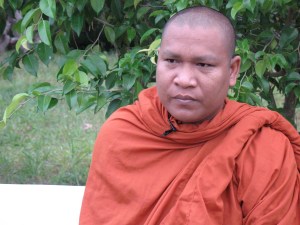
Each of the three personal narratives focuses on a different aspect of the story but forced evictions and land grabbing recur across all three. The Venerable Loun Sovath is a Human Rights Defender who uses video as part of his activist campaigning, all the while fighting against the corruption within his religious order. He is the 2012 Laureate of the MEA. Sopheap, facing eviction and waiting for a new home, is struggling to start a new business while she tries to cope with her slowly disintegrating family. And Srey Pov – at the front lines of a high profile forced eviction – comes face to face with a corrupt political elite and the sometimes difficult relationship between global institutions and the developing world.
This film will offer a unique insight into a country at a pivotal time in its development, finally shaking off the legacy of the past and the atrocities of the Khmer Rouge, Cambodia’s future direction is uncertain.
Those who want to keep up to date on future developments of this project should sign up to the film’s blog, join its facebook group, and mailing list and follow on twitter @chriskellyfilm
The Jury for the Dutch Human Rights Defenders Tulip has awarded the 2012 Tulip to Marimuthu Barathan (note that the spelling is sometimes Bharatan) from India. It will be presented in The Hague on 9 January 2013. True Heroes is making a filmed portrait on his work.
The jury praised Mr Barathan as a ‘tireless campaigner for better living and working conditions for the Dalits in India’.The Human Rights Defenders Tulip, which is being awarded for the fifth time, comprises a statuette and €100,000 for a project to be decided on in consultation with the recipient.
On December 9, Front Line Defenders held a one-off production called Voices from the Front Line. The event, which took place at Vicar Street Theatre in Dublin, celebrated the inspirational courage of 11 human rights defenders from around the world through an evening of stories and song. Among the performers were leading actors and musicians Martin Sheen, Andrea Corr, Robert Sheehan, Amy Huberman, Paul Brady, Hazel O’Connor, Cara O’ Sullivan, Liam Ó’ Maonlaí and Finbar Furey.
The show was attended by over 800 people and streamed live on Irish broadcaster RTE’s youtube channel. Through telling the stories of human rights defenders in their own words, the evening sought to raise public awareness of who human rights defenders are and the many risks they face. The selected human rights defenders provided an illustrative sample of the thousands more that Front Line Defenders works to protect and support on a daily basis.
The photojournalist Fernando Moreles has been awarded the second Tim Hetherington Grant, an annual visual journalism award focusing on human rights, Human Rights Watch and World Press Photo announced 0n 11 December 2012. Human Rights Watch and World Press Photo established the grant to honor the legacy of Hetherington, a photojournalist and filmmaker who was killed during fighting in Libya in April 2011. The €20,000 grant was given to Moleres for his project “Waiting for an Opportunity,” in which he is documenting the harsh realities of juvenile justice in Sierra Leone. For more than two decades Moleres, who was born and lives in Spain, has been committed to documenting the plight of the most vulnerable populations and covering issues relating to children and labor, juvenile justice, and refugees. “Fernando Moleres’ moral and emotional commitment to his photographic subjects is clear,” said Carroll Bogert, deputy executive director at Human Rights Watch. “Tim Hetherington would have loved this work and Human Rights Watch is thrilled to support it.”
This is third and last chapter in the series of animated videos to which I referred earlier. This is the chapter dealing with collective rights and the issue of enforcement. Unfortunately I see a major error with regard to the latter as the clip does not make clear that the Treaty Bodies complaint procedures are only open to those who reside in countries that have (1) ratified the treaty in question (b) recognised the right of individual complaint. For everybody there are the co-called ‘charter-based’ procedures (mechanisms) which are even less legally binding. These together constitute the global level of complaint procedures, against which one can then place the regional systems.
For the rest a solid and neutral explanation of the history and cohesion of the international system.
The Ceremony of the Alkarama Award will be held on Friday 7 December 2012 at 18h30 in Geneva at Centre International Conférences, Genève
This year, the laureates are two human rights defenders from the Gulf region:
– Dr Mohamed Abdullah Al Roken, United Arab Emirates
– Dr Saud Mukhtar Al Hashimi, Saudi Arabia.
PBI UK put on VIMEO an interesting panel discussion on Women Human Rights Defenders. It is over an hour long and you need good broadband access to see it properly.
Panellists:
Chair: Dr Sarah Wollaston MP (5 mins)
1. Jivka Petkova, Gender Advisor on Human Rights and Democracy, European External Action Service. “Protecting and supporting WHRDs through the EU.”
2. Dolores Infante, Assistant to the UN Special Rapporteur on HRDs. “An overview of the work of the Special Rapporteur’s office on addressing risks faced by WHRDs.”
3. Kathryn Lockett, Advisor, Violence Against Women and Girls, Conflict, Humanitarian and Security Department, DFID. “DFID’s work on tackling Violence Against Women and Girls: the role of WHRDs”.
4. Amy Clemitshaw, Deputy Head of Human Rights and Democracy Department, FCO. “The UK’s use of the EU human rights guidelines overseas to support human rights defenders.”
This is the second part of the series “Focus Human Rights” that I referred to in an earlier post. It deals with the second dimension of the Human Rights system: The Economic, Social and Cultural Rights. Additionally, it explains women’s rights and shows how NGOs in the Human Rights sector work. Especially the latter part seems somewhat forced into this second volume as they operate in both areas to say the least. It has also a rather strange reference to the International Society for Human Rights which is listed with AI, HRW and HRF as an example of well-known NGOs, while it is in fact fairly small and – outside Germany – without much influence.
The clips are done by Jan Künzl and Jörn Barkemeyer, who welcome comments.
Young Armenians aged from 17 to 25 can take part in a short (three minute long) film contest on human rights in the digital age by sending their submissions to the United Nations Department of Public Information (UN-DPI) in Armenia by 5 December. The contest is being organised by the UN-DPI, the Office of the High Commissioner for Human Rights, the UN Population Fund, the OSCE Office in Yerevan, the Council of Europe in Armenia and the EU Delegation to Armenia, with the support of the Human Rights Defenders Office.
The aim of the competition is to promote the Universal Declaration of Human Rights and to raise awareness among young people about human rights in the digital age, opportunities that the internet and social media offer to defenders of human rights, to give youth the opportunity to tackle this topic from a creative point of view and to promote successes for human rights defenders. All entries will be posted on the UN Armenia YouTube Channel and the general public will be invited to vote to select the best film. The best films will be screened on Human Rights Day in Yerevan in December 2012. The award ceremony in Armenia will be broadcast live, connecting youth from different countries, who will be able to talk to each other via the internet, promoting international dialogue, building tolerance and sharing their experiences in promotion of human rights.
The Armenian announcement states interestingly that “The same event will simultaneously take place in other UN member states.” but I have not seen or found any other such announcements !?


 Hans Thoolen on Human Rights Defenders and their awards