Each year, the Dutch municipality of Vlaardingen awards the so-called ‘Geuzenpenning’; a medal honouring human rights defenders around the world.
On 13 March Padre Alejandro Solalinde Guerra (73) received this year’s Geuzenpenning. He has dedicated his life to supporting migrants on dangerous journeys in search of a better life: a phenomenon of all time. During their flight, they have to deal with many ill-treatments that undermine their human dignity, such as rape, murder and human trafficking. Padre Solalinde has supported these people for over ten years and has often been lambasted by both governmental and clerical authorities for his efforts.
On 14 March an academic event will be organized, in collaboration with Erasmus School of Law and the Erasmus Initiative on Dynamics of Inclusive Prosperity, in honour of Padre Alejandro Solalinde’s work. Padre Solalinde will open the workshop with a speech. Following that, three scholars of Erasmus University from different disciplines will offer their reflections: Prof. Samer Abdelnour (Rotterdam School of Management), Prof. Kristin Henrard (Erasmus School of Law) and Prof. Gijs van Oenen (Erasmus School of Philosophy). Subsequently, the floor will be opened to a Q&A session with Padre Solalinde and the scholars of Erasmus University. [for last year’s award, see: https://humanrightsdefenders.blog/2018/03/13/girls-not-brides-winner-geuzenpenning-2018/%5D
Associated Press reports on 11 March, 2019 that a documentary about an Israeli human rights lawyer has won the top prize in its category at the Thessaloniki International Festival. “The Advocate,” a 108-minute film directed and produced by Rachel Leah Jones and Philippe Bellaiche, focuses on Lea Tsemel, who has defended Palestinians of every stripe, from protesters to known extremists, for more than 50 years. The Canadian-Israeli-Swiss production was given the “Golden Alexander Award” Sunday night.
A special jury award was given to Afghan director Hassan Fazili for the autobiographical “Midnight Traveler” which was actually filmed by his whole family. He, his wife and two daughters were forced to flee the country when the Taliban put a bounty on Fazili’s head. They first went to Tajikistan and, threatened with deportation, journeyed all the way to Europe.
Jessikka Aro was to receive a “Women of Courage” prize. Then officials read her Twitter feed.
Jessikka Aro, a Finnish investigative journalist, has faced down death threats and harassment over her work exposing Russia’s propaganda machine long before the 2016 U.S. presidential elections. In January, the U.S. State Department took notice, telling Aro she would be honored with the prestigious International Women of Courage Award, to be presented in Washington by Secretary of State Mike Pompeo. Weeks later, the State Department rescinded the award offer. A State Department spokesperson said it was due to a “regrettable error,” but Aro and U.S. officials familiar with the internal deliberations tell a different story. They say the department revoked her award after U.S. officials went through Aro’s social media posts and found she had also frequently criticized President Donald Trump.
“It created a shitstorm of getting her unceremoniously kicked off the list,” said one U.S. diplomatic source familiar with the internal deliberations. “I think it was absolutely the wrong decision on so many levels,” the source said. The decision “had nothing to do with her work.”
The State Department spokesperson said in an email that Aro was “incorrectly notified” that she had been chosen for the award and that it was a mistake that resulted from “a lack of coordination in communications with candidates and our embassies.” “We regret this error. We admire Ms. Aro’s achievements as a journalist, which were the basis of U.S. Embassy Helsinki’s nomination,” the spokesperson said.
Aro received a formal invitation to the award ceremony not from the embassy but from the State Department’s Office of the Chief of Protocol on Feb. 12.
There is no indication that the decision to revoke the award came from the secretary of state or the White House. Officials who spoke to FP have suggested the decision came from lower-level State Department officials wary of the optics of Pompeo granting an award to an outspoken critic of the Trump administration. The department spokesperson did not respond to questions on who made the decision or why.
To U.S. officials who spoke to FP, the incident underscores how skittish some officials—career and political alike—have become over government dealings with vocal critics of a notoriously thin-skinned president. ….In the minds of some diplomats, this has created an atmosphere where lower-level officials self-censor dealings with critics of the administration abroad, even without senior officials weighing in.
Aro said the decision to cancel her award and corresponding trip to the United States caught her completely by surprise. “[When] I was informed about the withdrawal out of the blue, I felt appalled and shocked,” Aro told FP. …
Djimon Hounsou (Left) set to play Congolese Nobel winner Denis Mukwege in new film. Pic credit: Fraternité Matin
On 9 March 2019, Mildred Europa Taylor reported for Face2FaceAfrica that Djimon Hounsou is set to play the roll of Congolese Nobel Peace Prize winner Denis Mukwegein a new film, the biopic ‘Panzi’, based on the book “Panzi” which was published in 2014. The 63-year-old Mukwege, a renowned Congolese gynaecologist and surgeon, has helped thousands of women and girls who have been victims of rape and sexual abuse at the hands of rebel forces in the Democratic Republic of Congo since the beginning of the civil war in the early 90s. He received many human rights awards [see: https://humanrightsdefenders.blog/2018/10/05/breaking-news-see-which-other-awards-the-2018-nobel-peace-prize-laureates-won-already/]. He founded the Panzi Hospital in the South Kivu province in 1999 to provide free and comprehensive care for female victims of rape and other forms of sexual violence during the conflict. The life of the “rape surgeon” has already been documented in the film, “The Man Who Mends Women”, and a book. [see: https://humanrightsdefenders.blog/2016/04/12/profile-denis-mukwege-democratic-republic-of-congo-courageous-doctor-rape-women/]
Hounsou, a Beninese-American actor and model who is best known for his Oscar-nominated performances in “Blood Diamond,” and “In America” will headline “Panzi.” The film will be produced by Cynthia Pinet at Paris-based 1divided Films. Last October, it was announced that the film was in casting and scheduled to start shooting this summer in Central Africa.
Radio Farda on 8 March 2019 reported that France’s President Macron has decided to invite jailed Iranian Human Rights Defender Nasrin Sotoudeh to the G7 Council. This is an excellent idea that deserves follow-up in other such forums. There are quite a few laureates of human rights awards who are in detention or subject to a travel ban. An invitation from a group of important world leaders is hard to ignore!
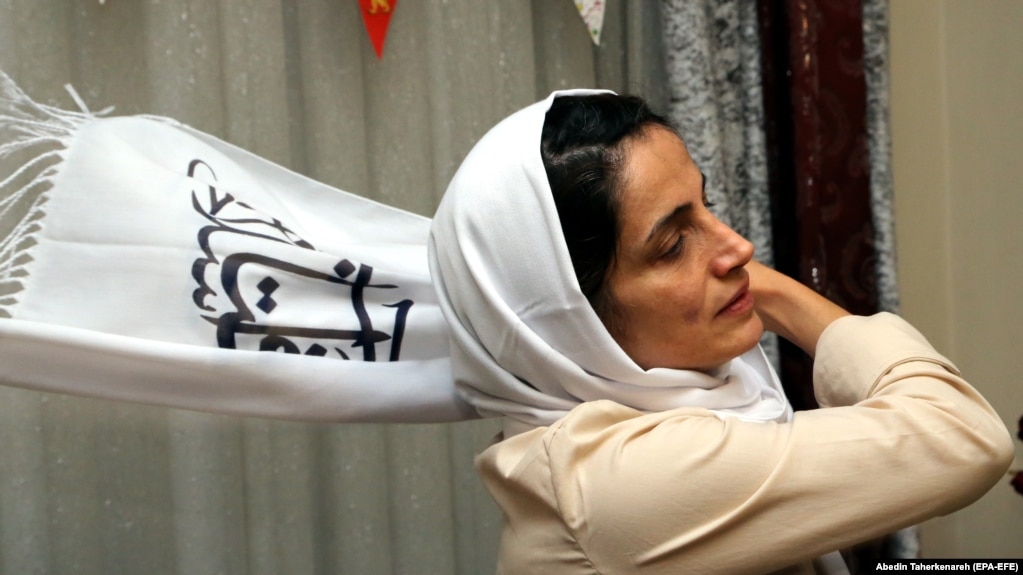
Imprisoned Iranian lawyer and human rights activist Nasrin Sotoudeh adjusts her scarf at her house in Tehran, September 18, 2013
French President Emmanuel Macron has invited jailed Iranian human rights lawyer Nasrin Sotoudeh to take part in the G7 gender equality forum. Sotoudeh’s husband Reza Khandan told Radio Farda on Friday that Macron’s invitation has been given to him in Tehran on Thursday March 7, one day before the International Women’s Day.[see also: https://humanrightsdefenders.blog/2018/06/16/iranian-human-rights-lawyer-nasrin-sotoudeh-arrested-again/]
Ms. Sotoudeh is to be a member of the consultative council for gender equality in Group 7. Khandan said Iranian women should be proud of Soutoudeh’s membership in the G7 council. Copies of the invitation have been handed to the Iranian Foreign Ministry and Bar Association.
Nasrin Sotoudeh has been in Jail since June 2018 with a five-year imprisonment sentence and is facing more charges for defending human rights activists in Iran. She is an outspoken opponent of the death penalty and compulsory hijab. Sotoudeh, 55, is the winner of numerous international awards, including PEN/Barbara Goldsmith Freedom to Write (2011), Southern Illinois University School of Law Rule of Law Citation (2011) and Sakharov Prize (2012). On 21 September 2018, she was awarded the 23rd Ludovic-Trarieux International Human Rights Prize.
On 7 March 2019, US Secretary of State Pompeo hosted the Annual International Women of Courage (IWOC) Awards at the State Department to honor 10 women from around the world. First Lady Melania Trump delivered special remarks at the ceremony.
Now in its 13th year, the Secretary of State’s IWOC Award wants to recognize women around the globe who have demonstrated exceptional courage and leadership in advocating for peace, justice, human rights, gender equality, and women’s empowerment, often at great personal risk and sacrifice. Since the inception of this award in March 2007, the State Department has recognized more than 120 women from more than 65 different countries. U.S. diplomatic missions overseas nominate one woman of courage from their respective host countries. The finalists are selected and approved by senior Department officials. For more in this and other awards for women: http://www.trueheroesfilms.org/thedigest/awards/international-women-of-courage-award.
The names of the 2019 IWOC winners are as follows:
Razia Sultana of Bangladesh
Naw K’nyaw Paw of Burma
Moumina Houssein Darar of Djibouti
Mama Maggie of Egypt
Colonel Khalida Khalaf Hanna al-Twal of Jordan
Sister Orla Treacy of Ireland
Olivera Lakic of Montenegro
Flor de Maria Vega Zapata of Peru
Marini de Livera of Sri Lanka
Anna Aloys Henga of Tanzania
Short bios of the 2019 awardees can be found through the link below.
Peter Nkanga, multilingual investigative journalist and former West Africa Representative of the Committee to Protect Journalists (CPJ), has been declared the laureate of the first “Jamal Khashoggi Award for Courageous Journalism” in 2019.
In a letter signed by Anas Talalqa, Human Rights Advisor at Inti Raymi Fund, the organisation congratulated Mr Nkanga for his selection for the award, noting that the “The Award honors the brave journalists who expose abuse of power and corruption, share difficult truths, discuss taboo topics, and work in hostile environments/”
“Today … dedicate this Award to all journalists and human rights defenders in #Africa. The struggle is real, but it is not over until We Win. #JusticeForJamal,” Peter Nkanga tweeted about the award.
Nigerian Peter Nkanga has been at the forefront of the campaign for the rights of journalists in Nigeria and across sub-Saharan Africa. Last year, he spearheaded the advocacy for the release of a journalist, Jones Abiri, publisher of Bayelsa State-based weekly paper, Weekly Source. He also coordinated the advocacy and protests in Nigeria on Jamal Khashoggi, the Saudi journalist who was murdered at the Saudi Arabian Consulate in Istanbul, Turkey, on October 2, 2018.
To celebrate its 70th anniversary, the Geneva Association of United Nations Correspondents (ACANU) organised a public lecture, panel discussion and award presentation in partnership with the Graduate Institute and the Club Diplomatique de Genève on “Press Freedom and Journalists Under Attack” on 25 February 2019.
Photo credit: Magali Girardin
The lecture, delivered by António Guterres, Secretary-General of the United Nations, addressed issues on the physical attacks and growing number of assaults on the credibility of journalists and media organisations, which are taking a heavy toll on media freedom. It also sought to answer what is spurring the growing hostility and violence and what can be done to protect professional journalists.
“Journalists are on the front lines, sounding the first alarm, questioning official accounts, looking into difficult and dangerous issues and – at their best – asking questions that demand an answer and telling truths that must be heard. […] In the face of this sustained campaign of harassment, intimidation and lack of accountability, we – the international community – cannot remain silent. […] I call on Governments and the international community to protect journalists and media workers, and to create the conditions they need to do their essential work, and to investigate and prosecute the perpetrators of attacks on them.”
Nina Larson, President of ACANU, then moderated a panel discussion on the situation facing journalists, which included Peggy Hicks, Director Thematic Engagement, Special Procedures and Right to Development Division, UN High Commissioner for Human Rights; Christophe Deloire, Secretary-General, Reporters Without Borders and David Sylvan, Professor, International Relations/Political Science, the Graduate Institute.
During the discussion, Ms Hicks pointed out that “one of the [phenomena] that’s really important for us to look at in this context is the extent to which we have a whole new world of threats in terms of how some of these [attacks] happen online as opposed to offline”. Mr Deloire found that oligarchical control of the media and restrictive laws were like invisible prisons, where “there is no visible victim, there is no blood, no people in jail, but the information can be controlled”. Citing ways that state entities falsely present themselves as independent journalists, Professor Sylvan added that “there are so many alternatives – “fake” or otherwise – to regular news media that the problem now for many journalists is just to try to distinguish what they are doing from the hundreds and hundreds of things that appear similar but are not. So on the one hand, there are many more means – quite apart from physical violence […] of putting sharp restrictions on press freedom, but also there is a much greater demand for this.”
In the final segment of the event, ACANU presented two new international journalism awards, created for the 70th anniversary celebration and to recognise journalists for outstanding work in the face of growing hostility. Jennifer O’Mahony, a British freelancer, was awarded the prize for “Excellence in Reporting” for her article published in The Telegraph: “Algeria dumps thousands of migrants in the Sahara amid EU-funded crackdown”. The ACANU award for “Best Journalistic Coverage of Human Rights” was given to two Geneva journalists, Adrià Budry Carbó of Le Temps and Camille Pagella of L’illustré, for their article, “Piège en haute mer”, published in Le Temps.
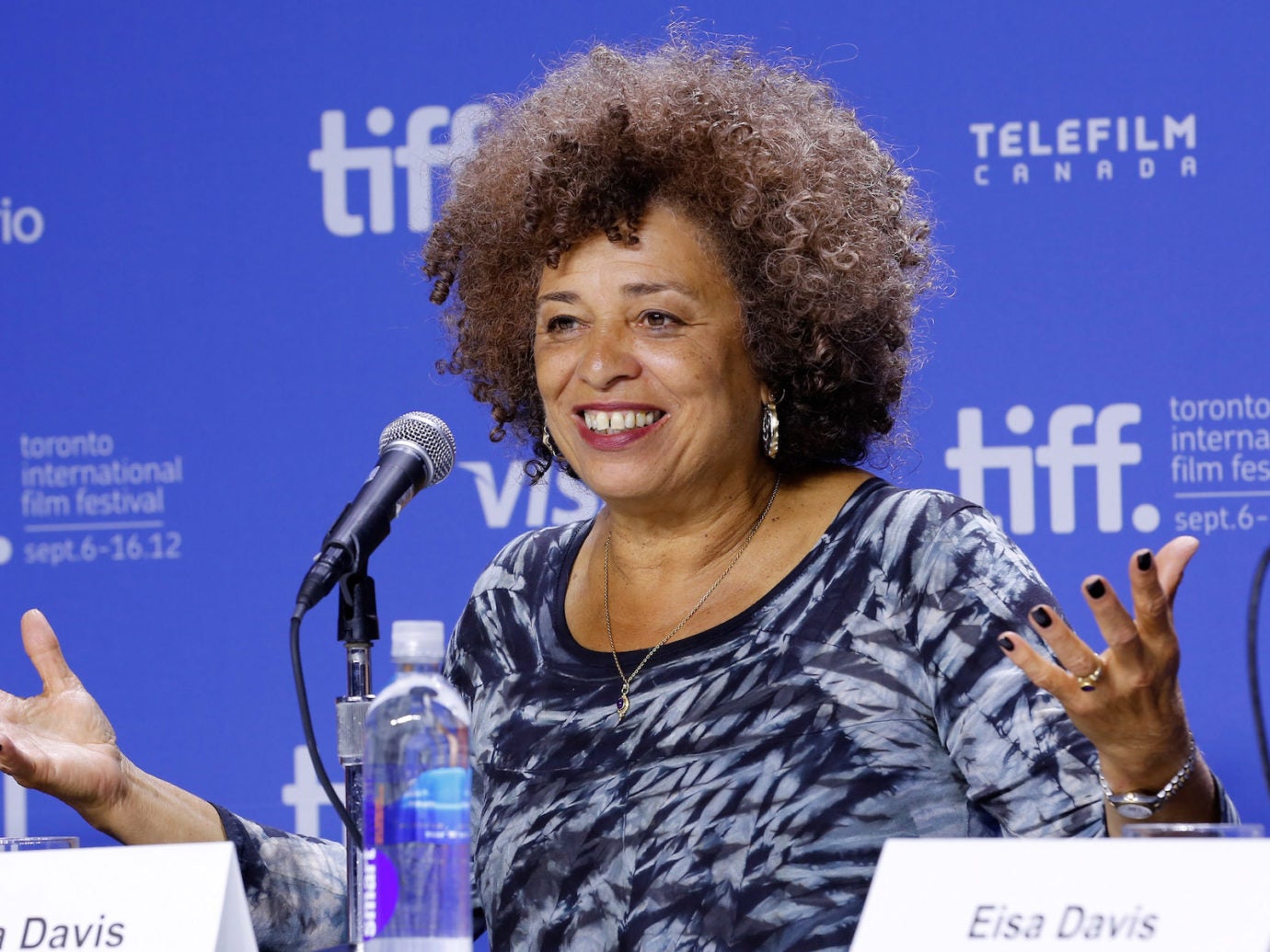
“This update follows a BCRI Board of Directors January 14 public apology for its missteps in conferring, then rescinding, its nomination of Dr. Angela Y. Davis in early January,” the institute said Friday in a statement.
(Davis wrote that her pro-Palestinian activism was the reason for the original withdrawal, as did Birmingham Mayor Randall Woodfin. But local Jewish leaders declined to comment, and no concrete evidence emerged that Jewish complaints were the deciding factor. Three BCRI board members resigned over the controversy. On Friday, Richard Friedman, the executive director of the Birmingham Jewish Federation, told JTA he was “digesting the implications” of the reversal. His federation had previously praised the decision to rescind the award.)
Davis also is controversial for declining to speak out on behalf of dissidents in communist-era Europe.
The award aims to recognize individuals, or exceptionally an organisation, who are working in conditions hostile to fundamental human rights, are at risk, and in need of protection.
Nominees must be currently active in the promotion and protection of human rights.
Nominations are welcome from all regions, genders, and human rights related themes. We take a broad view of what a human rights defender is. Nominations of women are particularly encouraged.
Special account is taken of those who combat human rights violations by courageous and innovative means.
Three finalists are selected and will be announced in October 2019. The laureate is selected from among them, and all three are invited to participate in the ceremony hosted by the City of Geneva, in February 2020.




 Hans Thoolen on Human Rights Defenders and their awards