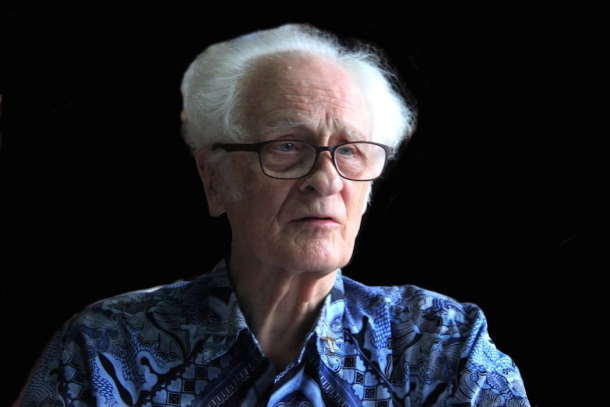
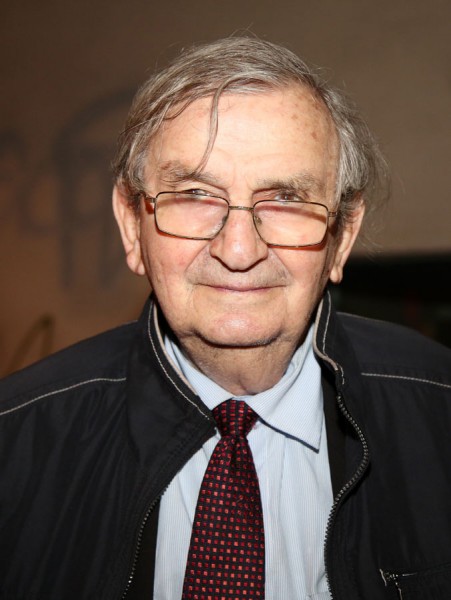
German-born Jesuit Father Franz Magnis Suseno has become an Indonesian citizen and an outspoken champion of democracy and interfaith dialogue in Indonesia. (Photo by Siktus Harson/ucanews.com)
Ryan Dagur painted on 15 April 2019 (in UCA News) a portrait of a remarkable man, the Jesuit priest Franz Magnis Suseno,doesn’t mince his words when promoting democracy and dialogue in Indonesia. “An adopted son’s passion for Indonesian pluralism”
Not so long ago, Jesuit priest Father Franz Magnis Suseno ..ruffled a few feathers by.. calling people who are threatening to boycott the polls fools, parasites, and psycho freaks.His scathing comments came in an article about the upcoming Indonesian presidential and legislative elections published by Kompas, the country’s bestselling newspaper.Many criticized him for the remarks, some even sent him letters of protest, but many also supported him. The German-born priest, a professor at the Driyarkara School of Philosophy, has apologized for his choice of words but argued the article was a call for all citizens to care for democracy and prevent the worst individuals from being elected to office.
…..The 82-year-old, born into a noble family and who was once called Count von Magnis, is now widely known as a philosopher, human rights defender, and culturalist, with his main area of expertise being Javanese culture. He has written 41 books on philosophy, political ethics, and Christianity, as well as made countless television appearances.During his time in the country, Father Magnis has witnessed a major shift in Indonesia’s political climate from a 32-year dictatorship under Suharto to the reform era that began in 1998 when the tap of democracy was opened.“It’s my moral obligation to speak up when democracy is threatened,” he said.He says he is optimistic that Indonesia will remain a leading democracy in Southeast Asia, but admitted various threats do concern him, especially what he calls the politicization of religion by hard-line Muslims. “Indonesia will only fall to another authoritarian regime if people continue to use religion in politics,” he said. He said it is dangerous because, for many people, religion is more important than democracy.
…. Father Magnis has built close friendships with several respected Muslim leaders, including the late Abdurahman Wahid, a highly respected figure, and Indonesia’s fourth president, as well as Nurcholish Majid, an avid defender of pluralism in Indonesia. Holding dialogue with extreme elements is also important, he said, especially when conflict occurs.He has met the now exiled Islamic Defenders Front chief, Muhammad Rizieq Shihab, several times when his organization sought to impose its own ban on worshiping activities in a number of churches in Jakarta. In 2011, Father Magnis met Shihab, to discuss the issue of an American pastor burning a Quran in Florida, which angered Muslims all over the world. Following the discussions, Shihab told his angry followers not to take out their anger on Indonesian Christians. In building a relationship with believers of other faiths, it is important for Christians to be humble and sensible and to avoid belittling acts or gestures. “It’s better to be low profile, rather than something fancy,” he said, adding that this philosophy should be especially applied in poor areas. This was why he called the erection of a 46-meter-high Marian statue in Ambarawa, Central Java in 2015, “inappropriate.” ..
Father Magnis is also critical of Christians who measure the success of their work by the number of people they attract to Christianity because it leads to aggressive Christianization. “Our mission is to bring the goodness of Christ into our society and let people decide whether to join us,” he said.He said Indonesia will remain an Islamic country, and what Christians can do is to help them build a better democratic system, where freedom of religion is upheld and interfaith relations are well established. Father Antonius Benny Sustyo, an outspoken activist priest, said Father Magnis’ openness and willingness to communicate with others are among his finest characteristics. “..Achmad Nurcholish, a Muslim activist said Father Magnis had contributed a lot to the progress of humanity in Indonesia, especially through his writings that have an enriched perspective.
Father Magnis’ endeavors have been duly recognized and have earned him a number of awards.In 2015, he received an award from Indonesian President Joko Widodo for his dedication to education and culture. A year later, in 2016, he won the Matteo Ricci International Prize for his commitment to promoting interreligious dialogue from the Catholic University of the Sacred Heart in Milan. However, the one that gives him the most pleasure is a so-called “Mud Award”, bestowed on him by communities in East Java whose land and homes were buried by mud caused by the activities of a company belonging to Aburizal Bakrie, a businessman cum politician. It was given in 2007 after the priest refused to accept a Bakrie Award — handed out by Aburizal Bakrie’s family — to show solidarity with people affected by the mud disaster. “I was very happy with that award. I’ll always treasure it,” he said.
The Canadian Museum for Human Rights is located in Winnipeg. Josh Arason / Global News
The Canadian Museum for Human Rights (CMHR) has earned an award for its interactive exhibition, Mandela: Struggle for Freedom, beating out top museums across the world. The annual international GLAMi Awards recognizes innovative and engaging cultural heritage projects in museums worldwide. This year, the event was held in Boston. The museum was the recipient of the best Non-Immersive Exhibition Media or Experience award for Mandela: Struggle for Freedom. The exhibit, which showcases Nelson Mandela and his fight against apartheid in South Africa, is an interactive, sensory experience of imagery, soundscape, digital media.
Two Reuters journalists who are currently serving seven-year prison sentences in Myanmar are to be awarded the 2019 UNESCO/Guillermo Cano Press Freedom Prize (for more on this and other media awards see: http://www.trueheroesfilms.org/thedigest/awards/unesco-guillermo-cano-world-press-freedom-prize). In the press release, president of the jury Wojciech Tochman explained the decision to honor Wa Lone and Kyaw Soe Oo, stating the choice “pays a tribute to their courage, resistance and commitment to freedom of expression,” and that the men “symbolize their country’s emergence after decades of isolation.”
Wa Lone and Kyaw Soe Oo are two journalists who had been working on stories about a military crackdown and alleged human rights violations in Rakhine state in Myanmar when they were arrested. Their investigation was published by Reuters while they were awaiting trial in February 2018, and included graphic photography and detailed accounts providing evidence that state security forces were implicated in carrying out extrajudicial killings of 10 Rohingya at the village of Inn Din. The Myanmar government has been accused of ethnic cleansing and genocide of Rohingya Muslims by the U.N. and various human rights organizations since 2016. [see also: https://humanrightsdefenders.blog/2018/11/06/50-human-rights-ngos-address-joint-letter-to-aung-san-suu-kyi-on-reuters-journalists/]
The activist is making waves globally (Photo: Anders Hellberg)
Teen climate activist Greta Thunberg – who is a vegan – has won the newly created Prix Liberté, launched last year by the Region of Normandy in France, reports Maria Chiorando in Plantbasednews. Thunberg, 16, is the first recipient of this new award, which was designed to honor a young person ‘engaged in a fight for peace and freedom’. The award comes with prize money of €25,000. [see: http://www.trueheroesfilms.org/thedigest/awards/prix-libert-normandy ] The campaigner has made global headlines through her efforts, which includes encouraging students to attend demonstrations demanding political action on climate change while ‘on strike’ from school. Her influence has spread beyond her native Sweden throughout Europe and beyond
“I am very grateful and honoured to have won the Prix Liberté!” Thunberg said in a post on social media. “The other final nominees have stood up for human rights in a way that I can’t even imagine. We must constantly be reminded of the sacrifices they have made. Lu Guang and Raif Badawi are true heroes of our time.”
Thunberg said she will be splitting all of the prize money between four organizations dedicated to climate justice: These include CARE, which helps women and girls in the global south to cope with the effects of rising temperatures and a changing climate, and The Adaptation Fund – which helps vulnerable communities in developing countries adapt and build resilience to climate change, 350.org and Greenpeace International who in Thunberg’s words ‘both fight for climate justice, the environment, and to keep the fossil fuels in the ground’, will also receive donations. Thunberg will receive her award on June 4, 2019, at the Normandy International Forum for Peace.
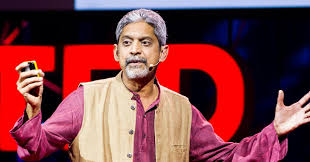
Ekaterina Pesheva reported on 2 Harvard Medical School researcher received the prestigious Canada Gairdner Award for transformational work in the fields of global health. Vikram Patel, the Pershing Square Professor of Global Health in the Blavatnik Institute at HMS and professor at the Harvard, will receive the 2019 John Dirks Canada Gairdner Global Health Award. Patel is being recognized for research that has transformed understanding of and attitudes toward the importance of mental health in a global context, for his contributions to international mental health policy, and for efforts to improve access to mental health services in areas of the world where mental health resources are acutely lacking.
Patel is among seven laureates who will each receive a $100,000 cash honorarium. The recipients will be formally honored Oct. 24 at the annual Canada Gairdner Awards gala in Toronto.
Patel has been instrumental in establishing the field of global mental health. He has dedicated his research to raising the global profile of mental health through epidemiological research that has demonstrated the burden of mental disorders in low- and middle-income countries as well as their impact on poverty, child growth and development, and risk for HIV infection, among other conditions. Patel’s work has demonstrated that mental health problems are universal forms of human suffering that fuel a vicious cycle with deprivation. The central theme of Patel’s work has been democratizing access to mental health care and making it a right for everyone, everywhere. Patel championed the concept of mental health care delivery by nonspecialists and lay health workers as a way to expand access to mental health services in underserved areas. His book “Where There Is No Psychiatrist: A Mental Health Care Manual” has become the definitive text for community health workers in developing countries. Patel’s research became the foundation for the design, delivery, and evaluation of psychosocial interventions provided by lay and community health workers, including the primary care treatment of depression, anxiety, and alcohol-use disorders, the community-based care of people with schizophrenia and autism, and the prevention and treatment of adolescent mental health problems through school-based interventions.
Much of Patel’s work has been done in partnership with Sangath, an Indian nongovernmental organization that he co-founded in 1996. Sangath, one of India’s leading community-based research organizations, received a 2008 MacArthur Foundation International Prize for Creative and Effective Institutions and a 2016 World Health Organization Public Health Champion of India prize. Patel co-founded the Centre for Global Mental Health and the Mental Health Innovation Network at the London School of Hygiene and Tropical Medicine and the Movement for Global Mental Health, the largest global network of individuals and organizations advocating for promoting services and human rights for people with mental health problems. In 2018, he co-founded the GlobalMentalHealth@Harvard Initiative, which is developing a suite of innovative, interdisciplinary programs aimed at implementing and generating knowledge to transform mental health globally.
Amnesty International UK runs a successful series of (national) media awards. Amnesty’s Media Awards, which have been running annually since 1992, celebrate excellence in human rights journalism and applaud the courage and determination of journalists who often put their lives on the line to report on vital human rights issues. Kate Allen, Director of Amnesty International UK, said at the 3 April 2019 ceremony: “Media work is vitally important for Amnesty and everything we do. This evening we’ve seen some brilliant journalism that has had enormous human rights impact…Without a free press, it’s extremely difficult to expose wrong-doing and hold leaders to account. But even here in the UK we’re seeing it being threatened – especially with the sinister arrest of Trevor Birney and Barry McCaffrey in Northern Ireland last year…That’s why our awards are about congratulating the achievements of the media and championing its role in creating a fairer, more open world.” The awards, hosted by Channel 4 News presenter Cathy Newman, held a moment of silence for the approximately 90 journalists imprisoned last year for doing their jobs. Canada and the USA are undertaking similar events.
The winners of the 2019 AI UK Media Awards include:
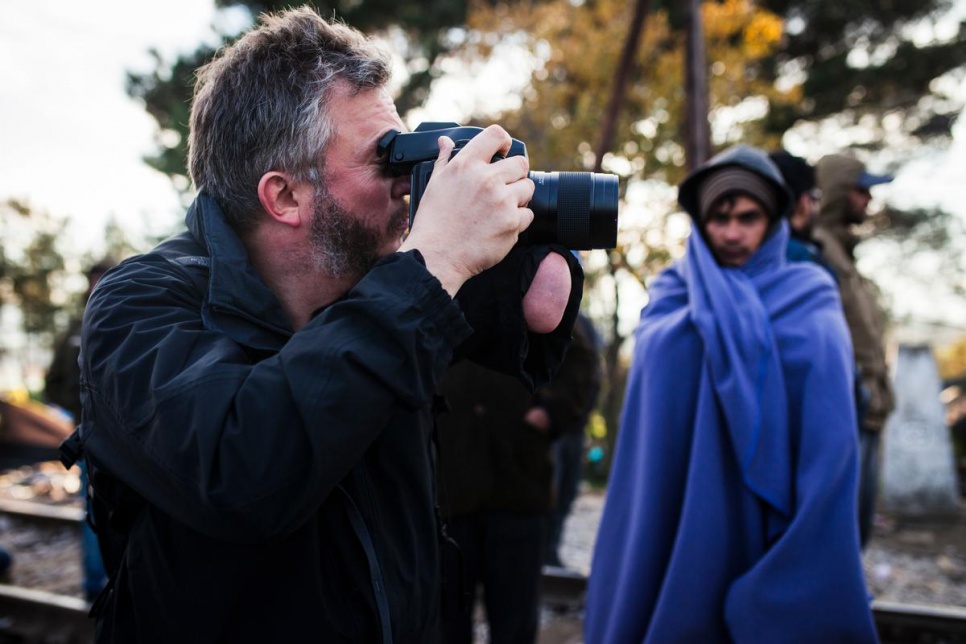
Humanitarian photographer Giles Duley won a Media Award for his powerful series depicting the plight and resilience of Congolese female refugees in Angola. His photo essay, “We Are Here Because We Are Strong”, was commissioned by UNHCR and published in Humanity magazine. The subjects of his project were forced to flee the Kasai region of Democratic Republic of the Congo after violence erupted in March 2017, triggering massive displacement.
The full Media Awards 2019 shortlist can be found here.
Silvana Meixner is the head of the ORF minority editorial office (Minderheitenredaktion) and presenter of the magazine “Heimat Fremde Heimat”. In the spirit of the late Ari Rath, she is honoured as a journalist who has rendered outstanding service in her work to critical reporting on flight, expulsion and asylum, committed to the protection of human rights. Silvana Meixner was born on March 16, 1958 in Split, Croatia; she lives in Vienna since 1986. After graduating from high school, she studied sociology and pedagogy in Zadar. Since 1988 she has been working for the Austrian Broadcasting Corporation (Österreichischer Rundfunk), where she was involved in setting up the minority editorial office. On 3 December 1993 Silvana Meixner, who moderated the television programme Heimat, fremde Heimat together with Lakis Iordanopoulos, was injured by a letter bomb from Franz Fuchs. She continued her journalistic work for refugees, ethnic minorities and human rights.
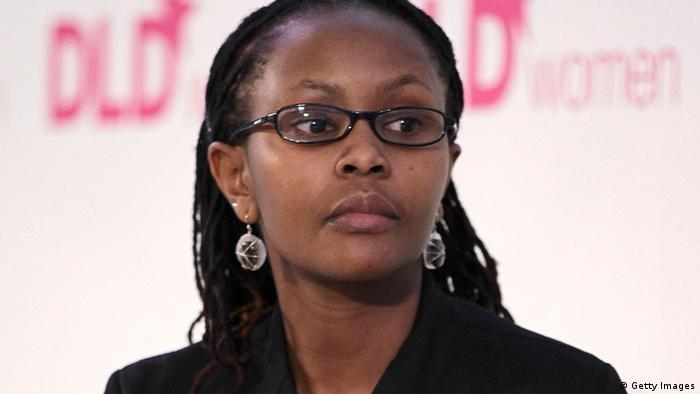
The winner of the 2019 German Africa Prize is Juliana Rotich, founder of software project Ushahidi, which was introduced to monitor violence in Kenya following the 2007 general elections.
Juliana Rotich became known in professional circles in 2007 as the co-founder of the open source platform Ushahidi (a Swahili word meaning ‘testimony’), which began in Kenya as an internet platform developed to map reports of post-election violence and which went on to revolutionize the international flow of data and information.
A 16-member independent jury selected Rotich from a list of 18 African nominees. The 42-year-old was informed at a meeting on Thursday 4 April 2019 at the German embassy in Nairobi, attended by Deputy Ambassador Michael Derus and the General Secretary of the German Africa Foundation, Ingo Badoreck. The award pays tribute to the Kenyan entrepreneur not only for her business achievements and technological innovations but also for her outstanding sense of social responsibility. For more on this another regional awards for Africa see: http://www.trueheroesfilms.org/thedigest/awards/german-africa-award]
In an interview with DW in 2013, Rotich explained the philosophy behind Ushahidi: “One of the things that we are doing is that we have a partnership with civil society organizations, peace networks and youth networks. And these are organizations that are doing peace work in terms of messaging and encouraging the population to be peaceful and to conduct themselves in a peaceful way. So in that respect we are part of a partnership. Ushahidi’s key role in this partnership is the technology. And this is the crowdsourcing technology that allows people to report but also provides a way for digital humanitarians to volunteer and help to sift through the information, categorize it and make it available on the website.“
Today Ushahidi is used in over 160 countries as a tool for crisis response and for independent election monitoring, for example in Nigeria and Afghanistan. It has also been used following natural disasters in Chile, Haiti and New Zealand. Juliana Rotich is regarded as one of the leading figures of the digital revolution in Africa and beyond.
From Ushahidi she went on to found BRCK, an innovative technology company which is now the biggest Wi-Fi provider in sub-Saharan Africa. The central product is a battery-operated modem which can function for up to eight hours without electrical power. It is used in 150 countries.
In the first of a two-part series on media repression and “fake news” in Morocco – written in collaboration with Access Now – Global Voices tells on 4 April 2019 how jailed human rights activist Nasser Zefzafi was smeared by Moroccan pro-government media.
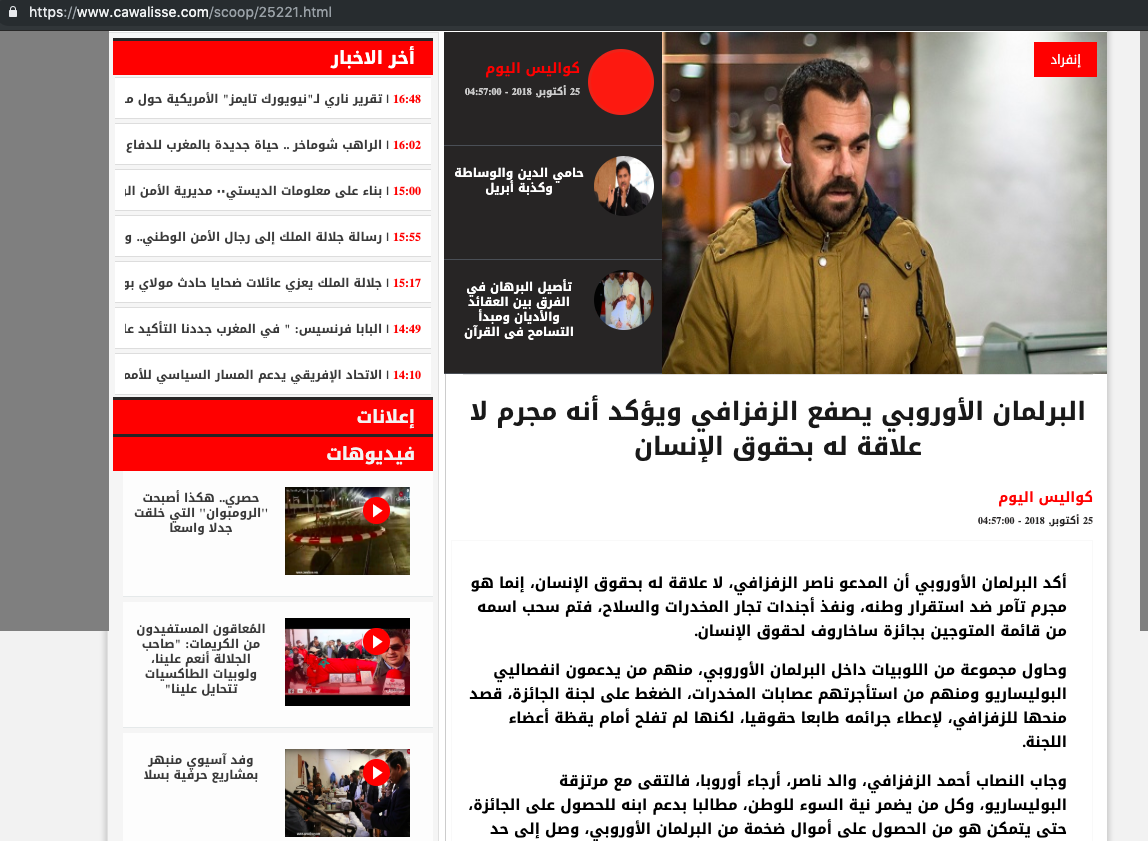
Zefazfi is currently serving a 20-year prison term for his role as a leader in the Hirak protests. … Zefzafi made it to the list of three finalists for the Sakharov Prize, but did not win. It was instead awarded to Ukrainian film director and writer Oleg Sentsov. Following the announcement of the winner on 25 October, Moroccan news site Cawalisse published a fabricated story alleging that the European Parliament “withdrew Zefzafi’s name from the list of winners’’ because he is a “criminal who has no link to human rights.”
Screenshot of the fabricated Cawalisse story alleging that the European Parliament deemed Zefzafi a ”criminal’.
The article (which does not list an author!) states that “a group of lobbies from within the European Parliament, including those that support Polisario separatists and those hired by drug gangs, pressured the prize’s committee to award it to Zefzafi and give his crimes the label of protecting rights.” The story is completely false. It is based on fabricated facts and conspiracy theories. The European Parliament never maintained that Zefzafi was a criminal, nor did they withdraw his name “from the list of winners.” He was simply not chosen to win the prize. In fact, there was no “list of winners” in the first place, but only one winner, Oleg Sentsov…




 Hans Thoolen on Human Rights Defenders and their awards