Egyptian media reported on 22 September, 2025, that President Abdel Fattah al-Sisi had issued a presidential pardon for the imprisoned Egyptian-British activist Alaa Abdel Fattah. On 23 September the Guardian, HRW and others reported that the British-Egyptian human rights activist Alaa Abd el-Fattah has indeed been released from jail after serving six years for sharing a Facebook post.
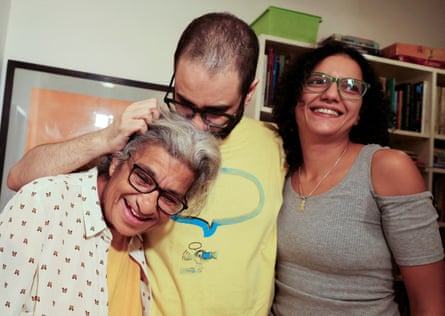
Early on Tuesday morning his campaign said in a statement that Abd el-Fattah was released from Wadi Natron prison and was now in his home in Cairo. “I can’t even describe what I feel,” his mother, Laila Soueif, said from her house in Giza as she stood next to her son surrounded by family and friends. “We’re happy, of course. But our greatest joy will come when there are no [political] prisoners in Egypt,” she added.
Alaa Abd el-Fattah stands next to his mother, Laila Soueif, and sister, Sanaa, at their home in Giza. Photograph: Mohamed Abd El Ghany/Reuters
Amnesty International’s Erika Guevara Rosas said the release was welcome but long overdue. “His pardon ends a grave injustice and is a testament to the tireless efforts of his family and lawyers, including his courageous mother Laila Soueif and activists all over the world who have been relentlessly demanding his release,” she said. The following quote can be attributed to Amr Magdi, senior Middle East and North Africa researcher at Human Rights Watch: “President Sisi’s pardon of the imprisoned Egyptian activist Alaa Abdel Fattah is long overdue good news. Though we celebrate his pardon.
The campaign for Abd el-Fattah’s release was led by his family, including his mother, who was admitted to hospital in London twice after going on hunger strikes trying to secure his release. The UK prime minister, Keir Starmer, is also known to have telephoned Sisi three times to lobby for Abd el-Fattah’s release. see: https://humanrightsdefenders.blog/2022/07/07/mona-seifs-letter-a-cry-for-help-for-alaa/
Dear Dr. Gillett, Dr. Yudkivska, Ms. Gopalan, Dr. Estrada-Castillo, and Dr. Malila,
We are writing, as a coalition of human rights organisations, regarding the urgent submission made to you, as members of the United Nations Working Group on Arbitrary Detention (UNWGAD), on behalf of Alaa Abd el-Fattah, the award-winning British-Egyptian writer and activist. Alaa Abd el-Fattah remains arbitrarily detained in Egypt and we strongly urge you to announce your opinion on his case at the earliest opportunity.
An international counsel team, led by barrister Can Yeğinsu, filed an urgent appeal with the UNWGAD on behalf of Mr. Abd el-Fattah and his family one year ago, on 14 November 2023, submitting that his continued detention is arbitrary and violates international law. Shortly afterwards, on 23 November 2023, 34 freedom of expression and human rights organisations sent a letter to the UNWGAD supporting that submission and urging the UNWGAD promptly to issue its opinion on this matter. On 17 April 2024, 27 freedom of expression and human rights organisations sent a follow up letter to the UNWGAD, enquiring whether there was any update in respect of this urgent appeal.
Alaa Abd el-Fattah’s case remains of significant concern to our organisations. He has spent much of the past decade imprisoned in Egypt due to charges related to his writing and activism. He was most recently arrested in September 2019 and was sentenced in December 2021 to five years’ imprisonment, having already spent two years in pre-trial detention. Despite completing his unjust and arbitrary five-year sentence on 29 September 2024, the Egyptian authorities have refused to release him, ignoring the time he spent in pre-trial detention. This defies international legal norms and contradicts Egyptian law. Alaa Abd el-Fattah is currently being held at Wadi al-Natrun prison near Cairo and continues to be denied consular visits, despite his British citizenship. His mother, Laila Soueif, has been on hunger strike since 29 September 2024 in protest against her son’s unjust and prolonged detention.
In November 2022, UN Experts joined the increasing number of human rights voices demanding Alaa Abd el-Fattah’s immediate release. Yet two years later, having fully served his five-year sentence, he remains in prison.
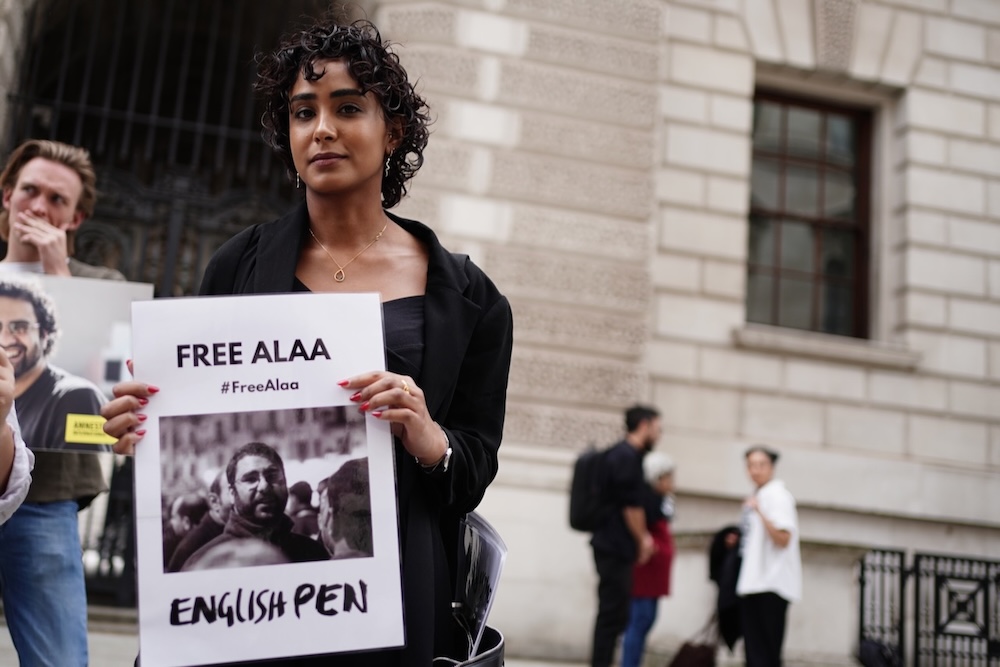
Despite his ongoing incarceration, Alaa Abd el-Fattah’s writing and activism continue to be recognised worldwide: most recently, in October 2024, he was announced as the joint winner of the 2024 PEN Pinter Prize with Arundhati Roy, and recognised as the 2024 Writer of Courage, eliciting the following encomium from Naomi Klein at the ceremony:
Alaa Abd El-Fattah embodies the relentless courage and intellectual depth that Arundhati Roy herself so powerfully represents, making her selection of him as the Writer of Courage profoundly fitting. Despite enduring a series of unjust sentences that robbed him of over a decade of freedom, his liberation continues to be denied. This prize, shared between two vital voices, reminds us of the urgent need to continue to raise our own in a call to ’Free Alaa’ at long last.
Our organisations continue to call for Alaa Abd el-Fattah’s immediate and unconditional release and we request that the UNWGAD urgently announce its opinion on his case.
Yours sincerely,
Alejandro Mayoral Baños, Executive Director, Access Now
Ahmed Samih Farag, General Director, Andalus Institute for Tolerance and Anti-Violence Studies
Quinn McKew, Executive Director, ARTICLE 19
Neil Hicks, Senior Director for Advocacy, Cairo Institute for Human Rights Studies (CIHRS)
Gypsy Guillén Kaiser, Advocacy and Communications Director, Committee to Protect Journalists (CPJ)
Chris Doyle, Director, Council for Arab-British Understanding (CAABU)
Jillian C. York, Director for International Freedom of Expression, Electronic Frontier Foundation
Ahmed Attalla, Executive Director, Egyptian Front for Human Rights
Samar Elhussieny, Programs Officer, Egyptian Human Rights Forum (EHRF)
Daniel Gorman, Director, English PEN
Rasmus Alenius Boserup, Executive Director, EuroMed Rights
James Lynch, Co-Director, FairSquare
Khalid Ibrahim, Executive Director, Gulf Centre for Human Rights
Mostafa Fouad, Head of Programs, HuMENA for Human Rights and Civic Engagement
Matt Redding, Head of Advocacy, IFEX
Baroness Helena Kennedy LT KC, Director, International Bar Association’s Human Rights Institute (IBAHRI)
Alice Mogwe, President, International Federation for Human Rights (FIDH), within the framework of the Observatory for the Protection of Human Rights Defenders
Liesl Gerntholtz, Managing Director, PEN/Barbey Freedom To Write Center, PEN America
Mark Allen Klenk, Writers at Risk Committee Chair, PEN Austria
Grace Westcott, President, PEN Canada
Romana Cacchioli, Executive Director, PEN International
Rupert Skilbeck, Director, REDRESS
Antoine Bernard, Director of Advocacy and Assistance, Reporters Sans Frontières
Ricky Monahan Brown, President, Scottish PEN
Ahmed Salem, Executive Director, Sinai Foundation for Human Rights (SFHR)
Menna Elfyn, President, Wales PEN Cymru
Gerald Staberock, Secretary General, World Organisation Against Torture (OMCT), within the framework of the Observatory for the Protection of Human Rights Defenders
In the three decades since I became a lawyer, human rights – once understood as an uncomplicated good, a tool for securing dignity for the vulnerable against abuses by the powerful – have increasingly come under assault. Perhaps never more so than in the current moment: we are constantly talking about human rights, but often in a highly sceptical way. When Liz Truss loudly proclaims “We’ve got to leave the ECHR, abolish the supreme court and abolish the Human Rights Act,” she’s not the fringe voice she might have been in the 1990s. She represents a dangerous current of opinion, as prevalent on parts of the radical left as on the populist right of politics. It seems to be gaining momentum.
As an idealistic youngster, I would have been shocked to know that in 2024 it would be necessary to return to the back-to-basics case, to justify the need for fundamental rights and freedoms. But in a world where facts are made fluid, what were once thought of as core values have become hard to distil and defend. In an atmosphere of intense polarisation, human rights are trashed along all parts of the political spectrum – either as a framework to protect markets, or as a form of undercover socialism. What stands out for me is that the most trenchant critics share a profound nationalism. Nationalists believe that universal human rights – the clue’s in the name – undermine the ability of states to agitate for their narrower interests.
Given that so many of our problems can only be tackled with an international approach, a robust rights framework is more important than ever
It’s no coincidence that the governments keenest on turning inwards – Viktor Orbán’s in Hungary, that of former president Bolsonaro in Brazil – have been least keen on common standards that protect minorities in their own territories and hold them to high standards in the international arena. At a time of insecurity, these leaders leverage fear to maximise their appeal. The prospect of a second Trump administration in the US demonstrates that this trend shows no sign of abating. In that context, it’s vital to make the case for human rights anew.
It boils down to this: given that so many of our problems – in an age of climate change, global disorder and artificial intelligence – can only be tackled with an international approach, a robust rights framework is more important than ever. There are parallels with the postwar period in which human rights were most fully articulated, a time when it was obvious to everybody that cooperation and global standards were the best way to shore up our common humanity after a period of catastrophic conflict and genocide.
Of course everyone believes in some rights – normally their own and those of friends, family and people they identify with. It is “other people’s” freedoms that are more problematic. The greater the divisions between us, the greater this controversy. And yet, it is precisely these extreme disparities in health, wealth, power and opinion that make rights, rather than temporary privileges given and taken away by governments, so essential. They provide a framework for negotiating disputes and providing redress for abuses without recourse to violence.
New technologies, and AI in particular, require more not less international regulation. As people spend more time online, they become vulnerable to degrading treatment, unfairness and discrimination, breaches of privacy, censorship and other threats. The so-called “black boxes” behind the technology we use make ever more crucial decisions about our daily lives, from banking to education, employment, policing and border control. Anyone who flirts with the notion of computer infallibility should never forget the postmasters and other such abuses, perpetrated and then concealed.
Our shrinking, burning planet is the ultimate reason why nationalism does not work in the interests of humankind
Perhaps most important of all is the growing contribution of human rights litigation to the struggle against climate catastrophe. A whole generation of lawyers and environmentalists is taking notes from earlier struggles, just as suffragists once learned from slavery abolitionists. This is despite the machinations of fossil fuel corporations versed in a thousand lobbying, jurisdictional and other delaying tactics.
Our shrinking, burning planet is the ultimate reason why nationalism does not work in the interests of humankind. Today’s global empires, sailing under logos rather than flags, need to be more directly accountable under human rights treaties. Our existing mechanisms, whether local and national governments, domestic and international courts, or some of the more notoriously tortuous UN institutions, may be imperfect and in need of reform. Yet, like all structures of civilisation, they are easier to casually denigrate than to invest in and adapt to be more effective.
While I have been writing this, I have been voting in the House of Lords on amendments to the so-called safety of Rwanda bill. It is the most regressive anti-human rights measure of recent times, and intended to be that way. It will not stop the boats of desperate people fleeing persecution, but is designed to stop the courts. British judges will be prevented from ensuring refugees’ fair treatment before they are rendered human freight and transported to a place about whose “safety” our supreme court was not satisfied. Rishi Sunak will be able to use this situation as excuse for an election pledge to repudiate the European convention on human rights.
If he gets his way, rights will be removed not just from those arriving by boat, but from every man, woman and child in the UK. By contrast, the golden thread of human rights is equal treatment: protecting others as we would wish to be protected ourselves, if that unhappy day ever came. It’s a thread we must never let go of.
On 29 June 2023 Andrew Stroehlein wrote for Human Rights Watch a short obituary on ‘off-shoring refugees’, concluding “That offshoring refugees has been a costly, abusive, illegal failure should surprise no one apart from maybe a few politicians who believed their own slogans and a portion of the public who fell for the politicians’ expensive snake-oil cures”
Offshoring Refugees: A Costly, Abusive Failure. Australia no longer holds any refugees on the island country of Nauru. In welcome news, the last refugee kept there under the Australian government’s abusive offshore processing policy has finally been evacuated to Australia. The hope now is that Australia, and the rest of the world, will finally realize what an abusive failure such policies have been.The so-called “Australian model” – variously labelled “externalizing,” “offshoring,” or “outsourcing” – has been wrongly admired and repackaged elsewhere by unscrupulous politicians around the globe for years. In the EU, they bloviate over its supposed merits, and member state Denmark pushed plans to send asylum seekers to detention in Rwanda, a country known for torture in detention. The UK government’s efforts to mimic Australia have also focused on sending folks to Rwanda, with the UK home secretary bizarrely saying it was not only her “dream” but also her “obsession” to do so. The Court of Appeal has just ruled the scheme unlawful this morning – more good news. Of course, the US has been “outsourcing” for years. Under both Biden and Trump, US authorities force asylum seekers to wait interminably in Mexico, where they face kidnapping, rape, and extortion. And despite the good news about Nauru, Australia itself still holds about 80 refugees and asylum seekers in limbo in Papua New Guinea.The “appeal” of outsourcing was based on a kind of political sadism. Politicians promised to be “tough” on asylum seekers – meaning cruel and vicious toward powerless, desperate people. That, they told voters, would deter people from coming. The truth is, it’s been absurdly expensive, it’s led to appalling human rights abuses, and it hasn’t deterred anyone. Australia has spent billions on transferring 3,127 asylum seekers and refugees to Nauru and Papua New Guinea. Last year, the system apparently cost 22 million Australian dollars per person being held in Nauru (US$ 14.5 million). The abuses you get for that money are clear. HRW has documented how individuals and families with children spent years living in substandard conditions in these centers, where they suffered severe, inhumane treatment, violence, and medical neglect. At least 14 people subjected to Australia’s offshore detention system have died, half from suicide or suspected suicide. [re Australia, see also: https://humanrightsdefenders.blog/2021/07/21/australias-migration-detention-industry-again-denounced/] And offshoring hasn’t “worked” even in the most limited sense of what politicians promised. Desperate people searching for safety and the chance of a better life keep coming. They’re not going to stop fleeing war and oppression just because you threaten to send them to a third country when they arrive. That offshoring refugees has been a costly, abusive, illegal failure should surprise no one apart from maybe a few politicians who believed their own slogans and a portion of the public who fell for the politicians’ expensive snake-oil cures. But now, it should be obvious to everyone: cruelty is never a good policy.
On 17 March 202 Ben McInerny of the international Observatory for Human Rights drew attention to the distressing news that “the British government plans to continue slashing overseas aid, with spending on the newly formed Open Societies and Human Rights directorate set to fall by as much as 80%.”.
Speaking in the House of Commons yesterday, the leader of the SNP Iain Blackford MP condemned the proposals, calling for greater bipartisan oversight of the reduction in aid spending: “Only this morning, it has emerged that the UK Government also plan to cut their human rights support and anti-corruption measures by a staggering 80%. If the Prime Minister is prepared to stand up for such callous cuts, is he also prepared to guarantee that he will allow for a straight vote on them in the House of Commons?”
One of the projects reportedly threatened by these cutbacks is a £16m initiative aimed at advancing press freedom across the Middle East and North Africa – a region which has seen a “decline in freedom of expression, media freedom and civic space”, according to participants of the 2020 Global Conference for Media Freedom.
The UK took a global role with the launch of the media freedom initiative by the Foreign, Commonwealth and Development Office (FCDO) under the previous Foreign Secretary, Jeremy Hunt. The UK also co-hosted the 2019 Global Conference for Media Freedom in London. However, though Dominic Raab has been supportive, he has had no direct involvement and this may be reflected in the budget cuts.
Despite the UK government’s attempts to depict post-Brexit Britain as a global “force for good”, these cutbacks come as part of a precipitous contraction of overseas aid spending.
Earlier this month, leaked Foreign Office internal documents revealed proposed aid cutbacks of more than 50%, with Syria and Libya seeing a reduction in funding of 67% and 63% respectively..
David Miliband, president of the International Rescue Committee, said the changes would undermine Britain’s “global reputation”, stating that:
“The phrase ‘global Britain’ rings hollow. As the UK prepares to host the G7, the reduction of assistance to Yemen is a stark warning of what is to come as the government delivers on widespread cuts across the entire UK aid portfolio”
Andrew Mitchell, Former Shadow Secretary of State for International Development, said reducing the aid budget to less than 0.7% of gross domestic income (GDI) remains unlawful without a change to legislation, adding that:
“To grow the budget to 0.7% from 0.5% took four years, but the equivalent cut is being undertaken in a matter of weeks”
Boris Johnson has said the decision to cut aid budgets is justified by the current Covid-19 crisis, stating that “current straitened circumstances” make reductions necessary, although no other G7 country is cutting its aid programme to the same extent.
It is imperative that funding, crucial to the provision of humanitarian assistance to some of the world’s most vulnerable groups, be at least 0.7% of GDI. The Covid-19 crisis should not be an excuse to reduce aid spending, but rather a reason to increase it.


 Hans Thoolen on Human Rights Defenders and their awards