Posts Tagged ‘UK’

Assange’s persecution or prosecution? Marjory Cohen knows the answer

May 31, 2017
Marjorie Cohn – professor emerita at Thomas Jefferson School of Law, former president of the National Lawyers Guild, and deputy secretary general of the International Association of Democratic Lawyers – wrote a perhaps controversial but clear piece about the case of Assange under the title:  The Meaning of Assange’s Persecution. In Consortiumnews of 29 May 2017 you will find the full piece.  She concludes that the long legal ordeal of Julian Assange – and the continuing threats against the WikiLeaks founder – make a mockery of the West’s supposed commitment to press freedom and the public’s right to know. Here some excerpts:

WikiLeaks founder Julian Assange. (Photo credit: Espen Moe)

….Although the Swedish investigation has now been dropped, the threat of arrest persists. The London police have indicated they will arrest Assange for failure to appear in a London Magistrates Court if he leaves the embassy. Britain would then likely extradite Assange to the United States for possible prosecution.

Attorney General Jeff Sessions declared in April that arresting Assange is a “priority” for the Department of Justice, even though the New York Times indicated that federal prosecutors are “skeptical that they could pursue the most serious charges, of espionage.” The Justice Department is reportedly considering charging Assange with theft of government documents. A decision to prosecute Assange would mark a 180-degree change of direction for President Trump. During the 2016 presidential campaign Trump declared, “I love WikiLeaks” after it published confidential emails from the Democratic National Committee that some U.S. intelligence agencies claim were obtained by Russian hackers (although Assange denies getting the material from Russia).

In March, WikiLeaks published CIA documents containing software and methods to hack into electronics. This was the beginning of WikiLeaks’ “Vault 7” series, which, Assange wrote in an op-ed in The Washington Post, contained “evidence of remarkable CIA incompetence and other shortcomings.” The publication included “the agency’s creation, at a cost of billions of taxpayer dollars, of an entire arsenal of cyber viruses and hacking programs – over which it promptly lost control and then tried to cover up the loss,” Assange added. “These publications also revealed the CIA’s efforts to infect the public’s ubiquitous consumer products and automobiles with computer viruses.”

CIA Director Michael Pompeo called WikiLeaks “a non-state hostile intelligence service often abetted by state actors like Russia.” Pompeo said, “We have to recognize that we can no longer allow Assange and his colleagues the latitude to use free speech values against us.” Pompeo declared, “Julian Assange has no First Amendment privileges. He is not a U.S. citizen.” But, the Supreme Court has long held that the Constitution applies to non-Americans, not just U.S. citizens. And, when the Obama Justice Department considered prosecuting WikiLeaks, U.S. officials were unable to distinguish what Wikileaks did from what the Times and Guardian did since they also published documents that Manning leaked. WikiLeaks is not suspected of hacking or stealing them.

…….

As Elizabeth Goitein, co-director of the Brennan Center for Justice’s Liberty and National Security Program, wrote at Just Security, Comey was drawing the line “not between leaking classified information and publishing it, but between publishing it for ‘good’ reasons and publishing it for ‘bad’ ones.” And, “[a]llowing the FBI to determine who is allowed to publish leaked information based on the bureau’s assessment of their patriotism would cross a constitutional Rubicon,” Goitein wrote.

Other advocates for civil liberties also defended WikiLeaks as a news organization protected by the First Amendment. “The U.S. government has never shown that Assange did anything but publish leaked information,” Kenneth Roth, executive director of Human Rights Watch, told the Times. Ben Wizner, director of the ACLU’s Speech, Privacy and Technology Project, stated in an interview with the Times, “Never in the history of this country has a publisher been prosecuted for presenting truthful information to the public.”

Assange’s Detention Called Unlawful [see also: https://humanrightsdefenders.blog/2016/02/07/on-assange-there-is-more-to-the-decision-than-knee-jerk-reactions/]

In 2016, following a 16-month investigation, the United Nations Working Group on Arbitrary Detention concluded that Assange’s detention by Britain and Sweden was unlawful. It stated, “[A] deprivation of liberty exists where someone is forced to choose between either confinement, or forfeiting a fundamental right – such as asylum – and thereby facing a well-founded risk of persecution.”….Thus, the U.N. group concluded that Assange’s continued stay in the embassy “has become a state of an arbitrary deprivation of liberty,” in violation of the Universal Declaration of Human Rights, and the International Covenant on Civil and Political Rights

….Even some mainstream news organizations that have been critical of WikiLeaks for releasing classified U.S. information have objected to the idea of criminal prosecution. A Washington Post editorial in 2010 entitled “Don’t Charge Wikileaks” said: “Such prosecutions are a bad idea. The government has no business indicting someone who is not a spy and who is not legally bound to keep its secrets. Doing so would criminalize the exchange of information and put at risk responsible media organizations that vet and verify material and take seriously the protection of sources and methods when lives or national security are endangered.”

In the U.S. government’s continued legal pursuit of WikiLeaks, there is much more at stake than what happens to Julian Assange. There are principles of press freedoms and the public’s right to know. By publishing documents revealing evidence of U.S. war crimes, emails relevant to the U.S. presidential election and proof of CIA malfeasance, Assange did what journalists are supposed to do – inform the people about newsworthy topics and reveal abuses that powerful forces want concealed. Assange also has the right to freedom of expression under both U.S. and international law, which would further argue for Great Britain dropping the failure-to-appear warrant and allowing Assange to freely leave the embassy and to finally resume his life.

Marjorie Cohn is professor emerita at Thomas Jefferson School of Law, former president of the National Lawyers Guild, and deputy secretary general of the International Association of Democratic Lawyers. Her most recent book is Drones and Targeted Killing: Legal, Moral, and Geopolitical Issues. Visit her website at http://marjoriecohn.com/ and follow her on Twitter https://twitter.com/marjoriecohn.

Source: The Meaning of Assange’s Persecution – Consortiumnews
2017 EU Human Rights Defenders Award In Uganda: Call for nominations

March 24, 2017

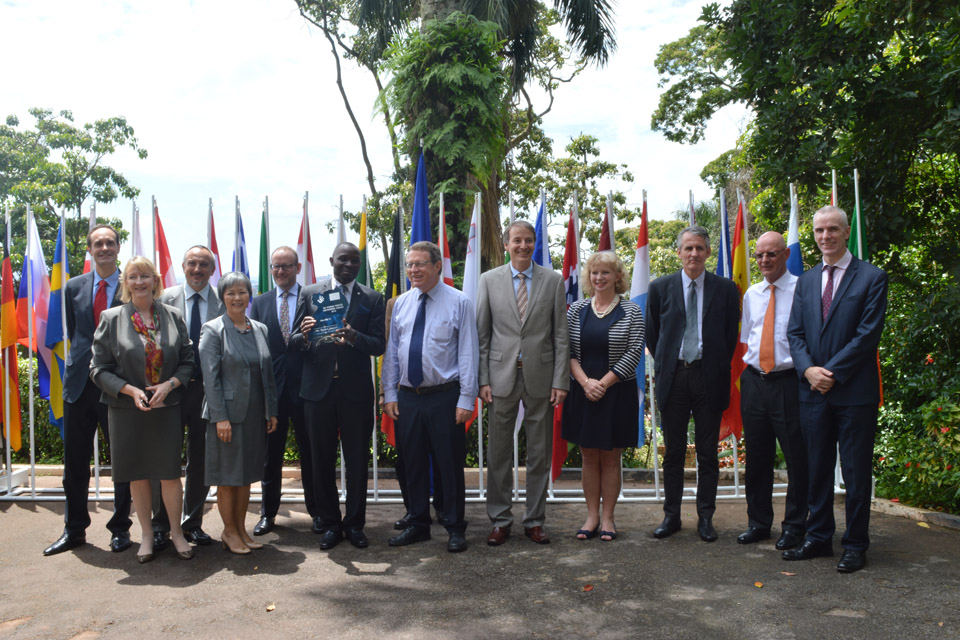
Interesting example of how governments (here the EU) can work together to protect human rights defenders in a specific country (here Uganda). Since a few years there is an annual EU HRD Award to recognise and honour the achievements of an individual Human Rights Defender active in Uganda.

Source: 2017 EU Human Rights Defenders Award: Call for nominations – GOV.UK

Sir Nigel Rodley – a giant human rights scholar – passed away

January 26, 2017

It is with great sadness that I learnt of the death of my old friend Nigel Rodley at the age of 75. From 1973 to 1990, he was the first Legal Adviser of Amnesty International (I was Executive Secretary of the International Commission of Jurists in Geneva at the time) and in that capacity we met often and worked together on many projects, in particular the coming about of the International Convention Against Torture. Nigel went on to become the United Nations’ Special Rapporteur on Torture, President of the International Commission of Jurists, Chairman of the UN Human Rights Committee and a long-time professor and Chair of the Human Rights Centre at the University of Essex. We saw each other last year at the anniversary party of our common friend Leah Levin and he was as sharp as ever. Reed Brody on his Facebook page wrote rightly: “Sir Nigel Rodley, one of the legends in the field of international human rights“. We will miss him.

If you would like to see and hear him, go to the minutes 34-48 in the video report of 2016 contained in: https://humanrightsdefenders.blog/2016/02/10/video-to-learn-more-about-the-nels… Read the rest of this entry »

HRW expresses human right concerns to the UK Parliament following Brexit

October 18, 2016

While the majority of NGO interventions indeed concern developing countries, this is a good example of a statement on a western country. In October 2016 Human Rights Watch made the following Submission to the UK Parliament Joint Committee on Human Rights: “The Human Rights Implications of Brexit“.    Human Rights Watch is very concerned about human rights developments in the United Kingdom since the referendum vote, and about the risks of a further deterioration of human rights protections as the UK moves towards exiting the EU. Here some excerpts:

Climate of Xenophobia and Hate Crimes

Human Rights Watch is deeply concerned at the current climate of xenophobia in the United Kingdom and increase in hate crimes since the Brexit vote. The climate of xenophobia was evident in the latter stages of the referendum campaign with the killing of the MP Jo Cox and has been acute since the vote…..It is manifest in the increase in hate crimes reported to police, including those expressing hostile sentiment or carrying out hostile acts towards EU citizens, among them assaults and arson attacks. There was a 60 percent increase in hate crimes after the referendum compared to the same period a year before, according to the National Council of Police Chiefs. By August, the number of incidents had decreased but was still 14 percent higher than the same period a year before. The killing of Arek Jóźwik in Harlow in September is being investigated as a possible hate crime.

..  The UN CERD committee recommended in August that UK “public officials not only refrain from such [hate] speech but also formally reject hate speech and condemn the hateful ideas expressed so as to promote a culture of tolerance and respect”.

…We welcome the commitment in the government’s new action plan on hate crimes to prevent them “by challenging the beliefs and attitudes that can underlie such crimes.” This philosophy needs to be applied to the government’s own policy proposals and the rhetoric of government ministers.

Risk to Family Life 

Human Rights Watch welcomes recent media reports suggesting that the government is committed to allowing all EU citizens residing in the UK to remain after Brexit. This is consistent with the duty of the government to uphold its obligations to protect the right to family life. The government should now confirm without delay that this is the case, and make clear that such rights will not depend on reciprocity for UK citizens living in other EU member states…

Risk to Human Rights Protected by EU Law

EU law protects critical areas of rights affecting millions of people in the United Kingdom. ….

It is of significant concern that these rights have received very little attention during and since the campaign and in particular in discussions concerning the form of Brexit. The UK’s departure from the European Union and the jurisdiction of the EU Court of Justice could remove crucial human rights protections. It would be the first time that a significant international legal framework to protect rights, which binds the UK government and parliament, was removed from UK citizens and residents.

There is a risk that the UK government could seek to weaken the anti-discrimination and employment rights protection in UK law that arise from EU legislation. While many EU law protections would remain binding during any transitional or permanent arrangement involving EEA status, if the UK cuts itself off entirely from the EU, including from jurisdiction of the EU Court of Justice, there would be scope for the government to adopt laws that weaken those protections, subject to parliamentary approval and to the extent permissible under other UK human rights obligations, including the Human Rights Act.

It is important that the committee and parliament as a whole is vigilant about this risk, particularly in relation to weakening of employment rights protections. The UK should also look to strengthen its commitments in related areas in other international mechanisms, in particular by ratifying Protocol No. 12 to the European Convention on Human Rights, which would directly strengthen anti-discrimination protections in domestic law.  

Risks to UK Participation in the Council of Europe

Human Rights Watch is concerned that the hostility to supranational oversight that drove much of the support for Brexit could lead to renewed calls for the UK to withdraw from the Council of Europe. We recognize that the Prime Minister has stepped away from her call during the referendum campaign for the UK to leave the Council of Europe, and welcome the decision by UK to seek to renew its membership of the UN Human Rights Council. Set against that is the ongoing climate of hostility towards human rights in some sections of the media and parts of the government, and the manifesto commitment by the government to replace the Human Rights Act with a British bill of rights that would give the Supreme Court, rather than European Court of Human Rights, final interpretation over violations. Leaving the Council of Europe would significantly weaken human rights protection in the UK, removing a key safeguard, in the form of the European Court of Human Rights. It could weaken the court and Council of Europe system in ways that would harm human rights protection across the Council of Europe region.

Source: Submission to the UK Parliament Joint Committee on Human Rights | Human Rights Watch

Translating Russia’s human rights defenders, UK charity looks for crowdfunding

June 28, 2016

Translating Russia's human rights defenders

Russia’s human rights organizations regularly produce reports about the human rights situation in  their country. Too often these reports are not translated into English because of the cost involved, or because of the difficulty of finding good translators.The project aims to enable the reports published by Russia’s human rights groups to reach a wider, international audience by providing first-rate translations into English. The money donated will be used to pay for the translations, which will be provided at no cost to the authors. The reports in question cover all kinds of human rights issues, including freedom of expression, right of assembly, right of association, the prohibition on torture, liberty and security of person, right to a fair trial, and freedom from discrimination, including on the basis of gender, ethnicity, religion or belief, or sexual orientation. The reports form the basis for the vital work of awareness-raising and advocacy to combat human rights violations in Russia.

Source: Translating Russia’s human rights defenders, a Charities in UK on Crowdfunder

Murdered British MP Jo Cox ‘always fought against the hate that killed her’

June 17, 2016

As you will all have read Jo Cox, Labour MP for Batley and Spen in West Yorkshire, UK, died on Thursday 16 June after she was shot and stabbed in Birstall in her constituency. She had previously spoken out against the “racism and fascism” of Britain First, an anti-Islam Right-wing group. There are strong indications that she was killed by the hate she fought against.[Her attacker is reported to have shouted “put Britain first” at least twice. A 52-year-old man, named locally as Tommy Mair, has been arrested, the BBC has reported.]. She showed that politician can be human rights defenders.

Colleague MP Cat Smith said in the Lancaster Guardian: “Her life was cut short at 41 but she didn’t waste a day of it…To stand up for human rights, the campaign on behalf of Syria and child refugees, and making sure we don’t forget about people who are suffering.”   “Before she became an MP she worked for Oxfam and was passionate about international development and childrens’ human rights in war zones.” “She did a lot of work on human rights in Gaza.” She spoke out in the House of Parliament on several human rights issues.

Her husband Brendan, with whom she had two young children, Cuillin and Lejla, released a statement after her death. He said: “Today is the beginning of a new chapter in our lives. More difficult, more painful, less joyful, less full of love. I and Jo’s friends and family are going to work every moment of our lives to love and nurture our kids and to fight against the hate that killed Jo”

Previously unreleased photo dated 06/06/16 of Labour MP Jo Cox, who died today after being shot and stabbed in the street outside her constituency advice surgery in Birstall, West Yorkshire. PRESS ASSOCIATION Photo. Issue date: Thursday June 16, 2016. See PA story POLICE MP. Photo credit should read: Yui Mok/PA Wire
Previously unreleased photo dated 06/06/16 of Labour MP Jo Cox, who died after being shot and stabbed in Birstall, West Yorkshire. PRESS ASSOCIATION Photo. Issue date: Thursday June 16, 2016. See PA story POLICE MP. Photo credit should read: Yui Mok/PA Wire


Sources:

http://www.telegraph.co.uk/news/2016/06/16/labour-mp-jo-cox-shot-in-leeds-witnesses-report/

Lancaster MP: Jo Cox ‘always fought against the hate that killed her’ – Lancaster Guardian

http://www.theguardian.com/commentisfree/2016/jun/16/the-guardian-view-on-jo-cox-an-attack-on-humanity-idealism-and-democracy

Why ‘lecturing’ China on human rights should be continued

March 30, 2016

German President Joachim Gauck (left) and Chinese President Xi Jinping are shown during the former's recent visit to Chna. Photo: Reuters

German President Joachim Gauck (left) and Chinese President Xi Jinping are shown during the former’s recent visit to China. Photo: Reuters

Stephen Vines published a piece in EJ Insight on 29 March 2016 under the title “Why China acquiesced to German leader’s human rights lecture”. I think it is an excellent read that makes the case for continued ‘human rights interference” in China and not just there. I save you the trouble of finding it by copying it below:

Read the rest of this entry »

Profile of Fahma Mohamed, a young British anti-FGM human rights defender

February 19, 2016

19 year-old British human rights defender, Fahma Mohamed, is committed to freeing the world of female genital mutilation (FGM), starting with her own community in Bristol, UK. From when she first heard about the practice of FGM from a teacher at the age of 14, Fahma Mohamed started to challenge its practice, one that studies estimate affects up to 137,000 women and girls in the UK alone.

‘I remember being in complete shock. I’m from an FGM affected community. Why didn’t anyone talk about it? Why isn’t anyone doing anything to stop it? Then I tried to put myself in their position. I couldn’t.’

Miss Mohamed is trustee of Integrate Bristol, an organization working, among other things, to eradicate FGM. Along with colleagues she spearheaded a petition campaign that collected over 230,000 signatures and earned the support of Malala Yousefzai and UN Secretary General, Ban Ki-Moon. The campaign resulted in mandatory training for all education staff on FGM.

‘We are still fighting for awareness on FGM to be taught in all classrooms across the UK. So many girls, both in the UK and further afar, are going through this absolutely traumatic experience. I saw it as my responsibility to give a voice to these young girls, many of whom have no support system and suffer entirely alone.’

Miss Mohamed identifies as a human rights defender, seeing it as a means to give voice to victims and encourage and empower other women and girls to voice their own opposition to FGM.

‘Many women from my Somali community were once afraid to speak out. Now, they’ve joined our campaign and, most notably, pledged not to put their daughters or their daughters’ daughters through it.’ Fahma is quick to underline the vast difference in her work as a defender and the particularly precarious situation of many defenders elsewhere.

‘For me it’s inspiring to hear people put their lives on the line for freedom. My battles are incomparable to theirs.’

However, Fahma’s FGM campaign has received its fair share of backlash. When Integrate Bristol first started to work on the issue, FGM wasn’t mentioned in the media much. Many voices argued that the problem was being exaggerated. On one occasion a group of 75 men, led by a female councilor in Bristol, protested outside the premiere of their film on FGM, Silent Scream.

‘They protested and chanted against us, we were 14 at the time! Some men even approached the families of the actors in our film, trashing the movie as a “porn film”. They were insisting that our teacher was forcing us.’

Integrate Bristol works to encourage young people to get involved in the fight against FGM. They have produced YouTube films and songs, including ‘Buckle Up’ and ‘Use Your Head’, as means to spread the word. These resources on challenging FGM have been shared with anti-FGM activists in other parts of the world, notably in Africa.

Miss Mohamed welcomes the UN response to FGM, including the first General Assembly resolution on the issue in 2012. As the General Assembly Third Committee continues its negotiations of a new resolution, Ms Mohamed stressed the importance of ensuring an explicit reference to FGM as a human rights violation.

‘Young girls are irreversibly mutilated against their will, and devastated physically, emotionally and mentally. Surely the deprivation of rights over your own body can only be described as a gross violation. Hundreds, maybe even thousands, of girls are being cut right at this moment. If the UN skirts around the issue, or hides behind euphemistic language, how will we help these girls? Or worse, how will we ever eradicate the custom if we can’t even say what it is?’

Miss Mohamed noted that if the UN did characterize FGM as a violation, this would resonate through the world, highlight the severity of FGM and underscore a global condemnation of the practice. She noted in particular that this could push the agenda in schools in countries such as Nigeria and Gambia where FGM is prevalent.

‘With education as our main weapon in this fight, we will end FGM once and for all.’

see also: https://thoolen.wordpress.com/2014/03/29/victims-become-human-rights-defenders-against-female-genital-mutilation/


This profile appeared in the Monitor of the ISHR of 10 November 2014: Fahma Mohamed: British anti-FGM human rights defender | ISHR

On Assange: there is more to the decision than knee-jerk reactions

February 7, 2016

The recent ruling by the UN Working Group on Arbitrary Detention has created quite a storm in and outside the human rights world. At first sight it would indeed seem almost ridiculous to maintain that Julian Assange, who is in ‘sel-imposed’ exile in the Ecuadorian Embassy, is being arbitrary detained. But a bit of reflection (which is not what the UK, Sweden practiced) would in order, especially as the countries involved still have a chance to comment the decision.

The General Council of the US-based NGO Human Rights Watch, Dinah PoKempner, wrote a clarifying piece on 5 February 2016 under the title: “On Assange, Following the Rules or Flouting Them?“. It does certainly help to see the decision in this context, in particular the consideration that Assange (whether one likes it or not) was recognized as a refugee by Ecuador and thus should be free to move.

It should not have been terribly surprising to Sweden or the United Kingdom that the United Nations Working Group on Arbitrary Detention found that the various forms of confinement suffered by WikiLeaks founder Julian Assange violate his human rights. The Working Group has many times warned that it is unlawful to force someone to choose between liberty and a fundamental right, such as asylum, which Assange now enjoys only so long as he stays inside the walls of the Ecuadorean embassy.

What is news are the deplorable rhetorical parries from the UK and Swedish governments, who both stated not just disagreement, but that the Working Group opinion would have absolutely no effect on their actions. This is not what one expects from democratic governments who usually support the UN mechanisms and international law.

“This changes nothing,” declared the UK Foreign & Commonwealth Office. The foreign secretary diplomatically called the ruling “frankly ridiculous,” disparaging the Working Group as “a group of laypeople, not lawyers” (in fact, many of the experts are professors of law or human rights or both – see below). Sweden managed to avoid imprecation, but was no less unreceptive. The Foreign Ministry declared that the Working Group had no right to “interfere in an ongoing case handled by a Swedish public authority” and continued to insist that “Mr. Assange is free to leave the Embassy at any point.” As for the Prosecutor’s Office, it declared the UN body’s opinion “has no formal impact on the ongoing investigation, according to Swedish law.”

While the Working Group does not have the authority to force governments to heed its decisions, it is the authoritative voice of the UN on the issue of arbitrary detention, and its opinions are given great weight as interpretations of binding international law obligations. The Office of the UN High Commissioner for Human Rights today attempted to remind Sweden and the UK of that in a discrete Note to Editors, saying the opinions should be taken into consideration as they are based on international human rights law that binds the relevant states.

Not much consideration appears to be happening. The UK has said that it will arrest Assange if he leaves the shelter of the embassy, either because of the European arrest warrant the Swedish prosecutor issued to investigate allegations of sexual offenses, or because he violated the conditions of his house arrest by going directly from his last UK court appearance to the Ecuadorean embassy in London to apply for asylum.

The Working Group found that Assange’s confinement – first in a UK prison, then under house arrest, and now in the embassy – violated his human rights. Given that Assange has claimed political asylum, a claim Ecuador recognizes but the UK and Sweden have not taken into account, the Working Group said his freedom of movement and security as a refugee should be respected, and compensation awarded.

Both Sweden and the UK are parties to the International Covenant on Civil and Political Rights, the treaty on which much of the decision rests, and are bound by other customary international law against returning refugees to locations where they risk persecution. Their failure to give due consideration to these international rights and obligations is what drove the conclusion that Assange’s confinement is “arbitrary.”

Let’s be clear: the issue is not Assange fleeing Swedish justice; he has continually expressed his willingness to be investigated by Sweden. What he won’t do is risk eventual extradition to the United States, which would like to prosecute him under the Espionage Act.

That is because WikiLeaks revealed the embarrassing diplomatic cables that Chelsea Manning leaked. And if you look at Manning’s fate, Assange has plenty to fear. Manning was abused in pretrial detention, denied the defense that the public interest justified her disclosures, and sentenced to 35 years. A secret US grand jury has been investigatingAssange on related Espionage Act charges for close to five years. Neither Sweden nor the UK will promise Assange he won’t be extradited, and both are close US allies in national security and intelligence affairs.

So who are the losers? Assange, who has already been confined longer than the maximum term he would serve in a Swedish prison were he found guilty, and the Swedish women who made the original allegations, and whose government won’t pursue the matter if it means protecting Assange from extradition to the US.

And now the UK and Sweden are big losers as well. Their fatuous dismissal of the Working Group won’t impugn this necessary and neutral body that was established by the world’s governments to uphold rights. But both have severely damaged their own reputation for being so ready to dismiss upholding inconvenient human rights obligations and their credibility as global advocates for rights by refusing to respect the institution of asylum.

Source: On Assange, Following the Rules or Flouting Them? | Human Rights Watch

http://www.thejakartapost.com/news/2016/02/06/un-arbitrary-detention-panel-opinionated-toothless.html

Shami Chakrabarti, outgoing Liberty Director, speaks in front of Scottish audience

January 25, 2016

The well-known human rights defender Shami Chakrabarti is leaving her job as Director of Liberty and the NGO Justice Scotland organized a public event in there honor at the Faculty of Advocates’ Laigh Hall with an open and informative discussion ranging from the ISIS threat to authoritarian politics and defending the Human Rights Act. The event, the second in the JUSTICE Scotland “Beyond Law” series hosted by the Faculty, was praised by Lord Hodge, the UK Supreme Court Justice, who is chairing the series. “What a treat,” he stated, describing Ms Chakrabarti as a “very articulate and humane voice for libertarian views.”

Ms Chakrabarti herself was delighted to have taken part. She said: “I really enjoyed it. I thought the contributions from the floor in particular showed what a thoughtful bunch of lawyers you have here, and how concerned they are, not only about the law but the way it shapes the kind of society we want to live in.”

Ms Chakrabarti recalled how she had caused alarm among family and friends when, after joining the English bar, she took a post in the Home Office, others not seeing her as a likely candidate for the civil service. And when she then left to become in-house counsel at Liberty, there was more consternation.

After a mere one day of “blue sky thinking” with Liberty the world was changed by the awful events of 9/11. “Of course it was a game changer but I don’t think it was the beginning of our authoritarian politics. That had started earlier – attacks on judges, lawyers, legal aid, migrants. In our age, governments can feel quite powerless because the challenges are global and are not going to be solved by one government or another, yet senior politicians have to be seen to be doing something,” she suggested.

.. All around the world, she added, attacks were being made on human rights defenders. “It is happening in our country, and we cannot let it continue,” she said. “I think we have to defend the Human Rights Act and the ECHR, otherwise we are going in completely the wrong direction.”

Source: Shami Chakrabarti wows audience at JUSTICE event – Scottish Legal News