Posts Tagged ‘Turkey’

Prosecution of human rights defender Öztürk Türkdoğan in Turkey should be dropped

February 23, 2022

All charges against Öztürk Türkdoğan, the co-chair of Turkey’s most prominent human rights organisation and a respected lawyer, should be immediately dropped, Amnesty International said ahead of the start of his trial. Öztürk Türkdoğan, the co-chair of the Human Rights Association (IHD), faces baseless charges of “membership of a terrorist organization”, “insulting a public official” and “insulting the Turkish nation and the Turkish state” for public statements he made in relation to his association’s human rights work.
See also: https://humanrightsdefenders.blog/2021/03/22/turkey-arrests-and-backsliding-on-femicide/.


The prosecution of Öztürk Türkdoğan is an undisguised attack on this one human rights defender and also on all those who speak out for human rights in Turkey,” said Julia Hall, Amnesty International’s Deputy Director for Research for Europe. “With these spurious charges against the co-chair of Turkey’s longest-standing human rights organisation, the prosecuting authorities send a chilling message that increases the climate of intense fear among Turkey’s already beleaguered human rights community.

According to IHD’s records, over 200 separate criminal investigations and prosecutions of IHD members and elected representatives of the organization are ongoing across Turkey.

The criminalization of human rights defenders and of the Human Rights Association are the true insults here. The authorities’ unrelenting attack on Öztürk Türkdoğan and Turkey’s civil society movement has to end,” said Julia Hall. “Turkey must immediately drop all charges against Öztürk Türkdoğan and create an enabling, protective environment for civil society in line with its obligations under international human rights law.”

In December 2021, the Turkish authorities initiated three separate prosecutions against Öztürk Türkdoğan. He was tried under Article 125 of the Turkish Penal Code allegedly for “insulting” a public official in a statement published on the IHD website on 29 June 2018. The first hearing of this prosecution, in which the Minister of Interior is the alleged victim, was held on 18 February 2022. The next hearing will be held on 11 May.

He was also charged with “membership of a terrorist organization” under Article 314/2 of the penal code after the authorities detained him and searched his home on 19 March 2021. During the search, his phone and laptop were confiscated. The first hearing for this case will take place on 22 February 2022.
https://www.amnesty.org/en/latest/news/2022/02/turkey-baseless-prosecution-of-ozturk-turkdogan-an-attack-on-all-those-who-speak-out-for-human-rights/

https://www.arabnews.com/node/2029361/middle-east


Council of Europe starts infringement process against Turkey

February 3, 2022
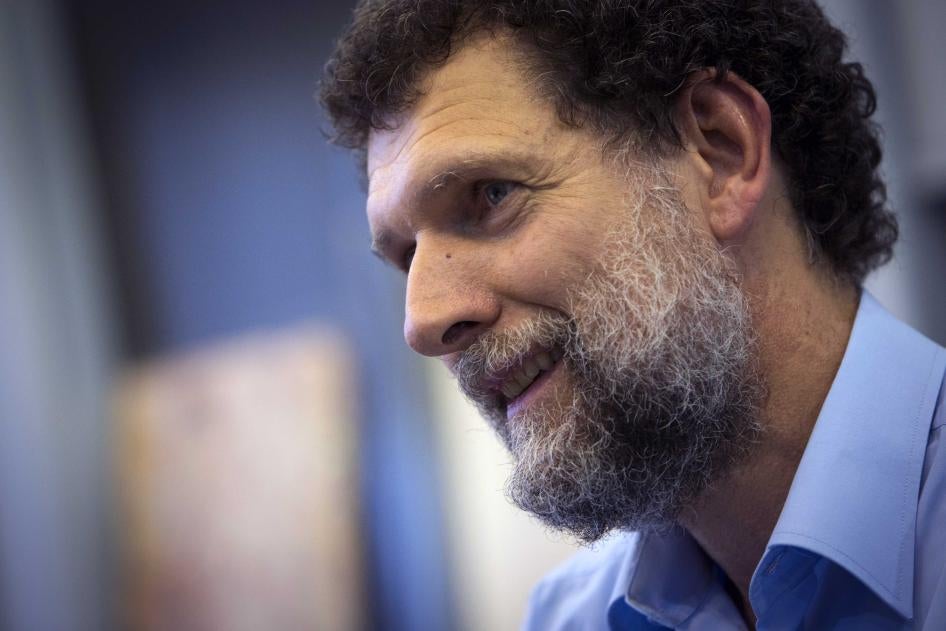
Osman Kavala © 2017 Private

The Council of Europe Committee of Ministers voted on 2 February, 2022 to begin infringement proceedings against Turkey. Human Rights Watch called it an important step to support human rights protection in Turkey and uphold the international human rights framework. The resolution concerns Turkey’s failure over the past two years to comply with the European Court of Human Rights’ judgment in which the Court ruled that Turkey should free human rights defender Osman Kavala and fully restore his rights. See also: https://humanrightsdefenders.blog/2022/01/18/kavala-saga-continues-turkish-court-keeps-philanthropist-in-prison/

The Committee of Ministers’ vote to pursue infringement proceedings against Turkey for its politically motivated, arbitrary detention of human rights defender Osman Kavala shows a resolve to uphold the international human rights law framework on which the Council of Europe is based,” said Aisling Reidy, senior legal adviser at Human Rights Watch. “The resolution sends a reminder to all Council of Europe member states that European Court of Human Rights judgments are binding, and it is an important acknowledgement of Turkey’s rule of law crisis.

The Committee voted to send the case of Kavala v Turkey back to the European Court of Human Rights for a legal opinion on whether Turkey has met its obligations to comply with the judgment. If the European Court confirms – as it is expected to do – that Turkey has failed to implement its judgment, the Committee of Ministers may then take additional measures against Turkey.

These could include ultimately suspending Turkey’s voting rights in the Council of Europe and could even jeopardize Turkey’s membership. Turkey is the second country in Council of Europe history to be subjected to the sanction process for breaching member states’ obligations to implement European Court of Human Rights judgments. (first time was in 2017 against Azerbaijan in the case of Ilgar Mammadov).

The Kavala judgment is legally binding, yet the Turkish authorities have snubbed the Strasbourg court and ignored the decisions of the Committee of Ministers, which represents the Council’s 47 member states, calling for his release and the full restoration of his rights. Ankara has already reacted as expexted: it has accused the Council of Europe of “interfering in an ongoing judicial process

The Turkish courts and prosecutors have engaged in a series of tactics to circumvent the authority of the European Court and the Council of Europe, using domestic court decisions to prolong Kavala’s detention and extend the life of baseless prosecutions. The courts have issued sham release orders, initiated multiple criminal proceedings against Kavala on the same facts, and separated and re-joined case files accusing him of bogus offenses.

In 2021, Turkey merged the proceedings against Kavala with an entirely separate and much older case against football fans and others charged with a demonstration during 2013 protests a few kilometers away from Istanbul’s Gezi Park.

Turkey’s international partners, in particular countries that supported the infringement vote, should make it clear that Turkey’s continued failure to implement the Court’s judgment and to release Osman Kavala would have consequences on their relations with Turkey. In particular, the European Union should tie its proposed “positive agenda” with Turkey to Kavala’s release and make respect for rights a prerequisite for opening talks on the Customs Union modernization that Turkey is seeking.

Turkey knows that the European Court’s judgments are binding but has chosen to defy its obligations and the rule of law,” Reidy said. “Through the infringement proceedings and engagement from other countries, that needs to change, and Turkey should free Osman Kavala immediately and restore all of his rights.

https://www.hrw.org/news/2022/02/02/turkey-council-europe-votes-infringement-process

https://www.hurriyetdailynews.com/turkey-slams-council-of-europe-for-intervening-in-ongoing-kavala-case-171229

Kavala saga continues: Turkish court keeps philanthropist in prison

January 18, 2022

A Turkish court ruled Monday that prominent Turkish civil rights activist and philanthropist Osman Kavala should stay in prison, despite his more than four years in pre-trial detention.
The hearing took place as a Council of Europe deadline that could trigger infringement procedures looms. The European Court of Human Rights ruled in 2019 that Kavala’s rights had been violated and ordered his release. But Turkey has repeatedly refused to do so.
Kavala, who is in Silivri prison on the outskirts of Istanbul, did not participate in the hearing in line with an October statement that he would no longer attend trials via video conference because he didn’t have faith the court would deliver a fair trial.

Kavala, 64, is accused of financing nationwide anti-government protests in 2013, attempting to overthrow the government by helping orchestrate a coup attempt three years later and espionage. He denies the charges, which carry a life sentence without parole.
He was acquitted in February 2020 of charges in connection with the 2013 Gezi Park protests. As supporters awaited his release, Kavala was rearrested on new charges. The acquittal was later overturned and linked to charges relating to the 2016 coup attempt, which the Turkish government blames on the network of US-based Muslim cleric Fethullah Gulen, who denies any ties to the coup.
That trial is now part of a merged case involving 51 other defendants, including fans of the Besiktas soccer club who were acquitted six years ago of charges related to the Gezi protests before that decision also was overturned. Kavala is the only jailed defendant.

His continued imprisonment for 1,539 days is the continuation of lawlessness identified by the European Court of Human Rights,” Bayraktar his lawyer said. “End this lawlessness today so our client gets his freedom.
In October, Kavala’s case also caused a diplomatic crisis between Turkey and 10 Western countries, including the United States, France and Germany, after they called for his release on the fourth anniversary of his imprisonment.
Turkish President Recep Tayyip Erdogan openly disdains Kavala, accusing him of being the “Turkish leg” of billionaire US philanthropist George Soros, whom Erdogan alleges has been behind insurrections in many countries. He threatened to expel Western envoys for meddling in Turkey’s internal affairs.
The European Court of Human Rights’ 2019 decision said Kavala’s imprisonment aimed to silence him and other human rights defenders and wasn’t supported by evidence of an offense.
The Council of Europe, a 47-member bloc that upholds human rights, notified Turkey in December that it intended to refer the case to the court to determine whether Turkey refused to abide by final judgments, which are binding. It called on Turkey to release Kavala immediately and conclude the criminal procedures without delay. It asked Turkey to submit its views by Jan. 19 before a Feb. 2 session of the council.
Kavala is the founder of a non-profit organization, Anadolu Kultur, which focuses on cultural and artistic projects promoting peace and dialogue. https://humanrightsdefenders.blog/2020/09/16/osman-kavala-and-mozn-hassan-receive-2020-international-hrant-dink-award/

The next hearing is scheduled for Feb. 21.

next: https://www.amnesty.org/en/latest/news/2022/03/turkey-osman-kavala-and-co-defendants-must-be-acquitted-of-all-charges/

https://www.arabnews.com/node/2006211/middle-east

https://www.whio.com/news/world/turkish-court-rules/GT56VN3YVPXZYAHFJ6FCKYKRE4/

Franco-German Prize for Human Rights 2021

December 17, 2021

Germany and France honoured this year 15 people who have made outstanding contributions to the protection of human rights, campaigning for causes including women’s rights in Afghanistan, the freedom of the press in South Africa and children who are born as a result of rape in wartime.

On 10 December, international Human Rights Day, Foreign Minister Annalena Baerbock and French Foreign Minister Jean‑Yves Le Drian presented fifteen people with the Franco-German Prize for Human Rights. This award recognises the efforts of all those who work tirelessly every day to advance the causes of human rights and the rule of law. It is presented decentralised by the French and German missions in various locations around the world.

Chang Weiping a Chinese human rights lawyer.

Jake Epelle who works to combat the ongoing stigmatisation and discrimination faced by people with albinism in Nigeria.

Noelah Godfrey Msuya who promotes the rights of children and women in Tanzania.

Monika Borgmann who is a German-Lebanese documentary-maker.

Jacques Letang who is a judge and lawyer in Haiti.

Cristina Palabay from the Philippines who leads the national association Karapatan.

Alexandrine Victoire Saizonou who is an advocate for women’s and children’s rights in Benin.

Ajna Jusic from Bosnia discovered at the age of 15 that she was born as a result of rape during wartime, and since then she has advocated for others in the same situation.

Erika Lorena Aifán Dávila is a judge who has been the target of constant attacks from the authorities of Guatemala.

Nebahat Akkoc is the Managing Director of the NGO Kamer in Turkey.

The Venezuelan Education-Action Program on Human Rights or PROVEA.

Narges Mohammadi who is spokesperson and vice chairman of the Iranian organisation Defenders of Human Rights Center.

May Sabai Phyu is a Kachin activist from Myanmar/Burma.

Shaharzad Akbar is an Afghan human rights defender who campaigns in particular for the rights of women in Afghanistan.

Tabelo Timse is an investigative journalist and a member of an independent non‑profit media centre in South Africa.

https://www.auswaertiges-amt.de/en/aussenpolitik/themen/menschenrechte/franco-german-prize/2501086

“We Will Stop Femicide” winner of gender equality award 2021

November 23, 2021

On 23 November, 2021 urdupoint.com reported that the Turkish human rights Platform “We Will Stop Femicide” has received the international prize for gender equality (IGEP), the Finnish Cabinet said on Monday. For more on this and similar awards, see: https://www.trueheroesfilms.org/thedigest/awards/ef066ac0-e59c-11e7-8845-81361f38ae62

We Will Stop Femicide was founded in 2010 to provide legal help to Turkish women facing abuse at home. It has been chosen as the winner out of about 400 applicants.

We are proud to announce the winner of the #IGEP 2021, WE WILL STOP FEMICIDE PLATFORM, a non-governmental organization that does groundbreaking work combating violence against women in Turkey and whose work has a global relevance. Congratulations!” the award’s organizers posted on Twitter.

The prize was awarded in the Finnish city of Tampere to the founder of the organization, Gulsum Onal, by Finnish Prime Minister Sanna Marin.

“The work of the We Will Stop Femicide Platform includes decision meetings, educational activities, informative seminars, mass protests, and a variety of correspondence meetings. The association seeks to work with provincial and district assemblies to ensure gender equality nationwide in Turkey,” Marin said.

She further stressed the importance of a global effort to end violence against women and called on the international community to ensure protection of women‘s rights in all countries.

Nobel Peace Laureate Nadia Murad also attended the ceremony.

https://www.urdupoint.com/en/world/turkish-human-rights-activists-awarded-finnis-1407890.html

Saturday Mothers charged in Istanbul

August 7, 2021

On 12 July 2021, the case against the 46 human rights defenders and activists, which includes the families of the disappeared and supporters continued at the Istanbul 21st Criminal Court of First Instance. They were charged with violating the Law on Assemblies and Demonstrations for “unarmed participation in an unauthorised assembly and refusal to disperse after warnings” (Article 32 of the Law 2911). The case was filed following the violent arrest of the 46 people and one minor by the police during the 700th gathering of the Saturday Mothers/People on 25 August 2018.

On 18 November 2020, an Istanbul court of first instance filed a lawsuit against 46 people who were arrested on 25 August 2018 during the violent police intervention at the 700th gathering of Saturday Mothers/People in Istanbul’s Galatasaray Square.

On 25 August 2018, police forcibly dispersed the Saturday Mothers’ weekly vigil and detained 47 protesters, including families of the victims of enforced disappearances in the 90s. The detained protesters were released from police custody later that day.

About the situation:

On 12 July 2021, the case against the 46 human rights defenders and activists, which includes the families of the disappeared and supporters of Saturday Mothers/People, continued at the Istanbul 21st Criminal Court of First Instance. They were charged with violating the Law on Assemblies and Demonstrations for “unarmed participation in an unauthorised assembly and refusal to disperse after warnings” (Article 32 of the Law 2911). The case was filed following the violent arrest of the 46 people and one minor by the police during the 700th gathering of the Saturday Mothers/People on 25 August 2018.

On 18 November 2020, an Istanbul court of first instance filed a lawsuit against 46 people who were arrested on 25 August 2018 during the violent police intervention at the 700th gathering of Saturday Mothers/People in Istanbul’s Galatasaray Square.

On 25 August 2018, police forcibly dispersed the Saturday Mothers’ weekly vigil and detained 47 protesters, including families of the victims of enforced disappearances in the 90s. The detained protesters were released from police custody later that day.

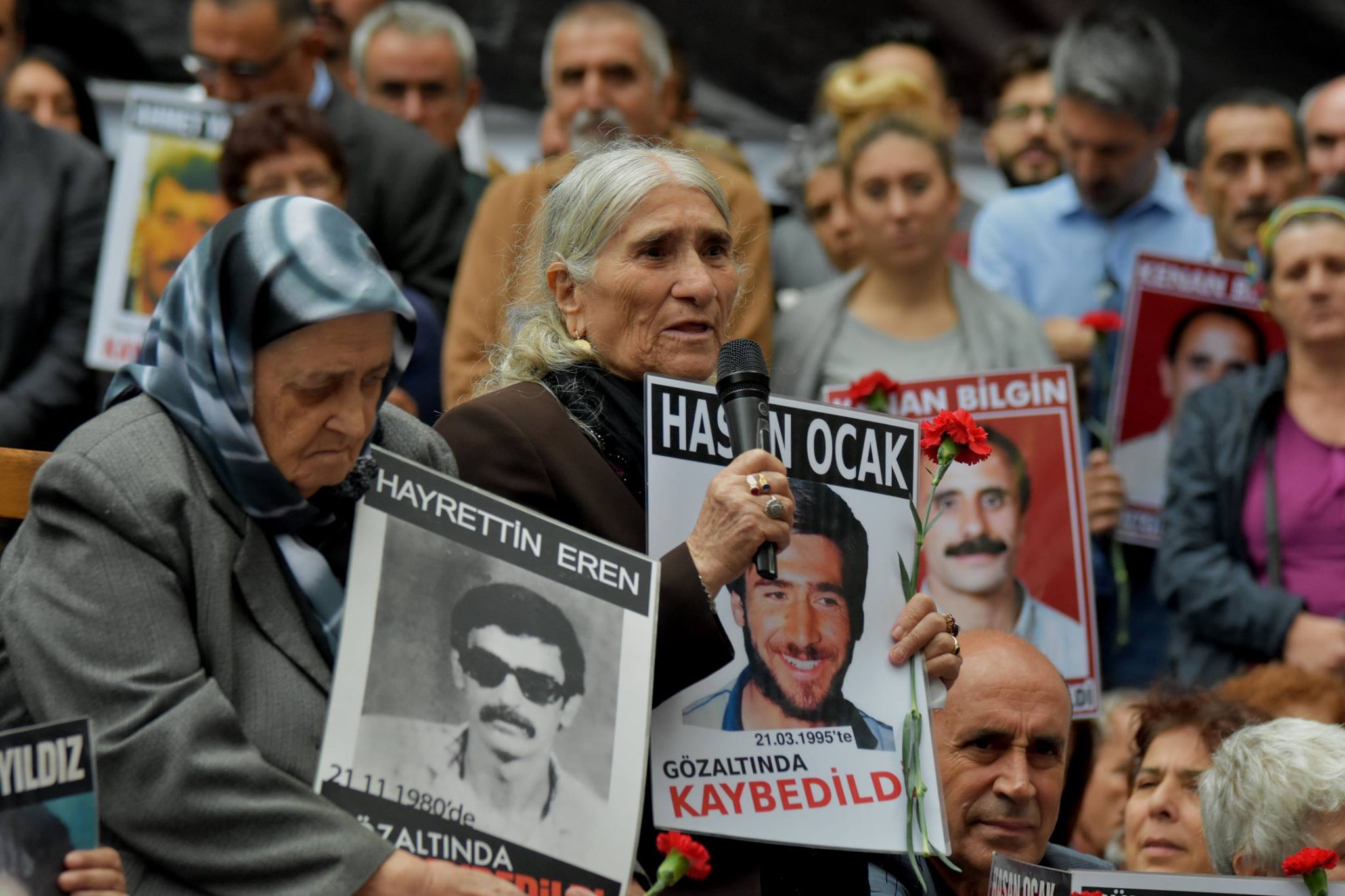
Cumartesi Anneleri/İnsanları: Saturday Mothers/People is a human rights group, comprised of human rights defenders and families of victims of enforced disappearance in Turkey in the 1990s. They began organising weekly vigils at Galatasaray Square after the detention of Hasan Ocak on 21 March 1995 and the subsequent discovery of his tortured body in a common grave. Human rights defenders and the families of the victims gathered in Galatasaray Square for the first time on 27 May 1995, demanding an end to enforced disappearances, seeking information on the whereabouts of those who have disappeared and justice for the victims. See: https://en.wikipedia.org/wiki/Saturday_Mothers

In the meatime in Malta, two Turkish mothers who were jailed and separated from their young sons for using forged passports have been freed as Court overturned their prison sentence. The women, Rabia Yavuz, 27, and Muzekka Deneri, 29, have been fighting to be reunited with their sons – aged two and four – after being sentenced to six months in prison. 

The two women were freed on Friday afternoon after having ear.lier this week filed an appeal against the ‘disproportionate and excessive’ punishment. They admitted to using fake travel documents, saying they could not return to their country because of political persecution. Moreover, the two women, who were separated from their sons, are in the process of applying for asylum.

https://www.frontlinedefenders.org/en/case/saturday-motherspeople-court-second-hearing

https://timesofmalta.com/articles/view/court-to-decide-whether-to-free-turkish-mothers-today.891802

Turkey finally starts paying a prize for its authoritarianism

May 20, 2021

Ahval on 20 May 2021 reports that the European Parliament said the EU’s membership talks with Turkey should be formally suspended unless the country reverses its democratic backsliding.

Parliamentarians said they were alarmed by the “authoritarian nature of the presidential system” in Turkey in a report adopted on Wednesday. The resolution was probably the toughest and most critical yet of Turkey, said rapporteur Nacho Sánchez Amor.

 “It reflects all that has unfortunately happened in the country in the last two years, in particular in the fields of human rights and rule of law, which remain the main concern for the European Parliament, and in its relations towards the EU and its members,” Amor said.

EU institutions should now make any positive agenda on Turkey conditional on democratic reform, he said.

Turkey began membership talks with the EU in October 2005. The negotiations were partly frozen a year later due to Turkey’s refusal to open its ports to ships from the Greek part of Cyprus. The EU informally approved a freeze in the membership process in 2016 citing a deterioration in democracy.

Turkey reacted angrily to the report, saying it was unacceptable in a period when relations with the EU were based on a positive agenda and a membership perspective.

The text contains “false allegations regarding human rights, democracy, the rule of law, our governmental system and political parties; and views Turkey’s effective, solution-oriented, humanitarian and enterprising foreign policy as a threat,” the Turkish Foreign Ministry said in a statement. See also my recent: https://humanrightsdefenders.blog/2021/03/22/turkey-arrests-and-backsliding-on-femicide/

EU lawmakers pointed to a “continued hyper-centralisation of power in the presidency” and called on Turkey’s relevant authorities to release all imprisoned human rights defenders, journalists, lawyers, academics and others, who it said the government had detained on unsubstantiated charges.

Turkey adopted a full presidential system of government at elections in 2018, awarding President Recep Tayyip Erdoğan vast executive powers, including the ability to rule by decree.

MEPS also highlighted Turkey’s “hostile” foreign policy, including towards Greece and Cyprus, and over its involvement in Syria, Libya, and the disputed region of Nagorno-Karabakh, which they said consistently collided with the EU’s priorities.

Lawmakers also urged Turkey to recognise the Armenian Genocide, which they said would pave the way for genuine reconciliation between the Turkish and Armenian people.

https://ahvalnews.com/eu-turkey/eu-parliament-highlights-authoritarianism-turkey-call-halt-talks

Turkey: arrests and backsliding on femicide

March 22, 2021

Living close to Turkey, I follow the situation there perhaps with more worry than others. And nothing good seems to happen:

Turkish police detained three district heads of the pro-Kurdish Peoples’ Democratic Party (HDP) and seven others in Istanbul on Friday over alleged links to militants, police said, two days after a court case began over banning the party.

Separately, Turkey’s Human Rights Association (IHD) co-chairman Ozturk Turkdogan was arrested by police at his home, IHD said, prompting human rights groups to call for his release. Turkdogan was then released on Friday evening, the association said.

Responding to the arrest today of Öztürk Türkdoğan, the president of Turkey’s Human Rights Organisation, Esther Major, Amnesty International’s Senior Research Adviser for Europe, said:

“The detention of Öztürk Türkdoğan is outrageous. With ink barely dry on the Human Rights Action Plan announced by President Erdoğan two weeks ago, his arrest reveals that this document is not worth the paper it is written on.

After over three years in jail without a conviction, one of Turkey’s highest-profile detainees, Osman Kavala, is “not optimistic” that President Tayyip Erdogan’s planned reforms can change a judiciary he says is being used to silence dissidents.
A philanthropist, 63-year-old Kavala told Reuters that after decades of watching Turkey’s judiciary seeking to restrict human rights, it was now engaged in “eliminating” perceived political opponents of Erdogan’s government.
Kavala was providing written responses via his lawyers to Reuters’ questions days after Erdogan outlined a “Human Rights Action Plan” that was said will strengthen rights to a free trial and freedom of expression. See: https://humanrightsdefenders.blog/2020/09/16/osman-kavala-and-mozn-hassan-receive-2020-international-hrant-dink-award/ and

Not surprisingly this is leading to reactions, such as a bipartisan letter penned by 170 members of the US Congress to Secretary of State Antony Blinken, in which the lawmakers have urged President Joe Biden’s administration to consider the “troubling human rights abuses” in Turkey.  “President Recep Tayyip Erdogan and his Justice and Development Party have used their nearly two decades in power to weaken Turkey’s judiciary, install political allies in key military and intelligence positions, crack down on free speech and (the) free press,” the letter said. Dated 26 February but made public on 1 March, the letter asks Washington to formulate its policy regarding Turkey considering human rights, saying that the Erdogan administration has strained the bilateral relationship. 

On top of this Turkey has pulled out of the world’s first binding treaty to prevent and combat violence against women by presidential decree, in the latest victory for conservatives in President Recep Tayyip Erdogan’s ruling party. The 2011 “Istanbul Convention| [SIC], signed by 45 countries and the European Union, requires governments to adopt legislation prosecuting domestic violence and similar abuse as well as marital rape and female genital mutilation. Conservatives had claimed the charter damages family unity, encourages divorce and that its references to equality were being used by the LGBT community to gain broader acceptance in society. The publication of the decree in the official gazette early Saturday sparked anger among rights groups and calls for protests in Istanbul. Women have taken to the streets in cities across Turkey calling on the government to keep to the 2011 Istanbul Convention.

Gokce Gokcen, deputy chairperson of the main opposition CHP party said abandoning the treaty meant “keeping women second class citizens and letting them be killed.” “Despite you and your evil, we will stay alive and bring back the convention,” she said on Twitter. Last year, 300 women were murdered according to the rights group We Will Stop Femicide Platform.
The platform called for a “collective fight against those who dropped the Istanbul convention,” in a message on Twitter.
The Istanbul convention was not signed at your command and it will not leave our lives on your command,” its secretary general Fidan Ataselim tweeted.

Kerem Altiparmak, an academic and lawyer specializing in human rights law, likened the government’s shredding of the convention to the 1980 military coup. “What’s abolished tonight is not only the Istanbul convention but the parliament’s will and legislative power,” he commented.

https://www.arabnews.com/node/1822001/middle-east

https://www.amnesty.org.uk/press-releases/turkey-outrageous-arrest-lawyer-makes-mockery-erdogans-human-rights-reforms

https://www.arabnews.com/node/1828581/middle-east

https://www.usnews.com/news/world/articles/2021-03-19/turkish-police-detain-pro-kurdish-party-officials-anadolu

https://www.arabnews.com/node/1818641/middle-east

https://www.hrw.org/news/2021/03/24/turkey-erdogans-onslaught-rights-and-democracy

Five young women human rights defenders to watch

March 16, 2021

Sarah Noble in Geneva Solutions of 15 March 2021 writes about her encounter with five young women activists from around the world who shared their motivation, their pandemic experiences, and advice for future generations:

On International Women’s Day, I was privileged to moderate the conversation, at an event hosted by the EU mission to the UN in Geneva and UN Women. I came away convinced world leaders could learn a lesson or two. They aren’t waiting to be invited to the decision-making table, and are already driving change in their communities and beyond.

The solidarity among them encapsulates a global movement led by female youth, determined in their fight for gender equality, education, eradicating period poverty, and dealing with climate change.

“We do not have to wait for the adults to start campaigning for the action that we want to see,” said Amy Meek of the UK. Along with her younger sister Ella, Amy, 17, launched an award-winning campaign, now a charity, called Kids Against Plastic. The sisters (see picture) were motivated by realising the devastating impact the misuse of plastic was having on the planet and also its potential legacy for future generations.

“I grew up realising how much girls were taught to be weak, were taught to be submissive while boys are taught to be strong and to be leaders. For me it was really puzzling, ”said Yande Banda, a passionate 17-year-old feminist activist and education advocate from Zambia. Yande is the chairperson of Transform Education, a global youth-led coalition hosted by the UN, where she advocates for a gender transformative approach to education. “I began being an advocate and in particular a feminist, ever since I could realise the consequential inequalities within society – so I would say I was around six years old,” “The fight to end the climate crisis has not stopped for the pandemic and as feminist leaders, neither have we”.

İlayda Eskitaşcioğlu, 28, is a human rights lawyer and a PhD student at Koç University in İstanbul. She founded an NGO, We Need to Talk, in 2016, which aims to fight against period poverty and period stigma in Turkey. “Periods do not stop for pandemics! Neither does the fight for gender equality! We are still breaking taboos, step by step – fathers, brothers, romantic partners, co-workers, teachers, those that are not menstruating, period poverty is your problem too! ” We Need to Talk provides sanitary products to three vulnerable target groups: Seasonal agricultural workers, refugees and pre-teens who are going to school in remote rural areas, and tries to start an honest and open conversation around menstruation in the Middle East.

Lucija Tacer is the current UN youth delegate for Slovenia and an advocate for women’s rights. She has made gender equality the priority in her interventions at the world body. “I entered into a workplace where all of the partners and the high level people are men, except one or two women and 100 percent of the secretaries were female and just being in that environment every day really got me thinking, what is going on here ? ”

Julieta Martinez, 17, from Chile is the founder of the TREMENDAS Collaborative Platform, which promotes the empowerment of girls, and young people by putting their skills and talents at the service of the community.

“Amazingly talented girls are all around the world. We have to continue looking for them. We have to continue giving them a space. And we have to continue this fight to actually get to gender equality… Girls, young women and adolescents have the right to raise their voices, to be heard and to take action for their dignity, their integrity and to be agents of social change in a society where human and youth rights must always be defended. ”

Watch the full event on youtube here.

https://genevasolutions.news/peace-humanitarian/five-young-women-activists-to-watch-a-moderator-s-take

Prominent human rights defender Eren Keskin given six-year jail sentence in Turkey

February 16, 2021

I have been prosecuted many times and jailed for my thoughts. I’m still here. I’m not going anywhere’ – Eren Keskin tweeted after she was sentenced.

Amnesty International has condemned the sentencing of four Turkish human rights defenders on “terrorism-related” in a case involving Özgür Gündem – a daily newspaper that was closed down in 2016. Eren Keskin, a prominent human rights defender and lawyer in Turkey – was sentenced to six years in jail for supposed “membership of an armed terrorist organisation”. See: https://www.trueheroesfilms.org/thedigest/laureates/BFDBB222-0FE0-32BF-ADD6-4D342A315C22

Zana Kaya, the newspaper’s editor-in-chief was sentenced to one year and 13 months in prison for “making propaganda for a terrorist organisation.” Özgür Gündem’s former publisher, Kemal Sancılı and the newspaper’s managing editor İnan Kızılkaya have been sentenced to six years and three months in prison for “being a member of an armed terrorist organisation” – the same sentence as Eren Keskin’s.

All four remain at liberty pending their appeals. This case is latest where anti-terrorism laws used to criminalise legitimate and peaceful activity in Turkey. Milena Buyum, Turkey Campaigner at Amnesty International said: “Today a human rights lawyer who has spoken out against injustice for more than three decades, has become the victim of injustice herself.

Eren Keskin has dedicated her life to defending the rights of women, prisoners and fought for justice for the families of the disappeared. This verdict is yet another shocking example of anti-terrorism laws being used to criminalise legitimate, peaceful activities.See also: https://humanrightsdefenders.blog/2019/05/12/martin-ennals-award-finalist-eren-keskin-honoured-in-ankara/

https://www.amnesty.org.uk/press-releases/turkey-human-rights-lawyer-eren-keskin-given-six-year-jail-sentence-terrorism