Posts Tagged ‘Martin Ennals Award for Human Rights Defenders’

Barbara Hendricks – a human rights defender of a special kind

November 2, 2012

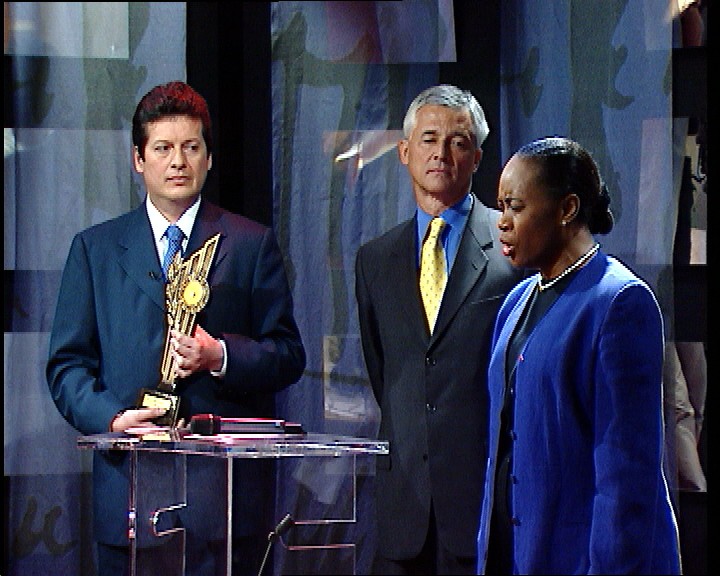
Barbara Hendricks at MEA ceremony 2003 with late Sergio Vieira de Mello and Alirio Uribe Munoz

The trigger to write about this very special person is that she has just been celebrated as UNHCR’s Goodwill ambassador for 25 years.

You are really the princess of the humanitarian and human rights world,” High Commissioner for Refugees António Guterres said at a special UNHCR staff ceremony in Geneva. “The authority of your voice is a precious instrument for our fight,” he added. “Twenty-five years – it’s a long time and the cause of refugees has been a part of my life since my first mission,” said Hendricks, adding that it had been an honour to work for UNHCR. She praised the refugees who inspire her and the UNHCR staff who help them. “Thank you so much. It has been a fantastic journey and I look forward to continuing for as long as I can.

What many people do not know is that Barbara Hendricks has not only been a dedicated and outspoken advocate for refugees for the past 25 years, but also been a strong supporter of other causes including human rights, e.g. as a Patron of the Martin Ennals Award for Human Rights Defenders or in giving her support to creating the True Heroes Foundation, Films for Human Rights Defenders in 2007.

The American-born Swedish citizen was inspired by the struggle for civil rights in the USA as a child and never let off. The human rights world needs celebrities but even more it needs celebrities with real and long-term commitment. This is what makes Barbara Hendricks a Human Rights Defender in her own name! Thanks.

Nobel Prize is for Peace not necessarily Human Rights

October 12, 2012

As this is post number 300 in my blog, I decided to write a more substantive piece and the news of the EU getting the Nobel Peace Prize is an excellent trigger:

The awarding of the 2012 Noble Peace Prize to the European Union has at least made clear that it is really a peace award and not a human rights award as is often assumed. With hindsight, it would have been more appropriate if Alfred Nobel had died on 21 September instead of 10 December 1896. Much later, the United Nations declared 10 December to be International Human Rights Day and designated 21 September as the International Day of Peace. The curious result is that the Nobel Peace Prize – intended for contributions to ‘peace’, not necessarily ‘human rights’ – is given every year in Oslo on 10 December, International Human Rights Day. On quite a few occasions the Peace Prize has been awarded to individuals who can safely be said to belong to the category of human rights defenders (HRDs), but in other cases it was awarded ‘merely’ because they stopped violating human rights (think of Kissinger and Le Duc Tho, Begin and Arafat or de Klerk) or to encourage leaders to continue their conflict resolution work (Obama and now the EU).

Awards for Human Rights Defenders are a different matter!

At the international diplomatic level human rights may nowadays receive a lot of attention in a myriad of procedures and mechanisms, but when it comes to the actual implementation at the grassroots level it is still the dedication of individual human beings that counts most. Fortunately, there are many such persons: some lobbying discreetly for improvements, others demonstrating loudly. However, some have to take tremendous personal risks when publicly challenging the powers that be. These heroes often have to sacrifice more than their time and energy, too many having been arrested, tortured and even killed.

Without the individual human rights defender, the Universal Declaration of Human Rights and other human rights law risks to remain a dead letter. It is for this reason that almost all human rights organisations have some degree of mandate to come to the succour of threatened colleague human rights defenders. Many organisations at both the local and international level have some kind of human rights award. However, ten international human rights organisations, including the most influential, have set their differences aside to join in a common award for such courageous individuals: the Martin Ennals Award for Human Rights Defenders (MEA), which next year exists 20 years.

A pertinent question is whether awards are really effective. To answer that, one has to know in which way human rights awards intend to help human rights defenders. In the first place, almost all awards want to give recognition and encouragement at the moral and psychological level. This goal should not be trivialized, as activists often have to work in environments that are not appreciative of their efforts, and the causes they defend can be unpopular even within their own social circles. Secondly, many awards come with a measure of direct financial support, which can be of great importance as even relatively small amounts go far in cash-strapped organisations, often based in developing countries.

Finally, the most ambitious but also the most elusive goal is to provide protection. The latter is not really possible without a fair degree of publicity. The problem is that much of the publicity generated by human rights awards tends to be in the country where the award is given, while from the protection point of view the most crucial publicity is in the country of the human rights activist in question. The award givers may want to see the name of their organisation or sponsor referred to in the media of their own country (usually in the West), but the recipients of the award are better served by attention and recognition in their own countries, often in the South with a low-level of literacy and limited independent press. Hence the importance of the use of the mass media, in particular radio and television and the internet. The freshly-crowned Nobel laureate, the EU, makes a major contribution to the protection of Human Rights Defenders, including a promise to give every year a reception in honor of the MEA laureate in the country of the winner.

The notoriety of the Nobel Peace Prize gives it great impact and we all would like to emulate it but it does not make it a human rights award. The number of human rights prizes can be  confusing, but individually and collectively they do have the potential to bring human rights defenders ‘from the front line to the front page’. http://www.martinennalsaward.org contains many stories of HRDs and the links to the websites of the 10 NGOs on the Jury give a lot more information.

Martin Ennals Foundation expresses concern regarding Nabeel Rajab’s upcoming trial

October 10, 2012
English: Nabeel Rajab protesting outside Muhar...

Nabeel Rajab May 2011 (Photo credit: Wikipedia)

The Martin Ennals Foundation would like to express its growing concern regarding the upcoming hearing on October 16th concerning the appeal of Nabeel Rajab’s conviction.

Mr. Rajab is appealing a three year sentence handed down by the Bahraini Courts. This sentence is widely viewed as an attempt to block his freedom of expression and prevent him from supporting peaceful protests.

The Bahrain Center for Human Rights was one of three Finalist Nominees for the Martin Ennals Award, which was handed out in Geneva on October 2nd. The Martin Ennals Award is selected by a Jury of ten leading Human Rights organizations and aims to publicize the work and protect a Human Rights Defender. Regrettably, Mr. Rajab was not able to attend the ceremony due to his detention.The Martin Ennals Foundation supports the widespread calls for his release made by many leading Human Rights Organizations including members of our Jury. We urge the Bahraini Courts to release Mr. Rajab.

from : http://www.martinennalsaward.org

CALL FOR NOMINATIONS for THE 2013 MARTIN ENNALS AWARD FOR HUMAN RIGHTS DEFENDERS

October 10, 2012

CALL FOR NOMINATIONS :  THE 2013 MARTIN ENNALS AWARD
FOR HUMAN RIGHTS DEFENDERS (MEA)


The Martin Ennals Foundation invites nominations for its 2013 Award. The deadline is 9th  December 2012. Nominations can be submitted electronically (Eng,Fre,Sp) at http://www.martinennalsaward.org or as printed document addressed to the MEA Secretariat: c/o OMCT, PO Box 21, CH-1211 Geneva 8, Switzerland.  Tel: +4122 8094925   fax: +4122 8094929  e-mail: info@martinennalsaward.org.

The Award is granted annually to an individual, or exceptionally an organisation, in recognition of their commitment and ongoing efforts in the defence and promotion of human rights. Nominees must be currently involved in work for the promotion and protection of human rights. Special account is taken of those who are at risk and have demonstrated an active record of combating human rights violations by courageous and innovative means. The MEA aims to encourage individuals or organisations, particularly those who are working in conditions hostile to fundamental human rights and who are in need of protection.

The present value of the annual Award is 20’000 Swiss Francs, to be used for further work in the field of human rights. The following organisations participate in the Jury that selects the award: Amnesty International, Human Rights Watch, Front Line, Human Rights First, International Federation for Human Rights, the World Organisation Against Torture, International Commission of Jurists, International Service for Human Rights, Diakonie Germany and HURIDOCS. Additionally, the last three nominees receive each from the City of Geneva a travel grant of 5’000 CHF as well as a project in the order of 11’000 CHF.

Past recipients are: 2012 Venerable Luon Sovath (Cambodia); 2011 Kasha Jacqueline Nabagesera (Uganda); 2010 Muhannad Al-Hassani (Syria); 2009 Emad Baghi (Iran); 2008 Mutabar Tadjibaeva (Uzbekistan); 2007 Pierre Claver Mbonimpa (Burundi) and Rajan Hoole and Kopalasingham Sritharan (Sri Lanka); 2006 Akbar Ganji (Iran) and Arnold Tsunga (Zimbabwe); 2005 Aktham Naisse (Syria); 2004 Lida Yusupova (Russia); 2003 Alirio Uribe Muñoz (Colombia); 2002 Jacqueline Moudeina (Chad); 2001 Peace Brigades International; 2000 Immaculée Birhaheka (D.R. Congo); 1999 Natasha Kandic (Yugoslavia); 1998 Eyad Rajab El Sarraj (Palestine); 1997 Samuel Ruiz García (Mexico); 1996 Clement Nwankwo (Nigeria); 1995 Asma Jahangir (Pakistan);  1994 Harry Wu (China).

Martin Ennals (1927-1991) was instrumental to the modern human rights movement. He creatively pursued ideas ahead of his time and was the driving force behind other organisations. His deep desire was to see more cooperation among NGOs.

Venerable LUON SOVATH becomes MEA laureate 2012

October 2, 2012


 The international human rights movement announces the 2012 Martin Ennals Award winner, A Cambodian Monk working to prevent Forced Evictions

 The Jury of the Martin Ennals Award for Human Rights Defenders (MEA), met in Geneva today and selected the Venerable LUON Sovath as the 2012 Martin Ennals Award winner. The Prize winner was announced at a ceremony hosted by the City of Geneva at Victoria Hall.

 The Venerable Luon Sovath, a Buddhist monk from Siem Reap, Cambodia witnessed his family and fellow villagers being forcibly evicted from their homes in 2009.  Since then he has been a strong advocate against forced evictions, which remove families from their homes, often violently and little or no compensation. Despite threats to his person, of arrest and disrobing, the Venerable Sovath, a non-violent Buddhist monk, uses videos, poems and songs to defend the right to housing. His advocacy touches powerful economic interests. The threats against the Venerable Sovath are very real.

Venerable Sovath was selected from among three final Nominees. Also nominated was Nasrin Sotoudeh, an Iranian Lawyer serving a 6 year prison sentence in Iran for her Human Rights work . She is known particularly for her work on behalf of women and children’s rights, especially juveniles facing execution. The third nominee is the Bahrain Center for Human Rights, who report widely on human rights abuses in Bahrain. Many of their key staff are currently imprisoned for their work.

The New Chair of the Martin Ennals Foundation, Micheline Calmy-Rey, the former Swiss President and Foreign Minister said: “This year’s novel  format with three nominees made the Jury’s decision particularly difficult. As a Buddhist monk, Venerable Sovath has managed to raise wider attention to the issue of forced evictions in Cambodia”

 The main award of the human rights movement. The Martin Ennals Award for Human Rights Defenders (MEA) is a unique collaboration among ten of the world’s leading human rights organizations to give protection to human rights defenders worldwide.  The Jury is composed of the following NGOs: Amnesty International, Human Rights Watch, Human Rights First, International Federation for Human Rights, World Organisation Against Torture, Front Line, International Commission of Jurists, German Diakonie, International Service for Human Rights and HURIDOCS.

 Previous laureates : Kasha Jacqueline Nabagesera (2011) Muhannad Al-Hassani, Syria, Emad Baghi, Iran; Mutabar Tadjibaeva, Uzbekistan; Pierre Claver Mbonimpa, Burundi and Rajan Hoole-Kopalasingham Sritharan, Sri Lanka; Akbar Ganji, Iran and Arnold Tsunga, Zimbabwe; Aktham Naisse, Syria; Lida Yusupova, Russia; Alirio Uribe Muñoz, Colombia; Jacqueline Moudeina, Chad; Peace Brigades International; Immaculée Birhaheka, DR Congo; Natasha Kandic, Yugoslavia; Eyad El Sarraj, Palestine; Samuel Ruiz, Mexico; Clement Nwankwo, Nigeria; Asma Jahangir, Pakistan; Harry Wu, China.

 Patrons of the Martin Ennals Award: Asma Jahangir, Barbara Hendricks, José Ramos-Horta, Adama Dieng, Leandro Despouy, Louise Arbour, Robert Fulghum, Irene Khan, Theo van Boven and Werner Lottje†.

For further information visit www.martinennalsaward.org

EMBARGOED until 18:45 Central European (Geneva) Time 2 Oct 2012
 

Who is the laureate of the MEA 2012? – answer tonight at 18h45 in Geneva

October 2, 2012


This morning the Jury of the Martin Ennals Award for human rights Defenders (MEA) came together in Geneva to decide who will ultimately be the Laureate of the MEA 2012. I was there and know the result but it stays under wraps until approximately 18h45 Geneva time when the UN High Commissioner for Human Rights will make the announcement during the ceremony which can be followed live on http://www.martinennalsaward.org as from 18h00.


Ceremony of the Martin Ennals Award to follow on the internet (2 October, 18h00)

September 27, 2012

Every day all over the world, unsung heroes are risking their lives to call attention to injustice and to fight for human rights. On Tuesday October 2nd, one of them will honored with the Martin Ennals Award. The Martin Ennals Award  is chosen by a Jury of ten leading Human Rights organizations including: Amnesty International, Human Rights Watch, Human Rights First and others (see www.martinennalsaward.org). Thus, this prize represents the expression of the whole Human Rights movement.

The winner will be selected from three nominees, who personalize wider issues in their home countries and allow these issues to be represented through individual cases:

  1. Venerable Sovath Luon: sometimes referred to as the “Multimedia Monk”. He challenges the widespread eviction of poor people from land they have long held but without title, often due to the destruction of records during the Khmer Rouge period.
  2. Nasrin Sotoudeh, an Iranian Lawyer serving a 6 year prison sentence in Iran for “… the offences of “acting against the national security”, “propaganda against the regime” and “membership of Human Rights Defenders Centre” – an organisation presided over by the Nobel peace laureate Shirin Ebadi.
  3. Bahrain Center for Human Rights: Currently high on the world media agenda. Two of the main founders: Abdulhadi al-Khawaja and Nabeel Rajab are serving jail sentences. Zainab al-Khawaja was arrested for demonstrating against the government, while other members are regularly arrested and abused.

The ceremony is hosted by the City of Geneva in Victoria Hall. Short films commissioned by the Martin Ennals Foundation. Those who cannot attend in person may want to follow it on the internet (www.martinennalsaward.org) starting at 18h00 Geneva time.

Bahraini Defender Sentenced to Prison for Tearing Picture of King

September 27, 2012

On 26 September Human Rights First (HRF) reports that a Bahraini court sentenced Zainab Al-Khawaja to two months in prison for publicly tearing a picture of Bahraini King Hamad bin Isa Al Khalifa. It notes that the ruling confirms Bahrain’s reputation as a volatile place without due respect for the rule of law.

“The Bahraini regime seems locked into a spiral of imprisoning human rights leaders and it is unable to tolerate freedom of expression. This is not the reform the king promised” said Human Rights First’s Brian Dooley ”

Zainab Al-Khawaja, a well-known activist, is the daughter of prominent Bahraini human rights defender Abdulhadi Al-Khawaja, who is currently serving a life sentence in prison after being arrested, tortured and given an unfair trial in a military court for taking part in the pro-democracy protest. Throughout the uprising in Bahrain, Zainab Al-Khawaja has worked to bring to light abuses committed by the Bahraini regime. Through her blog and twitter account, @angryarabiya, Zainab has urged to world to show its support for the Bahraini people.

“In 18 months, Bahrain has rocketed from obscurity to international fame as a place where doctors were tortured and human rights activists are jailed for peaceful dissent. Zainab’s sentence reinforces this image of a regime addicted to targeting its human rights defenders, and only able to respond to dissent with repression,” Dooley concluded.

Zainab Al-Khawaja’s verdict comes just one day before another prominent human rights leader, Nabeel Rajab, is scheduled to hear the verdict in his appeal of a three-year prison sentence for his part in what the government calls “illegal gatherings.” Rajab is president of the Bahrain Center for Human Rights (BCHR), an organization selected by Human Rights First to receive the 2012 Roger N. Baldwin Medal of Liberty and also one the three nominees for the Martin Ennals Award for Human Rights Defenders 2012 which will be decided on 2 October in Geneva.

Bahraini Defender Sentenced to Prison for Tearing Picture of King | Human Rights First.

Russian Federation: Harassment of human rights defender Ms Sophia Kropotkina | Front Line

September 24, 2012

Front Line reports succinctly on a case in the Russian Federation, where  human rights defender Ms Sophia Kropotkina is being harassed in and outside hospital:

via Russian Federation: Harassment of human rights defender Ms Sophia Kropotkina | Front Line.

NGOs call on Human Rights Council to take UPR recommendations on Bahrain seriously

September 19, 2012

A group of 10 human rights NGOs called during the 21st session of the United Nations Human Rights Council to accept the Universal Periodic Review (UPR) recommendations, to be adopted on 19 September. They urge the international community to call for the unconditional release of human rights defenders linked to the MEA 2012 nominee the Bahrain Centre for Human Rights who are currently jailed in Bahrain:

  • Nabeel Rajab, sentenced on 16 August 2012 to three years’ imprisonment in relation to three cases brought against him for calling for and participating in peaceful gatherings that the government deems “illegal”. His family has reported his ill-treatment in prison, where he is held separately from other political prisoners.
  • Zainab Al-Khawaja, arrested on 2 August 2012 after she staged a one-woman protest calling for the release of her father, Abdulhadi Al-Khawaja. It was her fifth arrest since April 2012. On 4 August, she was accused of tearing a photo of the King at the police station and remains in detention, facing 13 charges in total. She requires medical attention for a broken leg suffered during a demonstration.
  • Abdulhadi Al-Khawaja and Abdul-Jalil Al-Singace, whose life sentences were upheld by the High Criminal Court of Appeal on 4 September 2012 in the high-profile case of 13 political and human rights leaders. Despite allegations of confessions made under torture, the men were among 21 originally sentenced by military court in June 2011 to between two years and life in prison on charges including “setting up terror groups to topple the royal regime and change the constitution.” In the same case, Blogger Ali Abdulemam was sentenced to 15 years in absentia and his whereabouts are unknown.

…….
In November 2011, the Bahrain Independent Commission of Inquiry (BICI), which was mandated by the King to investigate reports of serious human rights violations that occurred since February 2011, released its report. Among the recommendations, the BICI called for the cases of over 300 individuals jailed for peacefully expressing their views to be transferred to civil court, and for an investigation into allegations of torture in detention, which was used to extract confessions. The BICI also recorded a culture of impunity in the deaths of prisoners in custody due to torture, and called for the authorities to hold those responsible accountable. Estimates by the Bahrain Centre for Human Rights (BCHR), of which Nabeel Rajab is President, put the number of political prisoners at 3000 as of today, and rights groups continue to record cases of torture and mistreatment in prison.

The NGOs demand the immediately and unconditionally release Nabeel Rajab, Zainab Al-Khawaja, Abdulhadi Al-Khawaja, Abdul-Jalil Al-Singace and all those jailed for exercising their right to freedom of expression and peaceful assembly, observing due process, as recommended by the BICI;

  • Implement all 176 recommendations in Bahrain’s UPR, including to respect the right to freedom of expression and peaceful assembly, not just 156 of them;
  • Suspend and then revoke the use of penal code articles that violate the right to freedom of expression and peaceful assembly;
  • Comply with the UN Declaration on Human Rights Defenders, adopted by the UN General Assembly in 1998, and international human rights treaties and documents ratified by Bahrain, including the International Covenant on Civil and Political Rights;
  • Guarantee the safety of Bahrainis who attend the UNHRC sessions, ensuring they won’t face reprisals as a result of their participation in the peaceful promotion of human rights protection.

Co-signatories:
(in red the two NGOs members of the MEA Jury)
Bahrain Press Association (BPA)
Bahrain Rehabilitation & Anti Violence Organisation (BRAVO)
Bahrain Youth Society for Human Rights (BYSHR)
CIVICUS: World Alliance for Citizen Participation
Front Line Defenders
Gulf Centre for Human Rights (GCHR)
International Federation for Human Rights (FIDH)
International Media Support (IMS)
Khiam Rehabilitation Centre
No Peace Without Justice